
Course: Introduction to AI & Prompt Engineering | AKTU B.Tech First Year | Semester I & II
Course Codes: AAI101 / AAI201
Streams: CSE, EE, ECE, CE, ME, BT, CH, TX & AG
Unit III Overview
These AI and Prompt Engineering Unit 3 Notes explain systems that produce text, images, code, audio and video. The unit connects their basic working principles with careful student use: supplying suitable inputs, understanding output variation and checking what a generated answer actually establishes.
The coverage includes LLM pre-training, post-training and inference; attention; tokens; context windows; temperature; multimodal systems; diffusion and latent image generation; hallucination; knowledge cutoff; bias; academic integrity and disclosure.
The focus is conceptual. Advanced model training and mathematical derivations are unnecessary for following the explanations. Numerical distributions, context budgets and classroom records are hypothetical teaching examples unless explicitly stated otherwise.
Topics Covered
| Topic | Source PDF Pages |
|---|---|
| Generative AI and output forms | 2–4 |
| Historical anchors and researchers | 5 |
| LLMs, training, inference and attention | 6–10 |
| Tokens and model-processing units | 11 |
| Context window, memory and retrieval | 12–13 |
| Temperature and sampling variation | 14 |
| ChatGPT, Gemini, Claude and Llama | 15–16 |
| Multimodal AI: text, image and voice | 17–18 |
| Image generation, diffusion, editing and demonstration | 19–22 |
| Hallucination, knowledge cutoff and bias | 23–25 |
| Academic integrity, plagiarism and disclosure | 26–27 |
| Classroom activities: inputs and hallucination checks | 28–29 |
| Revision and examination practice | 30 |
Learning Outcomes
- Define generative AI and distinguish generation from classification and retrieval.
- Explain pre-training, post-training and inference conceptually.
- Describe next-token generation and the role of attention.
- Differentiate tokens, parameters and context limits.
- Interpret temperature as a sampling control rather than a truthfulness switch.
- Distinguish model families, assistant applications and the organizations named in the syllabus.
- Explain multimodal inputs and outputs without assuming every interface supports every feature.
- Describe diffusion-based and latent image generation.
- Identify hallucination, cutoff and bias limitations.
- Apply assignment rules, verification and accurate AI-use disclosure.
Included in These Notes
Detailed topic-wise explanations, comparison tables, hypothetical numerical checks, 26 numbered figures and illustrations, image-generation and text-comparison activity plans, source-checking exercises, examination questions, complete explanatory answers and quick revision.
All 26 extracted PNGs use Img numbering that matches the article. Scientist portraits, graphs, generated concept illustrations and vector diagrams are included.
Study Approach
Trace the information. Identify whether an answer uses learned parameters, current context, retrieved material or an external computation.
Separate training from use. Prompting and retrieval can change the available input without updating the model’s weights.
Check the boundaries. A token probability is not automatically factual confidence; a large context is not perfect recall; a generated image is not measured evidence.
Use controlled examples. Keep the task, source and judging criteria fixed when comparing outputs.
Verify before using. Compare claims with sources, recalculate examples and describe assistance honestly under the applicable assignment rules.
Stream and Course Coverage
| Applicable Streams | Semester I Code | Semester II Code | Unit |
|---|---|---|---|
| CSE, EE, ECE, CE, ME, BT, CH, TX and AG | AAI101 | AAI201 | Unit III: Generative AI and Large Language Models |
These AI and Prompt Engineering Unit 3 Notes follow the common unit coverage in the supplied PDF. Visit www.notesgallery.com for additional unit-wise study material.
Essential Vocabulary
| Term | Meaning |
|---|---|
| Generative model | Produces content from learned patterns |
| LLM | Large neural language model |
| Token | Computational unit of a sequence |
| Parameter | Learned numerical value in a model |
| Context window | Bounded working capacity under a model’s accounting rules |
| Multimodal | Works across more than one data form |
| Diffusion | Generation family involving learned denoising |
| Hallucination | Unsupported or incorrect generated content |
| Retrieval | Selecting relevant existing information |
3.1 What Is Generative AI?
Generative Artificial Intelligence refers to AI methods that produce content such as language, images, program code, sound or video from patterns learned during training.
A user can influence the output through instructions, examples and other conditioning information.
A text generator might draft a description of a laboratory experiment. An image generator might create a conceptual view of a campus.
The generated object is a candidate output. It is not automatically a verified fact, an original research result or a construction-ready design.

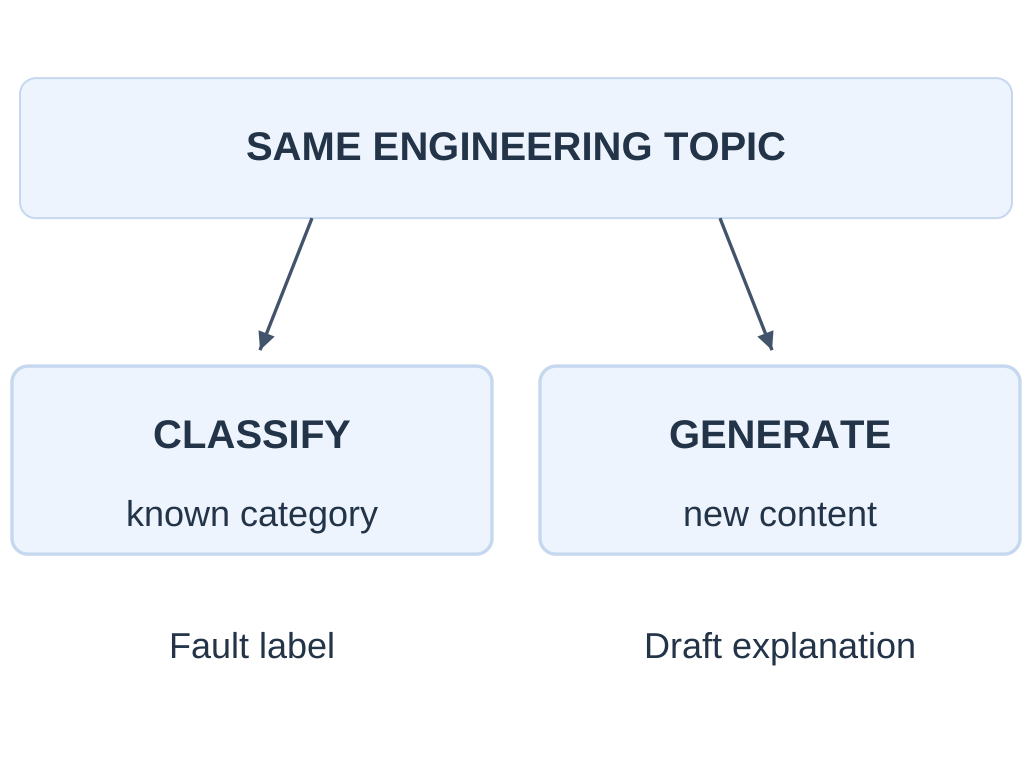
3.1.1 Compare with Classification
A classifier maps an input to a defined category, such as defective or acceptable.
A generator constructs a sequence or another content representation.
A system can combine both capabilities. For example, it can classify a request and then draft an explanation.
“Generative” describes a modelling or output capability. It does not mean that the system has human intentions, creativity in every human sense or permission to reuse any material.
3.1.2 Patterns, Not a Guaranteed Fact Store
During training, parameters are adjusted so that model behavior fits a learning objective.
A trained generator uses those parameters and the current input to produce an output.
It can recombine learned patterns in useful ways and can also reproduce or closely resemble existing material.
The word “new” means an output is being generated for the current request. It does not guarantee novelty, copyright clearance or freedom from memorization.
A generated sentence can be common wording or a mistaken combination of familiar facts.
| Task | Typical Output |
|---|---|
| Classify an email | A known category such as spam |
| Generate an email draft | A sequence of text |
| Predict a measured quantity | A numerical estimate |
| Generate a visual concept | An image |
| Retrieve a document | A selected existing item |
3.1.3 Generation Versus Retrieval
Retrieval selects relevant existing information; generation constructs content.
A search-assisted assistant may retrieve passages and then generate a summary. The retrieved passages and the generated wording are separate objects that can be checked independently.
A response that includes a title or citation is not necessarily a retrieved result.
A model can generate plausible-looking bibliographic text without finding the source. Verify that the document exists and supports the stated claim.
Engineering example
“Classify this surface image” requests a category.
“Write an explanation of possible surface defects” requests text.
“Find the approved inspection procedure” requests retrieval.
One application may combine all three, but their outputs and validation differ.
3.2 What Can Generative Systems Produce?
Generative AI is broader than a chatbot.
Different systems generate different data forms, and a single application can connect several models or tools.
Always specify both the input form and the expected output form.
A text-to-image system consumes a description and produces an image.
Image-to-text interpretation instead consumes an image and produces language.
These opposite directions need not be supported by the same model or product.


| Form | Student Example |
|---|---|
| Text | A draft explanation or comparison |
| Code | A candidate program or test case |
| Image | A visual concept for a presentation |
| Audio | A synthetic spoken explanation |
| Video | A short generated scene sequence |
3.2.1 Text and Code
Language generation can support brainstorming, explanations, summaries and translations.
Check facts, omissions and the match to the requested audience. A shorter summary can accidentally lose a condition that changes the original meaning.
Code generation produces candidate instructions in a programming language.
A syntactically valid program can still have logical mistakes, incorrect assumptions or unsafe handling of data.
Read it, test meaningful cases and understand the result before using it.
3.2.2 Images, Audio and Video
Image generation can create plausible objects and scenes without recording a real event.
Fine details, labels and physical connections can be wrong even when the composition looks convincing.
A concept image should not be presented as an experimental photograph.
Audio generation can synthesize speech or other sounds. It does not prove that a real person spoke those words.
Generated video can produce motion while still having inconsistent objects or physically implausible changes across frames.
| Output | Independent Quality Check |
|---|---|
| Explanation | Compare claims with suitable evidence |
| Program | Inspect logic and run relevant tests |
| Technical illustration | Check components, labels and geometry |
| Synthetic narration | Check script accuracy and pronunciation |
| Video concept | Check continuity and disclose synthetic origin |
A generated graph that looks scientific is not a measurement.
For exact data plots, supply verified data and use a plotting tool.
For a precise engineering diagram, draw from an explicit specification and verify every connection.
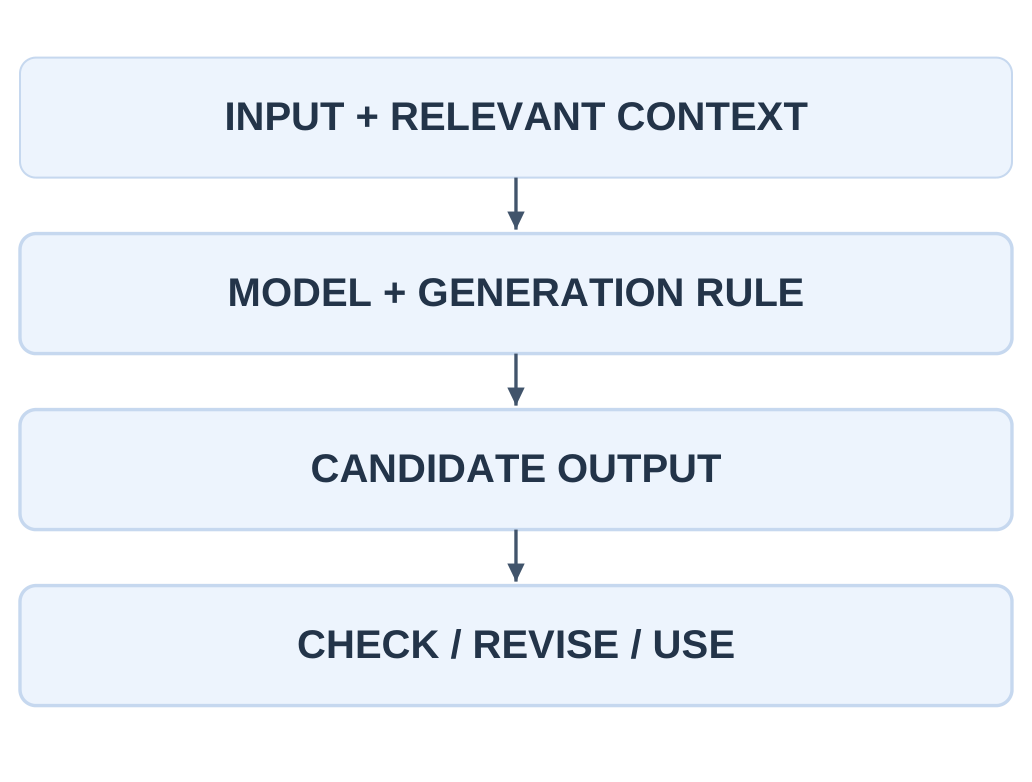
3.3 A Generation Workflow
A practical generation request combines a task, relevant context and an output requirement.
The model and the application’s settings determine how the output is produced.
A person then checks whether the candidate result meets the actual need.
For a simple study explanation, the input could name the topic, audience and required length.
For a document summary, the relevant source text must be supplied or retrieved.
Asking for a summary without providing the document can invite unsupported assumptions.

3.3.1 Conditioning
Conditioning means that generation depends on supplied information.
Text, an image, a partial sequence or a structured requirement can guide the result.
The same model may produce different outputs when the conditioning changes.
Changing the requested audience from a first-year student to a specialist can alter vocabulary and depth without changing the underlying topic.
Changing a supplied source passage can change which facts are available for the answer.
3.3.2 Different Generative Approaches


Autoregressive generation extends a sequence using preceding context.
Many text-generating LLMs follow this pattern. The next output affects the context for later outputs.
Adversarial generation trains a generator alongside a discriminator that distinguishes generated examples from training examples.
This framework is associated with Generative Adversarial Networks, or GANs.
Diffusion generation learns to reverse a noising process through denoising updates.
Text or other conditioning can guide the generated sample. Many image-generation systems use diffusion-related approaches.
3.3.3 Do Not Overgeneralize
Not every generator uses a GAN.
Not every image tool exposes the same settings.
Not every language system has the same training process.
These are conceptual families, not interchangeable product descriptions.
A model is one component of a wider workflow. Data preparation, retrieval, generation controls, a user interface and human verification also affect the result.
3.4 Historical Anchors for Modern GenAI
Generative modelling did not begin with one chatbot release.
Earlier statistical and neural approaches already modelled data distributions and produced samples.
Modern systems combine research progress with larger-scale data, computation and deployment infrastructure.
| Year | Development | Conceptual Importance |
|---|---|---|
| 2014 | GAN framework | Generator–discriminator training became influential |
| 2017 | Transformer paper | Attention-based sequence architecture |
| 2020 | GPT-3 work | Large-scale autoregressive language modelling |
| 2020 | DDPM work | Influential denoising diffusion formulation |
| 2021–22 | Latent diffusion work | Generation in a compressed image representation |
| 2022 | Public ChatGPT introduction | Conversational GenAI reached a broad audience |
3.4.1 What the Milestones Establish
GAN work showed a way to train generative models through an adversarial objective.
The Transformer introduced a sequence architecture centered on attention rather than recurrence.
The original paper studied sequence tasks including translation. Chat assistants add further training and application components.
Diffusion research developed a different route to sample generation.
Latent diffusion shifted a key part of image generation into a compressed representation.
These developments are related parts of a broad field, not one single algorithm evolving under different names.
3.4.2 Researchers and Contributions

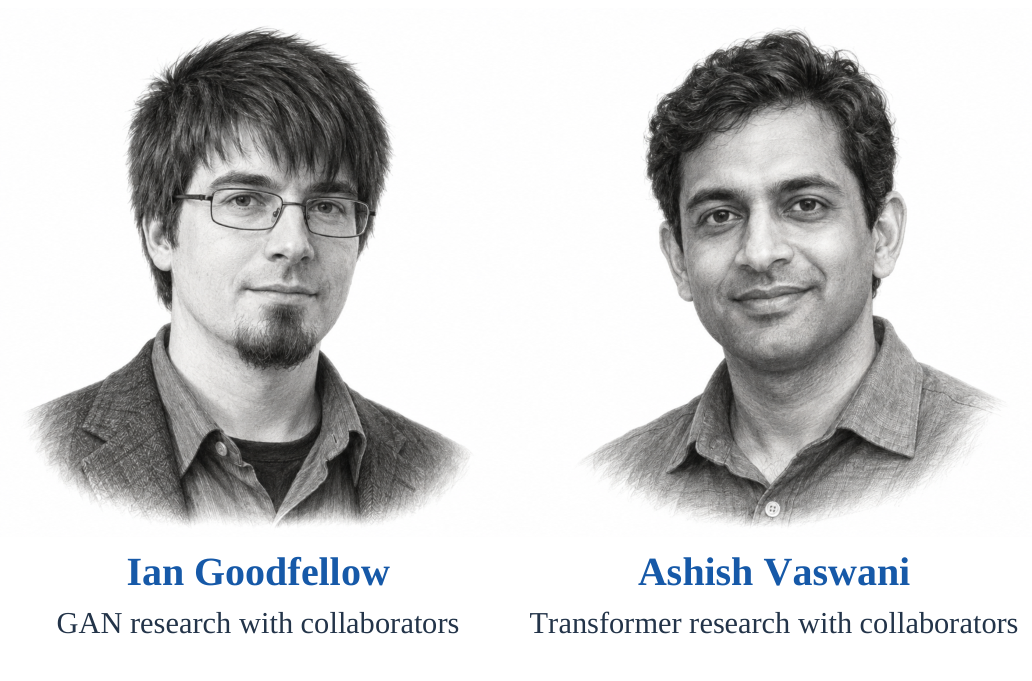
Ian Goodfellow and collaborators introduced the influential GAN framework in 2014.
A generator produces samples while a discriminator supplies a training signal by trying to distinguish generated samples from real training data.
Ashish Vaswani and collaborators introduced the Transformer in the 2017 paper Attention Is All You Need.
Its attention-based design became a major foundation for subsequent language-model development.
Neither portrait represents sole authorship. Both papers had multiple authors and drew on a wider research community.
3.4.3 From Research to Assistants
A research architecture is not yet a complete student assistant.
Training objectives, curated examples, preference learning, evaluation, interface design and optional tools influence the behavior users see.
Remember the idea linked to each milestone.
A date-only history answer is less useful than explaining how that idea changed the possible computation or training process.
Recall link
GAN → competing training roles.
Transformer → attention-based sequence processing.
Diffusion → learned denoising.
LLM assistant → trained language capability plus an application and often further tools.
3.5 Large Language Models
A Large Language Model (LLM) is a neural language model trained at substantial scale to represent and predict patterns in token sequences.
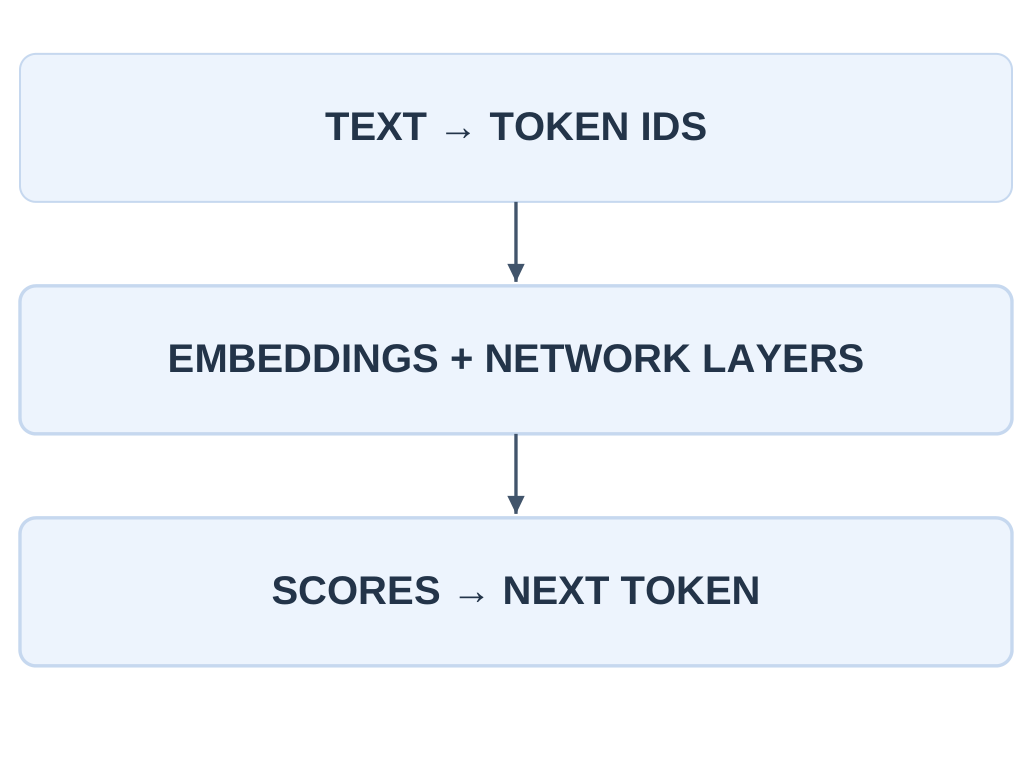
Many generative LLMs produce text by repeatedly predicting a next-token distribution from the available context.
“Large” generally refers to model and training scale rather than one fixed minimum parameter count.
Parameters are learned numerical values.
Tokens are the units processed in a particular input or output.
A large number of tokens in a message does not increase the model’s parameter count.

3.5.1 Learned Language Patterns
Training can support knowledge of grammar, associations, styles, program structure and many task-related patterns.
The resulting model can answer unfamiliar combinations of requests without being explicitly programmed with one response for each question.
However, a text-prediction objective is not a direct test that each generated statement is true.
A plausible continuation can combine entities or numbers incorrectly.
3.5.2 A Model Is Not the Whole Assistant
| Component | Role |
|---|---|
| Base language model | Learned sequence-modelling capability |
| Post-training | Further adaptation of behavior |
| Application | Messages, files and user controls |
| Optional retrieval / tools | Supply information or perform computations |
| Verification | Assess evidence and output quality |
ChatGPT is an assistant application using OpenAI models.
A model family can also be exposed through other applications or developer interfaces.
Some brands refer to both a model family and an assistant, so describe which level is being discussed.
An assistant may access a calculator or retrieve documents when such tools are enabled.
Those actions differ from answering solely from trained parameters.
3.5.3 Capability Versus Reliability
A model can solve many language tasks yet fail on a small arithmetic check or a rare factual detail.
Broad capability does not imply uniform reliability across all topics, languages or conditions.
A useful explanation separates observed performance from speculation about human-like thought.
Describe token prediction, contextual representation and evaluation without assuming consciousness or complete understanding.
Exam definition
Define the model, mention learned parameters and large-scale language training, explain token-based contextual prediction and give one capability plus one limitation.
Do not define an LLM merely as an online chatbot.
3.6 Pre-Training: Broad Pattern Learning
Pre-training adjusts a model on a broad collection of data before later adaptation.
For a typical autoregressive text model, the learning task is to predict subsequent tokens from earlier ones.
The text itself supplies prediction targets, so this is commonly called self-supervised learning.
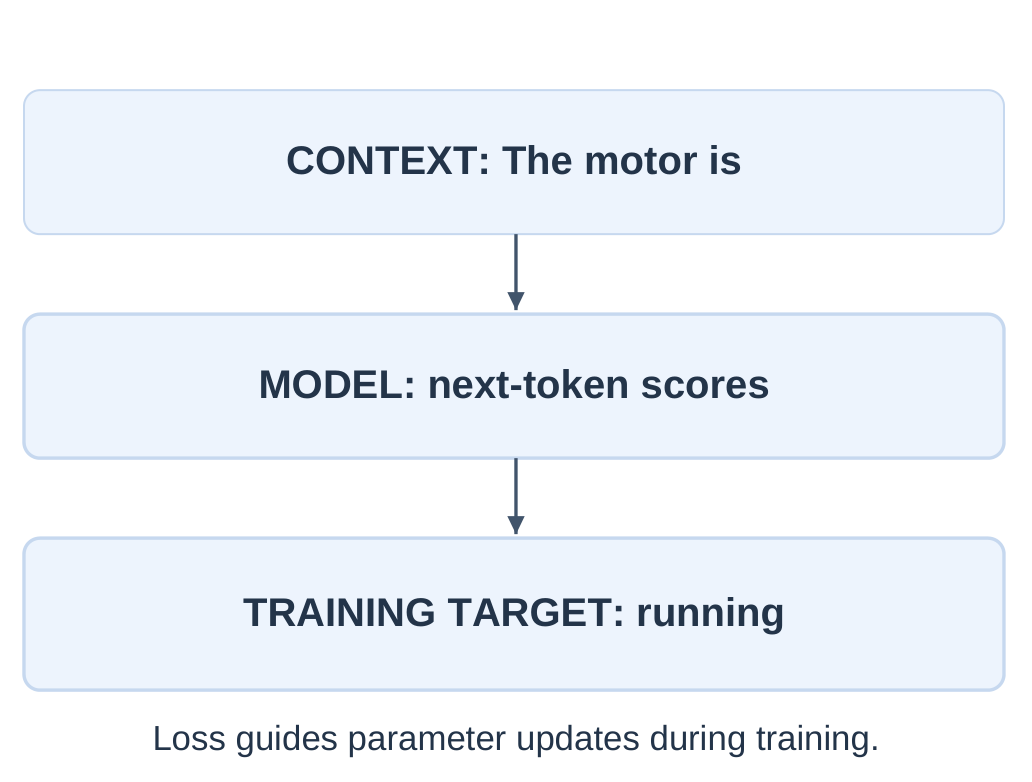
A training example can contain a context ending with “The motor is” and the observed next token corresponding to “running.”
The model produces scores, a loss measures the mismatch with the training target and optimization changes parameters.
This is a conceptual example, not an actual tokenizer trace.

3.6.1 Data Preparation Matters
- Collect data appropriate to the intended training process.
- Remove or manage duplicates and unsuitable records.
- Prepare consistent representations and tokenize sequences.
- Separate evaluation material to reduce leakage.
- Train and evaluate for both capabilities and failure cases.
3.6.2 What the Model May Learn
Predicting language repeatedly can encourage useful internal representations of syntax, common facts and relationships.
It also exposes the model to errors, omissions and unequal coverage in the data.
Scale cannot turn every training statement into verified truth.
A language model stores learned numerical patterns rather than a tidy record with a source citation attached to each generated sentence.
It can sometimes reproduce particular strings, but its ordinary output is not a dependable lookup of a complete indexed textbook.
| Question | Conceptual Answer |
|---|---|
| Are all labels manually written? | Not for ordinary next-token pre-training targets |
| Do weights change? | Yes, during training updates |
| Is every fact verified by the objective? | No |
| Can data quality affect behavior? | Yes |
| Does chatting always repeat pre-training? | No |
3.6.3 Why Compute Is Substantial
Large training runs process many examples through large numerical networks repeatedly.
Matrix operations, parameter storage and intermediate training values require compute and memory.
Accelerators and distributed systems can make this practical at scale.
The first-year distinction is between training cost and using the resulting model.
Inference still requires computation, but it usually does not perform the same weight-update cycle as training.
3.7 Post-Training and Instruction Following
A base model trained to continue text is not automatically a reliable conversational assistant.
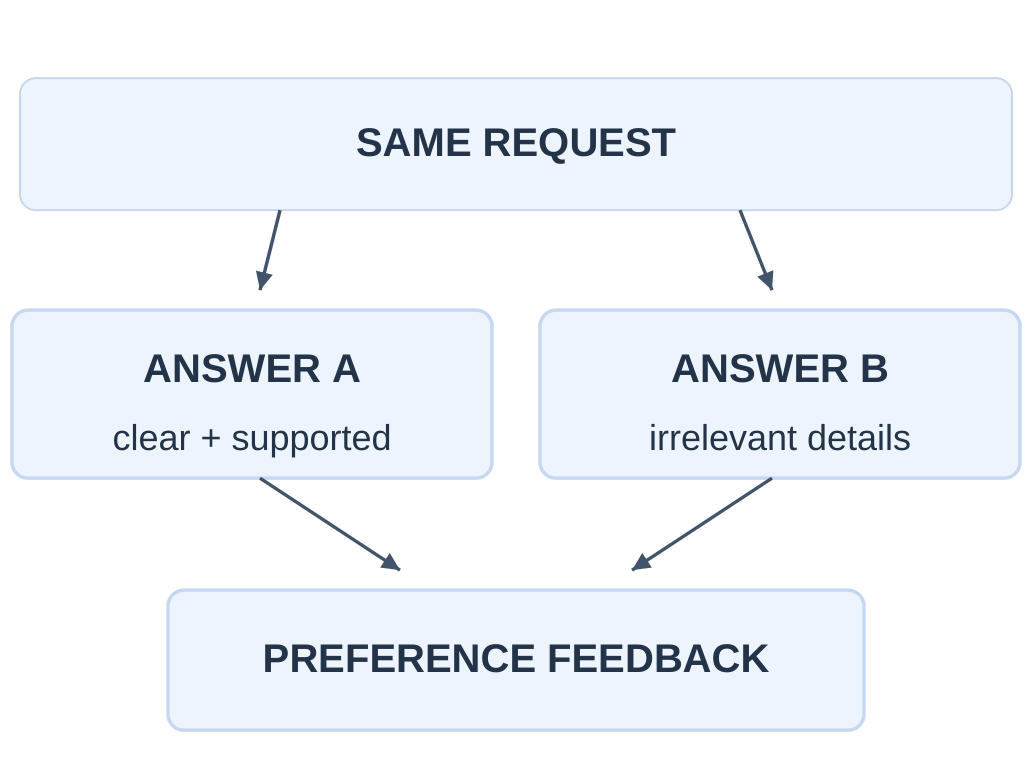
Post-training can adapt its behavior using demonstrations, feedback and other objectives.
Different systems use different combinations of methods.
Supervised instruction tuning uses examples of requests and desired responses.
Preference-based methods use information about which candidate response is preferred under stated criteria.
Some methods involve reinforcement learning. Other preference-optimization approaches do not require the same training loop.

3.7.1 What Changes During Tuning?
Fine-tuning updates model parameters or a trainable subset.
It can change how the model responds to instructions or performs a selected task.
The resulting behavior should be evaluated on suitable held-out examples.
Preference quality matters.
If feedback rewards confident style more than correctness, apparent helpfulness can be misleading.
Feedback and tuning reduce some problems but do not make factual errors impossible.
3.7.2 Training, Prompting and Retrieval
| Process | Primary Change | Weight Update? |
|---|---|---|
| Pre-training | Broad learned capability | Yes |
| Fine-tuning | Adapt learned behavior | Yes, at least some parameters |
| Prompting | Current request / examples | Normally no |
| Retrieval | Information supplied to the request | Not necessarily |
| Inference | Compute an output | Normally no |
Providing three worked examples in a prompt can guide the current answer without retraining the network.
This use of in-context examples differs from adding those examples to a fine-tuning dataset and updating weights.
An assistant remembering a preference through an application feature also does not prove that its base model was fine-tuned on the conversation.
The application can store information and supply it later as context.
3.7.3 A Classroom Analogy with Limits
Broad practice, guided examples and feedback form a useful analogy for pre-training and later adaptation.
The analogy has limits: a model’s numerical optimization is not a human student’s experience.
Ordinary conversation need not trigger a training update.
For an exam, explain the computational distinction first.
Use the analogy only to reinforce why broad sequence modelling and following a user request are related but different goals.
3.8 Inference: Generating a Sequence
In a typical autoregressive LLM, inference begins with tokenized context.
The network produces scores for possible next tokens.
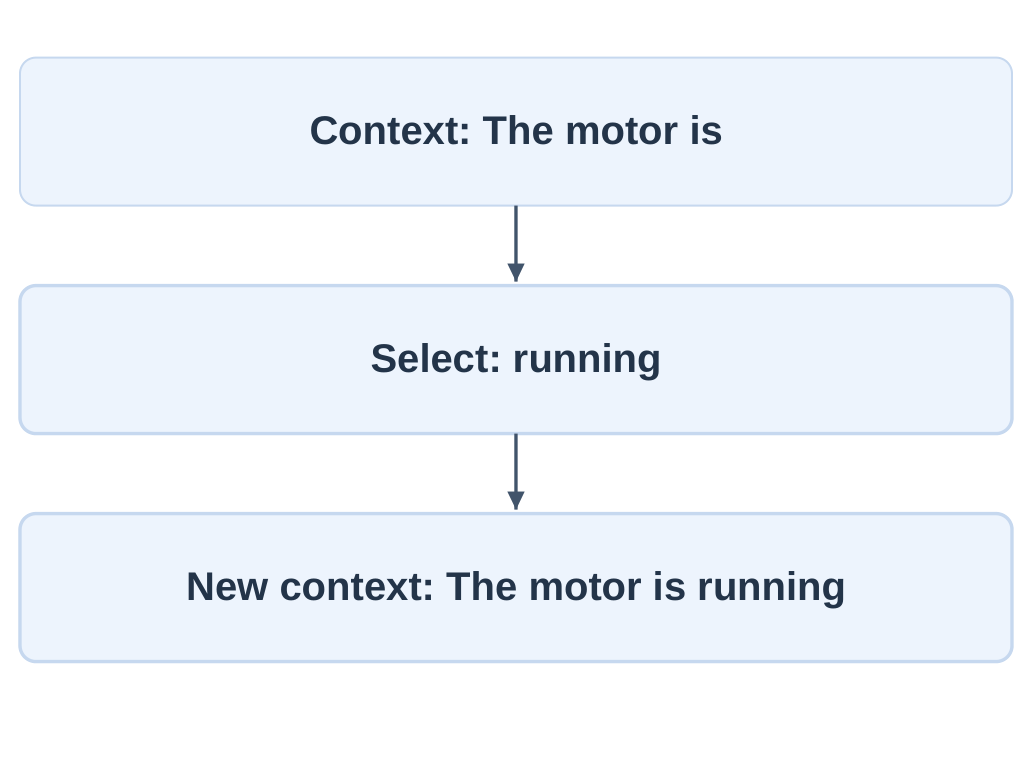
A decoding rule selects a token, that token is added to the sequence and the process continues until a stopping condition is met.
The output is generated incrementally, even when it eventually forms a long answer.
Earlier choices affect later possibilities because they become part of the context.
This helps explain why repeated runs can diverge after an early different selection.

3.8.1 A Toy Probability Table
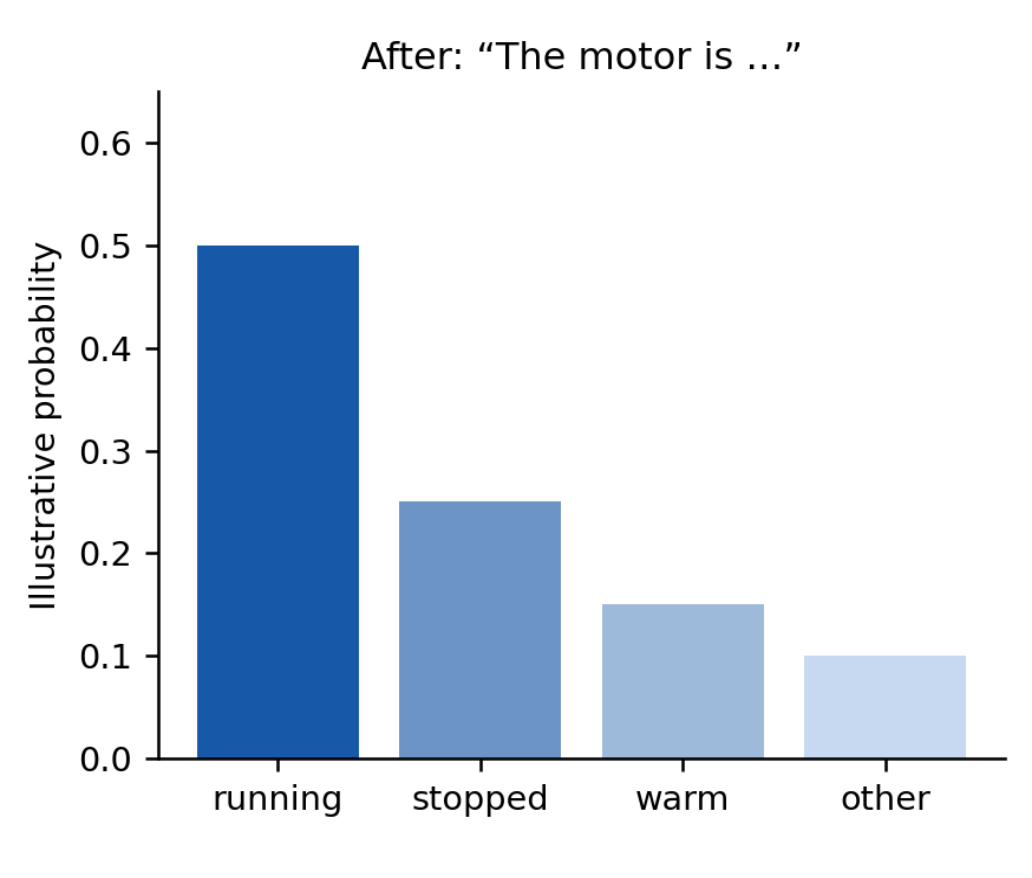
For the context “The motor is …”:
| Candidate | Illustrative Probability |
|---|---|
| running | 0.50 |
| stopped | 0.25 |
| warm | 0.15 |
| all remaining candidates | 0.10 |
The entries sum to one.
They are invented to illustrate a distribution and are not measured outputs from a named model.
Selecting a token differs from asserting that its probability is a factual confidence score.
3.8.2 Selection Changes the Continuation

A maximum-score selection would choose “running” in this example.
Sampling can choose another candidate according to the selected distribution.
With “running” appended, the next step predicts a continuation of a different sequence than it would after “stopped.”
A stop token, configured output limit or application rule can end generation.
Reaching an output limit can truncate an answer before its logical conclusion.
A short answer is not necessarily a deliberate summary.
3.8.3 Why Local Plausibility Is Insufficient
A sequence can be linguistically plausible while containing a wrong date or unsupported number.
Next-token probabilities describe choices under the model, not a guarantee of external truth.
A model can also perform useful structured reasoning or call tools through an application.
Explaining incremental generation does not mean that every task is solved by a simple memorized phrase lookup.
Establishing whether a real motor is running requires relevant observations, such as a sensor reading.
The fluency of the generated sentence is not that observation.
3.9 Transformers and Attention: The Concept
Many LLMs use Transformer-based architectures.
A Transformer processes token representations through layers that include attention operations and other transformations.
Token order or position information is represented so that sequence structure is not lost.
Attention combines information from token representations using learned, context-dependent weights.
This allows a token’s representation to depend on other relevant positions rather than treating each word as isolated.
The weights are computations within a model, not human attention or intention.


3.9.1 Weighted Combination Example
Suppose scalar values associated with motor, is and hot are:
motor = 2
is = 1
hot = 4
The displayed weights are:
0.6, 0.1 and 0.3
Calculation
Combined value = 0.6×2 + 0.1×1 + 0.3×4
Combined value = 1.2 + 0.1 + 1.2
Combined value = 2.5
Actual attention combines vectors and computes weights from learned representations.
This small arithmetic example explains weighted combination without claiming to reproduce a complete Transformer layer.
3.9.2 Context Changes Representation
The word “current” in “electric current” and “current timetable” has different roles.
Context-dependent representations can help a model distinguish such uses.
The ability must still be evaluated on actual tasks and languages.
Multiple attention heads can combine information in different learned ways.
Further layers transform the results.
Individual attention weights should not automatically be treated as a complete explanation of why a final answer was produced.
| Component Idea | Role at Concept Level |
|---|---|
| Token representation | Numerical information associated with a token |
| Position information | Helps represent sequence order |
| Attention | Combines context-dependent information |
| Feedforward transformation | Further transforms representations |
| Output scoring | Supports selection of generated tokens |
3.9.3 Different Architecture Forms
The original Transformer used an encoder–decoder structure.
Encoder-only and decoder-only variants also exist.
Many autoregressive text generators use decoder-style processing with a causal restriction: a generation position cannot use future output tokens that have not yet been produced.
Do not write that every LLM has the identical architecture or parameter count.
“Transformer” names an architectural family.
“LLM” identifies a scale and language-modelling category.
They are related terms, not exact synonyms.
3.10 Tokens: The Units a Model Processes
A token is a unit produced by a tokenizer for model processing.
It can correspond to a whole word, a word part, punctuation, whitespace-related text or another representation unit.
A token is not universally equal to one word or one character.
Tokenization maps input content into a sequence of identifiers from a vocabulary or related encoding.
The network works with numerical representations of these identifiers.
Generated identifiers are converted back into readable text.

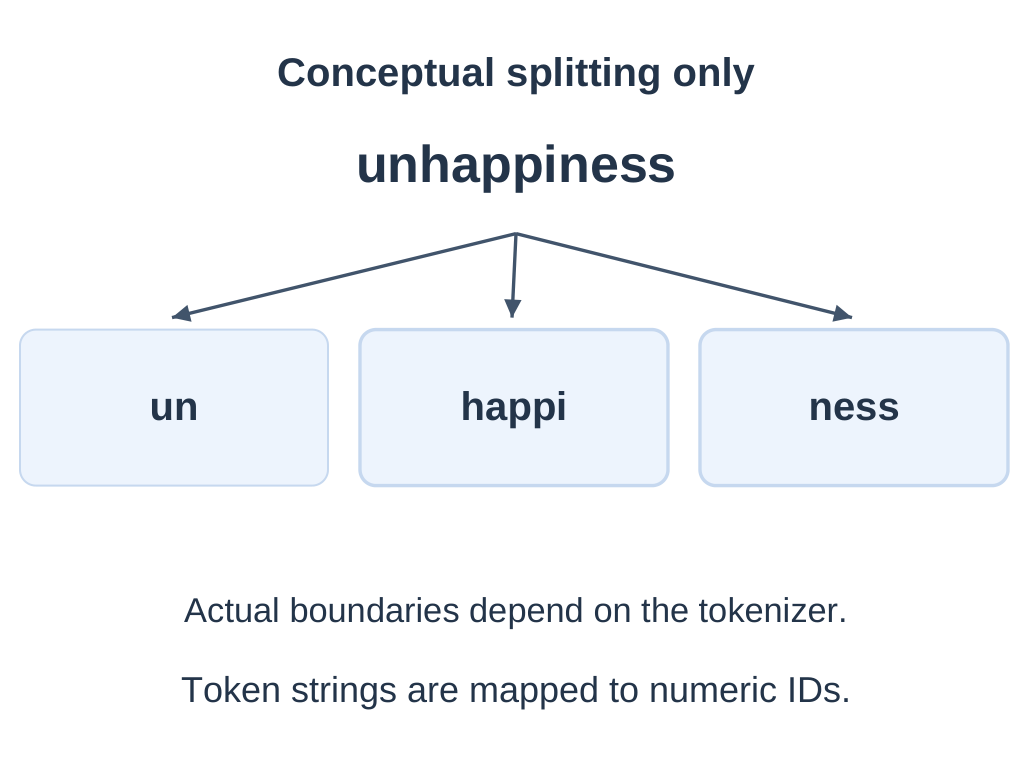
3.10.1 Why Splitting Varies
Common strings may be represented differently from rare spellings.
Languages, scripts, code and formatting can tokenize differently.
A token count estimated from English prose should not be applied as an exact rule to Hindi, mixed-language text or a program.
The toy split “un | happi | ness” demonstrates subword units.
An actual tokenizer may use a different split or a single unit.
Use the selected model’s counting method when an exact budget matters.
3.10.2 Tokens, Words and Parameters
| Term | Counts What? |
|---|---|
| Character | A text element at a chosen encoding level |
| Word | A linguistic / spacing-based unit |
| Token | A model-processing unit |
| Parameter | A learned numerical value in the model |
| Context capacity | How much working content the model can use under its limits |
A twenty-word sentence may use more than twenty tokens, but the exact number depends on the tokenizer and content.
Adding a token to a request uses more working context; it does not add a new trainable weight to the network.
Special message markers and service-managed content can also contribute to accounting.
Non-text inputs may be represented through tokens or related model-specific units.
Counting only visible words can therefore underestimate a request.
3.10.3 Practical Implications
- Long documents need a suitable context budget.
- Repeated irrelevant material consumes useful capacity.
- Output length limits are often expressed in tokens.
- Exact counts depend on the model and request format.
- A text box’s visible length is not an exact token meter.
“One token always equals four characters” is not a valid universal definition.
When preparing a long summary task, remove duplicate boilerplate while retaining qualifications, units and evidence.
Reducing tokens by deleting essential context can make an answer shorter and less correct.
3.11 Context Window: Bounded Working Space
The context window is the bounded amount of sequence information available for a model’s current computation.
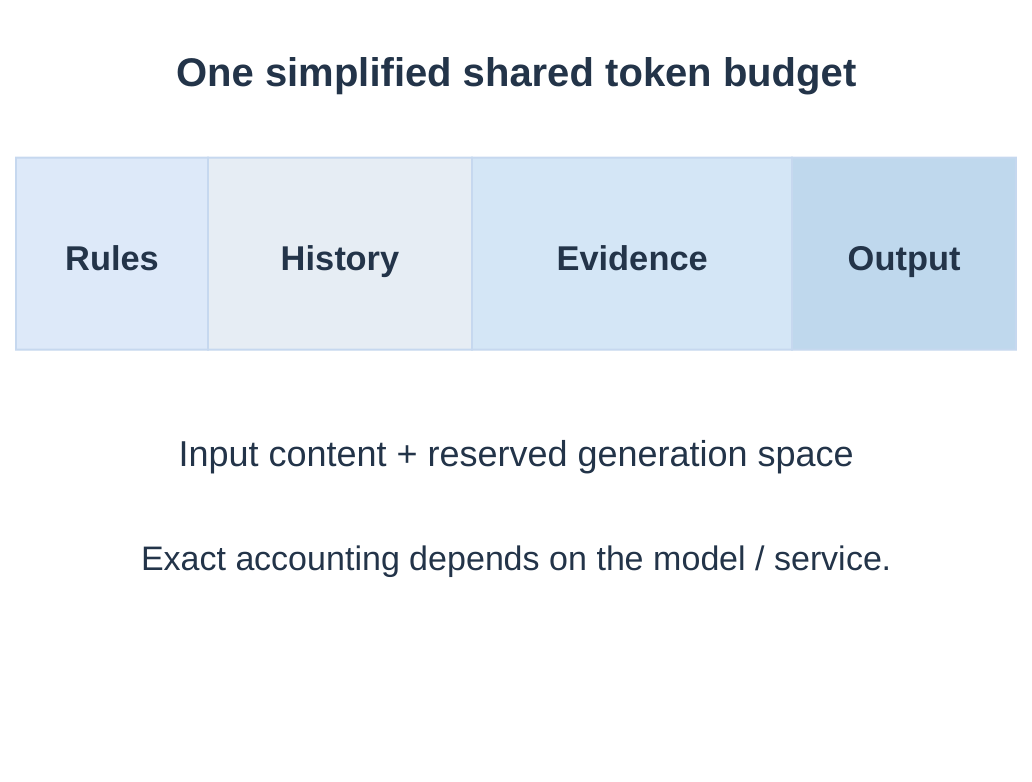
It can include instructions, conversation content, supplied evidence and generated output under the model and service’s accounting rules.
Think of context as working material for a particular request, while remembering that exact input limits, output limits and additional accounting vary.
Some systems also use internal reasoning tokens or other reserved content.
Exact deployment calculations require the actual model’s rules.

3.11.1 Capacity Is Not Perfect Recall
A larger context window allows more material to be included.
It does not guarantee that the model will find every relevant detail, resolve contradictions correctly or use every page equally well.
If a required condition appears once in a long document, ask for evidence tied to that condition.
A model can overlook it even when the document fits within the technical limit.
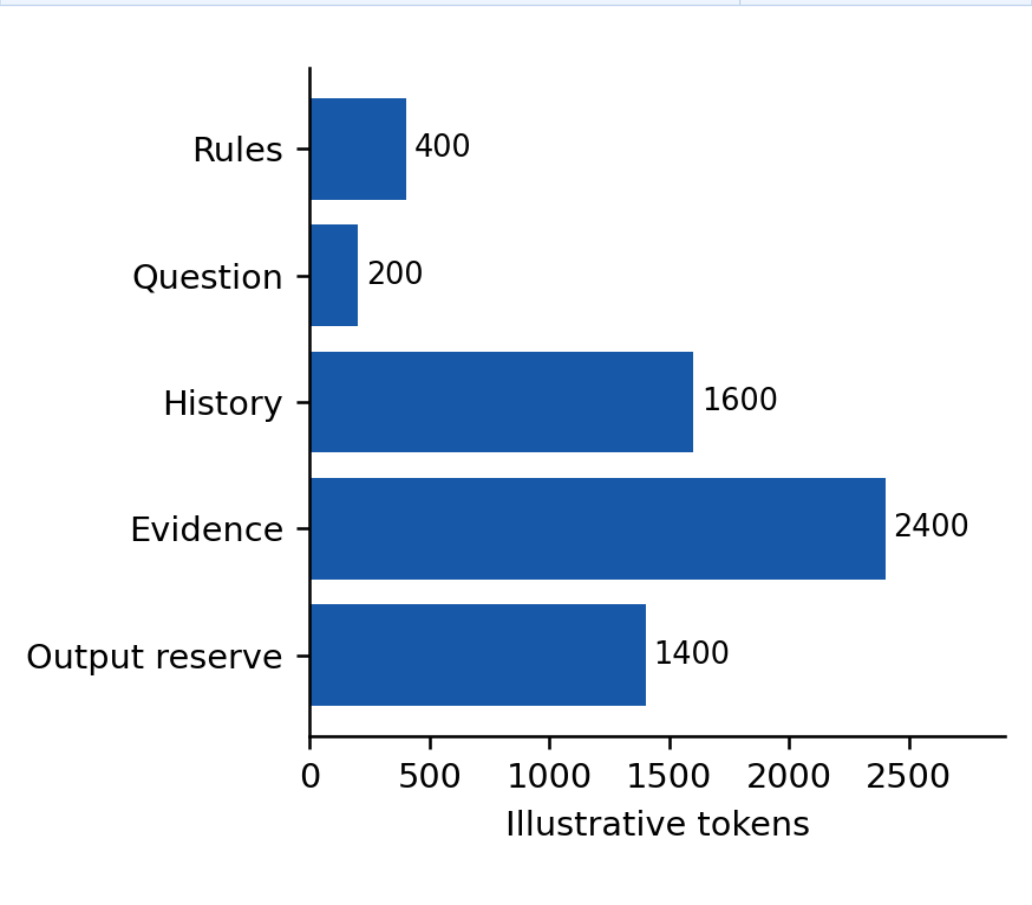
3.11.2 A Hypothetical Budget
| Component | Tokens |
|---|---|
| Application instructions | 400 |
| Current question | 200 |
| Included conversation | 1600 |
| Document excerpts | 2400 |
| Reserved output | 1400 |
| Total planned use | 6000 |
| Hypothetical context capacity | 8000 |
| Remaining margin | 2000 |

Step 1: Add the input components
400 + 200 + 1600 + 2400 = 4600 tokens
Step 2: Add reserved output
4600 + 1400 = 6000 tokens
Step 3: Calculate the remaining margin
8000 − 6000 = 2000 tokens
If a further 2500-token excerpt is added:
6000 + 2500 = 8500 tokens
This exceeds the assumed capacity by:
8500 − 8000 = 500 tokens
Shorten or select material while preserving relevant evidence.
A model may have a separate maximum output limit smaller than its context capacity.
Unused context does not imply permission to generate that entire amount as one answer.
3.12 Context, Memory and Retrieval
Context is material supplied to the current computation.
A saved conversation in an application is a stored record. The whole record is not necessarily included in every later request.
The application may select, summarize or omit parts.
A memory feature can store selected information and supply it later.
This differs from changing model weights.
The precise behavior depends on the application, so do not assume that every assistant remembers the same information indefinitely.
| Information Route | What Is Available? |
|---|---|
| Learned parameters | Patterns acquired during training |
| Current context | Instructions and evidence included now |
| Stored application memory | Selected information the application may supply |
| Retrieved material | Relevant external or stored excerpts fetched for the task |
3.12.1 When Relevant Material Is Omitted
Suppose a long chat once mentioned that a circuit used a 9 V source.
If that detail is no longer supplied to the model, the next answer may not reflect it.
Re-state essential values when continuing a technical task.
An assistant can produce a plausible default instead of noticing that a value is missing.
Ask it to list known values and unresolved assumptions before calculation.
Mentioning a filename is not the same as supplying its contents.
For a faithful summary, the relevant file must be available and the correct pages or excerpts must actually be used.
3.12.2 Retrieval-Augmented Generation

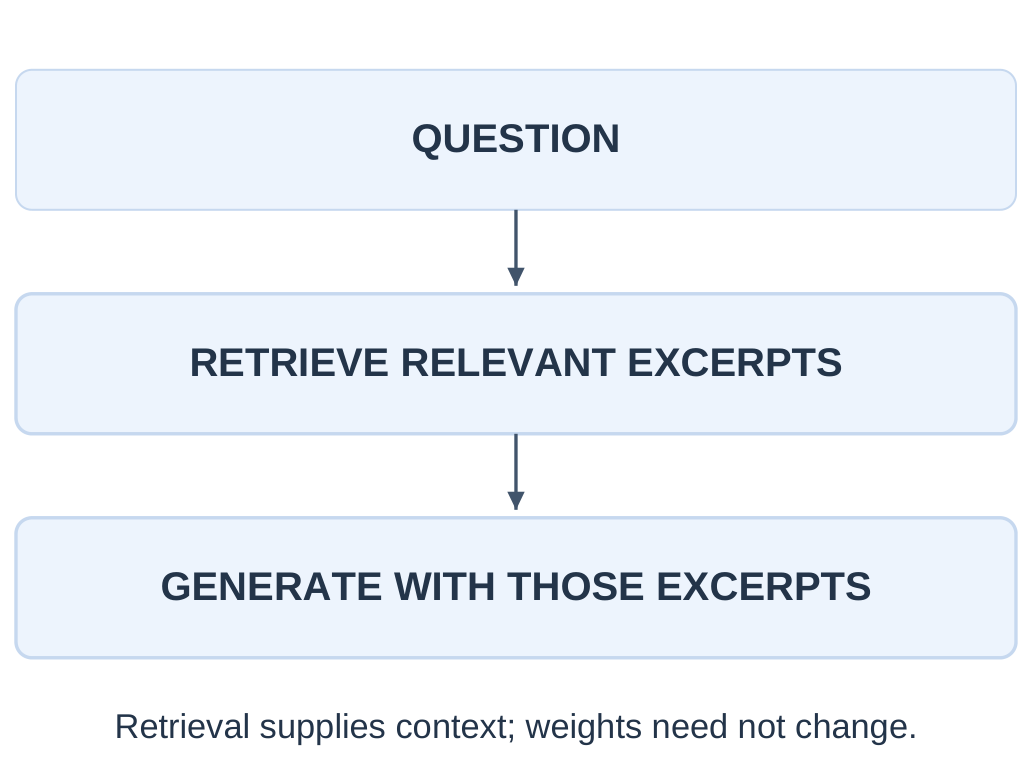
Retrieval-Augmented Generation (RAG) combines finding relevant material with generating an answer conditioned on that material.
The source collection can contain approved notes, manuals or other permitted documents.
The base model need not be retrained for each newly retrieved passage.
Failures can occur when:
- The wrong passage is retrieved.
- Important qualifications are missing.
- The generated response does not follow the passage.
- An authentic document applies to a different course, version or task.
For a notes assistant, a retrieved unit title should match the course and unit being asked about.
A correct paragraph from a different syllabus can still produce the wrong answer to the current request.
Three separate questions
Was the relevant evidence available?
Did the model use it faithfully?
Does the evidence itself justify the claim?
A positive answer to one does not automatically answer the other two.
3.13 Temperature: Controlling Sampling Variation
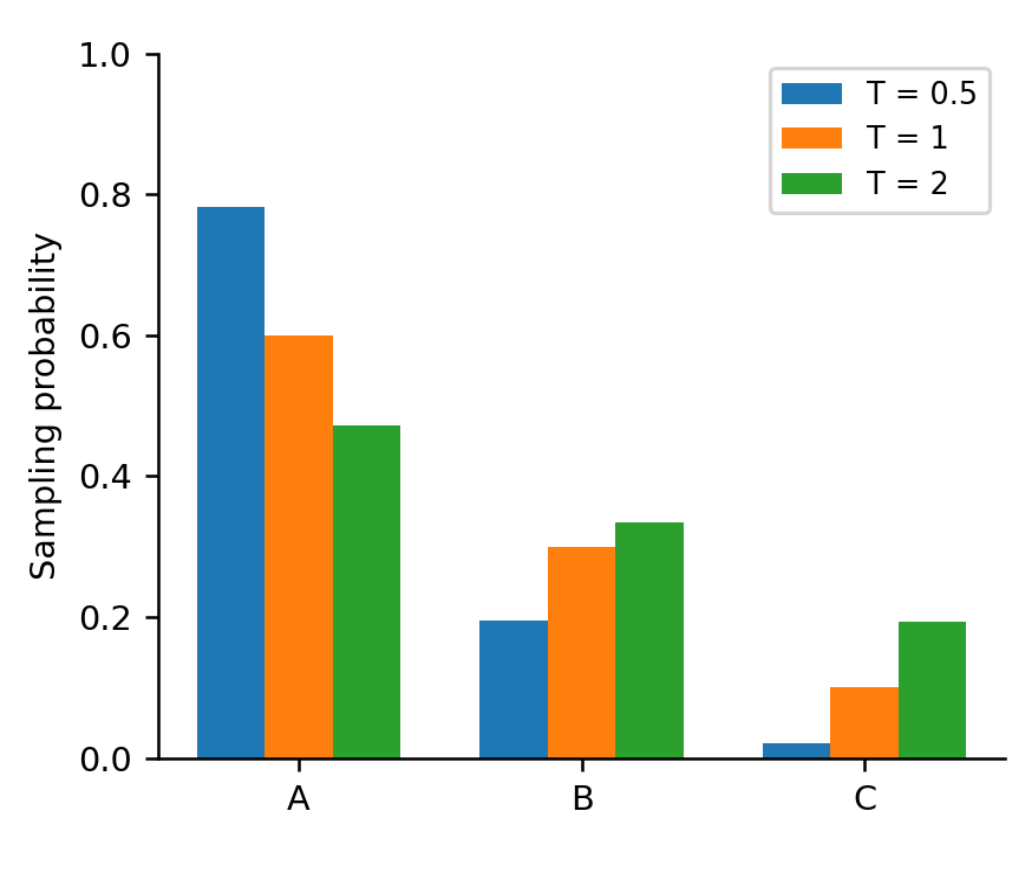
Temperature is a generation setting that can alter the distribution used to sample candidate tokens.
Under the usual temperature-scaling idea, a lower positive value makes the distribution more concentrated and a higher value makes it flatter.
This changes variation among possible continuations.
Temperature does not add knowledge, verify a citation or switch a model from incorrect to correct.
Some interfaces hide this control, restrict it or use different settings for particular models.

3.13.1 Read the Example
At T = 1, the probabilities remain:
0.6, 0.3 and 0.1
At T = 0.5, they become approximately:
0.783, 0.196 and 0.022
At T = 2, they become approximately:
0.473, 0.334 and 0.193
The same three candidates remain in the toy example.
Their relative chances change, while the most probable candidate stays A under positive temperature scaling.
For an existing probability vector p and T > 0, the toy rescaling is:
q_i = p_i^(1/T) / sum_j p_j^(1/T)
This illustrates a usual mathematical idea rather than a product-specific implementation.
3.13.2 A Simple Analogy and Its Limit
Imagine choosing from a list in which one candidate is already favored.
A lower temperature strengthens that preference; a higher temperature gives alternatives a larger chance.
The analogy describes sampling, not a human mood or physical heat.
At very low temperature, output can be more repeatable.
A zero-temperature option often requests a near-greedy or greedy style of selection.
It should not be explained by substituting zero into a formula that divides by temperature.
| Statement | Assessment |
|---|---|
| Lower temperature adds facts | False |
| Higher temperature can increase variation | Generally true under usual sampling |
| Zero temperature guarantees identical results | Not universally; implementation can vary |
| Lower temperature prevents hallucination | False |
| Every chat interface exposes temperature | False |
3.13.3 Choose the Task Before the Setting
Brainstorming may benefit from several varied candidates.
A structured extraction task may benefit from a more constrained generation process and validation.
Both still require checking that the result meets the task.
To study temperature experimentally:
- Keep the model and input fixed.
- Keep other controls fixed.
- Vary only the supported temperature setting.
- Repeat trials.
- Record observed differences.
If the control is unavailable, compare prompt changes instead and do not label that a measured temperature experiment.
3.14 Named LLMs and Assistants in the Syllabus
The syllabus names ChatGPT, Gemini, Claude and Llama to connect concepts with recognizable systems.
These names do not all describe the same layer of a product.
Distinguish the organization, model family, assistant application and access arrangement.
Product versions, limits, availability and pricing change.
Learn the conceptual distinction instead of memorizing an unqualified claim that one brand always has a particular context size or is always free.
| Name | Organization | How to Describe It |
|---|---|---|
| ChatGPT | OpenAI | An assistant application using OpenAI models |
| Gemini | Google / Google DeepMind | A model family and associated assistant experiences |
| Claude | Anthropic | A model family and associated assistant |
| Llama | Meta | A family with released model weights under model-specific terms |
3.14.1 Shared Broad Capabilities
Language systems in these families can support tasks such as drafting, explanation, summarization and coding assistance depending on the model and application.
Supported media, tools and limits differ.
A familiar logo does not reveal whether browsing is enabled, whether a file was read or whether a calculation tool was used.
Check the actual task context and output evidence.
3.14.2 Hosted Access and Released Weights
A hosted assistant runs through a provider’s service or an application connected to it.
The user interacts through messages and enabled tools.
Access to the interface does not provide the trained model’s complete weights.
Released-weight models allow eligible users to obtain parameter files under applicable terms.
Running them still requires suitable software, hardware and understanding of the model’s requirements.
Released weights do not guarantee unrestricted use or zero operating cost.
| Question | Why It Matters |
|---|---|
| Which exact model is used? | Behavior can vary within one brand |
| Which inputs are supported? | Text-only and multimodal tasks differ |
| What tools are enabled? | Retrieval and computation change the workflow |
| What access / licence terms apply? | Release arrangements differ |
| How was quality checked? | A brand name does not validate an answer |
3.14.3 Llama Terminology
The syllabus’s Llama example is useful for discussing model families with released weights.
Model-specific licences and conditions still apply.
Do not equate open weights automatically with every definition of unrestricted open-source software.
For this unit, installing a large model locally or comparing subscription plans is unnecessary.
Explain the conceptual access distinction and the continuing need for evaluation.
3.15 Comparing Model Outputs Fairly
A fair classroom comparison uses the same task and evidence for each candidate system.
Record:
- The model or application label visible at the time.
- The full input.
- Relevant enabled tools.
- The evaluation criteria.
- Differences in access conditions.
Comparing a source-grounded answer in one system with an ungrounded answer in another confuses model behavior with information availability.
Both may use the same brand name while performing different workflows.
3.15.1 A Small Evaluation Task
Supplied source
A lab recorded a motor temperature of 42 C at 10:00 and 46 C at 10:10.
The record does not state the cause of the change or a permitted operating limit.
Request
Summarize the two observations in two sentences.
State the numerical change.
Do not infer a cause or claim that the motor is safe or unsafe.
Supported answer requirements
- Give both temperatures and times.
- Calculate an increase of 4 C.
- State that the cause or operating judgment cannot be established from the supplied record.
- Follow the two-sentence format.
An answer that calls the rise a bearing failure adds unsupported content.
A polished explanation is weaker on this task if it invents a diagnosis or operating limit.
| Criterion | Simple Score |
|---|---|
| Includes both observations | 0 or 1 |
| Calculates +4 C | 0 or 1 |
| Avoids invented cause / limit | 0 or 1 |
| Follows two-sentence format | 0 or 1 |
3.15.2 What a Small Comparison Can Show
If one answer scores four out of four and another scores two, that distinguishes their performance on this constructed task.
It does not establish a universal ranking across engineering, languages, image generation or future model versions.
Repeat meaningful tasks and inspect error types.
A small set can help students learn evaluation, but broad statistical claims require a suitable study design.
| Keep Controlled | Record Explicitly |
|---|---|
| Source material | Exactly what was supplied |
| Task and output requirement | Same input wording |
| Tool access | Whether retrieval / calculator was enabled |
| Generation variation | Repeated trials if feasible |
| Judging rule | Criteria defined before reading answers |
3.15.3 Output Length Is Not Accuracy
A longer answer may contain more unsupported details.
A shorter answer may omit an essential qualification.
Evaluate task completion and correctness together rather than rewarding length automatically.
For an explanation task, assess whether the answer suits a first-year audience.
Correct but unexplained jargon may be unhelpful. Simplified language that changes the concept is also a problem.
3.16 Multimodal AI
Multimodal AI works with more than one data modality, such as text, images, audio or video.
A model or system can combine information across those forms to perform a task.
Multimodal input support and multimodal output support are separate capabilities.
An application may accept an image and a written question, then return text.
That is a multimodal interaction even if it does not generate images.
A voice interface may combine speech input and spoken output while also using text internally.

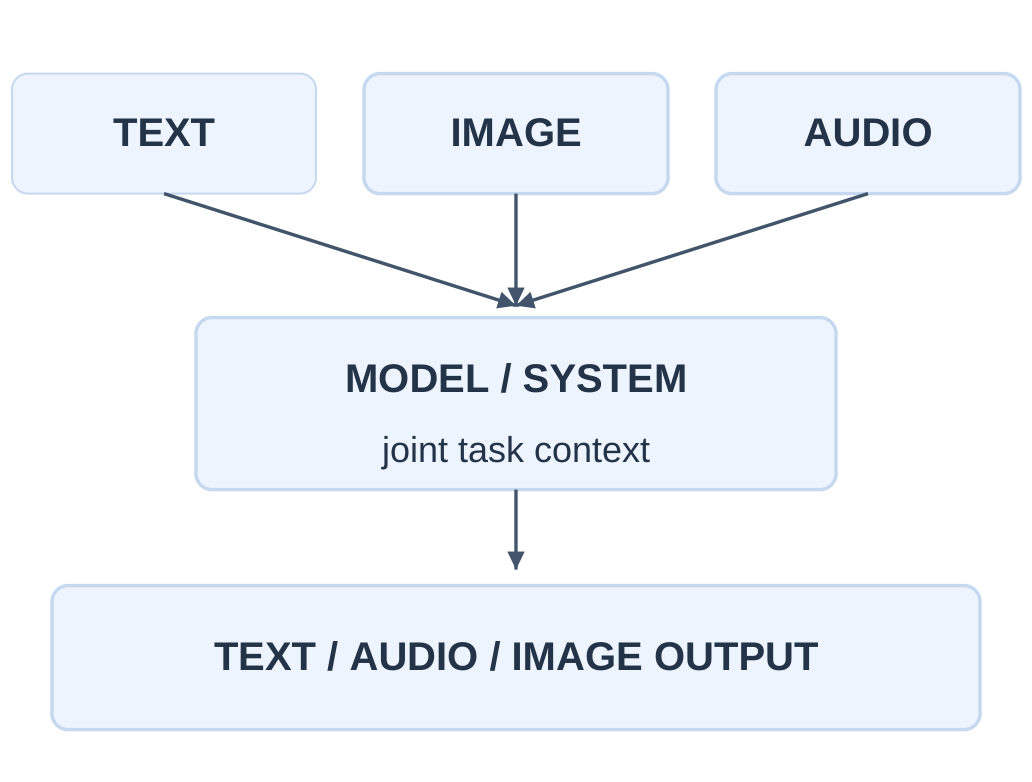
3.16.1 Why Combining Inputs Helps
A photograph can supply visual details that would be difficult to describe completely.
A written question specifies what to inspect.
Audio can add spoken instructions.
Their combination can reduce some ambiguity while also introducing interpretation errors.
If the photo is blurry or the spoken value is misheard, additional modalities do not automatically resolve the problem.
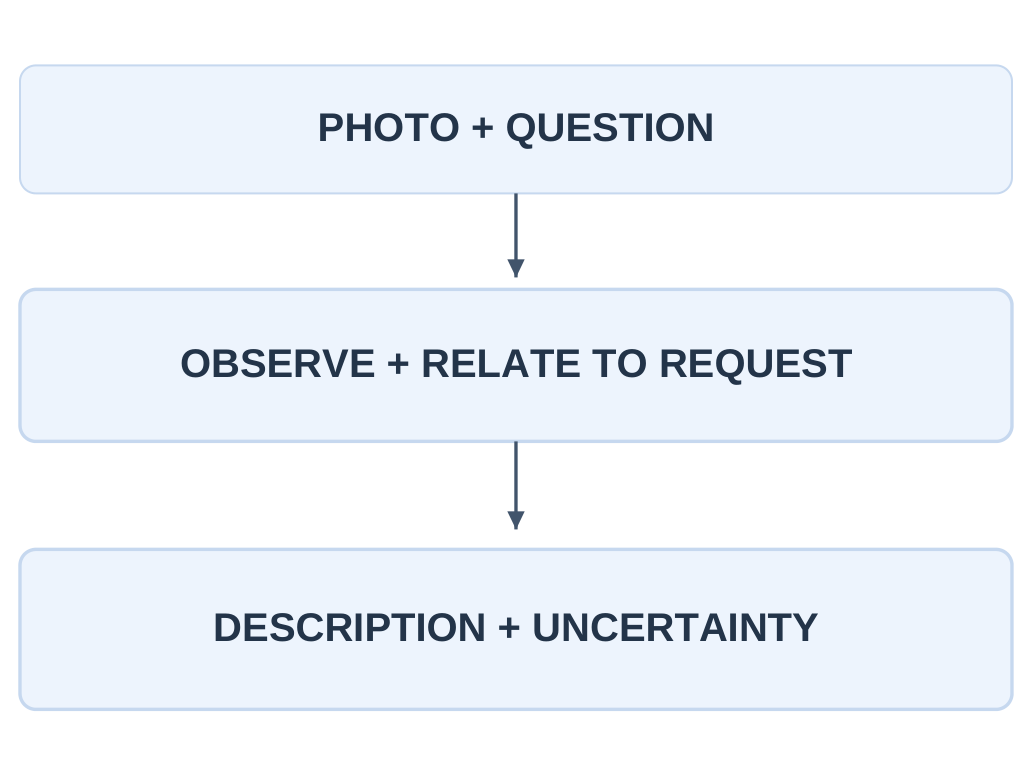
Ask the system to identify what it can observe and what remains uncertain.
3.16.2 Syllabus Examples: GPT-4o and Gemini
GPT-4o was introduced as an OpenAI model combining text, vision and audio capabilities.
Gemini is a Google model family designed around multimodal capabilities.
These syllabus examples illustrate integration across media rather than a promise that every interface exposes all possible features.
A model’s supported formats, an application’s enabled controls and an account’s available features can differ.
Do not infer that video generation is available merely because a system accepts video-related input.
| Interaction | What Changes Modality? |
|---|---|
| Photo + question → explanation | Image and text are interpreted together |
| Spoken question → text answer | Audio input becomes language output |
| Text description → image | Language conditions image generation |
| Video clip → summary | Visual sequence informs text output |
3.16.3 Native Model Versus Connected Pipeline
Some systems train a model to process several modalities jointly.
Others connect separate speech, vision and language components.
Both can present a multimodal user experience, but their internal computation differs.
A microphone icon does not prove that the core language model directly consumes raw audio.
A separate recognizer may supply a transcript.
Terminology check
Multimodal means multiple forms of data.
Multilingual means multiple languages.
A text-only system can be multilingual without accepting images or audio.
3.17 A Multimodal Engineering Study Example
Suppose a student has a permitted photograph of an unplugged classroom circuit board and asks for a description of visible components.
The image supplies appearance, while the written request defines the task.
The answer should distinguish visible observations from uncertain identifications.
Example request
Describe the clearly visible component types.
State when a label cannot be read.
Do not infer hidden connections or operating values.
This makes the requested evidence boundary explicit.

3.17.1 Observed Versus Inferred
| Possible Statement | Evidence Status |
|---|---|
| A cylindrical component is visible | Observation if clearly shown |
| The printed value reads 100 | Depends on legibility and units |
| The hidden track connects two points | Not established by the image |
| The circuit works safely | Not established by appearance alone |
The example concerns interpreting information, not operating a circuit.
A visual assistant should not fill unreadable markings with a confident guess simply because similar boards often use a familiar value.
3.17.2 Text, Image and Voice Together
A student may point to the photograph and ask a spoken question.
If speech is transcribed incorrectly, the request can change before visual analysis begins.
If a label is unreadable, a correct transcript does not repair the missing visual detail.
A model can confuse similar-looking components or misread a drawing’s scale.
Check the output against the original image, component markings and suitable independent information.
3.17.3 A Structured Response Format
- List only clearly observed items.
- Separate tentative identifications from clear ones.
- Quote visible markings with their units if legible.
- Name any missing view needed for a stronger conclusion.
- Avoid unsupported claims about operation or performance.
| Failure Source | Possible Check |
|---|---|
| Blurred label | Use a clearer permitted close-up |
| Wrong spoken number | Compare with the transcript |
| Missing back-side view | State that hidden tracks are unknown |
| Invented operating claim | Ask what evidence supports it |
The same logic applies to a scanned note, fabric photograph or crop image.
Multimodal assistance can describe and organize observations, but a domain conclusion may need measurements or expertise beyond the available media.
3.18 AI Image Generation: Diffusion Concept
A text-to-image generator maps a description and other conditioning into an image.
It can create a plausible scene rather than retrieve a photograph of an event.
The output can be useful for visual concepts, while its physical details and factual implications require checking.
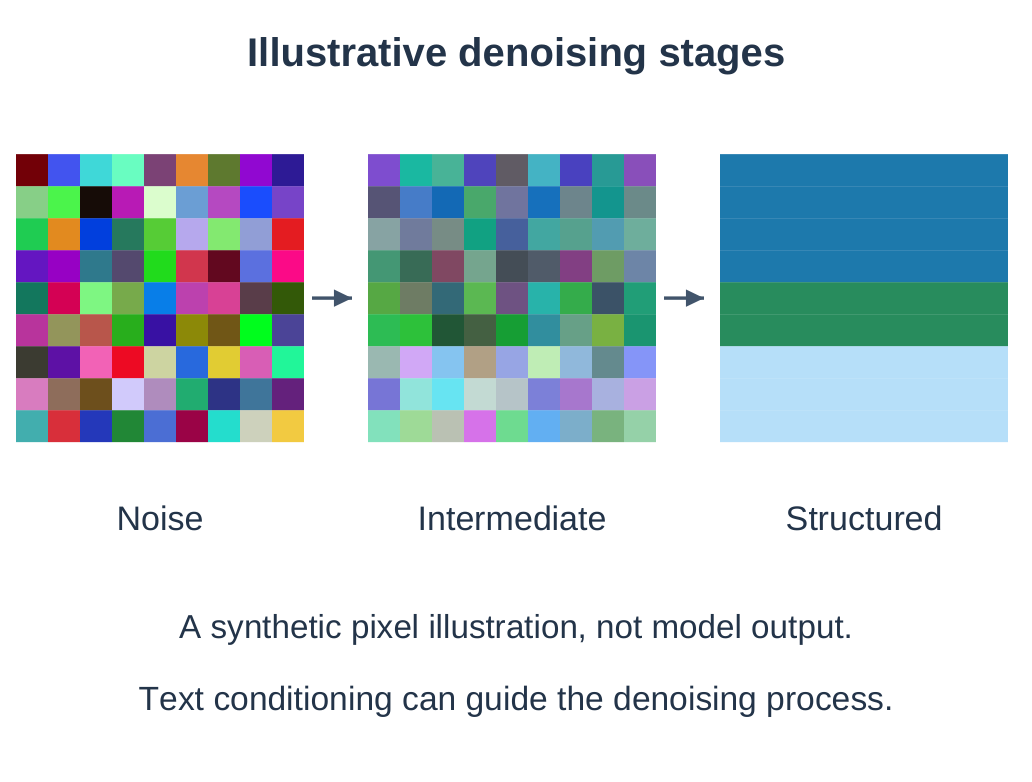
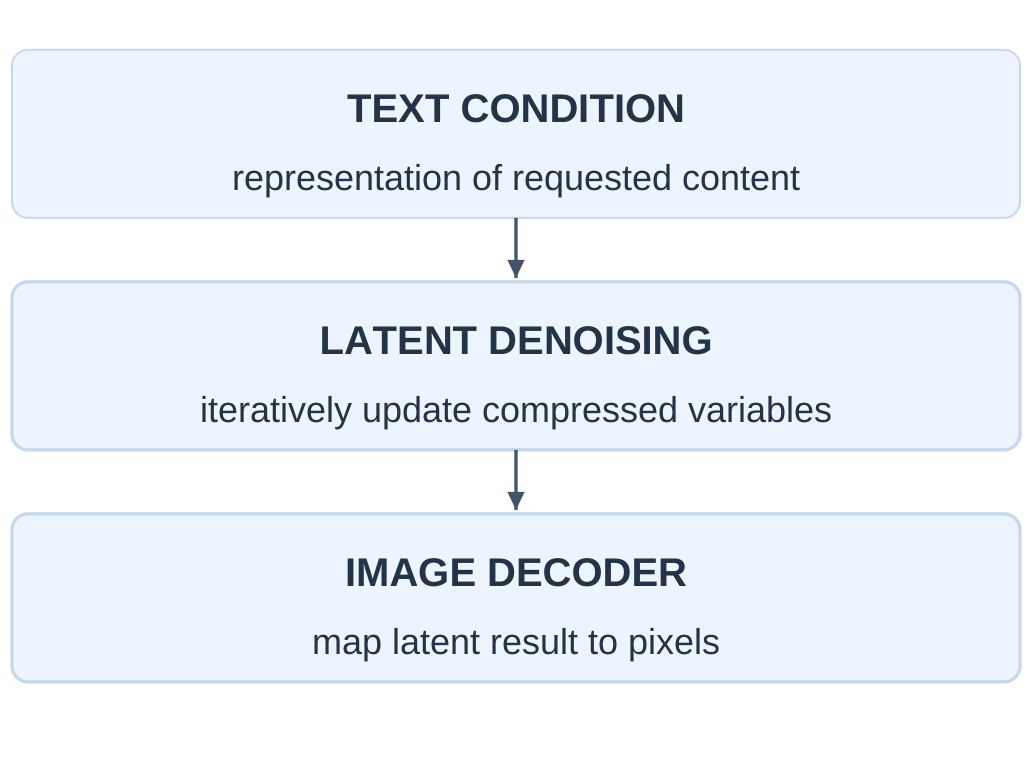
In a diffusion training idea, clean examples are progressively corrupted with noise and a model learns a related denoising task.
During generation, a learned process iteratively transforms a noisy state toward a structured sample.
Exact methods and mathematical parameterizations differ.

3.18.1 Text Conditioning
A representation of the text request can guide the denoising process toward the desired content.
The text does not directly position every pixel or prove that the generated object obeys physical laws.
Different random initial states or generation settings can lead to different outputs for the same prompt.
A chosen seed may help repeat a setup in some systems, but identical results across hardware or versions are not guaranteed.
3.18.2 Noise, Guidance and Learned Patterns
The random starting state introduces variation.
The trained model supplies learned structure.
Conditioning directs the kind of image requested.
The final image reflects their interaction rather than a manual assembly of verified components.
A generated machine may have a convincing silhouette but an impossible shaft connection.
A generated laboratory scene may omit a required support.
Visual realism and engineering correctness are separate evaluation dimensions.
| Element | Role |
|---|---|
| Training examples | Support learned visual patterns |
| Noise / latent start | Provides a starting variation |
| Text condition | Specifies desired subject and attributes |
| Denoising updates | Construct a structured representation |
| Output check | Assesses requested content and accuracy |
3.18.3 Generation Versus Restoration
Generating a scene from text differs from restoring a damaged measured image.
Even a restoration tool can invent plausible detail.
Do not interpret newly generated detail as recovered experimental evidence without suitable validation.
Diffusion is an important family, but not every generative image system has identical internals.
Avoid claiming that every image tool uses the same number of denoising steps or network architecture.
3.19 Latent Generation and Image Editing
A latent representation is an internal numerical representation of data.
In latent diffusion, a key part of the denoising process operates in a compressed representation rather than directly on every full-resolution pixel.
A decoder maps the resulting representation into an image.
Compression can reduce some computational requirements, but it also has representational limits.
A latent representation is not a hidden catalogue of complete photographs.
Decoding it does not guarantee precise physical structure.

3.19.1 Why a Compressed Representation?
Working in a lower-dimensional representation can make a large generation task more manageable.
The representation retains useful structure while the decoder produces the visible pixel array.
This connects with the distinction between input data and learned features.
The internal values need not be interpretable as human-readable objects one by one.
3.19.2 Image-to-Image and Local Edits


Image-to-image generation uses a supplied image as part of the condition.
Inpainting requests content within a selected region or mask.
Outpainting extends content beyond an existing boundary.
Availability and controls differ across tools.
A local edit should state both the intended change and the features that must remain.
For example, a presentation concept might require changing the background while preserving the main object’s outline.
The returned output still needs comparison with the original.
An image reference can guide appearance without guaranteeing exact identity, dimensions or labels.
For engineering drawings, use editable geometric assets when exact correspondence is required.
3.20 Stable Diffusion, Midjourney and DALL-E
The syllabus names three image-generation examples.
Their shared educational role is to show how text and other inputs can condition visual output.
They differ in model release arrangements, interfaces, available controls and version-specific behavior.
Study their concepts without assuming that each exposes identical settings or that a historical interface remains unchanged.
An account plan or exact product version is unnecessary for defining text-to-image generation.
| Example | Concept to Remember |
|---|---|
| Stable Diffusion | A model family associated with diffusion-based text-to-image generation and released models under applicable terms |
| Midjourney | A hosted visual-generation service guided by prompts and supported image inputs |
| DALL-E | OpenAI’s text-to-image model family named in the syllabus |
3.20.1 Stable Diffusion
Stable Diffusion became an important example of latent diffusion image generation.
Released model versions can be used through different interfaces and workflows.
Licences, hardware needs and supported controls are version dependent.
Do not interpret “Stable” as a claim that every generated design is physically stable or safe.
It is part of a model-family name. The output remains a generated visual sample.
3.20.2 Midjourney and DALL-E
Midjourney uses prompts to guide visual generation and supports workflows that can include images as references.
A reference can influence content, composition or style, but exact behavior depends on supported features and settings.
DALL-E illustrates text-conditioned image generation in the OpenAI ecosystem.
The family has had multiple versions.
An image-generation interface may use a different model, so do not label every image produced by an OpenAI tool as DALL-E.
The same written request can produce different results across systems.
Differences can arise from training, prompt interpretation, randomness, default settings and post-processing.
| Comparison Question | What to Inspect |
|---|---|
| Follows the description? | Subject, count and attributes |
| Composition appropriate? | Layout and view requested |
| Technical details correct? | Connections, labels and geometry |
| Required edit preserved? | Compare with the original |
| Origin presented clearly? | State synthetic / generated status |
3.20.3 Do Not Invent a Benchmark
A concept explanation is not a measured comparison.
To compare actual services, record the precise request, versions and observed outputs under comparable conditions.
Do not assign winner labels to images that were never generated in that service.
The lesson is to identify the system, describe its role and inspect output quality.
A brand-name list alone does not demonstrate understanding.
3.21 Image-Generation Demonstration
This demonstration uses a harmless visual concept: a study desk with a small lamp.
Its purpose is to observe prompt influence and check visible requirements.
It does not validate an electrical design or require a paid service.
Use an available permitted image tool under classroom rules.
The prompts below are activity inputs. Expected differences are evaluation targets, not claims that named services were run to create a benchmark.
Prompt A: Broad Input
Create an image of a study desk with a lamp.
Prompt B: Specific Input
Create a clean product-style image of one study desk with one compact blue desk lamp on its left side, a closed notebook in the centre and a plain white background. Use a front three-quarter view. Do not add people, logos or text.
3.21.1 Step-by-Step Procedure
Step 1: Select a permitted image-generation interface.
Step 2: Record the tool and any visible model label.
Step 3: Generate from A and save the observed result.
Step 4: Use a fresh comparable request for B.
Step 5: Record visible settings where available.
Step 6: Compare both outputs against the requirements.
A more specific prompt constrains the requested scene, but success is not guaranteed.
The model can still place the lamp on the wrong side, add an extra object or draw an inconsistent support.
3.21.2 Evaluation Sheet
| Requirement for B | What to Record |
|---|---|
| One desk and one lamp | Count actual visible objects |
| Blue lamp on image left | Check color and viewpoint |
| Closed notebook in centre | Check object and position |
| Plain white background | Check unwanted scene details |
| No people / logos / text | Inspect for unwanted additions |
| Consistent object structure | Check supports and plausible geometry |
Give each visible requirement a pass, fail or uncertain label.
Uncertainty is appropriate when a detail is hidden or too ambiguous to judge.
Do not mark an item correct merely because it was requested.
If repeating a request to study variation, record that the same prompt was used.
A changed result can reflect sampling or application differences; it does not automatically show retraining.
3.21.3 One Controlled Revision
If the lamp is on the wrong side, request only that positional correction and state what should remain.
Compare the result with the original to check whether the notebook or other objects changed unexpectedly.
For an exact study-material figure, add verified labels in a layout or drawing tool after checking the image.
Generated text inside an image can contain spelling errors or misplaced labels.
Report the input change, observed output change and one remaining limitation.
Do not write that prompt B always works better. State which criteria improved in the trials actually performed.
3.22 Hallucination: Fluent but Unsupported Output
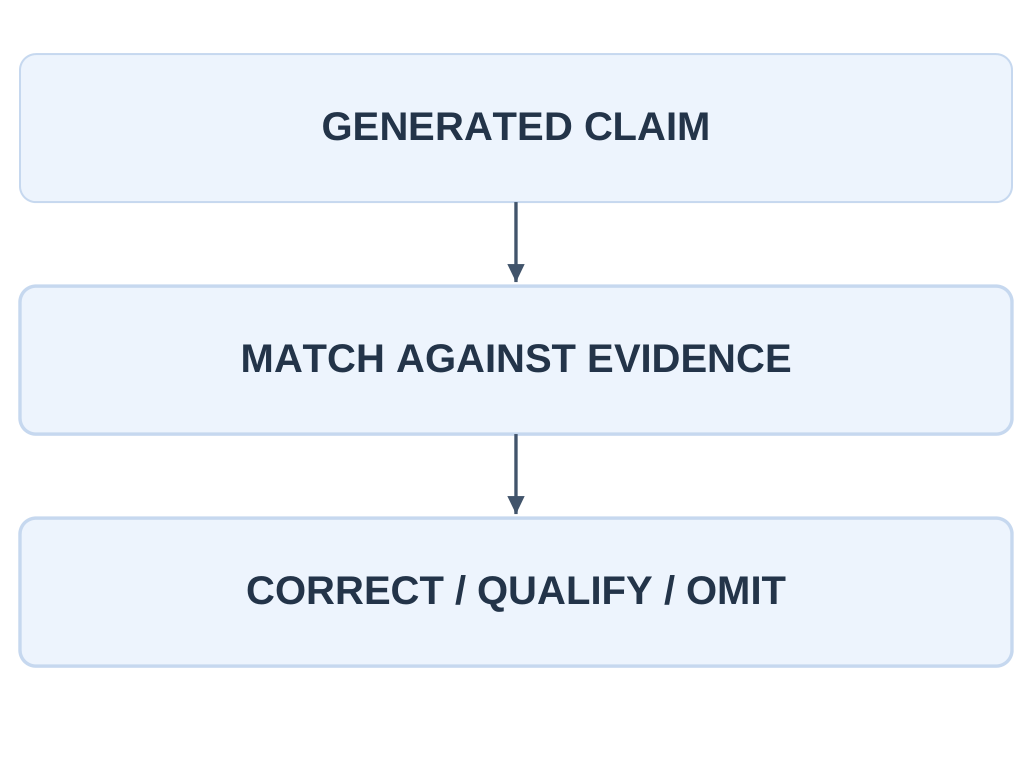
An LLM hallucination is generated content that is unsupported, incorrect or inconsistent with available evidence.
It can appear as:
- A false fact.
- An invented citation.
- A fabricated quotation.
- A wrong calculation.
- An unsupported detail in a summary.
The output may be grammatically polished and confident.
Style does not reveal whether the claim is true.
A model’s next-token likelihood is not a universal external-fact confidence score.

3.22.1 Why It Can Happen
A model generates patterns that fit its learned behavior and current context.
Missing information, ambiguous requests, misleading context and mistaken learned associations can contribute to unsupported completions.
A request that presupposes a false event can encourage a continuation that accepts the premise.
The appropriate response should question the premise rather than invent details to satisfy it.
3.22.2 A Constructed Source-Grounded Example
Supplied record
A classroom measured a sample length of 10 cm before a test and 11 cm after it.
The record contains no material name and no applied-force measurement.
Unsupported answer
“The aluminium specimen stretched by 1 cm because a 50 N force was applied.”
Only the 1 cm difference is supported by the supplied lengths.
Aluminium and 50 N were not given.
Even if either detail happened to be true elsewhere, the answer falsely presents it as established by this record.
Faithful answer
“The recorded length increased by 1 cm. The supplied record does not identify the material or applied force.”
This reports the observation and names the information gap.
3.22.3 Verification Methods
- Compare claims with the supplied source passage.
- Check a citation’s existence and relevant content.
- Recalculate numerical examples independently.
- Ask for missing assumptions to be identified.
- Omit unsupported detail rather than decorate a guess.
Asking “Are you sure?” can produce another confident statement without new evidence.
Request the actual supporting passage or use an independent source.
Repetition and agreement across systems can reproduce the same error.
A refusal, short answer or explicitly stated uncertainty is not automatically a hallucination.
Evaluate the content and evidence relationship.
3.23 Knowledge Cutoff and Changing Information
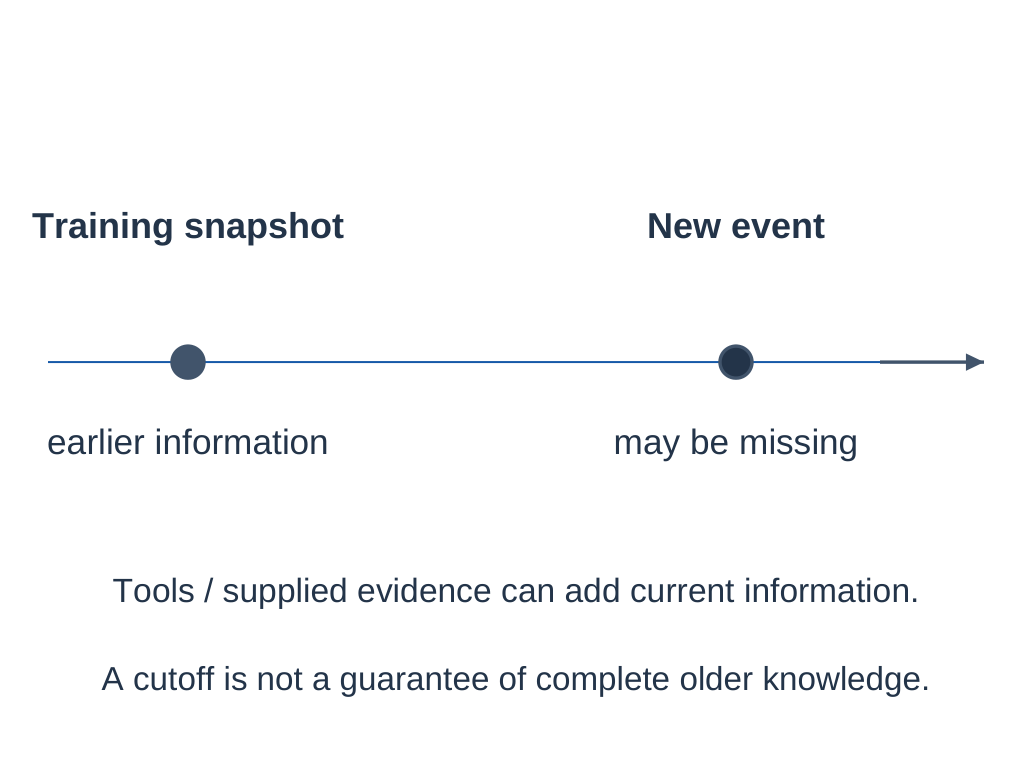
A knowledge cutoff describes a temporal limitation associated with a model’s training information.
Information about later events may be absent from its learned parameters.
Different models and training stages can have different boundaries.
A cutoff does not mean that every earlier fact is known or correctly recalled.
Training data may omit a topic, contain mistakes or represent it unevenly.
It is a time-related limit, not a completeness guarantee.

3.23.1 What Can Add Recent Information?
A browsing or retrieval tool can fetch current sources if it is available and actually used.
A user can also supply a recent document.
The model may then generate an answer conditioned on that information even if the event occurred after its training cutoff.
This does not mean the base model was retrained during the request.
Current context and learned parameters are different routes for information to influence an answer.
Model cutoff, document publication date, event date and access date can differ.
A recently published page may describe an old event. An older page may no longer reflect a current rule.
3.23.2 An Academic Notice Example
A student asks for the current examination schedule.
A model answering from older learned patterns may produce plausible dates that are wrong.
The appropriate evidence is the relevant official notice, including any later revision.
If a notice is supplied, identify the university, programme, examination and revision status before summarizing.
An authentic timetable for another course is not evidence for the current course’s date.
| Question | Appropriate Check |
|---|---|
| What is an LLM? | Stable concept explanation |
| What is today’s exam schedule? | Current applicable official notice |
| What does this supplied circular say? | Read the actual circular |
| Which tool feature is available now? | Current product documentation / interface |
| Did the assistant browse? | Inspect whether a source was actually retrieved |
3.23.3 Citation Quality
A source title alone does not establish relevance.
Verify that its content directly supports the nearby claim and applies to the required date and scope.
A valid link to an unrelated page is still inadequate evidence.
When information is insufficient, state what remains unknown.
It is better to identify the required notice than to generate a schedule-shaped answer from assumptions.
3.24 Bias and Uneven Performance
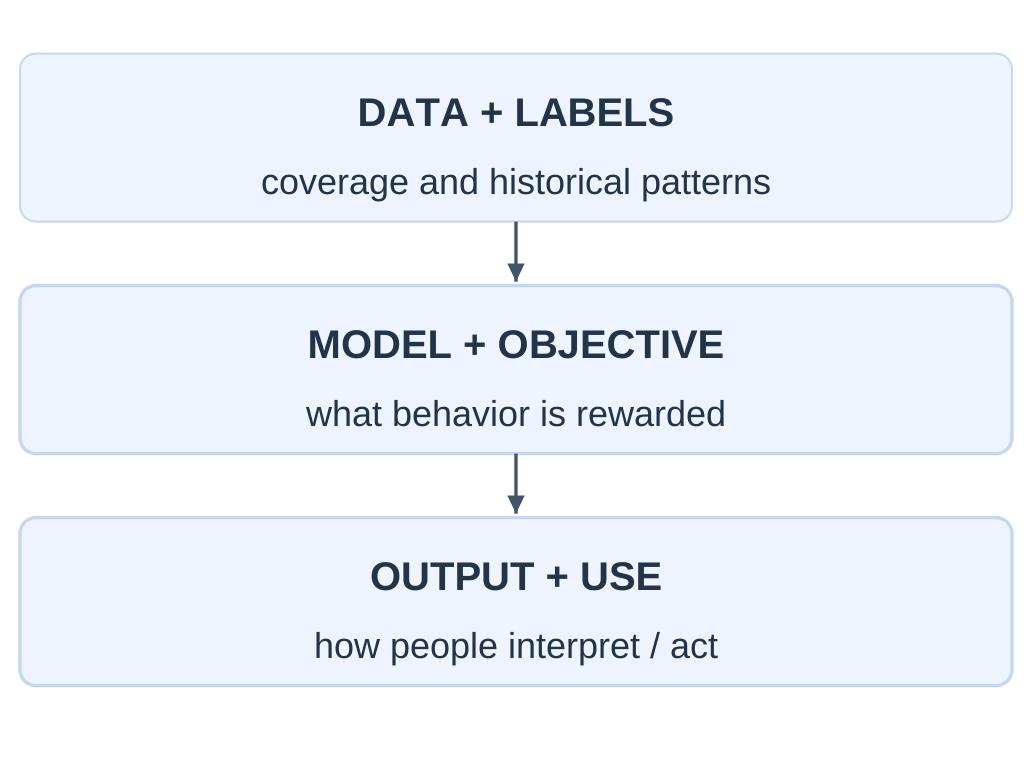
Bias in AI can refer to systematic distortions or unfair differences in model behavior.
In generative systems, outputs may reflect unequal representation, historical stereotypes, annotation choices and development objectives.
Bias is not limited to deliberately offensive language.
A model may provide weaker explanations in a less-represented language, assume an occupation’s gender or recommend opportunities in a way that omits some groups.

3.24.1 Representation and Context
If a training collection contains more examples of one linguistic style or social setting, the model may handle that style better.
A global average can hide differences across languages, domains or groups.
Removing an explicit group label does not necessarily remove related patterns.
Other information can act as a proxy, and learned associations can remain in behavior.
An engineering-role description should state relevant skills and tasks.
A generated assumption about gender, region or background is not evidence of competence.
3.24.2 A Controlled Classroom Comparison
Ask for a short description of a laboratory team using a neutral role label.
Inspect whether the output repeatedly assigns a narrow identity or stereotype without being asked.
Use several trials and record exact wording.
A second exercise can request the same concept explanation in two languages familiar to the class.
Check correctness, clarity and completeness independently.
Fluent output in two languages does not automatically have equal quality.
| Possible Issue | Meaningful Response |
|---|---|
| Stereotyped role assignment | Request neutral, task-relevant wording |
| Unequal language quality | Check with competent speakers and sources |
| Missing perspectives | Review coverage and add relevant evidence |
| Biased recommendation | Examine criteria and example groups |
| Repeated harmful assumption | Record and report the observed behavior appropriately |
3.24.3 Mitigation Has Limits
Balanced data, careful objectives, evaluation across relevant conditions and output review can reduce some problems.
A single “be unbiased” instruction does not guarantee fairness.
Student review should focus on observable content and task consequences.
A small set of examples can reveal a problem to investigate, but broad claims about all groups or versions require a suitable evaluation study.
3.25 Academic Integrity and Plagiarism
Academic integrity means representing learning and authorship honestly under applicable assessment rules.
Generative AI can support study, but using it to replace prohibited work or concealing its role can misrepresent what a student has done.
Permitted use depends on the institution, teacher and assignment.
An exercise may allow brainstorming but require the submitted solution to be independently developed.
Another exercise may explicitly assess how students evaluate AI output.
Read the actual instructions.

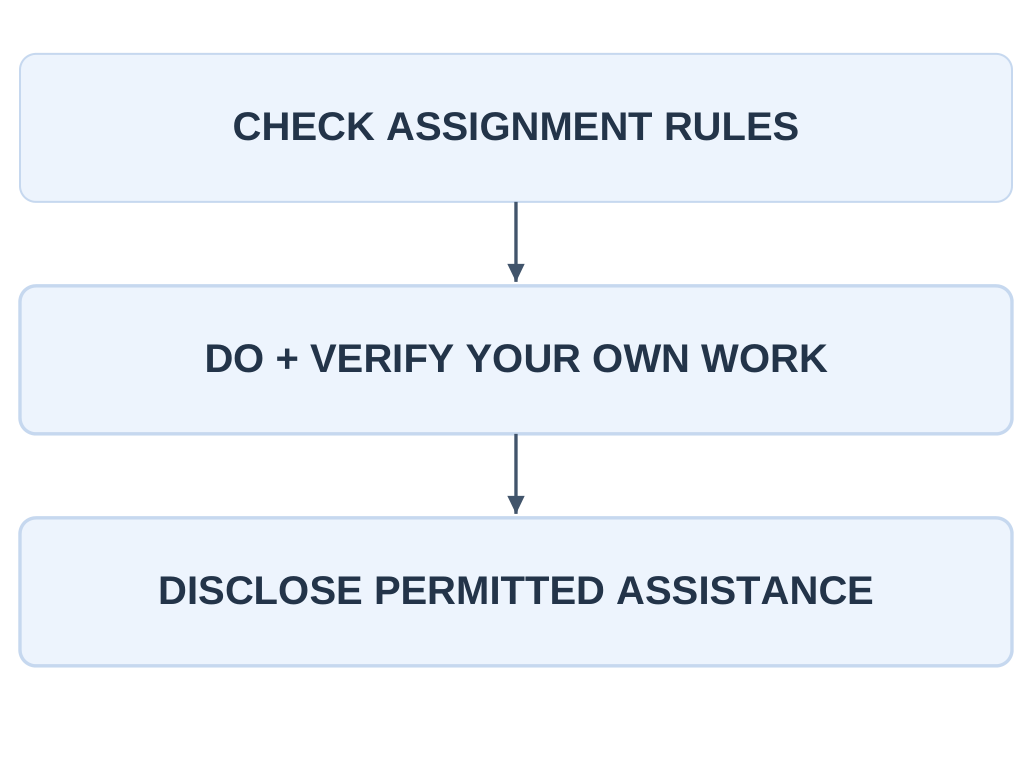
3.25.1 Learning Support Versus Substitution
Asking for a simpler explanation and then solving a fresh example yourself can support learning when allowed.
Submitting a generated answer as an unaided assessment response can violate the task’s rules.
Do not fabricate an experiment, observation, field visit or result because a model can generate a convincing report.
A plausible table is not evidence that measurements were taken.
3.25.2 What Is Plagiarism?
Plagiarism involves presenting another source’s words, ideas or work as one’s own without appropriate acknowledgement.
A generated answer may contain reused wording or ideas.
AI assistance also raises authorship and assessment-rule questions even when text is newly phrased.
Changing a few words does not automatically make borrowed ideas your own.
A paraphrase still needs appropriate attribution when it uses another source’s ideas.
Citing only an assistant does not verify the original facts or replace required source acknowledgement.
| Situation | What Must Be Considered |
|---|---|
| AI explains a concept | Whether assistance is allowed; verify understanding |
| AI drafts an assessed answer | Assignment rules and authorship representation |
| AI invents a laboratory reading | Fabrication of evidence |
| Output reproduces a passage | Attribution and permitted use |
| Student rewrites a sourced idea | Appropriate acknowledgement still matters |
3.25.3 Detectors and Certainty
A detector score alone is not definitive proof that a particular student used AI.
A low score does not establish honest authorship.
False classifications and context limits matter.
More meaningful evidence of learning can include drafts, explanations, a derivation the student can defend and records required by the assignment.
Do not use making text undetectable as a substitute for following the rules.
Use permitted assistance to improve understanding, preserve evidence of your own work and be transparent where required.
3.26 Disclosure, Verification and Privacy
AI-generated content disclosure explains what assistance was used and where it affected the work.
It should distinguish brainstorming, language editing, code drafting and substantive content generation.
Follow the required format for the assignment or publication.
A disclosure is not a substitute for checking the output.
The submitting student remains responsible for claims, calculations and work presented under their name.
A permitted tool can still produce an incorrect answer.
3.26.1 Example Disclosure Wording
Illustrative statement
“I used an AI assistant to suggest an outline and simplify wording in the introduction. I checked the factual claims against the supplied course material, completed the calculations independently and revised the final text myself.”
Use that wording only when it accurately describes what happened.
If the assistant generated a substantial section or program, say so rather than describing the use as spelling correction.
Name the tool or model and date when applicable instructions require them.
For synthetic illustrations, identify their generated nature where relevant.
A concept image is not a measured photograph or validated technical design.
| Record | Purpose |
|---|---|
| Tool / visible model label | Identify the assistance used |
| Relevant input and output | Show what was requested and produced |
| Student revisions | Show the actual contribution |
| Independent checks | Support correctness claims |
3.26.2 Keep Evidence and Data Appropriate
Do not upload another person’s private record, unpublished project details or confidential assessment material simply because a tool accepts files.
Use permitted excerpts, anonymized teaching data or synthetic examples appropriate to the task.
Privacy behavior depends on the service, account arrangement and settings.
Do not assume that every hosted chat is private or every locally run model is secure.
The actual workflow and data handling determine exposure.
3.26.3 A Review Before Submission
- Confirm that the use is allowed for the task.
- Check every factual claim that matters.
- Recalculate formulas and numerical examples.
- Read and test generated code where applicable.
- Check that references exist and support claims.
- Disclose the actual assistance in the required form.
A source citation should support the content being claimed.
A disclosure should describe the assistance used.
These serve different purposes.
Avoid presenting a generated bibliography as documents you personally read.
Inspect the sources your answer actually relies on and keep claims within their scope.
3.27 Class Activity: Different Inputs, Outputs
The syllabus asks students to interact with ChatGPT, Gemini or Claude and observe how different inputs affect outputs.
Use a permitted available assistant.
A paid plan is not required for the conceptual exercise. Exact access and features can vary.
Choose a stable first-year concept, such as supervised versus unsupervised learning.
Keep a short verified explanation available for checking.
The activity studies task specification rather than a brand ranking.

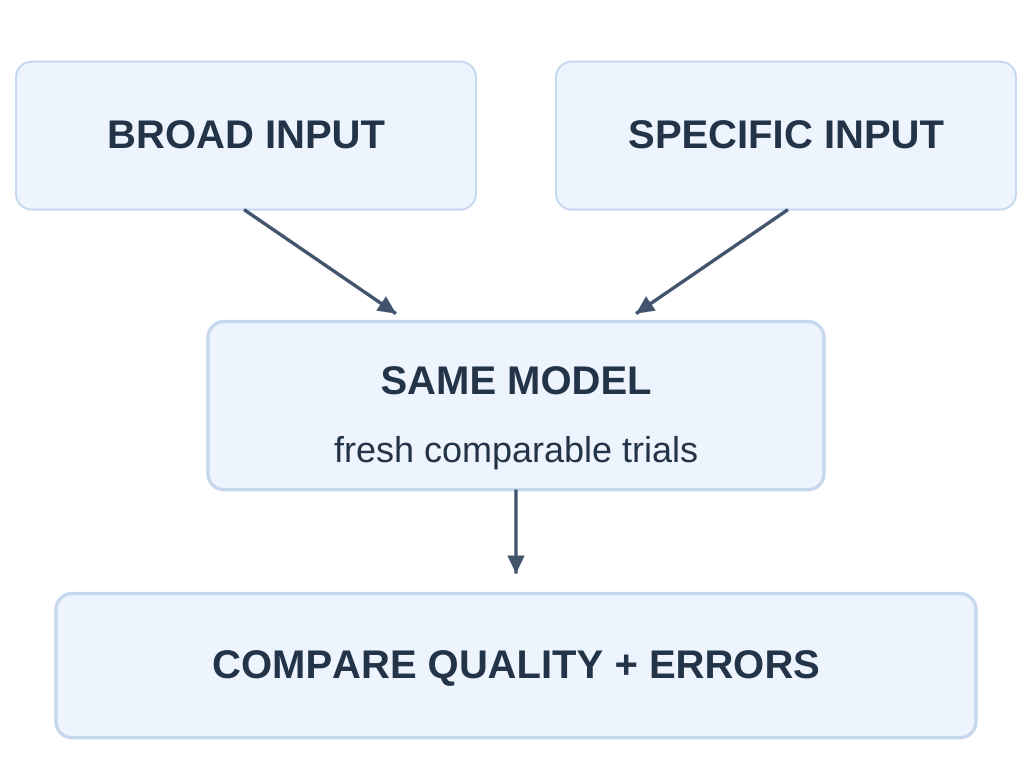
Input A
Explain machine learning.
Input B
For a B.Tech first-year student, compare supervised and unsupervised learning in a four-row table. Include labels, goal, one method and one engineering example. Do not add claims about a specific product’s private training data.
The second request supplies audience, scope, structure and a boundary.
It can guide a more targeted output.
The actual response must still be inspected for conceptual mistakes or missing rows.
3.27.1 Procedure and Observation Sheet
Step 1: Record the application and visible model label.
Step 2: Run A and B in separate fresh comparable chats.
Step 3: Save the exact inputs and outputs.
Step 4: Check both with the same relevant source material.
Step 5: Record differences and errors.
| Criterion | A Result | B Result |
|---|---|---|
| Correct learning definitions | Record | Record |
| Explains role of labels | Record | Record |
| Suitable for first-year readers | Record | Record |
| Engineering examples fit task | Record | Record |
| Follows requested structure | Record | Record |
| Unsupported claims present? | Record | Record |
A broad input permits a broad answer.
A specific input reduces some ambiguity, but it cannot supply missing knowledge by wording alone.
If B contains a false example, score that error rather than assuming specificity guarantees correctness.
If repeating the same prompt, record whether the answer changes.
Use a temperature control only if it is exposed; otherwise do not claim that a temperature value was measured.
3.27.2 Short Report Format
Write:
- The concept.
- The system label.
- Both exact inputs.
- Observed differences.
- One correctness check.
- One limitation.
Conclude with a statement restricted to the actual trials.
Illustrative conclusion
“In our two trials, input B produced the requested table and clearer label distinctions, but one example required correction.”
Use that sentence only if those were the observations.
The exercise does not prove that any assistant is universally reliable or that a longer prompt always produces a better answer.
3.28 Class Activity: Identify a Hallucination
The syllabus asks students to identify one hallucination example.
A controlled source-grounded task makes checking clearer than asking obscure trivia.
The reference record below is deliberately small, so every supported fact can be inspected.
Do not pretend that a constructed wrong answer was actually returned by a live model.
If a real trial contains no hallucination, record that result and use the labelled teaching example for practice.
Complete reference record
A sample weighed 20 g before drying and 18 g afterward.
The record does not identify the substance, drying duration, temperature or measurement uncertainty.
Trial request
Summarize this record in two sentences.
State the mass change.
Identify which experimental details are not provided.
Use only the supplied record.
3.28.1 Deliberately Incorrect Teaching Output
Constructed error, not an observed live response
“The salt lost 2 g after heating at 100 C for 30 minutes, proving that all moisture was removed.”
The 2 g loss follows from:
20 − 18 = 2 g
Salt, 100 C, 30 minutes and complete moisture removal are unsupported.
The conclusion about all moisture goes beyond the supplied measurement, even if the mass calculation is correct.
Supported alternative
“The recorded mass decreased by 2 g, from 20 g to 18 g. The substance, drying duration, temperature and measurement uncertainty are not provided, so the cause and completeness of drying cannot be established from this record.”
3.28.2 Analyze the Actual Response
| Check | What to Inspect |
|---|---|
| Numerical change | 20 − 18 = 2 g |
| Material name | Was one invented? |
| Time / temperature | Were values added without evidence? |
| Causal conclusion | Was drying completeness asserted? |
| Missing information | Were gaps acknowledged? |
| Evidence boundary | Did the answer stay within the record? |
Classify each questionable claim separately.
An answer can contain a correct subtraction and an unsupported cause at the same time.
Calling the whole answer correct because one number matches misses the issue.
If the actual assistant states that missing details are unknown, that is an appropriate boundary statement.
Do not mislabel a correct answer as a failure.
3.28.3 Revision Exercise
Ask for a corrected response that removes unsupported details and preserves recorded values.
Compare it again with the source.
A successful correction does not prove that every later answer will be reliable.
Have another student trace each sentence to the record.
If a claim needs an outside source, mark that need explicitly rather than pretending the record contained it.
3.28.4 Submission Checklist
- Exact reference record and request.
- Actual output, labelled as observed.
- Any separate teaching output, labelled as constructed.
- Supported and unsupported claims identified.
- Corrected answer and a short explanation.
A hallucination check is an evidence comparison.
It is not satisfied merely by asking whether the assistant is confident.
3.29 Revision and Examination Practice
| Concept | Essential Recall |
|---|---|
| GenAI | Produces content from learned patterns |
| LLM | Large neural language model |
| Pre-training | Broad pattern learning with parameter updates |
| Post-training | Further adaptation of model behavior |
| Inference | Compute an output for current context |
| Token | Processing unit; not always a word |
| Context window | Bounded working capacity |
| Temperature | Controls sampling concentration / variation |
| Multimodal | Works across multiple data forms |
| Diffusion | Generation through learned denoising |
| Hallucination | Unsupported or incorrect generated content |
| Cutoff | Temporal limitation of training information |
| Disclosure | Explain the actual role of AI assistance |
3.29.1 Short-Answer Questions
- Define generative AI and name five output forms.
- Differentiate tokens and parameters.
- Why does a larger context not guarantee perfect recall?
- What does temperature change, and what does it not fix?
- Name the organizations behind the four syllabus examples.
- Distinguish multimodal and multilingual.
- How can a current document inform an older trained model?
- Why is disclosure different from source verification?
- What is retrieval-augmented generation?
- Why is a generated citation not sufficient evidence?
- Distinguish image generation and image interpretation.
- Explain why low temperature does not guarantee truthfulness.
3.29.2 Longer-Answer Questions
- Explain the conceptual stages from pre-training to post-training and inference with a labelled diagram.
- Describe next-token generation using a toy probability table and explain why plausibility does not guarantee truth.
- Explain tokens, context window and temperature with one example for each.
- Describe multimodal AI and distinguish supported inputs from generated outputs.
- Explain diffusion and latent image generation, then outline a controlled visual demonstration.
- Discuss hallucination, cutoff and bias with examples and checks.
- Explain responsible academic use, plagiarism and AI-generated content disclosure.
- Describe a fair classroom comparison of assistant outputs using a supplied source and a scoring rule.
3.29.3 Worked Checks to Remember
Context-budget check
400 + 200 + 1600 + 2400 + 1400 = 6000 tokens
Under an assumed shared capacity of 8000:
8000 − 6000 = 2000 tokens remaining
Adding 2500:
6000 + 2500 = 8500
Excess = 500 tokens
Attention check
0.6×2 + 0.1×1 + 0.3×4 = 2.5
This illustrates a weighted combination, not a full Transformer.
Source-checking example
20 g to 18 g supports a 2 g loss.
It does not identify the material or prove complete moisture removal.
Temperature check
A lower positive value can concentrate sampling.
It does not verify a fact or universally guarantee deterministic results.
Use a precise definition, labelled computation or workflow, appropriate example and limitation tied to evidence.
COMPLETE EXPLANATIONS FOR EXAM ANSWERS
Use the following connected answers alongside these AI and Prompt Engineering Unit 3 Notes.
Explain Generative AI and Distinguish Generation from Retrieval
Generative AI produces content such as text, images, code, audio or video using learned patterns and conditioning information.
A classification task selects a category; a generation task constructs content.
A surface image can therefore support either a defect label or a generated description, depending on the requested output.
Retrieval selects relevant existing material. Generation produces wording or another representation.
In a retrieval-augmented assistant, a search step may fetch approved manual excerpts before an LLM generates an explanation from them.
The source passages and final response must be checked separately.
Newly generated content is not automatically factually correct, novel or free of reproduced wording.
A scientific-looking generated graph is not a measurement.
A plausible citation is not evidence that a document was retrieved.
State the task, input, output and independent check when explaining any example.
Explain Pre-Training, Post-Training and Inference
Pre-training adjusts learned parameters using a broad data collection.
For a typical autoregressive language model, earlier tokens provide context and the observed next token supplies a prediction target.
The loss measures mismatch and optimization updates parameters.
This is commonly self-supervised because the sequence supplies the targets.
Post-training adapts behavior through methods such as instruction demonstrations and preference-based learning.
Fine-tuning updates at least some trainable parameters.
Different model families use different procedures. Not all preference optimization involves an identical reinforcement-learning loop.
Inference computes an output for current context.
The network scores possible next tokens, a decoding rule selects one and the selected token becomes context for later steps.
Ordinary use does not necessarily retrain the model.
Prompt examples, retrieved passages and application memory can influence current input without modifying base-model weights.
Explain Tokens, Context Window and Temperature
A token is a model-processing unit produced by a tokenizer.
It may represent a word, word part, punctuation or another encoded unit.
It differs from a character, written word or learned parameter.
Exact counts depend on tokenizer, request format and supported media.
A context window bounds working sequence information used for current computation.
In a simplified shared budget, instructions, history, evidence and reserved output consume capacity.
A larger window permits more material but does not guarantee faithful use of every detail.
Separate input and output limits or other accounting rules may apply.
Temperature changes the concentration of a sampling distribution.
Under usual positive-temperature scaling, lower values favor already-likely candidates more strongly. Higher values give alternatives more chance.
It does not supply missing facts or verify claims.
A zero-temperature option is an implementation behavior, not permission to divide by zero in the scaling formula.
Describe Multimodal AI with an Engineering Example
Multimodal AI works across forms such as text, images, audio and video.
Input and output capabilities must be stated separately.
A photo plus a written question answered in text is multimodal even if the system cannot generate images.
For a permitted photograph of an unplugged classroom circuit board, a student can ask for clearly visible component types and readable markings.
The response should separate visible evidence from tentative identification and unknown hidden connections.
A blurry label cannot be repaired by confidence alone.
A voice question can add another stage.
Incorrect transcription can change the request before visual interpretation begins.
Check image, transcript and answer separately.
Some systems jointly process modalities; others connect separate recognition and language components.
A familiar interface does not reveal the entire architecture.
Explain Diffusion and Latent Image Generation
Diffusion-based generation involves learning a denoising process.
Training may corrupt clean examples with noise and teach a model to predict a denoising-related target.
During generation, a learned iterative process transforms a noisy starting state toward a structured sample, guided by text or other conditioning.
In latent diffusion, a key part of this process occurs in a compressed numerical representation.
A decoder maps the resulting representation into pixels.
This can reduce some computational requirements, but it does not make every generated detail physically correct.
Text-to-image, image-to-image, inpainting and outpainting describe different input or editing arrangements.
A demonstration should record the request, visible settings and observed result.
Compare object count, color, location and preserved features.
Label synthetic imagery appropriately.
Do not present a concept scene as a measured design or an unperformed product benchmark.
Discuss Hallucination, Cutoff and Bias
A hallucination is unsupported, incorrect or evidence-inconsistent generated content.
Fluent wording and high token likelihood do not establish truth.
In a record containing lengths 10 cm and 11 cm, the supported change is 1 cm.
Naming aluminium or a 50 N force adds information not present in the record.
A knowledge cutoff concerns temporal limits of learned information.
It does not establish complete knowledge of every earlier fact.
Current retrieved material or a supplied notice can inform an answer without retraining weights.
The correct document, scope, date and revision status must still be checked.
Bias can enter through representation, labels, objectives and use.
Unequal language coverage, stereotyped role assumptions or narrow evaluation can produce systematic differences.
Check concrete outputs across relevant conditions and revise unsupported assumptions.
More data or a single neutral-wording instruction does not guarantee fairness.
Explain Academic Integrity and AI-Use Disclosure
Academic integrity requires honest representation of learning and authorship under applicable assignment rules.
Permitted explanation support differs from submitting prohibited generated work as an unaided answer.
A plausible generated observation is not evidence that an experiment was performed.
Plagiarism involves presenting another source’s words, ideas or work without appropriate acknowledgement.
Paraphrasing does not remove the need to credit sourced ideas.
A detector score alone is not conclusive proof of AI use or honest authorship.
Disclosure should describe actual assistance: outline suggestions, language edits, a program draft or substantive text generation.
It does not substitute for source verification.
Keep relevant records, recalculate numerical examples, test code when applicable and submit work whose assistance and evidence are represented accurately.
CONCEPT AND NUMERICAL SHEET WITH CONDITIONS
| Concept / Relation | Meaning and Check |
|---|---|
| Generation versus classification | Construct content versus predict a defined category |
| Generation versus retrieval | Produce content versus select existing evidence |
| Pre-training / fine-tuning | Training processes change at least some learned parameters |
| Prompting / retrieval | Can change current input without updating model weights |
| Autoregressive generation | Select a next token, append it and repeat |
| Toy next-token probabilities | 0.50 + 0.25 + 0.15 + 0.10 = 1 |
| Attention illustration | 0.6×2 + 0.1×1 + 0.3×4 = 2.5 |
| Token versus parameter | Processing unit versus learned numerical value |
| Shared context example | 400 + 200 + 1600 + 2400 + 1400 = 6000 |
| Remaining margin | 8000 − 6000 = 2000 under the hypothetical shared-capacity assumption |
| Additional 2500-token excerpt | 6000 + 2500 = 8500; exceeds assumed capacity by 500 |
| Toy temperature scaling | q_i = p_i^(1/T) / sum_j p_j^(1/T), for T > 0 and a valid normalizable vector |
| Multimodal versus multilingual | Multiple data forms versus multiple languages |
| Diffusion | Learned iterative denoising; exact implementations differ |
| Hallucination check | Compare each factual claim with relevant evidence |
| Source-grounded length change | 11 cm − 10 cm = 1 cm; material and force remain unknown |
| Source-grounded mass change | 20 g − 18 g = 2 g loss; substance and complete drying remain unestablished |
| Source citation versus disclosure | Evidence for a claim versus description of assistance used |
Memory check: Parameters store learned patterns; context supplies current material; retrieval supplies selected evidence; generation creates an output; verification checks whether the output is supported.
QUICK REVISION: EXPLAIN AND CONNECT
Does Generative Mean Guaranteed Original or Correct?
No. An output can reproduce familiar wording or contain unsupported details.
Generation does not certify novelty or truth.
Is an LLM Just an Online Chatbot?
No. An LLM is a trained neural language model.
An assistant application combines model access with messages, tools and other workflow components.
Does Every New Prompt Update Model Weights?
No. Prompting changes current input.
Ordinary inference does not necessarily perform a training update.
Is a Token Always One Word?
No. Tokens depend on the tokenizer and can represent word parts, punctuation or other units.
Does a Large Context Window Guarantee Recall?
No. Material can fit within capacity while still being overlooked or interpreted incorrectly.
Check evidence for important details.
Does Low Temperature Prevent Hallucination?
No. Sampling concentration is different from factual verification.
An incorrect continuation can remain highly likely.
Does Image Input Imply Image Generation?
No. Supported input directions and generated output directions are separate capabilities.
Is a Generated Photograph-Like Image Evidence of an Event?
No. It may be a synthetic scene.
Appearance does not establish that an event was recorded or a design was measured.
Can Retrieval Add Information After a Cutoff?
Yes, if suitable material is actually supplied or retrieved.
That changes available context without necessarily retraining the model.
Is Asking Another Model Independent Verification?
Agreement alone is insufficient.
Check source passages, independent calculations or other evidence appropriate to the claim.
Is AI Disclosure the Same as Citing a Source?
No. Disclosure describes assistance.
A citation supports a claim or acknowledges a source.
Both may be required.
What Should a Classroom Report Record?
Record exact inputs, observed outputs, visible system labels, checking criteria, actual corrections and limitations.
Label constructed teaching errors separately from real observations.
Use these AI and Prompt Engineering Unit 3 Notes to revise concepts together with worked checks and figure references. Additional unit-wise resources are available at www.notesgallery.com. The university website is https://aktu.ac.in.