

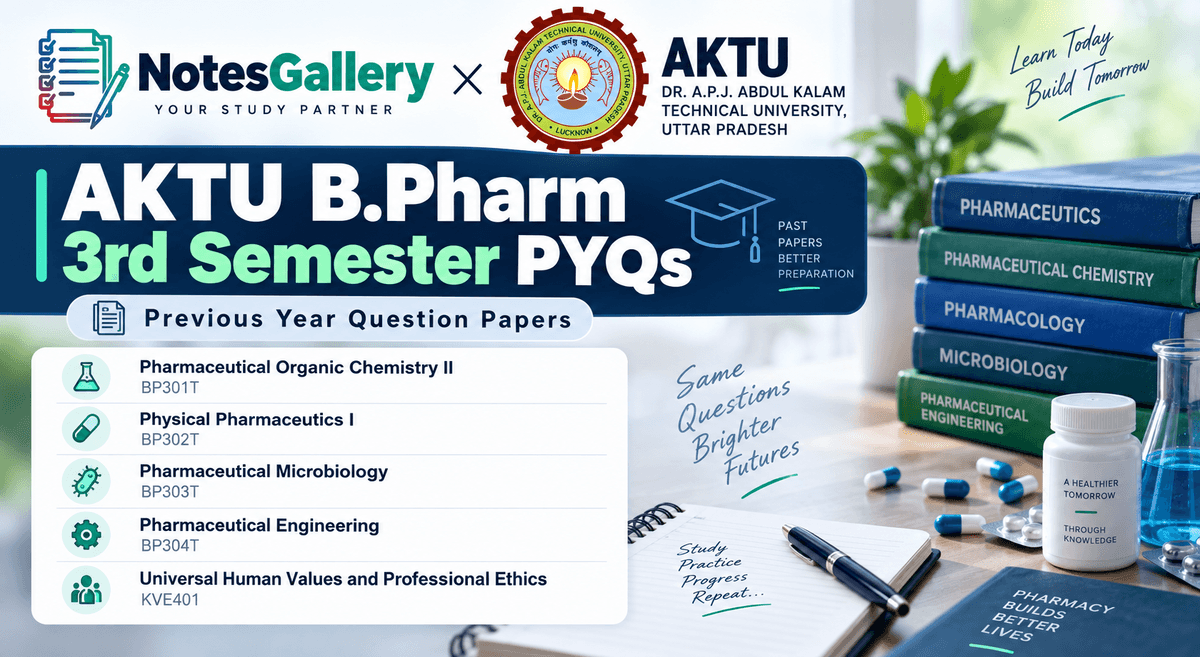
The third semester of B.Pharm includes subjects that strengthen students’ understanding of pharmaceutical chemistry, physical pharmacy, microbiology, pharmaceutical engineering, and professional ethics. Practicing AKTU B.Pharm 3rd Semester PYQs helps students understand how questions are framed in university examinations and which concepts need stronger revision before the semester exams.
Previous-year papers are most useful when students solve them after completing a topic or unit. Instead of only reading old questions, students should attempt them in writing, check where they are making mistakes, and revise the weak areas again.
Students can find B.Pharm previous-year question papers and other academic study resources on NotesGallery. For official university notices, examination announcements, circulars, and other authoritative updates, students should always refer to the AKTU Official Website.
AKTU B.Pharm 3rd Semester Subjects
The Semester 3 subjects shown here are:
| Subject Code | Subject Name |
|---|---|
| BP301T | Pharmaceutical Organic Chemistry II |
| BP302T | Physical Pharmaceutics I |
| BP303T | Pharmaceutical Microbiology |
| BP304T | Pharmaceutical Engineering |
| KVE401 | Universal Human Values and Professional Ethics |
Each subject has a different examination approach, so students should prepare them according to the nature of the paper instead of following the same revision method for every subject.
Subject-Wise AKTU B.Pharm 3rd Semester PYQs
Pharmaceutical Organic Chemistry II – BP301T
Pharmaceutical Organic Chemistry II develops understanding of organic compounds, their chemical behaviour, reactions, structures, and pharmaceutical relevance.
This subject requires regular written practice because students may understand a reaction while reading but still forget important structures, reagents, or reaction steps during the examination.
While preparing Pharmaceutical Organic Chemistry II PYQs, students should focus on:
- chemical structures
- classification of organic compounds
- important reactions
- reaction mechanisms
- preparation methods
- properties of compounds
- named reactions
- chemical transformations
- pharmaceutical importance of compounds where relevant
- comparison between related reactions or compounds
For reaction-based topics, students should practice the complete sequence rather than memorizing only the reaction name.
A useful revision structure is:
- Name of reaction or compound
- Structure
- Reagents
- Reaction conditions
- Product formation
- Mechanism where required
- Important applications or relevance
Practicing structures repeatedly is important because structure-based questions can be difficult to reproduce correctly through last-minute revision alone.
Physical Pharmaceutics I – BP302T
Physical Pharmaceutics I applies physical and physicochemical principles to pharmaceutical systems.
The subject helps students understand how physical properties of substances can influence formulation behaviour, stability, solubility, distribution, and other pharmaceutical characteristics.
While solving Physical Pharmaceutics I previous-year papers, students should prepare areas involving:
- important definitions
- physicochemical principles
- mathematical relationships
- factors affecting pharmaceutical properties
- graphs
- numerical problems
- units
- comparisons
- pharmaceutical applications of physical principles
This paper can contain both theoretical and calculation-based questions.
For numerical questions, students should use a proper step-by-step format:
Given data → Required value → Formula → Substitution → Calculation → Final answer with unit
This reduces calculation mistakes and makes the answer easier to understand.
For theory questions, students should focus on understanding the relationship between the physical concept and its pharmaceutical application rather than memorizing only a definition.
Pharmaceutical Microbiology – BP303T
Pharmaceutical Microbiology focuses on microorganisms and their importance in pharmaceutical products, manufacturing environments, healthcare, and microbiological quality control.
The subject contains many definitions, classifications, techniques, and processes. These become easier to prepare when students organize them using flowcharts and comparison tables.
Important preparation areas may include:
- microorganisms
- classification of microorganisms
- microbial growth
- cultivation-related concepts
- sterilization
- disinfection
- aseptic techniques
- contamination control
- microbiological testing
- pharmaceutical applications of microbiology
- evaluation of antimicrobial processes
Students should clearly differentiate between closely related microbiological concepts.
For process-based questions, a useful answer structure is:
- Definition
- Principle
- Procedure
- Important conditions
- Applications
- Advantages or limitations where relevant
Labelled diagrams and flowcharts can also improve the presentation of long answers.
Pharmaceutical Engineering – BP304T
Pharmaceutical Engineering deals with engineering principles, equipment, and unit operations used in pharmaceutical manufacturing.
This is a highly process-oriented subject, so students should understand the construction and working of important equipment rather than memorizing isolated definitions.
While practicing Pharmaceutical Engineering PYQs, students should focus on:
- engineering principles
- unit operations
- equipment construction
- equipment working
- operating procedures
- labelled diagrams
- pharmaceutical applications
- factors affecting different operations
- advantages and disadvantages
- comparison between different types of equipment
For equipment-based questions, students can prepare answers in the following format:
- Principle
- Construction
- Working
- Diagram
- Applications
- Advantages
- Limitations
This format makes long technical answers more organized and easier to reproduce in the examination.
Students should practice important equipment diagrams separately because diagrams often help explain the working more clearly.
Universal Human Values and Professional Ethics – KVE401
Universal Human Values and Professional Ethics introduces students to human values, ethical behaviour, professional responsibilities, and the importance of making responsible decisions in personal and professional life.
This subject is different from technical pharmacy papers because it focuses more on understanding values, relationships, responsibilities, ethical conduct, and professional behaviour.
Students preparing the PYQs of this subject should focus on:
- basic human values
- ethical behaviour
- professional ethics
- responsibilities in professional life
- decision-making based on values
- human relationships
- social responsibility
- harmony in personal and professional life
- ethical conduct in organizations
- importance of responsible professional behaviour
For descriptive questions, students should write answers with clear headings and logical examples wherever appropriate.
A useful structure can be:
- Definition
- Main concept
- Importance
- Practical relevance
- Professional application
- Conclusion
Students should avoid overly short answers in this subject because many questions require explanation rather than one-line definitions.
Why Solve AKTU B.Pharm 3rd Semester Previous Year Papers?
Previous-year question papers help students in several ways when used as part of regular study.
Understand the Question Pattern
PYQs help students understand how topics may be asked as:
- definitions
- short notes
- classifications
- reactions
- numerical questions
- process explanations
- diagrams
- comparisons
- long descriptive answers
- ethical or conceptual questions
Understanding the question style helps students decide how much detail they should prepare for a particular topic.
Identify Repeated Academic Areas
If similar concepts appear across several previous-year papers, students can mark them for extra revision.
However, students should not rely only on repeated questions. The complete prescribed syllabus should still be prepared because questions can be asked from any part of the course.
Improve Written Practice
Semester 3 includes subjects where writing practice is especially important.
For example:
- Pharmaceutical Organic Chemistry II requires structures and reactions.
- Physical Pharmaceutics I may require formulas and numerical calculations.
- Pharmaceutical Microbiology requires definitions, processes, and comparisons.
- Pharmaceutical Engineering requires principles, working, and diagrams.
- Universal Human Values and Professional Ethics requires clear descriptive explanations.
Practicing actual PYQs helps students improve presentation and recall.
Identify Weak Topics
Students may feel confident while reading notes but struggle when writing an answer without looking at them.
PYQ practice can reveal problems such as:
- forgetting a reagent
- using the wrong formula
- confusing two microbiological methods
- forgetting equipment working
- giving an incomplete ethics-based explanation
These weak areas should be revised separately.
Subject-Wise Preparation Strategy
For Pharmaceutical Organic Chemistry II
Focus on:
- structures
- reactions
- mechanisms
- reagents
- preparation methods
- named reactions
Practice important reactions repeatedly in writing.
For Physical Pharmaceutics I
Prepare both theory and numerical problems.
For each numerical topic:
- Remember the formula.
- Understand every variable.
- Practice unit conversion.
- Solve multiple questions.
- Check the final unit.
For Pharmaceutical Microbiology
Use tables to compare related concepts.
Prepare processes using:
Definition → Principle → Procedure → Conditions → Applications
This approach makes long answers easier to revise.
For Pharmaceutical Engineering
Practice labelled diagrams and equipment-based questions separately.
Prepare each equipment topic as:
Principle → Construction → Working → Applications → Advantages → Limitations
For Universal Human Values and Professional Ethics
Focus on understanding concepts instead of memorizing paragraphs.
Prepare answers around:
- meaning
- importance
- human relevance
- professional relevance
- practical examples
- responsible behaviour
This makes descriptive answers more natural and easier to remember.
How to Practice AKTU B.Pharm 3rd Semester PYQs
A systematic PYQ routine is more effective than randomly reading previous papers.
Step 1: Complete One Unit
Study the complete unit using your class notes, textbook, and prescribed syllabus.
Step 2: Find Related Previous Questions
Look for PYQs from the same unit.
Separate them into:
- short-answer questions
- medium-length questions
- long-answer questions
- numerical or reaction-based questions
Step 3: Attempt Without Notes
Try writing the answer independently.
This helps test actual understanding and recall.
Step 4: Compare With Study Material
Check whether you missed:
- definitions
- structures
- reactions
- formulas
- diagrams
- classifications
- important steps
- examples
- applications
- advantages or limitations
Step 5: Create a Weak-Topic List
Maintain a small list of topics you were unable to answer properly.
Revise these again before attempting the next paper.
Step 6: Solve a Full Previous-Year Paper
After completing most of the syllabus, attempt one complete paper within a fixed time limit.
This improves:
- time management
- answer-writing speed
- recall
- presentation
- examination confidence
Important Areas to Focus on While Using PYQs
When reviewing AKTU B.Pharm 3rd Semester PYQs, pay special attention to:
- chemical structures
- named reactions
- reaction mechanisms
- important formulas
- numerical problems
- definitions
- classifications
- microbiological processes
- sterilization and disinfection concepts
- equipment construction
- working principles
- diagrams
- comparisons
- ethical concepts
- professional responsibilities
These types of topics usually require structured preparation and should be practiced in writing.
Quick Revision Strategy Before the Exam
During final revision, prepare each subject according to its nature.
- Pharmaceutical Organic Chemistry II: revise structures, reactions, reagents, mechanisms, and important conversions.
- Physical Pharmaceutics I: revise formulas, important concepts, graphs, and numerical problems.
- Pharmaceutical Microbiology: revise classifications, sterilization, disinfection, microbial processes, and important procedures.
- Pharmaceutical Engineering: revise principles, equipment, working, diagrams, and applications.
- Universal Human Values and Professional Ethics: revise definitions, values, ethical concepts, responsibilities, and professional applications.
After completing the first revision, attempt selected previous-year questions without looking at your notes.
Any question that still feels difficult should be revised again before the examination.
Useful Resources for AKTU B.Pharm Students
Students can explore B.Pharm previous-year question papers, notes, and other academic study resources on NotesGallery.
For official AKTU notices, examination-related announcements, circulars, and other authoritative university information, students should refer to the AKTU Official Website.
NotesGallery is an independent educational resource platform and should not be considered the official website of Dr. A.P.J. Abdul Kalam Technical University.
How to Use NotesGallery PYQs Effectively
Students can use the previous-year papers available on NotesGallery together with their semester notes.
A practical study routine is:
- Complete one topic.
- Find related PYQs.
- Attempt the questions without assistance.
- Identify missing points.
- Revise weak areas.
- Attempt the same question again later.
- Move to complete paper practice after syllabus completion.
This makes previous-year papers part of regular preparation instead of a last-minute resource.
Pharmaceutical Organic Chemistry II
| Year | Odd Semester |
|---|---|
| 2020-21 | N/A |
| 2021-22 | Download PDF |
| 2022-23 | |
| 2023-24 | Download PDF |
| 2024-25 | Download PDF |
| 2025-26 |
Physical Pharmaceutics I
| Year | Odd Semester |
|---|---|
| 2020-21 | Download PDF |
| 2021-22 | Download PDF |
| 2022-23 | Download PDF |
| 2023-24 | |
| 2024-25 | Download PDF |
| 2025-26 |
Pharmaceutical Microbiology
| Year | Odd Semester |
|---|---|
| 2020-21 | Download PDF |
| 2021-22 | Download PDF |
| 2022-23 | |
| 2023-24 | Download PDF |
| 2024-25 | Download PDF |
| 2025-26 |
Pharmaceutical Engineering
| Year | Odd Semester |
|---|---|
| 2020-21 | Download PDF |
| 2021-22 | Download PDF |
| 2022-23 | Download PDF |
| 2023-24 | |
| 2024-25 | |
| 2025-26 |
Universal Human Values and Professional Ethics
| Year | Odd Semester |
|---|---|
| 2020-21 | N/A |
| 2021-22 | N/A |
| 2022-23 | N/A |
| 2023-24 | N/A |
| 2024-25 | N/A |
| 2025-26 | Download PDF |
Frequently Asked Questions
What subjects are included in AKTU B.Pharm 3rd Semester?
The subjects shown for Semester 3 are Pharmaceutical Organic Chemistry II (BP301T), Physical Pharmaceutics I (BP302T), Pharmaceutical Microbiology (BP303T), Pharmaceutical Engineering (BP304T), and Universal Human Values and Professional Ethics (KVE401).
Where can I find AKTU B.Pharm 3rd Semester PYQs?
Students can use AKTU B.Pharm 3rd Semester PYQs available through NotesGallery for subject-wise previous-year paper practice and revision.
What is the official website of AKTU?
Students should refer to the AKTU Official Website for official university notices, circulars, examination announcements, and other authoritative information.
Which B.Pharm 3rd Semester subject requires the most reaction practice?
Pharmaceutical Organic Chemistry II requires regular practice of chemical structures, reactions, reagents, and mechanisms. Writing reactions repeatedly is generally more effective than only reading them.
Which subject requires numerical practice in B.Pharm 3rd Semester?
Physical Pharmaceutics I can involve mathematical relationships and numerical problems. Students should practice formulas, substitution, calculations, and units carefully.
How should I prepare Pharmaceutical Engineering using PYQs?
Prepare every major equipment topic through its principle, construction, working, diagram, applications, advantages, and limitations. Then attempt related PYQs without referring to notes.
Should I study only repeated questions from previous-year papers?
No. Repeated questions can help identify areas that deserve extra revision, but students should still prepare the complete prescribed syllabus. PYQs should be used for practice, revision, and understanding the examination pattern.


