
University: Dr. A.P.J. Abdul Kalam Technical University (AKTU)
Programme: B.Tech First Year, Semester I & II
Course Codes: AAS102A-H / AAS202A-H
Branches: CSE, EE, ECE, CE, ME, BT, CH, TX and AG
Unit: IV — Functional Materials, Energy and Bioprocessing
Introduction to Functional Materials, Energy and Bioprocessing
Functional materials provide useful behaviour through their composition, bonding, structure and interfaces. A conducting nanotube network, an optical quantum dot, a reflective roof coating and a cross-linked textile finish perform different tasks, yet each connects chemical design with a measurable engineering function.
Energy systems add reactions and transport. Batteries move ions between compatible hosts, fuel cells convert continuously supplied reactants, photovoltaics collect light-generated carriers and thermochemical materials store heat through reversible transformations. Their output depends on the complete device as well as the active substance.
Polymers and specialty chemicals combine molecular structure with formulation. Fermentation connects medium chemistry and metabolism with product recovery. Food chemistry links composition, deterioration, preservation and packaging. Textile finishing uses mechanical operations and selected chemical interactions to change fabric performance.
These Applied Chemistry Unit 4 Notes develop all eight branch routes through connected explanations, labelled figures, comparison tables, worked problems and answered revision. Start with the reading guide to select the route associated with your stream and paired course codes.
Unit Coverage
- Nanotechnology, surface-to-volume ratio and accessible interfaces.
- Carbon nanotubes, graphene and quantum dots.
- Smart coatings, wetting and self-cleaning mechanisms.
- Photochromic, thermochromic and shape-memory materials.
- Flexible electronics and device integration.
- Nanoparticle synthesis and thin-film deposition.
- Self-assembled monolayers, MoS₂, h-BN and nanoelectronics.
- Geopolymers, recycled aggregates and bio-based building materials.
- Insulation, cool roofs, self-healing polymers and demolition recovery.
- Galvanic cells, Nernst calculations and concentration cells.
- Fuel cells, batteries, supercapacitors and hydrogen production.
- Photovoltaics and thermochemical energy storage.
- Polymer growth, industrial plastics, elastomers and thermosets.
- Surfactants, detergents and specialty formulations.
- Fermentation, sterilization, metabolic pathways and downstream processing.
- Food composition, browning, preservation and packaging quality.
- Textile finishing, easy-care chemistry, repellency, flame retardance and UV protection.
Important Terms
| Term | Meaning |
|---|---|
| Nanometre | One billionth of a metre |
| Accessible surface | Interface actually reached by the interacting medium |
| Aspect ratio | Ratio of selected length to width or diameter |
| Sheet resistance | Resistance parameter for a uniform thin conducting layer |
| Quantum yield | Emitted photon count divided by absorbed photon count |
| Contact-angle hysteresis | Difference between advancing and receding contact angles |
| Photochromism | Reversible light-induced change in optical absorption |
| Thermochromism | Temperature-dependent change in optical response |
| Shape memory | Programmed temporary-shape retention and stimulus-dependent recovery |
| ALD | Deposition through sequential self-limiting surface reactions |
| Geopolymer | Activated aluminosilicate-based binding network |
| Solar reflectance | Fraction of incident solar radiation reflected |
| EMF | Reversible open-circuit potential under stated conditions |
| Productivity | Product quantity per defined volume and time |
| Recovery | Target output relative to target input |
| Purity | Target quantity relative to the total selected stream |
| Water activity | Equilibrium vapour-pressure ratio relative to pure water |
| Dry add-on | Retained dry finish relative to original dry fabric |
Working Conventions
Equations use written mathematical notation with a stated physical model. Particle geometry, film thickness and bending dimensions require consistent units. Geometric surface area and experimentally accessible surface area can differ.
Electrochemical signs follow reaction direction. Reversible potential differs from loaded voltage; charge differs from energy. Capacitor and photovoltaic estimates retain their supplied operating limits and input boundaries.
Yield, purity and recovery have different denominators. Food moisture is labelled wet basis or dry basis. Textile wet pickup includes solvent, while dry add-on concerns retained dry material. Numerical properties and efficiencies supplied in the worked problems are educational values within the stated conditions.
Branch Reading Guide
Each row is the complete Unit IV reading route, including shared chapters. It is not only a list of additional topics. No separate common block needs to be added. Paired semester codes have the same within-stream syllabus.
| Stream / Codes | Official Subject and Unit IV | Complete Route |
|---|---|---|
| CE — AAS102A / AAS202A | Applied Chemistry for Sustainable Structure & Material Design; Unit IV: Green and Sustainable Building Materials | Sections 16–22 |
| ME — AAS102B / AAS202B | Applied Chemistry for Advanced Metal Protection and Sustainable Energy Systems; Unit IV: Sustainable Energy Chemistry | Sections 23–30 |
| EE / ECE — AAS102C / AAS202C | Applied Chemistry for Emerging Electronics and Futuristic Devices; Unit IV: Nanomaterials and Thin Films for Electronics | Sections 1–4 and 11–15 |
| CSE — AAS102D / AAS202D | Applied Chemistry for Smart Systems; Unit IV: Nanomaterials and Functional Materials for Smart Systems | Sections 1–10 |
| TX — AAS102E / AAS202E | Applied Chemistry for Fibres, Polymers and Sustainable Textiles; Unit IV: Textile Finishing Chemistry | Sections 45–48 |
| BT — AAS102F / AAS202F | Applied Chemistry for Biomolecules and Bioprocess Systems; Unit IV: Fermentation Chemistry and Bioprocessing | Sections 36–40 |
| CH — AAS102G / AAS202G | Applied Chemistry for Process Engineering and Industrial Applications; Unit IV: Polymer and Specialty Chemical Chemistry | Sections 31–35 |
| AG — AAS102H / AAS202H | Applied Chemistry for Soil, Water and Agro Systems; Unit IV: Food Chemistry and Agro-product Quality | Sections 41–44 |
Shared foundations, then different topics: CSE reads Sections 1–10. EE/ECE read Sections 1–4 and 11–15. The shared chapters cover nanotechnology, CNTs, graphene and quantum dots. Sections 11–15 add synthesis, deposition, monolayers, two-dimensional materials and nanoelectronics.
EE/ECE do not need to add CSE-only Chapters 5–10 to complete this route.
Independent complete routes: CE reads Sections 16–22; ME 23–30; CH 31–35; BT 36–40; AG 41–44; TX 45–48. These are complete branch routes. There is no compulsory common block of Chapters 1–30 for these streams.
Follow numbered chapter headings and study-route labels. Broad page ranges in a combined volume can share boundary pages. A chapter can contain useful context beyond its shortest syllabus phrase, so study the explanation with its diagrams and worked examples.
The 50 worked problems are placed beside the relevant theory. Select formulas for your route and retain their assumptions and units. Other branch chapters provide optional enrichment.
1. Nanotechnology: Scale, Surface and Function
Study route: CSE / EE / ECE
Nanotechnology concerns understanding and engineering matter at roughly 1–100 nm to use behaviour associated with that scale. One nanometre equals 10^-9 m.
A nanoscale dimension can change the fraction of material at interfaces, the available electronic states or the way structures connect. These are distinct mechanisms rather than one universal nano effect.

Why Size Matters
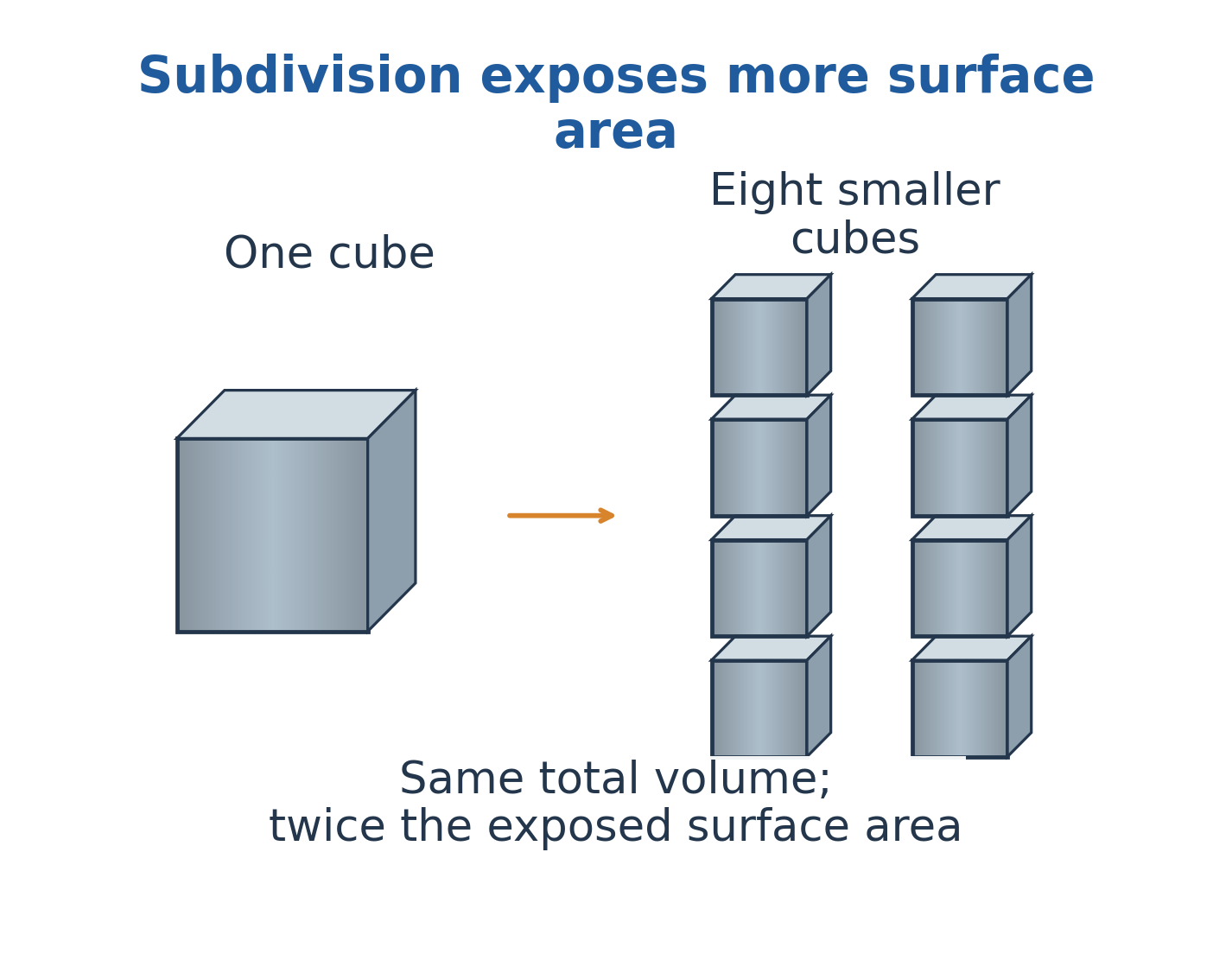
Atoms at a surface have a different environment from those deep inside a solid. Subdividing a material into smaller, separated particles increases exposed area per unit volume.
This can affect adsorption, chemical reaction and interaction with a surrounding polymer. Aggregation can reduce the area actually accessible to a liquid or gas.
For a sphere of diameter d:
Surface area, A = πd²
Volume, V = πd³/6
Therefore:
A/V = 6/d
For a cube of side L:
A/V = 6/L
Use one consistent length unit. With diameter in metres, the surface-to-volume ratio is expressed in m^-1.
A high surface-to-volume ratio can increase the number of exposed reaction sites per unit material. It can also increase unwanted interactions, such as oxidation or moisture adsorption.
A material therefore needs to be assessed for the intended function. Greater area alone does not prove improved durability, conductivity or strength.
Worked Problem 4.1: Surface-to-Volume Scaling
Route: CSE / EE / ECE
Problem: Compare isolated spherical particles of diameters 20 nm and 100 nm. Find A/V in m^-1 and the surface-area ratio for equal total volume.
Solution:
Convert the diameters into metres:
d₁ = 20 × 10^-9 = 2 × 10^-8 m
d₂ = 100 × 10^-9 = 1 × 10^-7 m
For the smaller particles:
A/V = 6/(2 × 10^-8) = 3 × 10^8 m^-1
For the larger particles:
A/V = 6/(1 × 10^-7) = 6 × 10^7 m^-1
At equal total volume, the ratio of total geometric areas is:
Area ratio = (3 × 10^8)/(6 × 10^7) = 5
Answer: The surface-to-volume ratios are 3 × 10^8 m^-1 and 6 × 10^7 m^-1. The equal-volume surface-area ratio is 5:1.
Smaller particles of the same ideal shape provide greater geometric area per unit volume. Actual accessible area can be lower when particles aggregate or become covered.
2. Carbon Nanotubes: Structure, Networks and Properties
Study route: CSE / EE / ECE
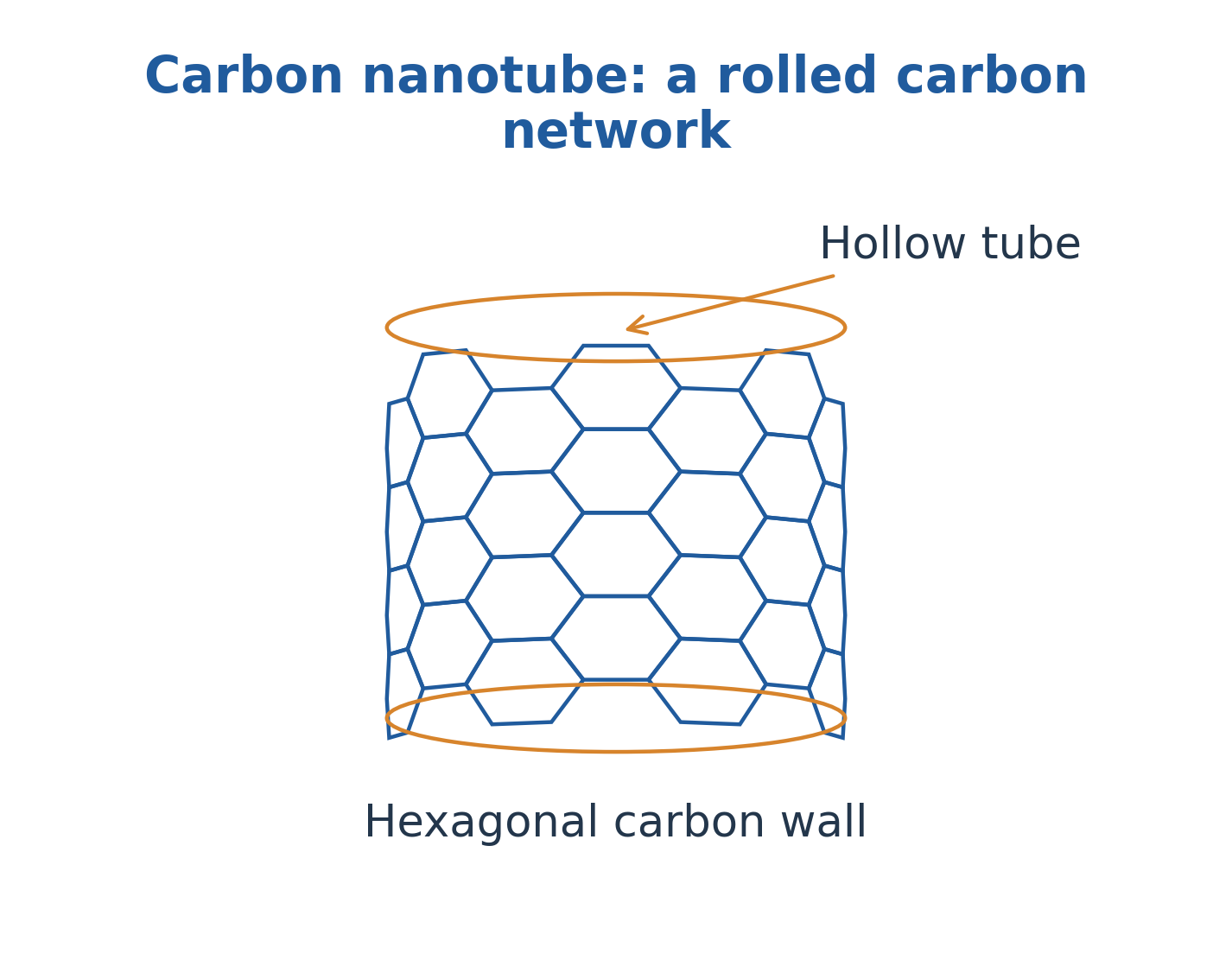
A carbon nanotube, or CNT, has a cylindrical graphitic wall. A single-walled CNT has one tubular wall, while a multi-walled CNT contains nested walls.
A bundle of separate tubes is different from one multi-walled tube. The distinction matters because the arrangement of walls and the junctions between separate tubes influence transport and mechanical response.

Bonding and Conduction
The ideal wall contains an sp²-bonded carbon network. Strong in-plane bonding contributes to axial stiffness, and delocalised electronic states support useful transport.
Single-walled CNT electronic behaviour depends on structure, including chirality and diameter. Different tubes can be metallic or semiconducting.
In a real film, tube-to-tube junctions, contacts, defects, impurities and processing damage can dominate resistance. Properties of one ideal tube are not automatically the properties of a bulk composite.
Reinforcement and Heat Transport
High-aspect-ratio fillers can reinforce a polymer and support heat or charge transport. Reinforcement requires effective stress transfer at the interface.
Poorly dispersed clusters can instead introduce defects. Excessive filler can reduce flexibility or processability.
CNT networks can conduct after enough tubes form connected paths. Percolation depends on aspect ratio, dispersion and contacts rather than merely total carbon mass.
Metallic or semiconducting behaviour depends on nanotube structure. A commercial mixture cannot be assumed to have one electronic type.
Functionalization can improve compatibility, but it can also introduce defects or change transport. Distinguish an individual nanotube property from the resistance of a processed network.
EE/ECE Synthesis Emphasis
Catalytic chemical vapour deposition decomposes a suitable carbon precursor at catalyst-containing regions and supports tube growth under controlled conditions.
Arc discharge and laser ablation provide other production routes.
Catalyst composition, temperature and feed affect yield, diameter, defects and impurities. Purification can remove unwanted material but can also damage tubes.
Characterize the processed product rather than assuming that its properties remain identical to an ideal untreated nanotube.
Worked Problem 4.2: Tube Aspect Ratio
Route: CSE / EE / ECE
Problem: A tube is 2 μm long with an outside diameter of 10 nm. Find its length-to-diameter ratio.
Solution:
Convert the length into nanometres:
2 μm = 2000 nm
Then:
Aspect ratio = Length/Diameter
Aspect ratio = 2000/10 = 200
Answer: The aspect ratio is 200.
Length and diameter must be expressed in the same unit before their ratio is calculated.
3. Graphene and Related Carbon Films
Study route: CSE / EE / ECE
Graphene is one atomic layer of carbon in a two-dimensional hexagonal network. Its sp² bonding and electronic structure provide a useful combination of in-plane strength, electrical transport, thinness and optical transmission under suitable conditions.


Graphene Oxide Is a Different Material
Oxygen-bearing groups and disrupted structure change processing and conduction. Reducing graphene oxide can improve conductivity without restoring every feature of a pristine monolayer.
Graphite is a stacked bulk material. Few-layer graphene is not the same specimen as a monolayer.
Graphene oxide contains oxygen-bearing groups and structural disruption that can improve processing in some media while reducing conductivity.
Reduction can increase conductivity but does not necessarily restore a perfect graphene lattice.
Practical Electronic Distinctions
Ideal monolayer graphene has no conventional band gap. This helps explain why useful conduction does not make graphene a universal replacement for silicon digital switches.
Suppressing off-state current is a different requirement from producing a good conducting film.
A conducting sheet can be useful for electrodes, interconnects or sensing interfaces while still presenting limitations for a particular switching function.
EE/ECE Synthesis Emphasis
Exfoliation separates layers from suitable graphite, while CVD grows carbon layers from reactive feed on an appropriate substrate.
Oxidation of graphite followed by exfoliation produces graphene-oxide-related material. Reduction is a further chemical step.
Transfer, residues and substrate interaction affect the final film. Route selection must therefore consider the device interface as well as layer count.
Worked Problem 4.3: Find Sheet Resistance
Route: CSE / EE / ECE
Problem: A uniform film has a film-only resistance of 240 Ω, a length of 12 mm and a width of 3 mm. Find its sheet resistance.
Solution:
For a uniform rectangular film:
R = Rₛ × L/W
The number of squares is:
L/W = 12/3 = 4
Therefore:
Rₛ = R/(L/W)
Rₛ = 240/4 = 60 Ω per square
Answer: The sheet resistance is 60 Ω per square.
Four geometric squares in series reproduce the measured film resistance of 240 Ω under the stated model.
4. Quantum Dots: Confinement, Absorption and Emission
Study route: CSE / EE / ECE
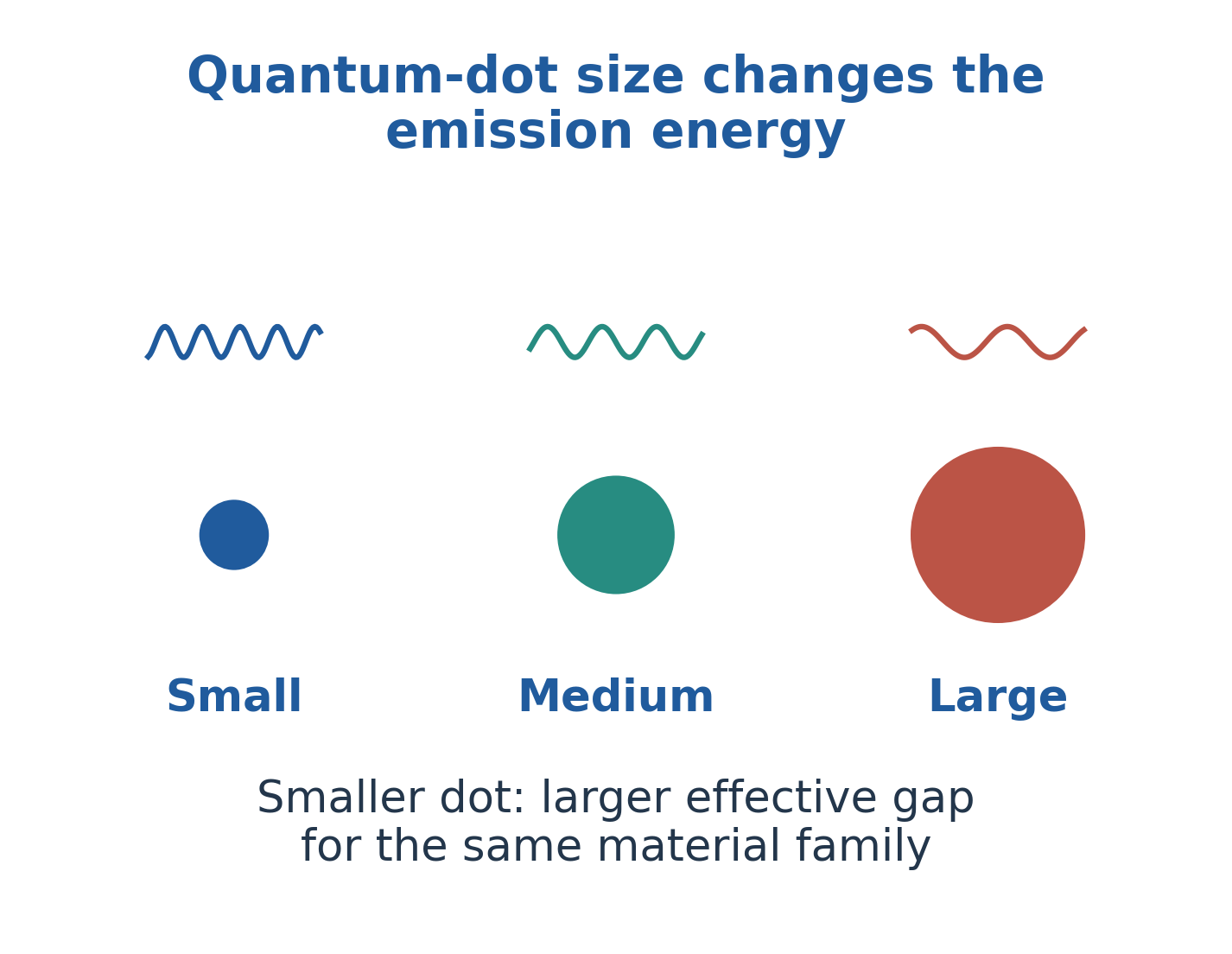
Quantum dots are semiconductor nanostructures that can confine carriers in all three directions. Their size-sensitive electronic states can produce a tunable optical response.
Composition, size distribution, shape, core/shell design and surface chemistry all influence the spectrum.

From Excitation to Emission
Suitable photons create excited states. Relaxation can be followed by radiative electron-hole recombination, producing an emitted photon.
Non-radiative pathways compete with emission. Surface defects can create loss channels, while passivation or a suitable shell can reduce selected surface-related losses.
For one photon:
E = hc/λ
A useful approximate conversion is:
E(eV) = 1240/λ(nm)
Shorter wavelength means higher photon energy. This relation converts energy and wavelength; it does not independently determine dot diameter.
Quantum Yield
Photoluminescence quantum yield is:
Quantum yield = Emitted photon count/Absorbed photon count
The definition applies over a stated measurement.
It differs from electrical efficiency, which includes electrical input and other system losses. Brightness also depends on excitation intensity, absorption and collection geometry.
| Dot Family | Chemistry and Interpretation |
|---|---|
| CdSe | Semiconductor nanocrystal containing cadmium |
| InP | Different semiconductor chemistry; surface passivation remains important |
| Carbon dots | Heterogeneous carbon-based systems in which surface states can be important |
A cadmium-free composition identifies one compositional distinction. It does not automatically establish the complete environmental profile of every precursor, coating or final device.
Worked Problem 4.4: Wavelength from a Transition
Route: CSE / EE / ECE
Problem: A supplied optical transition emits a 2.4 eV photon. Estimate its wavelength.
Solution:
Use:
λ = 1240/E
Substitute the energy in electronvolts:
λ = 1240/2.4 = 516.7 nm
Answer: The wavelength is approximately 517 nm.
As a check:
2.4 × 516.7 ≈ 1240 eV·nm
5. Smart Coatings and Engineered Interfaces
Study route: CSE
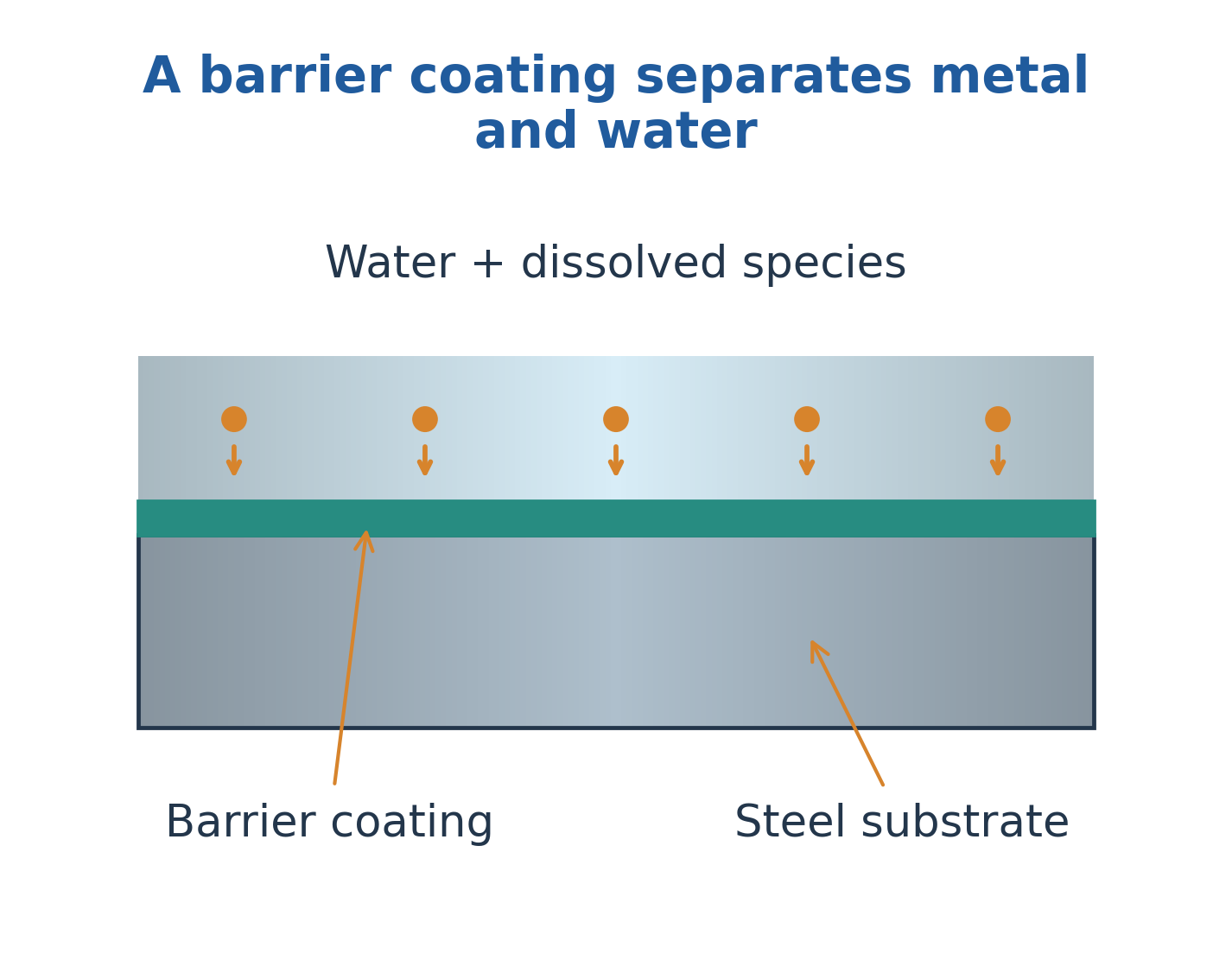
A coating changes a surface property while a substrate provides much of the support. A smart coating supplies a useful response or adaptive function, such as a change in wetting, colour or protection under a stimulus.
State the actual response rather than calling every protective paint smart.

Thickness
More material can improve coverage but increase stiffness, optical loss or diffusion distance. A discontinuous film can leave unprotected regions.
Thickness must therefore be selected alongside continuity, flexibility and the intended transport or optical function.
Adhesion
Compatibility, preparation and thermal or mechanical stress influence long-term attachment.
Good initial spreading during application does not guarantee durable adhesion.
A film that initially wets a surface can still detach during repeated bending, moisture exposure or temperature cycling.
Roughness
Texture can change apparent wetting and light scattering.
A texture that helps water repellence may also produce haze or wear rapidly. The appropriate roughness depends on whether the coating serves an optical, mechanical, protective or wetting function.
Durability
Evaluate scratching, repeated cleaning, moisture, temperature cycles and the intended environment.
One attractive drop photograph is an initial observation rather than a lifetime test. Performance needs to be assessed after relevant use and environmental exposure.
6. Hydrophobic and Self-Cleaning Surfaces
Study route: CSE
Wetting describes a liquid’s interaction with a solid.
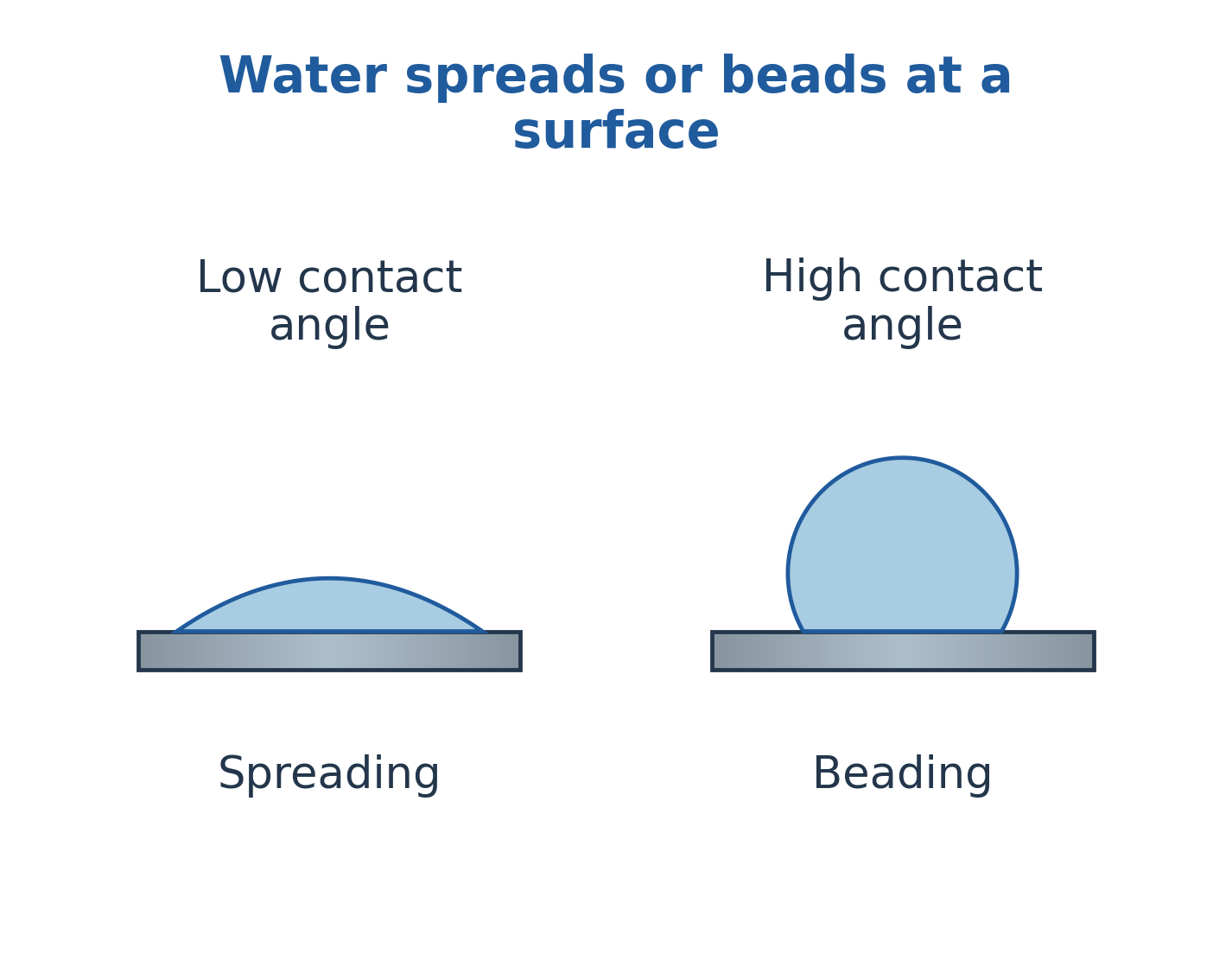
Contact angle θ is measured through the liquid between the solid surface and the tangent to the liquid interface at the contact line.
Surface chemistry, roughness and history influence the apparent angle.

Static Angle Is One Observation
A large static water angle does not establish easy drop motion.
Advancing and receding angles, together with roll-off tests, add information about pinning and mobility under their own conditions.
A water angle below 90° commonly describes hydrophilic behaviour, while an angle above 90° describes hydrophobic behaviour.
Superhydrophobic surfaces are often associated with apparent angles above about 150° and low resistance to drop motion. A large static angle alone does not prove low adhesion.
Self-Cleaning Mechanisms
Self-cleaning reduces the need for external cleaning through a defined operating mechanism.
Water-assisted particle removal and photocatalytic chemical transformation must be distinguished.
On a suitable low-adhesion, water-repellent surface, moving drops can collect loose particles. This lotus-effect concept depends on water availability, drop motion and dirt interactions.
Sticky oily deposits or strongly attached particles can limit removal.
A surface that repels water is not automatically effective against every type of contamination. Cleaning performance depends on both the surface and the material being removed.
Worked Problem 4.5: Contact-Angle Hysteresis
Route: CSE
Problem: A surface has an advancing angle of 153° and a receding angle of 137°. Find the contact-angle hysteresis.
Solution:
Hysteresis = Advancing angle − Receding angle
Hysteresis = 153° − 137° = 16°
Answer: The contact-angle hysteresis is 16°.
The static angle is not substituted for either dynamic-angle measurement.
7. Photochromic Materials and Reversible Switching
Study route: CSE
Photochromism is a reversible light-induced change between states with different absorption spectra.
Activation and reversal can follow different photochemical or thermal pathways depending on the material.


In an organic system, light can alter molecular arrangement or bonding, changing electronic absorption.
A polymer host influences mobility and stability. Inorganic photochromic systems can use other mechanisms, so identify the class rather than implying one reaction explains all materials.
A Reversible Cue Can Fade
A photochromic state can recover while exposure history changes.
A cumulative-dose interpretation needs a validated history-response model. Tint alone is not a permanent exposure record.
This distinction matters when choosing between a reversible visual response and a label intended to preserve evidence of past exposure.
Transmission and Absorbance
Transmission is expressed as a fraction when used in:
A = −log₁₀(T)
A transmission of 80% means T = 0.80, not 80.
Absorbance at a selected wavelength describes attenuation under the stated measurement. It is not automatically a complete measure of visual appearance over the whole visible spectrum.
Worked Problem 4.6: Transmission and Absorbance
Route: CSE
Problem: At one wavelength, a lens changes from 80% transmission to 25% transmission. Find the absorbance in both states.
Solution:
For the initial state:
T₁ = 0.80
A₁ = −log₁₀(0.80) = 0.0969
For the activated state:
T₂ = 0.25
A₂ = −log₁₀(0.25) = 0.6021
Answer: The absorbances are approximately 0.097 and 0.602.
Using 80 instead of 0.80 inside the logarithm would be incorrect.
8. Thermochromic Materials and Temperature Response
Study route: CSE
Thermochromism is a temperature-dependent optical change.
Molecular state, ordering or phase behaviour can change absorption or reflected colour.
Leuco-dye and liquid-crystal systems are examples of different mechanisms rather than one universal reaction.

Reversible and History-Recording Behaviour
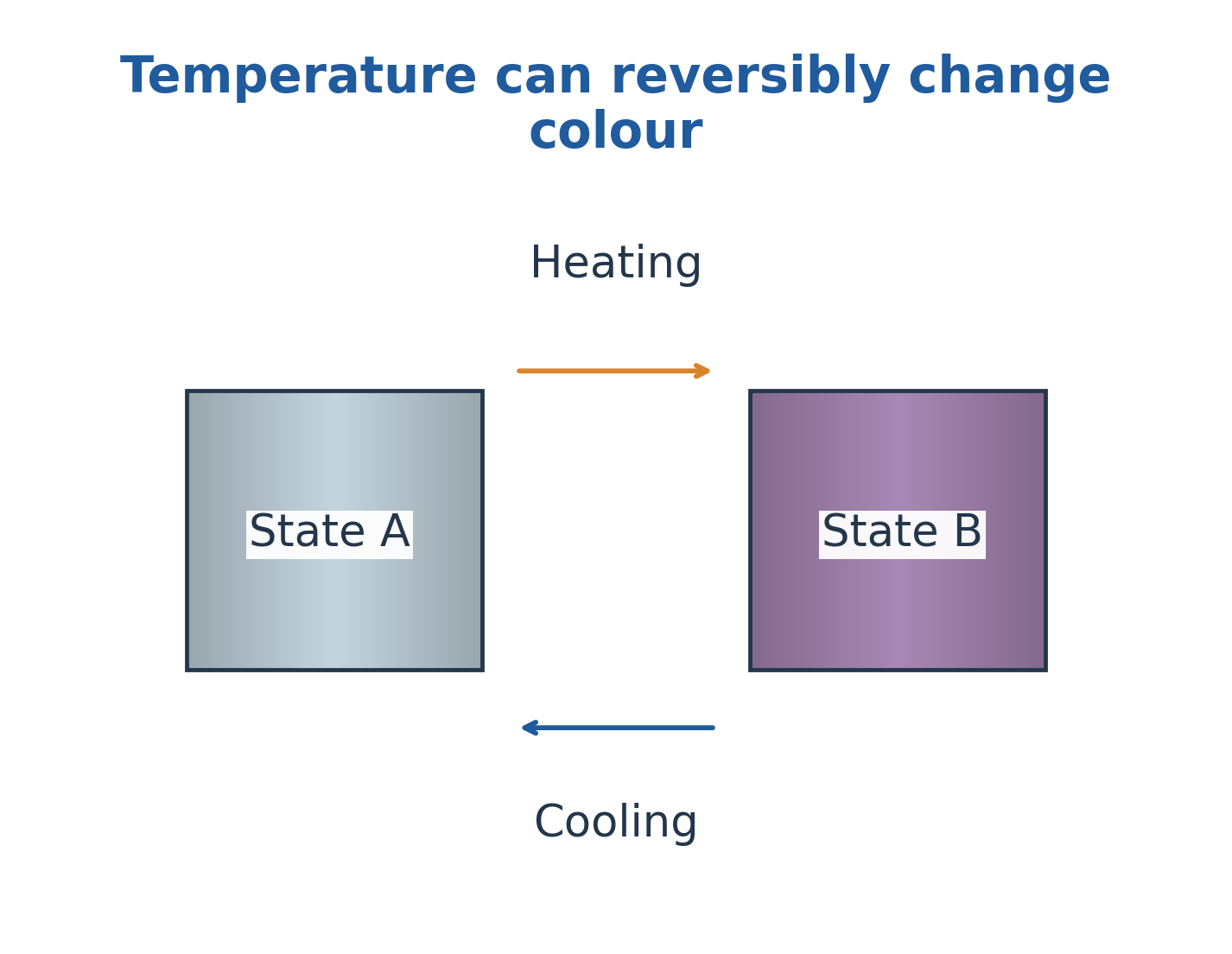
A reversible material returns towards an earlier appearance on cooling through its response range.
An irreversible label can retain evidence of a past event.
Choose the response that matches the information required. Current condition and past threshold crossing are different questions.
Heating and cooling thresholds can differ. This thermal hysteresis means that colour near the transition depends on recent history as well as current temperature.
Ageing, viewing light and response time can also influence interpretation.
Thermochromic coatings can support packaging indicators and visual thermal displays.
A visual change does not inherently generate electrical power. An electrical system needs a detector or a separate transduction route.
Interpreting a Thermochromic Indicator
Identify the stimulus range, expected optical change and reversal behaviour.
A useful answer should state whether the indicator reports current temperature, a temperature range or a past event.
A colour photograph without stated lighting, time and temperature history cannot completely describe the response.
Repeated-cycle behaviour is also relevant. A material that changes once can serve a different purpose from one expected to switch repeatedly during normal use.
9. Shape-Memory Polymers and Programmed Recovery
Study route: CSE
A shape-memory polymer, or SMP, retains a programmed temporary shape and recovers towards a stored permanent shape under a suitable stimulus.
In a common thermal design, stable netpoints preserve the reference structure while switching domains become mobile across a transition.

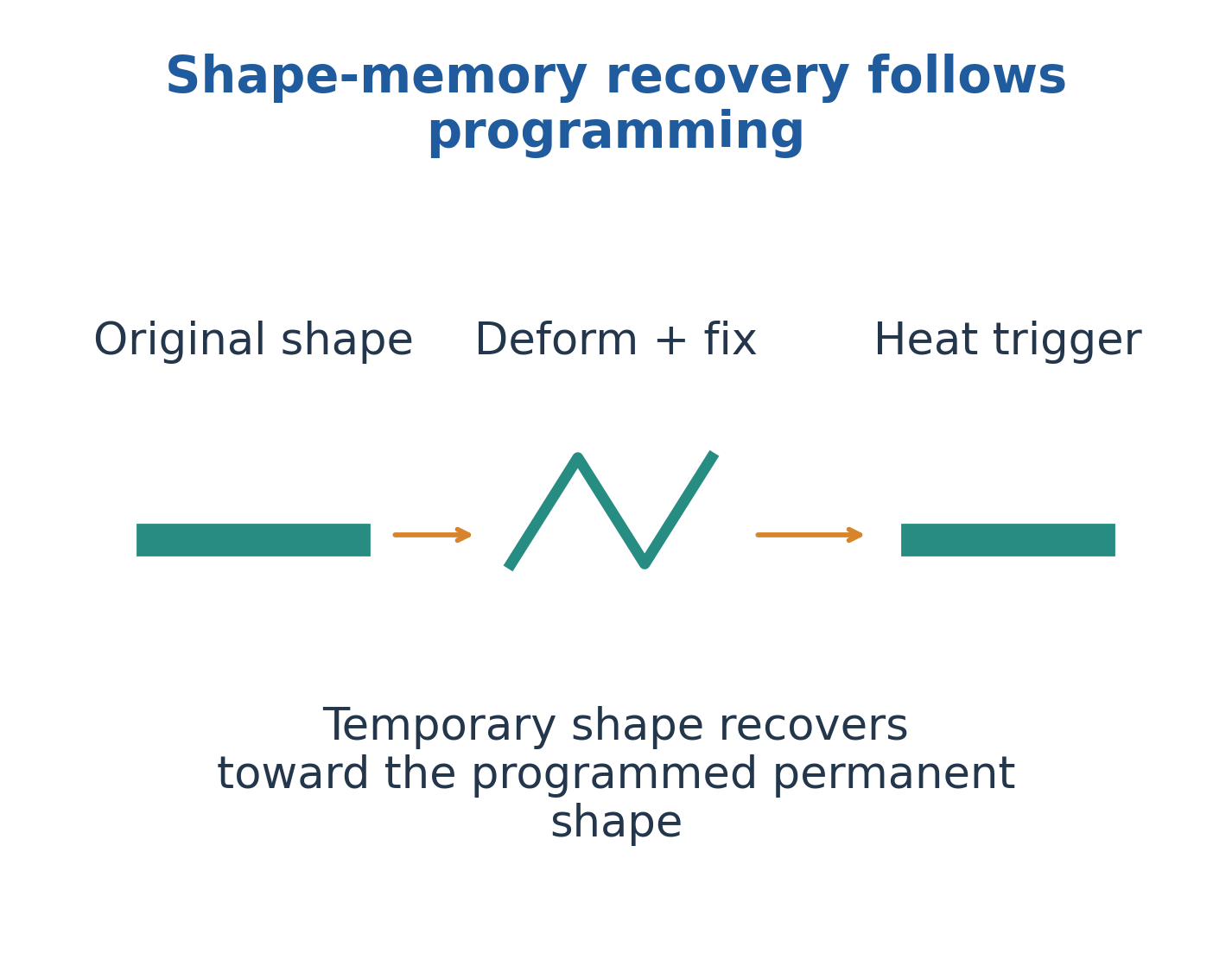
The transition can involve glass transition or melting of a switching phase. Complete melting of the polymer is not required.
Simply heating an ordinary plastic until it deforms does not demonstrate a programmed shape-memory cycle.
Steps of the Thermal Cycle
- Establish the permanent reference geometry through the network architecture or stable netpoints.
- Heat through the appropriate switching transition and deform within the supported range.
- Cool under constraint to restrict switching-domain motion.
- Unload to retain the temporary shape.
- Reheat appropriately so stored driving forces allow recovery towards the reference shape.
A common one-way SMP needs another programming step to produce a new temporary shape.
Repeated automatic opening and closing during heating and cooling requires an appropriate two-way material or system. It is not established merely by demonstrating a one-way effect.
Different Shape-Memory Measurements
Shape fixity describes retention of the programmed temporary shape.
Shape recovery describes movement back towards the reference shape under the selected convention.
Recovery force, speed and repeated-cycle durability provide further information. A high recovery percentage alone does not establish all of these properties.
Worked Problem 4.7: Calculate Shape Recovery
Route: CSE
Problem: A zero-residual starting cycle is programmed to 50% strain and ends at 5% residual strain. Find the recovery ratio.
Solution:
Programmed strain:
εₚ = 50%
Residual strain:
εᵣ = 5%
Recovered strain under the stated definition:
50 − 5 = 45 percentage points
Therefore:
Recovery = (50 − 5)/50 × 100
Recovery = 90%
Answer: The recovery is 90% under the stated definition.
Do not mix this convention with a different cyclic strain definition.
10. Flexible Electronics and Integrated Smart Devices
Study route: CSE
Flexible electronics retain function while bending or conforming.
A polymer support, compliant conductors, functional films and small rigid islands can be combined.
Flexibility and stretchability differ. Curvature change is not the same as in-plane extension.

A Bend Test Has Defined Conditions
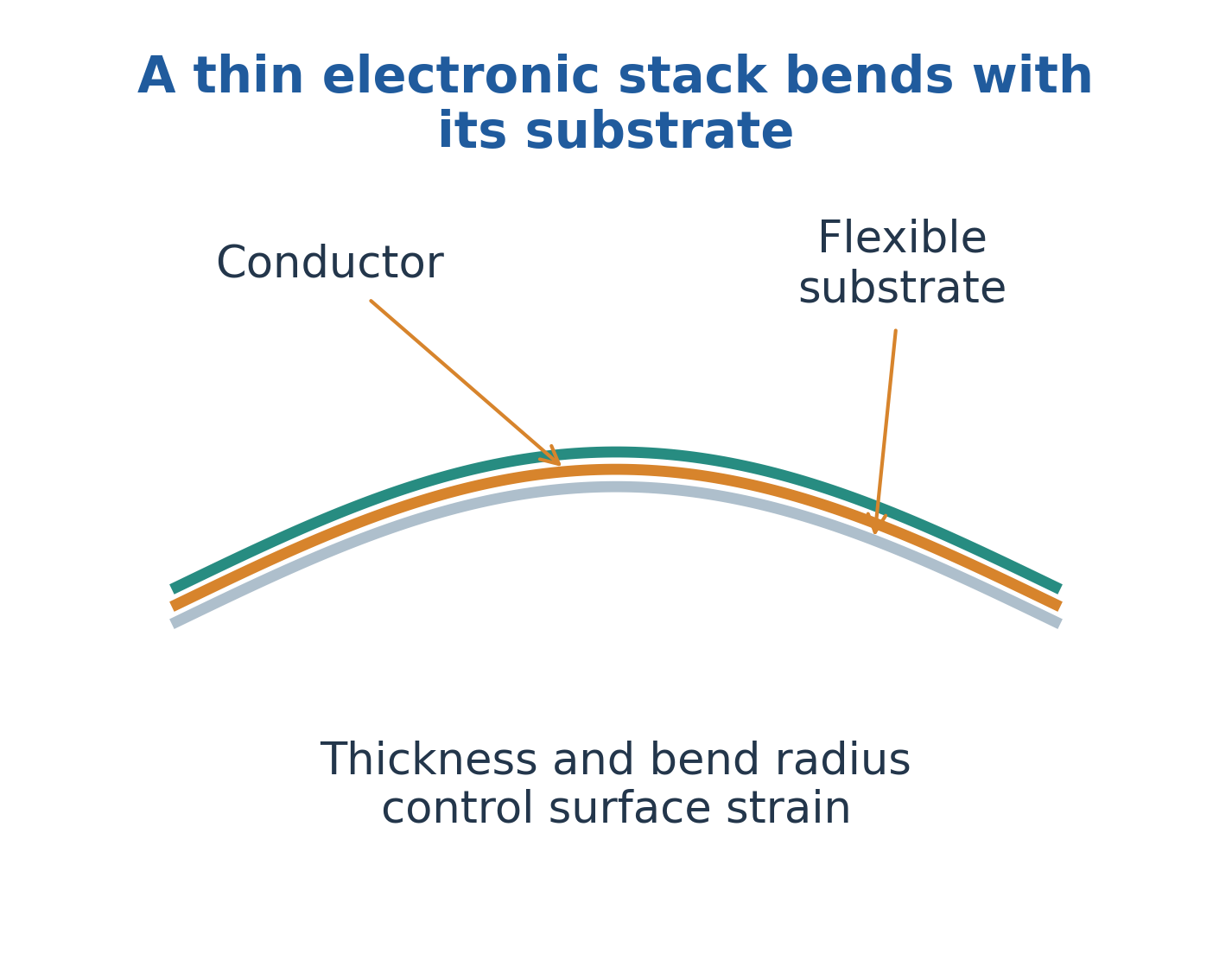
Radius, cycle count, direction and measurement conditions define the result.
Passing one bend radius does not establish resistance to every wearable motion or to in-plane stretching.
For a thin homogeneous film of thickness t bent to radius R, an outer-surface estimate is:
|ε| ≈ t/(2R)
This assumes that thickness is much smaller than radius and that the neutral plane is near the middle.
Use the same length unit for both quantities.
A wearable patch needs support, conduction, response, insulation, protection and readout. No single nanomaterial automatically provides every function.
Designing a Flexible Smart-Material System
Begin with the required function, then identify the mechanism that can produce it.
A conducting CNT or graphene network can carry charge or respond to changes at its interfaces.
A quantum-dot layer can emit light under suitable excitation. A photochromic layer changes optical absorption after illumination, while a thermochromic layer responds to temperature.
A shape-memory polymer uses a programmed temporary shape and a stimulus-dependent recovery process.
These functions are complementary and should not be described as one universal smart reaction.
A device additionally requires contacts, interfaces, encapsulation and a stable substrate.
Under a simple bending model, surface strain is approximately t/(2R), where t is the relevant thickness and R is the bend radius.
Placing a sensitive layer near the neutral mechanical plane can reduce its strain.
However, delamination, contact failure, fatigue and moisture ingress can occur even if the active material remains intact.
Compare performance before and after defined bending and environmental cycles.
A visually impressive recovery or colour change is not a complete measurement of electrical reliability, actuation force or service life.
Worked Problem 4.8: Estimate Bending Strain
Route: CSE
Problem: A 100 μm homogeneous film bends to a radius of 10 mm. Find the outer-surface strain.
Solution:
Convert thickness:
100 μm = 0.100 mm
Apply the thin-film estimate:
ε = t/(2R)
ε = 0.100/(2 × 10)
ε = 0.005
As a percentage:
ε = 0.5%
Answer: The estimated outer-surface strain is 0.5%.
A thinner film or larger radius reduces this estimate.
11. Nanoparticle Synthesis: Reduction, Sol-Gel and Hydrothermal Routes
Study route: EE / ECE
Chemical reduction converts dissolved precursor ions into less-oxidized species that nucleate and grow into particles.
Capping agents can limit aggregation and modify surfaces.
Sol-gel processing forms a network from molecular precursors through hydrolysis and condensation, followed by drying and optional heat treatment.
Hydrothermal processing uses aqueous conditions at elevated temperature and pressure in a suitable vessel to control crystallization.
These methods differ in feed chemistry, growth environment and resulting defects. None guarantees one particle size without process control.


Chemical Reduction
Chemical reduction separates nucleation from subsequent growth only when precursor supply, reduction rate and stabilizer action are controlled.
A burst of nuclei followed by growth can narrow a distribution. Continued nucleation can broaden it.
Reduction conditions therefore influence particle number, size distribution and aggregation.
Sol-Gel Processing
Hydrolysis replaces suitable precursor groups, while condensation links metal-oxygen units.
Drying can shrink or crack a gel.
The chemistry of precursor conversion must be considered together with the physical changes during drying and subsequent treatment.
Hydrothermal Growth
Hydrothermal growth uses heated aqueous solution in a pressure-rated vessel.
Temperature, mineralizer and time influence phase and morphology.
Compare the chemical pathway rather than only the equipment name.
Characterization should include particle distribution and composition instead of relying on a single attractive microscope image.
Quantum-Dot Composition and Passivation
CdSe, InP and carbon dots have different compositions, surface states and optical behaviour.
Quantum confinement can change electronic energy levels when dimensions approach relevant characteristic scales.
Surface passivation affects non-radiative recombination and stability.
Cadmium-free composition does not automatically prove low environmental impact of every precursor or final formulation.
Absorption and emission spectra, particle-size distribution and surface analysis answer different characterization questions.
A broad emission band can reflect size variation or surface effects. Colour alone cannot uniquely determine diameter.
Choose synthesis and passivation together with intended device function and end-of-life handling.
Worked Problem 4.9: Precursor Conversion
Route: EE / ECE
Problem: A supplied batch contains 0.020 mol of metal precursor. Eighty percent becomes the target particles. Find the metal amount incorporated.
Solution:
Incorporated amount = Initial precursor amount × Conversion fraction
Incorporated amount = 0.020 × 0.80
Incorporated amount = 0.016 mol
Answer: The incorporated metal amount is 0.016 mol.
Particle diameter cannot be determined from conversion alone. Particle number, composition and density would also be needed.
12. Thin-Film Deposition: PVD, CVD, ALD and Spin Coating
Study route: EE / ECE
Physical vapour deposition transports material from a source by evaporation or sputtering and condenses it on a substrate.
Chemical vapour deposition supplies volatile precursors that react or decompose near the surface.
Substrate temperature, gas delivery and by-product removal affect composition, texture and coverage.
A film is not characterized completely by nominal thickness. Adhesion, defects, roughness and impurities can govern its function.


Physical Vapour Deposition
PVD supplies material through physical transport from a source.
Evaporation and sputtering use different source processes, but both require suitable transport and condensation conditions.
Geometry, substrate condition and process parameters affect coverage and film properties.
Chemical Vapour Deposition
CVD relies on reactive volatile precursors.
Reaction or decomposition produces a solid deposit, while gaseous products must leave the growth region.
Temperature, reactant delivery and removal influence composition and uniformity.
Atomic Layer Deposition
ALD alternates suitable precursor exposures with purge steps.
Each half-cycle approaches a self-limiting surface reaction when adequate access and dose are provided.
Growth per cycle is process dependent and can change during nucleation.
The word atomic does not guarantee exactly one atom of thickness per cycle or a defect-free film without verification.
Spin Coating
Spin coating spreads a liquid formulation through rotation, followed by solvent removal or curing.
It is a solution-processing route rather than automatically a conformal atomic-layer process.
Wetting, viscosity, solvent behaviour and drying influence the final film.
| Route | Material Delivery |
|---|---|
| PVD | Physical evaporation or sputtering |
| CVD | Reactive volatile precursors |
| ALD | Sequential self-limiting surface steps |
| Spin coating | Solution spreading followed by drying or conversion |
For a reasonably uniform film:
Mass = Density × Coated area × Thickness
All units must be consistent.
Worked Problem 4.10: ALD Growth
Route: EE / ECE
Problem: A supplied saturated ALD process grows 0.10 nm per cycle after nucleation. Find the number of cycles for a 25 nm film.
Solution:
Cycles = Required thickness/Growth per cycle
Cycles = 25/0.10 = 250
Answer: The estimate is 250 cycles.
It assumes that the stated growth per cycle remains valid and excludes any nucleation delay.
Worked Problem 4.11: Film Inventory
Route: EE / ECE
Problem: A uniform film covers 100 cm² at a thickness of 1 μm and has a density of 2 g/cm³. Find its mass.
Solution:
Convert thickness:
1 μm = 10^-4 cm
Calculate volume:
Volume = 100 × 10^-4 = 0.010 cm³
Calculate mass:
Mass = 2 × 0.010 = 0.020 g
Answer: The film mass is 0.020 g.
Use actual film thickness and avoid mixing centimetres with micrometres in the same multiplication.
13. Self-Assembled Monolayers and Interface Chemistry
Study route: EE / ECE
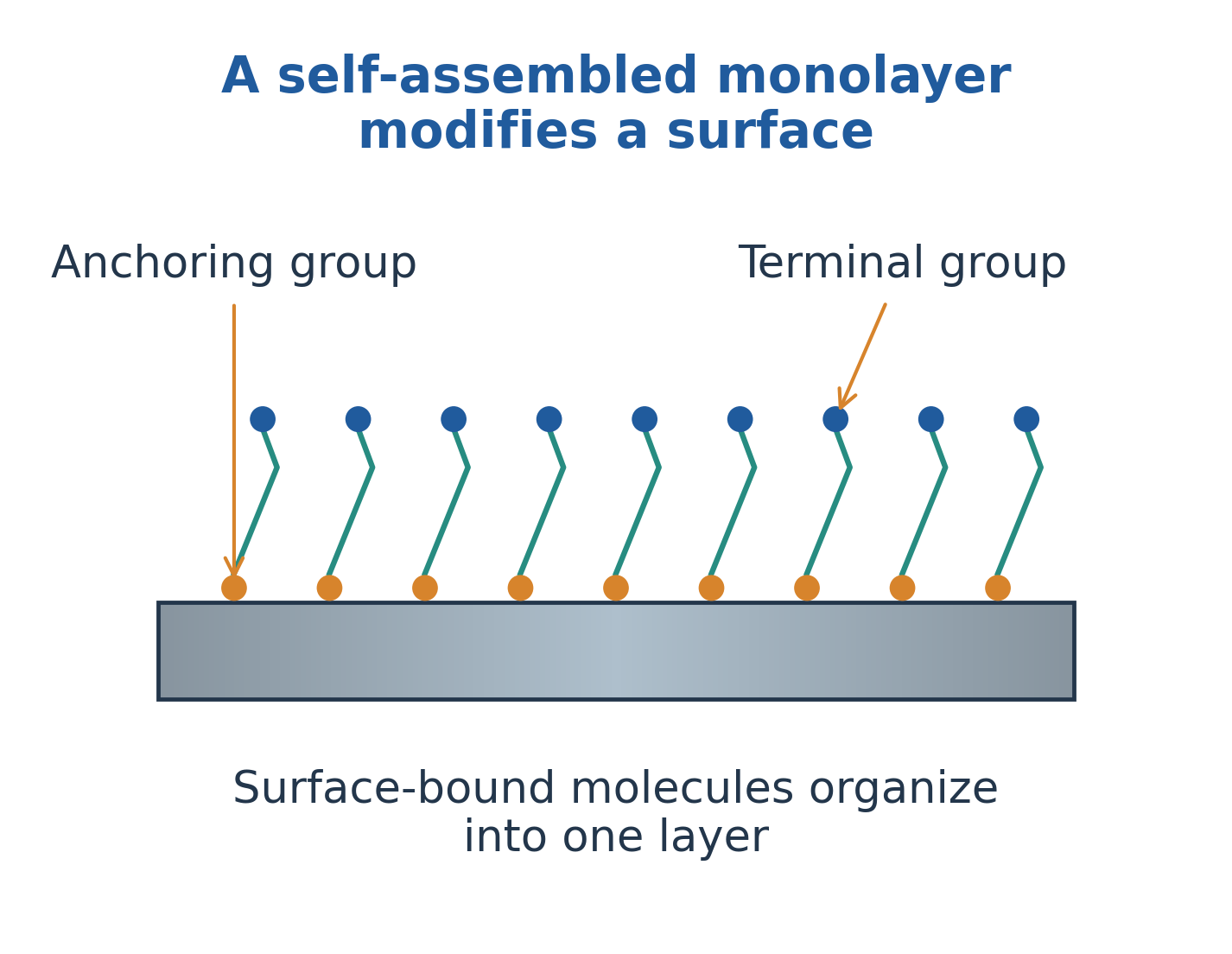
A self-assembled monolayer forms when suitable molecules attach and organize on a compatible substrate.
A head group anchors to the surface, a molecular backbone helps organization and a terminal group controls the exposed interface.
Thiol-containing molecules on suitable gold surfaces and silane chemistry on hydroxylated oxides illustrate different anchoring mechanisms.
Surface cleaning, water content, concentration and time influence coverage.

Functions of SAMs
SAMs can modify wetting, adhesion, interfacial dipoles or selective binding.
A monolayer is not simply any dried organic coating.
Defects, pinholes, mixed orientations and contamination can alter electrical or barrier behaviour.
Verify attachment and coverage through appropriate measurements.
A changed contact angle alone is incomplete proof of molecular identity.
Select chemistry for both the substrate and the next deposited layer. An interface that attaches well to the substrate can still be unsuitable for the following coating or device function.
Worked Problem 4.12: Monolayer Inventory
Route: EE / ECE
Problem: A surface has 2.0 × 10^18 accessible sites per m² and an area of 0.010 m². If one molecule occupies one site at 75% coverage, find the attached molecule count.
Solution:
Total accessible sites:
Sites = 2.0 × 10^18 × 0.010
Sites = 2.0 × 10^16
Attached molecules at 75% coverage:
Molecules = 2.0 × 10^16 × 0.75
Molecules = 1.5 × 10^16
Answer: The ideal attached population is 1.5 × 10^16 molecules.
This inventory does not prove uniform orientation or a defect-free barrier.
14. Two-Dimensional Materials: MoS₂ and h-BN
Study route: EE / ECE
MoS₂ consists of layered sulfur-molybdenum-sulfur units.
Its semiconducting properties depend on thickness, phase, defects and environment.
It is studied for channels, photodetectors and sensing interfaces.
A monolayer and a bulk crystal can have different optical transitions.
The term two-dimensional refers to a thin structure. It does not guarantee that every relevant behaviour is identical across all thicknesses and processing histories.

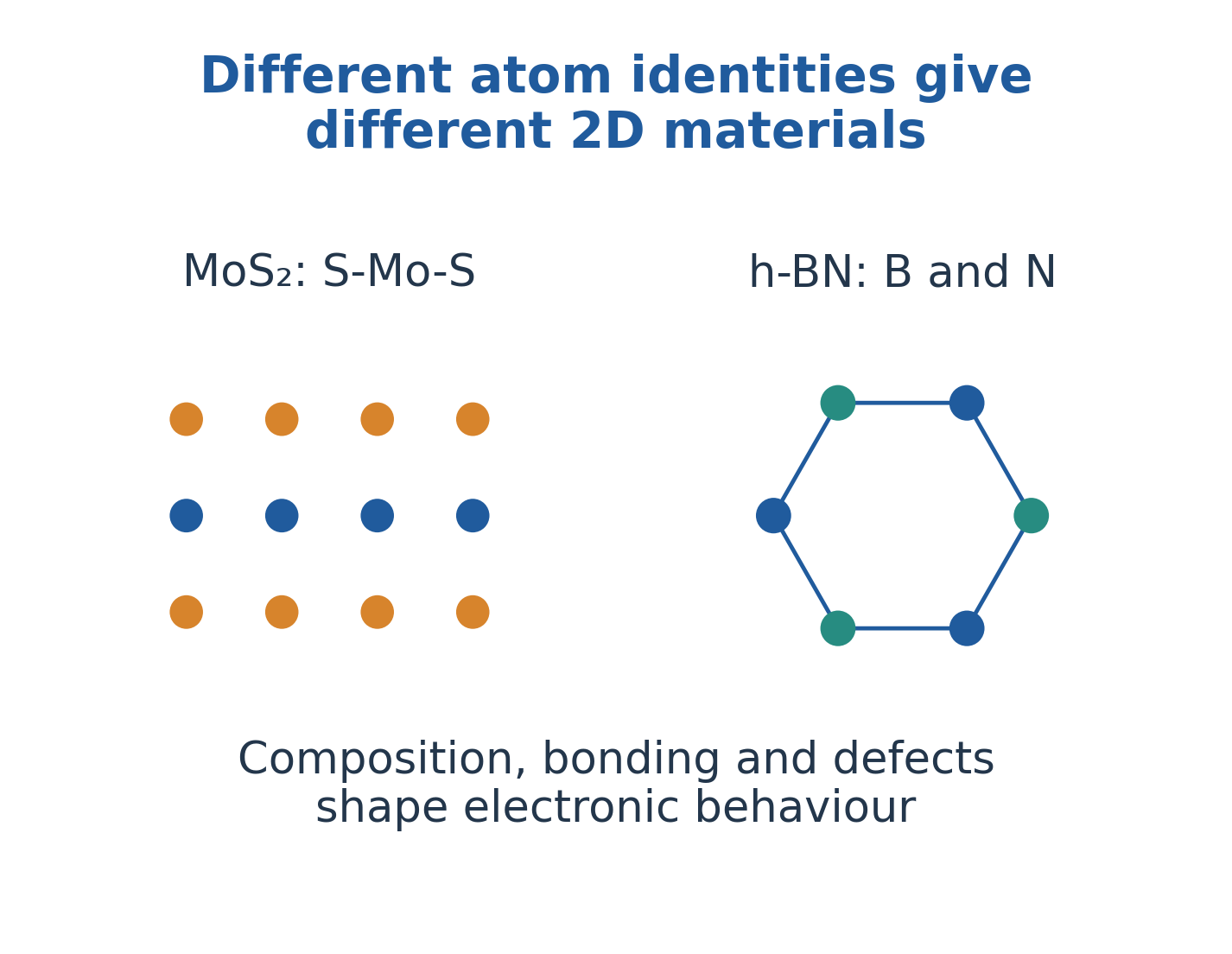
Hexagonal boron nitride is a layered electrical insulator useful as a dielectric or encapsulating interface in suitable heterostructures.
Graphene is highly conducting, MoS₂ is commonly semiconducting and h-BN is insulating.
Combining layers can provide complementary functions.
Transfer contamination, strain, contact resistance and substrate charge can dominate a practical device.
Compare processing compatibility and measured performance rather than assuming every thin material provides a better transistor.
Worked Problem 4.13: Select a Two-Dimensional Layer
Route: EE / ECE
Problem: A stack needs a conducting electrode, a semiconducting channel and an insulating interface. Assign graphene, MoS₂ and h-BN to introductory roles.
Solution:
- Graphene provides a possible conducting electrode.
- MoS₂ provides a possible semiconducting channel.
- h-BN provides a possible insulating interface.
Answer: Use graphene for conduction, MoS₂ for the semiconducting role and h-BN for insulation, subject to verification of the actual stack.
Suitability depends on thickness, phase, contacts and processing. These are introductory material roles rather than guaranteed device ratings.
15. Nanoelectronics: Characterization, Interfaces and Device Integration
Study route: EE / ECE
Nanoparticle and thin-film characterization answers different questions.
Microscopy estimates shape and local dimensions.
Diffraction probes crystalline structure.
Spectroscopy probes chemical or electronic states.
Electrical measurements probe an assembled conduction path.
A reported average size does not describe every particle. A diffraction crystallite size need not equal an aggregate size seen in an image.



Integration Requirements
Nanoelectronic integration requires the right active material, controlled contacts, a compatible dielectric and a stable package.
Quantum-dot surfaces can introduce non-radiative traps. Capping and passivation can improve emission while changing carrier transfer.
CdSe, InP and carbon dots differ in composition and surface chemistry.
A cadmium-free label does not alone establish a complete environmental comparison.
Include precursor handling, device stability and recovery in a materials decision.
Comparing Thin-Film Synthesis Routes
A good comparison starts with how material reaches and reacts at the substrate.
In evaporation or sputtering, PVD supplies material through physical transport.
In CVD, volatile precursor chemistry produces a deposit and gaseous by-products.
ALD divides suitable chemistry into sequential self-limiting surface steps, with purge stages that prevent unwanted mixing of reactants.
Spin coating spreads a liquid formulation and relies on solvent removal or subsequent conversion.
Compare substrate temperature, conformality, composition control, contamination and processing throughput.
ALD can provide conformal coverage where precursors reach and react with the surface. Incomplete dose or purge can invalidate the ideal cycle model.
PVD can have line-of-sight limitations depending on the arrangement.
Solution processing can be convenient for large areas yet sensitive to wetting, solvent compatibility and drying.
A self-assembled monolayer is distinguished by anchoring and molecular organization rather than simply small thickness.
Choose the route from the required interface and geometry, then verify thickness, composition, continuity and actual device response.
The best nominal film metric does not necessarily give the best integrated component.
16. Geopolymer Chemistry: Activation and Network Formation
Study route: CE
Geopolymers are aluminosilicate-based binders formed through activation of suitable precursors and development of an interconnected network.
Dissolution releases reactive species, which reorganize and condense with charge-balancing cations.
Feedstock chemistry, activator, water, curing and calcium content affect the products.
A geopolymer is not merely ordinary cement coloured differently.
Potential reduction in clinker-related emissions must be assessed together with activator production, processing and service performance.


Framework Chemistry
In a simplified aluminosilicate description, tetrahedral aluminium introduces a negative framework charge relative to silicon. Suitable cations balance that charge.
Dissolution, species transport and network formation overlap rather than occurring as perfectly separate steps.
Low-calcium and calcium-rich precursors can develop different mixtures of binding products.
Activator concentration and silicate supply affect dissolution and gel development.
Excessive or unsuitable alkalinity does not automatically improve durability.
Curing controls moisture and reaction progress.
Compare strength, shrinkage, permeability and exposure resistance for the actual mix.
Worked Problem 4.14: Activator Basis
Route: CE
Problem: A supplied geopolymer mix uses 40 kg of activator solution containing 30% dissolved solids. Find activator solids and solvent water.
Solution:
Dissolved solids:
Solids = 40 × 0.30 = 12 kg
Solvent water:
Water = 40 − 12 = 28 kg
Answer: The solution contains 12 kg of dissolved solids and 28 kg of solvent water.
Solution mass must not be reported as the same mass of dry activator. Additional mix water remains separate.
17. Recycled Aggregates: Chemistry, Quality and Mix Behaviour
Study route: CE
Recycled aggregates from construction and demolition waste can conserve virgin resources.
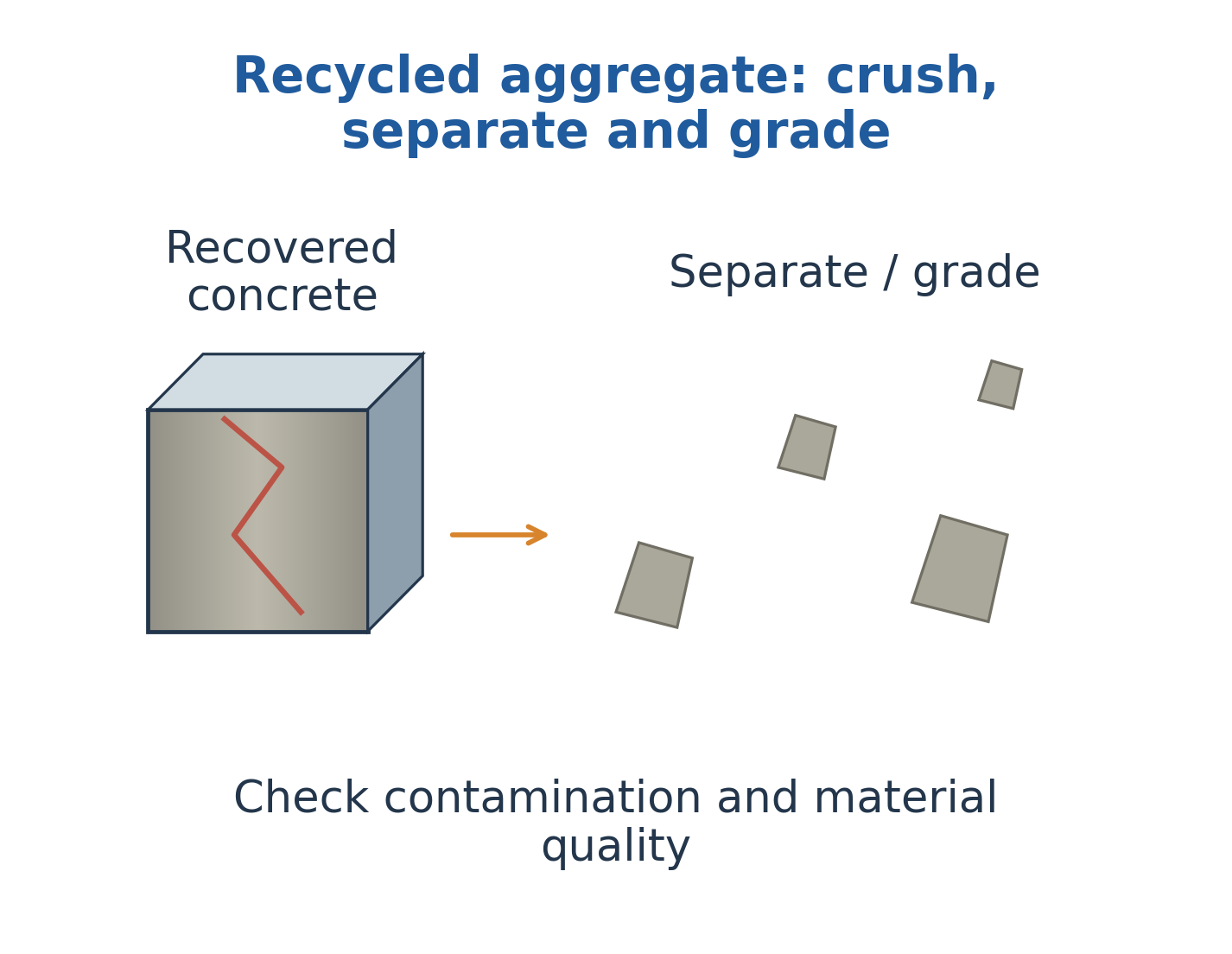
Adhered mortar, porosity, contaminants and variable composition affect water absorption and bond behaviour.
Sorting, removal of unsuitable fractions, grading and appropriate mix design are therefore important.
Recycled content percentage alone does not establish durability or environmental superiority.
A fair comparison specifies the same delivered function and lifetime, includes transport and treatment, and checks the resulting material against required performance.
Distinguish reuse of an intact component from crushing material into aggregate. Their energy, retained value and quality-control needs differ.

Water Absorption and Contamination
Adhered old mortar can increase aggregate porosity and water absorption.
If dry aggregate removes water from a fresh mix, workability and effective water availability change.
Uncontrolled extra water can then alter hardened porosity.
Preconditioning and mix design must account for measured absorption.
Chloride, sulfate, organic or gypsum contamination requires assessment.
Distinguish aggregate replacement percentage from cement replacement percentage and report the mass or volume basis.
Worked Problem 4.15: Recycled Aggregate
Route: CE
Problem: A 1200 kg aggregate batch includes 360 kg of verified recycled aggregate. Find its fraction.
Solution:
Recycled fraction = Recycled aggregate mass/Total aggregate mass
Recycled fraction = 360/1200 = 0.30
Recycled content = 30 wt%
Answer: The batch contains 30 wt% recycled aggregate.
This inventory does not independently establish equal strength, transport impact or durability.
18. Bio-Based Building Materials: Bamboo and Hemp Concrete
Study route: CE
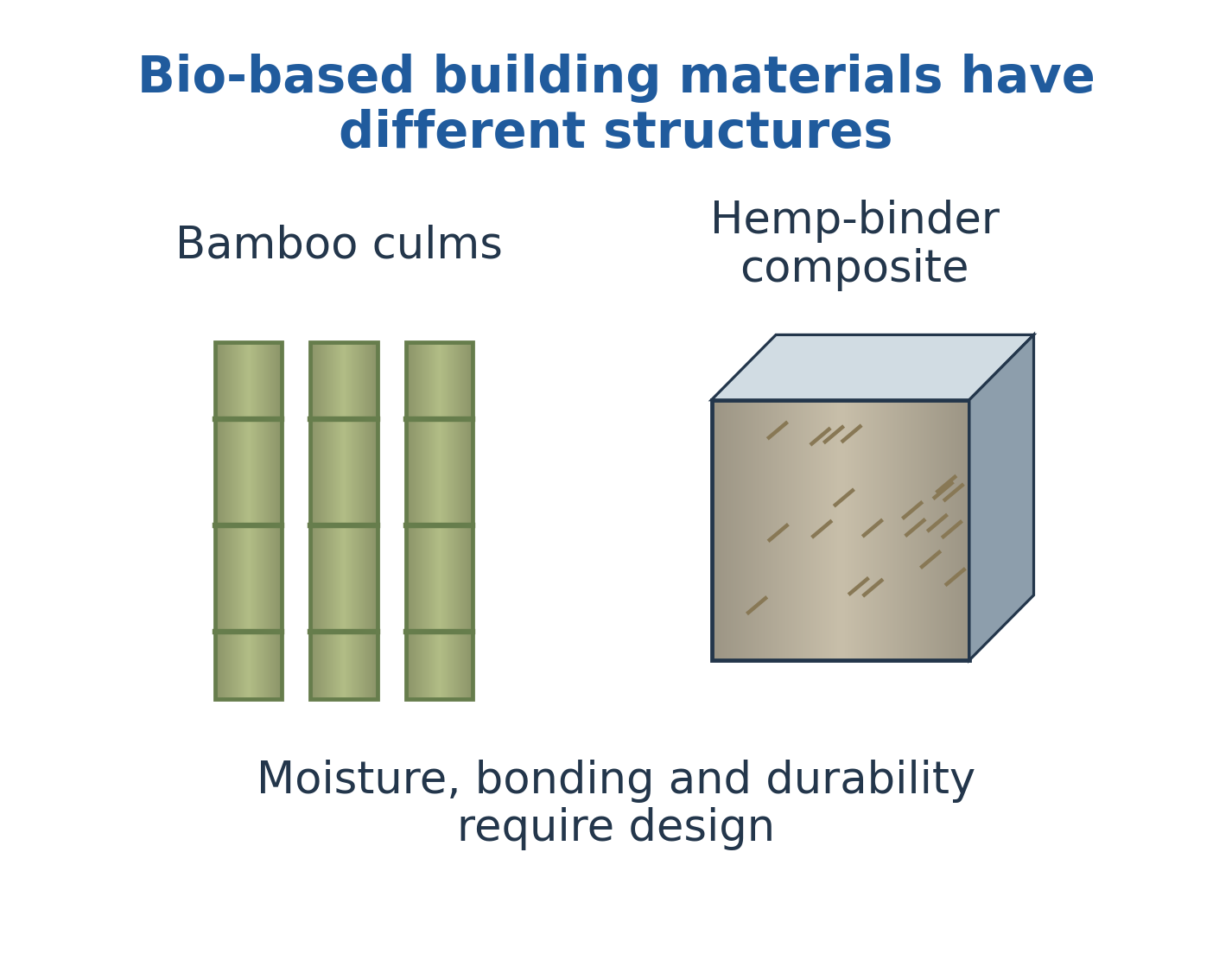
Bamboo contains cellulose, hemicellulose and lignin. It can provide a renewable construction resource when durability, connection design and treatment are appropriate.
Hemp concrete combines plant-based aggregate with a mineral binder.
It is often used for insulating infill rather than automatically replacing every load-bearing concrete element.
Moisture, biological degradation, fire performance and binder choice must be considered.
Bio-based origin describes feedstock. It does not prove indefinite durability or zero environmental burden.

Matching Material to Function
Bamboo elements require appropriate connections and protection for their service environment.
A hemp-binder composite can provide useful thermal behaviour while requiring a separate structural system.
The engineering comparison should identify which component carries load, controls heat transfer, resists weather or provides enclosure.
Renewable feedstock is one part of the evaluation. Processing, binder production, treatment, transport and replacement influence the full result.
Worked Problem 4.16: Compare Building Functions
Route: CE
Problem: Can hemp concrete automatically replace an equal volume of structural reinforced concrete? Explain.
Solution:
Many hemp-based concretes serve as insulating infill.
Density, stiffness, strength, moisture and fire requirements differ from those of structural reinforced concrete.
Equal volume does not ensure equal engineering function.
Answer: No. Compare the delivered function and verified design rather than only volume or renewable feedstock.
19. Thermal Insulation: Chemistry, Structure and Heat Transfer
Study route: CE
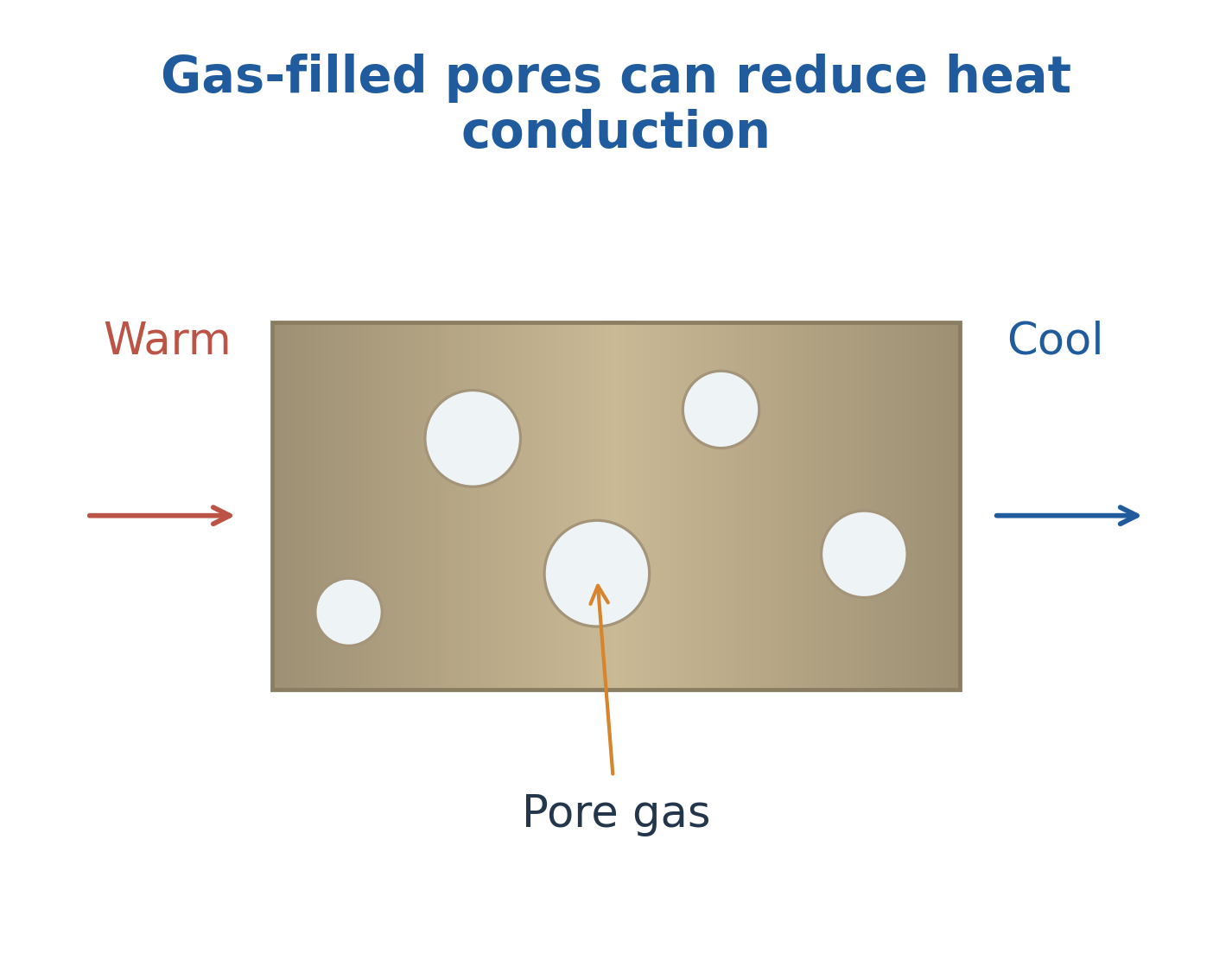
Thermal insulation reduces heat transfer through low effective conductivity and controlled structure.
Trapped gas, solid conduction, radiation and moisture all contribute.
Wet insulation can behave differently from dry laboratory material.

Ideal Plane-Slab Model
For steady conduction through an ideal plane slab:
Thermal resistance = L/(kA)
Heat rate = kA(T₁ − T₂)/L
Here:
- k is thermal conductivity.
- A is area perpendicular to heat flow.
- L is layer thickness.
- T₁ − T₂ is the temperature difference.
A temperature difference has the same numerical size in kelvin and Celsius.
Absolute temperatures are not interchangeable in radiation laws.
Increasing thickness or decreasing conductivity reduces the ideal conduction rate.
Porous polymer foams, mineral wool and other insulating structures use different chemistry, but all require control of moisture, dimensional stability, fire behaviour and ageing.
Joints, fasteners and structural members can create thermal bridges that bypass the ideal layer.
Worked Problem 4.17: Insulation Heat Rate
Route: CE
Problem: For a steady slab, k = 0.040 W/(m·K), A = 10 m², thickness = 0.10 m and temperature difference = 20 K. Find the conduction rate.
Solution:
Heat rate = kAΔT/L
Heat rate = 0.040 × 10 × 20/0.10
Heat rate = 80 W
Answer: The ideal conduction rate is 80 W.
This excludes thermal bridges, air leakage and additional heat-transfer effects. It is not a complete building energy model.
20. Cool Roofs: Reflectance, Emittance and Ageing
Study route: CE
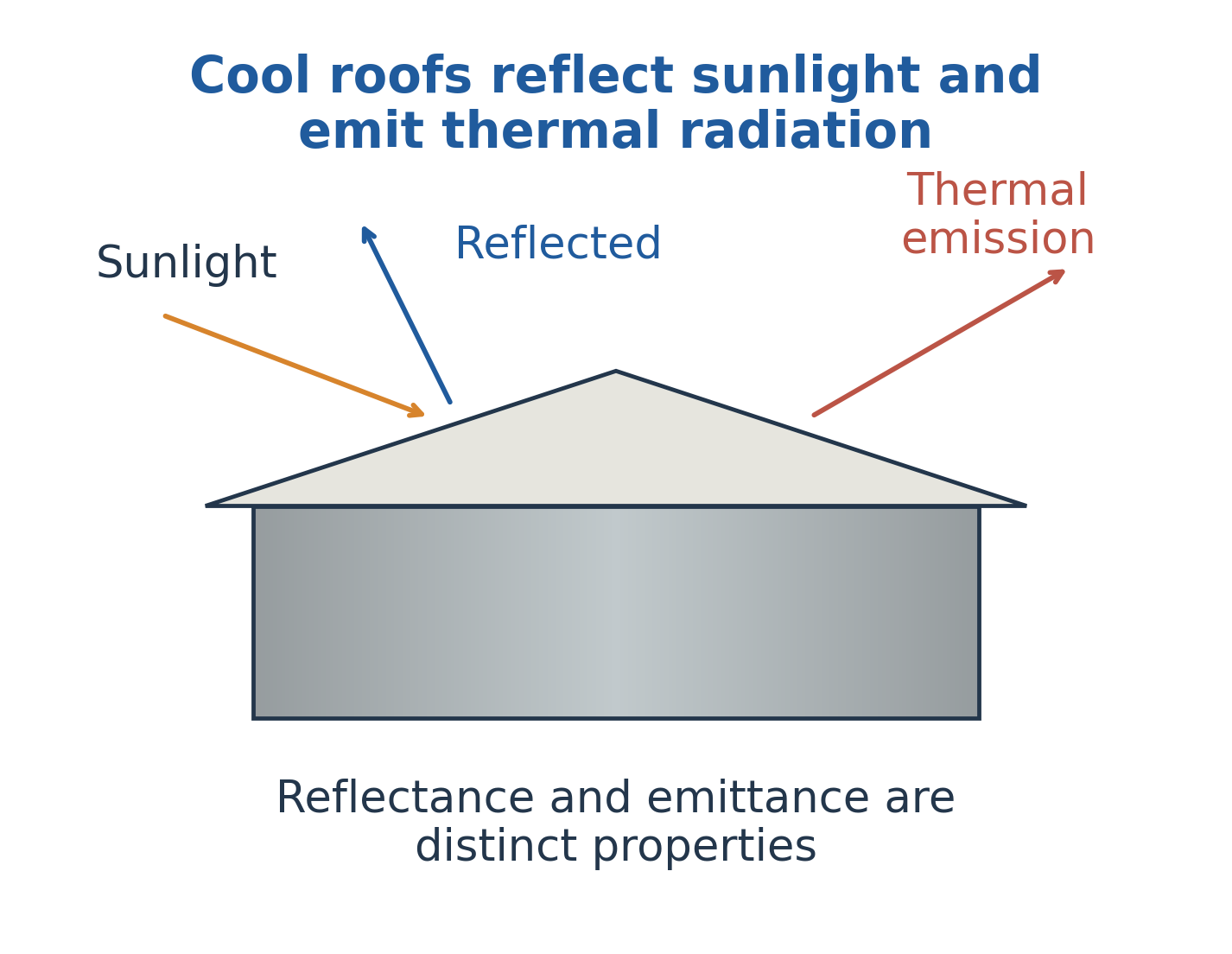
An opaque roof absorbs a fraction approximately equal to one minus its solar reflectance under the stated spectral conditions.
A highly reflective roof can reduce absorbed sunlight.
Thermal emittance describes radiative heat exchange in the thermal infrared and is a different property.
Surface temperature results from solar absorption, radiation, convection and conduction into the building.

Chemistry and Service Performance
Pigments, binders, surface texture and weathering affect roof performance.
Dirt and biological growth can change reflectance.
Moisture and degradation can change the underlying envelope.
Compare initial and aged measurements.
Reduced absorbed solar flux is not automatically equal to reduced cooling electricity.
Climate, insulation, occupancy and the cooling system determine that outcome.
A light appearance can help, but it does not replace measured reflectance and emittance.
For the stated opaque-surface model:
Absorbed solar flux = (1 − Reflectance) × Incident solar flux
Worked Problem 4.18: Roof Absorption
Route: CE
Problem: A supplied opaque roof receives 800 W/m². Compare absorbed flux at reflectances of 0.30 and 0.70.
Solution:
For reflectance 0.30:
Absorbed flux = (1 − 0.30) × 800 = 560 W/m²
For reflectance 0.70:
Absorbed flux = (1 − 0.70) × 800 = 240 W/m²
Difference:
560 − 240 = 320 W/m²
Answer: The absorbed fluxes are 560 W/m² and 240 W/m², with a reduction of 320 W/m².
This is a reduction in absorbed solar flux rather than automatically the same reduction in cooling electricity.
21. Auto-Healing Polymers: Intrinsic and Extrinsic Routes
Study route: CE
Self-healing or auto-healing polymers recover some function after damage through intrinsic reversible bonding or extrinsic healing agents.
Intrinsic systems can use reversible covalent or supramolecular interactions activated under suitable conditions.
Capsule-based systems release a healing agent when a crack ruptures capsules.
Vascular systems supply agent through a network.
Healing can require heat, time or contact. It can be limited by damage size, reagent supply and repeatability.
Recovery of visible appearance is not identical to restored structural strength.

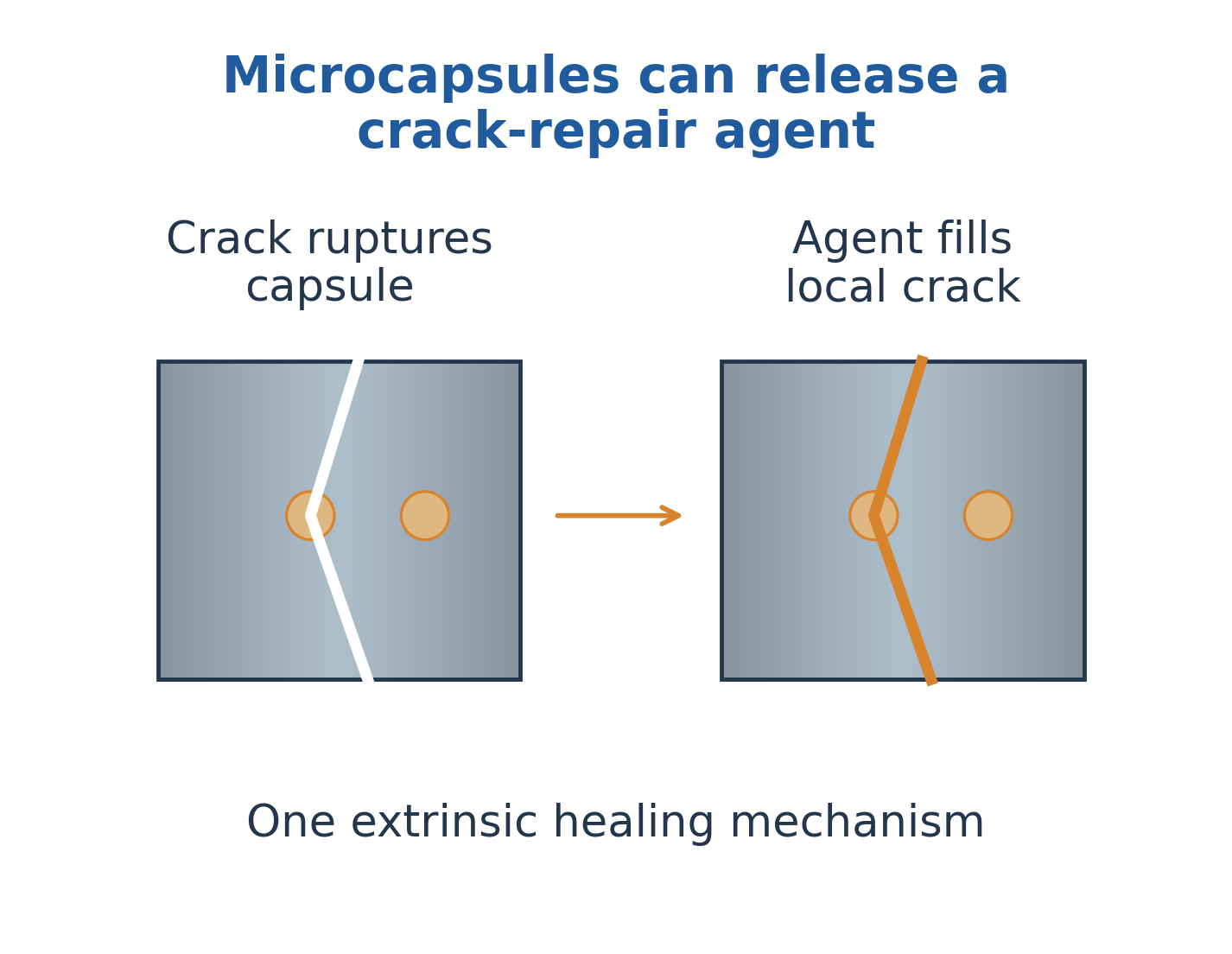
| Healing Route | Limitation to Assess |
|---|---|
| Intrinsic | Reversible chemistry, stimulus and contact requirements |
| Capsule-based | Local healing-agent delivery and available supply |
| Vascular | Delivery-network function and replenishment conditions |
Defining Healing Performance
A healing percentage must state the measured property and denominator.
Final strength divided by original strength measures retained original performance.
Regained strength divided by lost strength measures recovery of the damage-induced loss.
These values can differ even when calculated from the same specimen measurements.
Worked Problem 4.19: Healing Performance
Route: CE
Problem: A specimen reaches 40 MPa before damage, 20 MPa after damage and 32 MPa after healing. Find the regained fraction of lost strength.
Solution:
Lost strength:
40 − 20 = 20 MPa
Regained strength:
32 − 20 = 12 MPa
Regained fraction of loss:
12/20 × 100 = 60%
For comparison, final strength relative to original strength is:
32/40 × 100 = 80%
Answer: The regained fraction of lost strength is 60%.
The final-to-original strength ratio is 80%, which is a different metric.
22. Construction and Demolition Waste: Recovery and Circular Use
Study route: CE
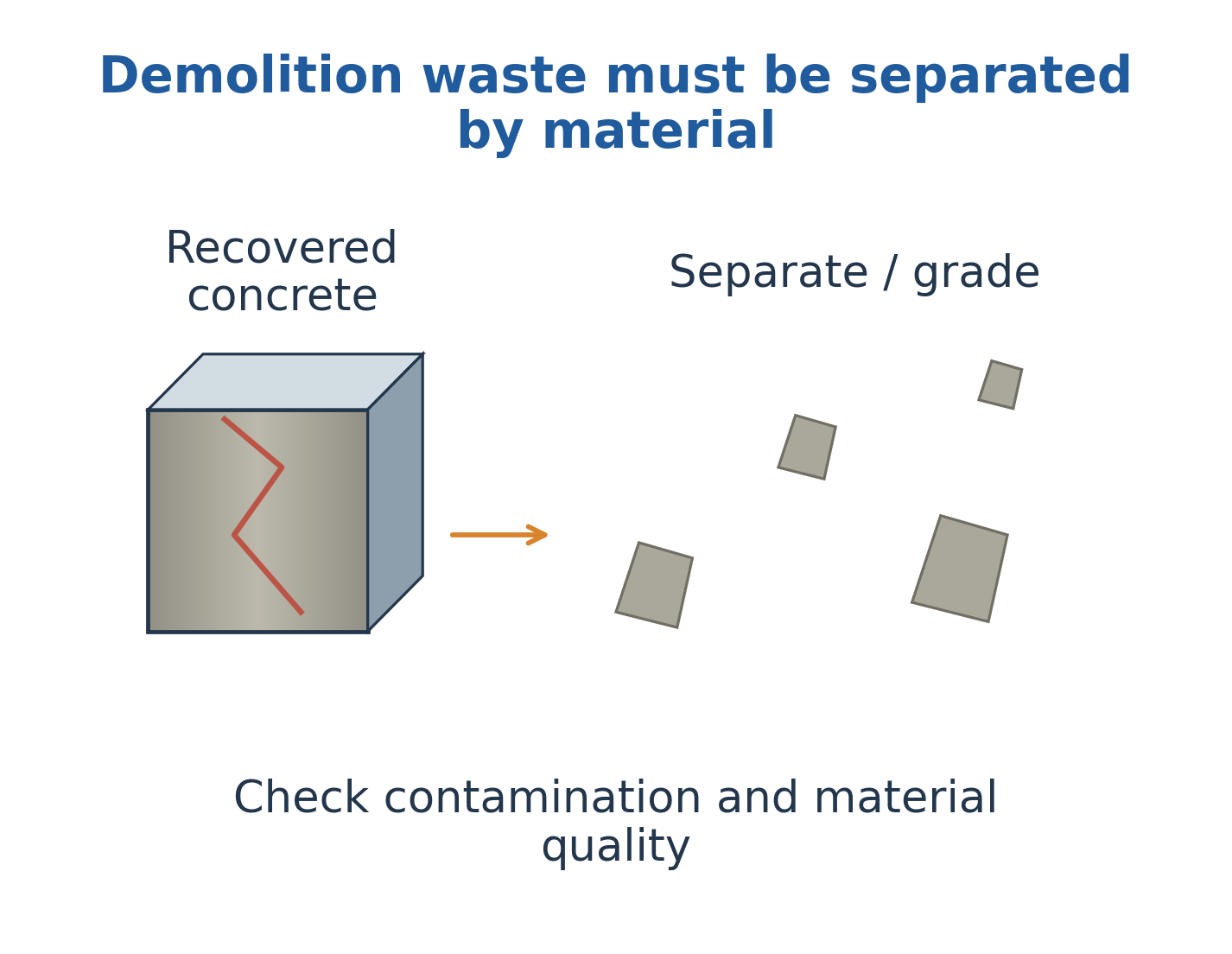
Construction-waste recycling begins with an inventory and separation of concrete, masonry, metals, wood, glass and problematic materials.
Selective demolition can preserve material quality.
Crushing and screening produce graded mineral fractions. Metals can be recovered separately.
Contamination can limit reuse and should not be diluted into a larger batch as a substitute for assessment.
Recovered material can serve in appropriate aggregate, road-base or other products according to its verified properties.
A closed-loop claim requires evidence that recovered output actually replaces relevant new material rather than merely being collected or stored.
Include rejects and residual treatment in the material balance.

Evaluating a Sustainable Building Material
Specify the delivered function before comparing environmental claims.
A structural member, an insulating infill and a reflective roof coating have different responsibilities.
Geopolymer chemistry involves activated aluminosilicate precursors, dissolution and network development.
The activator, curing and feed composition influence the outcome.
Recycled aggregate retains variable adhered mortar and can have higher absorption, requiring grading and mix adjustments.
Bamboo and hemp-based systems offer renewable feedstocks but still require moisture, biological, fire and connection assessment.
For insulation, use conductivity measured under relevant moisture and temperature conditions.
Thermal bridges and air leakage are additional building effects.
A cool roof changes solar absorption and thermal radiation.
Self-healing polymers address selected damage through reversible chemistry or supplied healing agents.
Define what has recovered: visible closure, permeability or mechanical strength.
Finally, follow demolition waste into sorted reusable fractions, recovered products and rejects.
Collection alone is not recycling, and recycled content alone does not establish a lower life-cycle impact.
Include production, transport, installation, service life and realistic replacement in a fair comparison.
Worked Problem 4.20: Demolition Recovery
Route: CE
Problem: A 1000 kg separated waste batch yields 700 kg of aggregate, 80 kg of metal and 120 kg of other usable output. Find the recovered fraction and residual mass.
Solution:
Recovered output:
700 + 80 + 120 = 900 kg
Recovered fraction:
900/1000 × 100 = 90%
Residual mass:
1000 − 900 = 100 kg
Answer: The recovered fraction is 90%, with 100 kg residual material.
Actual substitution and quality must be established before describing all collected output as closed-loop recycling.
23. Electrochemical Cells, Galvanic Operation and EMF
Study route: ME
A galvanic cell converts a favourable chemical reaction into electrical work.
In a concentration cell, the driving force arises from unequal activities of the same relevant species in otherwise comparable electrodes.
For an ideal divalent metal concentration cell at 25°C:
E = (0.05916/2) log₁₀[a(high)/a(low)]
The orientation must remain consistent.
The Nernst equation predicts reversible potential. It does not include every operating loss.
Internal resistance and electrode polarization reduce terminal voltage during current delivery.


Electrode Reactions and Charge Balance
For a spontaneous galvanic reaction:
- Oxidation occurs at the anode.
- Reduction occurs at the cathode.
- Electrons travel externally from anode to cathode.
- The electrolyte or salt bridge supports ionic charge balance.
Electrode signs depend on operating mode. Define the anode by oxidation rather than memorizing it as always negative.
EMF is the reversible open-circuit potential under specified conditions.
With reduction potentials:
E°cell = E°cathode − E°anode
Choose a consistent reaction before substituting values.
Worked Problem 4.21: Galvanic Cell Voltage
Route: ME
Problem: Use reduction potentials of +0.34 V and −0.76 V. Find the standard voltage for zinc oxidation and copper-ion reduction.
Solution:
Copper-ion reduction occurs at the cathode.
The zinc reduction potential is used as the anode reduction-potential value in the subtraction.
E°cell = 0.34 − (−0.76)
E°cell = 1.10 V
Answer: The standard cell voltage is 1.10 V.
Reaction coefficients balance electron amounts but do not multiply electrode potentials.
24. Nernst Equation and Concentration Cells
Study route: ME
For a balanced cell reaction transferring n electrons, reversible cell potential is:
E = E° − RT ln(Q)/(nF)
The reaction quotient Q uses activities raised to stoichiometric powers.
Pure solids and pure liquids usually have unit activity in the selected standard-state treatment.
At 25°C, the base-ten form is:
E = E° − (0.05916/n) log₁₀(Q)
Temperature, reaction orientation and the chosen reduction-potential convention must remain consistent.


Concentration-Cell Interpretation
A concentration cell can generate potential from unequal activities of the same relevant species.
For an ideal divalent metal-ion example at 25°C, the magnitude is:
E = (0.05916/2) log₁₀(aHigh/aLow)
Equal activities give zero potential in this ideal arrangement.
The Nernst result describes reversible potential. Ohmic, activation and concentration losses change loaded voltage.
Do not multiply electrode potentials when balancing reaction coefficients.
Worked Problem 4.22: Concentration Cell
Route: ME
Problem: At 25°C, a divalent concentration cell has an activity ratio of 100. Use 0.05916 V in the Nernst form. Find the magnitude.
Solution:
E = (0.05916/2) log₁₀(100)
Since:
log₁₀(100) = 2
Then:
E = (0.05916/2) × 2 = 0.05916 V
Answer: The magnitude is 0.05916 V, or 59.16 mV.
Reversing the chosen electrode orientation reverses the sign. Equilibrium potential remains distinct from loaded terminal voltage.
25. Hydrogen-Oxygen Fuel Cells: PEM and SOFC Chemistry
Study route: ME
A fuel cell supplies reactants continuously and converts a chemical free-energy decrease into electrical output.
The overall hydrogen-oxygen reaction is:
2H₂ + O₂ → 2H₂O
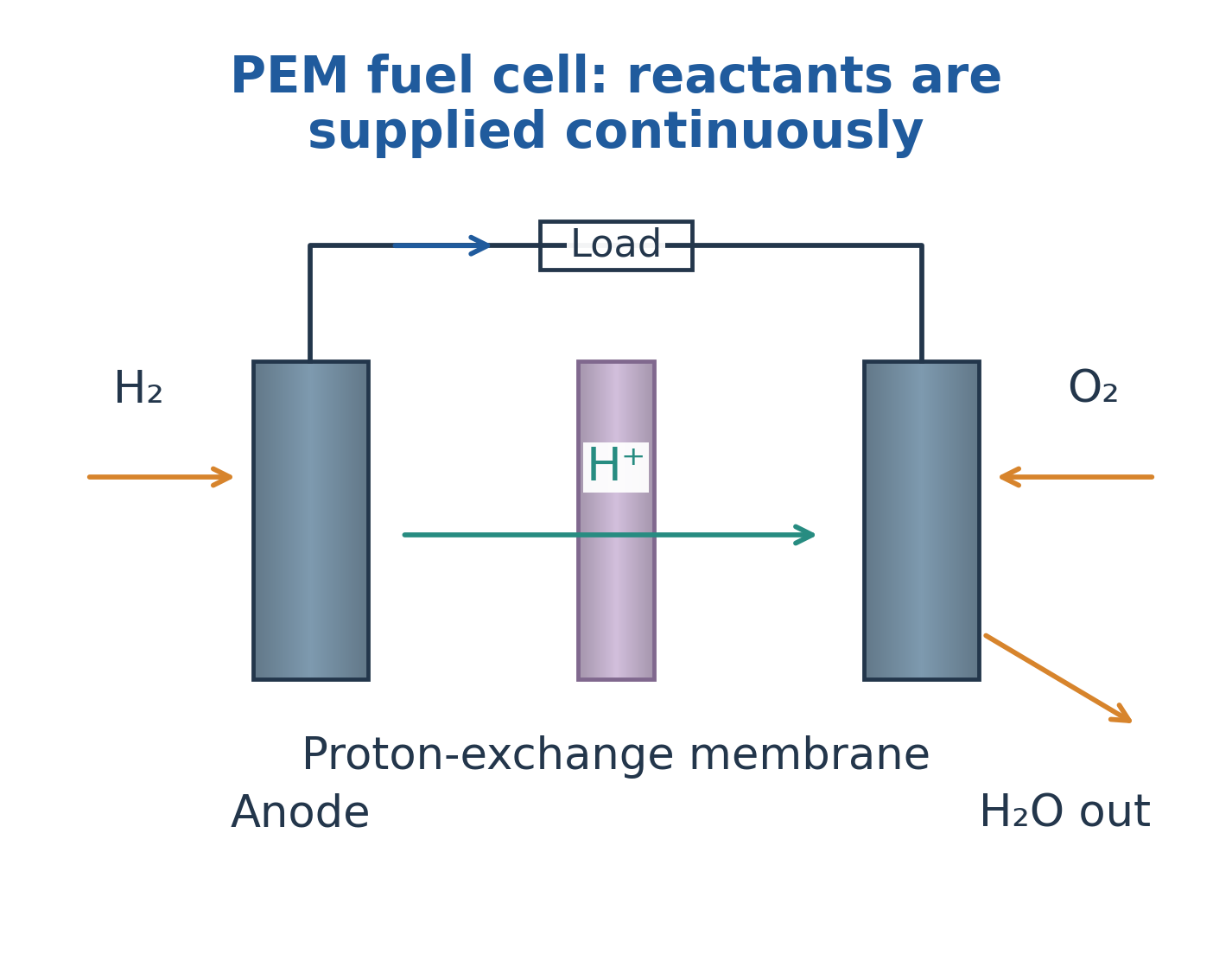
In a PEM cell, a proton-conducting membrane separates electrode processes.
At the anode:
H₂ → 2H⁺ + 2e⁻
At the cathode:
½O₂ + 2H⁺ + 2e⁻ → H₂O
Electrons pass through the external circuit while protons cross the membrane.

Solid Oxide Fuel Cells
An oxide-ion SOFC commonly transports O²⁻ through a high-temperature ceramic electrolyte.
Oxygen reduction occurs at the cathode, followed by oxide-ion transfer and fuel oxidation at the anode.
Electrolyte identity and temperature requirements differ from PEM chemistry.
Catalysts affect rates and losses but do not change the equilibrium free energy of the same reaction.
Include fuel utilization, water and heat management, and operating voltage in a practical efficiency explanation.
| Cell | Common Electrolyte Transport |
|---|---|
| PEM fuel cell | Protons through a membrane |
| Oxide-ion SOFC | Oxide ions through a ceramic electrolyte |
Worked Problem 4.23: Fuel-Cell Hydrogen Use
Route: ME
Problem: A cell transfers 19,300 C. Use F = 96,500 C/mol and two electrons per H₂. Find the ideal reacted hydrogen amount.
Solution:
n(H₂) = Q/(2F)
n(H₂) = 19,300/(2 × 96,500)
n(H₂) = 0.10 mol
Answer: The reaction-associated hydrogen amount is 0.10 mol H₂.
Feed hydrogen can exceed reacted hydrogen because utilization can be incomplete.
26. Lithium-Ion and Solid-State Batteries
Study route: ME
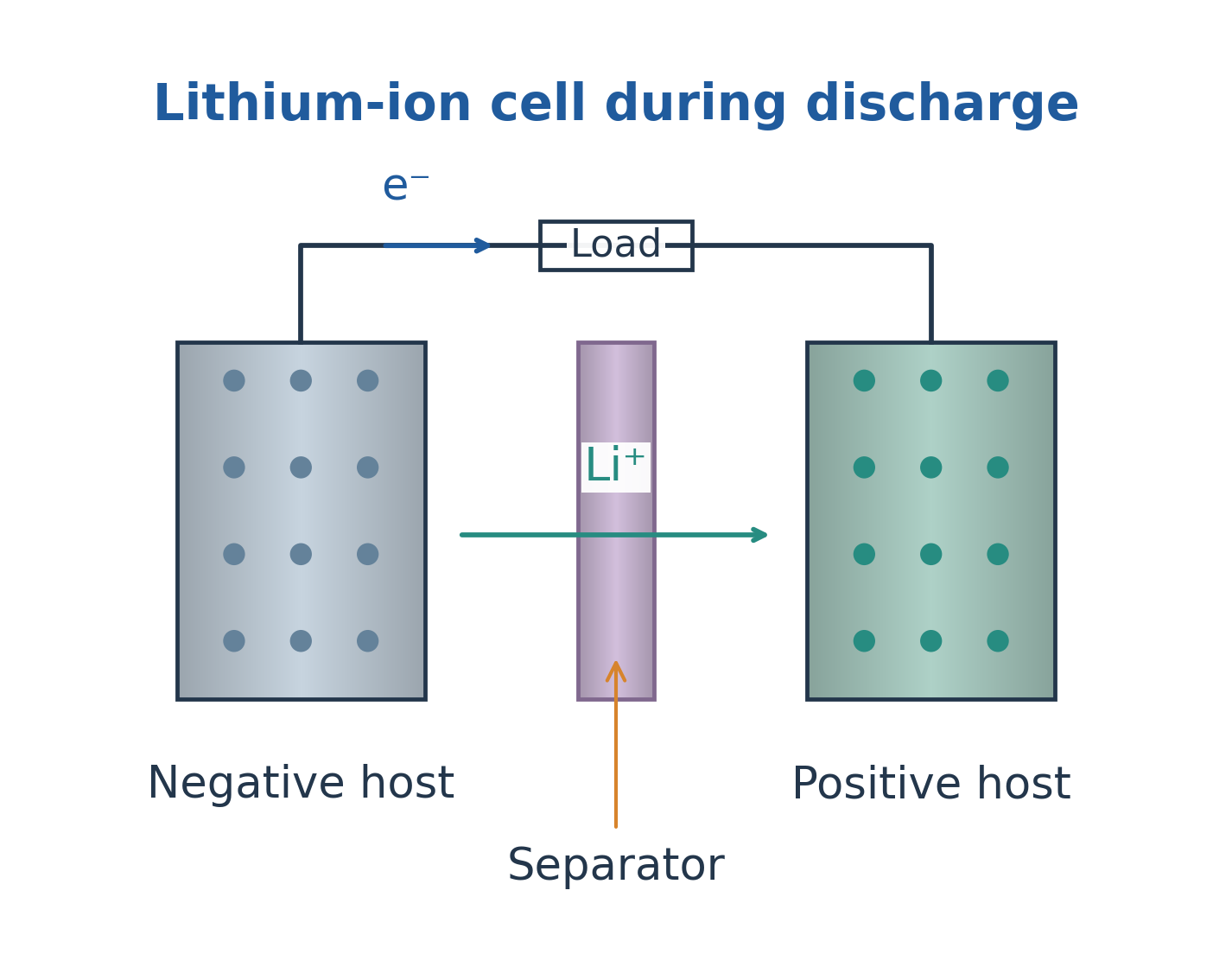
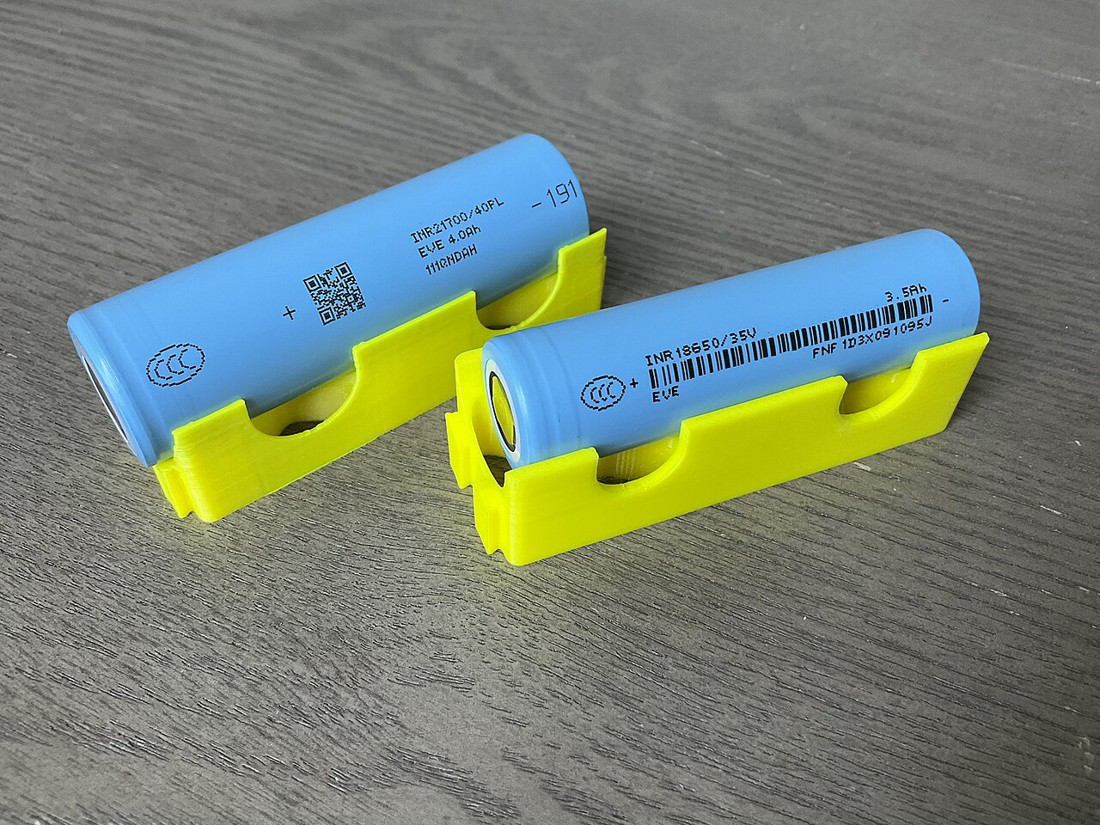
Lithium-ion batteries transfer lithium ions between compatible host electrodes while electrons pass through the external circuit.
A graphite anode and a suitable lithium-containing cathode are common choices, but actual voltage and safety depend on the full chemistry.
The electrolyte conducts ions while the separator prevents direct electronic contact.
During charging, an external source drives the reverse overall transfer within operating limits.
Solid-state cells use solid ionic conductors and face contact, transport and stability challenges.
The label solid-state alone does not guarantee immunity to failure.


Capacity and Energy
Capacity in ampere-hours measures transferred charge.
1 Ah = 3600 C
An approximate electrical energy calculation is:
Energy in Wh ≈ Average voltage × Capacity in Ah
The average voltage must correspond to the stated operating interval.
Multiplying by an unrelated maximum voltage gives a different and potentially misleading estimate.
Worked Problem 4.24: Battery Energy
Route: ME
Problem: A supplied cell provides 2.0 Ah at an average voltage of 3.6 V. Find the approximate electrical energy in Wh and joules.
Solution:
Energy = 3.6 × 2.0 = 7.2 Wh
Convert to joules:
7.2 × 3600 = 25,920 J
Answer: The approximate energy is 7.2 Wh, or 25,920 J.
The supplied average voltage is used for this estimate.
27. Supercapacitors: Interfaces, Energy and Power
Study route: ME
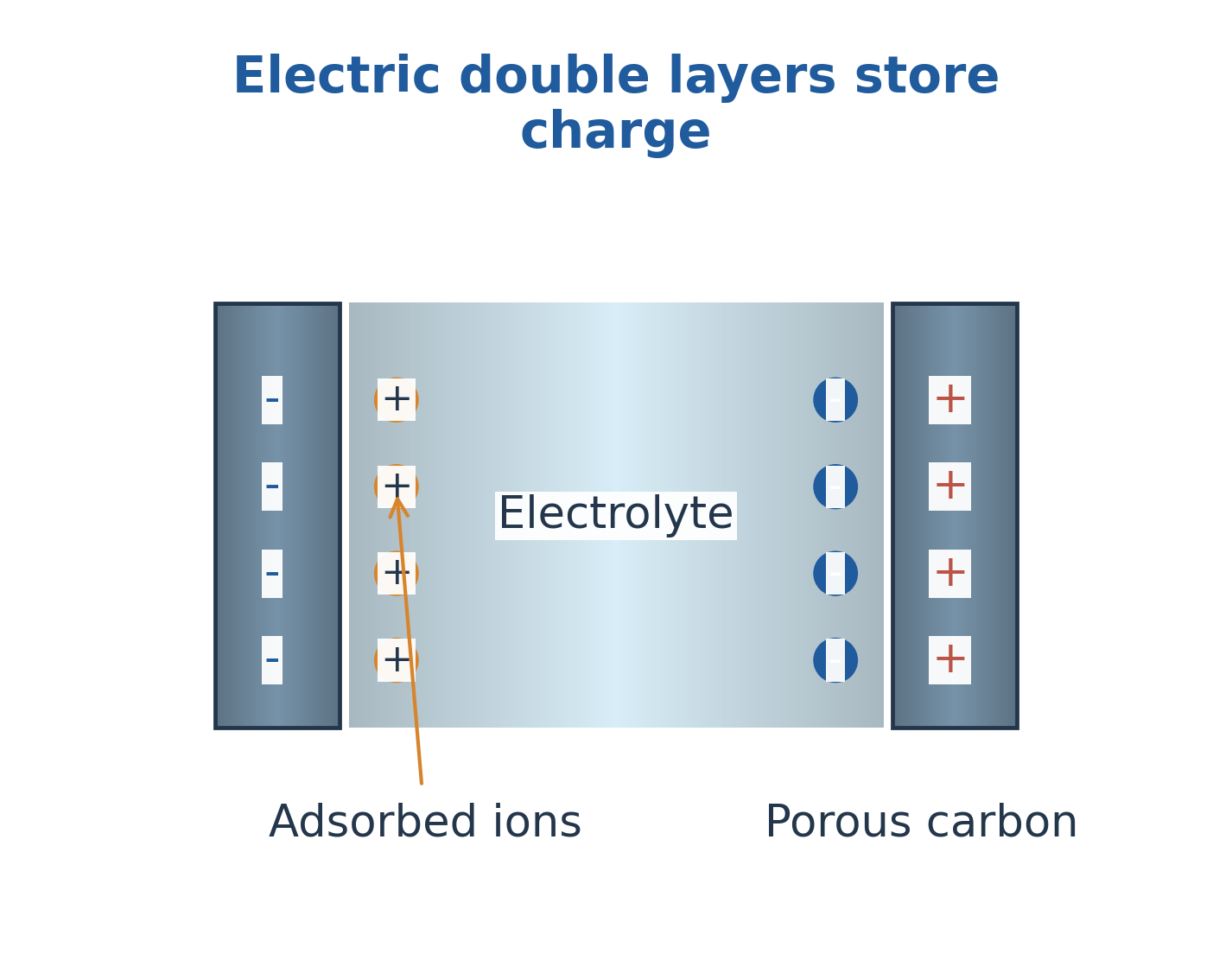
Supercapacitors store charge at high-area interfaces or through rapid reversible surface redox processes.
They commonly support high-power pulses but have a different usable-energy and voltage profile from batteries.
For constant ideal capacitance:
Usable energy = C(Vmax² − Vmin²)/2
The lower voltage matters because energy remaining below that operating limit is not delivered during the stated interval.

Comparing Storage and Conversion
A battery stores energy through its defined electrochemical inventory.
A supercapacitor stores charge through interfaces and, for some systems, rapid surface redox contributions.
A fuel cell converts continuously supplied reactants.
A PEM hydrogen-oxygen fuel cell transports protons through its electrolyte. Hydrogen oxidation supplies electrons at the anode, while oxygen reduction forms water at the cathode.
In a common oxide-ion SOFC, oxygen is reduced at the cathode, oxide ions cross the ceramic electrolyte and fuel reacts at the anode.
Temperature, catalysts, electrolyte and fuel purity influence losses and lifetime.
Compare storage capacity, delivery power and conversion of continuously supplied fuel as separate functions.
Worked Problem 4.25: Supercapacitor Usable Energy
Route: ME
Problem: An ideal constant 100 F capacitor operates from 2.5 V down to 1.0 V. Find the released energy.
Solution:
Released energy = ½C(Vmax² − Vmin²)
Released energy = 0.5 × 100 × (2.5² − 1.0²)
Released energy = 50 × (6.25 − 1.00)
Released energy = 262.5 J
Answer: The released energy is 262.5 J.
Energy remaining at the lower voltage is not delivered during this interval.
28. Hydrogen Production: Electrolysis and Steam Reforming
Study route: ME
Water electrolysis uses electrical energy to produce hydrogen and oxygen.
The ideal stoichiometric ratio is two moles of hydrogen per mole of oxygen:
2H₂O → 2H₂ + O₂
Steam reforming converts methane and steam into a hydrogen-containing mixture, followed commonly by water-gas shift.
The idealized overall combination is:
CH₄ + 2H₂O → CO₂ + 4H₂
Its carbon dioxide stream must be accounted for.
Hydrogen is an energy carrier whose life-cycle impact depends on production and handling.


Hydrogen-oxygen fuel cells reverse the overall water-electrolysis reaction to deliver energy, but round-trip efficiency is below unity.
PEM cells use proton-conducting electrolytes.
SOFCs use high-temperature ceramic ion conductors, commonly transporting oxide ions.
Charge Requirement
Two moles of electrons correspond to one mole of hydrogen in the stated reaction.
For ideal charge allocation:
Q = 2F × n(H₂)
With charge efficiency included:
n(H₂) = Charge efficiency × Q/(2F)
Actual energy input also depends on operating voltage.
Worked Problem 4.26: Hydrogen Charge
Route: ME
Problem: Use F = 96,500 C/mol. How much charge ideally produces 0.10 mol H₂ by water electrolysis?
Solution:
Q = 0.10 × 2F
Q = 0.10 × 2 × 96,500
Q = 19,300 C
Convert to ampere-hours:
Q = 19,300/3600 = 5.36 Ah
Answer: The ideal charge is 19,300 C, or approximately 5.36 Ah.
Actual electrical input also depends on efficiency and operating voltage.
29. Photovoltaic Chemistry and Maximum Power
Study route: ME
Photovoltaic materials absorb photons and generate mobile charge carriers that are separated and collected.
The absorber, junction and interfaces, transport layers and contacts determine performance.
A solar cell’s maximum electrical power is:
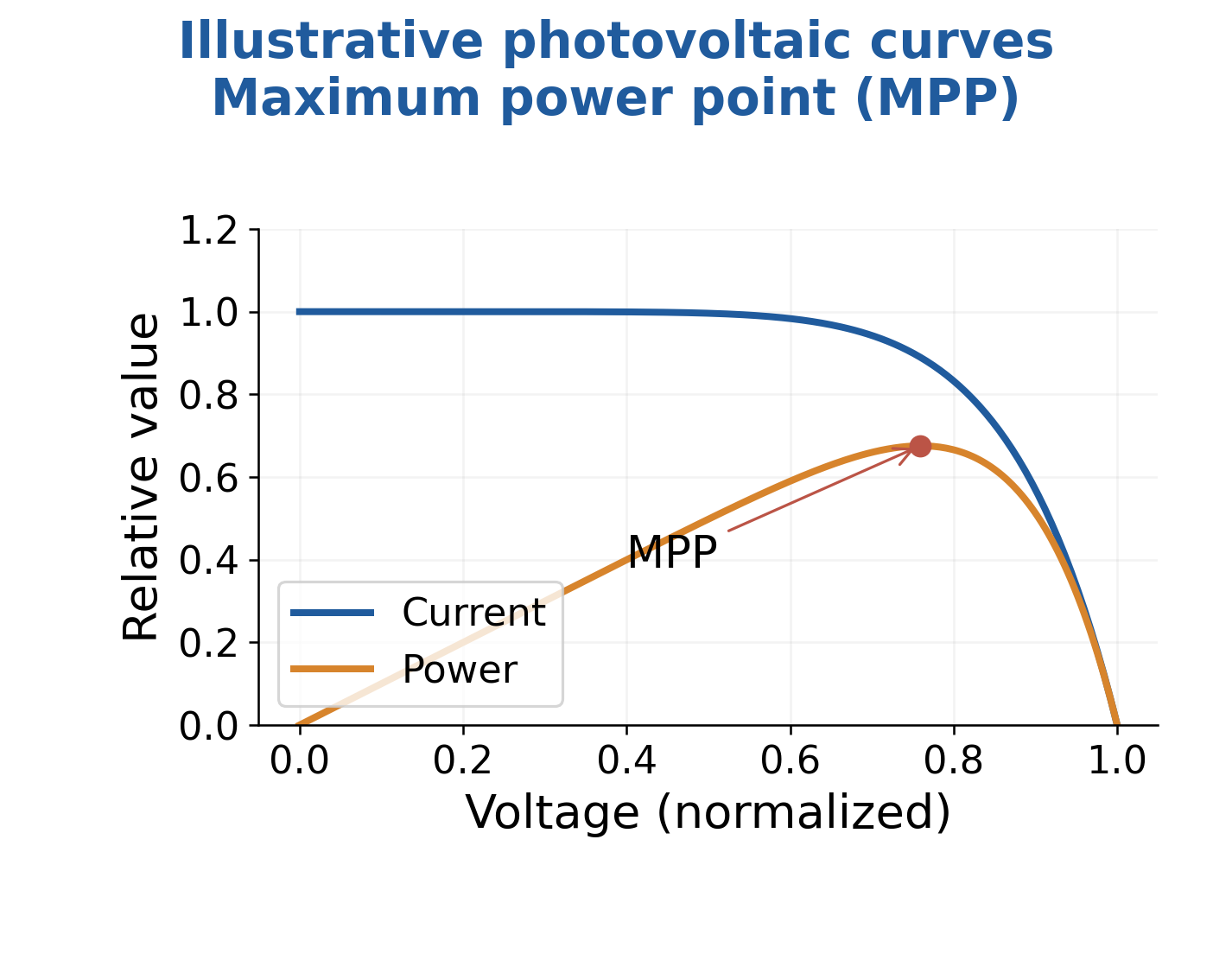
Pmax = Vm × Im
Efficiency is maximum electrical power divided by incident optical power on the stated area.
Open-circuit voltage multiplied by short-circuit current exceeds the actual maximum-power product.
The fill factor describes their ratio.
Chemistry influences band gap, defects, stability, contacts and encapsulation.



Efficiency and Fill Factor
For irradiance G and illuminated area A:
Incident optical power = G × A
Then:
Efficiency = Pmax/(G × A)
The fill factor is:
FF = Pmax/(Voc × Isc)
Open circuit has voltage but no delivered current.
Short circuit has current but nearly zero terminal voltage.
The maximum-power point lies between these endpoints.
Worked Problem 4.27: PV Efficiency
Route: ME
Problem: A cell outputs 4 W of maximum electrical power while receiving 1000 W/m² on 0.025 m². Find its efficiency.
Solution:
Incident power:
Pin = 1000 × 0.025 = 25 W
Efficiency:
η = 4/25 = 0.16
η = 16%
Answer: The efficiency is 16%.
Open-circuit voltage multiplied by short-circuit current is not the delivered maximum power.
30. Thermochemical Energy Storage and Cycling
Study route: ME
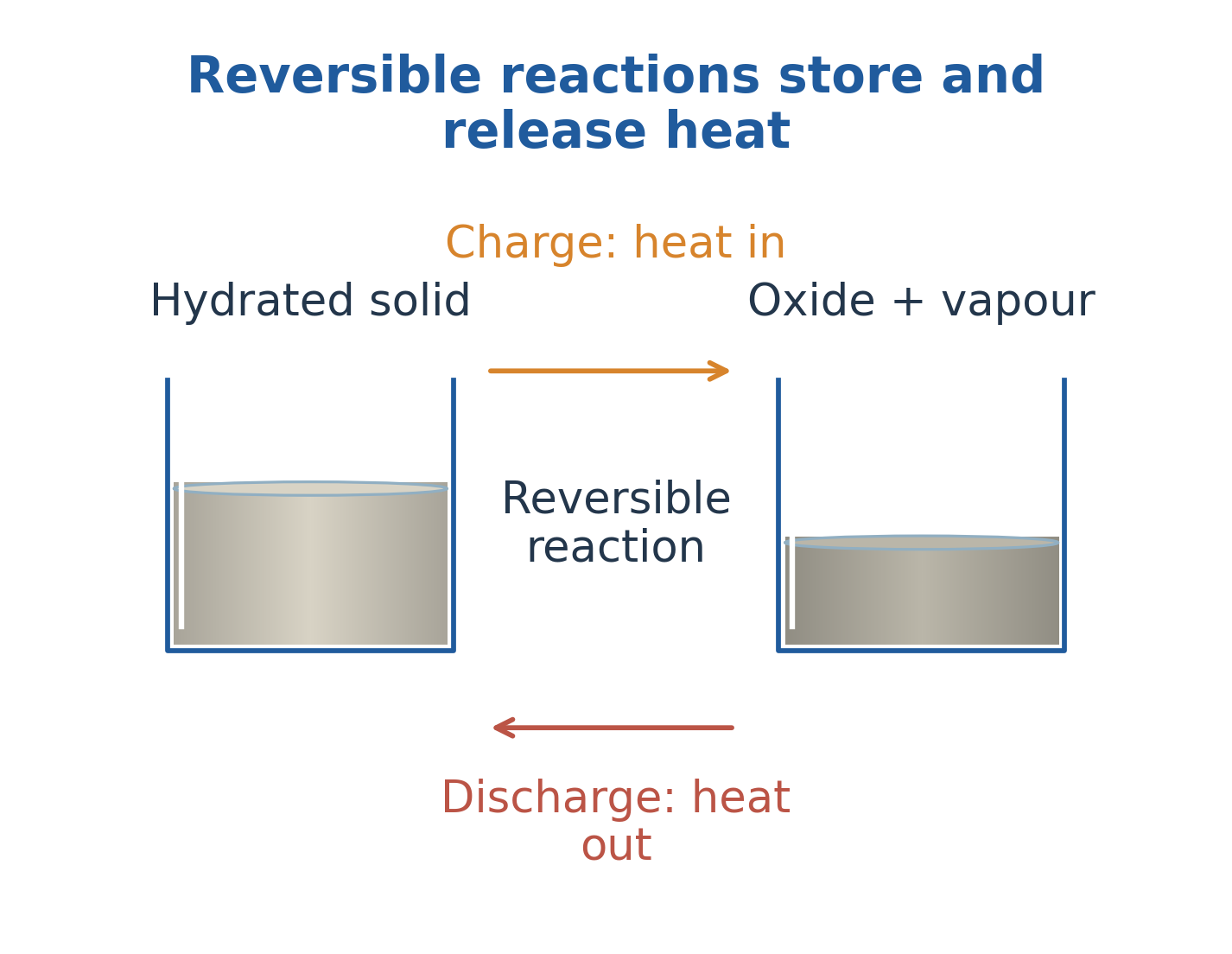
Thermochemical storage uses reversible reactions or sorption to store and release heat.
Charging drives an endothermic process.
Discharging allows the reverse exothermic process under suitable conditions.
A simplified example is reversible dehydration and hydration of a suitable salt.
Stored reaction energy is the usable reaction extent multiplied by the relevant reaction enthalpy when the extent and state basis match.
This differs from sensible heat storage and latent heat storage.

Different Thermal Storage Mechanisms
Sensible heat storage changes temperature:
Q = mcΔT
Latent heat storage involves a phase change.
Thermochemical storage involves a reversible reaction or sorption relationship.
Practical systems need transport, heat exchange, containment and cycling stability.
A large reaction enthalpy alone does not prove high deliverable power or complete reversibility over many cycles.
Comparing Electrochemical Energy Systems
A galvanic cell converts a favourable reaction into electrical work.
An electrolyser uses electrical input to drive a selected nonspontaneous overall conversion.
Reversible voltage follows thermodynamics, while activation, ohmic and transport losses affect operating voltage.
In lithium-ion batteries, ions shuttle through the electrolyte and electrons travel through the external circuit.
Both electrodes and their interfaces must operate reversibly.
Solid-state batteries replace a liquid electrolyte with a solid ion-conducting phase but still face contact, interfacial and mechanical constraints.
EDLC supercapacitors store energy predominantly through interfacial charge separation.
Pseudocapacitive contributions involve rapid reversible faradaic processes.
They should not be assigned one universal battery-like reaction.
A hydrogen system includes production, conditioning, storage and conversion back to useful energy.
Steam reforming produces carbon-containing streams. Electrolysis inherits the impacts of its electricity and equipment.
Photovoltaics convert incident light into electrical output, while thermochemical storage moves energy through a reversible reaction.
Compare full boundaries and useful output rather than treating a high theoretical voltage, stored enthalpy or laboratory efficiency as a complete system ranking.
Worked Problem 4.28: Thermochemical Storage
Route: ME
Problem: A reversible storage reaction has an enthalpy of 80 kJ/mol and a usable extent of 5 mol. Find the ideal reaction energy.
Solution:
Energy = Reaction enthalpy × Usable extent
Energy = 80 × 5 = 400 kJ
Answer: The ideal reaction energy is 400 kJ.
Heat exchange, incomplete cycling and sensible heating are separate contributions unless the problem explicitly includes them.
31. Polymer Foundations: Addition, Condensation and Growth
Study route: CH
A polymer contains many chemically linked repeat units.
Monomer identity and linkage chemistry influence chain flexibility, polarity and degradation.
Molecular-weight distribution, branching, crystallinity and cross-linking connect chemical structure with processing and properties.
A repeat unit is a structural description. It need not have the same formula as the starting monomer when a small molecule is eliminated.

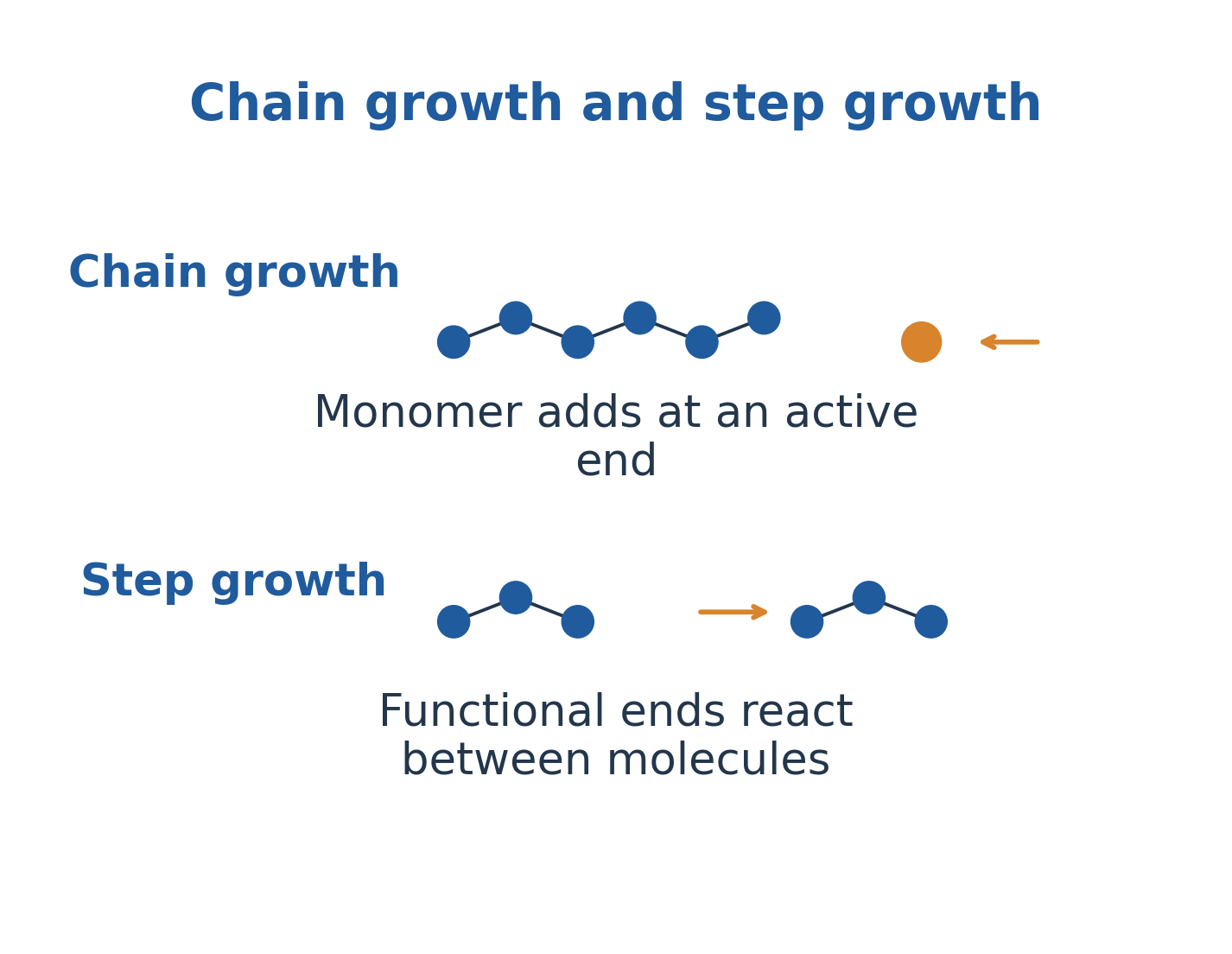

Chain Growth and Step Growth
Chain growth commonly involves initiation, propagation and termination or transfer.
Step growth involves reactions between compatible functional groups on molecules of many sizes.
Addition and condensation describe a different distinction involving incorporation and small-molecule release.
Many familiar condensation polymers form by step growth, but the two classification pairs are not universal synonyms.
Write representative groups and the reaction rather than memorizing a label without chemical structure.
Worked Problem 4.29: Condensation Repeat Mass
Route: CH
Problem: A supplied step-growth repeat arises from two monomer residues totalling 250 g/mol before loss of two water molecules. Use 18 g/mol per water molecule. Find the repeat molar mass.
Solution:
Water loss per stated repeat:
2 × 18 = 36 g/mol
Repeat molar mass:
250 − 36 = 214 g/mol
Answer: The repeat molar mass is 214 g/mol under the stated repeat definition.
End groups require separate treatment for a finite molecule.
32. Industrial Thermoplastics: PE, PP, PVC, Nylon and Polyester
Study route: CH
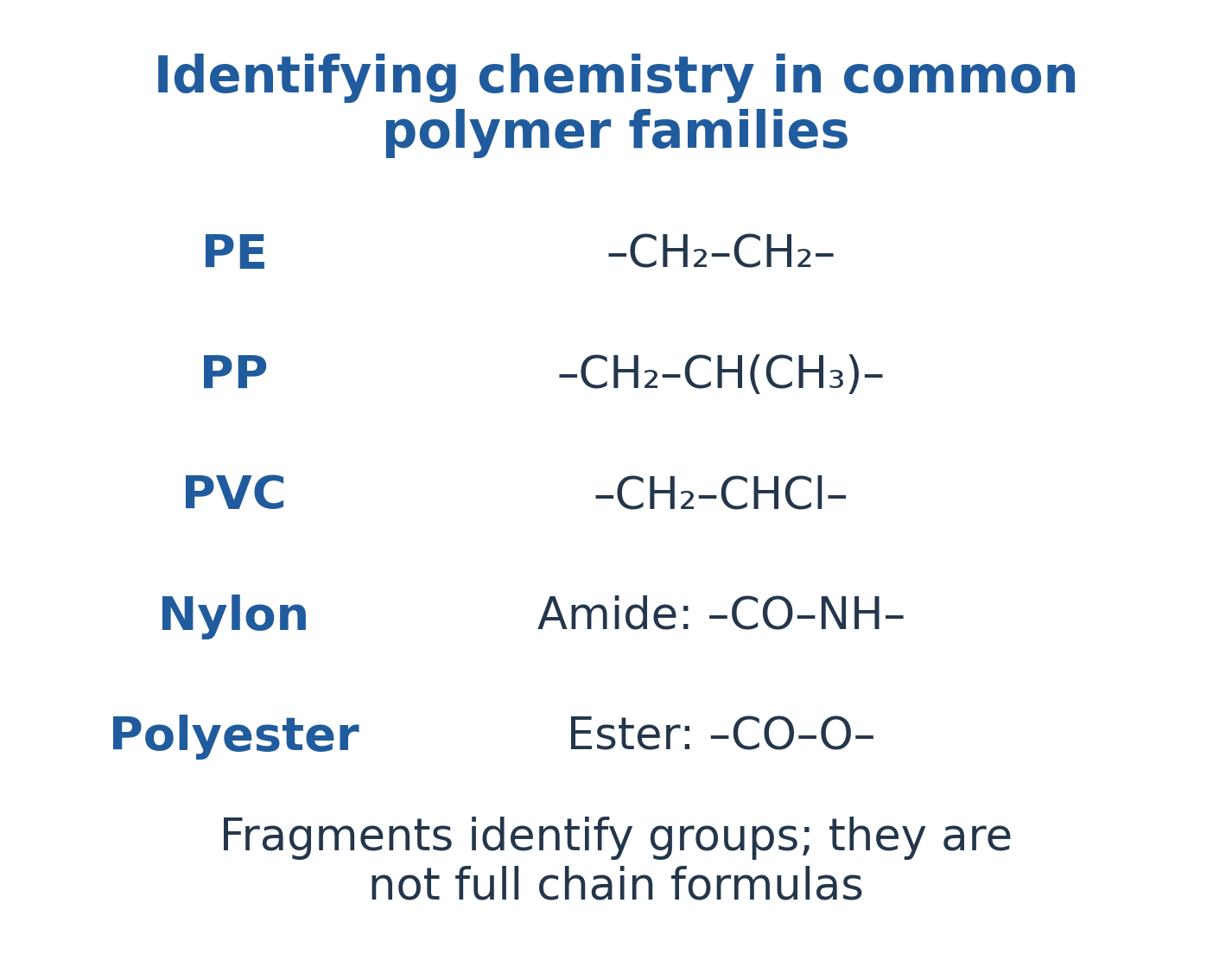
Polyethylene has a hydrocarbon backbone. Its properties depend on branching and crystallinity.
Polypropylene has methyl side groups. Stereoregularity influences packing and stiffness.
PVC contains chlorine-bearing repeat units and often needs suitable stabilization.
Plasticization can increase flexibility.
A commercial polymer formulation includes additives and is not always equivalent to a pure laboratory resin.

Nylon and Polyester
Nylon is a polyamide.
Its amide groups support interchain interactions and water response.
Common polyesters contain ester links. Hydrolysis and processing conditions influence molecular integrity.
Compare linkage, polarity, water response, processing and application.
PE and PP are widely used in packaging and parts.
PVC serves appropriate rigid or flexible products.
Nylon is used in fibres and engineering components, while polyester is used in fibres and containers.
Select an actual grade for the required service rather than assuming one property for every family member.
| Polymer | Characteristic Linkage or Group |
|---|---|
| PE | Hydrocarbon chain |
| PP | Hydrocarbon chain with methyl side groups |
| PVC | Chlorine-bearing repeat unit |
| Nylon | Amide links |
| Polyester | Ester links |
Worked Problem 4.30: Plasticizer Formulation
Route: CH
Problem: A formulation contains 80 kg of polymer and 20 kg of plasticizer. Find the plasticizer mass fraction and parts per hundred polymer.
Solution:
Total formulation mass:
80 + 20 = 100 kg
Plasticizer fraction in the final formulation:
20/100 × 100 = 20%
Parts per hundred polymer:
phr = 20/80 × 100 = 25
Answer: The formulation contains 20 wt% plasticizer, equivalent to 25 phr.
The values use different denominators.
33. Elastomers and Thermosetting Networks
Study route: CH
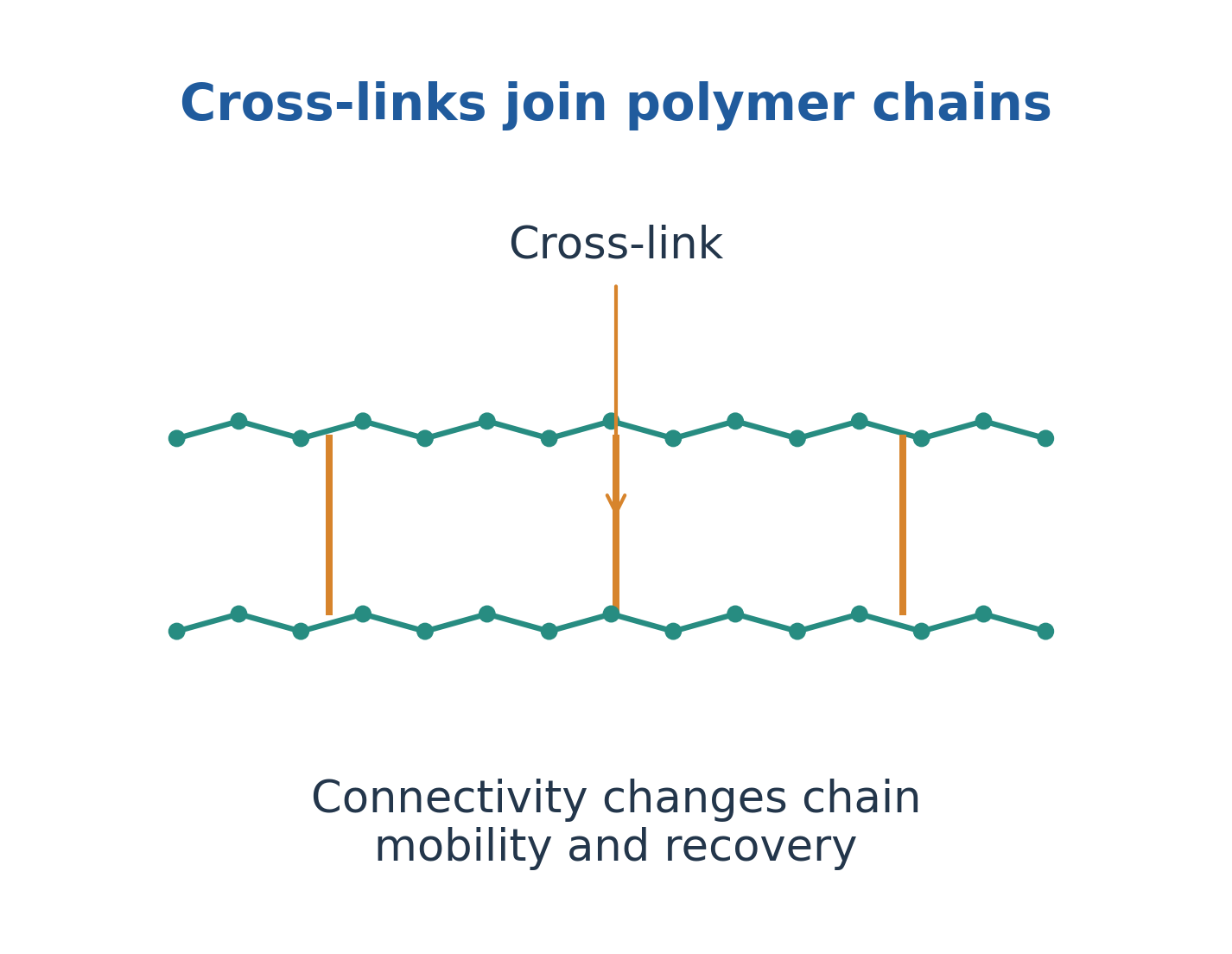
Elastomers undergo large reversible deformation because flexible chains are constrained by an appropriate network or physical junctions.
Cross-link density must balance recovery and extensibility.
Polymerization mechanism, chain length, branching, crystallinity and cross-linking connect chemistry with performance.
Addition versus condensation describes whether monomer incorporation commonly releases small molecules.
Chain versus step growth describes how molecular size develops.
These classifications should not be equated in every case.

Selection and End of Life
Polymer selection must include operating temperature, solvent exposure, stress, ageing and end-of-life pathway.
A recycling symbol alone does not establish local recoverability of a mixed or contaminated product.
A permanent thermosetting network prevents ordinary independent-chain melt flow.
Heating can cause degradation rather than an equivalent melt.
Recycling can require other physical or chemical routes.
Worked Problem 4.31: Polymer Classification
Route: CH
Problem: Why can a cross-linked thermoset not simply be remelted like a typical thermoplastic?
Solution:
A permanent network connects chains and prevents ordinary viscous flow of independent molecules.
The cross-links remain constraints during heating until chemical changes or degradation occur.
Answer: A cross-linked thermoset cannot ordinarily be remelted as an equivalent independent-chain melt because its permanent network prevents that flow.
Other recovery methods require their own process and chemistry.
34. Surfactants and Detergents: Interfaces and Micelles
Study route: CH
Surfactants contain hydrophilic and hydrophobic regions.
They can accumulate at interfaces and reduce interfacial free energy.
Above a condition-dependent critical micelle concentration, aggregates such as micelles become important.
Anionic, cationic, nonionic and amphoteric surfactants have different charge behaviour and compatibility.
Detergent formulations combine surfactants with builders and other additives.
Cleansing can involve wetting, emulsification and stabilization of removed soil.
Soap can form insoluble salts with hard-water ions, whereas many synthetic formulations behave differently.

Micelle Structure and Conditions
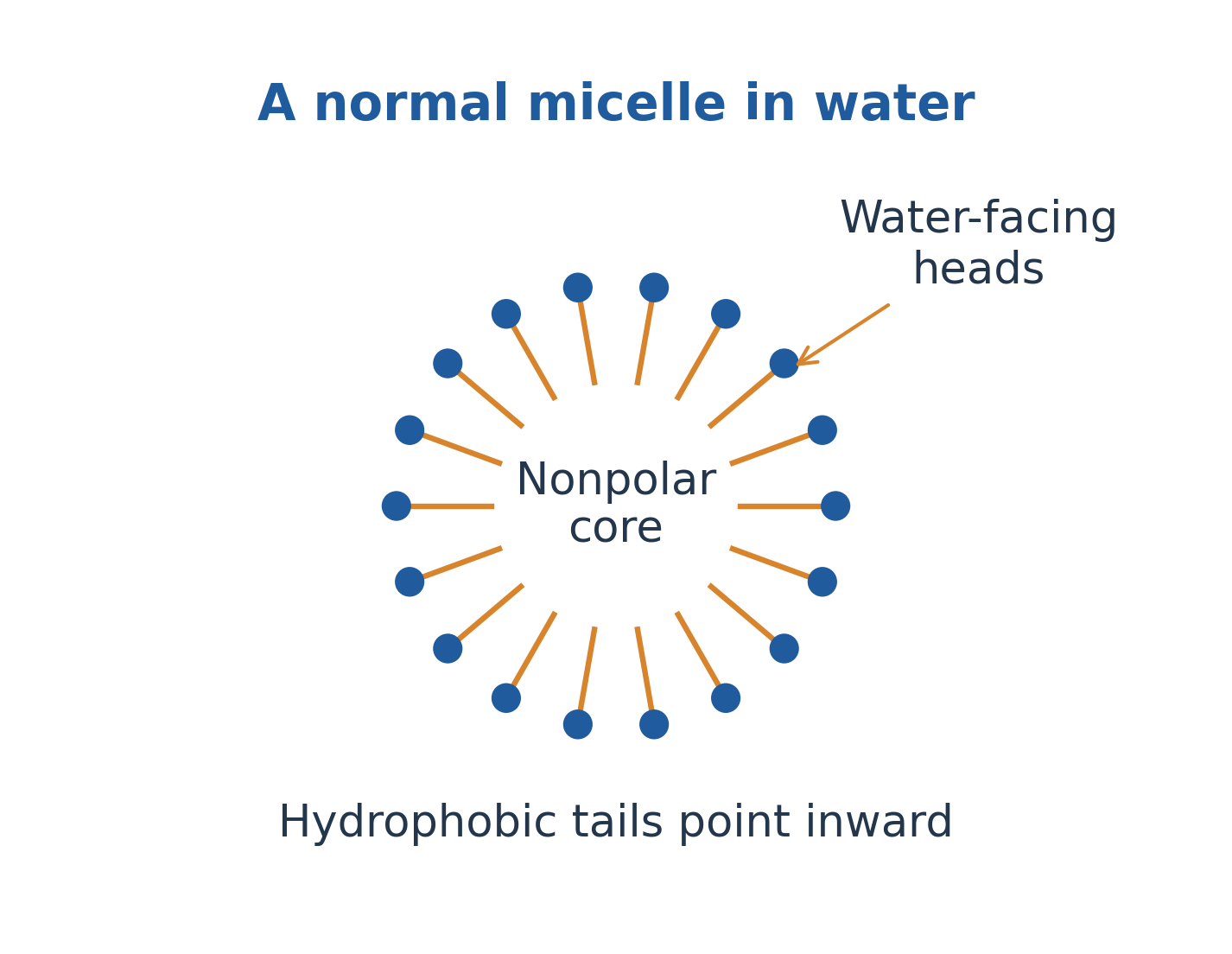
In a normal aqueous micelle, nonpolar tails are directed toward a less-water-exposed interior.
Compatible head groups face water.
Ionic surfactants carry charged heads.
Nonionic examples use suitable polar uncharged groups.
Amphoteric charge behaviour depends on molecular groups and conditions.
Salt, temperature and additives can shift aggregation behaviour, so a CMC belongs to a specified formulation.
Soap scum forms when suitable fatty-acid anions precipitate with hardness ions.
This is different from simply observing foam.
Worked Problem 4.32: Surfactant Concentration
Route: CH
Problem: A formulation contains 0.020 mol of surfactant in 2 L. Its stated CMC is 0.004 mol/L. Is the concentration above the CMC?
Solution:
Concentration = Amount/Volume
Concentration = 0.020/2 = 0.010 mol/L
Compare:
0.010 mol/L > 0.004 mol/L
Answer: The concentration is above the supplied CMC, so micellar aggregates are expected under the stated conditions.
This does not mean that every surfactant molecule is inside a micelle.
35. Specialty Chemicals: Formulation and Function
Study route: CH
Lubricants reduce friction through fluid films or boundary chemistry.
Plasticizers increase segmental mobility and flexibility but can migrate or alter barrier properties.
Dyes contain chromophores and suitable groups for interaction with substrates.
Colour depends on electronic structure and environment.
Fertilizers supply plant nutrients in chemical forms with different release and loss behaviour.
Pharmaceutical intermediates are compounds used in subsequent synthesis and require identity, purity and controlled impurity profiles.
These are function-based families rather than one shared reaction type.
A specialty chemical’s value often depends on specific performance at relatively low use level.
Purity, formulation and compatibility can therefore matter as much as bulk tonnage.

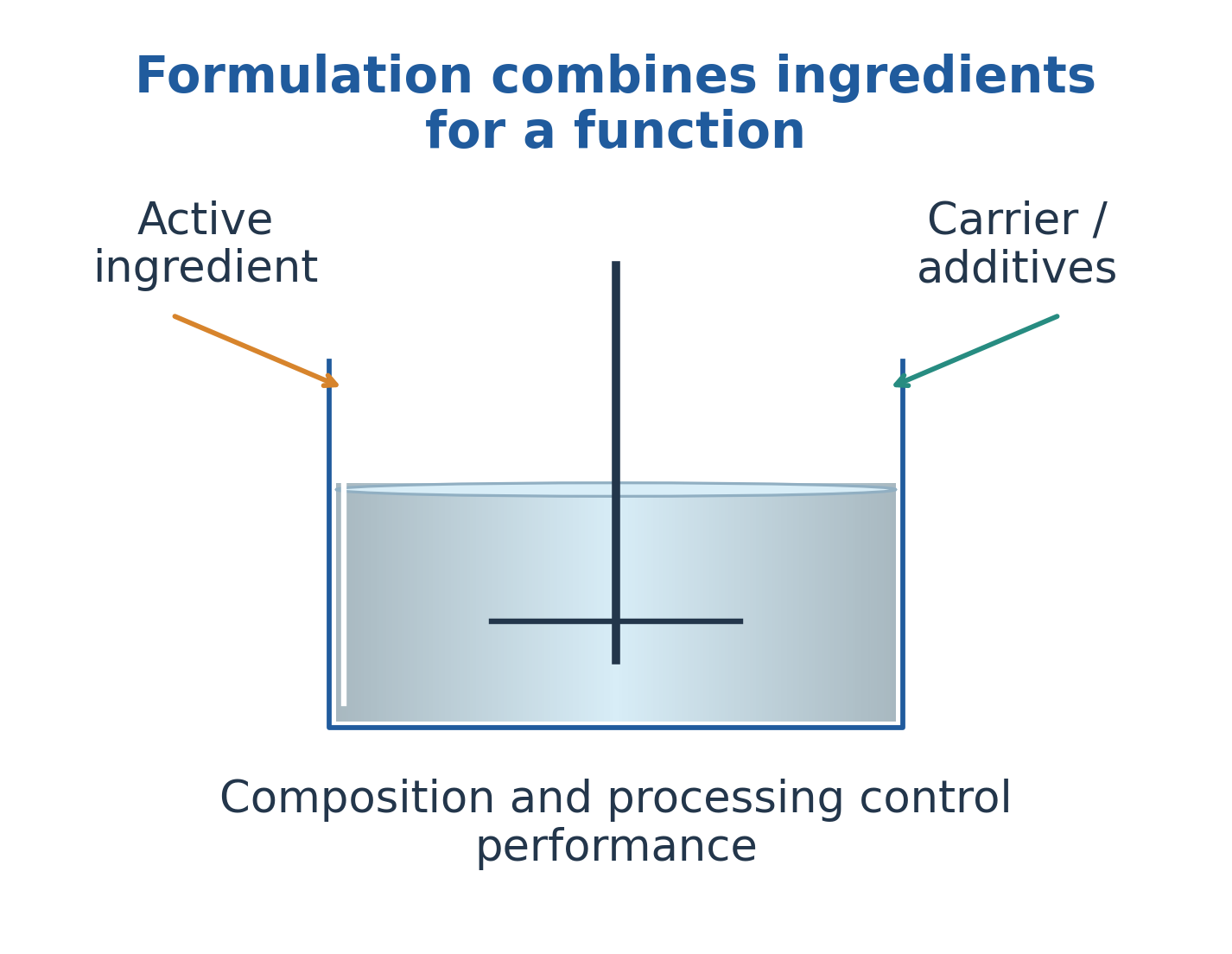
Selecting a Polymer and Specialty Formulation
Relate chemical connectivity to the service environment.
Hydrocarbon PE and PP differ from chlorine-containing PVC, amide-containing nylon and ester-containing polyester.
Polarity and intermolecular interactions affect wetting, sorption and compatibility.
Molecular size, crystallinity and morphology affect processing and mechanical response.
A thermoplastic can soften within an appropriate processing range.
A permanent thermoset network does not simply become the equivalent original melt.
Elastomer performance requires flexible chains with enough junctions to support recovery without making the network too restrictive.
Formulation modifies the base material.
Plasticizers can increase segmental mobility but may migrate.
Stabilizers address particular deterioration pathways.
Fillers and reinforcement change interfaces and load transfer.
Surfactants modify interfaces and can form micelles above a condition-dependent concentration.
Lubricants reduce friction by film formation or boundary chemistry.
Dyes provide selected optical absorption and substrate interactions.
Fertilizers supply nutrients rather than merely colouring or filling a product.
Pharmaceutical intermediates must meet identity and impurity requirements for their next reaction.
State chemical family, intended function and compatibility rather than classifying all specialty products by one manufacturing mechanism.
Worked Problem 4.33: Intermediate Purity
Route: CH
Problem: A 50 kg intermediate batch contains 98% target material on a supplied mass assay. Find the target and other-material masses.
Solution:
Target mass:
50 × 0.98 = 49 kg
Other-material mass:
50 − 49 = 1 kg
Answer: The batch contains 49 kg of target material and 1 kg of other material.
A purity percentage alone does not identify individual impurities or establish suitability for the next pharmaceutical synthesis.
36. Fermentation Technology and Medium Chemistry
Study route: BT
Fermentation uses microorganisms or cells to convert substrates into desired products under controlled conditions.
A medium supplies carbon and energy sources, nitrogen, minerals and required growth factors.
Glucose, starch hydrolysates or other feedstocks can supply carbon.
Ammonium salts, amino acids or complex ingredients can supply nitrogen.
The choice affects growth, product formation, oxygen demand, downstream purification and cost.
Carbon-to-nitrogen balance and inhibitory impurities require attention.
A nutrient-rich medium is not automatically optimal for the desired product.

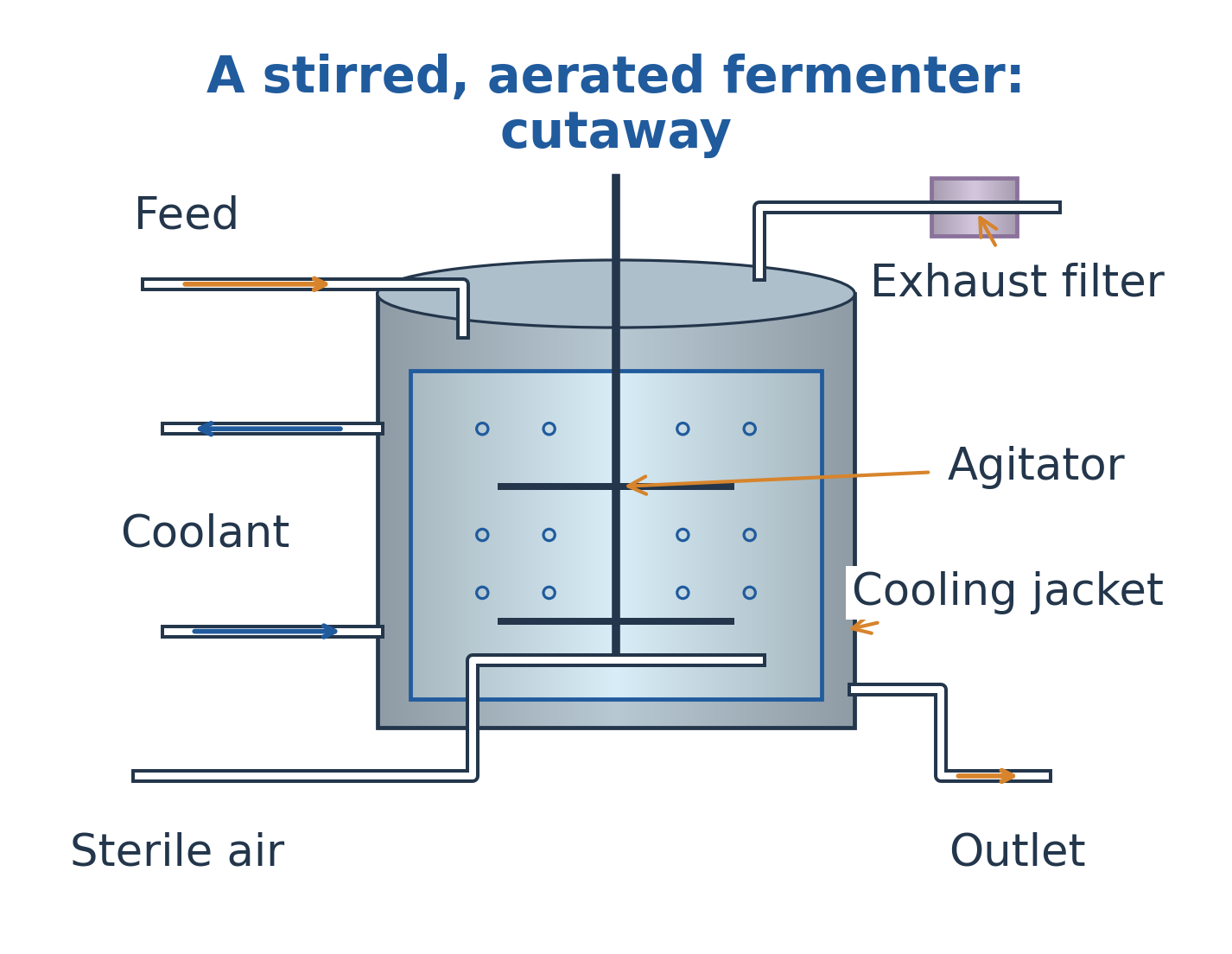
Batch Operation
Batch operation begins with a defined charge.
Product is usually withdrawn after cultivation.
The composition changes during the run as substrate is consumed and biomass, products and by-products accumulate.
Fed-Batch Operation
Fed-batch adds selected feed during cultivation.
This can help control substrate inhibition or metabolic response.
Changing feed and volume requires careful material accounting.
Continuous Operation
Continuous operation supplies feed and removes culture at a defined rate.
Contamination and culture stability remain important.
The vessel must support compatible mixing, temperature control, sampling and gas handling.
Aeration supplies oxygen only when the organism and product route require it.
Anaerobic operation is not simply an aerobic drawing with an oxygen arrow added.
Worked Problem 4.34: Medium Nitrogen Inventory
Route: BT
Problem: A supplied medium contains 5 g/L of a nitrogen source with a nitrogen mass fraction of 0.20. Find nitrogen per litre and in 100 L.
Solution:
Nitrogen per litre:
5 × 0.20 = 1 g/L
For 100 L:
1 × 100 = 100 g
Answer: The medium contains 1 g nitrogen per litre, or 100 g nitrogen in 100 L.
This inventory is not an automatic biomass yield because uptake, by-products and other nutrients also matter.
37. Sterilization: Heat, Filtration and Chemical Action
Study route: BT
Sterilization aims to eliminate viable organisms from a defined material or system using a validated process.
Moist heat acts through temperature-dependent damage to cellular components.
Filtration can remove microorganisms from heat-sensitive solutions using a suitable validated filter.
Chemical agents act through mechanisms such as oxidation or protein damage, but residues and material compatibility matter.
Sterilization differs from cleaning and from limited disinfection.

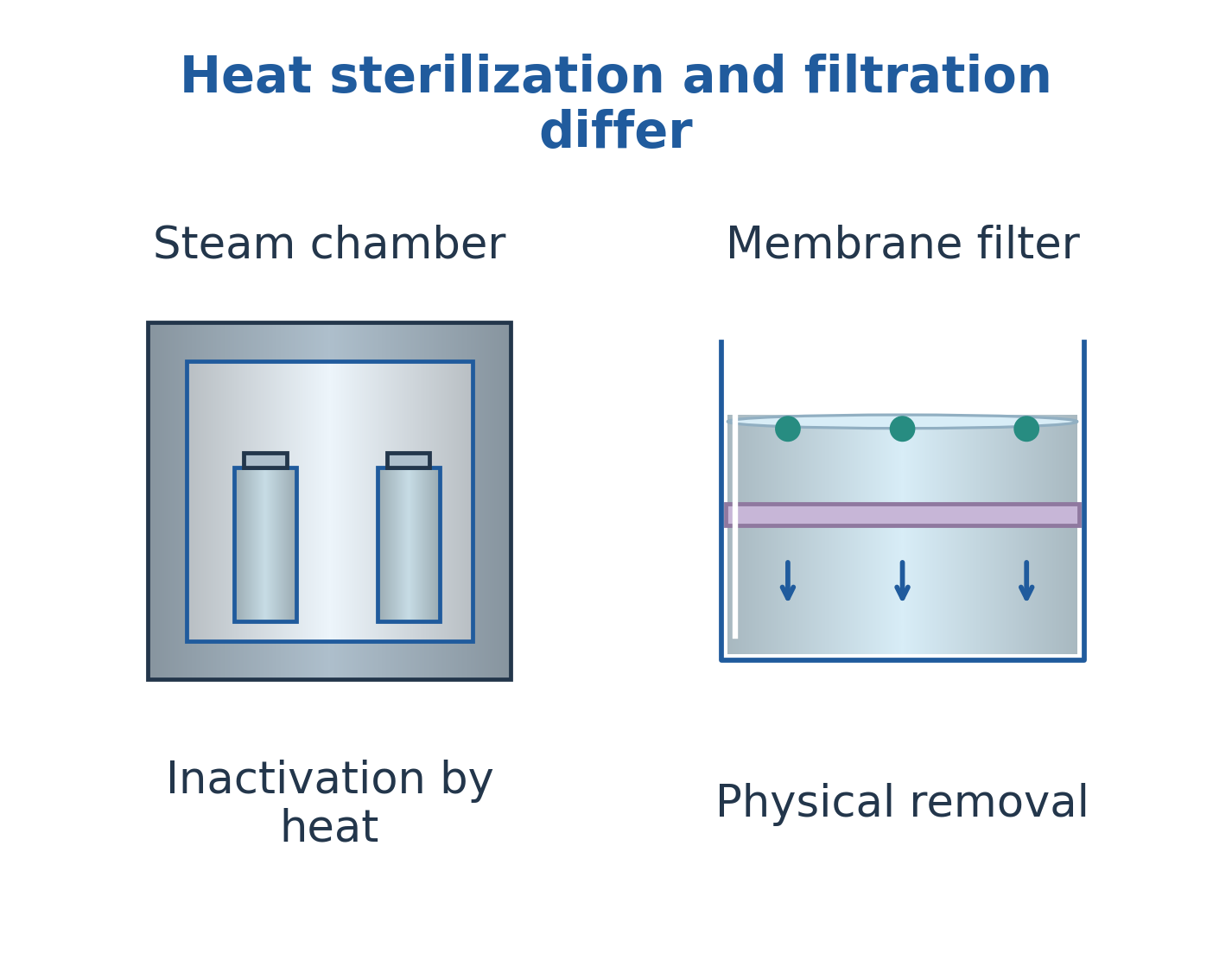
Decimal-Reduction Model
In a simple decimal-reduction model:
N = N₀ × 10^(-t/D)
Here:
- N₀ is the initial count.
- N is the expected surviving count.
- t is treatment time.
- D is the condition-specific decimal-reduction time.
A predicted average survival below one is a probability-based process measure.
It is not a guarantee that every item is free of contamination.
The D value depends on organism and conditions and must not be transferred unchanged to a different process.
Worked Problem 4.35: Decimal Reduction
Route: BT
Problem: Use N = N₀ × 10^(-t/D), N₀ = 10^6 and D = 2 minutes. Find the expected count after 10 minutes.
Solution:
Number of decimal reductions:
t/D = 10/2 = 5
Expected count:
N = 10^6 × 10^-5
N = 10
Answer: The expected surviving count is 10 under the supplied model.
The D value belongs to the specified organism and conditions.
38. Aerobic and Anaerobic Metabolism: Glycolysis, TCA and PPP
Study route: BT
Glycolysis converts glucose to pyruvate through a sequence that yields ATP and reduced cofactors.
Under aerobic respiratory conditions, pyruvate-derived acetyl-CoA can enter the TCA cycle.
Further oxidation generates reduced cofactors and carbon dioxide.
Electron transport and oxidative phosphorylation couple redox chemistry to ATP formation.
Under fermentative conditions, alternative pathways regenerate cofactors and produce products such as lactate or ethanol, depending on the organism and pathway.
Anaerobic does not mean that every organism makes ethanol.

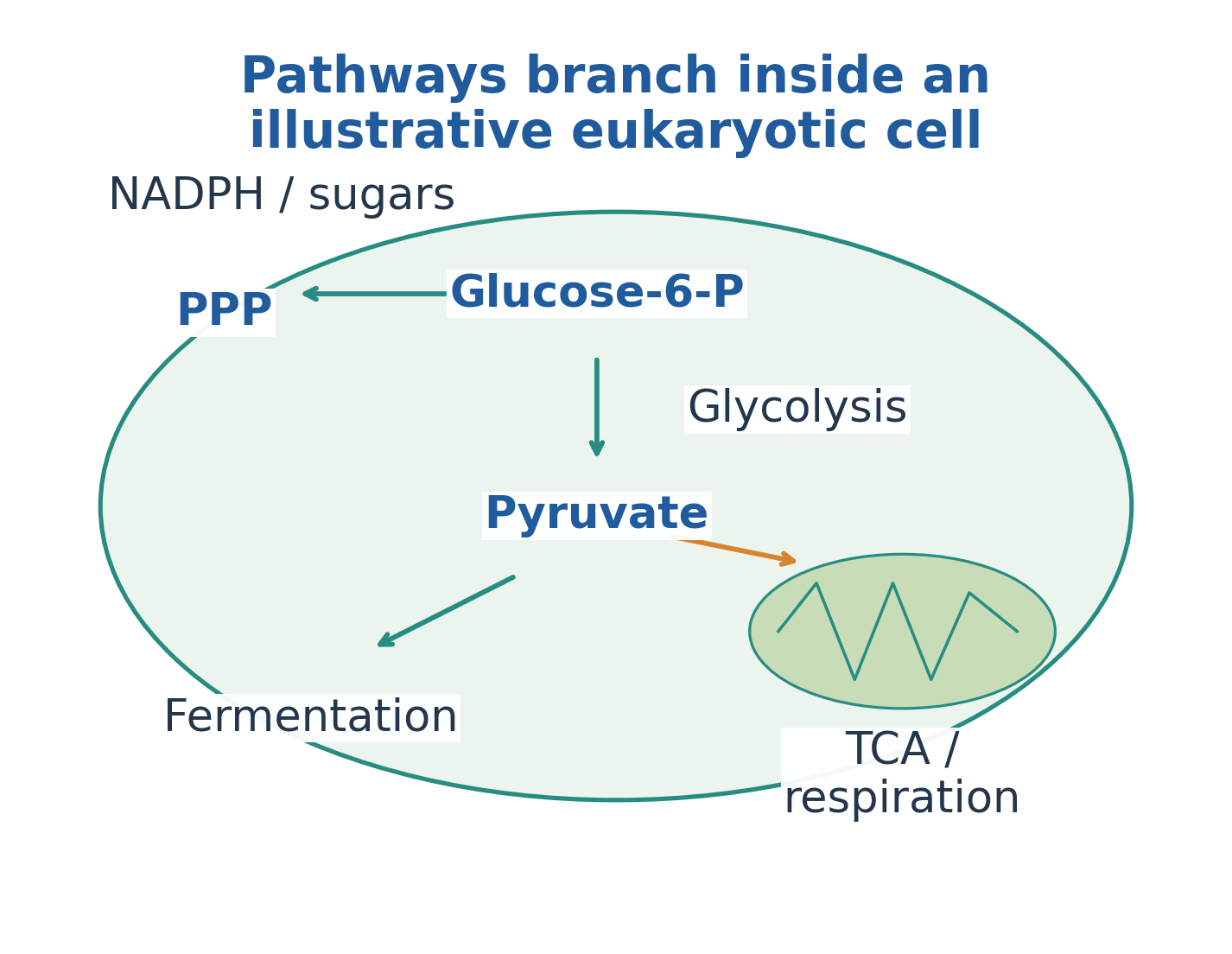
Pentose-Phosphate Pathway
The pentose-phosphate pathway supplies NADPH and sugar-phosphate precursors, including ribose-related intermediates.
It complements glycolysis rather than being the same sequence with a different name.
Oxygen availability affects metabolism, but pathway choice also depends on organism, substrate and regulation.
A fermenter drawing should label feed, mixing, temperature control, gas supply and exhaust, and sampling where appropriate.
An anaerobic system has different gas requirements from an aerated process.
Yield coefficients describe observed material conversion, while pathway equations describe stoichiometry.
Biomass formation, maintenance and by-products mean that real process yields can differ from a single ideal reaction calculation.
| Pathway | Main Introductory Role |
|---|---|
| Glycolysis | Glucose to pyruvate, with ATP and reduced-cofactor formation |
| TCA cycle | Acetyl-unit oxidation and reduced-cofactor generation |
| Pentose-phosphate pathway | NADPH and sugar-phosphate precursor supply |
Worked Problem 4.36: Pathway Assignment
Route: BT
Problem: Which pathway is especially important for NADPH and sugar-phosphate precursor supply: glycolysis, TCA or the pentose-phosphate pathway?
Solution:
The pentose-phosphate pathway has the intended introductory role.
Glycolysis and the TCA cycle provide different functions within the connected metabolic network.
Answer: The pentose-phosphate pathway is the intended answer.
Actual cellular flux depends on organism, substrate and regulation.
39. Bioprocess Yield Coefficients and Productivity
Study route: BT
Biomass yield on substrate is:
Yx/s = Mass of biomass formed/Mass of substrate consumed
The dry-mass basis must be stated.
Product yield uses product formed in the numerator:
Yp/s = Mass of product formed/Mass of substrate consumed
Volumetric productivity is product quantity per reactor volume per time.
It is not identical to yield.
Batch, fed-batch and continuous operation change substrate history and recovery conditions.
A concentration increase can result partly from volume change, so a material balance should use actual masses and volumes.


Yield and Productivity
Yield describes conversion efficiency on the selected material basis.
Productivity includes time and volume.
A high-yield process can be slow, while a rapid process can consume substrate inefficiently.
The selected metric should match the question being answered.
Initial biomass is not newly formed biomass.
Initial substrate is not necessarily completely consumed substrate.
Subtract the relevant starting or residual amount before calculating the ratio.
Worked Problem 4.37: Biomass Yield
Route: BT
Problem: Dry biomass rises from 2 g to 8 g while substrate falls from 25 g to 5 g in a defined batch. Find Yx/s.
Solution:
Biomass formed:
8 − 2 = 6 g
Substrate consumed:
25 − 5 = 20 g
Yield:
Yx/s = 6/20 = 0.30 g/g
Answer: The biomass yield is 0.30 g biomass per g substrate consumed.
Initial biomass is subtracted rather than counted as newly produced.
40. Downstream Processing and Product Recovery
Study route: BT
Downstream processing recovers a target from a complex broth.
Cell separation can use centrifugation or filtration.
Intracellular products can require disruption.
Precipitation changes solubility.
Chromatography exploits differential interactions.
Membrane filtration separates according to suitable size or transport properties.
Concentration, purification and formulation are distinct goals.

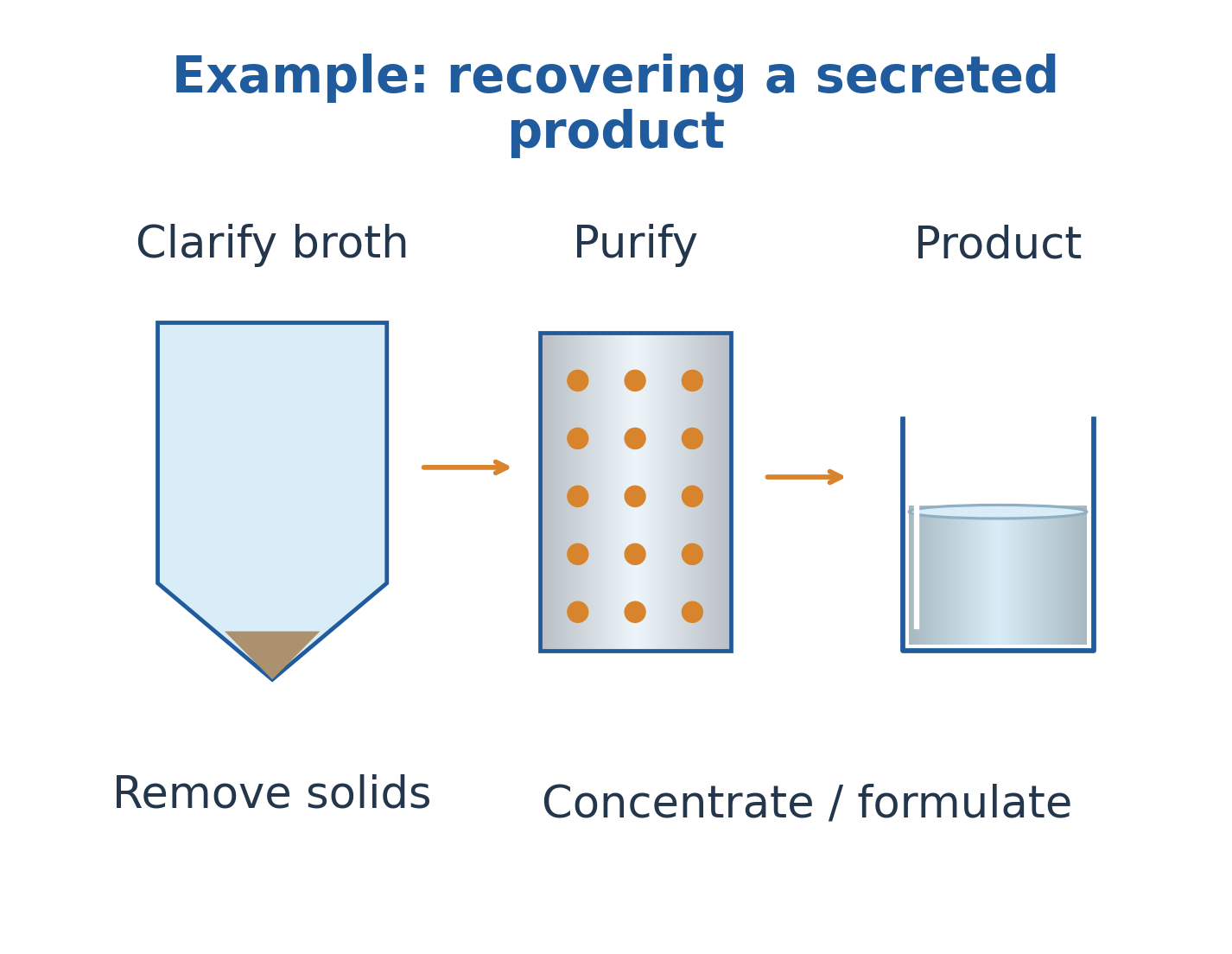
Recovery and Purity
Total recovery through serial steps is the product of fractional recoveries when each fraction refers to the input of that step.
Overall recovery fraction = r₁ × r₂ × r₃ × …
Purity is:
Purity = Target mass/Total product-stream mass
Purity can rise while overall recovery falls.
Include temperature, pH and residence-time limits for sensitive biomolecules.
A process is not complete merely because a coloured band or precipitate is visible.
Building a Fermentation Material Balance
First identify the organism, product and operating mode.
Medium carbon can support biomass, product and maintenance.
Nitrogen, minerals and growth factors must suit that aim.
Aerobic cultivation needs appropriate oxygen supply and transfer, while an anaerobic process follows its own metabolic requirements.
Glycolysis produces pyruvate and reduced cofactors.
Respiratory pathways can connect acetyl-CoA with TCA oxidation and electron transport.
Fermentative routes regenerate cofactors through products such as ethanol or lactate depending on the organism.
The pentose-phosphate pathway supplies NADPH and sugar-phosphate intermediates. It is not a second name for glycolysis.
Subtract initial biomass when calculating new biomass formed.
Divide by substrate consumed rather than substrate initially loaded for a yield coefficient on that basis.
Productivity also contains volume and time.
During downstream processing, locate the product.
Extracellular product begins in clarified broth, while intracellular product can require cell disruption.
Each precipitation, chromatography or membrane stage has a recovery and a purity effect.
Multiply sequential recovery fractions on their stage-input bases.
A purer final stream can contain less total target than the starting broth.
Worked Problem 4.38: Serial Recovery
Route: BT
Problem: Three downstream steps retain 90%, 80% and 75% of incoming target. Find the overall recovery.
Solution:
Convert percentages to fractions:
r₁ = 0.90, r₂ = 0.80, r₃ = 0.75
Multiply:
Overall fraction = 0.90 × 0.80 × 0.75
Overall fraction = 0.54
Answer: The overall recovery is 54%.
Adding the percentages would be invalid because each applies to a different stage input.
Worked Problem 4.39: Purity Versus Recovery
Route: BT
Problem: A feed contains 10 g of target in 100 g of total material. A recovered stream contains 8 g of target in 20 g total. Find purity and target recovery.
Solution:
Initial purity:
10/100 × 100 = 10%
Product purity:
8/20 × 100 = 40%
Target recovery:
8/10 × 100 = 80%
Target lost:
10 − 8 = 2 g
Answer: Product purity is 40%, while target recovery is 80%.
Purification increased the target fraction while losing 2 g of target material.
41. Food Composition, Nutrients and Water Activity
Study route: AG
Food contains carbohydrates, proteins, lipids, water, vitamins and minerals in proportions that affect nutrition, texture and stability.
Carbohydrates provide energy and structure.
Proteins provide amino acids and functional properties.
Fats carry energy and influence flavour and texture.
Vitamins and minerals are required in smaller amounts but remain essential.
Water activity, rather than moisture percentage alone, helps describe availability of water for microbial and chemical processes.


Chemical Composition
Carbohydrates include sugars and polysaccharides.
Proteins contain amino-acid residues.
Lipids include triacylglycerols and other families.
Vitamins are chemically diverse organic micronutrients, while minerals supply inorganic elements.
Processing can change solubility, denaturation, oxidation and nutrient retention.
Water Activity
Water activity is often expressed as the equilibrium vapour-pressure ratio to pure water at the same temperature.
aw = Vapour pressure over food/Vapour pressure over pure water
A lower value can limit selected organisms.
No single moisture number guarantees stability for every food.
The way water interacts with dissolved and structural constituents influences its availability.
Worked Problem 4.40: Food Moisture
Route: AG
Problem: A 100 g food sample contains 20 g of water. Find wet-basis and dry-basis moisture.
Solution:
Dry solids:
100 − 20 = 80 g
Wet-basis moisture:
20/100 × 100 = 20%
Dry-basis moisture:
20/80 × 100 = 25%
Answer: Moisture is 20% on a wet basis and 25% on a dry basis.
Neither value alone specifies water activity.
42. Browning Reactions and Food Adulteration Detection
Study route: AG
The Maillard reaction involves reducing sugars and amino groups.
It develops complex browning and flavour pathways during suitable processing or storage.
It differs from caramelization, which involves sugar transformations without requiring amino compounds.
It also differs from enzyme-mediated browning after tissue damage.
Temperature, pH and water availability influence each process.

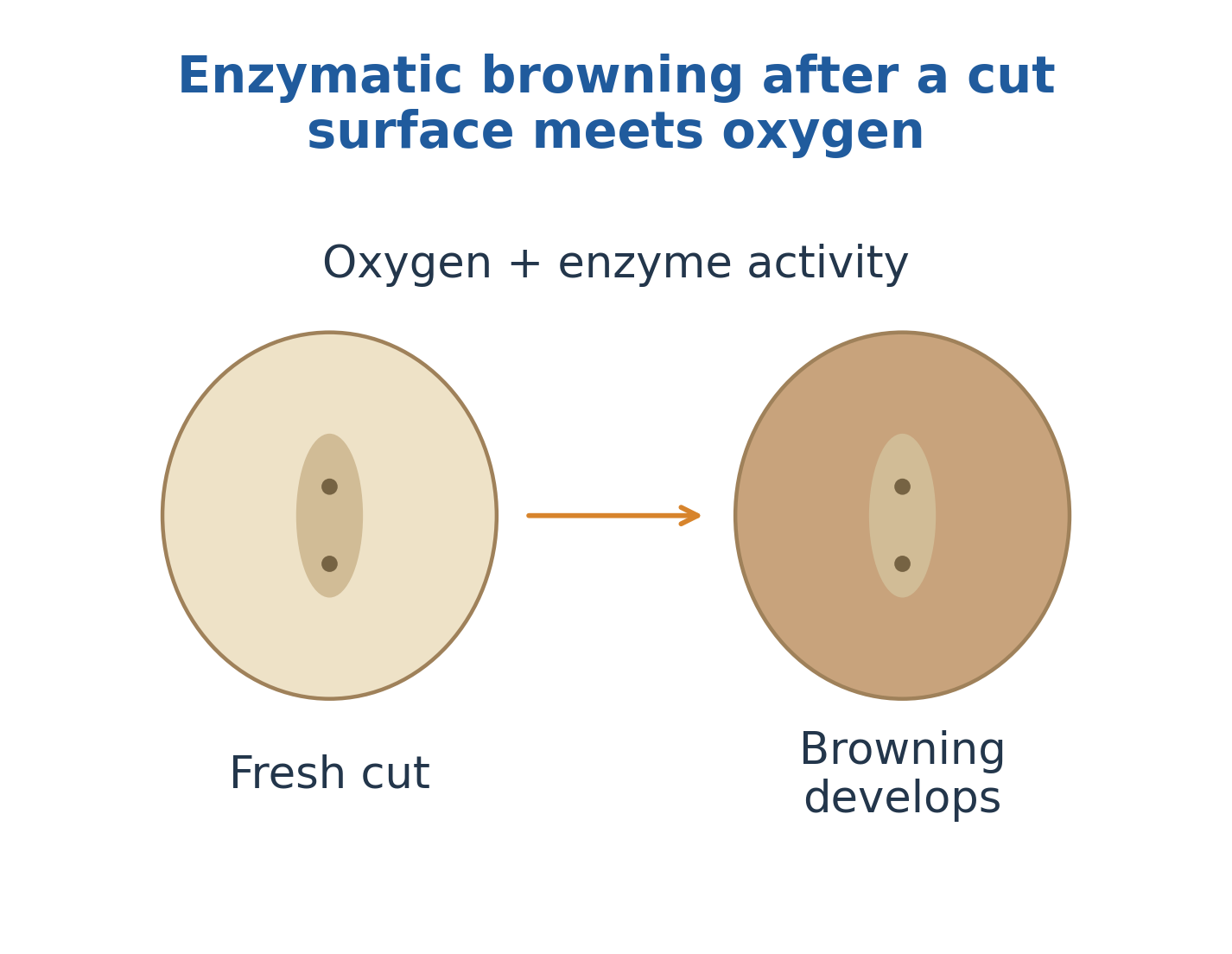
Adulteration and Detection
Adulteration can involve dilution, substitution or unauthorized additions.
Detection should use a method specific to the suspected adulterant and suitable controls.
A simple colour test is a screening result rather than complete compositional proof.
Instrumental, physical and chemical methods can be combined for identity, quality and traceability.
Detection starts with a specific suspected adulterant and a validated sampling method.
Iodine colour can screen for starch in an appropriate matrix.
Measured density can reveal some dilution patterns but is also affected by normal composition.
Chromatography and spectroscopy can help identify substituted oils or unusual components with suitable standards.
A positive screening observation needs interference controls and confirmation.
A negative nonspecific test cannot prove absence of all adulterants.
Maillard products arise through carbonyl-amino chemistry and later rearrangement or condensation. They do not arise simply through evaporating water.
Worked Problem 4.41: Browning Diagnosis
Route: AG
Problem: Cut apple tissue browns in air. Is this necessarily caramelization? Explain.
Solution:
Enzyme-mediated oxidation after tissue damage is a relevant mechanism.
Caramelization involves sugar transformations.
Maillard browning involves reducing sugars and amino groups.
The visible colour alone does not establish the mechanism.
Answer: No. Enzymatic browning is a relevant explanation for cut apple exposed to air.
Identify conditions and chemistry before choosing a control.
43. Food Preservation, Antioxidants and Preservatives
Study route: AG
Pickling controls microbial growth through acidity and sometimes salt.
Canning combines heat processing with sealed packaging.
Dehydration reduces water availability.
Irradiation uses ionizing radiation under a controlled process to achieve specified effects.
None should be described as a universal replacement for hygiene or proper storage.
Antioxidants slow oxidation through mechanisms such as radical interception or metal chelation.
Preservatives target selected deterioration pathways.
An antioxidant does not automatically inhibit every microorganism.


| Method | Primary Preservation Principle |
|---|---|
| Pickling | Acidity and sometimes salt |
| Canning | Defined heating combined with a sealed container |
| Dehydration | Reduced available water |
| Irradiation | Controlled ionizing-radiation treatment |
Dehydration Balances
When dry solids are conserved, their mass connects initial and final food amounts.
The final water fraction is based on final mass.
It is therefore incorrect to subtract the initial and final moisture percentages and apply that difference directly to the initial mass without a material balance.
Worked Problem 4.42: Dehydration Balance
Route: AG
Problem: A 100 kg food contains 80% water. It is dried to 20% water with dry solids conserved. Find final mass and water removed.
Solution:
Initial dry solids:
100 × 0.20 = 20 kg
The final food contains 80% dry solids.
Therefore:
Final mass = 20/0.80 = 25 kg
Final water:
25 − 20 = 5 kg
Initial water:
100 × 0.80 = 80 kg
Water removed:
80 − 5 = 75 kg
Answer: Final mass is 25 kg, and water removed is 75 kg.
The final moisture fraction is based on final mass.
44. Oil, Grain and Dairy Quality; Packaging Materials
Study route: AG
Oil quality can be assessed through acid value, peroxide value and other defined tests that reflect different degradation pathways.
Grain quality includes moisture, infestation, damaged kernels and composition.
Dairy quality includes fat and protein content, acidity, microbial condition and adulteration checks.
Packaging provides containment, barrier function, mechanical protection and information.
Glass, metals, paper-based structures and polymers have different oxygen, moisture, light and migration behaviour.
Product, package and storage conditions form one system.

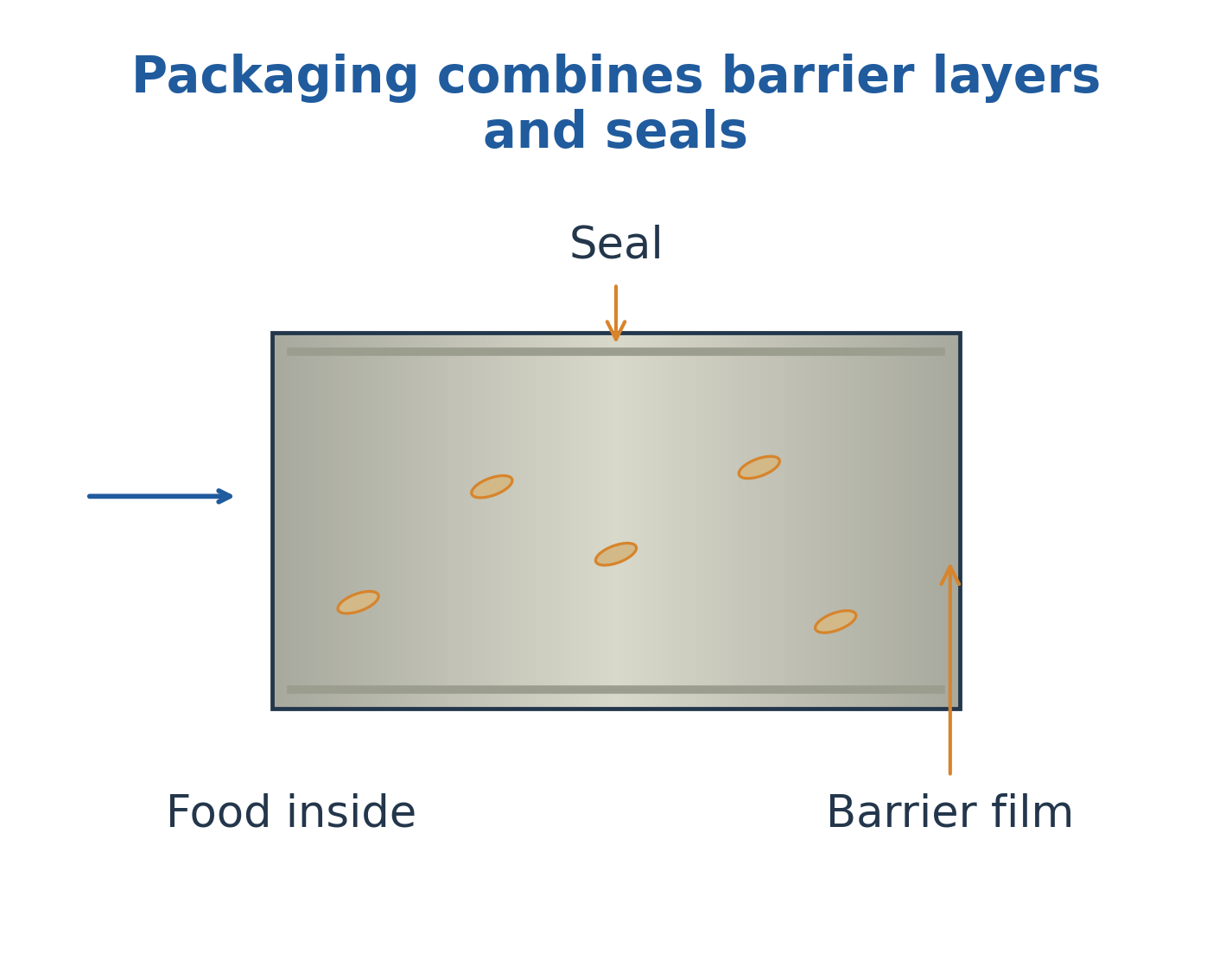


Quality Measurements and Packaging Choices
A high barrier can extend shelf life but complicate recycling in a multilayer structure.
Choose a material by required protection and verified compatibility rather than assuming all food-grade plastics behave identically.
For dairy products, fat and protein content, acidity, solids and microbial measures answer different questions.
Grain assessment includes foreign matter, moisture, broken or damaged kernels and infestation.
Oil peroxide value can rise and later fall as primary peroxides decompose.
Combine it with other relevant quality indicators.
Paper-based packaging offers different moisture barriers from glass, metal or polymer structures.
Multilayers can improve protection but make material separation difficult.
Seal integrity and product-package compatibility are part of the assessment.
Connecting Food Composition to Preservation
Food quality reflects composition, chemical reactions, microorganisms and physical structure.
Moisture content is a mass fraction.
Water activity concerns thermodynamic availability of water and is not fixed uniquely by moisture percentage.
Maillard browning involves reducing sugars and amino groups.
Caramelization involves sugar transformations.
Enzymatic browning depends on enzyme-mediated oxidation after tissue damage.
Their control strategies therefore differ.
Pickling uses an acid environment, often with salt.
Canning combines a defined thermal process with sealed packaging.
Dehydration lowers water availability.
Irradiation delivers a controlled ionizing-radiation treatment.
None removes the need for sound hygiene and storage.
Antioxidants slow selected oxidation routes, while preservatives act against specified deterioration processes.
Oil acid value measures titratable free-acid-related demand.
Peroxide value addresses primary oxidation products.
A low peroxide value alone cannot prove that oil has never oxidized because peroxides can decompose.
Grain quality includes moisture and damage.
Dairy assessment includes composition, acidity and microbiological condition.
Packaging must provide appropriate oxygen, moisture and light barriers without unacceptable migration.
Its protective benefit should be considered alongside its end-of-life route.
Worked Problem 4.43: Oil Acid Value
Route: AG
Problem: A 2 g oil sample consumes 0.10 mmol of KOH beyond the blank. Use 56.1 mg/mmol. Find the acid value.
Solution:
KOH mass:
0.10 × 56.1 = 5.61 mg
Acid value:
5.61/2 = 2.805 mg KOH/g oil
Answer: The acid value is 2.805 mg KOH per g of oil.
It measures a defined titration property rather than all forms of oxidation.
Worked Problem 4.44: Package Transmission
Route: AG
Problem: A supplied package area is 0.20 m² and water-vapour transmission is 2 g/(m²·day) at fixed test conditions. Find the 10-day transfer.
Solution:
Transfer = Transmission rate × Area × Time
Transfer = 2 × 0.20 × 10
Transfer = 4 g
Answer: The model predicts 4 g transfer in 10 days.
Real gradients, seals and storage conditions can change the result.
45. Mechanical and Chemical Textile Finishing
Study route: TX
Mechanical finishing changes fabric geometry or surface through pressure, heat or mechanical action.
Calendaring can smooth a surface.
Raising develops surface fibres.
Compacting can reduce residual shrinkage in suitable fabrics.
Chemical finishing deposits or reacts selected agents to alter properties.
Neither class is automatically permanent.
Subsequent washing, abrasion and heat can change the effect.


Assessing a Finish
A finish must be assessed for the intended use.
Appearance, handle, strength, absorbency, crease recovery and durability are separate properties.
Specify dry add-on versus wet pickup and test uniformity across the fabric.
The same retained mass can produce different performance when distribution or chemistry changes.
Compatibility with the fibre, dyes and other auxiliaries prevents precipitation, uneven application or loss of another useful property.
Worked Problem 4.45: Finish Add-On
Route: TX
Problem: A dry 100 g fabric weighs 104 g after application of a dry finish. Find the dry add-on percentage.
Solution:
Retained dry finish:
104 − 100 = 4 g
Dry add-on:
4/100 × 100 = 4%
Answer: The dry add-on is 4%.
Wet pickup must not be substituted when the question concerns retained dry solids.
46. Softeners and DMDHEU Easy-Care Chemistry
Study route: TX
Mechanical finishing alters fabric structure or surface through operations such as calendaring, raising or compacting.
Chemical finishing deposits or reacts materials to produce selected performance.
Anionic, cationic and silicone-based softeners alter surface interactions and friction.
Compatibility depends on fibre, dyes and other auxiliaries.
Softer handle alone does not prove better absorbency, strength or durability.
Finish level and uniformity should be matched to the intended fabric use.

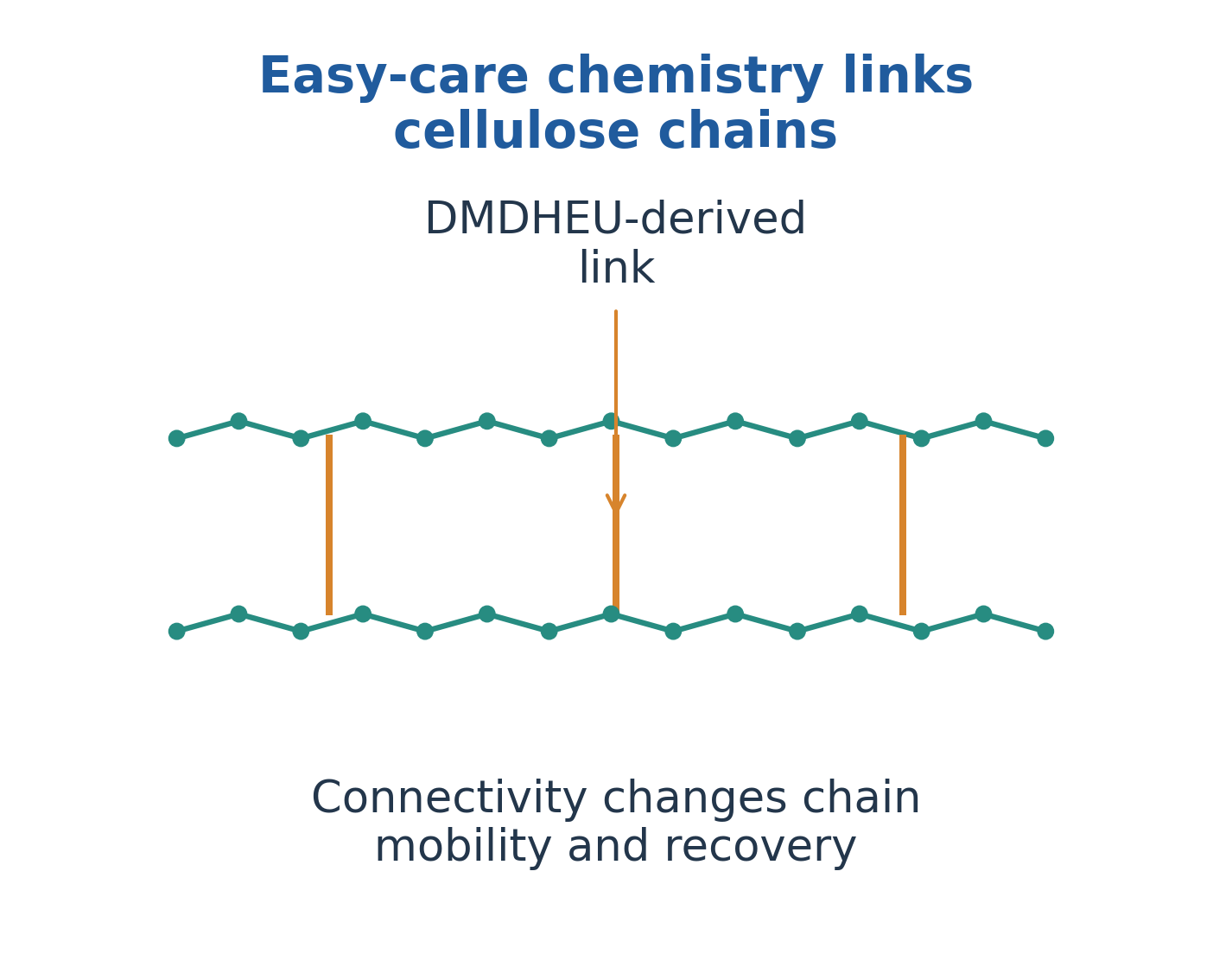
DMDHEU and Cellulose
DMDHEU denotes dimethylol dihydroxyethyleneurea, an important historical easy-care resin family.
Suitable methylol-related chemistry can connect cellulose chains during catalysed curing.
This restricts molecular movement during wetting and drying, helping crease recovery.
Under-curing can leave inadequate durability.
Severe conditions can damage cellulose or change handle.
Formulation and after-treatment influence formaldehyde release and other performance measures.
Compare treated and untreated fabric after the same conditioning and wash protocol.
Easy-Care Trade-Offs
Easy-care and anti-wrinkle treatments reduce irreversible chain rearrangement during wetting and drying.
DMDHEU-type systems cross-link suitable cellulose hydroxyl sites under curing conditions.
Crease recovery can improve while strength, handle and formaldehyde-related behaviour change.
Chemistry, catalyst, curing and after-treatment influence the balance.
A finishing answer should state:
- The target property.
- The reactive group or deposition mechanism.
- Activation conditions.
- Relevant trade-offs.
- Durability after defined use.
Wash durability is measured retention of function after defined laundering.
It is not established simply because a finish was initially applied.
Untreated controls and equal fabric conditioning make comparisons meaningful.
Worked Problem 4.46: Finish Retention
Route: TX
Problem: A defined performance index falls from 90 to 72 after washing. Find the retained percentage.
Solution:
Retention = Final index/Initial index × 100
Retention = 72/90 × 100
Retention = 80%
Answer: The stated performance index retains 80% of its initial value.
This does not automatically describe strength retention or retained chemical mass.
Worked Problem 4.47: Wet Pickup Versus Dry Add-On
Route: TX
Problem: A 100 g dry fabric retains 80 g of bath containing 5% solids. Assuming all those solids remain after drying, find the add-on.
Solution:
Retained solids:
80 × 0.05 = 4 g
Dry add-on:
4/100 × 100 = 4%
Wet pickup:
80/100 × 100 = 80%
Answer: Dry add-on is 4%, while wet pickup is 80%.
Evaporation removes solvent rather than all retained solute.
47. Water Repellency: Fluorocarbon Finishes, C6 and C8
Study route: TX
Water-repellent finishes lower surface wettability.
They differ from a continuous waterproof barrier.
Fluorocarbon systems, including historical C8 and shorter-chain C6 variants, and silicone or other fluorine-free systems have different performance and environmental profiles.
Shorter chain does not mean absence of persistence or hazard concerns.
Report required water and oil performance and durability instead of treating all formulations as equivalent.
Contact angle describes a defined droplet-surface test.
It is not a complete measure of fabric breathability or waterproofness.

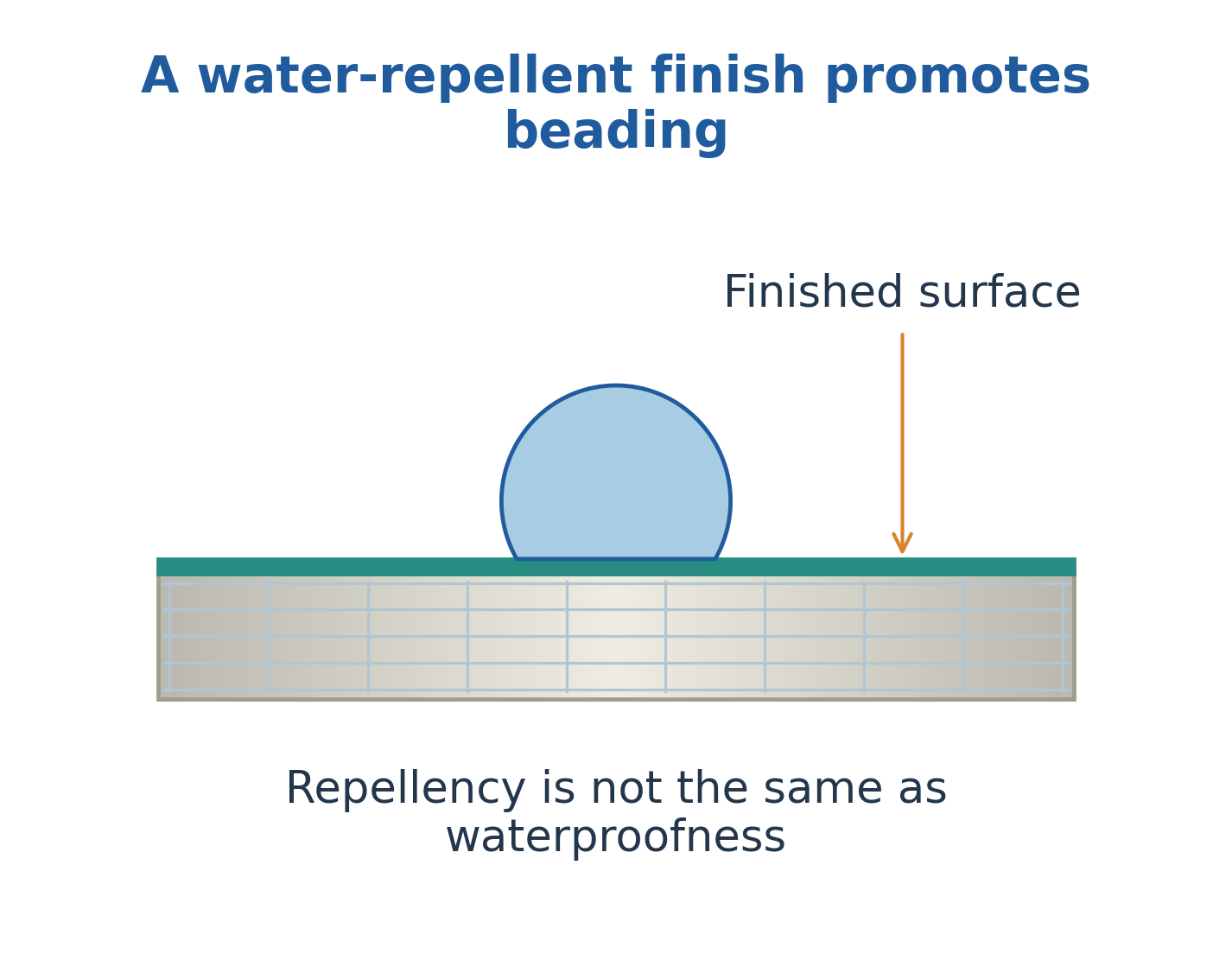

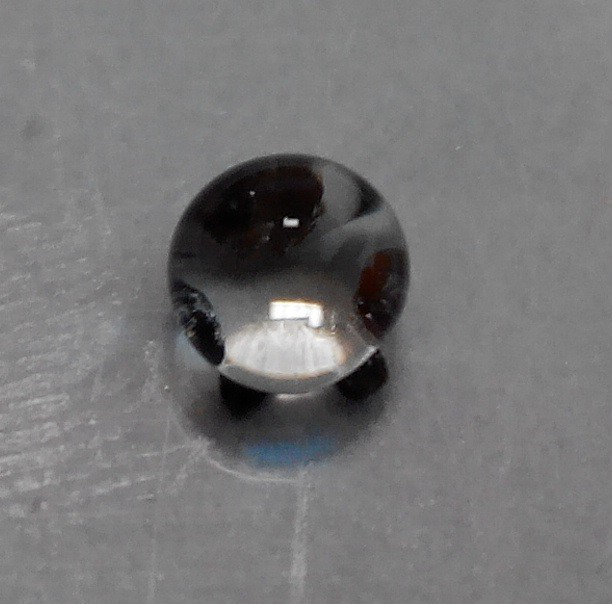
Comparing Functional Claims
Water repellency concerns the interaction of liquid drops with the surface.
Waterproofness concerns resistance to penetration under relevant conditions.
Breathability concerns transport through the material and requires its own measurement.
Pore structure, coating continuity, wear and washing can affect these properties differently.
Worked Problem 4.48: Repellent Versus Waterproof
Route: TX
Problem: Can a high initial water contact angle prove that a fabric is waterproof and breathable?
Solution:
Contact angle measures a droplet interaction.
Hydrostatic penetration and vapour or air transport require separate tests.
Fabric pores, coating continuity and wear influence the outcomes.
Answer: No. A high initial contact angle does not prove waterproofness and breathability.
Worked Problem 4.49: C6 Versus C8 Claim
Route: TX
Problem: Does changing a fluorocarbon finish label from C8 to C6 prove that the complete product is nonpersistent and harmless?
Solution:
The chain-length label provides only part of the chemical description.
Assess full chemistry, precursor and degradation profile, exposure and actual performance.
Durability and release measurements also matter.
Answer: No. A C6 label is not a complete environmental assessment.
48. Flame Retardants, UV Protection and Nano Finishes
Study route: TX
Flame retardants alter combustion through condensed-phase char promotion, gas-phase reactions or other mechanisms.
Phosphorus-based and halogenated systems differ in chemistry and by-products.
Some formulations combine mechanisms.
A flame-retardant textile is not necessarily noncombustible.
UV-protective finishes absorb or scatter radiation using suitable organic agents or inorganic particles such as TiO₂ and ZnO.
Nanofinishes can add antimicrobial, UV or surface functions.
Dispersion, attachment, wash release and durability matter.
Assess performance after appropriate use cycles and include effects on strength, comfort and effluent rather than reporting only a dramatic initial demonstration.

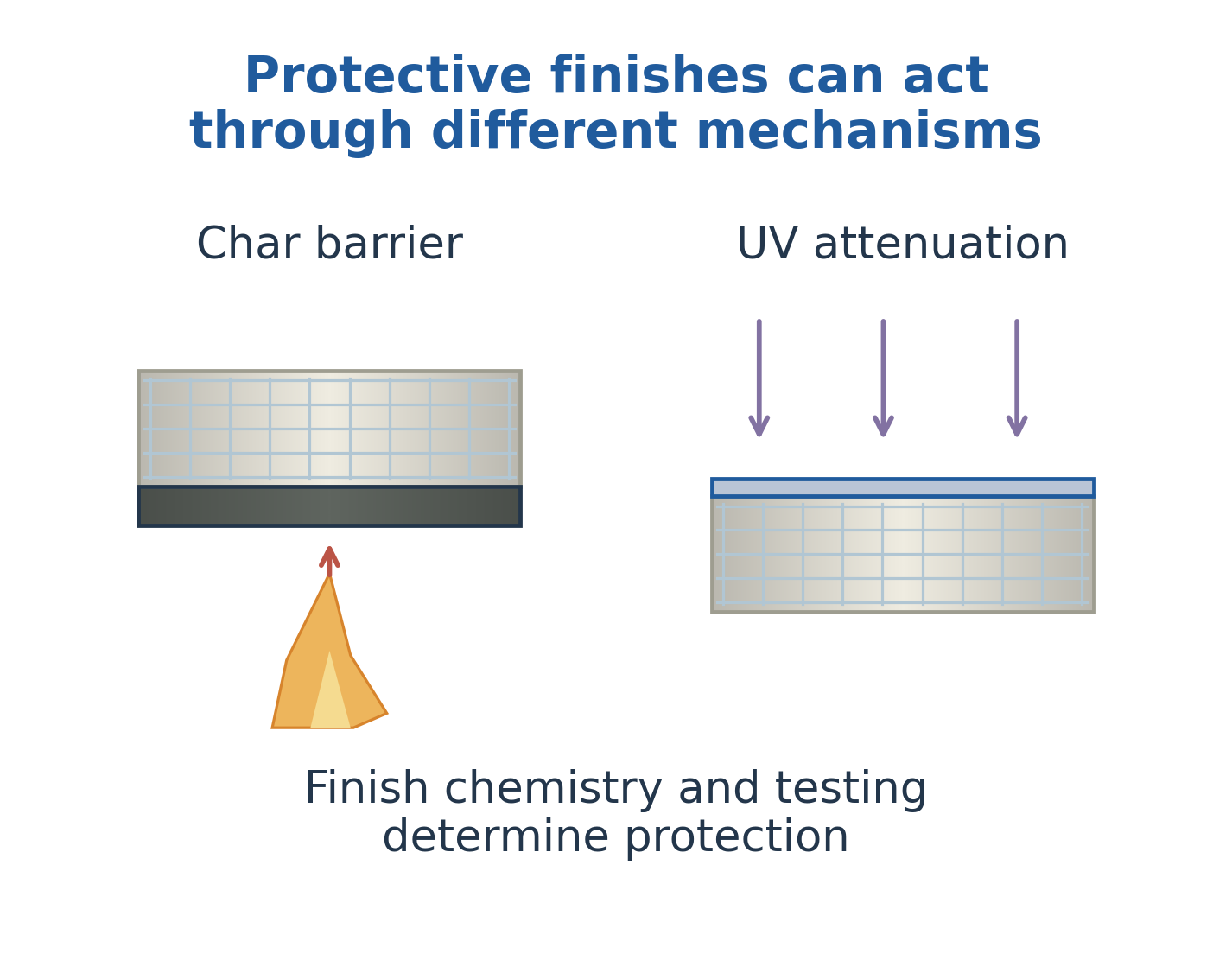
Assessing a Functional Textile Finish
Choose chemistry compatible with fibre, dye and required service.
Softeners alter surface interactions.
DMDHEU-type systems restrict cellulose rearrangement through suitable cross-linking.
Compare crease recovery with strength, handle and formaldehyde-related behaviour after curing and washing.
Fluorocarbon C6 and C8 labels describe chain-related distinctions rather than complete environmental profiles.
Phosphorus-based formulations can promote char.
Suitable halogenated systems can interrupt flame chemistry.
The actual mechanism depends on fibre and formulation.
UV finishes absorb or scatter radiation.
Nanofinishes require controlled dispersion, attachment and wash-release assessment.
Measure wetting, pressure penetration, flame behaviour and UV protection separately under defined protocols.
An initially dramatic effect does not establish durable overall performance.
Worked Problem 4.50: UV Transmission
Route: TX
Problem: A supplied textile transmits 5% of a selected UV band, while a finished sample transmits 2%. Find the relative transmission reduction.
Solution:
Relative reduction = (Initial transmission − Final transmission)/Initial transmission × 100
Relative reduction = (5 − 2)/5 × 100
Relative reduction = 60%
Answer: Transmission in the selected UV band is reduced by 60%.
This single-band result is not a complete UPF value, which requires appropriate spectral weighting and test convention.
TX Complete Answer: Compare Finishes Fairly
Use matched specimens and an untreated control.
Record formulation, application, wet pickup, drying and curing.
Calculate dry add-on from conditioned dry masses.
Wet pickup includes solvent.
Drying alone does not prove chemical cross-linking.
Choose a test for each function.
Crease recovery and tensile strength assess different outcomes.
Contact angle does not establish pressure resistance or vapour transmission.
Flame behaviour requires a defined exposure and endpoint.
UV protection depends on wavelength.
A complete protection factor needs the prescribed spectral and biological weighting rather than one transmission point.
Pores, stretch and wetting can change transmission.
Repeat relevant measurements after defined wash or wear cycles.
Distinguish retained finish mass from retained function.
Organization, attachment and substrate damage can change performance independently.
Where relevant, assess material released to wash water.
Report durability together with strength and comfort using the same conditioning and test basis for treated and control fabrics.
TX Mechanism Answer: Softening and Crease Recovery
A softener changes interactions experienced at fibre surfaces and between fibres.
Anionic products have negatively charged groups.
Cationic products have positively charged groups.
Nonionic silicone-based systems depend on their particular formulation.
Cationic agents can have useful affinity for suitable negatively charged surfaces.
Direct mixing with anionic auxiliaries can produce incompatibility.
Silicone structure and distribution influence lubricity and handle.
The family name alone does not specify every absorbency or durability effect.
Easy-care treatment has a different purpose.
During wetting, cellulose chains can move as intermolecular interactions change.
Drying can preserve a creased arrangement.
Suitable cross-linking restricts part of that rearrangement.
In DMDHEU-type treatment, cellulose hydroxyl groups participate in curing chemistry, connecting polymer regions through the finishing system.
The result can improve crease recovery, but it can reduce extensibility or strength and alter handle.
Explain the reactive substrate, reagent family, curing requirement and measured trade-offs.
A softener can modify handle in the same formulation, yet lubrication and cross-linking remain different mechanisms.
Formulas and Model Conditions
| Topic | Relation and Condition |
|---|---|
| Nanoparticle area | A/V = 6/d for separated ideal spheres |
| Specific particle area | Area per mass = 6/(ρd) for the stated ideal spherical model |
| Film inventory | Mass = Density × Coated area × Uniform thickness |
| Sheet resistance | R = Rₛ × Length/Width for a uniform rectangular film |
| Optical energy | Photon energy = hc/λ |
| Contact-angle hysteresis | Advancing angle − Receding angle |
| Bending strain | Surface strain ≈ t/(2R) under the stated thin-layer model |
| Slab conduction | Heat rate = kAΔT/L for steady one-dimensional conduction |
| Roof absorption | Absorbed flux = (1 − Reflectance) × Incident flux for an opaque surface |
| Standard cell voltage | E°cell = E°cathode − E°anode using reduction potentials |
| Nernst equation | E = E° − RT ln(Q)/(nF) |
| Nernst equation at 25°C | E = E° − (0.05916/n) log₁₀(Q) |
| Electrolysis | Hydrogen amount = Charge efficiency × Q/(2F) |
| Charge | Q = It |
| Battery energy | Energy in Wh ≈ Average voltage × Capacity in Ah |
| Capacitor energy | Ideal usable energy = C(Vmax² − Vmin²)/2 |
| Photovoltaics | Efficiency = Maximum electrical power/Incident optical power |
| Fill factor | FF = Pmax/(Voc × Isc) |
| Thermochemical storage | Ideal energy = Usable reaction extent × Reaction enthalpy |
| Biomass yield | Yx/s = Net biomass formed/Substrate consumed |
| Product yield | Yp/s = Product formed/Substrate consumed |
| Serial recovery | Overall fraction = Product of individual stage fractions |
| Purity | Target mass/Total selected stream mass |
| Sterilization | N = N₀ × 10^(-t/D), with D specific to organism and conditions |
| Wet-basis moisture | Water mass/Total food mass |
| Dry-basis moisture | Water mass/Dry-solids mass |
| Dry finish add-on | Retained dry finish/Original dry fabric mass |
Constants
Faraday constant, F = 96,485 C/mol
Gas constant, R = 8.314 J/(mol·K)
Planck constant, h = 6.626 × 10^-34 J·s
Speed of light, c = 2.998 × 10^8 m/s
Use the rounded constants explicitly supplied in an exercise.
Constants do not remove the need to select a valid physical model.
Unit Conversions and Checks
| Quantity | Useful Conversion or Check |
|---|---|
| Energy | 1 kWh = 3.6 MJ |
| Power | 1 kW = 1 kJ/s |
| Nanometre | 1 nm = 10^-9 m |
| Micrometre | 1 μm = 10^-6 m |
| Battery capacity | 1 Ah = 3600 C |
| Watt-hour | 1 Wh = 3600 J |
| Fractions | State mass, mole, volume or charge basis |
| Food moisture | Distinguish wet basis from dry basis |
| Textile finishing | Distinguish wet pickup from dry add-on |
Before Using a Formula
Distinguish geometric area from accessible area.
Distinguish reversible voltage from loaded voltage.
Distinguish absorbed solar heat from cooling electricity.
Use consistent particle, film and device dimensions.
State reaction direction and activity convention in electrochemistry.
Keep yield, purity and recovery denominators separate.
Define food moisture basis and textile wet pickup versus dry add-on.
D values, optical tests and finish durability apply to stated conditions.
A single model does not certify every service condition.
Answered Revision: All Study Routes
CSE: Is Shape Memory Ordinary Elastic Recovery?
No.
A shape-memory cycle includes programming, fixing a temporary shape and stimulus-dependent recovery toward a permanent shape.
Fixity, recovery, force and repeatability are different measurements.
Define reference strain and test conditions.
EE/ECE: Does ALD Mean Exactly One Atom per Cycle?
No.
Growth per cycle depends on chemistry, surface and nucleation.
Self-limiting half-reactions require adequate exposure and purge.
Confirm the process and film continuity rather than treating pulse count as automatic proof of atomic perfection.
CE: Is Recycled Content Proof of Sustainability?
No.
Compare verified function, lifetime and a complete boundary including processing and transport.
Aggregate absorption, contamination and variability affect performance.
Collection becomes useful recycling only when suitable output actually displaces relevant new material.
ME: Is Reversible Voltage the Loaded Voltage?
No.
Activation, ohmic and transport losses affect operation.
Fuel utilization, energy input and balance-of-system demands also matter.
Compare useful energy on matched boundaries instead of equating theoretical voltage with whole-system efficiency.
CH: Is Thermoset Softening Equivalent to Remelting?
A permanent network prevents ordinary independent-chain melt flow.
Heating can cause degradation.
Linkage chemistry, network structure and formulation determine service behaviour.
A thermoplastic or thermoset label alone does not specify every processing limit.
BT: Can Purity Increase While Recovery Falls?
Yes.
Removing impurities can increase the target fraction while some target is lost.
Recovery compares target output with target input.
Purity compares target with total stream mass.
Multiply sequential stage recoveries on their stated bases.
AG: Does Moisture Specify Water Activity?
No.
Binding and composition affect water availability.
Equal moisture percentages can give different activities and deterioration behaviour.
Preservation and packaging must match the food and storage conditions.
One test cannot describe every quality attribute.
TX: Does Contact Angle Prove Waterproofness?
No.
Wetting, pressure-driven penetration and vapour transport are separate properties.
Finish chemistry, pores, continuity and washing affect them differently.
Report relevant test conditions rather than inferring every function from initial droplet appearance.
Integrated Explanations and Examination Applications
1. Connect Nanoscale Geometry to Accessible Surface
Consider dividing one solid cube into eight equal smaller cubes without removing material.
Each smaller cube has half the original side length.
Its area is one quarter of the original cube’s area, but eight such cubes provide twice the original external area.
Total volume remains unchanged.
This is the geometric basis of the subdivision illustration. It explains why total mass alone does not describe the surface available for interaction.
For spherical particles of one density:
Specific geometric area = 6/(Density × Diameter)
Keeping density constant while reducing diameter increases ideal area per unit mass.
However, this expression assumes separated particles with the stated shape.
Agglomeration, inaccessible pores, surface coatings and attachment to a support can change the area that a reacting fluid actually reaches.
A geometric prediction and an adsorption measurement therefore need not have identical values.
The effect on performance depends on mechanism.
More exposed area can provide more adsorption or catalytic sites, yet it can also increase unwanted reaction with moisture or oxygen.
In a composite, increased interface can improve reinforcement only when the interface transfers stress effectively.
A weakly attached filler with a large nominal surface can still produce poor mechanical performance.
Similarly, adding more conducting particles helps only when their arrangement supports continuous electrical paths.
An examination answer should connect dimension, interfacial fraction and required property in that order.
Avoid using small size as a complete explanation.
For a quantum dot, electronic confinement is central.
For a rough coating, wetting and texture matter.
For a conducting network, junction resistance and connectivity can dominate.
These materials share a dimensional scale while operating through different physical and chemical relationships.
2. Compare Carbon Nanomaterials Through Their Processed Form
Graphene and carbon nanotubes contain related graphitic bonding, but their geometry gives different design possibilities.
A sheet can cover an area and form a thin conducting interface.
A tube provides a long, narrow element with a large aspect ratio.
A collection of tubes forms a network containing many junctions.
A transferred sheet can contain cracks, folds, grain boundaries and residue.
The processed structure determines how ideal bonding contributes to a useful component.
For an electrode, evaluate electrical transport together with optical transmission, adhesion and mechanical cycling.
Increasing a conducting coating’s loading can reduce resistance while also reducing transparency.
An apparently excellent resistance value does not establish that the same film can operate as a transparent display electrode.
Surface contamination can influence contacts.
Contact resistance can obscure the resistance of the film itself.
State whether a measurement includes electrodes and connecting leads.
The sheet-resistance model is particularly useful for a uniform rectangular conducting layer.
Length divided by width counts the number of geometric squares along the current path.
The term per square describes this geometric relationship.
It does not mean that the sample must have one particular square size.
Doubling both length and width leaves their ratio unchanged under the model.
Changing thickness or introducing nonuniform conduction can change the measured result.
Graphene oxide and reduced graphene oxide require their own descriptions.
Oxygen-containing groups change dispersion and compatibility but disturb the continuous electronic network.
Reduction removes or alters some oxygen functionality without necessarily repairing every defect.
Choosing a material therefore involves balancing processing, interfacial chemistry and performance.
The best dispersed material in a liquid is not automatically the best electrical conductor after drying.
The most conducting powder does not automatically make the most durable flexible coating.
3. Explain Optical Switching Without Confusing the Information Produced
A quantum dot, a photochromic coating and a thermochromic label can all change what an observer sees, but their functions differ.
A quantum dot can absorb excitation and emit photons through radiative recombination.
A photochromic material changes its absorption spectrum after illumination.
A thermochromic material changes its optical response with temperature.
Begin an answer by naming the stimulus, changing material state and observed quantity rather than grouping all three as colour-producing chemicals.
Photon-energy calculations connect transition energy with wavelength.
The supplied relation is:
Energy in eV × Wavelength in nm ≈ 1240
It describes an individual photon.
It does not specify how many photons are emitted or how efficiently electrical energy becomes light.
Photoluminescence quantum yield uses emitted and absorbed photon counts.
Brightness also depends on absorption, illumination intensity and collection.
These quantities answer related but separate questions.
For an optical indicator, distinguish present condition from accumulated history.
A reversible photochromic coating can fade after activating light is removed.
Its current tint does not necessarily preserve a permanent record of earlier exposure.
A reversible thermochromic label can similarly return toward its starting appearance on cooling.
An irreversible threshold label serves a different information function.
Hysteresis can make appearance depend on whether the system is heating or cooling near its transition.
A useful comparison records activation conditions, reversal conditions, response time, optical contrast and retention through repeated cycles.
The polymer host can restrict molecular motion or influence ageing.
Viewing light can change perceived colour without changing the underlying material state in the same way.
A complete device might need a detector and calibration to convert optical response into an electrical reading.
The visual effect itself does not establish electrical generation, precise temperature measurement or validated exposure-dose recording.
4. Distinguish Wetting, Self-Cleaning and Mechanical Reliability
A drop photograph reveals a particular interaction between liquid and surface.
It cannot independently establish how easily the drop moves, whether oil behaves similarly or whether water penetrates a porous fabric under pressure.
A high apparent angle can coexist with substantial contact-line pinning.
Advancing and receding measurements describe different stages of drop motion.
Their difference gives hysteresis under the specified protocol.
Roll-off observations provide additional information about mobility.
The mobile-drop self-cleaning mechanism needs water drops that can move and interact appropriately with loose contamination.
Dirt removal becomes less effective when contamination binds strongly or oily deposits wet the surface.
Photocatalytic cleaning operates through chemical transformation and must be explained separately.
Surface roughness can support one wetting state while making a coating vulnerable to abrasion.
A useful initial effect must therefore be related to realistic handling and cleaning cycles.
A flexible smart surface adds mechanical requirements.
Under the simple bending estimate, making a film thinner reduces its outer-surface strain at the same bend radius.
Placing an active layer near the neutral mechanical plane can reduce its deformation.
Multilayer stacks need more careful treatment than a homogeneous sheet.
Adhesive interfaces, electrical contacts and encapsulation can fail even when the active layer remains chemically intact.
Record radius, direction, cycle count and measured function.
Shape-memory recovery is another distinct property.
A programmed polymer first fixes a temporary shape, then recovers when an appropriate stimulus activates molecular mobility.
A recovery percentage describes the stated strain convention and does not directly give recovery force.
Ordinary elasticity, one-way shape memory and two-way cycling require separate explanations.
In a design answer, identify the support, conductor, responsive layer, interfaces and readout before discussing the tests needed for each function.
5. Choose Synthesis and Deposition from Interface Requirements
Particle synthesis and thin-film deposition solve different geometrical problems.
A reduction process can create particles dispersed in a liquid.
A sol-gel route develops connected inorganic chemistry through hydrolysis and condensation.
Hydrothermal conditions support selected crystallization pathways in heated aqueous media.
Producing material through one of these routes does not automatically place a continuous, electrically useful film on a device substrate.
Subsequent dispersion, coating or integration can introduce additional interfaces and defects.
Precursor conversion measures how much feed enters the defined target rather than how many particles form.
To infer average particle volume from total incorporated material, further information is needed about composition, density and particle number.
A high conversion can coexist with a broad size distribution or severe aggregation.
A photograph showing a few particles cannot establish the distribution of an entire batch.
Use complementary characterization to connect chemistry, size and final function.
Deposition route selection begins with substrate geometry and thermal tolerance.
Physical transport, surface reaction, sequential self-limiting chemistry and solution spreading impose different constraints.
A substrate with recessed features can require attention to reactant access and conformality.
A polymer substrate can limit processing temperature or solvent choice.
Nominal thickness alone cannot describe pinholes, adhesion, composition or interfacial contamination.
The required device function determines which defects are most important.
For ALD, a pulse is useful only when chemistry and exposure support the intended surface reaction.
Purge stages remove excess precursor and by-products, preventing unwanted mixing.
Growth per cycle can differ during initial nucleation and later growth.
A calculation based on a constant value is appropriate only within the supplied model.
For a self-assembled monolayer, verify molecular attachment and organization rather than treating any thin dried organic deposit as an equivalent interface.
6. Evaluate Sustainable Construction Through a Common Function
A material comparison needs a defined engineering service.
One cubic metre of insulating infill and one cubic metre of reinforced structural concrete do not provide the same function.
Their density, load capacity, thermal response and connection requirements differ.
Equal mass or equal volume is therefore not always an appropriate basis.
Compare the quantity of each system required to deliver the same stated service over a comparable lifetime, including maintenance and replacement where relevant.
Geopolymer performance depends on reactive feed, activator chemistry and curing rather than a single material name.
Activator solution contains dissolved solids and water.
Reporting its full mass as dry activator distorts the chemical inventory and can confuse the mixture’s water balance.
Different precursor compositions can produce different binding products.
Strength development, shrinkage and exposure resistance must be assessed for the actual formulation instead of inferred from a general low-clinker description.
Recycled aggregate introduces another inventory problem.
Replacement can be defined by mass or volume, and the denominator must be identified.
Adhered mortar can increase water absorption, influencing workability and effective water availability.
Adding uncontrolled water to recover workability can change hardened properties.
Sorting, grading and preconditioning therefore support performance as well as resource recovery.
Contamination requires assessment before material is diluted into a larger batch.
Bamboo and hemp-based systems introduce renewable feedstocks, but their service requirements remain material specific.
Moisture protection, biological durability, fire behaviour and connection design influence usable life.
Recovered construction material also needs a verified destination.
Collection or stockpiling is not the same as substitution in a new product.
Follow input into reusable components, usable recovered fractions and rejects.
Relate processing and transport to the function actually delivered.
7. Connect Roof, Insulation and Healing Measurements to Their Boundaries
Insulation, reflective surfaces and healing polymers address different parts of building performance.
Insulation limits heat flow through a layer.
A cool roof changes the fraction of incident sunlight absorbed and the thermal radiation exchanged.
A self-healing material attempts to restore a selected function after damage.
These functions can complement each other.
They should not be represented by one common efficiency percentage or compared without an explicit boundary.
For ideal one-dimensional conduction, the slab model assumes steady conditions, defined thickness and conductivity, and the stated temperature difference.
The result is a heat rate in watts.
Multiplying by time gives transferred energy only when the assumed rate remains applicable.
Joints, air movement and thermal bridges create additional paths.
Moisture can alter conductivity, making a dry laboratory value unsuitable for some service conditions.
Record the material state with the thermal property.
Solar reflectance and thermal emittance describe different spectral regions and processes.
For the opaque-surface absorption model, increasing reflectance reduces absorbed solar flux at a specified incident intensity.
The resulting surface temperature also depends on convection, thermal radiation and conduction.
Cooling electricity depends further on the building and equipment.
An absorbed-flux reduction cannot be reported directly as an equal electrical saving without the additional system model.
Healing results likewise depend on the chosen reference.
Final strength divided by original strength measures retained original performance.
Strength regained divided by strength lost measures recovery of damage-induced loss.
The same three test values can produce different legitimate percentages because the denominators differ.
Visible crack closure can improve appearance while leaving other properties partly impaired.
Intrinsic and agent-delivery mechanisms should be assessed for stimulus, damage scale, repeatability and supply.
Keep the specific function being recovered explicit.
8. Build Electrochemical Answers Around Reaction Direction and Charge
Electrochemical nomenclature becomes clearer when electrode roles are defined by reactions.
Oxidation occurs at the anode.
Reduction occurs at the cathode.
The signs associated with these roles depend on whether the device operates galvanically or is externally driven.
External electrons follow the conducting circuit, while ions carry charge through the electrolyte.
A diagram should show these separate paths and the barrier preventing unintended direct electronic contact.
A standard cell potential uses consistently tabulated reduction potentials.
Subtract the anode reduction potential from the cathode reduction potential after choosing the intended reaction.
Balancing electrons changes stoichiometric amounts but does not multiply an electrode potential.
In contrast, transferred electron number enters free-energy and Nernst relationships.
This distinction connects intensive voltage with the amount-dependent chemical work associated with the reaction.
The reaction quotient must match the balanced overall equation.
Activities appear with stoichiometric powers.
The logarithm base must agree with the numerical coefficient.
The common 0.05916 V coefficient belongs to the base-ten form at 25°C.
Changing temperature requires the appropriate temperature-dependent expression.
In the ideal concentration-cell example, equal activities remove the driving difference.
Reversing the chosen cell orientation reverses the sign without changing the underlying physical pair of compartments.
Charge accounting gives a direct link to hydrogen.
Two moles of electrons correspond to one mole of reacted or ideally produced hydrogen in the stated water-hydrogen reaction.
Faraday’s constant converts charge into electron amount.
Feed hydrogen can exceed reacted hydrogen.
Electrolysis input can exceed the ideal charge allocation when efficiency is lower than unity.
Operating voltage, time and current are needed to connect charge demand with electrical energy.
Charge itself must not be treated as energy.
9. Compare Batteries, Capacitors and Fuel-Based Energy Systems
A battery stores chemical inventory within a defined cell or pack.
A fuel cell converts continuously supplied reactants.
A supercapacitor stores charge through interfaces and possibly rapid surface redox contributions.
These devices can meet different combinations of energy demand, power demand and response time.
A useful comparison starts with application duty rather than ranking technologies from one isolated numerical property.
Battery capacity in ampere-hours describes transferred charge.
Approximate energy in watt-hours requires multiplication by an appropriate average operating voltage.
A maximum label voltage cannot automatically replace average discharge voltage.
Internal losses, temperature and discharge conditions influence usable output.
In a lithium-ion cell, electrodes, separator and electrolyte have complementary roles.
Replacing a liquid electrolyte with a solid ionic conductor changes interfaces and mechanical constraints as well as the electrolyte’s form.
Capacitor energy decreases with the square of voltage in the constant-capacitance model.
If a load cannot use voltages below a defined minimum, some stored energy remains inaccessible during the stated interval.
Use both voltage limits when calculating released energy.
Voltage window, capacitance and resistance influence practical operation.
Energy and power remain distinct.
A device can deliver a short high-power pulse while having modest total stored energy.
A hydrogen system extends beyond the fuel cell.
Production, separation, conditioning, storage and conversion contribute to its energy balance.
Steam reforming creates carbon-containing output.
Electrolysis requires electricity and suitable equipment.
The fuel cell’s theoretical reaction does not erase earlier production inputs.
Photovoltaic conversion and thermochemical storage add different pathways.
Compare useful output on matched system boundaries.
Keep reversible values, laboratory measurements and whole-system performance clearly identified.
10. Explain Photovoltaic and Thermochemical Output with the Right Quantities
A photovoltaic current-voltage curve contains several characteristic points.
Open circuit has voltage but no delivered current.
Short circuit has current but nearly no terminal voltage.
Their product is a reference rectangle rather than an operating point at which both values occur simultaneously.
The maximum-power point lies on the measured curve.
It gives the largest current-voltage product under the stated illumination and temperature.
Fill factor relates this maximum product to the reference product.
Incident optical power is irradiance multiplied by the defined illuminated area.
Electrical efficiency compares maximum useful electrical output with optical input.
Area must be consistently defined when comparing devices.
Absorber defects can promote recombination.
Contacts can introduce resistance.
Encapsulation can influence stability.
Chemistry and interfaces determine whether generated carriers become collected current rather than merely existing briefly after light absorption.
Thermochemical storage uses a reversible chemical or sorption relationship.
During charging, an endothermic direction stores energy in the resulting state or separated components.
Discharge releases heat through the reverse process under suitable conditions.
A salt-hydration illustration must be interpreted for the selected chemistry.
Different salts and operating conditions have different equilibrium and cycling behaviour.
Usable reaction extent determines how much of the stated molar enthalpy contributes in a calculation.
Reaction energy alone does not specify discharge rate.
Heat exchangers, vapour transport, particle structure and reaction kinetics influence power.
Sensible heating of containers or reactants can add separate energy requirements.
Cycling can change morphology or reaction accessibility.
An examination comparison should distinguish sensible heat, phase-change storage and chemical storage by what changes during charging.
Then identify the model and boundary used for the numerical energy estimate.
11. Relate Polymer Classification to Connectivity and Processing
Polymer names give an initial chemical family, but practical behaviour also depends on molecular architecture.
Long chains, branching, stereoregularity, crystallinity and cross-link density affect mobility and packing.
Additives modify the formulation further.
Two products carrying the same family name can therefore differ in stiffness, flexibility, barrier performance or temperature response.
Explain a property through chemical groups and structure before assigning an application.
Addition versus condensation and chain growth versus step growth answer different classification questions.
One distinction concerns incorporation and possible small-molecule release.
The other concerns how molecules develop during reaction.
Chain growth adds units through active centres.
Step growth involves compatible functional groups on molecules of different sizes.
Many familiar examples align the two pairs, but this pattern is not a universal identity.
Use the actual reaction and repeat-unit definition where a mass calculation is required.
Thermoplastics can undergo suitable softening and flow without a permanent network linking all chains.
A thermoset’s permanent cross-links restrict independent-chain motion.
Heating therefore does not simply regenerate an equivalent melt.
Elastomers require mobile chains with sufficient constraints for recovery.
Increasing constraints can improve recovery while limiting extensibility.
Material selection must include operating temperature, solvent environment, sustained stress and ageing rather than relying on one short classification label.
Formulation percentages need clear bases.
Twenty kilograms of plasticizer added to eighty kilograms of resin makes twenty percent of the final hundred-kilogram formulation.
It also equals twenty-five parts per hundred resin.
Both statements describe the same mixture.
Water, volatile carriers or other additives can introduce further denominators.
State whether a composition refers to dry polymer, total formulation or active ingredient before comparing values or calculating purchase and mixing inventory.
12. Link Specialty Formulation to Interfacial and Chemical Function
A surfactant molecule combines regions with different affinity for water and nonpolar environments.
At an interface, it can change wetting and interfacial free energy.
In a normal aqueous micelle, less water-compatible tails occupy an interior while compatible head groups face the surrounding liquid.
The critical micelle concentration applies to specified conditions, including temperature, salts and other formulation ingredients.
It is not a universal number independent of the medium.
Exceeding the stated CMC indicates that aggregate formation is important.
It does not place every molecule permanently inside a micelle.
Monomeric and aggregated surfactant remain related through the formulation’s equilibrium and dynamics.
Cleaning also depends on soil type, mixing, substrate and water chemistry.
Foam appearance is not a complete measure of removal.
Soap precipitation with suitable hardness ions is a chemical compatibility problem distinct from visible lather.
Other specialty products supply different functions.
A lubricant can create a separating fluid film or participate in boundary interactions.
A dye requires electronic absorption and a suitable relationship with its substrate.
A fertilizer supplies nutrients in available chemical forms.
A pharmaceutical intermediate enters a later chemical conversion and needs identity and an appropriate impurity profile.
Listing these products under specialty chemicals does not imply a shared mechanism.
Purity calculations establish target and nontarget inventory on the declared assay basis.
They do not identify individual impurities or predict how an impurity behaves during the next reaction.
A plasticizer’s mass fraction does not alone establish migration rate or its effect on a barrier film.
A complete formulation answer names the active ingredient, carrier, auxiliaries, target property, compatibility and relevant retention of performance through service.
13. Separate Fermentation Medium, Metabolic Route and Process Mode
Medium composition provides resources for cellular activity, but a carbon inventory is not automatically a product inventory.
Carbon can enter biomass, desired product, by-products or maintenance metabolism.
Nitrogen, minerals and growth factors can limit performance even when carbon is abundant.
Impurities can inhibit cells or complicate purification.
Medium selection therefore considers organism and product together with mixing, gas handling and downstream requirements.
Batch, fed-batch and continuous operation describe material movement through time.
A batch begins from a defined charge.
Fed-batch supplies selected material during cultivation, potentially changing substrate concentration and metabolic response.
Continuous operation combines feed and withdrawal.
Concentrations cannot be interpreted as total amounts without the corresponding volume.
An apparent rise in concentration can partly reflect changing volume rather than an equal increase in total target mass.
Metabolic descriptions identify chemical pathways.
Glycolysis produces pyruvate with energy and cofactor changes.
Respiratory metabolism connects suitable carbon intermediates to further oxidation and electron transport.
Fermentative routes regenerate cofactors through organism-specific products.
The pentose-phosphate pathway supports NADPH and sugar-phosphate supply.
Oxygen availability matters, yet it does not independently identify every pathway or final product.
A complete explanation relates organism, feed, regulation and operating conditions.
The fermenter diagram should support this account.
An aerated system needs appropriate gas delivery and exhaust handling.
An anaerobic system follows different requirements.
Mixing helps distribute material and influences transport.
Temperature control manages conditions needed for biological function.
These engineering operations support metabolism without becoming identical to it.
Distinguish pathway stoichiometric possibilities from measured yield and productivity in an actual process.
14. Keep Sterilization, Yield and Downstream Recovery on Separate Bases
Sterilization is a defined treatment applied to material or equipment under validated conditions.
Cleaning removes soil.
Filtration can remove selected microorganisms from a stream.
Heat or chemical treatment can inactivate organisms through different mechanisms.
A filter must be suitable for the material and intended removal.
Heat treatment must achieve the required conditions throughout the relevant system.
The word sterilization does not make all these mechanisms interchangeable.
The decimal-reduction model expresses a proportional decrease in expected survivors.
One D interval reduces the expected count by a factor of ten at the specified conditions.
Five D intervals correspond to a factor of one hundred thousand.
D depends on organism and environment.
A value measured for one situation should not be carried into another without justification.
Very small expected counts express a probability-related result rather than a direct guarantee about each item.
Yield concerns conversion of consumed material into a defined product or biomass increment.
Subtract starting biomass from final biomass when the numerator is new biomass formed.
Subtract residual substrate from initial substrate when the denominator is consumed substrate.
Productivity introduces reactor volume and time.
A high yield does not necessarily mean a rapid process.
A rapid concentration increase does not independently establish efficient substrate conversion.
Downstream recovery follows the target through serial operations.
Clarification, disruption, precipitation, chromatography and membranes must be chosen according to target location and sensitivity.
Multiply stage recoveries when each uses its incoming target as denominator.
Purity compares target with all material in the selected stream.
Purification can increase purity while decreasing target mass.
Track both quantities to avoid describing a highly concentrated but low-recovery fraction as an efficient overall recovery process.
15. Connect Food Composition, Deterioration and Packaging
Food moisture is an inventory quantity.
Water activity describes water availability through an equilibrium relationship.
Water associated differently with sugars, salts, proteins or other constituents can have different activity at the same total moisture.
Wet-basis and dry-basis percentages use different denominators.
State the basis before comparing foods or solving a drying balance.
Where dry solids are conserved, use those solids to connect initial and final masses.
Browning mechanisms require separate chemical explanations.
Maillard chemistry involves reducing sugars and amino groups.
Caramelization concerns sugar transformation without that required amino reactant.
Enzymatic browning after tissue damage involves enzyme-mediated oxidation under suitable conditions.
Similar visible colours do not establish an identical pathway.
Processing temperature, oxygen access, pH and water availability help identify the relevant mechanism and appropriate preservation approach.
Preservation methods act through selected controls.
Acidification, heating and sealing, water removal or irradiation address particular deterioration routes under defined conditions.
Antioxidants target oxidation chemistry and are not universal antimicrobial treatments.
Screening for adulteration needs a suspected target, representative sampling and interference checks.
A negative result from one nonspecific test cannot demonstrate absence of every adulterant.
Relate an analytical observation to the actual property it measures.
Packaging provides an additional barrier and mechanical system.
Film transmission values apply to stated conditions and areas.
Seals can create separate leakage paths.
Oxygen, moisture and light protection need to match the product’s deterioration chemistry.
Oil acid value and peroxide value describe different aspects.
Grain and dairy require additional composition and condition measurements.
A complete quality decision combines product, treatment, package and storage rather than treating one favourable laboratory number as total quality.
16. Assess Textile Finishes as Interacting Functions
A textile can receive mechanical and chemical finishing in the same manufacturing sequence.
Calendaring changes surface geometry.
Raising changes surface fibre structure.
Compacting addresses dimensional behaviour in suitable fabrics.
Chemical agents can lubricate surfaces, cross-link cellulose, lower wettability, influence combustion or attenuate ultraviolet radiation.
Identify the actual target property and mechanism before comparing treatment results.
The presence of a chemical finish does not establish that every desirable property improved.
Wet pickup measures retained application liquor relative to original dry fabric.
Dry add-on measures retained dry mass after solvent removal on the stated conditioning basis.
Multiplying wet pickup by bath solids fraction gives an ideal solids estimate only when those solids remain and relevant bases match.
Curing can produce additional chemical changes.
Drying and cross-linking are different operations.
Uniformity and compatibility influence whether equal add-on produces equal function.
Softeners reduce selected interfacial friction or alter surface interactions.
Easy-care agents restrict cellulose rearrangement.
The resulting crease recovery can involve trade-offs in strength and handle.
Water-repellent finishes influence wetting.
Pressure penetration and vapour transport require other measurements.
A C6 or C8 label does not provide a complete environmental profile.
For any finish, connect composition, attachment, use conditions and release rather than relying on one family name.
Flame retardance and UV protection also require appropriate endpoints.
Altering burning behaviour does not necessarily make a fabric noncombustible.
A single UV-band transmission reduction is not a complete protection factor.
Nanoparticles need controlled dispersion and attachment if their initial effect is to persist through washing.
Matched untreated specimens, equal conditioning and repeated tests after use cycles allow a fair assessment of retained function alongside comfort and substrate integrity.