
AKTU B.TECH 1ST YEAR | SEMESTER I & II
COURSE CODES: AAS102A-H | AAS202A-H
UNIT II – Energy, Corrosion, Polymers and Water Chemistry
For CSE, EE, ECE, CE, ME, BT, CH, TX & AG Streams
Unit II Overview
Study chemistry through the materials, reactions and systems used in different engineering streams. This combined volume brings the branch-specific Unit II topics together while retaining separate reading routes. Use page 2 to identify your official unit title, paired semester codes and assigned sections.
Topics Covered
| Study route | Pages |
|---|---|
| CSE: Energy Storage and Power Chemistry | 3-15 |
| EE / ECE: Electrochemical Energy Devices | 3-13 |
| CE: Corrosion Science and Protection | 15-23 |
| ME: Corrosion and Protection | 15-23 |
| TX: Polymer Chemistry and Fibre Formation | 25-30 |
| BT: Biochemical Thermodynamics and Kinetics | 30-35 |
| CH: Electrochemistry and Corrosion in Process Industry | 3-25 |
| AG: Water Chemistry for Agro Systems | 35-40 |
Learning Outcomes
Connect composition, structure and processing with practical function.
Explain the prescribed mechanisms using labelled concept diagrams.
Select formulas with their units, assumptions and material boundaries.
Work through numerical and application questions with complete answers.
Distinguish your branch requirements from useful additional reading.
Included in These Notes
50 solved numerical and application problems distributed across the study routes; labelled structures, process diagrams and plots; comparison tables; formulas and answered revision checks.
Study Approach
Choose your route. Match your stream and course code on page 2 before starting.
Understand the chemistry. Read each process or structure diagram with the accompanying explanation.
Practise with conditions. Convert units, identify the model and check the worked result.
Revise actively. Explain mechanisms in your own words and use the final revision checks.
Coverage note: eight chemistry code groups cover nine streams. Unit titles and topics differ across groups; a combined file does not mean every topic is prescribed for every branch.
UNIT II: COMPLETE BRANCH READING GUIDE
Each row is the complete Unit II reading route, including shared chapters. It is not only a list of additional topics. No separate common block needs to be added. The paired semester codes use the same within-stream theory syllabus.
| Stream / codes | Official subject and Unit II | Complete route: sections |
|---|---|---|
| CE AAS102A / AAS202A | Applied Chemistry for Sustainable Structure & Material Design Unit II: Corrosion Science and Protection | 15-18, 20, 23, 25 |
| ME AAS102B / AAS202B | Applied Chemistry for Advanced Metal Protection and Sustainable Energy Systems Unit II: Corrosion and Protection | 15-19, 21-26 |
| EE / ECE AAS102C / AAS202C | Applied Chemistry for Emerging Electronics and Futuristic Devices Unit II: Electrochemical Energy Devices | 1-5, 7, 9-12 |
| CSE AAS102D / AAS202D | Applied Chemistry for Smart Systems Unit II: Energy Storage and Power Chemistry | 1-4, 6-8, 10-14 |
| TX AAS102E / AAS202E | Applied Chemistry for Fibres, Polymers and Sustainable Textiles Unit II: Polymer Chemistry and Fibre Formation | 30-35 |
| BT AAS102F / AAS202F | Applied Chemistry for Biomolecules and Bioprocess Systems Unit II: Biochemical Thermodynamics and Kinetics | 36-41 |
| CH AAS102G / AAS202G | Applied Chemistry for Process Engineering and Industrial Applications Unit II: Electrochemistry and Corrosion in Process Industry | 1-5, 15-19, 21-23, 25-29 |
| AG AAS102H / AAS202H | Applied Chemistry for Soil, Water and Agro Systems Unit II: Water Chemistry for Agro Systems | 42-47 |
Electrochemistry and energy. CSE reads 1-4, 6-8 and 10-14. EE/ECE read 1-5, 7 and 9-12. CH reads 1-5 as electrochemical foundations and monitoring support, then its assigned corrosion/industrial chapters. CSE can use 5 as extra kinetic background; solid-state and sodium-ion chapter 9 is an EE/ECE requirement here.
Corrosion. CE reads 15-18, 20, 23 and 25. ME reads 15-19 and 21-26. CH reads 15-19, 21-23 and 25-29 in addition to 1-5. In 18, stress-corrosion cracking is the CE emphasis and intergranular attack the ME emphasis; CH uses both as plant-corrosion context. Anodic protection chapter 24 is prescribed for ME.
Independent routes. TX reads 30-35 for polymers and fibre formation; BT reads 36-41 for biochemical thermodynamics and kinetics; AG reads 42-47 for water chemistry. These streams do not need to add chapters 1-29 to complete their Unit II.
Practice and revision. Worked problems are placed beside their theory and carry route labels. Use the formulas for your route and revision answers. Read chapters by their numbered headings: different routes can share a boundary page.
1. Redox reactions and the complete electrochemical cell
Study route: CSE, EE, ECE, CH
Oxidation releases electrons and reduction accepts them. A galvanic cell couples a favourable overall reaction to electrical work through two electrode regions, an external electronic path and an ionic path through electrolyte or a suitable separator. The anode is the oxidation electrode and the cathode is the reduction electrode in both galvanic and electrolytic operation; their electrical signs depend on the operating mode.

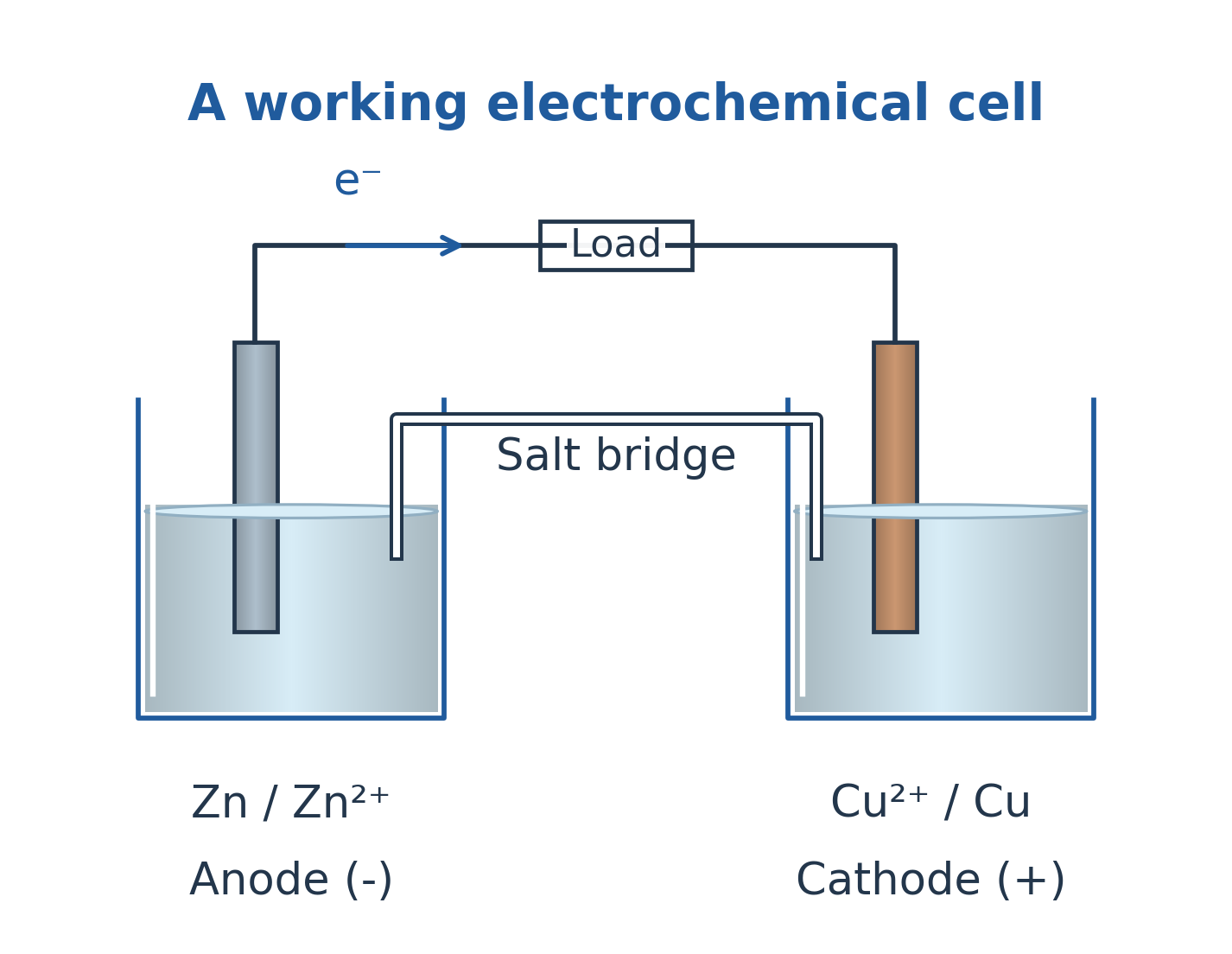
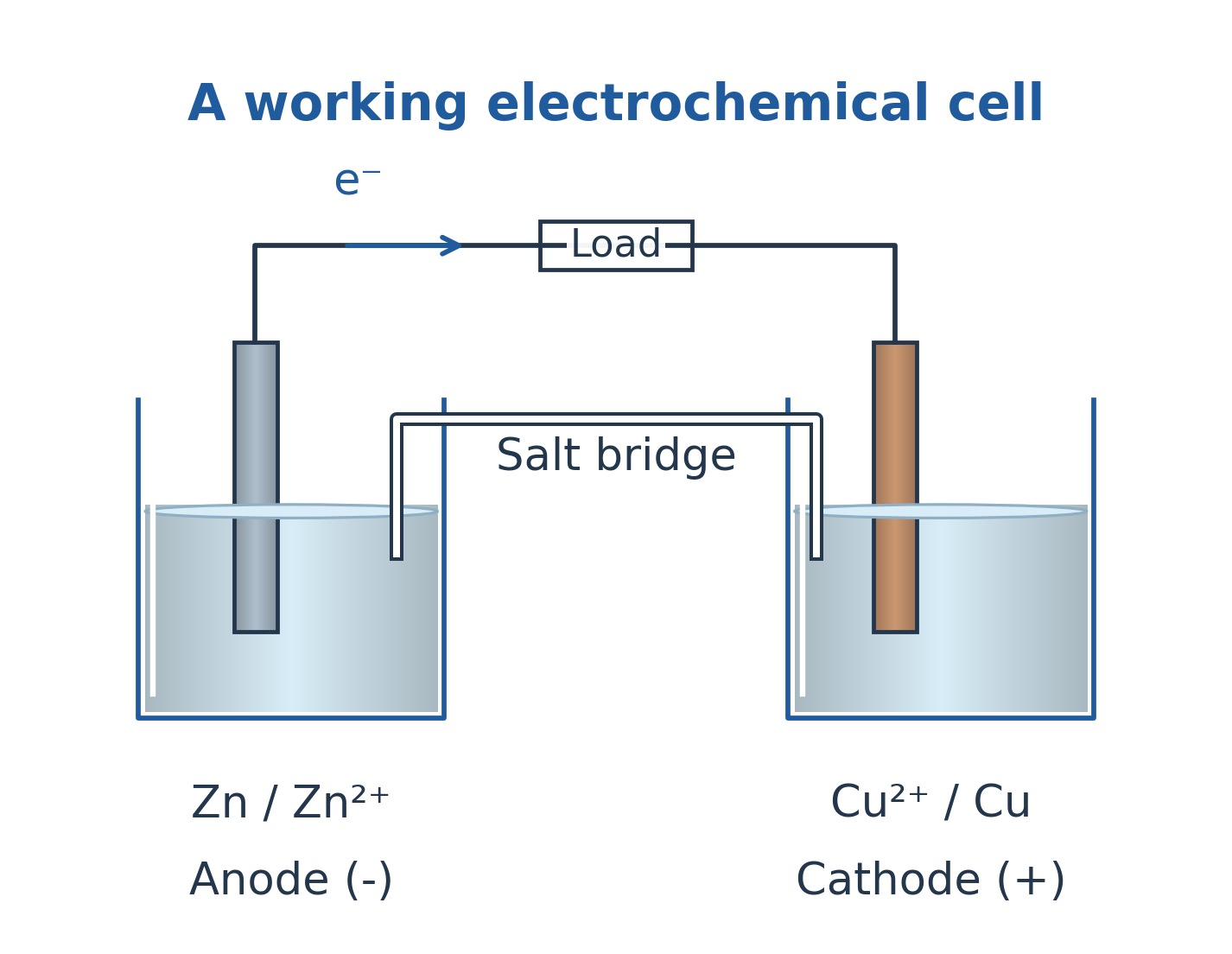
For a Daniell-type cell, Zn -> Zn2+ + 2e- and Cu2+ + 2e- -> Cu give the net reaction Zn + Cu2+ -> Zn2+ + Cu. Electrons travel externally from zinc toward copper during discharge. Ionic movement maintains charge balance; electrons do not simply travel through the salt bridge as if it were a metal wire. A balanced reaction transfers two electrons here, not four obtained by adding the same released and consumed transfer.
Worked problem 2.1: Balance the electron transfer before using the reaction
Route: CSE/EE/ECE/CH
Problem. The supplied oxidation is Zn → Zn2+
- 2e-, and reduction is Cu2+ + 2e- → Cu. Find the smallest integer multipliers that cancel electrons and the transferred-electron count in the resulting reaction.
Working. Oxidation releases 2 electrons per written event; reduction consumes 2. The least common electron count is 2.
Answer and explanation. Oxidation multiplier 1; reduction multiplier 1; n = 2 for the combined written reaction.
2. Electrode potentials and the electrochemical series
Study route: CSE, EE, ECE, CH
A single-electrode potential is measured relative to a reference convention. Tabulated standard reduction potentials describe reduction reactions in their specified standard states. For a stated cell orientation, E°cell = E°cathode – E°anode using both tabulated values as reduction potentials. Reversing the net reaction reverses the cell-potential sign; multiplying a half-reaction to balance electrons does not multiply its electrode potential.

The electrochemical series helps compare thermodynamic tendencies. A more positive standard reduction potential generally indicates a stronger tendency for that reduction under standard conditions. Real corrosion or deposition also depends on activities, films, kinetics and competing reactions. A standard series is therefore not identical to a measured galvanic series in every service electrolyte. State the reference, reaction direction and conditions before using a potential difference.
| Operation | Use the tabulated reduction values |
|---|---|
| Cell calculation | Ecell = Ecathode – Eanode |
| Balance electrons | Multiply reaction amounts, not E values |
| Real service | Activities, films and kinetics also matter |
Worked problem 2.2: Cell potential from reduction values
Route: CSE/EE/ECE/CH
Problem. Given standard reduction potentials +0.34 V for Cu2+/Cu and -0.76 V for Zn2+/Zn, find Ecell for zinc oxidation and copper-ion reduction.
Answer and explanation. Ecell = 0.34 – (-0.76) = 1.10 V. Multiplying half-reaction amounts to balance charge does not multiply these electrode potentials.
3. Nernst equation: composition and reversible voltage
Study route: CSE, EE, ECE, CH
For the balanced reaction, E = E° – (RT/nF) ln Q, where Q is built from activities and n is the electron-transfer number. At 25°C, E approximately equals E° – (0.05916/n) log10 Q in volts. Pure solids and pure liquids have unit activity in the corresponding standard-state model. Concentrations approximate activities only under appropriate solution assumptions.

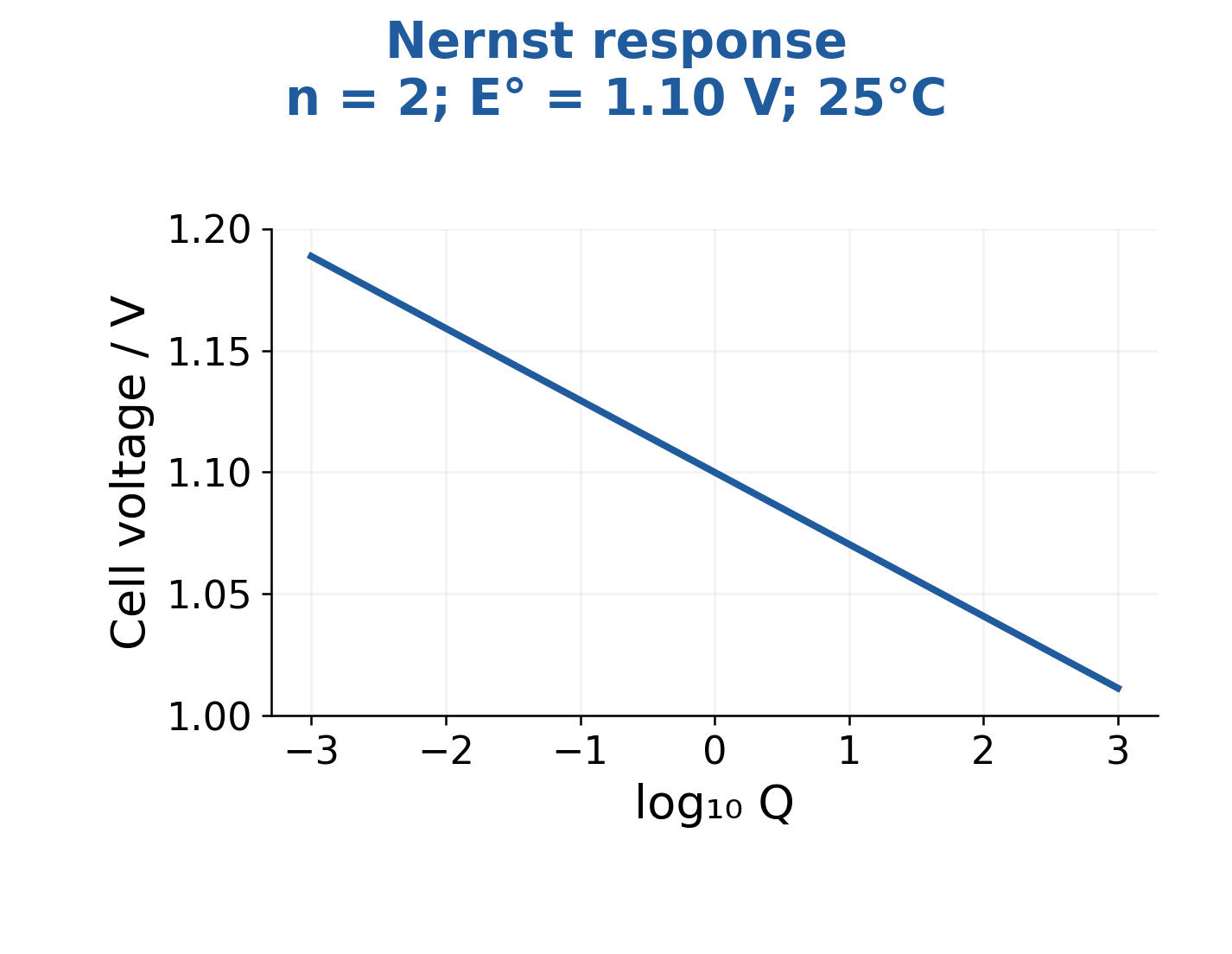
For Zn + Cu2+ -> Zn2+ + Cu, Q = a(Zn2+)/a(Cu2+). Changing this ratio changes reversible voltage. At equilibrium, E = 0 for the reversible cell reaction and the relation links E° with K. The Nernst equation does not include all voltage losses under load; activation, ohmic and transport effects require additional description. Always balance the reaction before choosing n or constructing Q.
Derive the composition correction
Write ΔG = ΔG° + RT ln Q and substitute ΔG = -nFE and ΔG° = -nFE°. Dividing by -nF gives the Nernst equation with its minus sign. If Q increases for a fixed written reaction, the reversible voltage decreases in this model. Reversing the reaction inverts Q and reverses the voltage sign. This derivation connects chemical driving force to electrical measurement rather than treating the sign as a memory rule.
Worked problem 2.3: Use the supplied base-10 Nernst form
Route: CSE/EE/ECE/CH
Problem. At the specified 298 K approximation, a written cell reaction has E° = 1.1 V, n = 2 and dimensionless reaction quotient Qr = 10. Use E = E° – (0.05916/n)log10 Qr. Find the reversible voltage shift and E.
Working. log10 Qr = 1. The subtracted Nernst term is (0.05916/2) × log10 Qr = 0.02958 V.
Answer and explanation. E = 1.07042 V; signed change from E° = -0.02958 V.
4. Faraday balance, charge, free energy and cell energy
Study route: CSE, EE, ECE, CH
Charge Q = It for constant current, and 1 Ah = 3600 C. A reaction transferring n moles of electrons per mole of reaction requires nF coulombs per mole of extent. Faraday deposition mass is m = eta ItM/(nF) for a desired product with molar mass M and current efficiency eta. Chemical extent, mass, charge and time must retain compatible units.

Reversible electrical work is related to ΔG = -nFE. Voltage is energy per charge, capacity is charge, and energy is neither of those alone. For an approximately constant average voltage, energy in Wh approximately equals average volts times Ah. A changing voltage requires the relevant integration or a supplied average. Current capacity, energy capacity and maximum safe power are separate device properties.
Separate charge efficiency from energy efficiency
Charge efficiency compares useful returned charge with charge supplied. Energy efficiency additionally depends on voltage during charging and discharge. A cell can return nearly the same charge yet return less electrical energy because the charging voltage exceeds the discharge voltage. For deposition, current efficiency instead refers to the fraction of charge assigned to the desired product reaction. Name the numerator, denominator and physical boundary before multiplying any efficiency into a balance.
Worked problem 2.4: Connect reversible cell potential to Gibbs free energy
Route: CSE/EE/ECE/CH
Problem. A supplied written reaction transfers n = 2 mol electrons per mole reaction and has reversible E = 1.1 V. Use F = 96485 C/mol. Find ΔG per mole of that written reaction and reversible work magnitude.
Working. Charge magnitude per mole reaction is nF = 192970 C/mol reaction. ΔG = -2 × 96485 × 1.1 = -212267 J/mol reaction.
Answer and explanation. ΔG = -212.267 kJ/mol reaction; reversible work magnitude 212.267 kJ/mol.
5. Electrode kinetics, overpotential and operating losses
Study route: EE, ECE; CH monitoring support; CSE supporting model
Equilibrium potential describes a reversible balance, whereas a finite operating current requires charge transfer and transport. Activation overpotential is associated with electrode reaction kinetics; concentration polarization arises when surface and bulk activities differ; ohmic loss arises in resistive paths. These contributions help explain why discharge voltage is below, and charging voltage above, a reversible prediction for the same state.


A catalyst can lower kinetic losses without changing the equilibrium free energy of the same net reaction. Exchange-current density characterizes near-equilibrium reaction activity for a specified interface. At suitable conditions, Tafel behaviour relates overpotential to the logarithm of current density; it is not universal across every current range. Current density, electrode area, temperature and surface condition must accompany a kinetic comparison.
Worked problem 2.5: Separate operating voltage losses
Route: EE/ECE; CH support
Problem. A reversible discharge voltage is 1.20 V. At one current, activation, ohmic and transport losses are 0.08, 0.05 and 0.02 V. Find terminal voltage.
Answer and explanation. Total loss = 0.15 V. Terminal voltage = 1.20 – 0.15 = 1.05 V. The kinetic and resistive losses do not redefine the equilibrium potential.
6. Primary and secondary batteries: chemistry and selection
Study route: CSE
Primary batteries are designed for one main discharge service rather than normal repeated recharging. An alkaline Zn-MnO2 cell is a familiar example. Secondary batteries support a controlled reverse electrochemical process during charging; examples include lead-acid, nickel-metal-hydride and lithium-ion families. Calling a reaction theoretically reversible is not enough to prove safe practical rechargeability.


Selection considers delivered energy, voltage, pulse power, leakage, temperature, storage life and handling. A large nominal capacity does not guarantee the largest usable energy under every load because voltage and discharge conditions differ. Lead-acid discharge involves conversion of both electrode active materials toward lead sulfate; suitable charging reverses the overall process within limits. Compare cells using a common test basis rather than ranking them only by mass or a printed voltage.
| Class | Normal intended service |
|---|---|
| Primary | Mainly one discharge use |
| Secondary | Controlled repeated charging |
| Compare | Voltage, energy, power, life and conditions |
7. Lithium-ion materials, intercalation and current paths
Study route: CSE, EE, ECE
A lithium-ion cell commonly uses host electrodes that reversibly accept and release lithium. A graphite anode and a compatible lithium-containing cathode are common choices, but cathode families differ in structure, voltage, capacity and stability. The electrolyte conducts ions while the separator prevents direct electronic contact. Current collectors connect the electrode layers to the external circuit.

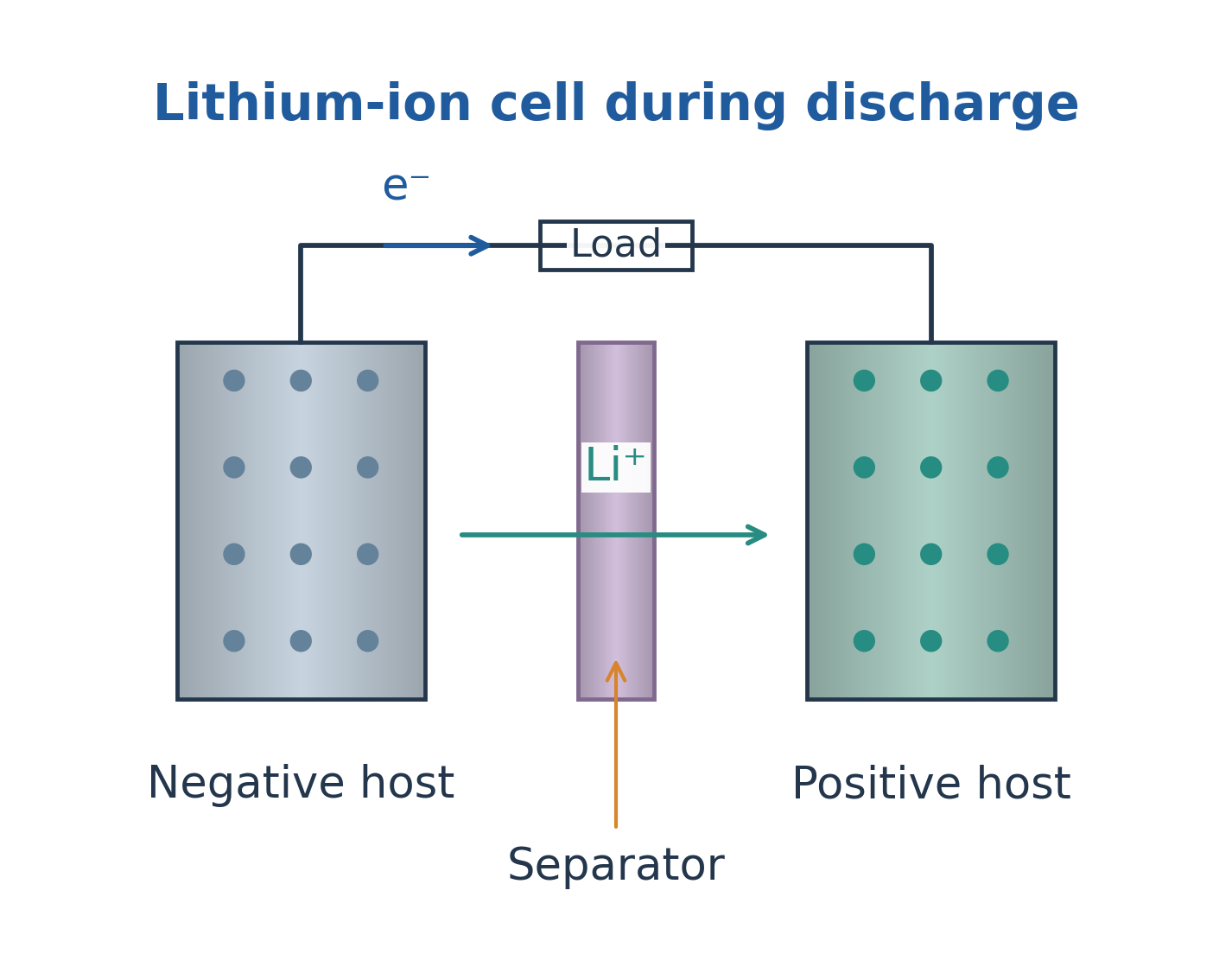


During discharge in the common graphite/host picture, lithium leaves the negative-electrode host as Li+ and electrons. Li+ crosses the electrolyte toward the positive electrode; electrons pass through the load. Charging drives the reverse transfer using an external source. The intercalation hosts and electrolyte must remain within suitable chemical/electrical limits. A lithium-ion cell is not normally described as a simple pair of bulk lithium-metal electrodes.
Interfaces and material families
Graphite surfaces develop an interphase that permits lithium-ion transport while limiting continuing electrolyte reaction when stable. Continued interphase growth can consume cyclable inventory and increase resistance. Cathodes such as layered oxide families and lithium iron phosphate provide different host structures and property balances. A complete introductory description identifies cathode, anode, electrolyte, separator and collectors, then explains how chemical stability and interfaces limit the otherwise reversible host-transfer picture.
Worked problem 2.6: Nominal energy, SI energy and specific energy
Route: CSE/EE/ECE
Problem. A supplied nominal model has voltage 3.7 V, charge capacity 4 Ah and included mass 0.08 kg. Use EWh = VQ. Find nominal energy in Wh and J and specific energy for this same boundary.
Working. Nominal energy is 3.7 × 4 = 14.8 Wh. In joules, this is 14.8 × 3600 = 53280 J.
Answer and explanation. 14.8 Wh = 53280 J; specific energy 185 Wh/kg.
8. Charging, battery safety and applications
Study route: CSE
Charging must respect the chosen chemistry, cell condition, voltage, current and temperature limits. A suitable lithium-ion protocol can include constant-current followed by constant-voltage operation, with current taper and termination criteria. It is not a universal prescription for every rechargeable chemistry. Monitoring and protective functions help prevent overcharge, excessive discharge, short circuit and unsuitable temperature exposure.

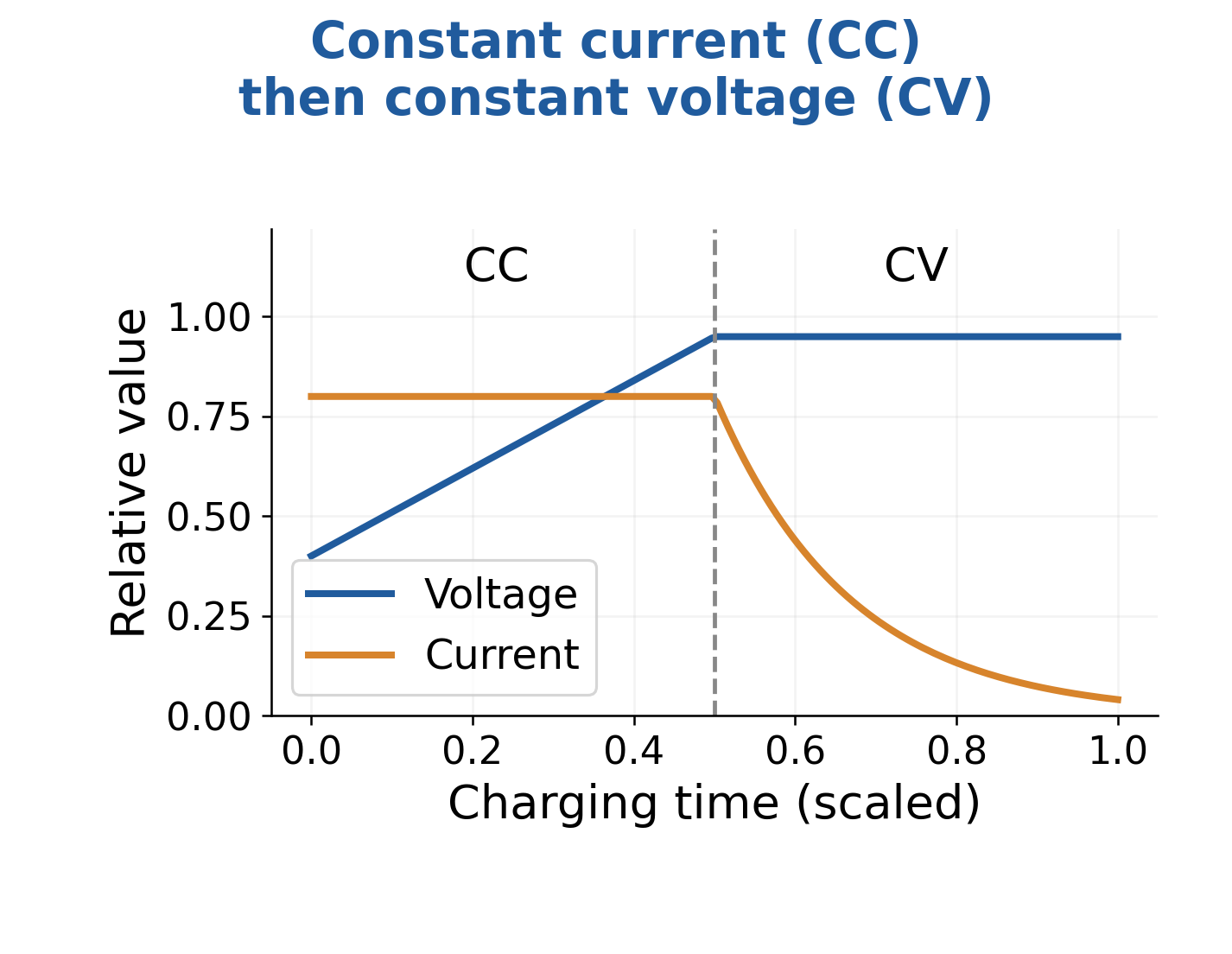


Heat can arise from resistive and electrochemical losses. Separator failure, unstable reactions or internal faults can initiate severe self-heating in susceptible conditions. Device applications differ: phones and laptops emphasize compact stored energy, while EV packs also require power, thermal management, monitoring and consistent cell operation. Series grouping raises voltage and parallel grouping raises charge capacity in an ideal matched-cell model. Actual grouping requires compatible cells and protective design; a simple arithmetic result is not a pack safety qualification.
Worked problem 2.7: Interpret a supplied C-rate as current
Route: CSE
Problem. A reference capacity is 2 Ah. A paper exercise defines operating rate 0.5C and assumes the full reference charge is available at that constant current. Find current and ideal full-capacity duration.
Working. 1C corresponds to 2 A for this reference. Current at 0.5C is 0.5 × 2 = 1 A.
Answer and explanation. Current 1 A; ideal duration 2 h.
Worked problem 2.8: Calculate discharge voltage sag and internal heat
Route: CSE
Problem. A supplied steady source-plus-resistance model uses E = 4 V, internal r = 0.1 Ω and discharge current 2 A. Find terminal voltage, useful terminal power and internal resistive heating.
Working. Internal voltage drop is Ir = 0.2 V. Terminal voltage is 4 – 0.2 = 3.8 V.
Answer and explanation. Terminal 3.8 V; output 7.6 W; internal heat 0.4 W.
Worked problem 2.9: Count voltage, capacity and energy in an ideal grouping
Route: CSE
Problem. An ideal paper arrangement is 3S2P using identical supplied cells, each 3.6 V nominal and 2 Ah. Find cell count, nominal pack voltage, ideal Ah capacity and nominal energy.
Working. Total cell count is NsNp = 3 × 2 = 6. Series voltage is NsVcell = 10.8 V; parallel capacity is NpQcell = 4 Ah.
Answer and explanation. 6 cells; 10.8 V; 4 Ah; 43.2 Wh nominal.
9. Solid-state and sodium-ion battery chemistry
Study route: EE, ECE
Solid-state batteries use a solid ionic conductor in place of a conventional liquid-electrolyte arrangement. Candidate ceramic or polymer-based conductors have different transport, processing and stability properties. Potential benefits include reduced liquid leakage and alternative electrode combinations, but interfacial contact, chemical compatibility and mechanical changes can limit operation.

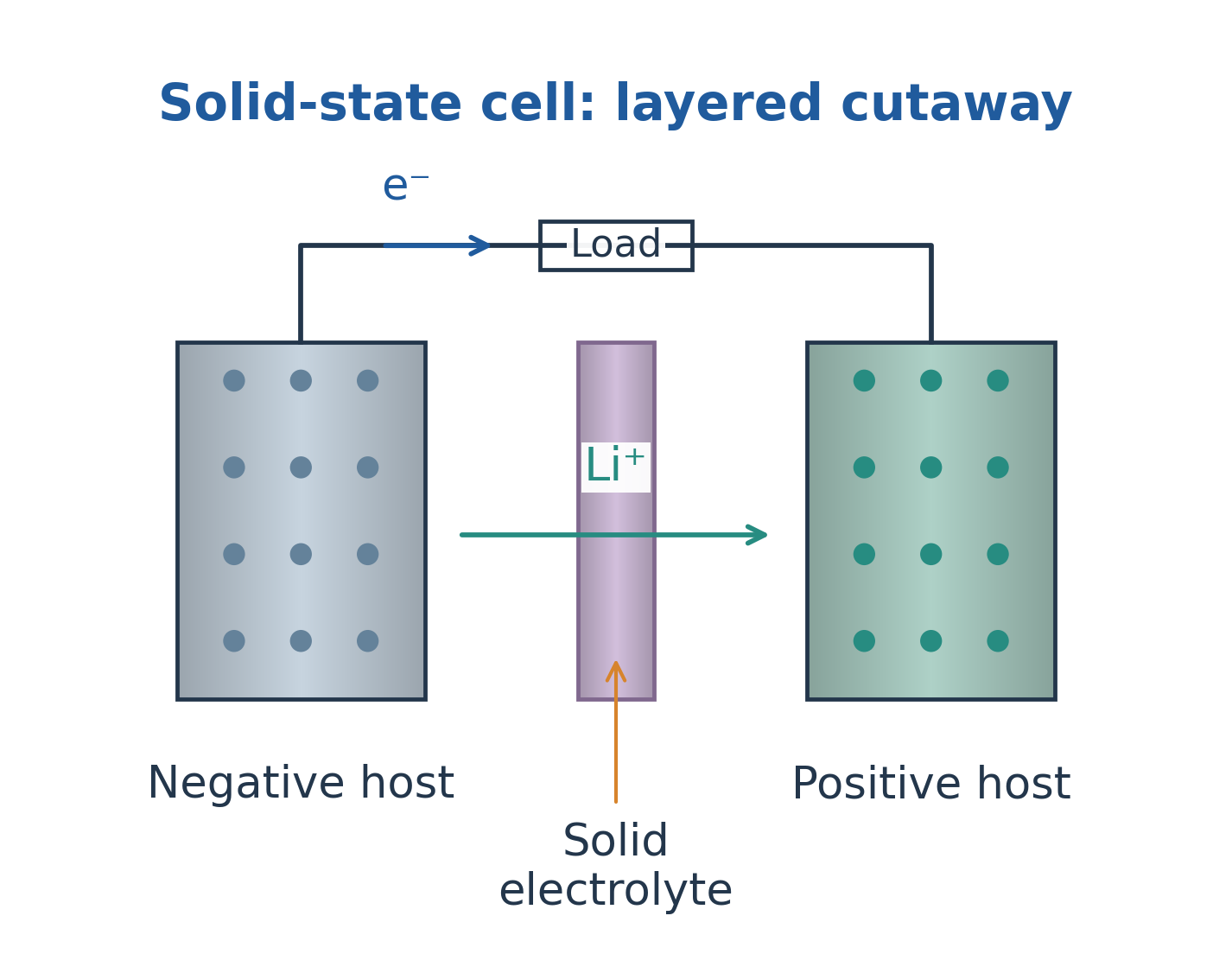
Sodium-ion cells shuttle Na+ between compatible host electrodes and commonly use different host choices from graphite-based lithium-ion systems. Resource availability can be attractive, while energy density, voltage and cycling depend on the full chemistry. Neither sodium-ion nor solid-state identifies one fixed universal reaction or rating. A solid electrolyte does not automatically guarantee immunity to dendrites, heating or failure. Compare cathode, anode, electrolyte, interface and operating conditions as a complete system.
Worked problem 2.10: Compare supplied battery energies
Route: EE/ECE
Problem. A supplied Li-ion module delivers 150 Wh/kg and a supplied Na-ion module 100 Wh/kg under the same test. Find masses for 600 Wh, ignoring packaging.
Answer and explanation. Required masses are 600/150 = 4 kg and 600/100 = 6 kg. These are supplied example values, not universal chemistry ratings, and do not rank safety or cycle life.
10. Supercapacitors: EDLC and pseudocapacitance
Study route: CSE, EE, ECE
An electric-double-layer capacitor stores charge predominantly through interfacial ion/electron separation at high-area electrodes. A pseudocapacitor has rapid reversible faradaic contributions, often involving suitable surface or near-surface redox processes. Carbon electrodes, selected transition-metal compounds and conducting polymers support different mechanisms; a capacitor-like curve does not prove identical storage chemistry.

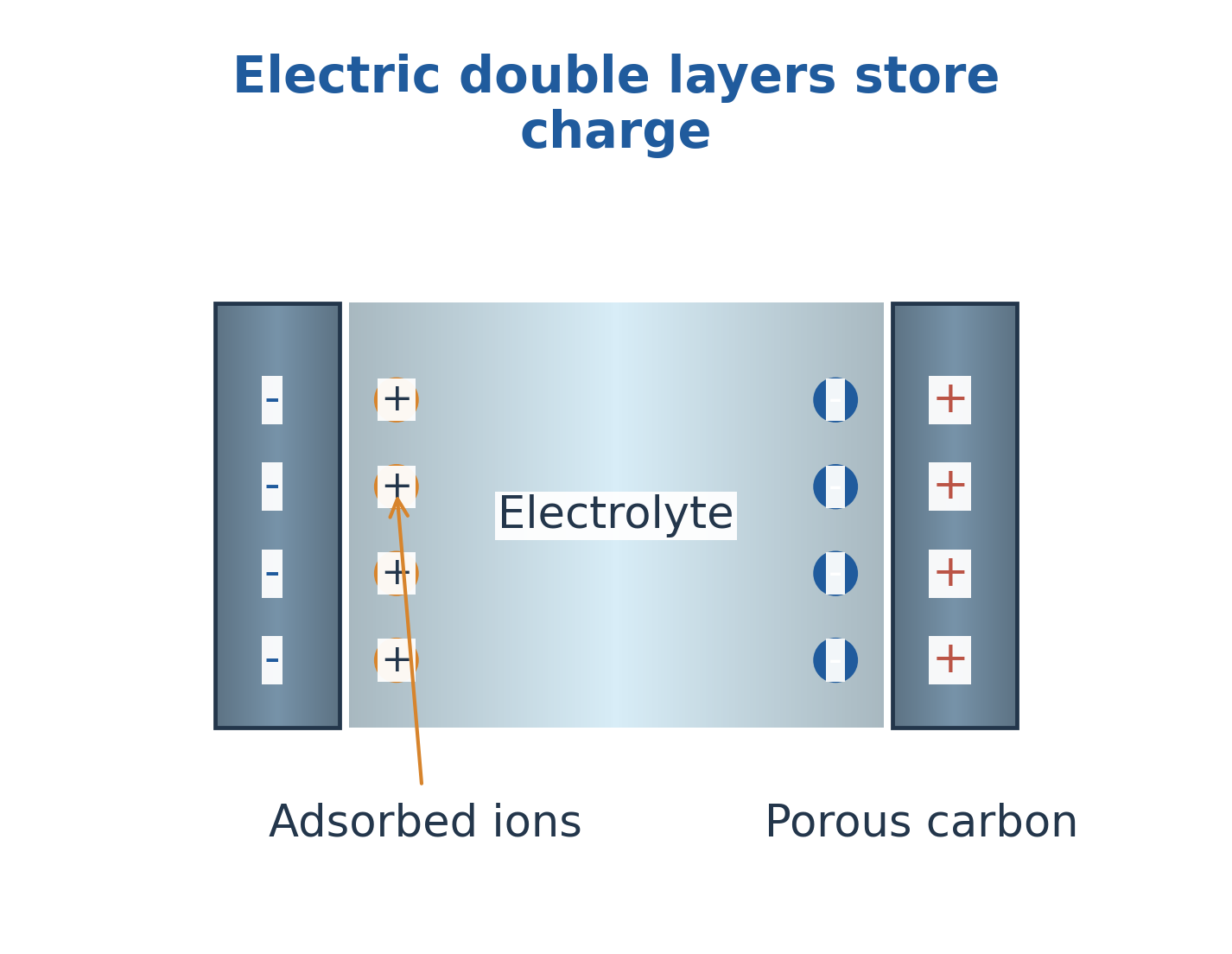
For a constant ideal capacitance, U = CV²/2. Usable energy across an allowed voltage interval is C(Vmax²-Vmin²)/2. Equivalent series resistance causes voltage drop and heating under current. High accessible area is useful only when pores, electrolyte and time scale allow ions to reach it. Supercapacitors commonly support high-power pulses, while their voltage profile and stored energy differ from battery behaviour.
Why the voltage window matters
Integrating electrical work with q = CV gives U = CV²/2 only when capacitance can be treated as constant. Discharging from Vmax to Vmin therefore leaves residual energy CVmin²/2. At a sudden current step, equivalent series resistance produces an immediate IR voltage change, while ideal capacitive voltage then changes at a rate I/C for constant current. The resistive jump and capacitive droop are different effects and should be labelled separately on a pulse trace.
| Storage type | Dominant mechanism |
|---|---|
| EDLC | Interfacial nonfaradaic separation |
| Pseudocapacitance | Rapid reversible faradaic contribution |
| Storage type | Dominant mechanism |
|---|---|
| Battery | Bulk/host redox storage with chemistry-dependent profile |
Worked problem 2.11: Pseudocapacitance
Route: EE/ECE
Problem. Classify rapid reversible surface redox storage versus nonfaradaic interfacial ion storage.
Answer and explanation. The first is pseudocapacitive; the second is electric-double-layer storage. Similar capacitor-like curves do not prove identical chemistry. Electrode composition and the charge-storage mechanism determine the classification.
Worked problem 2.12: Usable capacitor energy
Route: CSE/EE/ECE
Problem. A constant ideal 100 F supercapacitor is used from 2.7 V down to 1.5 V. Find usable stored energy.
Answer and explanation. Usable energy = 0.5 x 100 x (2.7²-1.5²) = 252 J. Using 0.5 C Vmax² alone would count residual energy still stored at the minimum allowed voltage.
11. Fuel cells: PEM and alkaline mechanisms
Study route: CSE, EE, ECE
A fuel cell converts continuously supplied reactants into electrical energy. In a hydrogen PEM cell, H2 -> 2H+ + 2e- occurs at the anode and oxygen reduction forms water at the cathode. Protons cross the membrane; electrons pass through the external load. In an alkaline cell, hydroxide ions provide the electrolyte charge transport, with half-reactions written for the alkaline medium.

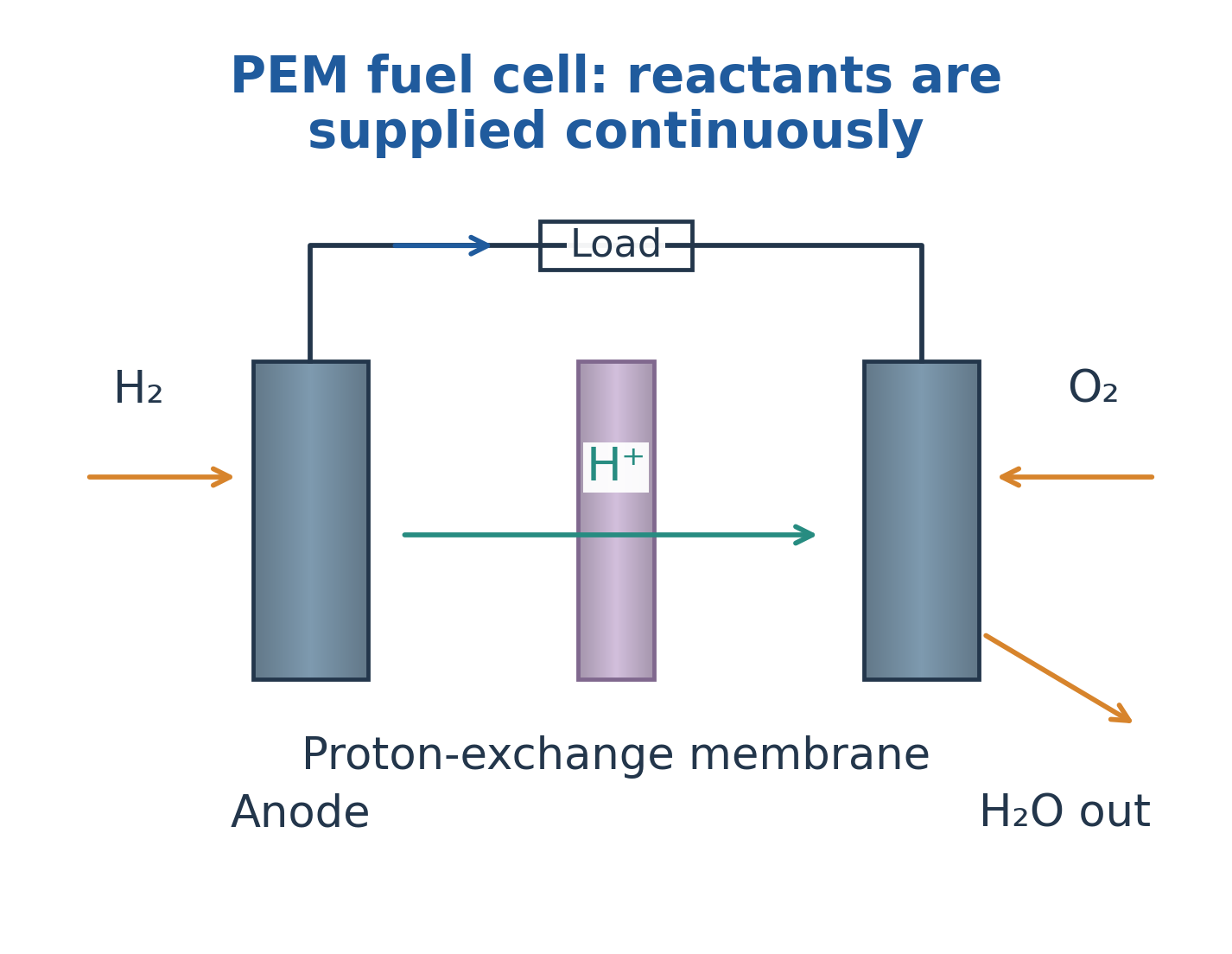


Alkaline reactions can be written 2H2 + 4OH- -> 4H2O + 4e- and O2 + 2H2O + 4e- -> 4OH-. Their sum is 2H2 + O2 -> 2H2O. PEM and alkaline cells therefore share an overall ideal reaction but differ in electrolyte and electrode chemistry. Fuel supply, catalyst condition, water management and contamination affect operation. Alkaline/PEM detail is prescribed for EE/ECE; it develops the general fuel-cell requirement for CSE.
Worked problem 2.13: Account for hydrogen in every series stack cell
Route: CSE/EE/ECE
Problem. A supplied PEM stack has 1 identical active series cells, current 2 A for 3600 s, and hydrogen utilisation 0.8, defined as reacted/supplied fuel. Use F = 96485 C/mol and two electrons per H2. Find total reacted and supplied hydrogen amounts.
Working. One-cell reacted amount is It/(2F) = 0.0373115 mol H2. All-cell total reacted amount is Ns times this, 0.0373115 mol.
Answer and explanation. Total reacted H2 0.0373115 mol; supplied H2 0.0466394 mol.
Worked problem 2.14: Fuel-cell charge and hydrogen amount
Route: CSE/EE/ECE
Problem. A hydrogen fuel cell transfers 1930 C. Use F = 96500 C/mol and ideal two-electron transfer per H2. Find consumed hydrogen.
Answer and explanation. H2 amount = Q/(2F) = 0.010 mol. This is the stoichiometric amount associated with the stated charge; excess fuel flow, utilization and losses require additional data.
12. Self-discharge, cycle life and useful capacity
Study route: CSE, EE, ECE
Self-discharge reduces retained charge while a device rests, through processes such as parasitic reactions or internal leakage. Calendar ageing occurs with time and storage conditions; cycle ageing depends on charge/discharge history. Electrolyte reactions, interface growth, structural change and loss of cyclable inventory can contribute differently in different chemistries.


Cycle life must state temperature, current, depth of discharge and end-of-life criterion. Capacity retention is measured remaining capacity divided by the defined initial value; it is not automatically energy retention if voltage also changes. Coulombic efficiency compares returned and input charge, while energy efficiency also includes voltage and losses. A cell with a high result in one short cycle can still age over extended service.
Worked problem 2.15: Self-discharge
Route: EE/ECE
Problem. A cell retains 1.92 Ah from 2.00 Ah after rest. Find retained fraction and lost charge.
Answer and explanation. Retained fraction = 1.92/2.00 = 96%; loss = 0.08 Ah = 288 C. Rest loss is not the same measurement as cycle life under repeated charging.
13. Energy-harvesting materials for smart systems
Study route: CSE
Energy harvesting converts an available environmental input rather than creating energy. Photovoltaic materials absorb light and support charge generation/separation. Thermoelectric materials generate a voltage from a temperature difference through suitable transport behaviour. Piezoelectric materials couple mechanical deformation and electrical polarization. Input availability and the complete conversion/storage chain determine useful output.

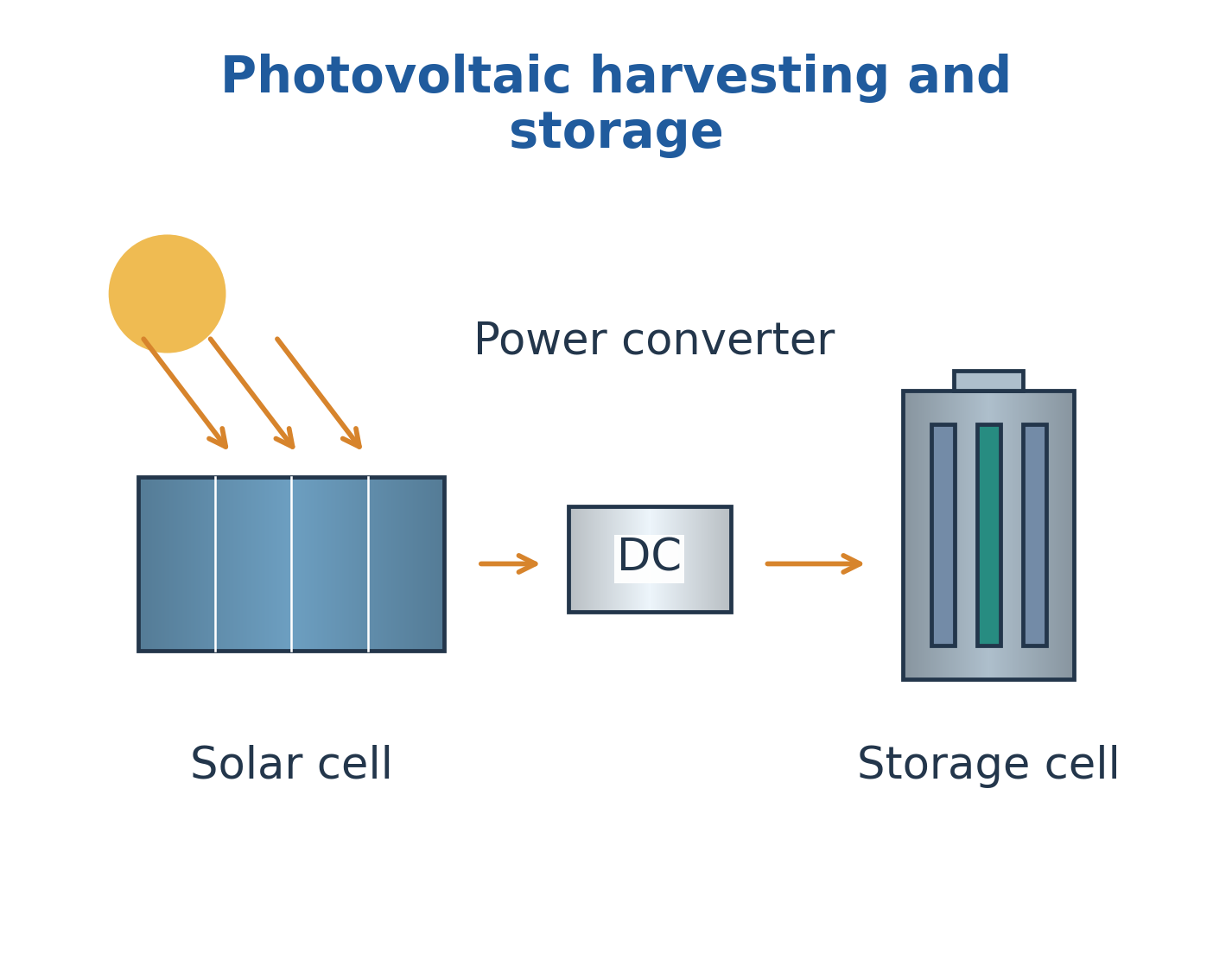


A harvester must meet both an energy budget and instantaneous-power needs. A low-duty-cycle sensor may accumulate energy between active events, using a storage element to supply pulses. Input fluctuation, conditioning losses and standby demand must be included. A large open-circuit voltage alone does not establish useful power. Select the material, transducer, power-management function and storage together rather than treating a harvesting element as an unlimited battery.
Worked problem 2.16: Track incident, converted and delivered solar energy
Route: CSE
Problem. A supplied uniform illumination is 800 W/m² over active area 0.01 m² for 3 h. PV conversion efficiency is 0.2 and a separate downstream efficiency 0.9. Find PV electrical power and useful delivered interval energy.
Working. Incident optical power is GA = 8 W. PV electrical output is ηPVGA = 1.6 W.
Answer and explanation. PV output 1.6 W; delivered interval energy 4.32 Wh.
14. Wireless charging: chemistry and power-transfer boundary
Study route: CSE
Inductive wireless charging transfers energy through coupled magnetic fields between suitable coils. Resonant operation can improve transfer under selected coupling conditions. The receiver rectifies and conditions electrical power before it reaches battery charging control. Wireless transfer is not itself a new battery reaction: the storage chemistry still imposes charging limits.

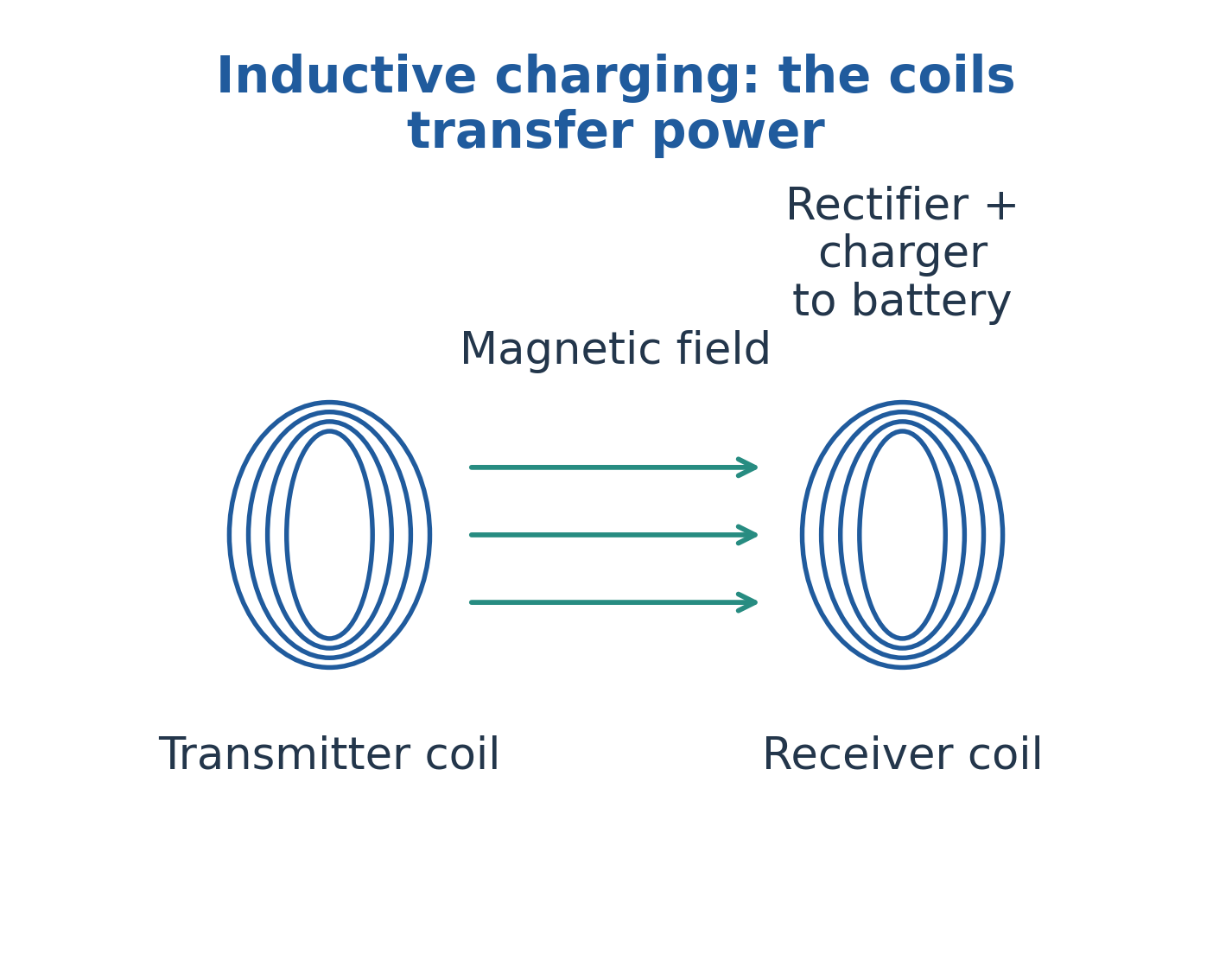
Alignment, separation, nearby materials, frequency and control affect coupling and losses. A power balance follows input -> transferred/received power -> conversion -> usable battery or load energy, with the missing power accounted for as losses. Heating and foreign-object effects require appropriate system design. State whether efficiency describes the coil link or the entire wall-to-storage boundary; multiplying compatible stage efficiencies gives an overall estimate.
Worked problem 2.17: Multiply matching wireless-stage efficiencies
Route: CSE
Problem. A supplied steady transfer chain takes 10 W input. Its successive matching efficiencies are 0.9, 0.8 and 0.9. The last output is the defined useful charging boundary. Find overall efficiency, output and represented total loss.
Working. Overall efficiency is product 0.9 × 0.8 × 0.9 = 0.648. Useful output is Pinη = 6.48 W.
Answer and explanation. Overall 64.8%; useful 6.48 W; loss 3.52 W.
15. Electrochemical corrosion and environmental factors
Study route: CE, ME, CH
Wet corrosion couples anodic metal oxidation to cathodic reduction through electronic and ionic paths. Iron oxidation can be written Fe -> Fe2+ + 2e-. Aerated near-neutral water can support O2 + 2H2O + 4e- -> 4OH-, while acid can support hydrogen evolution. Subsequent chemistry produces corrosion products. The metal-loss site is anodic even when a visible deposit appears elsewhere.

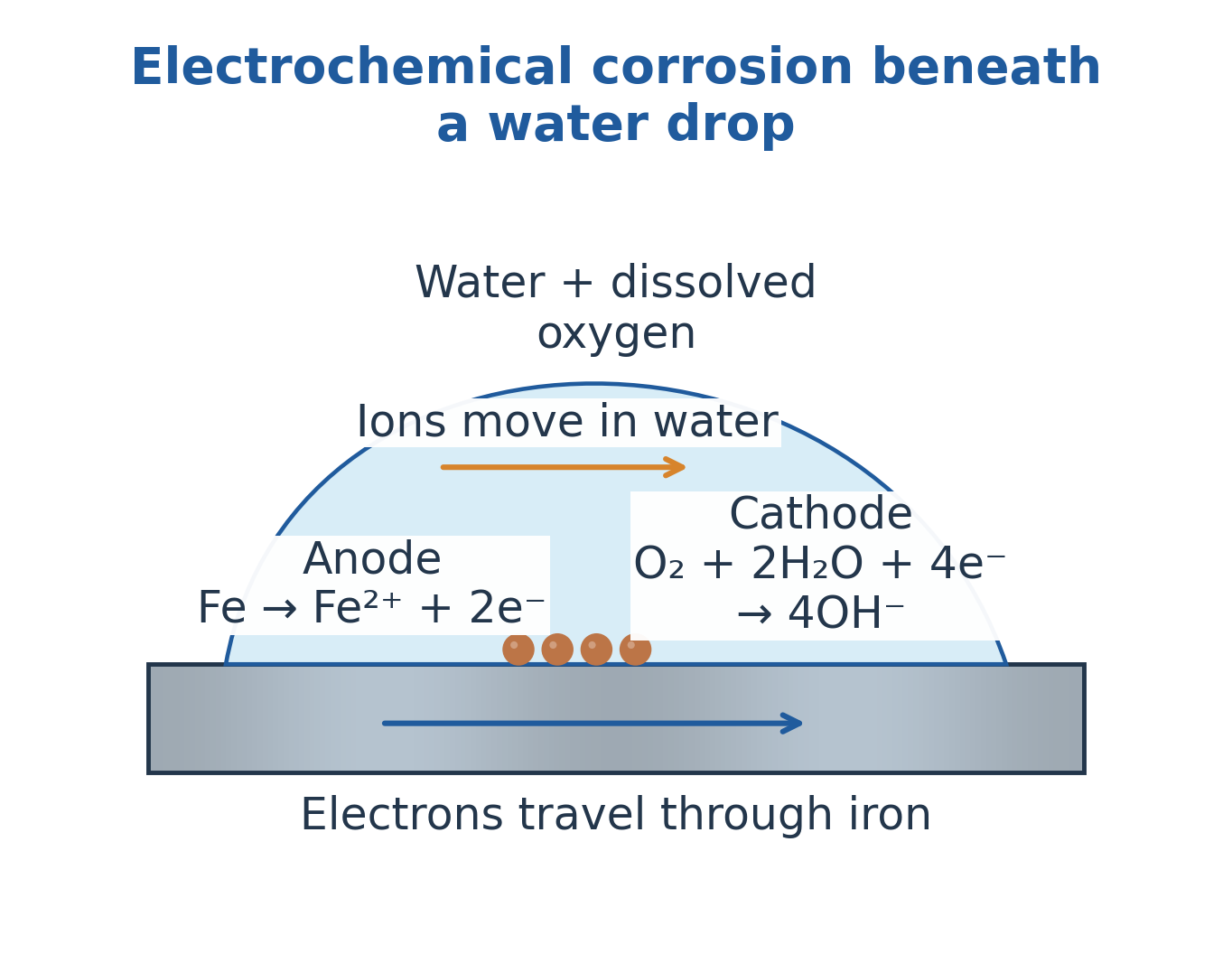
Composition, surface condition, oxygen, pH, electrolyte conductivity, temperature, flow, geometry and films influence rate. Thermodynamic tendency is not a complete rate prediction. Identify the electrolyte, electron path, anodic region and cathodic reaction before selecting a protection mechanism. This chapter provides the electrochemical theory required by all three corrosion routes.
Write the complete corrosion explanation
Start with a metal oxidation half-reaction, identify a compatible cathodic reduction and show how electrons and ions close the circuit. Then explain how the environment alters reaction rates or film stability. A protective film may reduce attack, while chloride, acidity, differential aeration or mechanical damage can destabilize it in a particular system. Rust visible at one location does not by itself identify every anodic region or quantify the deepest penetration.
Worked problem 2.18: Corrosion mass loss
Route: CE/ME/CH
Problem. A coupon loses 0.78 g from 100 cm² in 10 days. Density is 7.8 g/cm³. Find mean thickness loss.
Answer and explanation. Volume lost = 0.78/7.8 = 0.10 cm³. Mean thickness = 0.10/100 = 0.001 cm = 0.010 mm over 10 days. Local pit depth can exceed this average.
16. Galvanic corrosion and differential aeration
Study route: CE, ME, CH
Galvanic attack requires electrical connection between regions with different electrochemical behaviour in an electrolyte. The more active anodic region loses metal while the other region supports cathodic reaction. A small active anode coupled to a large cathode can experience high local anodic current density. The actual service electrolyte and surface state matter more than a standard-potential list alone.


Differential aeration can make an oxygen-poor shielded region anodic relative to an oxygen-rich region. Geometry and local solution changes sustain the cell. Prevention can use compatible material combinations, electrical isolation, controlled area ratio, improved drainage or a verified protective system. Two dry, disconnected metals placed nearby do not establish the complete galvanic circuit.
Worked problem 2.19: Galvanic area effect
Route: CE/ME/CH
Problem. Explain why a small exposed steel region coupled to a large noble cathode can be vulnerable.
Answer and explanation. The cathodic reaction supported over a large area can drive metal oxidation through a small anodic area, increasing local current density. The electrolyte and electrical connection must both exist for this galvanic mechanism.
17. Pitting and crevice corrosion
Study route: CE, ME, CH
Pitting is concentrated attack following local film breakdown or another localized instability. A small exposed region can support deep penetration while average mass loss remains modest. Local chemistry inside the pit can differ strongly from the surrounding bulk solution. A shiny external surface therefore does not rule out dangerous localized loss.

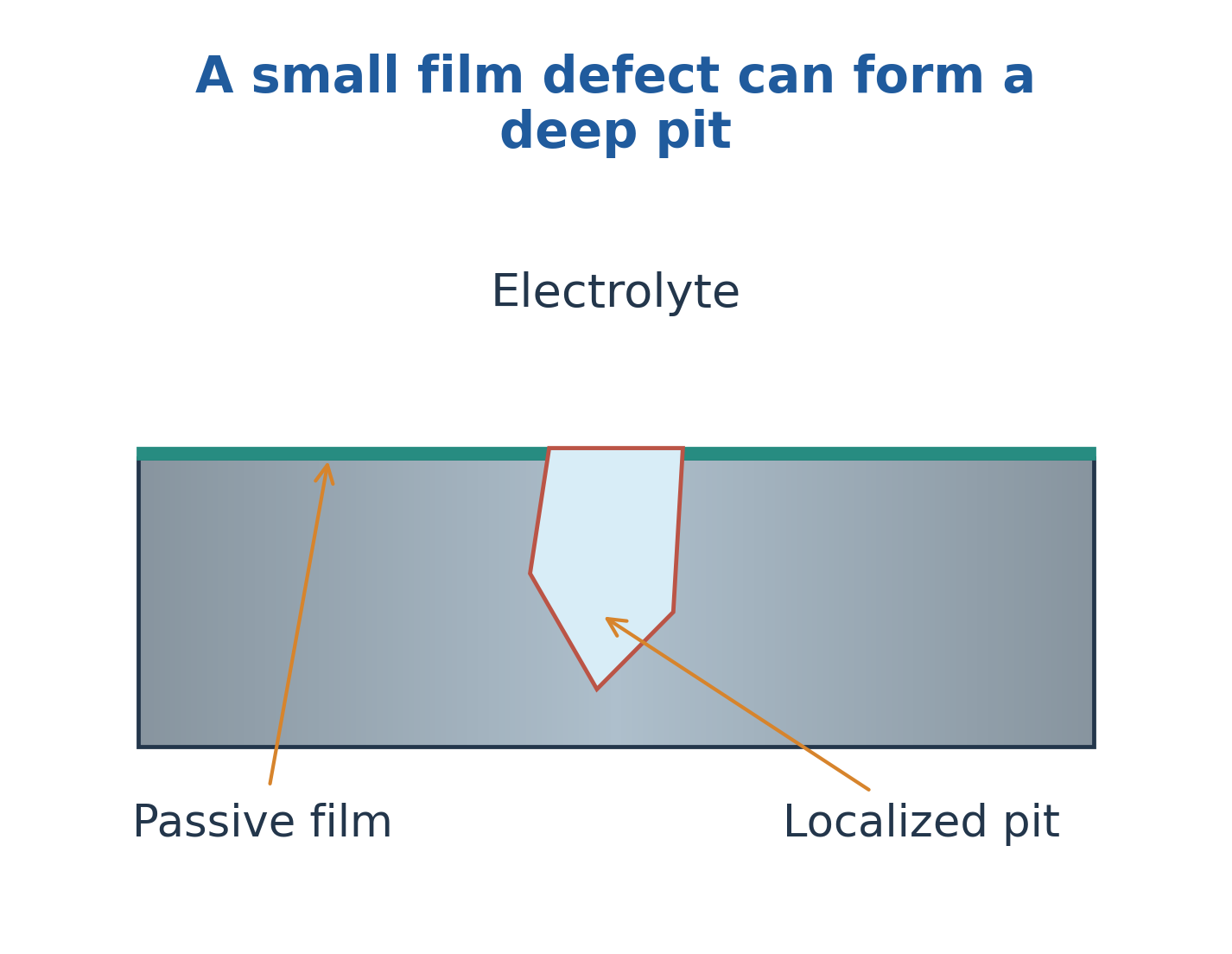
Crevice corrosion develops in shielded electrolyte-filled regions such as joints or deposits. Restricted transport and altered oxygen/ion conditions can favour local anodic dissolution. The mechanisms overlap with differential aeration but should be explained through the actual geometry and chemistry. Avoid stagnant crevices, improve joint design and cleanliness, and choose a compatible material/protection system. An average corrosion-rate value cannot alone describe maximum pit depth.
Worked problem 2.20: Local pit versus average loss
Route: CE/ME/CH
Problem. An inspection finds maximum pit depth 1.5 mm while mass-loss analysis gives mean equivalent penetration 0.10 mm. Find the ratio and interpret.
Answer and explanation. Maximum/mean depth ratio = 15. The average cannot represent the deepest attack. A uniform-loss calculation can be correct while failing to characterize local remaining thickness.
18. Stress-corrosion cracking and intergranular attack
Study route: CE, ME, CH
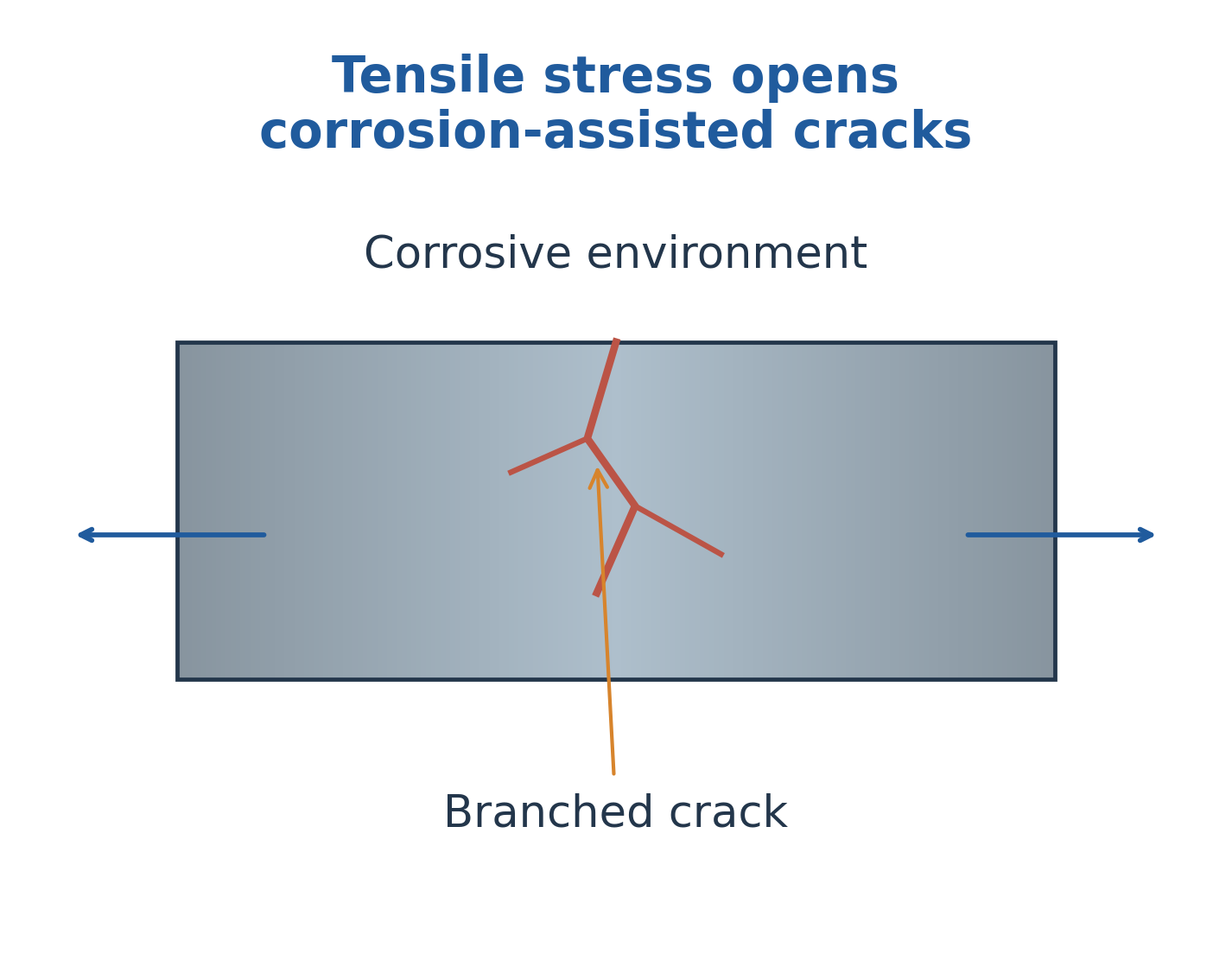
Stress-corrosion cracking requires a susceptible material, tensile stress and an appropriate environment. Crack growth can occur with relatively little uniform surface loss. Stress may be applied or residual; removing only visible corrosion product does not necessarily remove the cause. This mechanism is explicitly prescribed for CE and forms useful chemical-plant context for CH.


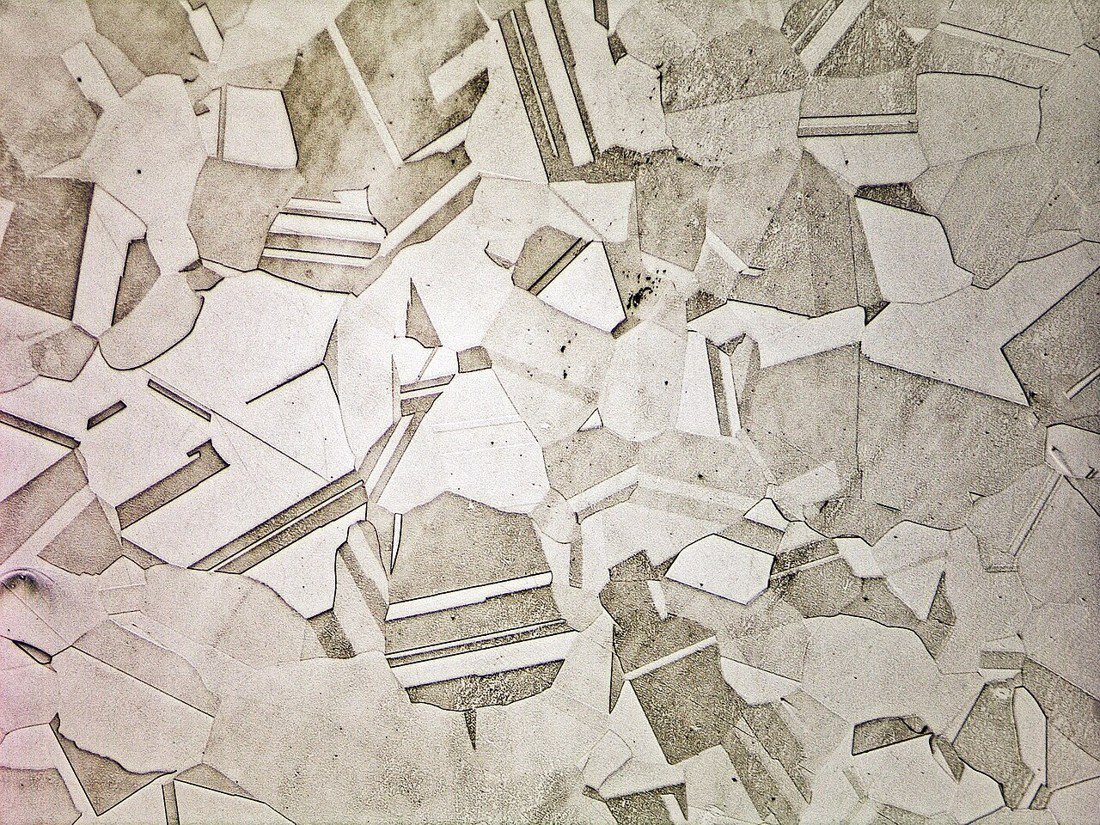
Intergranular corrosion attacks chemically altered grain-boundary regions. In some stainless steels, sensitization can create chromium-depleted zones next to certain precipitates, reducing local resistance. This is distinct from ordinary uniform attack and is explicitly prescribed for ME. Appropriate composition, heat treatment, environmental control and stress management depend on the confirmed mechanism. A grain boundary is not automatically a corroding path in every alloy.
| Mechanism | Prescribed emphasis |
|---|---|
| Stress-corrosion cracking | CE; CH plant context |
| Intergranular corrosion | ME; CH plant context |
| Both | Specific material and environment required |
Worked problem 2.21: Stress-corrosion diagnosis
Route: CE; CH context
Problem. A susceptible alloy cracks under tensile load only in a particular environment. Which combination should be investigated rather than only average mass loss?
Answer and explanation. Investigate the material state, tensile stress and specific environment together. Their combination supports stress-corrosion cracking. Surface cleaning alone may not remove residual stress or the environmental cause.
Worked problem 2.22: Intergranular attack
Route: ME; CH context
Problem. A susceptible stainless steel shows attack beside grain-boundary precipitates after an unsuitable thermal history. Explain a plausible chemical mechanism.
Answer and explanation. Sensitization can create locally chromium-depleted regions next to suitable precipitates, reducing local passive-film support. This is not proof that all stainless steels or all grain boundaries behave identically; verify composition and thermal history.
19. Erosion-corrosion and flow-assisted damage
Study route: ME, CH
Erosion-corrosion combines corrosive chemistry with mechanical or flow-assisted removal/damage of protective surface material. Fast or disturbed flow, suspended particles and local geometry can intensify attack. Elbows, inlets and impingement regions may behave differently from a quiet flat coupon. It is not simply the same process as a chemically isolated scratch.

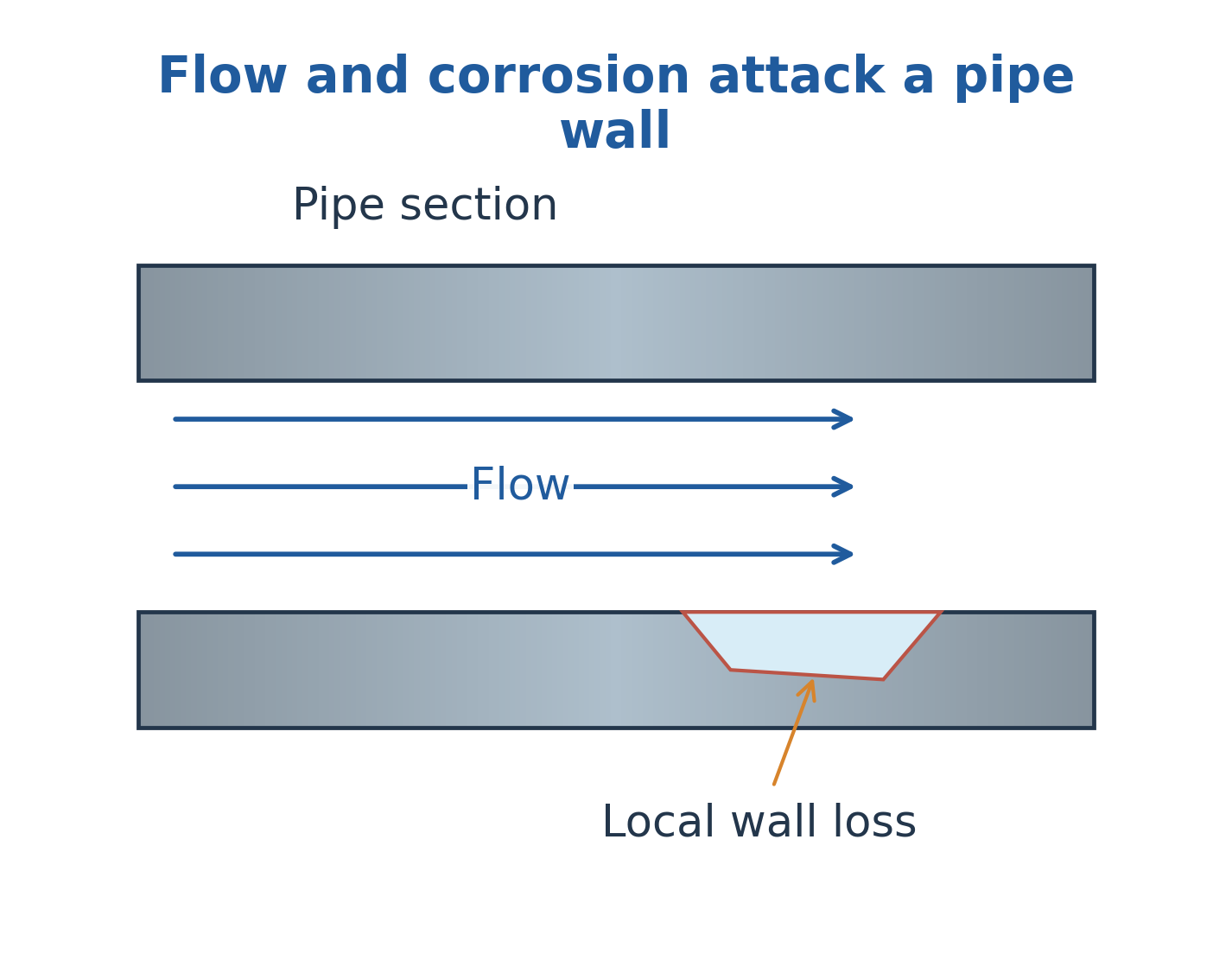
Diagnosis connects damage pattern, flow conditions, material and electrolyte. Remedies can include smoother flow transitions, controlled velocity, particle management, a more suitable material or a compatible protective layer. Raising hardness alone may not solve a problem caused by film chemistry or intense impingement. Distinguish erosion-corrosion from pure wear and from cavitation-related damage when interpreting a failed component.
20. Reinforcement corrosion in concrete
Study route: CE
Concrete normally provides a highly alkaline environment that can passivate reinforcing steel. Carbonation consumes alkaline constituents and lowers pH; chloride exposure can promote local passive-film breakdown even when the overall environment remains alkaline. Moisture supports ionic conduction and oxygen can support cathodic reduction, allowing a functioning corrosion cell.

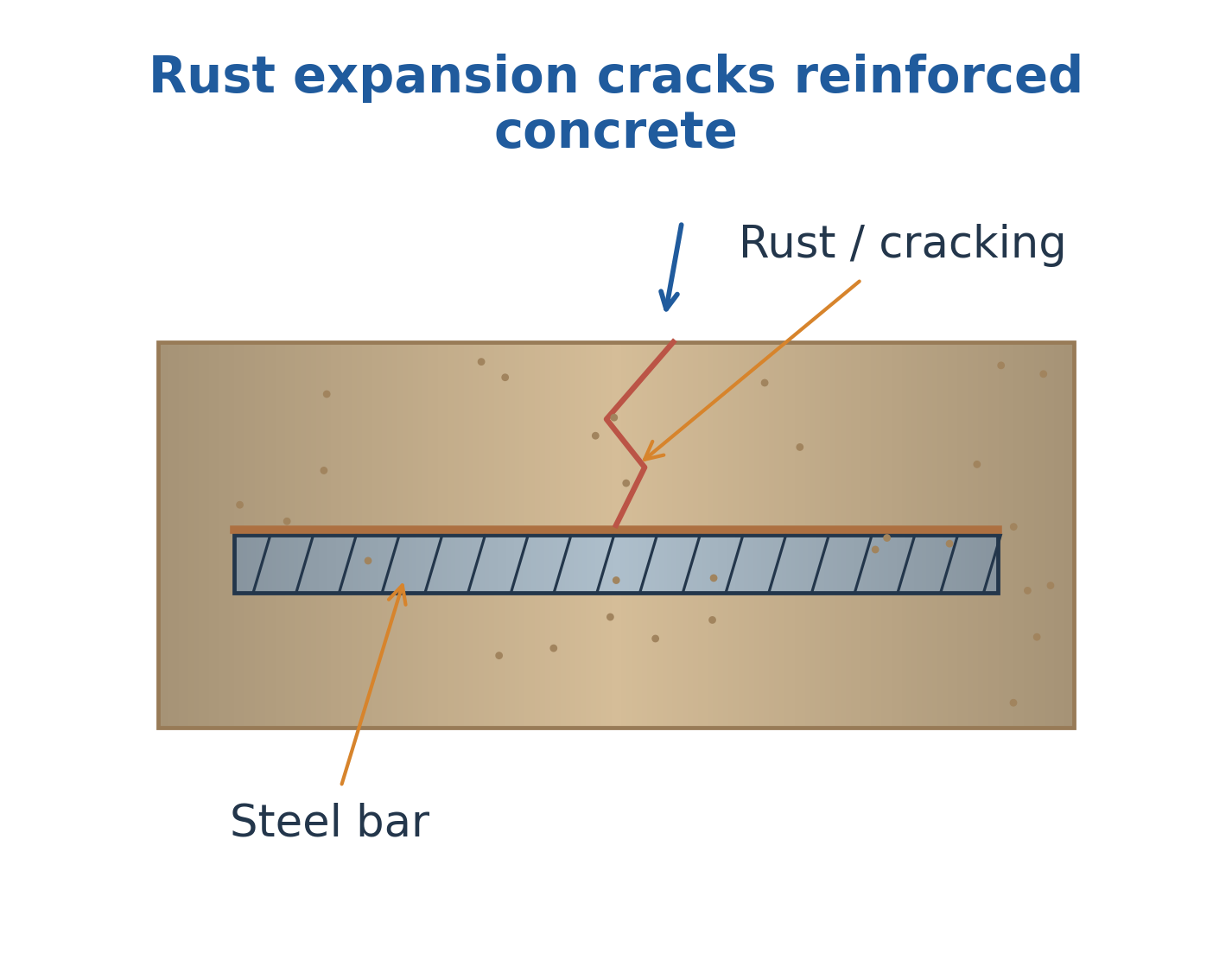
Corrosion products can occupy more volume than the consumed steel and generate cracking, delamination or spalling. These changes can increase ingress and expose more reinforcement. Protection combines suitable cover, well-compacted low-permeability concrete, curing, exposure control and mechanism-based repair. Coatings, inhibitors or cathodic systems can be appropriate in selected cases. A cosmetic patch or a universal chloride threshold is not a complete diagnosis for every structure.
Worked problem 2.23: Rebar diagnosis
Route: CE
Problem. Concrete near reinforcing steel has carbonated and remains wet. Explain the chemical risk.
Answer and explanation. Carbonation can lower alkalinity and destabilize steel passivity. Moisture permits ionic conduction and oxygen can support cathodic reduction. Corrosion-product expansion can crack concrete; inspect the exposure and electrochemical condition rather than relying on appearance alone.
21. High-temperature oxidation and growth laws
Study route: ME, CH
High-temperature oxidation can proceed without a liquid electrolyte. A metal reacts with the atmosphere to form a scale; transport of ions/electrons through that layer can limit growth. Continuous, adherent, slowly growing scales may protect, while porous, cracked, volatile or spalling scales can expose fresh metal. Thermal cycling and stress influence adherence.

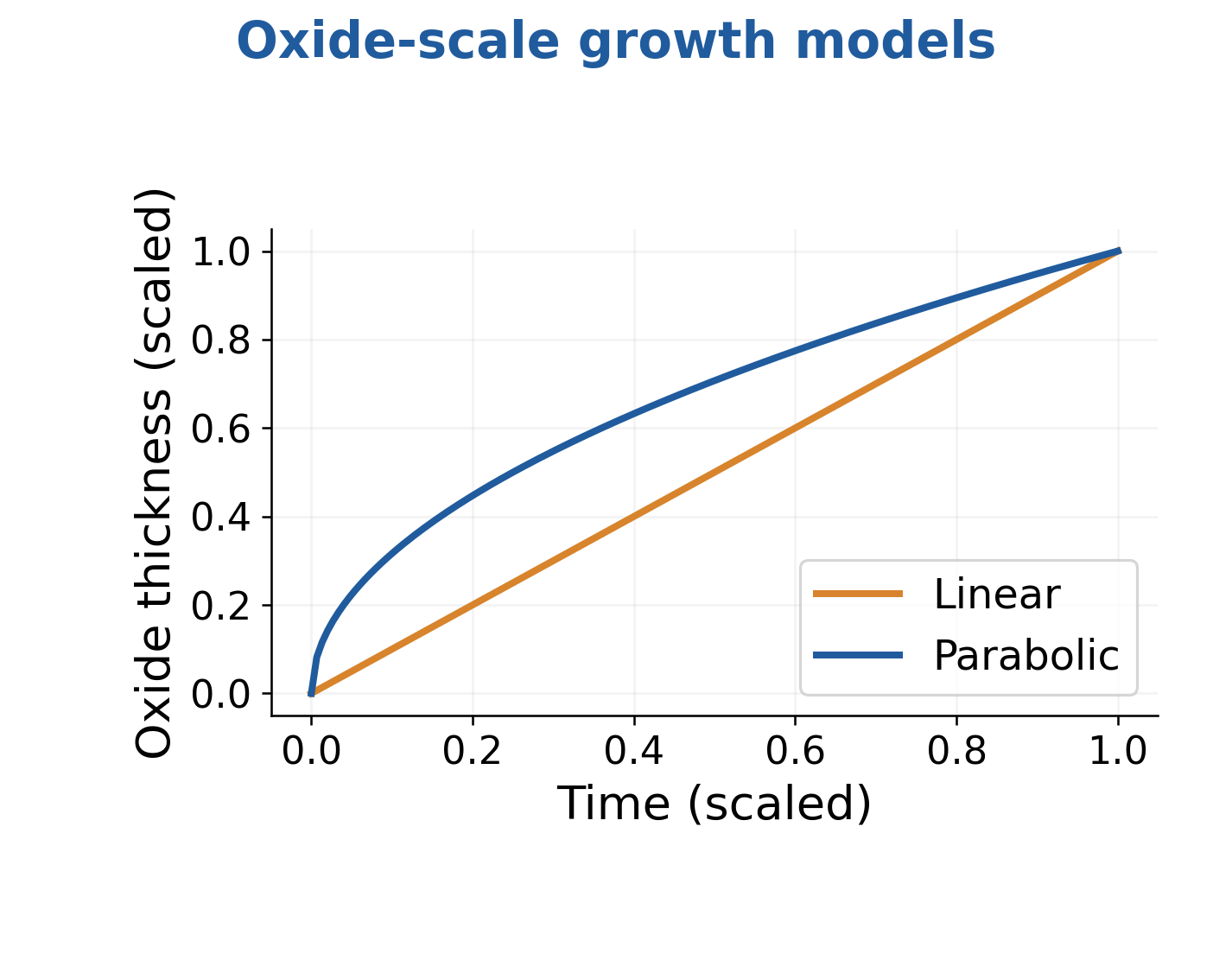
A simple diffusion-controlled model gives x² = kp t for zero initial thickness. A constant-rate model gives x = kl t; the constants have different dimensions. An existing scale requires the appropriate initial-thickness term. The Pilling-Bedworth volume ratio is a useful screening concept but does not independently predict adhesion or every service outcome. Extrapolation through scale cracking, phase change or a different atmosphere is not justified by one short-time fit.
Apply a growth law to an existing scale
For the same parabolic regime with initial thickness x0, x²-x0² = kp t. It is the difference of squared thicknesses, not (x-x0)². Under a linear regime, x-x0 = kl t. Test dimensions before substituting values and state whether thickness or mass gain was fitted. A protective scale can later spall or change phase, so a single fitted constant should not be extended through every heating cycle without evidence.
Worked problem 2.24: Parabolic oxidation
Route: ME/CH
Problem. A scale follows x² = kp t with kp = 4 micrometre²/h and zero initial thickness. Find x after 9 h.
Answer and explanation. x = sqrt(4 x 9) = 6 micrometres. A fourfold time increase doubles thickness in this model. The law is not valid through arbitrary scale cracking or spallation.
22. Passivation and the active-passive response
Study route: ME, CH
Passivation is a low-reactivity surface state associated with a suitable protective film, often a thin oxide. Composition and environment determine whether that film forms, remains stable or breaks down. A passive material is corrosion resistant under particular conditions rather than universally immune. Local breakdown can lead to pitting despite a small average current.

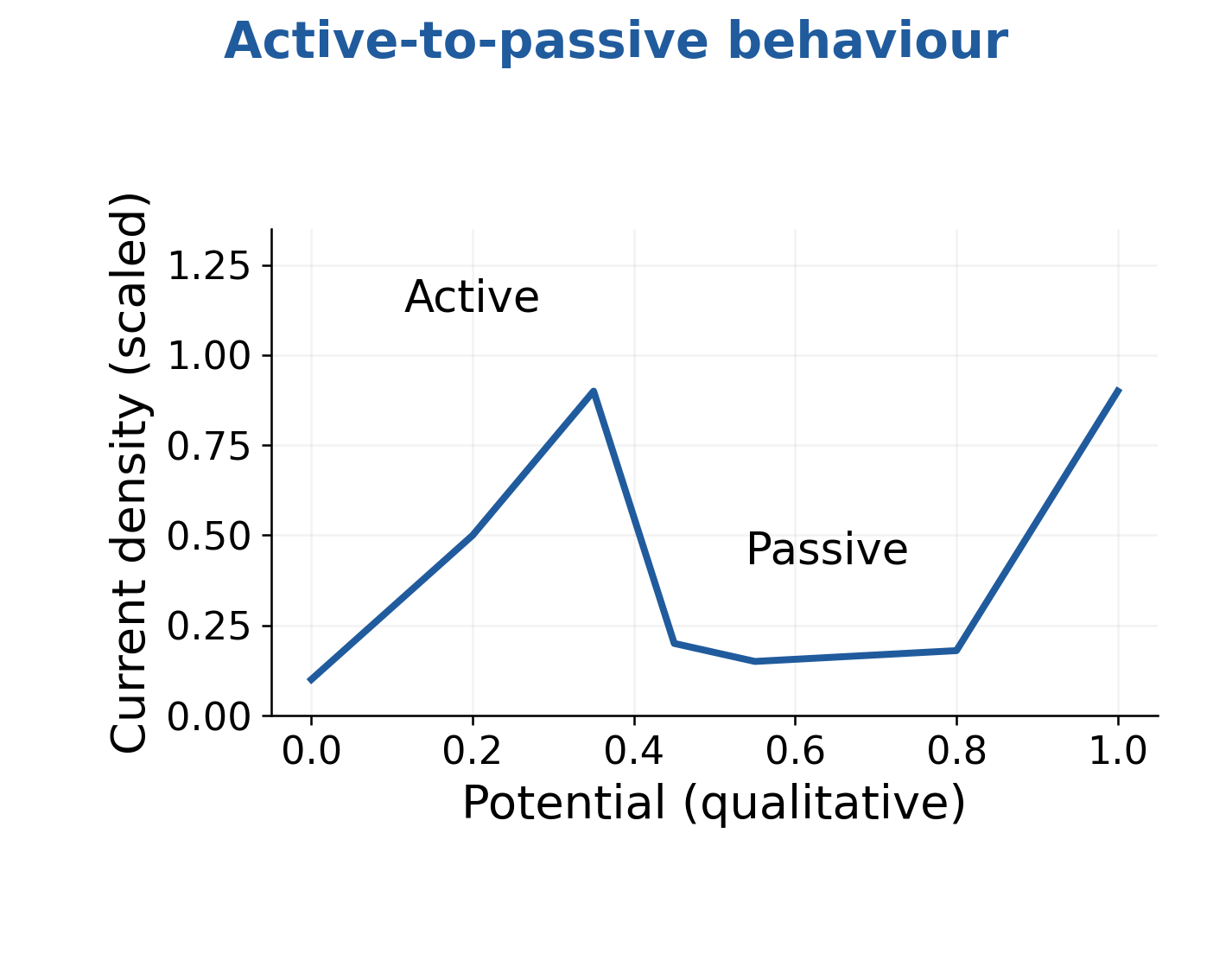
An active-passive polarization curve can show increasing active dissolution, a transition to a low-current passive region and further changes at higher potential. The location and width of useful regions depend on the system. This helps distinguish deliberately maintained anodic protection from cathodic protection. A potential value without a reference electrode and environment cannot establish that a surface is safely passive.
Worked problem 2.25: Current density and total current
Route: ME/CH
Problem. A passive region has supplied current density 2 microamp/cm² across 50 cm². Find total current, and state one limit of the interpretation.
Answer and explanation. Current = 100 microamps = 0.10 mA. A small average current does not independently rule out a local pit or establish behaviour at another potential, temperature or solution composition.
23. Cathodic protection: sacrificial and impressed-current systems
Study route: CE, ME, CH
Cathodic protection supplies electrons so the protected structure operates as the cathode. A sacrificial-anode system connects a suitable more active metal that is consumed. An impressed-current system uses an external DC source and suitable anodes, with appropriate monitoring. The protected structure is not deliberately made the site of metal oxidation.

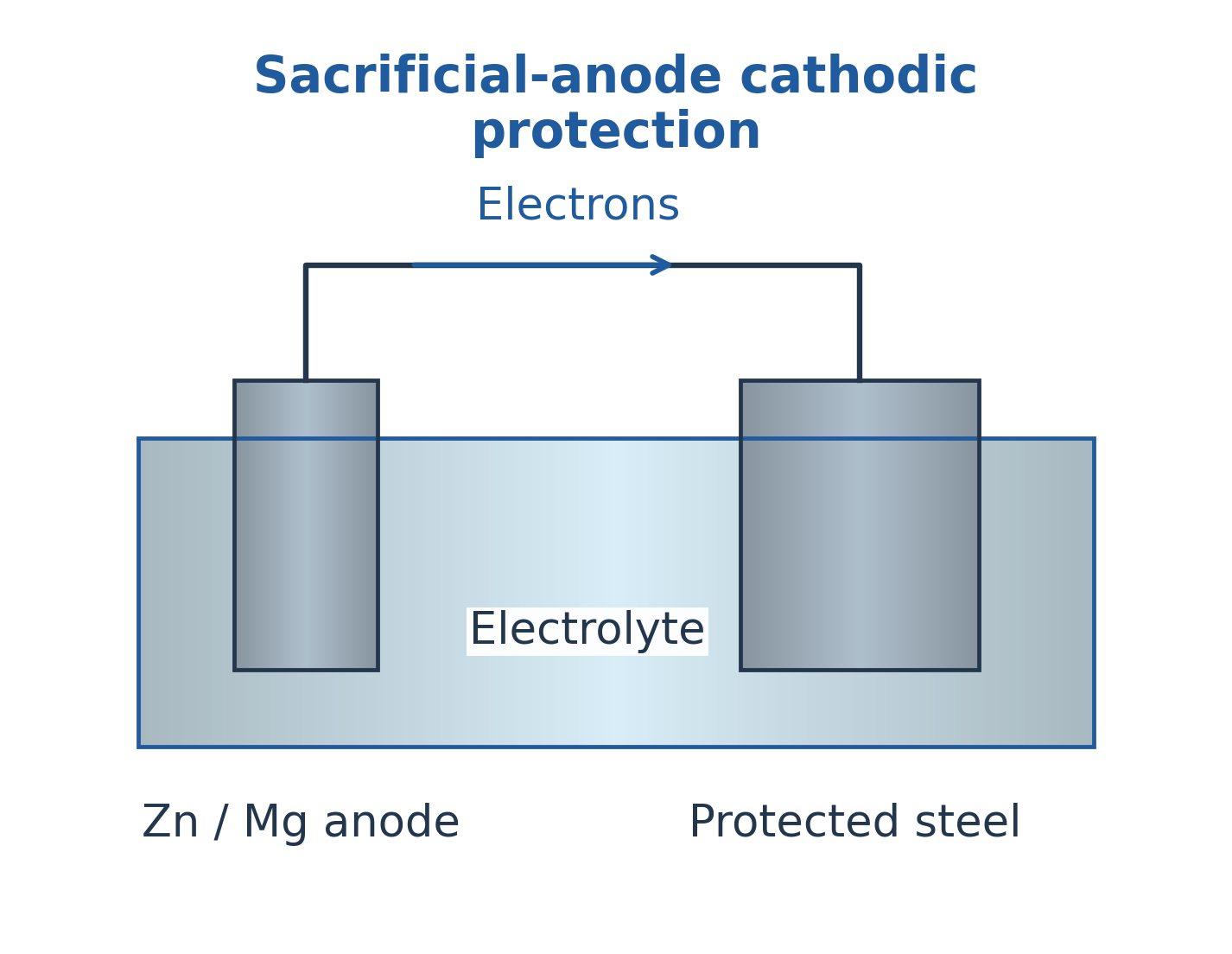
The electrolyte and metallic paths must form the intended circuit. Current distribution, coating condition and geometry affect protection. Anode mass consumption can be related to charge through Faraday balance under a specified efficiency, but that inventory alone is not a complete design. Excessive or unsuitable polarization can create other problems in some materials. Explain polarity, current path, protected region and monitoring, not merely the name of the connected metal.
| System | Electron supply / operating role |
|---|---|
| Sacrificial anode | More active connected metal is consumed |
| System | Electron supply / operating role |
|---|---|
| Impressed current | External DC supply and suitable anodes |
| Protected structure | Acts cathodically |
24. Anodic protection and controlled passivity
Study route: ME
Anodic protection holds a suitable passivating metal in a controlled passive potential region. Unlike cathodic protection, the method does not simply make every metal more negative. A monitoring/control system uses a reference and appropriate electrodes to maintain the target region. It requires a material/electrolyte system with a useful active-passive response.

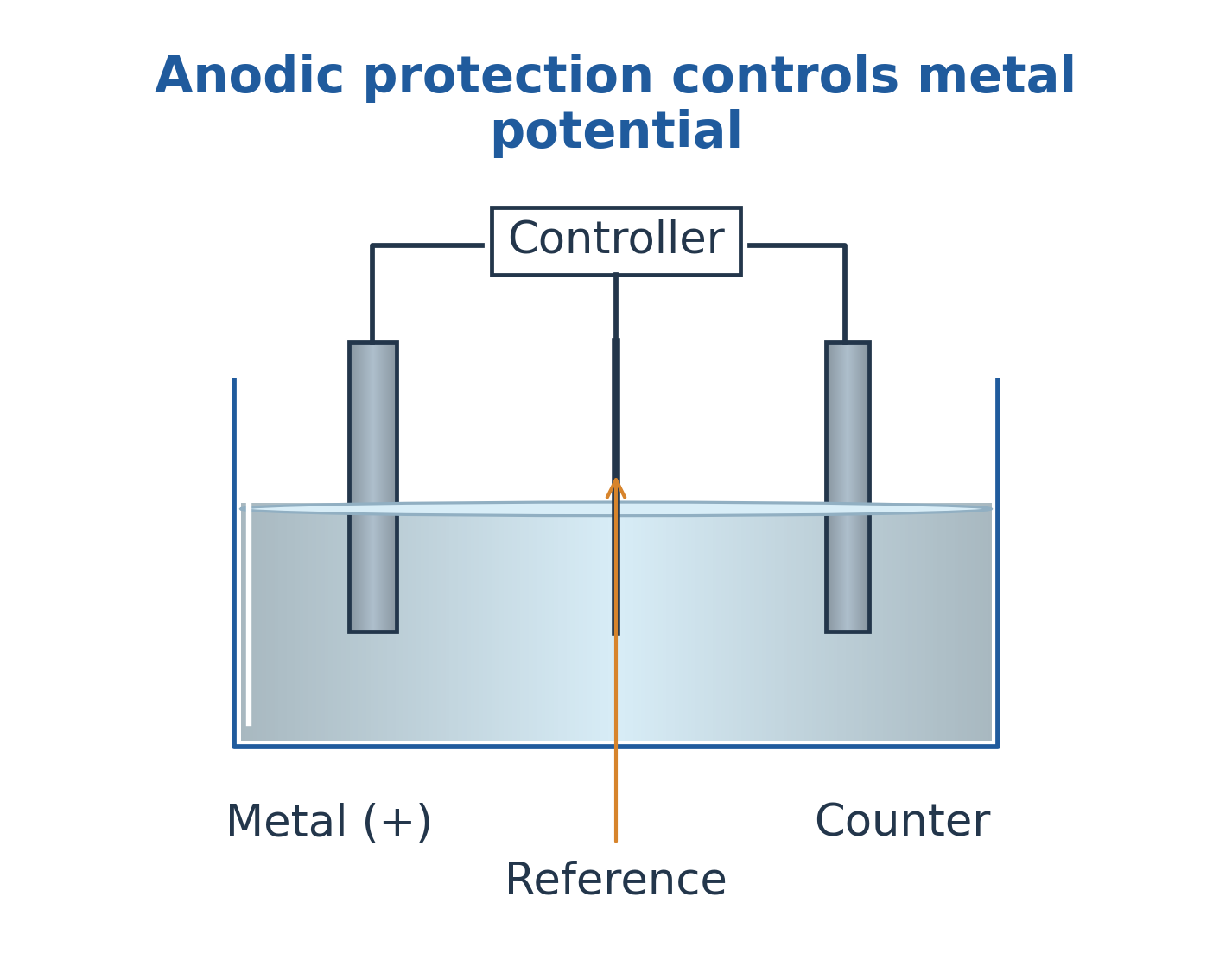
Starting or losing control can involve substantially different currents and corrosion behaviour. The passive range, reference convention, chemistry and temperature therefore matter. The method cannot be selected for an arbitrary material simply because it has an anode. Compare the two protection methods through the intended potential change and mechanism: cathodic protection suppresses anodic dissolution by cathodic polarization,
while anodic protection relies on a maintained passive state.
Worked problem 2.26: Choose anodic or cathodic protection
Route: ME
Problem. Can anodic protection be selected for any metal simply by making its potential more positive? Explain.
Answer and explanation. No. It requires a suitable stable passive region and controlled potential relative to a reference. Outside that region, increased anodic polarization can increase dissolution. Cathodic protection uses a different suppression mechanism.
25. Inhibitors, coatings and surface treatments
Study route: CE, ME, CH
An inhibitor reduces attack through actions such as adsorption or alteration of anodic/cathodic reaction kinetics. Effectiveness depends on dose, environment, flow and compatibility. Inhibitor efficiency can compare matched rates: 100(r0-ri)/r0. It describes the supplied comparison rather than universal performance. A treatment effective in one acid or temperature may fail elsewhere.

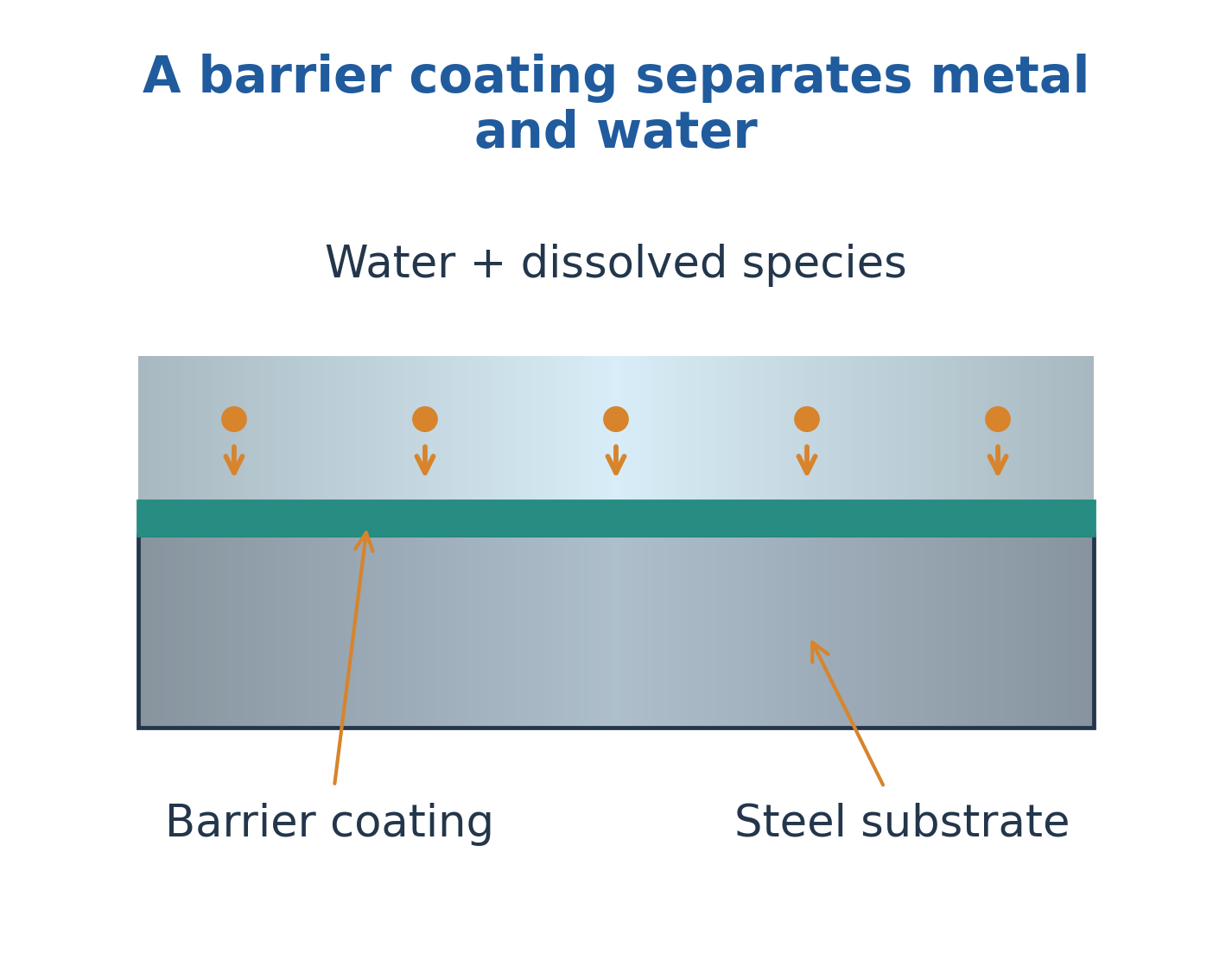
Organic coatings provide barriers through suitable polymer systems; inorganic or metallic coatings provide different combinations of barrier, conversion-film or sacrificial action. Surface preparation, adhesion, continuity and damage govern service. A noble coating defect can expose a small anodic region on an active substrate, whereas zinc on steel can offer sacrificial support under suitable conditions. Select the entire surface-treatment system and inspect relevant defects rather than equating visible colour with protection.
Worked problem 2.27: Inhibitor efficiency
Route: CE/ME/CH
Problem. Mass loss is 0.50 g without inhibitor and 0.12 g with it under identical conditions. Find inhibition efficiency.
Answer and explanation. Efficiency = 100(0.50-0.12)/0.50 = 76%. This compares the supplied test only; it does not establish performance in every concentration, temperature or flow condition.
Worked problem 2.28: Coating defect interpretation
Route: CE/ME/CH
Problem. Compare a noble metallic coating defect on an active substrate with a suitable zinc coating defect on steel in an electrolyte.
Answer and explanation. A noble coating can make a small exposed substrate region anodic relative to a large cathode. Zinc can instead provide sacrificial support under suitable conditions. Geometry, continuity, contact and electrolyte determine the outcome.
26. Galvanizing and electroplating
Study route: ME, CH
Galvanizing applies a zinc-containing coating to steel. Zinc can provide a barrier and, in suitable electrical/electrolyte contact, sacrificial protection of exposed steel. Coating thickness, adhesion and environment influence durability. It differs from simply painting the surface with an arbitrary metallic-looking layer.

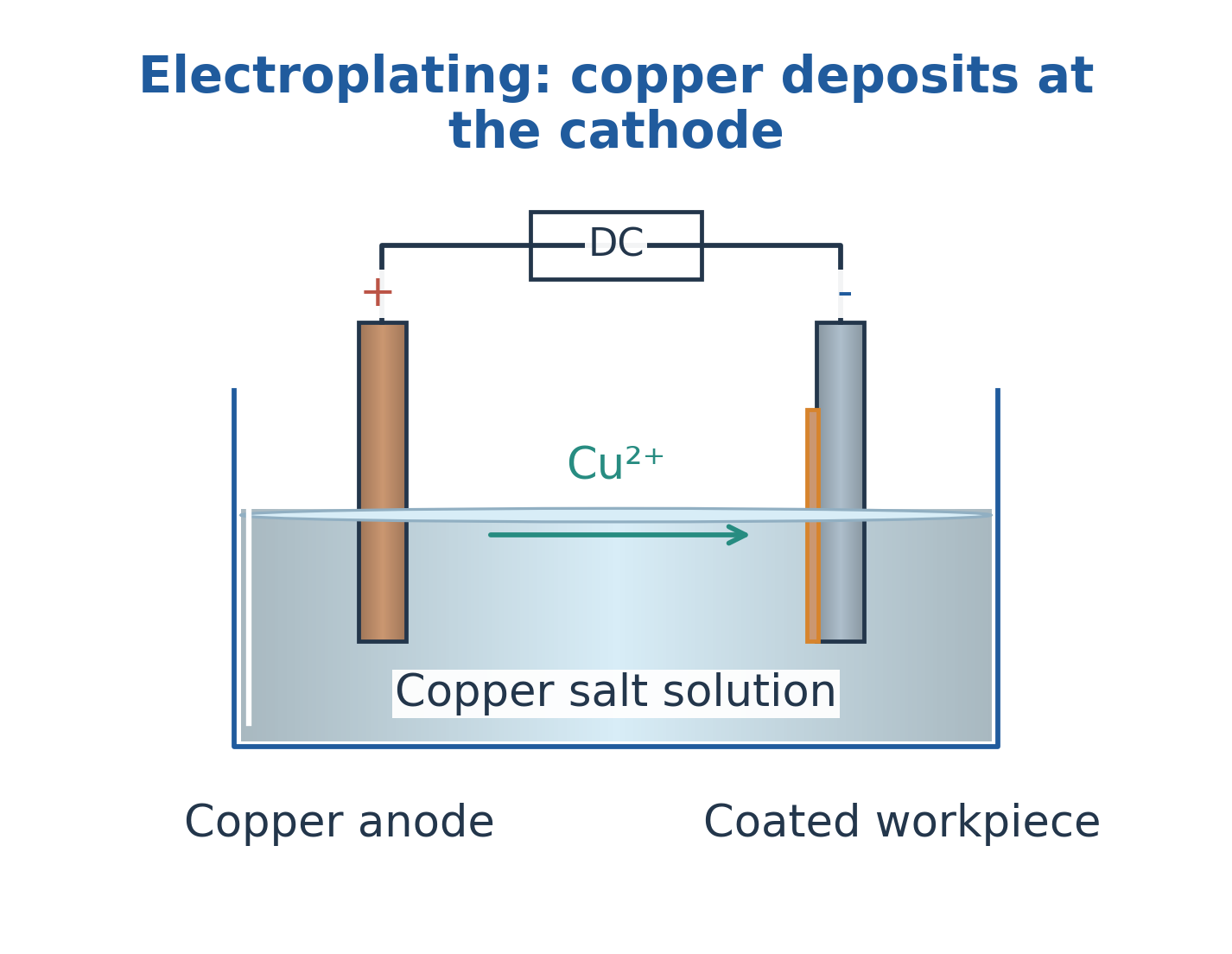
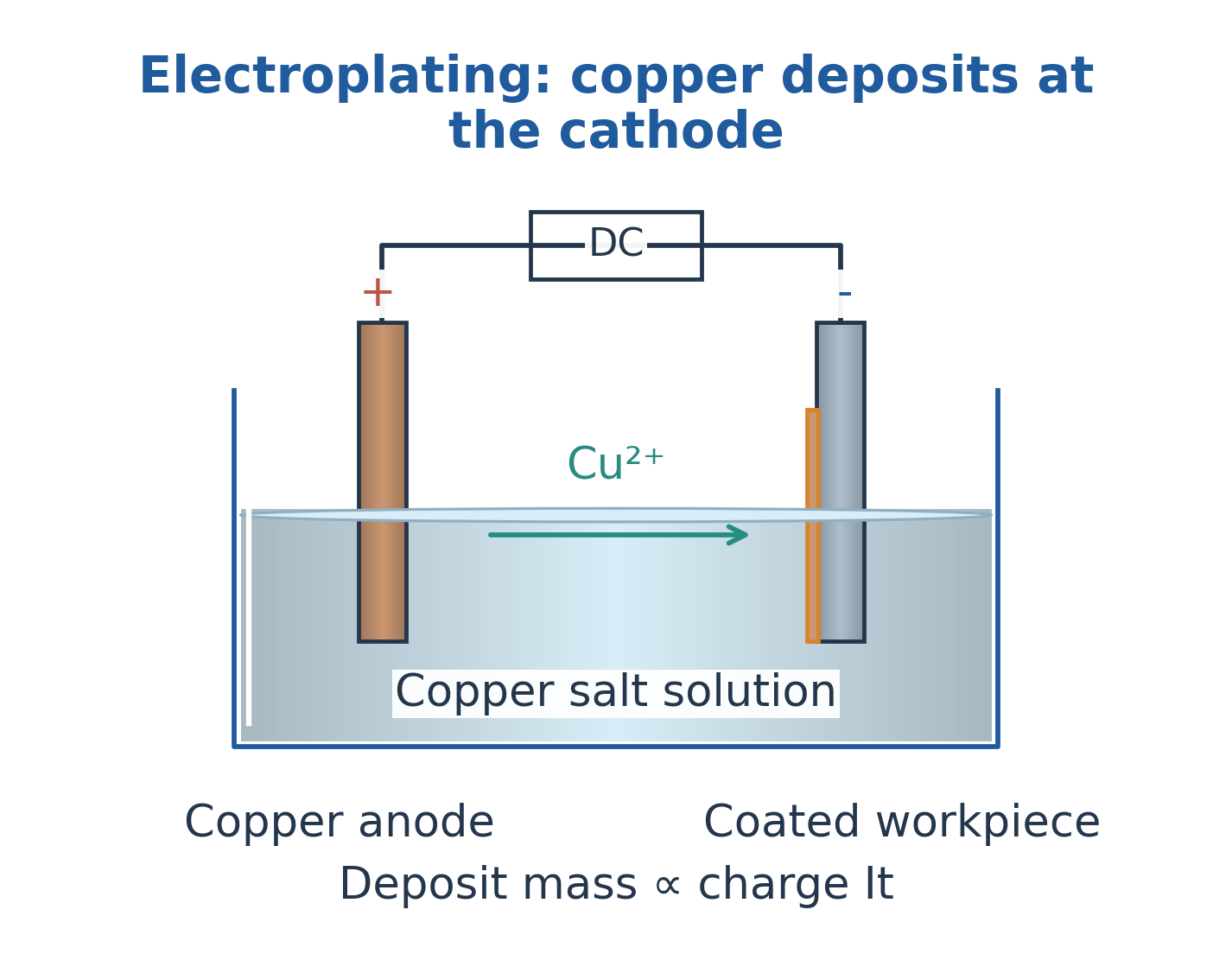
Electroplating deposits metal onto a cathodic workpiece using external current. Metal-ion reduction, electrolyte transport and surface preparation control the deposit. Faraday mass m
= eta ItM/(nF) gives deposited mass for a stated current efficiency, and uniform thickness is m/(rho A). Deposit porosity, stress and adhesion can matter even at the correct average thickness. The process basis is shared with CH industrial electrolysis, while ME emphasizes protective application.
Worked problem 2.29: Copper plating
Route: CH
Problem. Current 2 A runs for 965 s at 80% efficiency. Cu2+ has M = 63.5 g/mol; use F = 96500 C/mol. Find deposit.
Answer and explanation. Theoretical m = ItM/(2F) = 0.635 g. Actual m = 0.80 x 0.635 = 0.508 g. Efficiency applies to the desired deposition reaction, not to the molar mass.
27. Corrosion monitoring in chemical plants
Study route: CH
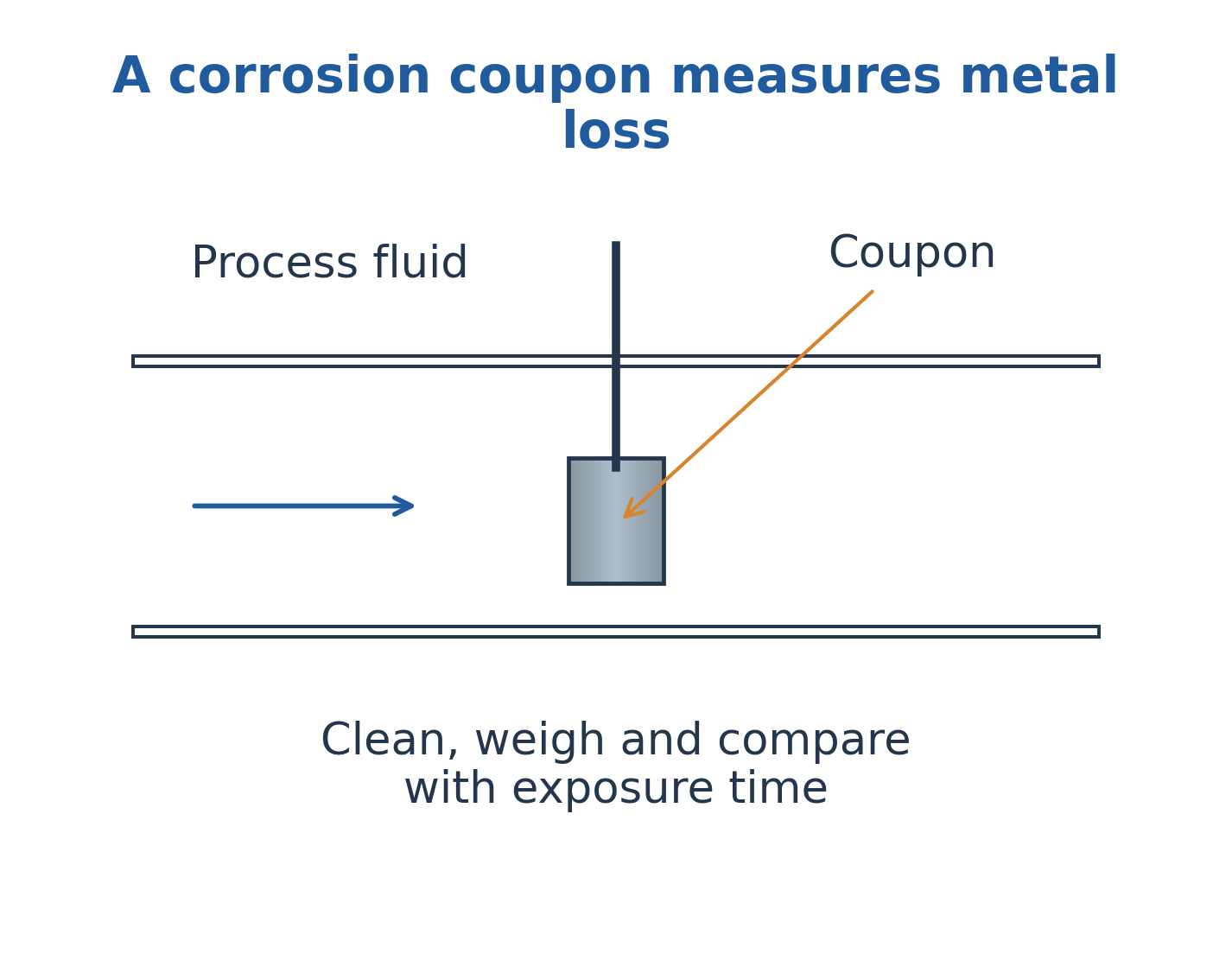
Mass-loss coupons measure average material removal over a known area and exposure time. Electrical-resistance probes follow changes in a metallic element; potential measurements describe electrochemical state relative to a reference. Polarization techniques can estimate kinetic quantities under stated assumptions. Inspection and thickness measurements provide different spatial information.

A Tafel plot uses suitable polarization regions to relate potential and logarithmic current density; extrapolation requires an appropriate model and valid range. Monitoring should match the expected failure mode: average loss can miss a deep pit, while one potential reading does not directly give every corrosion rate. Combine chemistry, temperature, flow history and spatial inspection. A monitoring programme is useful when its results trigger an appropriate operational or maintenance response.
Interpretation and action
A measured increase in average rate should be compared with changes in temperature, flow, chemistry and operating history. A local failure can need spatial inspection even when the average probe signal is low. Monitoring is strongest when the measurement location and assumptions match the expected damage and a defined response follows. Recording a potential without its reference or comparing differently exposed coupons can create a false trend.
28. Chlor-alkali electrolysis and product separation
Study route: CH
In a membrane chlor-alkali process, brine supplies chloride at the anode: 2Cl- -> Cl2 + 2e-. At the cathode, 2H2O + 2e- -> H2 + 2OH-. Sodium ions pass through a suitable cation-selective membrane, supporting a sodium-hydroxide product stream. The ideal overall equation is 2NaCl + 2H2O -> Cl2 + H2 + 2NaOH.

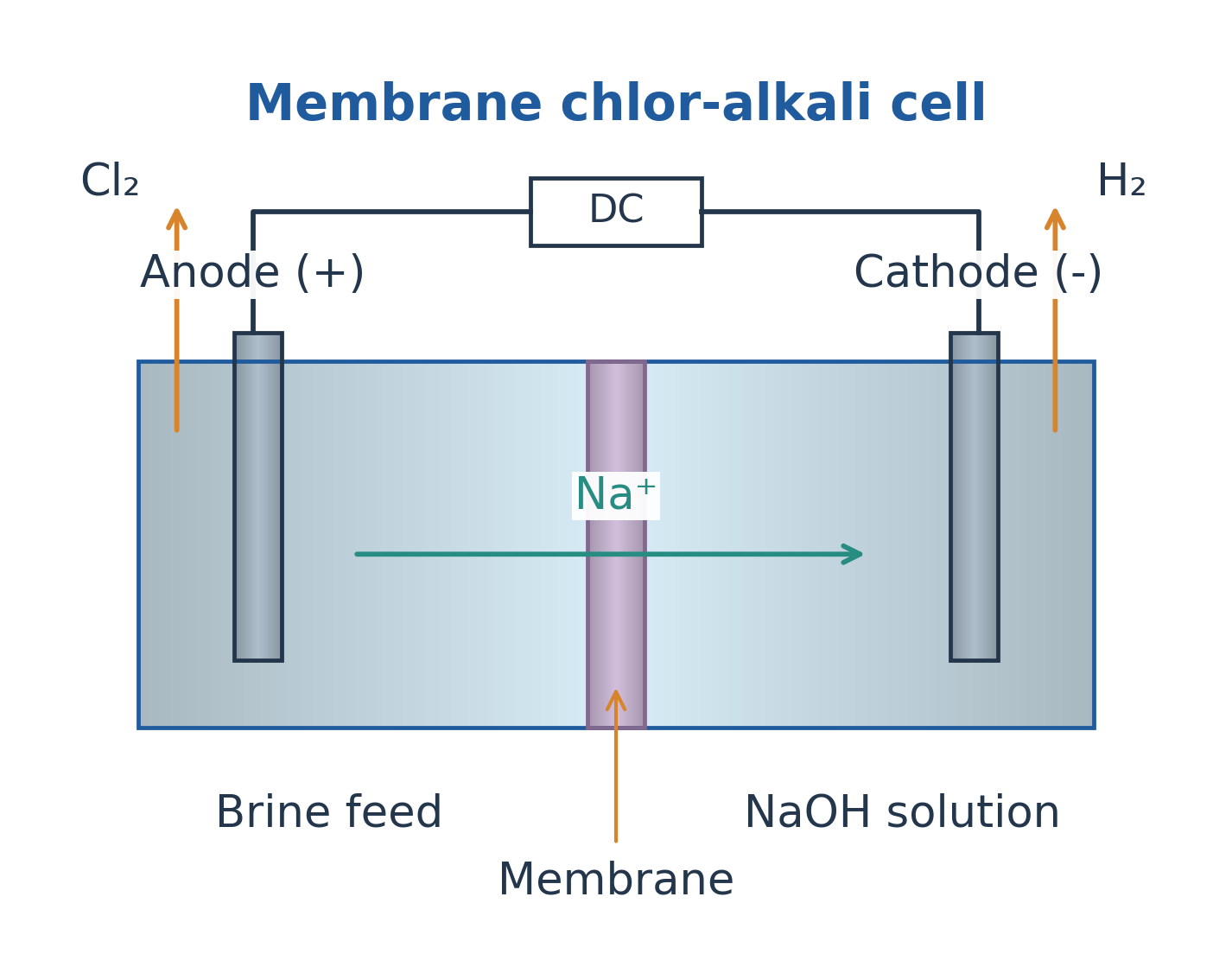
Separation of electrode regions and products is integral to the process, not an optional downstream detail. Ionic selectivity, brine quality, competing reactions and operating losses affect performance. Stoichiometry determines ideal product ratios, while current efficiency describes the fraction of charge producing the specified desired reaction. Applied voltage also supplies losses, so a charge balance alone does not determine total electrical energy consumption.
Worked problem 2.30: Chlor-alkali balance
Route: CH
Problem. Ideal electrolysis consumes 4 mol NaCl. Find Cl2, H2 and NaOH amounts.
Answer and explanation. From 2NaCl + 2H2O -> Cl2 + H2 + 2NaOH, products are 2 mol Cl2, 2 mol H2 and 4 mol NaOH. Separate product streams prevent unwanted mixing reactions.
29. Anodizing: controlled oxide growth
Study route: CH
Anodizing makes a suitable workpiece anodic and deliberately develops an oxide layer, commonly on aluminium. Electrolyte, potential/current conditions and surface preparation influence film growth and structure. Subsequent treatment can modify porosity or surface performance. The desired product is an oxide-containing surface, not a metal deposit on a cathodic workpiece.

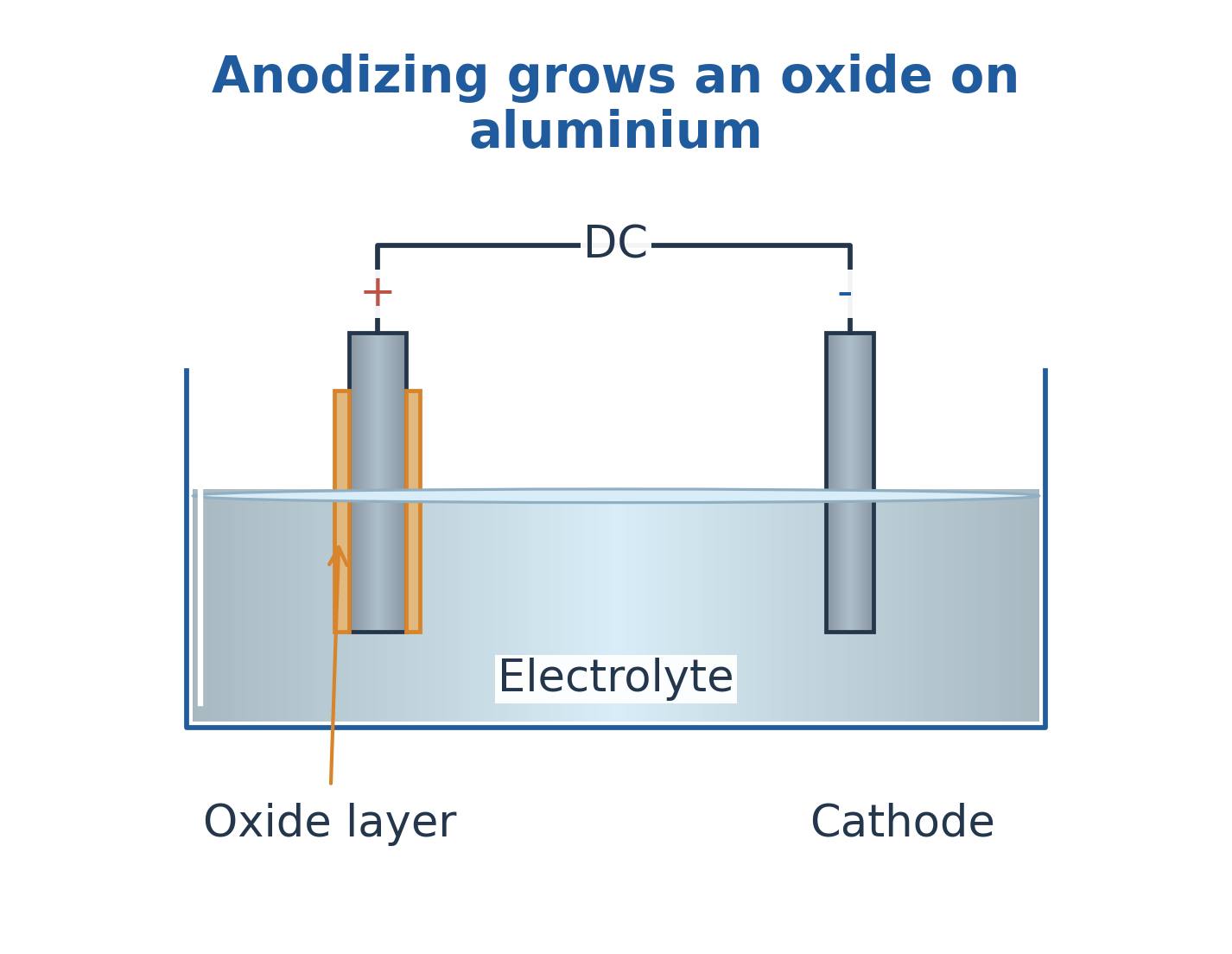
Contrast anodizing with electroplating by workpiece polarity, reaction and resulting layer. In both, thickness uniformity, cleanliness and interface quality matter. The electrochemical series gives useful tendencies but cannot alone predict every film formed under process conditions. Complexing, passivation, dissolution and competing reactions can alter the practical outcome. Explain the controlled transformation and its protection/function rather than defining every electrochemical surface process as plating.
| Process | Workpiece role / product |
|---|---|
| Electroplating | Cathode; deposited metal |
| Anodizing | Anode; grown oxide |
| Both | Surface preparation and film verification |
30. Polymers, monomers and repeat-unit descriptions
Study route: TX
A monomer can contribute units to a macromolecule; a repeat unit describes the recurring structure of a polymer chain. Number-average molecular mass and molecular-mass distribution describe a population, not one identical chain length. For a simple repeat-unit definition, Xn approximately equals Mn/M0 when end-group corrections can be neglected.

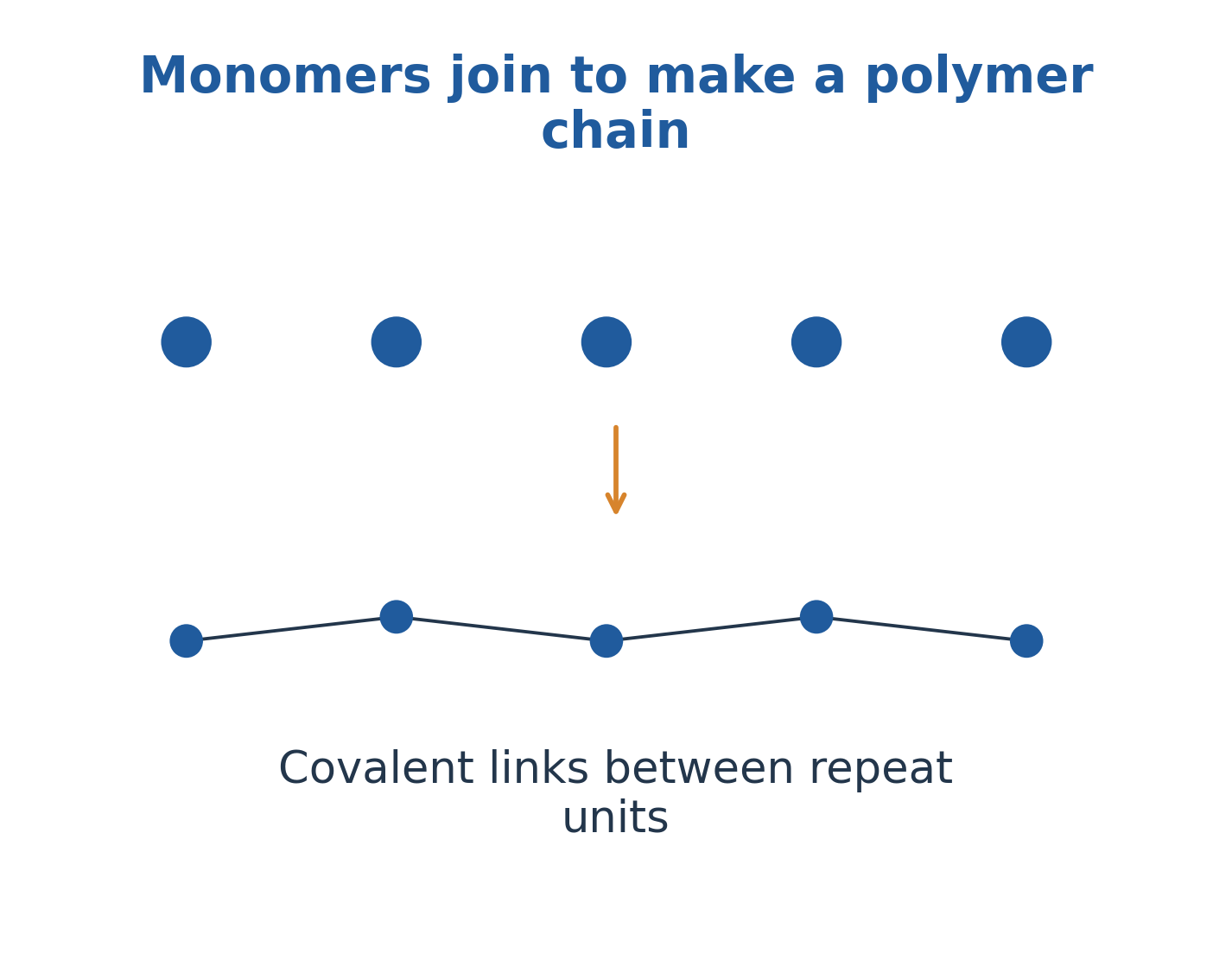


Linear, branched and network architectures affect processing and properties. Thermoplastics can soften within a suitable processing range, whereas permanent networks do not simply remelt into equivalent independent chains. Polymerization creates macromolecules; spinning converts a suitable feed into fibres. Distinguish monomer identity, linkage, chain architecture and physical fibre form before linking chemistry to strength, sorption or processing.
Worked problem 2.31: Repeat-unit count
Route: TX
Problem. An ideal polymer has Mn = 56000 g/mol and repeat-unit mass 280 g/mol. Estimate number-average chain length.
Answer and explanation. Xn = Mn/M0 = 200, neglecting end-group corrections. This is an average; it does not mean every chain has exactly 200 units.
31. Chain growth, step growth, addition and condensation
Study route: TX
Chain-growth polymerization develops through active centres, with initiation, propagation and termination/transfer in a common description. Vinyl-monomer addition is an important example. Step-growth polymerization involves reaction between functional groups on molecules of different sizes; high molecular mass commonly requires very high conversion and good group balance.

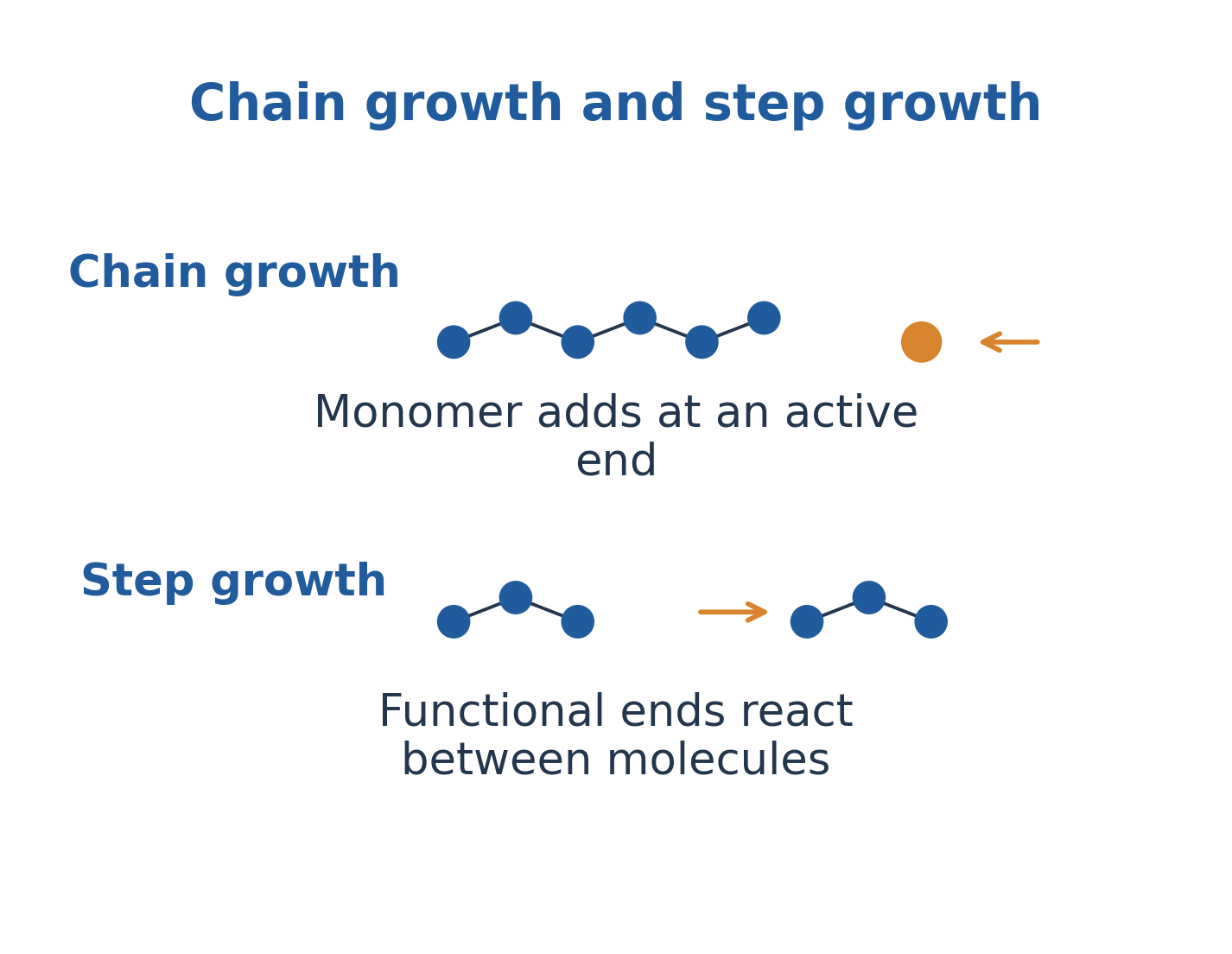
Addition/condensation and chain/step growth are related but not exact synonyms. Many condensation systems release a small molecule, such as water during suitable nylon/polyester formation. Polyurethane formation shows that step growth need not always release a small molecule. For an ideal balanced bifunctional step-growth system, Xn = 1/(1-p). Branching, imbalance or monofunctional impurities require different treatment. State the mechanism and functional groups rather than classifying from fibre appearance.
Why conversion near one is important
In the ideal balanced bifunctional step-growth model, each successful link reduces the number of separate reacting molecules, giving Xn = 1/(1-p). Raising p from 0.98 to 0.995 changes Xn from 50 to 200. This strong response near complete conversion explains the importance of group balance and purity. It is not a universal molecular-weight law for branching, side reactions, imbalance or every chain-growth mechanism.
| Classification | What it describes |
|---|---|
| Chain / step growth | How chain size develops |
| Addition / condensation | Incorporation and small-molecule release |
| Not identical | Step growth need not release a small molecule |
Worked problem 2.32: Step-growth conversion
Route: TX
Problem. Use Xn = 1/(1-p) for an ideal balanced bifunctional system. Find Xn at p = 0.98 and 0.995.
Answer and explanation. At 0.98, Xn = 50. At 0.995, Xn = 200. The strong change near complete conversion explains the need for high conversion and stoichiometric balance.
32. Copolymerization and sequence architecture
Study route: TX
A copolymer incorporates more than one monomer species. Random, alternating, block and graft architectures describe different sequence or connectivity patterns. A physical blend of two separate polymers is not automatically a copolymer, and changing architecture can change phase organization even when overall monomer fraction is similar.

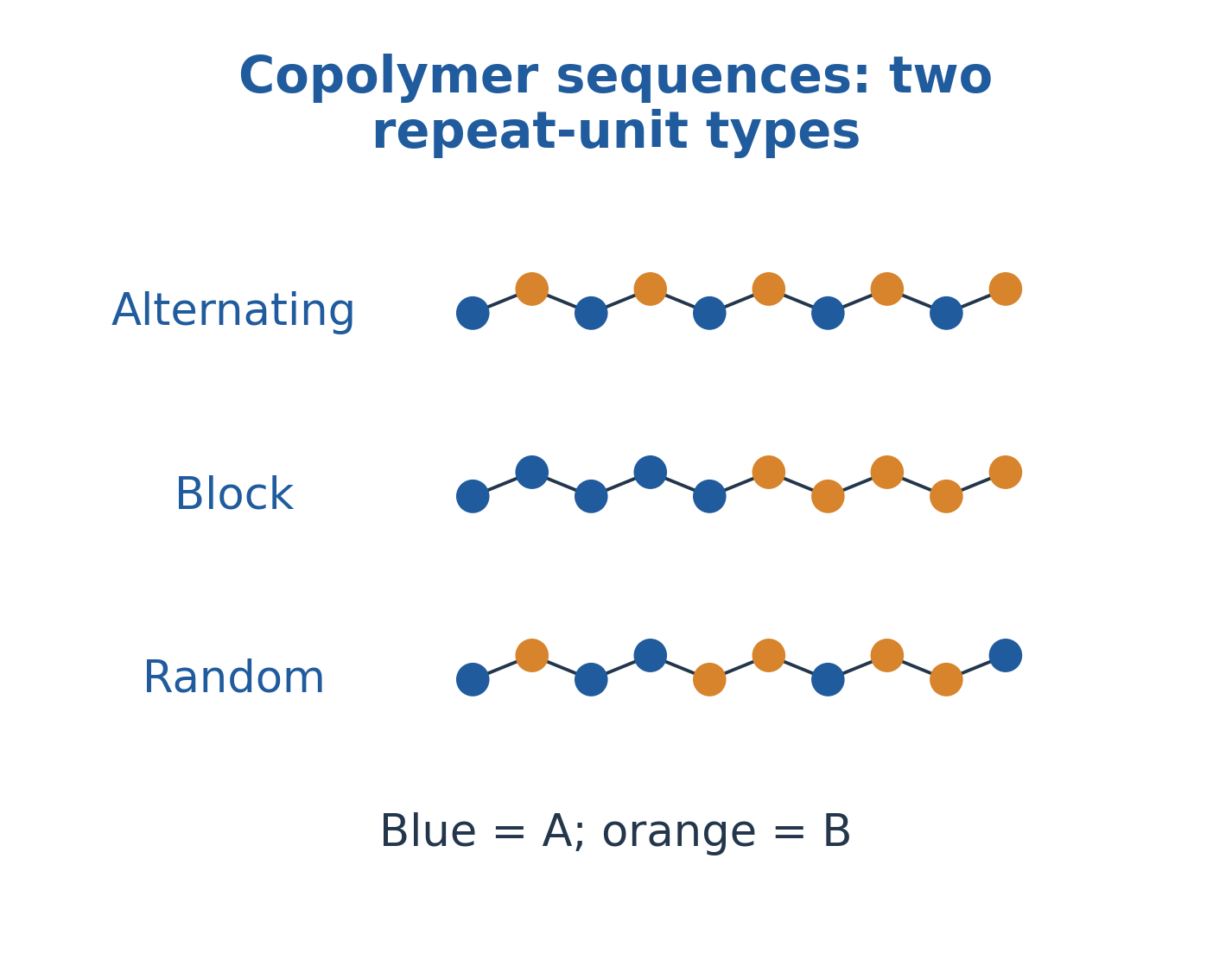
Copolymerization can alter dye affinity, flexibility, thermal response or processability. Functional groups, sequence length and compatibility determine the actual effect. Graft modification attaches branches to an existing backbone; cross-linking connects chains into a network. Neither should be described as simply adding any powder to a fibre. Identify backbone, added segment and bond/network change before explaining the targeted textile function.
Worked problem 2.33: Copolymer versus blend
Route: TX
Problem. A yarn contains separate polyester and nylon fibres. Is that automatically a copolymer? Contrast it with a graft structure.
Answer and explanation. No. Mixing separate fibres is a blend/assembly, not proof of covalent copolymer structure. A graft copolymer has side-chain segments covalently attached to a backbone. Composition and connectivity must be distinguished.
33. Melt, dry and wet spinning
Study route: TX
Melt spinning extrudes a polymer melt and solidifies it by cooling. It needs a usable melt-processing interval without unacceptable degradation. Dry spinning extrudes a solution and removes solvent through evaporation. Wet spinning extrudes a solution into a coagulation bath, where solvent exchange or suitable reaction develops a solid fibre.

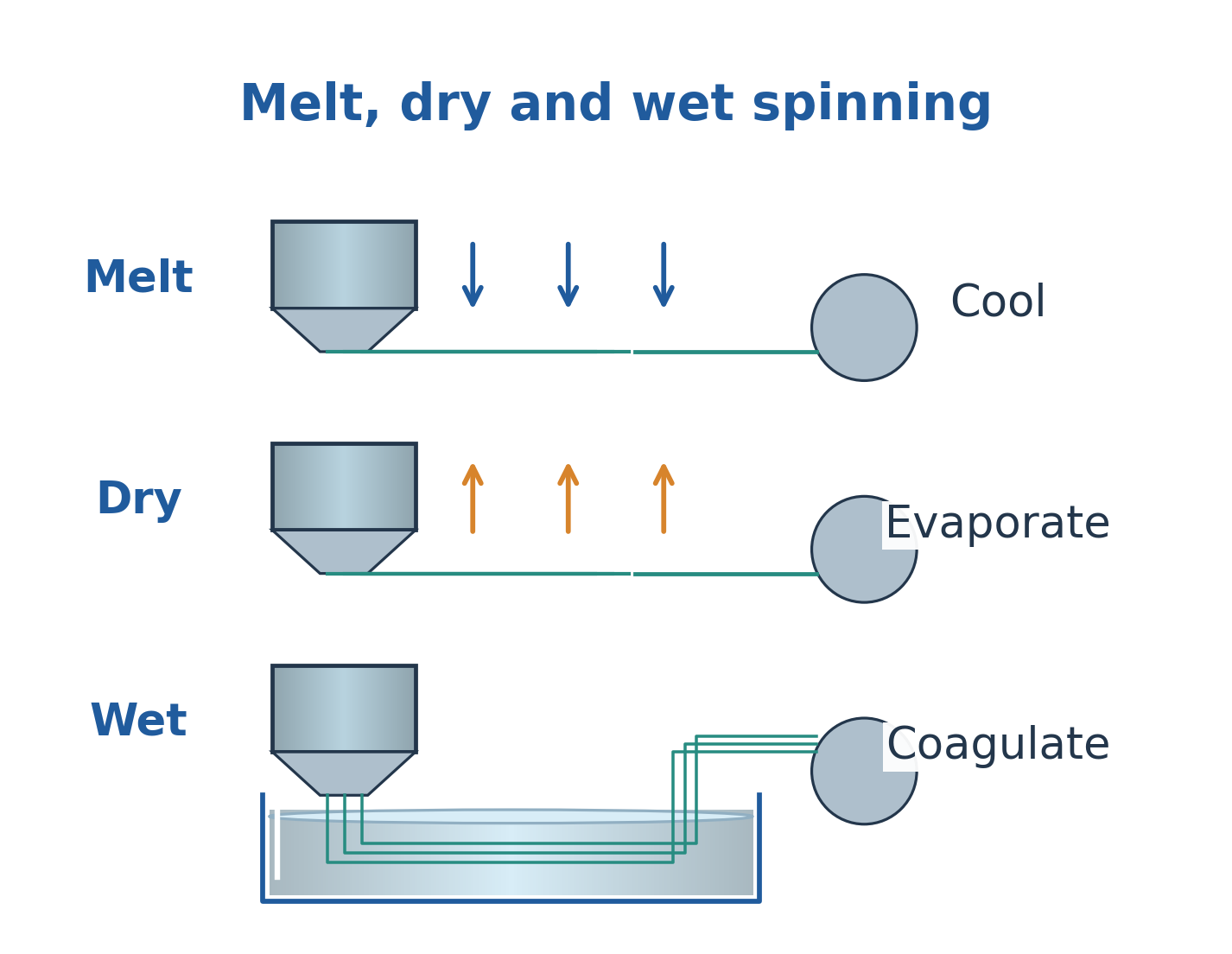
Choose by thermal stability, solubility, viscosity, solidification mechanism and solvent recovery. A polymer that degrades before a stable melt may need a solution route. Spinning conditions influence filament uniformity, voids and orientation. The spinneret, solidification zone and collection/drawing stages perform different functions. A labelled process sketch should show the actual cooling, evaporation or coagulation step instead of representing all three routes as identical boxes.
What a correct spinning diagram shows
For melt spinning, label molten feed, spinneret, cooling zone and take-up. For dry spinning, replace cooling-controlled solidification with a solvent-evaporation region and solvent handling. For wet spinning, show the spinneret entering a coagulation bath and a solvent/non-solvent exchange region. Drawing and winding follow appropriate formation stages. These distinctions connect the diagram to actual mass transfer instead of using the same unlabelled line for every process.
| Spinning route | Solidification mechanism |
|---|---|
| Melt | Cooling molten polymer |
| Dry | Solvent evaporation |
| Wet | Coagulation in a bath |
Worked problem 2.34: Spinning selection
Route: TX
Problem. A polymer degrades before useful melt processing but dissolves in a suitable solvent. Name two possible fibre-forming routes.
Answer and explanation. Dry spinning can solidify by solvent evaporation; wet spinning can solidify in a coagulation bath. Choose using solvent, polymer and recovery conditions. Melt spinning is unsuitable if degradation prevents stable melt extrusion.
34. Drawing, orientation, crystallinity and amorphous regions
Study route: TX
Drawing stretches the formed fibre to align chains and load-bearing structures. It can raise axial strength and modify crystallinity, while excessive drawing can damage filaments or reduce useful extensibility. Ordered regions restrict motion and penetrant access; less-ordered regions allow segmental movement and influence diffusion and sorption.

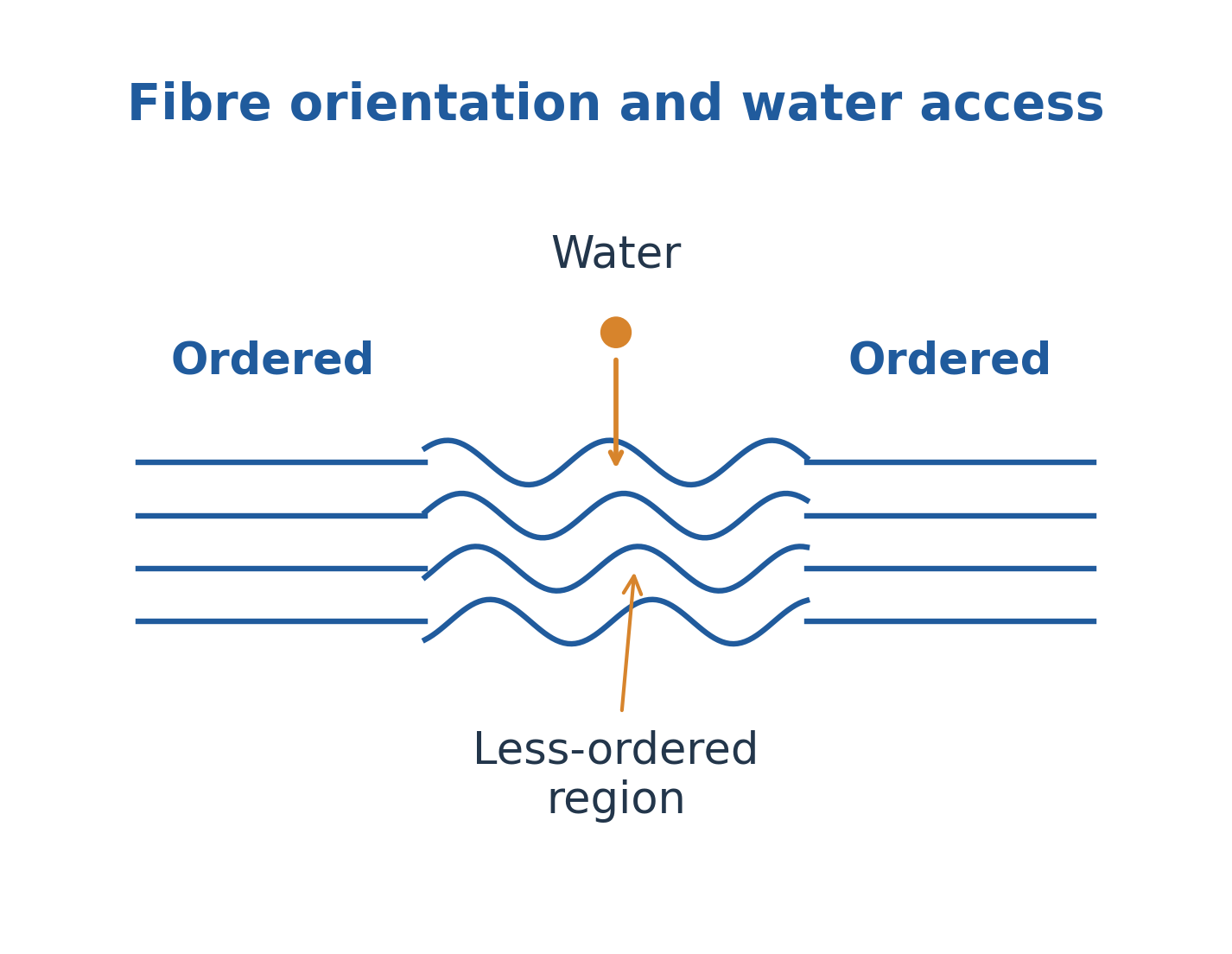

Crystalline fraction and orientation are different descriptors. A fibre can be highly oriented without every region being crystalline. Processing history connects these features to strength, thermal shrinkage, elasticity and dye uptake. The structure-property chain is polymer chemistry -> spinning/solidification -> drawing/organization -> measured performance. A reported crystallinity value does not independently specify every property or processing limit.
Worked problem 2.35: Drawing ratio
Route: TX
Problem. A marked filament segment lengthens from 20 cm to 80 cm during a supplied drawing operation. Find draw ratio and explain what it does not directly measure.
Answer and explanation. Draw ratio = 80/20 = 4. It describes the imposed length change, not an automatically equal strength increase or crystallinity percentage. Chain orientation, defects and processing conditions affect properties.
Worked problem 2.36: Crystalline and amorphous fractions
Route: TX
Problem. A supplied dry specimen contains 30 g crystalline polymer and 70 g amorphous polymer on a stated mass basis. Find the crystalline mass fraction.
Answer and explanation. Crystalline mass fraction = 30/(30+70) = 30%. Orientation is a different structural descriptor; the fraction alone does not fix strength, swelling or dye diffusion.
35. Chemical fibre modification, recycling, PLA and PHA
Study route: TX
Graft copolymerization can introduce new side groups or chains, changing properties such as dyeability. Cross-linking can improve dimensional retention by restricting chain rearrangement, but can also limit melt reprocessing. The extent and location of modification matter; a treatment that improves one function may reduce another.

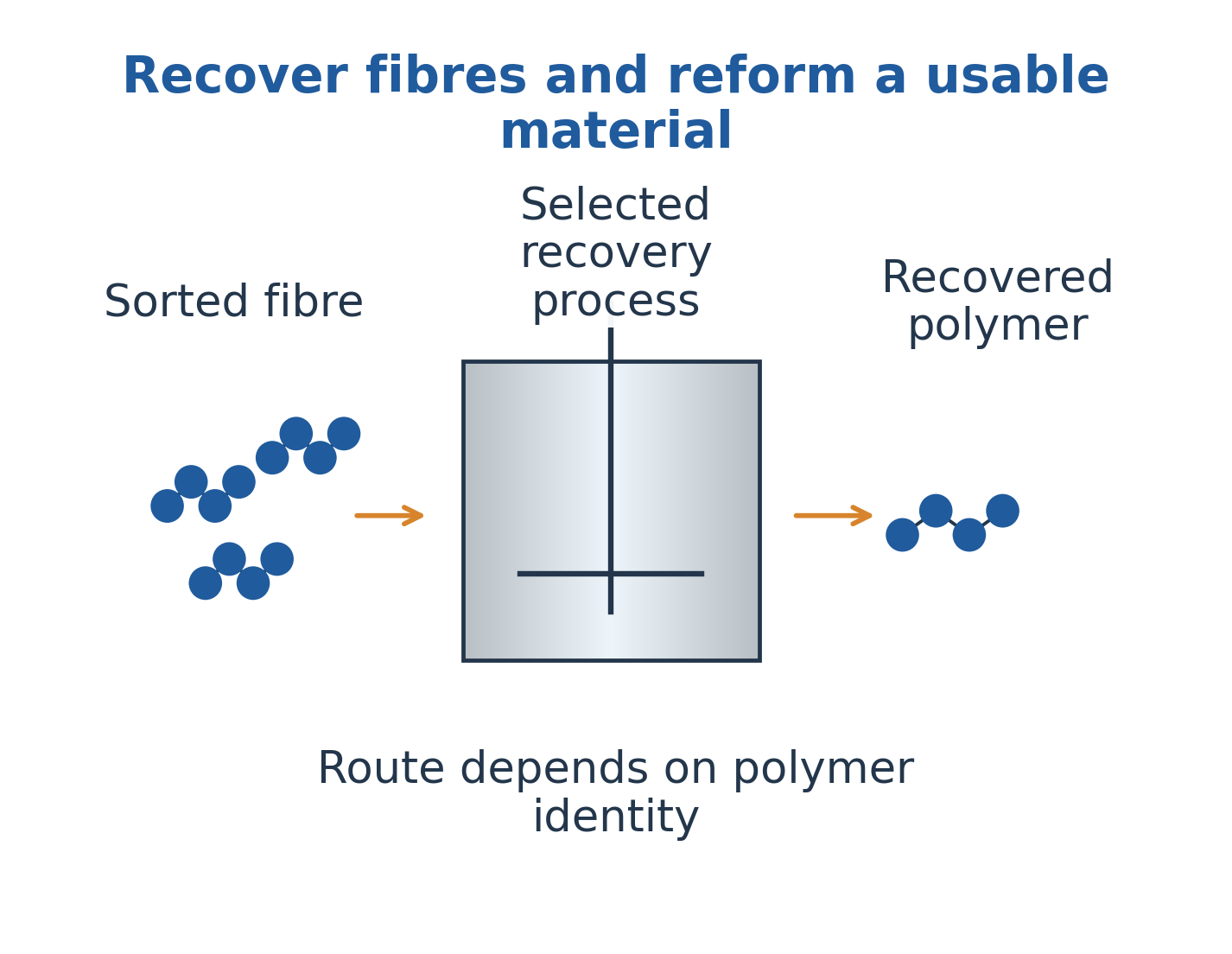
Recycled fibre feed must be controlled for contamination, polymer identity and molecular-mass retention. Mechanical or chemical routes preserve/recover different levels of material value. PLA is a lactic-acid-related polyester; PHA denotes a family of microbially produced polyesters. Bio-based origin, biodegradation and compostability are separate descriptions. Performance and breakdown depend on composition, structure and receiving conditions; renewable origin alone does not guarantee rapid degradation in every soil or water environment.
36. Thermodynamic laws in biological systems
Study route: BT
The first law accounts for conservation of energy. With heat into the system positive and work done by the system positive, ΔU = Q-W for a simple closed-system convention. Cells are open systems exchanging matter and energy; a closed-system equation cannot represent every cellular balance without appropriate flow terms.


The second law concerns total entropy production and the direction of spontaneous change. A cell can maintain organized structures while exporting entropy and consuming resources; local organization does not violate the law. State functions such as U, H, S and G depend on state, while heat and work depend on the path. Temperature must be absolute in thermodynamic equations, and conservation of energy does not imply that all energy can become useful work.
Steady state is not equilibrium
An open biological system can maintain approximately constant concentrations while substrates enter, products leave and reactions continue. That steady state can have substantial flux and energy dissipation. At chemical equilibrium, the relevant net reaction driving force vanishes. A constant measured concentration therefore does not prove that metabolism has stopped or that every reaction is at equilibrium. Define the boundary and flows before applying a thermodynamic balance to a cell or bioprocess.
Temperature and entropy references
The zeroth law links thermal equilibrium to a consistent temperature measurement. The third law supplies the limiting entropy reference for an ideal perfect crystal with a unique ground state as temperature approaches absolute zero. Biological balances mainly use the first and second laws together with chemical potentials; local organization does not imply that a living system has zero entropy.
37. Gibbs energy, ATP and coupled reactions
Study route: BT
At constant temperature and pressure, ΔG = ΔH-T ΔS helps describe favourable change. ATP hydrolysis can be coupled through a real reaction pathway to otherwise unfavourable processes. Net free energies add when reactions are written on compatible stoichiometric and standard-state bases. Breaking a bond alone costs energy; net hydrolysis favourability concerns the whole reactant-to-product change.


Biochemical ΔG° prime uses a transformed convention that fixes selected biochemical conditions, commonly including pH. It is not numerically interchangeable with every chemical standard-state definition. Coupling requires a mechanistic link or shared intermediate; placing unrelated equations next to each other does not physically transfer their driving force. Cells maintain ATP-related nonequilibrium concentrations through continuing metabolism.
Worked problem 2.37: Gibbs energy
Route: BT
Problem. For ΔH = 20 kJ/mol, ΔS = 80 J/(mol K) and T = 300 K, calculate ΔG.
Answer and explanation. Convert entropy to 0.080 kJ/(mol K). ΔG = 20 – 300 x 0.080 = -4 kJ/mol. The stated thermodynamic model favours forward change; it does not specify its speed.
Worked problem 2.38: Coupled reactions
Route: BT
Problem. A desired step has ΔG = +18 kJ/mol and a mechanistically coupled step has -30 kJ/mol on matching bases. Find net change.
Answer and explanation. Free-energy changes add: +18-30 = -12 kJ/mol. The overall process is favourable under the specified conditions. Actual coupling requires a linked pathway, not merely adjacent equations.
38. Biochemical equilibrium and concentration effects
Study route: BT
Actual reaction free energy follows ΔG = ΔG° + RT ln Q, or the corresponding biochemical convention used consistently. At equilibrium ΔG = 0 and ΔG° = -RT ln K. Standard free energy and actual free energy can differ because cellular concentrations differ from standard-state conditions.

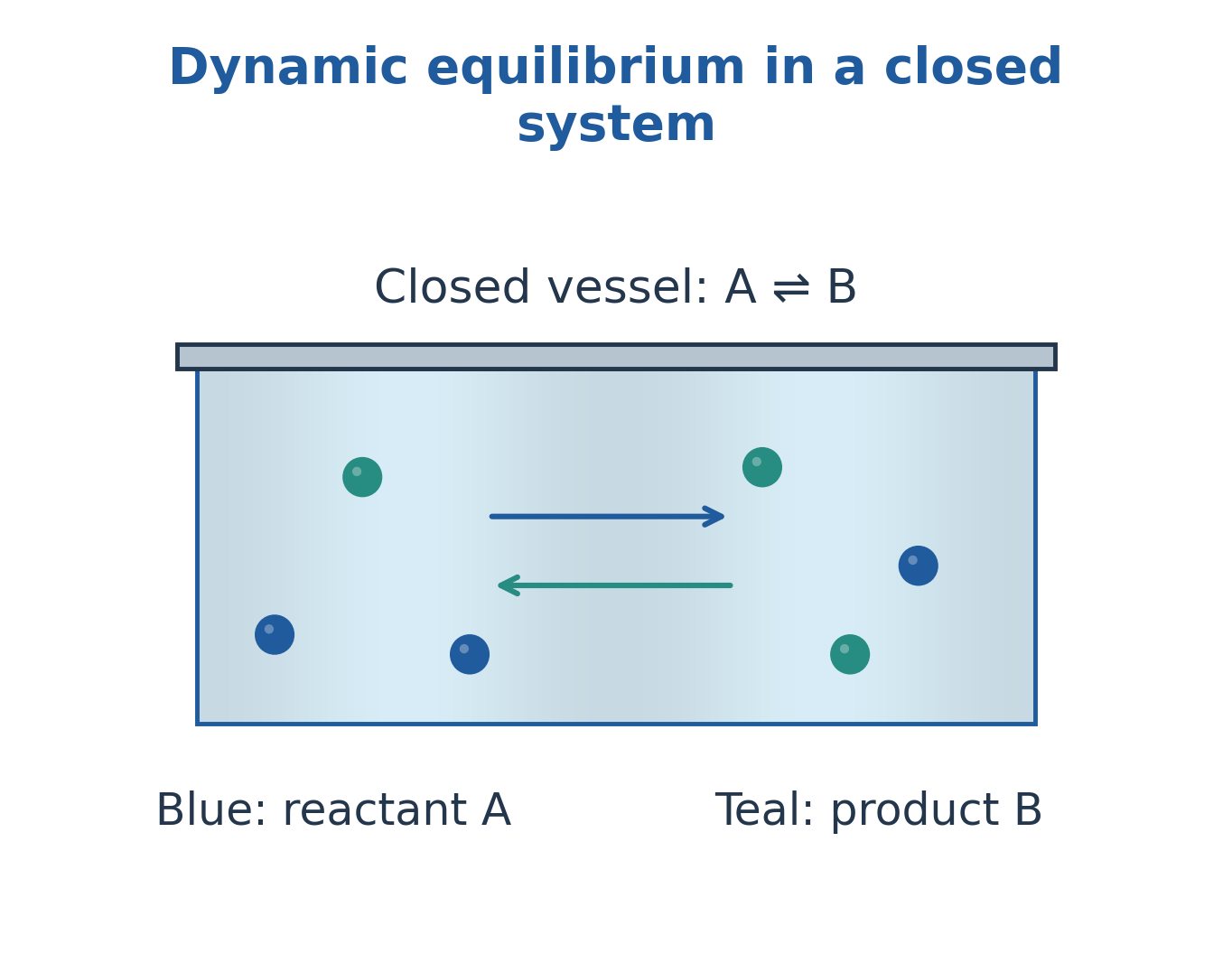
A favourable standard value does not guarantee forward change at every composition. Products, reactants, pH and ionic conditions influence the appropriate description. Enzymes change approach rates without changing the equilibrium constant of the same overall reaction at fixed conditions. A maintained metabolic steady state can have ongoing flux and is not the same as chemical equilibrium. Distinguish the system boundary, reaction quotient and imposed biochemical conditions before interpreting a free-energy number.
Worked problem 2.39: Actual biochemical driving force
Route: BT
Problem. For a consistent supplied standard-state convention, ΔG° = -5.0 kJ/mol, T = 300 K and Q = 10. Use R = 8.314 J/(mol K). Find ΔG.
Answer and explanation. RT ln Q = 5.743 kJ/mol. ΔG = -5.0 + 5.743 = +0.743 kJ/mol. A favourable standard value need not imply favourable actual forward change at every composition.
39. First- and second-order biochemical kinetics
Study route: BT
For a simple first-order disappearance, -dA/dt = kA, so ln(A0/At) = kt and half-life = ln2/k. The remaining fraction is exp(-kt). For a second-order model defined by -dA/dt = kA², 1/At-1/A0 = kt and half-life = 1/(kA0). The definitions of rate and stoichiometry must accompany the constants.


First-order k has inverse-time units, while this second-order k has inverse-concentration inverse-time units. Order is established from kinetic behaviour and is not automatically the stoichiometric coefficient of the overall reaction. Initial conditions, suitable concentration interval and absence of a mechanism change limit the model. Biological pathways can show more complicated kinetics, so do not force every enzyme reaction into one elementary rate law.
Worked problem 2.40: First-order decay
Route: BT
Problem. A substrate follows first-order disappearance with k = 0.20 min^-1. Find half-life and remaining fraction after 5 min.
Answer and explanation. Half-life = ln2/0.20 = 3.47 min. Remaining fraction = exp(-0.20 x 5) = 0.368. First-order half-life is independent of initial concentration within the model.
Worked problem 2.41: Second-order kinetics
Route: BT
Problem. With -dA/dt = kA², A0 = 0.10 M and k = 2 L/(mol min), find A after 5 min.
Answer and explanation. 1/A = 1/0.10 + 2 x 5 = 20 L/mol, so A = 0.050 M. The rate-constant units differ from a first-order model.
40. Arrhenius behaviour and transition-state interpretation
Study route: BT
The Arrhenius form k = A exp(-Ea/RT) relates rate constant and temperature over a suitable range. For approximately constant Ea and prefactor, ln(k2/k1) = Ea/R(1/T1-1/T2). A catalyst changes the available pathway rather than the net reaction free energy. An ln k versus 1/T plot gives slope -Ea/R in this model.


Transition-state theory connects a rate with passage through a free-energy barrier. A basic expression is k approximately (kB T/h) exp(-ΔG‡/RT), with transmission and standard-state factors as appropriate. Activation free energy is not the same as the overall reaction free energy. A favourable final state can remain kinetically inaccessible when its barrier is high. Temperature extrapolation must not ignore enzyme denaturation or a changed mechanism.
Activation quantities and reaction quantities
Ea and ΔG‡ describe barriers along a pathway; overall ΔG describes the difference between reactant and product states under specified conditions. Lowering a barrier can increase forward and reverse approach rates without moving equilibrium. Enzymes exploit appropriate interactions to stabilize a productive transition-state region, not merely to make substrates stick as strongly as possible. Excessively stable unproductive binding can instead limit turnover or product release.
Worked problem 2.42: Arrhenius rate ratio
Route: BT
Problem. Use Ea = 40000 J/mol, R = 8.314 J/(mol K) and a constant-barrier model. Find k310/k300.
Answer and explanation. ln ratio = (40000/8.314)(1/300-1/310) = 0.5173. The ratio is 1.678. This prediction excludes denaturation and mechanism changes.
41. Enzyme catalysis and factors controlling activity
Study route: BT
An enzyme stabilizes productive reaction pathways through a structured active site and interactions with substrates. Acid-base chemistry, covalent intermediates or metal-ion assistance may contribute according to the enzyme. The enzyme is regenerated in the ideal catalytic cycle, but real preparations can lose activity through damage or inhibition.

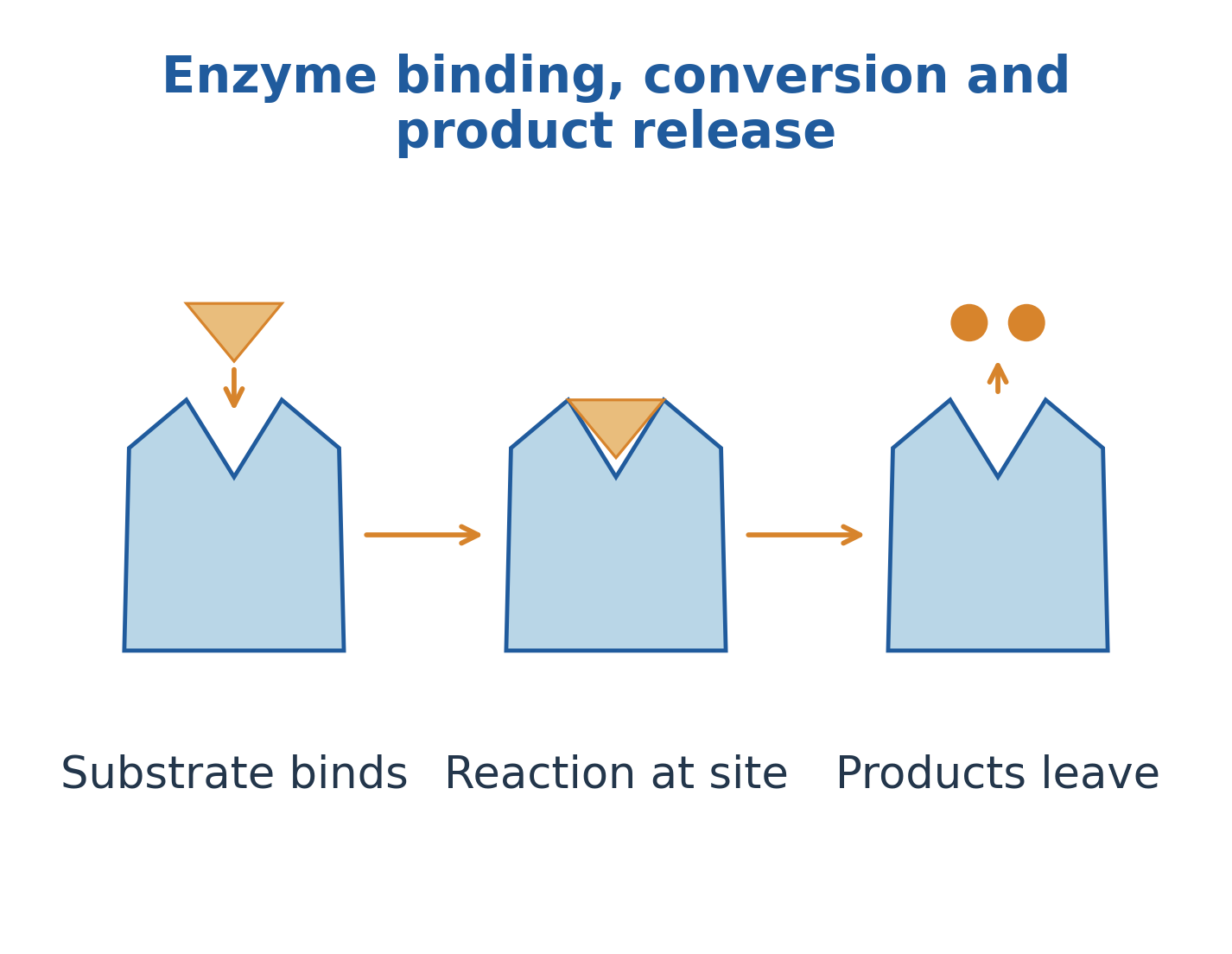
Activity depends on temperature, pH, substrate supply, cofactors, inhibitors and the fraction of active enzyme. A temperature increase can accelerate intrinsic reaction initially, then reduce measured activity through structural damage. pH changes can alter catalytic-group ionization and substrate state. Mixing or diffusion can limit a measured rate without changing intrinsic chemistry. Detailed enzyme classification, Michaelis-Menten parameters and inhibition models belong to BT Unit III; this unit introduces catalysis and activity factors.
Worked problem 2.43: Active enzyme fraction
Route: BT
Problem. A preparation contains 2.0 mg total protein, of which 60% remains active in a supplied assay. Find active mass and explain why total protein alone is insufficient.
Answer and explanation. Active mass = 1.2 mg. Lost activity can arise without complete disappearance of protein mass, so catalytic activity and total protein concentration are distinct measurements.
42. Water properties and hardness equivalents
Study route: AG
Water polarity and hydrogen bonding support solvent behaviour, cohesion and significant heat capacity. Dissolved ions, gases and suspended material determine irrigation suitability. Hardness arises mainly from Ca2+ and Mg2+. Temporary hardness is associated with bicarbonate chemistry affected by boiling; permanent hardness is associated with other common salts and is not removed simply by boiling.

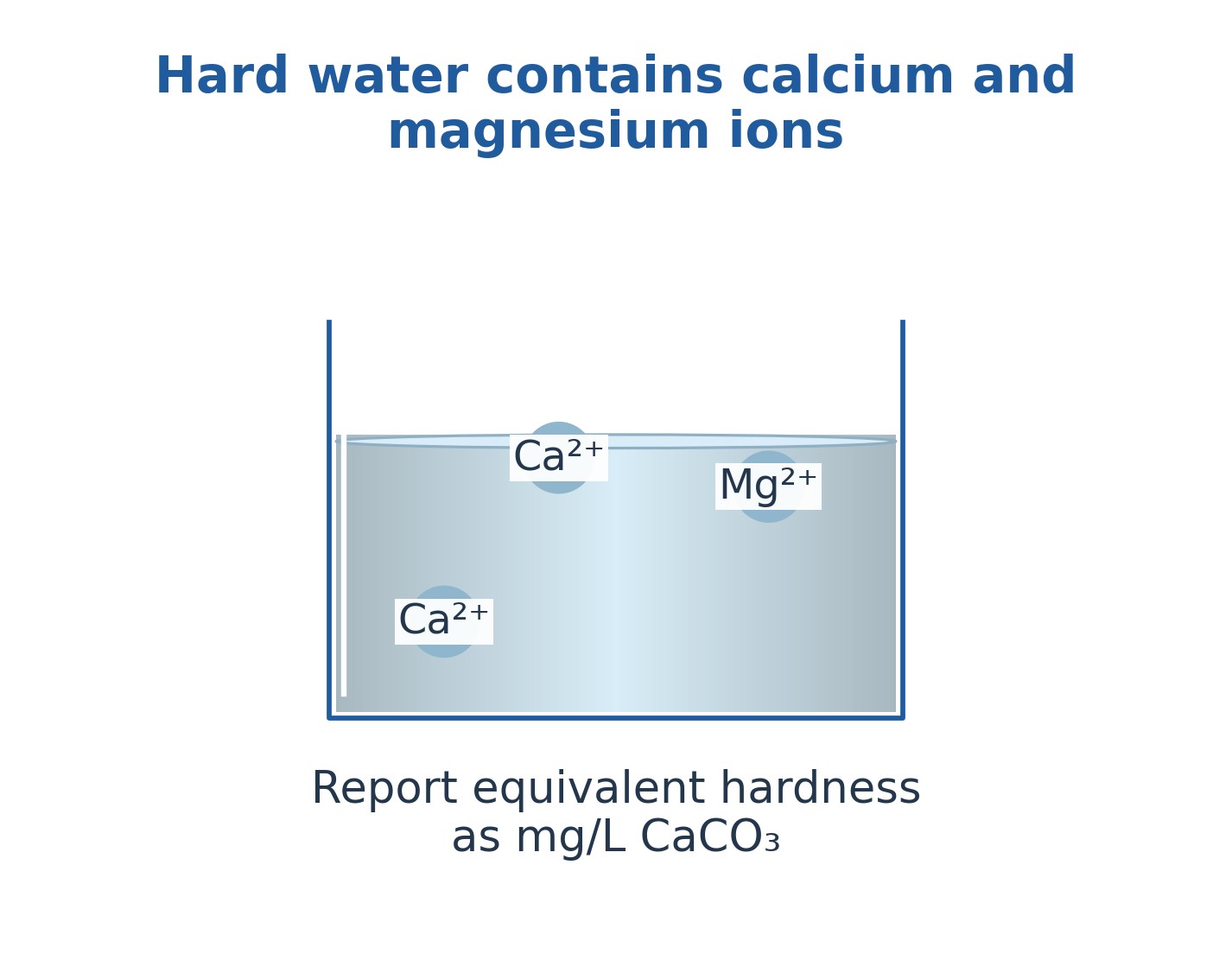

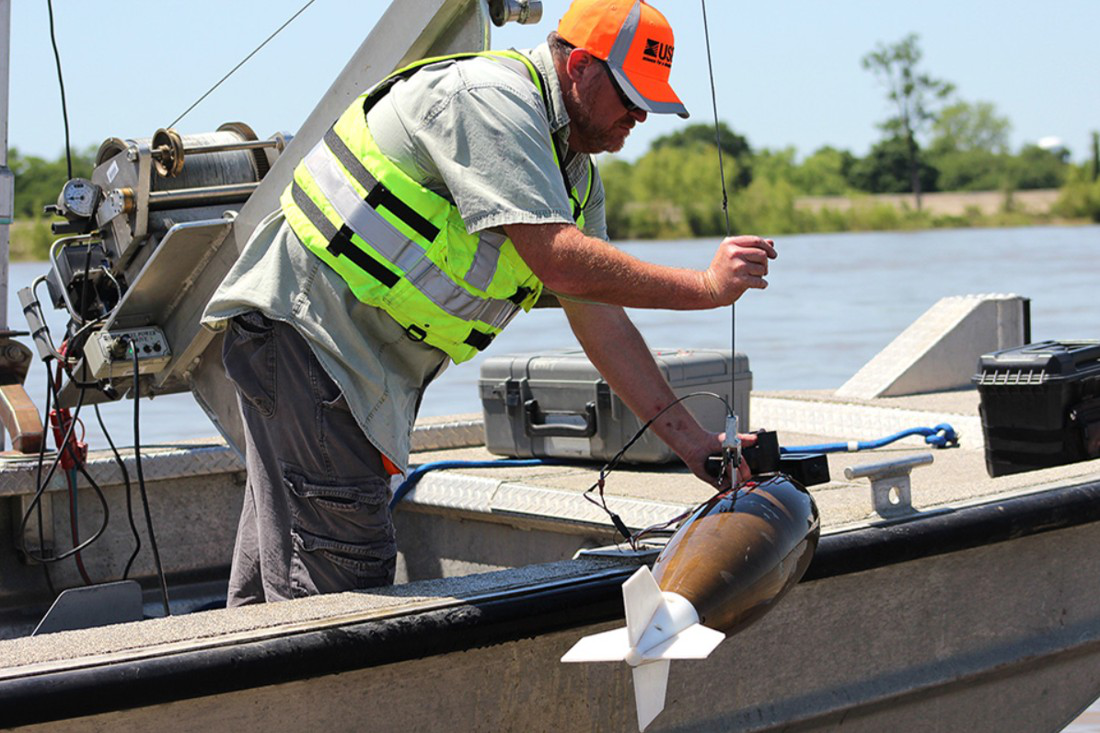
Report hardness on a declared equivalent basis, commonly mg/L as CaCO3. An ion concentration is multiplied by 50/equivalent weight to obtain that basis. Calcium and magnesium use different equivalent weights. Hardness is not identical to total dissolved salts, sodium hazard or alkalinity. A clear sample can still contain substantial dissolved material, so appearance is not a complete quality test.
Worked problem 2.44: Hardness equivalents
Route: AG
Problem. Water contains 40 mg/L Ca2+ and 12 mg/L Mg2+. Use equivalent weights 20 and 12 g/eq. Find hardness as CaCO3.
Answer and explanation. Calcium contribution = 40 x 50/20 = 100 mg/L. Magnesium = 12 x 50/12 = 50 mg/L. Total = 150 mg/L as CaCO3.
43. Alkalinity, dissolved oxygen, BOD and COD
Study route: AG
Alkalinity is acid-neutralizing capacity, commonly from bicarbonate, carbonate and hydroxide. It differs from pH, which describes hydrogen-ion activity. Dissolved oxygen is oxygen present in the sample. BOD measures biological oxygen demand under a defined incubation/test protocol; COD measures an oxidation demand through a specified chemical procedure.

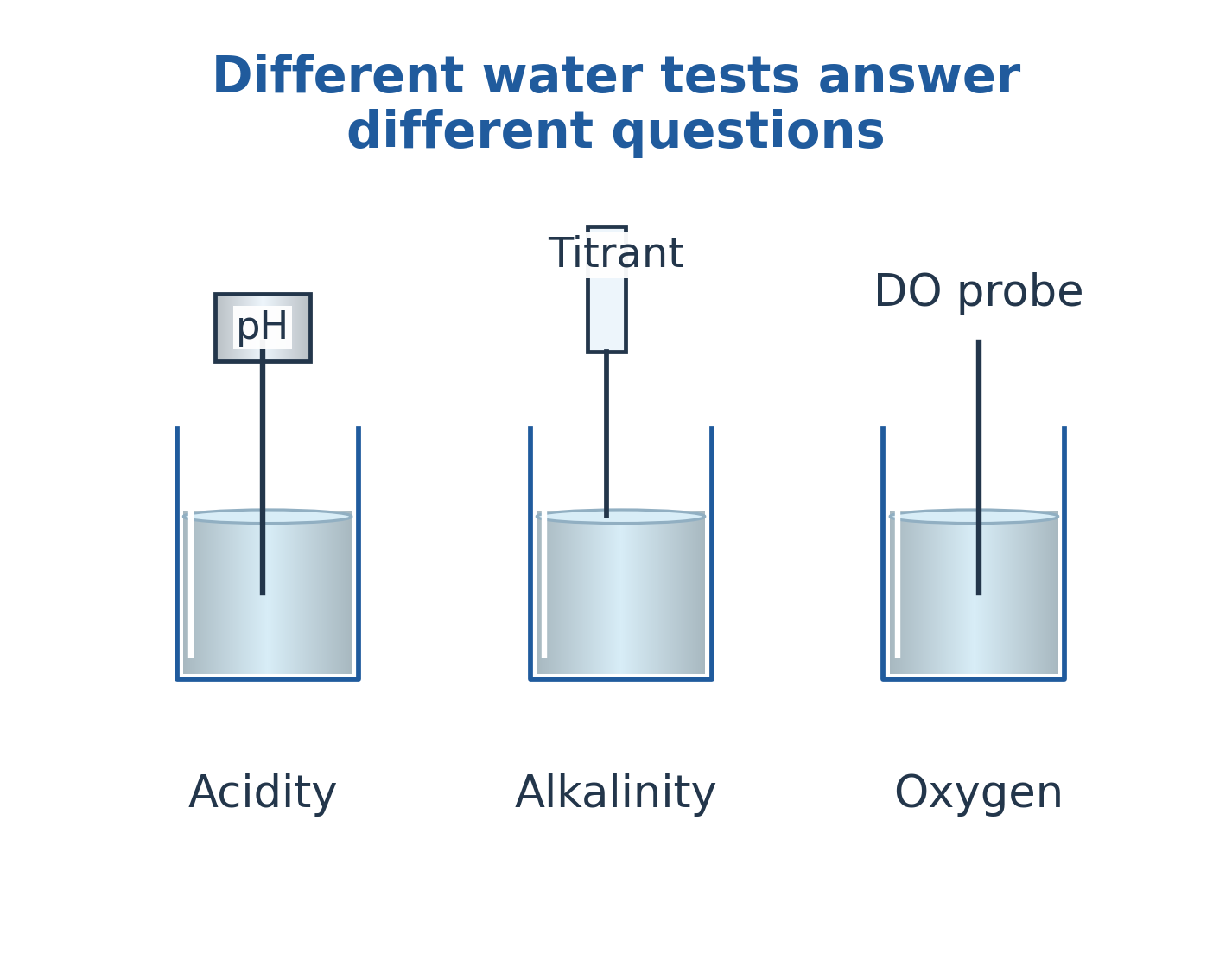

High oxygen demand can deplete receiving-water oxygen. BOD, COD and DO must not be substituted for one another or interpreted directly as pathogen counts. A dilution-based BOD result needs the sample fraction and any supplied seed/blank correction. Turbidity measures scattering by suspended matter and can affect treatment. State sampling and test conditions so that a numerical comparison refers to the same physical quantity.
| Measure | Meaning |
|---|---|
| pH | Hydrogen-ion activity |
| Alkalinity | Acid-neutralizing capacity |
| DO | Oxygen present |
| Measure | Meaning |
|---|---|
| BOD / COD | Defined biological / chemical oxygen demand |
Worked problem 2.45: Alkalinity equivalents
Route: AG
Problem. A water sample contains 122 mg/L HCO3- as the only alkalinity contributor. Use equivalent weight 61 g/eq. Find alkalinity as CaCO3.
Answer and explanation. Equivalent concentration = 122/61 = 2 meq/L. Alkalinity = 2 x 50 = 100 mg/L as CaCO3. This is acid-neutralizing capacity, not a pH value.
Worked problem 2.46: Dilution BOD calculation
Route: AG
Problem. A correction-free BOD test has DO decreasing from 8 to 3 mg/L with sample fraction 0.10. Find BOD under the stated test.
Answer and explanation. BOD = (8-3)/0.10 = 50 mg/L. A supplied blank or seed correction would need to be included. The result is not the initial dissolved-oxygen concentration.
44. Nitrogen transformations and phosphorus chemistry in water
Study route: AG
Organic nitrogen can be converted toward ammonium through mineralization/ammonification. Under suitable aerobic conditions, nitrification converts ammonium through nitrite toward nitrate. Denitrification can reduce nitrate toward gaseous nitrogen under appropriate low-oxygen conditions with available electron donors. These transformations change chemical form and availability; they do not destroy the nitrogen element.

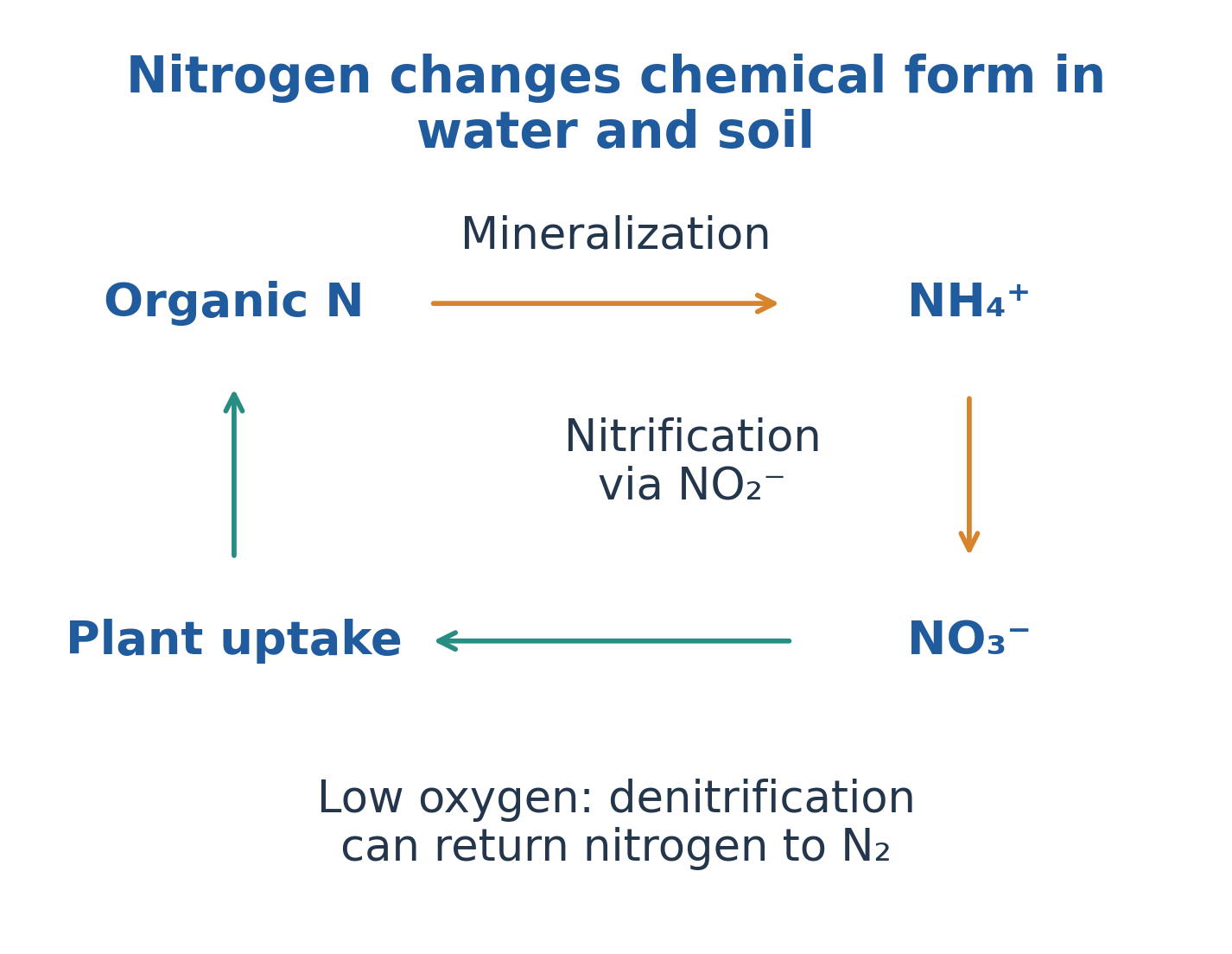
Phosphorus occurs in dissolved and particulate forms. Phosphate can sorb on mineral surfaces or precipitate with suitable metal ions depending on pH and chemistry. Excess available nitrogen/phosphorus can support eutrophication, followed by oxygen depletion as biomass decomposes. Nutrient control must consider source, form and transport rather than only one total concentration. Irrigation reuse can supply nutrients but also introduce salts or contaminants that need separate assessment.
Worked problem 2.47: Nitrogen reporting basis
Route: AG
Problem. A sample contains 14 mg/L nitrate expressed as nitrogen. Using molar masses N = 14 and NO3 = 62 g/mol, express nitrate-ion mass concentration.
Answer and explanation. Nitrate-ion concentration = 14 x 62/14 = 62 mg/L as NO3-. A value reported as nitrate-N must not be compared numerically with an ion-mass limit without conversion.
45. SAR, RSC and electrical conductivity
Study route: AG
Using meq/L or mmol(c)/L consistently, SAR = Na/sqrt((Ca+Mg)/2). Residual sodium carbonate is RSC = CO3 + HCO3 – Ca – Mg on the same equivalent-charge basis. Electrical conductivity indicates overall ionic content and salinity tendency. These indices describe different questions: relative sodium, carbonate balance and total ionic response.

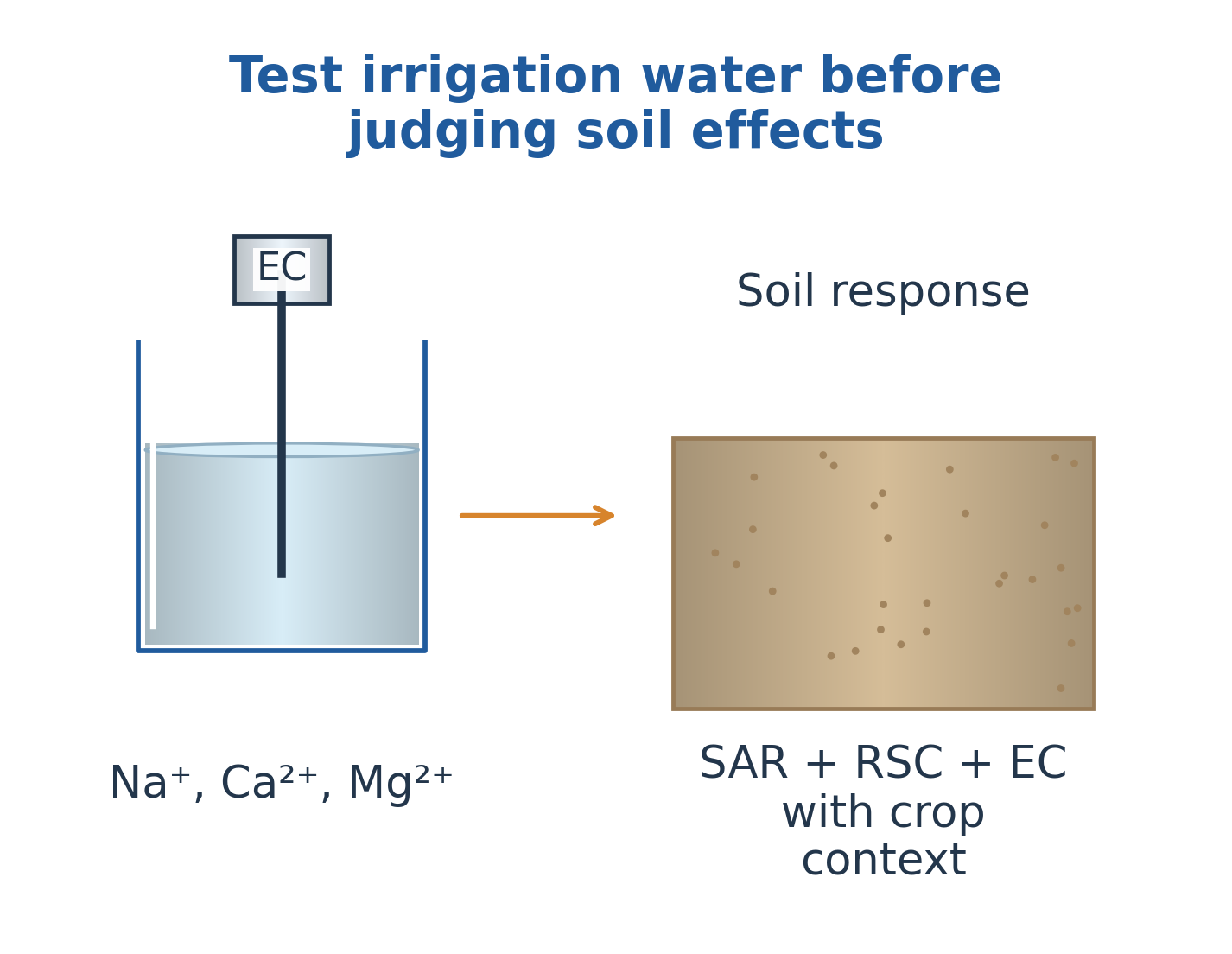
Do not insert unconverted mg/L directly into equivalent-based formulas. Calcium/magnesium precipitation during concentration can alter the effective sodium balance. Interpret SAR together with EC, crop tolerance, soil structure, rainfall, drainage and irrigation method. A single index cannot establish complete suitability. Report the concentration convention and water-sampling conditions, and avoid treating a classroom cutoff as a universal field decision.
Keep equivalent and molar conventions distinct
A divalent ion contributes twice its molar amount in charge equivalents. The stated SAR formula uses equivalent concentrations with the denominator divided by two. If using ordinary mmol/L instead, the expression must be converted consistently; copying the same numerical equation with mixed bases changes the result. RSC likewise compares charge equivalents. A positive calculated carbonate residual is an index to interpret with the water-soil system, not a complete treatment prescription.
| Index | Calculation basis / purpose |
|---|---|
| SAR | Equivalent cation concentrations; relative sodium |
| RSC | Equivalent carbonate balance |
| EC | Overall ionic response; salinity context |
Worked problem 2.48: SAR calculation
Route: AG
Problem. Using meq/L, Na = 6, Ca = 4 and Mg = 4. Calculate SAR.
Answer and explanation. SAR = 6/sqrt((4+4)/2) = 6/2 = 3. The equivalent-concentration convention matters; do not insert the same numerical values in mg/L.
Worked problem 2.49: RSC calculation
Route: AG
Problem. All values are meq/L: carbonate 1, bicarbonate 5, calcium 3 and magnesium 2. Find RSC.
Answer and explanation. RSC = (1+5)-(3+2) = 1 meq/L. This balance is distinct from EC and SAR; irrigation suitability additionally depends on soil, crop and management.
46. Groundwater chemistry and irrigation interpretation
Study route: AG
Groundwater chemistry reflects rock dissolution, carbonate equilibria, ion exchange, redox conditions, residence time, mixing and human inputs. Carbonate-containing rocks can contribute calcium, magnesium and bicarbonate; other geological settings give different ions. Reducing conditions can change the forms or mobility of certain elements.

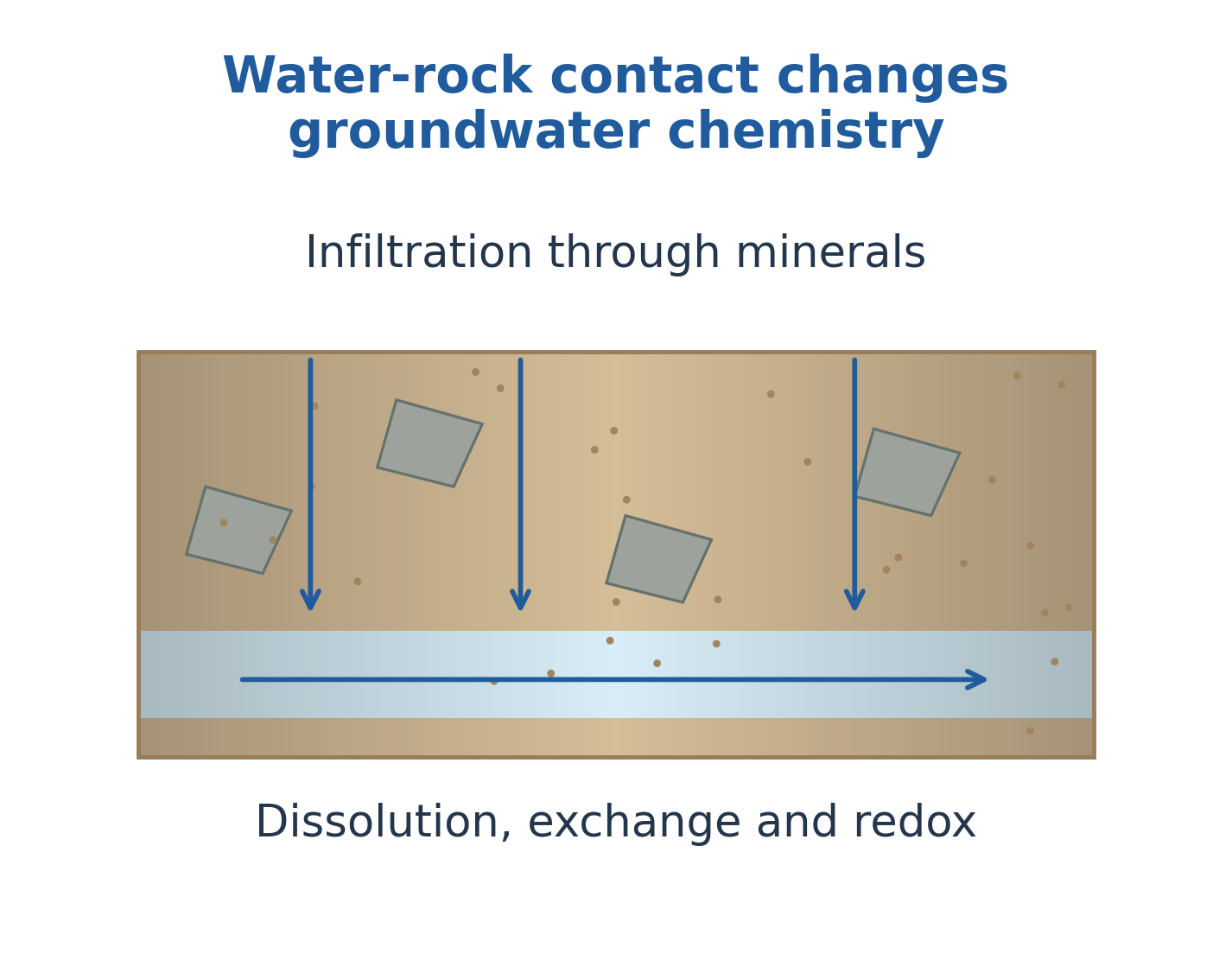
A clear groundwater sample can contain salinity, nutrient or trace-contaminant problems. Representative sampling and suitable preservation are needed for reliable analyses. Irrigation assessment considers overall salts, relative sodium, specific-ion effects and interactions with the soil. Repeated application can concentrate salts as water is removed by evapotranspiration, so one initial appearance or pH is insufficient. Connect the measured chemistry with crop, soil and water-management conditions.
47. Irrigation water treatment and residual streams
Study route: AG
Coagulation destabilizes fine colloids; flocculation grows aggregates through gentler mixing; sedimentation and filtration remove suitable particulate fractions. These processes do not necessarily remove dissolved salinity. Chlorination establishes HOCl/OCl- chemistry in water, with their relative fractions depending on pH. Demand, contact time, temperature and water quality affect disinfection.

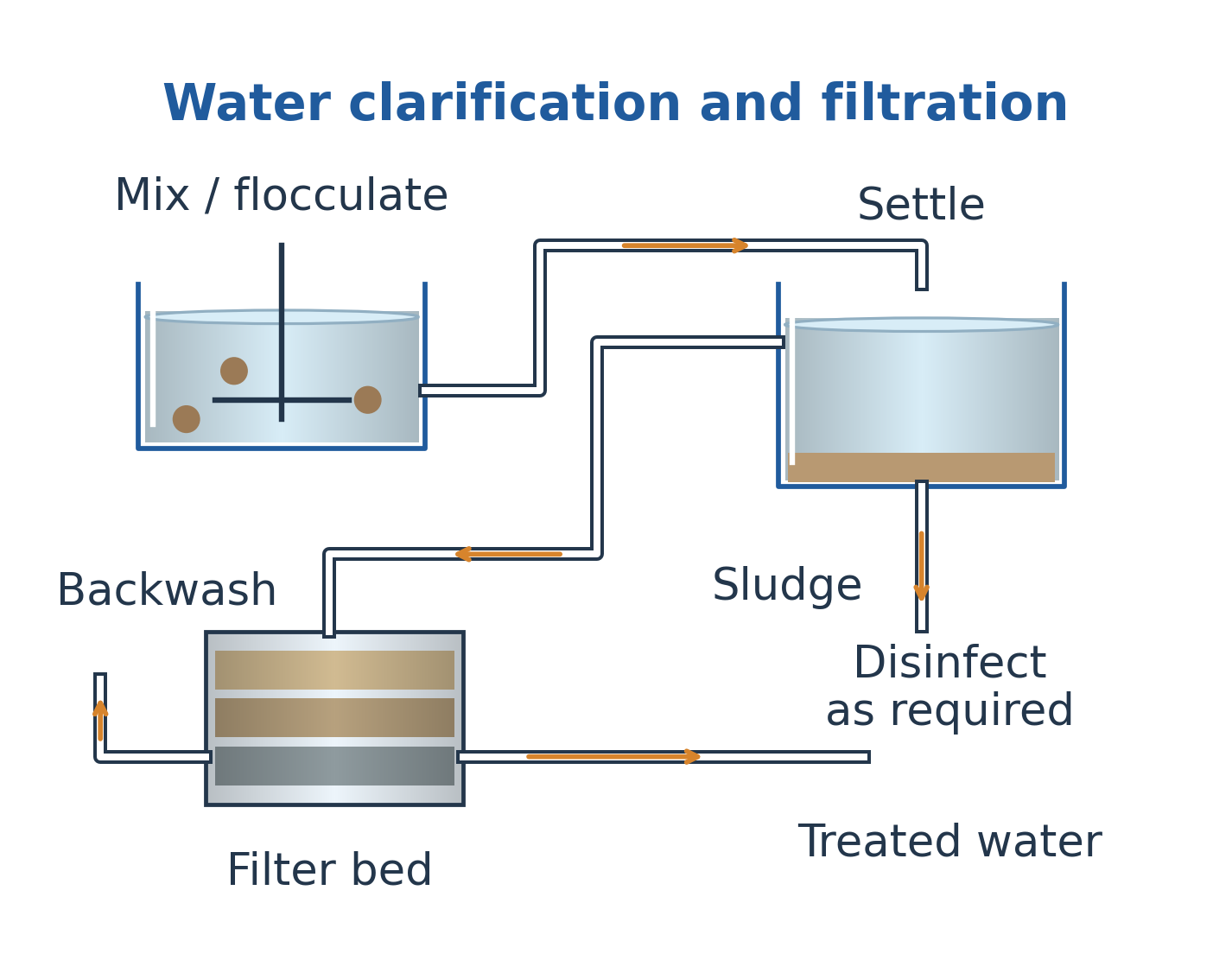

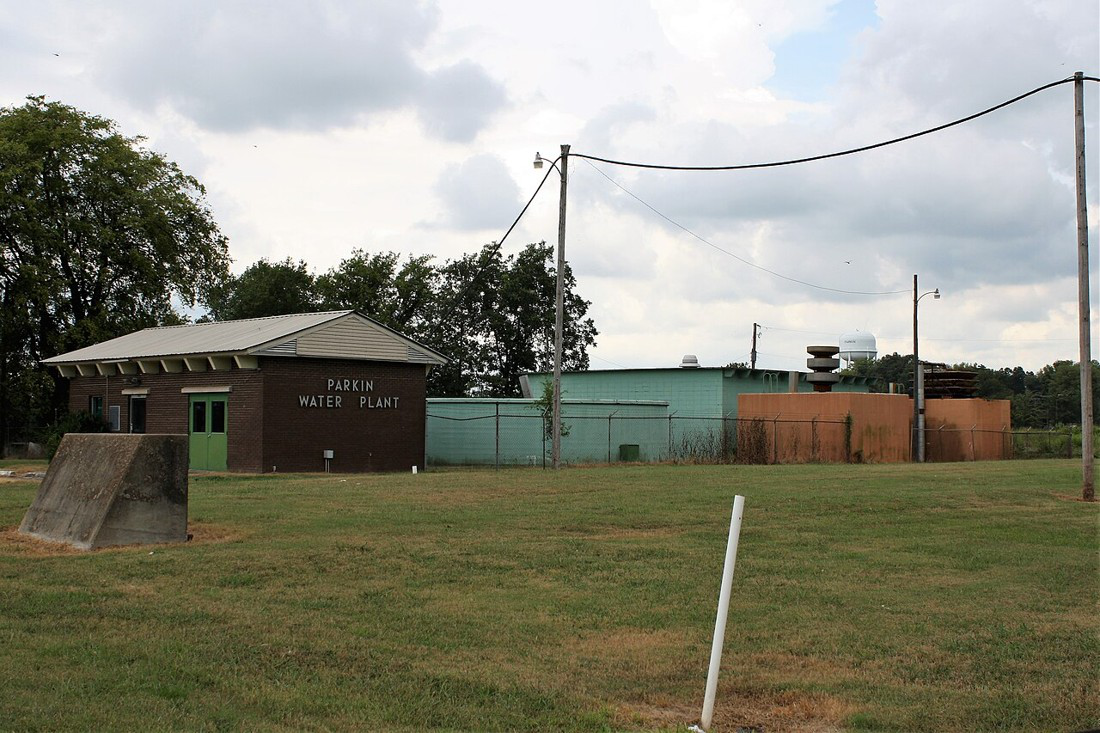
Treatment also helps control emitter clogging from particles, precipitates or biological growth. Select the process for the actual target: a particulate filter is not complete desalination, and clear water is not automatically microbiologically suitable. Sludge, filter backwash and concentrated streams still require management. A complete process diagram shows both improved-water output and residual streams rather than suggesting that treatment makes removed matter disappear.
Control the actual clogging mechanism
Particles can be removed by appropriate separation, but a dissolved species may pass the filter and precipitate later as conditions change. Biological growth can also develop after filtration. Treatment selection therefore starts with chemical analysis and inspection of the deposit or blockage. Include cleaning and residual management in the system description. A successful demonstration of clarified water does not establish removal of every dissolved ion or future emitter reliability.
Worked problem 2.50: Treatment selection
Route: AG
Problem. Does coagulation plus filtration remove all dissolved sodium chloride from irrigation water?
Answer and explanation. No. These steps principally address particulate and colloidal material. Dissolved salts require an appropriate desalting or management strategy. A clear filtered sample can retain essentially the original dissolved salinity.
AG complete answer: choose a treatment train
Begin with the actual water problem. A suspended-particle problem can be addressed by suitable settling and filtration; fine stable colloids may first require coagulation and flocculation. Coagulation destabilizes particles, while gentler flocculation allows larger aggregates to develop. The settling or filter stage then removes a material fraction rather than destroying it. Include sludge and backwash outlets in the process description.
Disinfection addresses a different target. Chlorine demand from water constituents can consume the added chemical before an effective residual/contact exposure is achieved. pH changes the relative forms of free chlorine, while turbidity can shield organisms or complicate treatment. Therefore a clear appearance, a chlorine dose and a completed treatment are not interchangeable observations. Verify the relevant outcome under the actual conditions. Dissolved salinity can remain after clarification and disinfection, so irrigation indices still require separate assessment.
AG complete answer: connect water quality to soil response
Start with representative chemical measurements on consistent units. EC indicates overall ionic response; SAR compares sodium with calcium and magnesium; RSC describes a carbonate-equivalent balance. Soil texture, infiltration, drainage, rainfall, crop tolerance and ion-specific effects determine how that water behaves during repeated application. Evapotranspiration removes water and can concentrate salts, so the long-term root-zone condition can differ from the initial feed-water sample.
A complete interpretation separates measurement, calculation and management. First check ion-reporting conventions and calculate the relevant indices. Next identify whether the dominant issue is particles, organisms, salinity, relative sodium or another constituent. Then choose a compatible treatment or water-management response and monitor both water and soil. Changing one index does not automatically correct every other problem.
FORMULAS AND MODEL CONDITIONS
| Topic | Relation / condition |
|---|---|
| Cell voltage | Ecell = Ecathode – Eanode using reduction potentials |
| Nernst | E = E° – RT ln Q/(nF); at 25 C: E = E° – 0.05916 log10 Q/n |
| Charge | Q = It; 1 Ah = 3600 C |
| Electrolysis | m = eta ItM/(nF); uniform thickness = m/(density x area) |
| Free energy | ΔG = -nFE; ΔG = ΔG° + RT ln Q |
| Stored energy | Wh approximately average voltage x Ah; 1 Wh = 3600 J |
| Supercapacitor | Usable ideal energy = C(Vmax²-Vmin²)/2 |
| Corrosion | Mean thickness loss = mass loss/(density x exposed area) |
| Inhibition | Efficiency = 100(r0-ri)/r0 under matched conditions |
| Oxide growth | x²-x0² = kp t or x-x0 = kl t for the specified model |
| Step growth | Xn = 1/(1-p) for ideal balanced bifunctional conditions |
| Kinetics | First order: ln(A0/At)=kt; second order: 1/At-1/A0=kt |
| Arrhenius | ln(k2/k1) = Ea/R(1/T1-1/T2); use absolute temperature |
| Water indices | SAR = Na/sqrt((Ca+Mg)/2); RSC = CO3+HCO3-Ca-Mg; equivalent basis |
Constants: F = 96485 C/mol of electrons; R = 8.314 J/(mol K); use the rounded constants explicitly supplied in an exercise. Constants do not remove the need to select a valid physical model.
UNIT CONVERSIONS AND CHECKS
| Quantity | Useful conversion / check |
|---|---|
| Charge / energy | 1 Ah = 3600 C; 1 Wh = 3600 J |
| Ion equivalents | meq/L = ion concentration in mg/L divided by equivalent weight |
| Hardness | CaCO3 equivalent in mg/L = ion mg/L x 50/equivalent weight |
| Fractions | State mass, mole, volume or charge basis; do not mix denominators |
| Temperature | Thermodynamic and Arrhenius equations use absolute kelvin |
BEFORE USING A FORMULA
Balance redox reactions before choosing n. Distinguish equilibrium voltage from loaded voltage, mass-average corrosion from local pit depth, and monomer incorporation from fibre processing. Use equivalent-charge concentrations in the stated irrigation indices.
Check atom, charge and energy balances. State whether an efficiency compares charge, energy or one transfer stage. Keep polymer-model assumptions, kinetic rate conventions and water-test conditions attached to their results. A correct simplified calculation does not certify every operating condition.
ANSWERED REVISION: ALL STUDY ROUTES
Use these answers after revising your assigned theory and worked problems. Each question tests a distinction that commonly causes an incomplete examination answer.
CSE: Is wireless charging a new chemistry?
No. It transfers energy to a receiver and conditioning stage. Battery chemistry still imposes charging limits. Distinguish link efficiency from wall-to-storage efficiency and include device demand and losses in the stated boundary.
EE/ECE: Are EDLC and pseudocapacitance identical?
No. EDLC storage is predominantly interfacial nonfaradaic separation; pseudocapacitance includes rapid reversible faradaic contributions. Similar response curves do not prove identical chemistry. Voltage stability, ion access, resistance and cycling still matter.
CE: Why can steel corrode inside concrete?
Carbonation can reduce alkalinity and chlorides can destabilize passivity. Moisture supports the electrochemical circuit. Expanding corrosion products can crack concrete and increase ingress. Diagnose exposure and steel condition before selecting repair.
ME: Is any positive potential anodic protection?
No. A suitable material must be maintained in a controlled passive region. Outside that region, dissolution can increase. Cathodic protection uses a different mechanism; material, environment, reference convention and control determine suitability.
CH: How does anodizing differ from plating?
Anodizing grows an oxide-containing surface on an anodic workpiece. Conventional metal plating deposits metal on a cathodic workpiece. Both need preparation and verification, but polarity, reaction and product layer differ.
TX: Is all step growth condensation?
No. Step growth describes how reacting molecules build size; condensation commonly involves small-molecule release. State the functional groups and mechanism. Polymer formation is also different from later fibre spinning and drawing.
BT: Why can warming reduce enzyme activity?
Structural damage can outweigh faster intrinsic kinetics. pH, substrate, cofactors, inhibitors and transport also affect measured activity. A simple Arrhenius extrapolation cannot describe every regime, and protein mass alone does not establish activity.
AG: Can SAR alone prove irrigation suitability?
No. SAR concerns relative sodium on an equivalent basis; EC reflects overall ionic response. RSC, specific ions, soil, crop and drainage also matter. Convert units consistently and interpret the complete water-soil system.
48. DETAILED EXPLANATIONS AND APPLICATION CONNECTIONS
48.1 Trace both paths through an electrochemical cell
An electrochemical explanation must account for electron transfer and ionic charge balance at the same time. At the anode, oxidation produces electrons that travel through a metallic connection. At the cathode, reduction consumes those electrons. Inside the electrolyte, ions move so that charge does not accumulate indefinitely in either region. The separator or salt bridge serves a different role from the external wire. Replacing the ionic connection with an electronic short circuit would not reproduce the intended cell operation. Label the species and the conducting medium on each part of a diagram.
The words anode and cathode identify reaction type rather than one universal sign. Oxidation remains anodic and reduction remains cathodic in both galvanic and electrolytic operation. Their electrical polarities depend on how the cell is driven. This distinction explains why the cathodic workpiece in electroplating receives metal while the anodic workpiece in anodizing develops an oxide. Memorizing only a plus or minus sign can obscure that chemical difference. Begin with the half-reaction, then identify whether electrical energy is produced or supplied and assign the relevant polarity consistently.
Balancing half-reactions also fixes the amount basis used later. If zinc oxidation releases two electrons and copper-ion reduction consumes two, one written event of each gives a balanced two-electron reaction. The value n equals two for that reaction basis. Doubling the complete reaction doubles n and the associated free energy per written reaction, but does not double its reversible voltage. Voltage is energy per charge, so both extensive quantities scale together. This connection prevents an electron-balancing operation from introducing a false multiplication of tabulated electrode potentials.
48.2 Derive the voltage-composition connection
The Nernst relation follows by connecting chemical and electrical descriptions of the same reversible reaction. Chemical free energy is Delta G = Delta G° + RT ln Q, while electrical free energy is Delta G = -nFE. Substituting the corresponding standard-state expression gives E = E° – RT ln Q/(nF). The reaction quotient contains activities raised to the powers fixed by the balanced equation. Its definition must follow the written reaction rather than an arbitrary ratio of concentrations selected because those species happen to appear in a question.
For zinc oxidation and copper-ion reduction, increasing zinc-ion activity relative to copper-ion activity raises Q and reduces the reversible voltage. Reversing the complete reaction inverts Q and reverses the corresponding cell voltage. Pure solid activities are treated as unity in the stated model; they are not inserted as masses into the quotient. Concentration can approximate activity in suitable solutions, but this is a model assumption. A comparison of concentrated or chemically complex electrolytes may require more information than the simple classroom concentration ratio supplies.
At twenty-five degrees Celsius, the familiar coefficient 0.05916 V applies to the base-ten logarithm. The general expression instead uses a natural logarithm, the actual absolute temperature and the gas and Faraday constants. Substituting a natural logarithm into the base-ten form without changing the coefficient gives an incorrect correction. The equation describes a reversible voltage at a defined chemical state. A measured operating voltage may additionally contain activation, resistive and transport losses, so disagreement under load is not automatically evidence that the thermodynamic relation has failed.
48.3 Build charge, mass and energy balances separately
Charge passed at constant current is current multiplied by time. With amperes and seconds, the result is in coulombs. An ampere-hour is a charge unit equal to 3600 coulombs, while a watt-hour is an energy unit equal to 3600 joules. Confusing the two hides the role of voltage. A battery rated at a larger ampere-hour capacity does not necessarily contain more nominal energy than another battery with a smaller capacity and a higher voltage. State the material and device boundary before comparing either quantity per unit mass.
Faraday’s law connects charge to reaction amount. For deposition, desired mass equals eta times ItM divided by nF, where eta is the current efficiency assigned to that product. If another reaction consumes part of the charge, the desired deposited mass decreases even though the external current has flowed. The molar mass and electron number must correspond to the deposited species and written half-reaction. Uniform thickness then follows by dividing deposited mass by density and coated area, provided uniform coverage is a justified approximation rather than merely an intended fabrication outcome.
Electrical energy depends on voltage during charge transfer. A supplied constant or average voltage permits the approximation energy in watt-hours equals volts multiplied by ampere-hours. When voltage varies significantly, use an appropriate average or the integral of voltage with respect to charge. Charge efficiency compares returned and supplied charge; energy efficiency also includes the different charging and discharge voltages. A cell can return nearly all the charge yet dissipate appreciable energy. The same word efficiency therefore needs its numerator, denominator and operating boundary attached every time it is used.
48.4 Interpret operating losses through interfaces and geometry
A reversible potential is a thermodynamic reference, whereas a working electrode must support a finite reaction rate. Activation overpotential relates to charge transfer at an interface. Concentration polarization reflects differences between surface and bulk composition created by reaction and transport. Ohmic losses arise in resistive electronic or ionic paths. These contributions can coexist, and their relative importance changes with current, temperature and geometry. A voltage-loss budget is useful only when the signs and operating direction are stated, because charging and discharge compare differently with the reversible value.
A catalyst can improve reaction kinetics without increasing the equilibrium energy available from the same net reaction. Likewise, increasing a suitable electrode area can reduce current density at a fixed total current, changing operating losses without changing the standard cell potential. A thicker or less conductive electrolyte path can increase ohmic loss. These examples show why a complete device cannot be characterized by electrode chemistry alone. The interfaces, ionic pathway, electronic connections and current distribution influence how much reversible driving force remains available at the external terminals.
Measured polarization curves need an applicable interpretation range. A logarithmic Tafel relation may describe a suitable kinetic region but cannot be assumed across every low-current, transport-limited or passive regime. Report current density rather than total current when comparing surfaces of different area, and specify the reference electrode and environment for potential measurements. A single data point cannot separate every loss mechanism. An effective analysis identifies the measured boundary, considers the likely rate-limiting processes and uses additional evidence before assigning the entire voltage difference to one microscopic cause.
48.5 Follow lithium through the cell and its interfaces
In the common graphite-based lithium-ion picture, discharge removes lithium from the negative host while electrons travel through the load and lithium ions travel through the electrolyte. The positive host accepts the corresponding charge and lithium. Charging drives the reverse transfer within the allowable operating range. Current collectors carry electronic current, while the separator helps keep the electrodes from directly touching. The electrolyte and separator therefore perform complementary functions. Drawing one arrow through the entire cell without identifying electrons and ions misses the separation that makes useful external electrical work possible.
The host materials must remain compatible with the electrolyte and the accessible chemical states. Graphite interfaces can develop a protective interphase that limits continuing electrolyte decomposition while still permitting lithium-ion transport. Continued side reactions can consume cyclable inventory and increase resistance. Cathode families also differ in their structural response, voltage and stability. A cylindrical can or a nominal voltage does not identify every internal material choice. A complete chemistry answer names the electrode hosts, electrolyte, separator and collectors, then connects their functions to transport and stability.
Capacity loss and voltage sag are related but separate observations. A reduction in accessible stored charge can arise from inventory loss or inactive material, while an increased internal resistance can lower loaded voltage and increase heating. The same device may show both changes. Comparing capacity retention alone can conceal a decline in usable energy if the discharge voltage changes. Useful ageing measurements therefore need a consistent current, temperature, voltage window and reference capacity. A material mechanism should be linked to the observed property rather than inferred solely from one lower endpoint reading.
48.6 Interpret C-rate and ideal battery grouping
C-rate translates a reference charge capacity into a current scale. For a two-ampere-hour reference, one C corresponds to two amperes and half C to one ampere. The reciprocal relationship between rate and ideal duration assumes that the defined charge remains accessible at the stated current. Real delivered capacity can depend on temperature, cutoff and cell condition. The notation is therefore a comparison convention rather than proof that every cell can safely sustain the current implied by a large C-rate number.
In an ideal matched-cell grouping, series connection adds voltages while leaving the string ampere-hour capacity at the cell value. Parallel identical strings add ampere-hour capacity while retaining their common voltage. Thus three series cells and two parallel strings contain six cells, with nominal voltage three times one-cell voltage and capacity twice one-cell capacity. Nominal energy agrees whether calculated from pack voltage and capacity or by summing the six cell energies. This equality is a useful bookkeeping check and helps expose errors that multiply both voltage and capacity by the full cell count.
The arithmetic does not establish a complete pack design. Cell mismatch, connection resistance, monitoring, thermal conditions and protective functions affect operation. Charging follows the chosen chemistry and device limits rather than being determined by series-parallel notation alone. A constant-current and constant-voltage description is useful for an appropriate lithium-ion charging model, but it is not a universal prescription for all rechargeable families. Keep the educational grouping calculation within its stated assumptions and explain why nominal energy, instantaneous power and safe operating conditions require different information.
48.7 Compare storage by mechanism and usable output
An electric-double-layer capacitor stores charge mainly by interfacial separation, while pseudocapacitive materials add rapid reversible faradaic processes. Batteries involve chemistry-dependent redox storage and voltage profiles. These categories explain why two devices with similar-looking discharge curves need not have identical mechanisms. Electrode area matters only when electrolyte ions can access the relevant surface on the operating timescale. Pore structure, transport and resistance therefore influence useful performance alongside the nominal amount of active material or a reported large surface area.
For constant ideal capacitance, the stored energy at voltage V is one-half CV squared. A device used only down to a nonzero minimum voltage retains energy at that endpoint. Usable energy is therefore one-half C times the difference between maximum and minimum squared voltages. Counting the full energy at the starting voltage would overstate the energy available to a load with a minimum-voltage requirement. Equivalent series resistance causes an additional immediate voltage drop and heating under current, whereas ideal capacitive voltage changes continuously as charge is removed.
Storage selection must match the duty. A pulse load needs adequate instantaneous power, while a long operating interval needs enough delivered energy. A small harvester may accumulate energy gradually and use a storage element to supply short bursts. Standby consumption, conversion losses and input availability belong in the energy budget. A high open-circuit voltage, large capacitance or favourable one-cycle efficiency cannot independently establish that a complete sensor system will operate indefinitely. Compare the useful output at the defined load and timescale rather than choosing from one headline parameter.
48.8 Account for fuel-cell reactants across a stack
Fuel cells require continuing reactant supply, unlike a simple description of a sealed battery discharging its initial inventory. In a PEM hydrogen cell, protons cross the membrane while electrons pass through the load. An alkaline cell uses hydroxide-ion transport and different half-reactions, even though the ideal overall hydrogen-oxygen reaction is the same. Catalyst compatibility, contamination and water management differ with the electrolyte system. A correct answer therefore gives both the overall equation and the actual charge-carrying ion for the chosen cell type.
For one hydrogen cell, reacted hydrogen amount associated with charge Q is Q divided by two F in the ideal two-electron model. In a series stack, the same external current passes through each active cell, and each cell consumes its own reactant amount. The total stack consumption is therefore multiplied by the number of active cells. Stack voltage adds because the electrical energy per external charge includes the contribution of every cell. Omitting the cell-count factor can preserve a correct one-cell calculation while seriously underestimating the total fuel requirement.
Utilization is a separate denominator. If reacted fuel divided by supplied fuel is u, supplied fuel equals reacted fuel divided by u. It is greater than reacted fuel when utilization is below one. This correction does not directly specify electrical efficiency, because delivered voltage, auxiliary demand and other losses also matter. Distinguish reacted amount, supplied flow and useful electrical energy. A complete introductory balance states operating time, current, cell count, electron stoichiometry and the utilization convention before discussing the system’s broader performance.
48.9 Diagnose corrosion as a spatial electrochemical process
Wet corrosion requires linked anodic and cathodic reactions and pathways for electrons and ions. The metal-loss region is anodic, while a nearby or more distant region supports reduction. Corrosion products may form away from the original dissolution site after ions move and react. Visible rust is consequently evidence of reaction but not a complete map of current paths or remaining thickness. Start a diagnosis with the material, environment and geometry, then identify how the electrochemical circuit can close under the actual service conditions.
A mass-loss coupon averages removal over its exposed area. Dividing mass loss by density gives removed volume; dividing again by area gives an equivalent mean thickness. This is a meaningful measure for the specified specimen and interval, but it cannot replace maximum pit-depth measurement. A small pit can penetrate deeply with modest total lost mass. Conversely, extensive uniform loss can produce a large mass change without the same localization. The monitoring quantity must therefore match the failure mode of concern rather than being treated as a universal measure of component safety.
Corrosion rate also depends on more than standard thermodynamic tendency. Films, oxygen supply, conductivity, flow and reaction kinetics influence the actual current. A potential measurement requires a reference and does not independently provide all kinetic information. Comparing differently exposed coupons can create a false trend, while a probe placed away from an aggressive local region can miss the important damage. Combine measurements with spatial inspection and operating history. A useful monitoring result is one whose location, assumptions and response action fit the mechanism that could limit service.
48.10 Explain area effects and localized attack together
Galvanic coupling can concentrate anodic current into a small exposed active region connected to a large cathodic surface. The total current must be supported by both reactions, but dividing the anodic part over a small area can produce severe local loss. A coating defect can therefore matter beyond its fraction of visible area. The actual electrolyte, electrical connection and surface states must exist for this mechanism. Simply placing two dry disconnected metals near each other does not establish the complete galvanic circuit described in the model.
Differential aeration supplies another route to spatially different behaviour. Shielded electrolyte-filled regions can develop lower oxygen availability and different local chemistry than the exposed surrounding surface. Crevices and deposits restrict exchange with the bulk environment, helping sustain localized dissolution. Pitting also involves local instability or breakdown of a protective condition. These mechanisms can overlap, but an explanation should identify the actual geometric and chemical changes rather than using their names interchangeably for every small hole found on a surface.
Stress-corrosion cracking adds tensile stress and material susceptibility to the environmental requirement. Intergranular attack instead emphasizes chemically altered grain-boundary regions in an appropriate material condition. Neither is captured fully by average corrosion mass loss. Removing a deposit may improve inspection but does not automatically remove residual stress or sensitization. Prevention follows the diagnosed mechanism: material state, joint geometry, stress, water access and chemical exposure can each require attention. Choosing a treatment before distinguishing the failure process risks improving one visible symptom while leaving the controlling cause active.
48.11 Connect reinforcement protection with concrete chemistry
Reinforcing steel benefits from the alkaline environment of suitable concrete because that environment can support a passive surface state. Carbonation changes alkaline constituents and can reduce the chemical support for passivity. Chlorides introduce a different risk of local film destabilization. These processes need not produce identical spatial patterns or require the same interpretation of bulk pH. Moisture and oxygen then help support the electrochemical reactions. A sound explanation connects ingress, pore conditions, steel surface chemistry and the paths that make a functioning corrosion cell possible.
The consequences extend beyond the steel mass consumed. Corrosion products can occupy additional volume and place tensile stresses on surrounding concrete. Cracking and spalling can expose more material or provide easier transport routes. This creates a connection between chemical reaction and structural deterioration, rather than a purely cosmetic surface change. An assessment should therefore consider cover, cracking, exposure and local steel condition. A visually repaired surface does not by itself establish that all active regions or the chemical cause have been addressed.
Protection combines suitable initial concrete quality and exposure-specific maintenance. Low connected permeability, adequate compaction and curing can limit ingress, while selected coatings, inhibitors or cathodic systems may have roles in appropriate repairs. Each method has a mechanism and a boundary. An inhibitor needs to reach and remain effective at the relevant region; a coating needs continuity and compatible adhesion; a cathodic system needs current distribution and monitoring. A complete answer explains why the chosen system addresses the diagnosed process rather than presenting a universal product or concentration as a remedy for every reinforced structure.
48.12 Keep passive control and cathodic protection distinct
Cathodic protection supplies electrons to reduce the protected structure’s tendency to dissolve anodically. A sacrificial metal provides that supply through its own oxidation, while an impressed-current system uses an external source and suitable electrodes. Electrical and electrolyte paths must distribute the intended current to the target region. Anode inventory estimated by Faraday’s law is only one part of the problem. Coating defects, shielding and geometry affect how current reaches different locations, so sufficient total current does not automatically imply uniform protection everywhere.
Anodic protection uses a different property: a suitable material can exhibit a low-current passive region over an appropriate potential interval. The controller maintains the workpiece in that region relative to a reference. Moving potential more positive without checking the active-passive response can instead increase dissolution or enter another unsuitable regime. The material, electrolyte and temperature determine whether a useful passive region exists. The method’s name should therefore be connected to controlled passivity rather than interpreted as a general rule that every anodic condition protects every metal.
A passive film is also not a universal immunity certificate. Local breakdown can occur while average current remains relatively low. Surface preparation and environmental changes can alter stability, and control loss can change the operating condition substantially. Report reference electrode, potential range and service environment when interpreting a polarization curve. Compare protection methods using the intended change in reaction behaviour, the source of current, the required monitoring and the likely failure consequences. This gives a clearer mechanism-based distinction than memorizing the words anode and cathode without their operating context.
48.13 Treat coatings and industrial electrolysis as different operations
A barrier coating reduces contact between metal and the environment when its continuity, adhesion and permeability are suitable. A metallic coating may also change galvanic behaviour. Zinc on steel can offer sacrificial support in an appropriate connected electrolyte system, whereas a defect in a more noble coating can expose a small active substrate region coupled to a large cathode. Coating appearance does not identify which mechanism dominates. Inspect the complete surface system and explain what happens at defects as well as across intact regions.
Electroplating intentionally reduces metal ions onto a cathodic workpiece. Anodizing intentionally grows an oxide-containing layer on an anodic workpiece. These products and workpiece roles differ even though both processes use controlled electrochemistry. Surface preparation, current distribution and solution chemistry influence layer quality. Correct average deposited mass does not establish low porosity, good adhesion or uniform local thickness. A Faraday calculation accounts for charge and material amount, while film verification determines whether the intended surface function was achieved over the relevant component geometry.
The membrane chlor-alkali process adds product separation as an essential function. Chloride oxidation produces chlorine at the anode, while water reduction produces hydrogen and hydroxide at the cathode. Sodium-ion transport supports the caustic product stream. The ideal equation fixes product ratios but does not describe all competing reactions or energy losses. A charge balance gives theoretical production, a current-efficiency factor adjusts the desired reaction amount, and applied voltage determines energy input. Keeping the electrode compartments and product streams distinct connects stoichiometry to the actual process purpose.
48.14 Distinguish polymer identity from chain population
A polymer specimen contains a distribution of macromolecular sizes and arrangements. A repeat unit describes recurring covalent structure, while number-average molecular mass describes a population average. Dividing that mass by repeat-unit mass gives an approximate number-average degree of polymerization when end-group effects are negligible. A value of two hundred therefore does not mean every molecule contains exactly two hundred units. It is important to distinguish average size, chemical connectivity and physical fibre form before predicting processing or strength.
Chain-growth and step-growth labels describe how molecular size develops. In chain growth, active centres add monomer through a pathway involving initiation and propagation, with suitable termination or transfer processes. In step growth, functional groups on molecules of different sizes react with each other. High molecular mass in the ideal balanced bifunctional model requires conversion very close to one. At conversion 0.98 the predicted degree is fifty, whereas 0.995 gives two hundred. The change illustrates the sensitivity to conversion and the importance of functional-group balance in this model.
Addition and condensation describe a different aspect of reaction chemistry. Many condensation processes release a small molecule, but not every step-growth process does. Sequence and architecture add further distinctions: a block copolymer, random copolymer and graft copolymer can differ despite related overall composition. Mixing separate fibres produces an assembly or blend, not automatic evidence of new covalent copolymer chains. Explain the backbone, linking groups and branch or sequence arrangement before connecting the material to a textile modification or desired property.
48.15 Follow matter through a fibre-spinning process
Melt spinning begins with a usable polymer melt and produces a filament as the extruded material cools. Dry spinning begins with a solution and relies on solvent evaporation. Wet spinning also begins with a solution but develops a solid filament through coagulation, often involving solvent exchange in a bath. The same generic spinneret sketch cannot explain all three mechanisms. Label the feed state, solidification zone and destination of solvent or heat so that the process diagram accounts for what actually changes as the fibre forms.
The processing route must suit polymer behaviour. A material that decomposes before it develops a workable melt cannot be assigned to melt spinning simply because that route avoids solvent. Solution viscosity, solvent compatibility and recovery conditions then become relevant. Spinning conditions influence voids, uniformity and initial organization, while later drawing changes orientation and the load-bearing network. A draw ratio reports the imposed length change. It is not a percentage crystallinity or a direct multiplier for tensile strength, because defects and molecular rearrangement also influence the resulting fibre.
Modification and recycling must retain these distinctions. Grafting introduces covalent side structures, while cross-linking restricts independent chain motion and can complicate melt reprocessing. Recycled feed needs appropriate polymer identification and control of contaminants and degradation. PLA and PHA identify chemical families and production relationships, but renewable origin does not establish breakdown under every environmental condition. A credible comparison names the polymer, relevant processing history, intended service and receiving conditions rather than using bio-based, biodegradable and compostable as interchangeable words.
48.16 Apply thermodynamics to an open living system
A living cell exchanges both matter and energy with its surroundings. The first law still requires conservation, but an open-system balance includes energy associated with incoming and outgoing material as well as heat and work. A simple closed-system expression cannot be applied to every cellular process without identifying that boundary. State functions describe the system’s state, while heat and work depend on the path. Energy conservation also does not imply that all supplied energy can be converted into a chosen useful output without dissipation.
The second law allows local biological organization because the total balance includes the surroundings. A cell can maintain organized structures while consuming substrates and exporting products and entropy. Steady concentrations can coexist with ongoing flux. This is a steady state rather than proof of chemical equilibrium. At equilibrium, the relevant net driving force vanishes; in a maintained metabolic state, continual input and removal can support reactions away from that condition. Distinguishing these cases explains why a constant concentration measurement does not establish that metabolism has stopped.
Thermodynamic temperature is absolute in the relevant equations. The zeroth law supports consistent temperature measurement, while the ideal third-law reference concerns a perfect crystal approaching absolute zero. These references do not imply that an organized biological system has no entropy. For a biochemical answer, define the system, flows and constraints before discussing favourability. This keeps a valid statement about local order from being mistaken for a claim that living matter violates energy conservation or that every organized structure must be at equilibrium.
48.17 Connect ATP coupling to actual reaction conditions
At fixed temperature and pressure, a reaction’s actual free energy depends on both its standard-state term and the reaction quotient. Cellular reactant and product activities therefore influence whether the written forward reaction is favoured. A biochemical transformed convention may also fix selected conditions such as pH. Values from incompatible conventions cannot be combined casually. State the basis before adding reaction free energies, and distinguish an actual cellular condition from a tabulated standard-state value. The sign of one alone does not determine the sign of the other at every composition.
ATP hydrolysis can drive another process only through a suitable mechanistic connection. Free-energy changes add for reactions combined on matching stoichiometric bases, but placing independent reactions in neighbouring lines does not physically couple them. An enzyme pathway or shared intermediate supplies the relevant connection. Likewise, breaking one chemical bond alone requires energy; favourable net hydrolysis includes all changes between reactants and products. This whole-reaction interpretation avoids attributing the entire driving force to a single bond-breaking event considered without its product-forming and environmental changes.
The supplied example of a positive eighteen-kilojoule step coupled to a negative thirty-kilojoule step gives a negative twelve-kilojoule net change on matching bases. That result describes thermodynamic favourability, not instantaneous speed. Activation barriers and enzyme state still affect kinetics. Cells maintain suitable ATP-related concentrations through continuing metabolism, so coupling belongs within the open-system description. A complete answer follows the reaction basis, actual conditions, physical connection and barrier separately, showing how they contribute to a useful biochemical process without treating them as the same property.
48.18 Choose a kinetic model before fitting a rate
A first-order disappearance model gives a remaining fraction exp(-kt), a logarithmic integrated relation and a half-life independent of initial concentration. The specified second-order model gives a reciprocal-concentration relation and a half-life that depends on the initial concentration. Their rate constants have different units. Before substitution, identify the definition of rate and the concentration variable, because stoichiometric conventions can affect how a reported constant is used. An overall balanced equation alone does not establish the experimentally observed reaction order.
Temperature dependence also needs an applicable range. The Arrhenius relation compares rate constants under an approximately unchanged mechanism and parameter set. Transition-state reasoning instead emphasizes the free-energy barrier for passage through a productive pathway. That barrier differs from the overall free-energy difference between reactants and products. A catalyst can alter the pathway and the approach rates without changing the equilibrium constant for the same net reaction at fixed conditions. Keep activation quantities and reaction quantities separately labelled when drawing energy diagrams or interpreting a temperature plot.
An enzyme preparation introduces the fraction of protein that remains catalytically active. Heating can accelerate intrinsic kinetics within one range while simultaneously or subsequently reducing activity through structural damage. pH, cofactors, inhibitors, substrate supply and transport also influence an assay. Total protein mass therefore cannot replace a measurement of useful catalytic activity. A simple Arrhenius extrapolation through denaturation can predict the wrong observed trend because the assumed unchanged active system no longer exists. Report the assay conditions and identify what the measured rate actually includes.
48.19 Convert water measurements onto the correct basis
Hardness, alkalinity, pH and oxygen-related tests describe different properties. Hardness commonly accounts for calcium and magnesium on a calcium-carbonate equivalent basis. Alkalinity measures acid-neutralizing capacity, while pH measures hydrogen-ion activity. Dissolved oxygen is oxygen present, whereas BOD and COD describe oxygen demands under defined procedures. A clear sample can have appreciable dissolved ions or oxygen demand. No one of these measurements can be substituted for every other water-quality question merely because they are all reported for the same sample.
Equivalent concentration is especially important for multivalent ions. Dividing ion concentration in milligrams per litre by its numerical equivalent weight gives milliequivalents per litre. Multiplying by fifty converts that charge-equivalent concentration to milligrams per litre as calcium carbonate. Calcium and magnesium therefore use different conversion factors. Reporting a value as calcium carbonate does not imply that all dissolved material physically exists as suspended calcium carbonate. It supplies a common comparison basis. Keep the original species, equivalent weight and reporting convention visible during the calculation.
Nitrogen reporting gives another denominator example. Nitrate expressed as nitrogen counts only the nitrogen mass in the ion. Converting to nitrate-ion mass requires the molar-mass ratio sixty-two divided by fourteen. A numerical comparison with a limit or another test is meaningful only when the bases match. Biological transformations also change nitrogen species without destroying the element. Nitrification, denitrification, uptake and mineralization involve different conditions and products. Interpret concentration changes with transport and reaction information rather than assuming that a lower concentration of one species means all nitrogen has disappeared.
48.20 Connect irrigation indices with treatment targets
The stated SAR formula compares sodium with calcium and magnesium using equivalent concentrations. RSC compares carbonate and bicarbonate charge equivalents with calcium and magnesium equivalents, while EC reflects overall ionic response. These are complementary indices. Directly inserting milligrams per litre into an equivalent-based expression mixes species with different charge-to-mass relationships. Convert first, then interpret with crop, soil and drainage conditions. A water source can have one acceptable-looking index and still present another constraint because total salinity, relative sodium and specific-ion effects are different questions.
Repeated irrigation changes the root-zone balance as evapotranspiration removes water and can leave salts behind. Carbonate precipitation or ion exchange can change the relative dissolved composition, so initial feed-water chemistry is not the complete long-term soil condition. Groundwater likewise reflects dissolution, mixing and redox history before it reaches the field. Representative sampling and appropriate preservation support reliable interpretation. Connect water measurements to actual application, soil texture, infiltration, rainfall and crop tolerance instead of treating one calculated ratio as a universal field-treatment prescription.
Treatment should address the identified target and account for residual streams. Settling, coagulation and filtration remove appropriate particulate or colloidal material, while dissolved salinity may remain. Disinfection addresses a different target and depends on demand, contact conditions and water quality. A filter can pass dissolved species that precipitate later, and biological growth can develop downstream. Include sludge, backwash and any concentrated streams in the material balance. Verification should measure the intended improvement in both water and operating system, rather than equating clear appearance with complete chemical or microbiological suitability.