AKTU B.TECH 1ST YEAR | SEMESTER I & II
COURSE CODES: AAS102A-H | AAS202A-H
UNIT I – Materials, Biomolecules, Reactions and Soil Chemistry
For CSE, EE, ECE, CE, ME, BT, CH, TX & AG Streams
Unit I Overview
Study chemistry through the materials, reactions and systems used in different engineering streams. This combined volume brings the branch-specific Unit I topics together while retaining separate reading routes. Use page 2 to identify your official unit title, paired semester codes and assigned sections.
Topics Covered
| Study route | Pages |
|---|---|
| CSE: Hardware Materials for Computing & Electronics | 3-10 |
| EE / ECE: Chemistry of Electronic Materials | 3-13 |
| CE: Chemistry of Construction Materials | 13-17 |
| ME: Chemistry of Metals and Alloys | 3-23 |
| TX: Chemistry of Textile Fibres | 23-27 |
| BT: Chemistry of Biomolecules | 27-32 |
| CH: Industrial Reaction Chemistry and Thermodynamics | 32-36 |
| AG: Soil Chemistry | 36-40 |
Learning Outcomes
Connect composition, structure and processing with practical function.
Explain the prescribed mechanisms using labelled concept diagrams.
Select formulas with their units, assumptions and material boundaries.
Work through numerical and application questions with complete answers.
Distinguish your branch requirements from useful additional reading.
Included in These Notes
50 solved numerical and application problems distributed across the study routes; labelled structures, process diagrams and plots; comparison tables; formulas and answered revision checks.
Study Approach
Choose your route. Match your stream and course code on page 2 before starting.
Understand the chemistry. Read each process or structure diagram with the accompanying explanation.
Practise with conditions. Convert units, identify the model and check the worked result.
Revise actively. Explain mechanisms in your own words and use the final revision checks.
Coverage note: eight chemistry code groups cover nine streams. Unit titles and topics differ across groups; a combined file does not mean every topic is prescribed for every branch.
UNIT I: BRANCH AND TOPIC GUIDE
Read the sections listed for your stream. The paired AAS102 and AAS202 codes have the same theory syllabus in the supplied course documents. EE and ECE share suffix C; TX uses E. Section numbers refer to this combined edition.
| Stream / course codes | Official subject and Unit I | Read sections |
|---|---|---|
| CE AAS102A / AAS202A | Applied Chemistry for Sustainable Structure & Material Design Unit I: Chemistry of Construction Materials Topics: Cement hydration, admixtures, blended concrete, lime, gypsum, POP, ceramics and refractories. | 14-18 pp. 13-17 |
| ME AAS102B / AAS202B | Applied Chemistry for Advanced Metal Protection and Sustainable Energy Systems Unit I: Chemistry of Metals and Alloys Topics: Metallic bonding, engineering metals, alloy phases, heat treatment, hardening mechanisms and NDT. | 1-2; 19-24 Shared pp. 3-4 ME pp. 17-23 |
| EE / ECE AAS102C / AAS202C | Applied Chemistry for Emerging Electronics and Futuristic Devices Unit I: Chemistry of Electronic Materials Topics: Bonding, silicon/germanium, doping, compound and wide-bandgap semiconductors, CVD and MBE. | 1-6, 11-13 pp. 3-13 |
| CSE AAS102D / AAS202D | Applied Chemistry for Smart Systems Unit I: Chemistry of Hardware Materials for Computing and Electronic Devices Topics: Conductors, silicon/doping, PCB and solder materials, insulation, dielectrics, corrosion and reliability. | 1-10 pp. 3-10 |
| TX AAS102E / AAS202E | Applied Chemistry for Fibres, Polymers and Sustainable Textiles Unit I: Chemistry of Textile Fibres Topics: Natural/synthetic fibre composition, morphology, moisture absorption, swelling and structure-property relationships. | 25-28 pp. 23-27 |
| BT AAS102F / AAS202F | Applied Chemistry for Biomolecules and Bioprocess Systems Unit I: Chemistry of Biomolecules Topics: Carbohydrates, amino acids/proteins, lipids, DNA/RNA, vitamins, coenzymes and biomolecular interactions. | 29-34 pp. 27-32 |
| CH AAS102G / AAS202G | Applied Chemistry for Process Engineering and Industrial Applications Unit I: Industrial Reaction Chemistry and Thermodynamics Topics: Equilibrium, thermodynamics, kinetics, activation energy, ammonia, nitric acid and sulfuric acid manufacture. | 35-40 pp. 32-36 |
| AG AAS102H / AAS202H | Applied Chemistry for Soil, Water and Agro Systems Unit I: Soil Chemistry Topics: Soil composition/humus, pH, nutrients, colloids, salinity, testing, pollution and sustainable management. | 41-45 pp. 36-40 |
How overlap is handled. Shared chemistry is developed once, with explicit reading assignments. CSE reads sections 1-10. EE/ECE read 1-6 and 11-13. ME reads the bonding/structure foundation in 1-2 and its full metals/alloys route in 19-24. CE reads 14-18, TX 25-28, BT 29-34, CH 35-40 and AG 41-45. Worked problems appear beside the relevant theory.
Reading rule. A broad page range can include a different branch between two assigned blocks. Follow the section numbers. The first two sections are prescribed bonding/structure foundations for the ME and electronics routes; other streams can use them as optional background.
1. Atomic structure, valence and chemical bonding
Study route: CSE, EE, ECE, ME
An atom contains a positively charged nucleus and electrons arranged in allowed states. The atomic number identifies its proton count; a neutral atom has the same number of electrons. Valence electrons participate strongly in bonding and determine many chemical tendencies. Losing or gaining electrons produces ions, whereas sharing electron density produces covalent bonds. A chemical element and a material made from it are not identical descriptions: crystal structure, impurities and processing also influence the material.

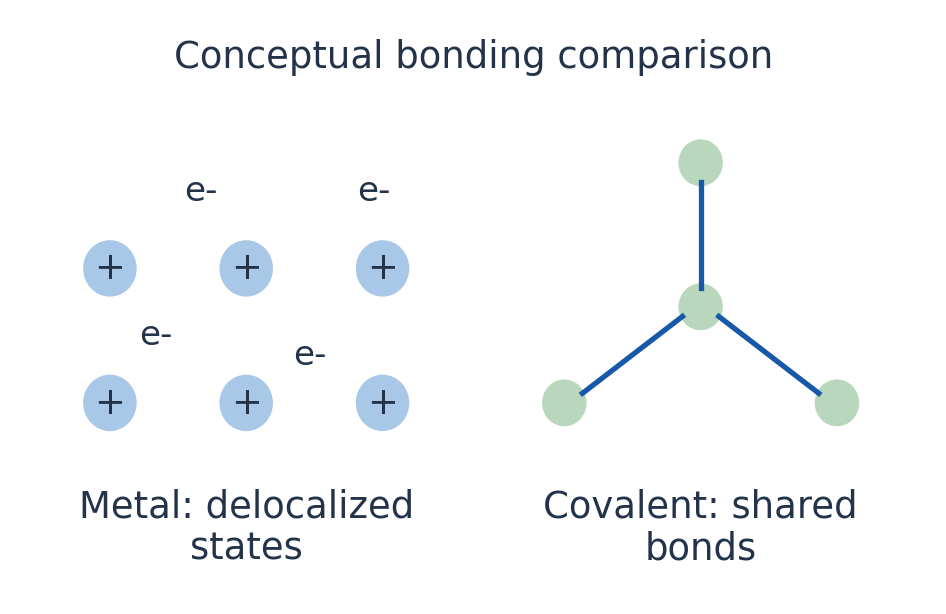
In metallic bonding, ion cores are held within delocalized electronic states. This supports electrical conduction and allows deformation without breaking a fixed set of directional bonds. In covalent solids such as crystalline silicon, shared-electron bonds form an extended network. Ionic bonding contributes strongly to many ceramics. Real engineering materials can combine bonding character. Strong bonding does not automatically mean high electrical conductivity; the availability and mobility of charge carriers must also be considered.
2. Structure, phases, defects and interfaces
Study route: CSE, EE, ECE, ME
A crystal has long-range periodic order; an amorphous solid lacks that long-range periodic arrangement. A grain is a crystal region with one orientation, and grain boundaries separate differently oriented regions. A phase is a structurally and chemically homogeneous region. An alloy can have several grains of one phase or several distinct phases; grain and phase are therefore different terms.

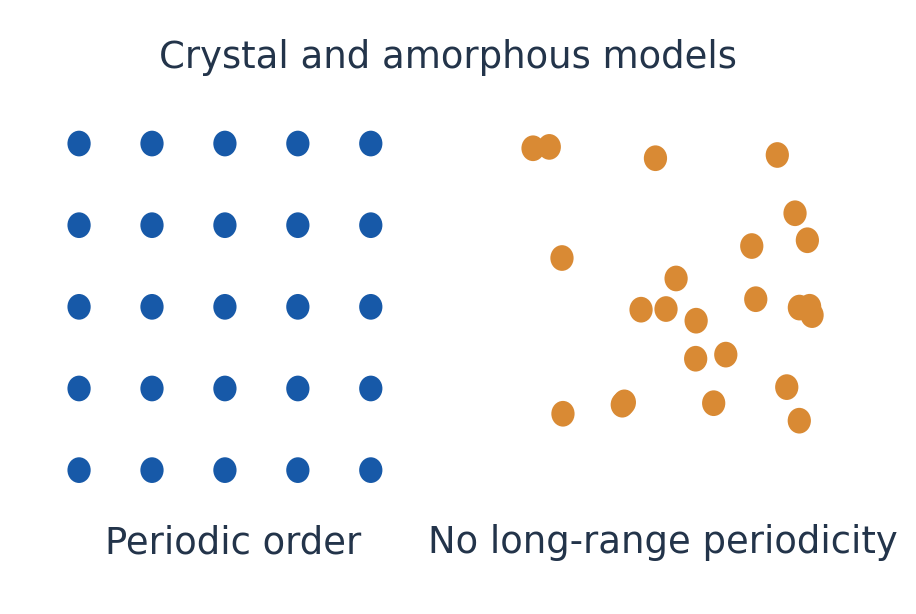
Vacancies, solute atoms and dislocations alter local structure. Dislocations permit slip and help explain plastic deformation; solutes, particles and boundaries can impede their motion. At an interface, bonding and chemistry can differ from the bulk. Oxide films influence solder wetting, passive layers influence corrosion, and fibre/matrix interfaces influence load transfer. The useful chain is composition -> processing -> structure -> property -> function. A bulk-property value alone cannot establish how a complete joined or coated component will behave.
3. Conductors, semiconductors and insulators
Study route: CSE, EE, ECE
Electrical classes describe how electronic states support charge transport under specified conditions. Metals have accessible mobile electronic states; semiconductors have a gap between occupied valence states and conduction states; insulators generally have a larger gap and very low electronic conduction in ordinary service. The boundaries are not universal resistivity numbers independent of temperature, purity or field.

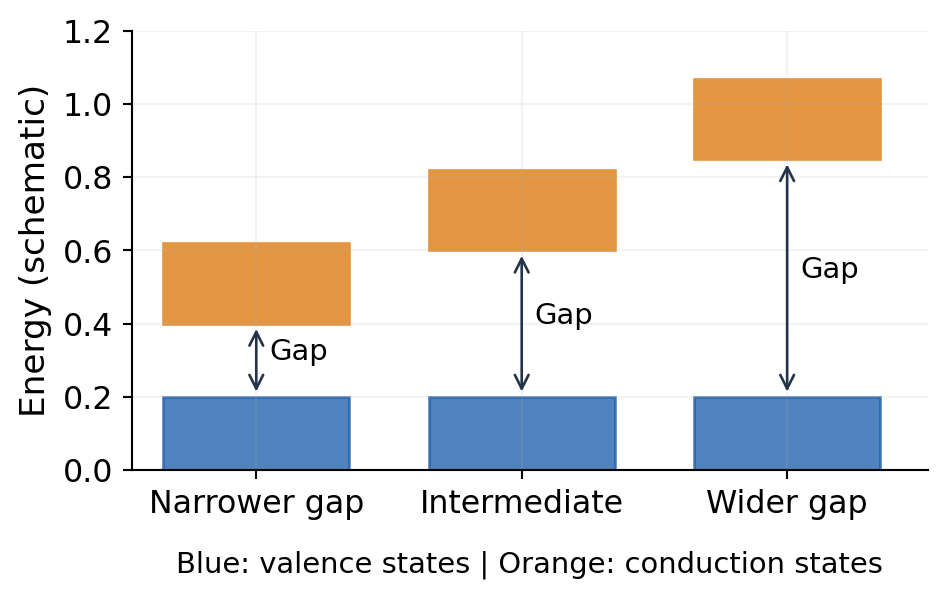

Conductivity sigma measures current response to field. Resistivity rho = 1/sigma, while a uniform bar has R = rho L/A. Resistance belongs to a specimen and its geometry; resistivity belongs to the material state and conditions. Metallic resistance commonly rises with temperature over a suitable interval because scattering increases. Intrinsic semiconductor conductivity can instead rise strongly as thermal carrier generation increases. A surface film may dominate contact resistance even when the underlying bulk metal conducts well.
Worked problem 1.1: Find resistance from material and geometry
Route: CSE
Problem. A uniform specimen has length 0.1 m, cross-section 1 mm² and supplied resistivity 1.7 × 10^-8 Ω m. Find resistance and conductivity. Contact effects and temperature change are excluded.
Working. Area is 1 mm² = 1 × 10^-6 m². Resistance is (1.7 × 10^-8) × 0.1/(1 × 10^-6) = 0.0017 Ω.
Answer and explanation. R = 0.0017 Ω; σ = 5.88235 × 10^7 S/m.
4. Silicon, germanium and intrinsic charge carriers
Study route: CSE, EE, ECE
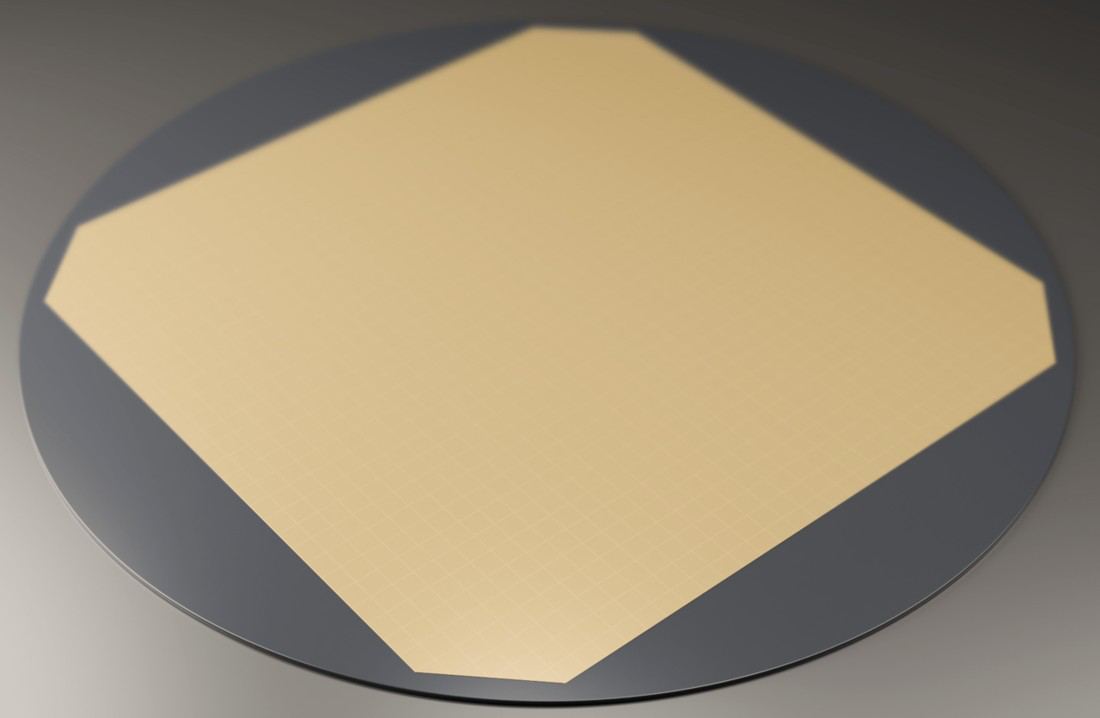
Silicon has four valence electrons and commonly forms a tetrahedral covalent crystal. Controlled purity and stable oxide/interface chemistry make it important in computing hardware. Germanium is also a group-14 semiconductor, but its gap, temperature response and surface chemistry differ. A silicon wafer is starting material; a packaged chip includes patterned structures, contacts, interconnects and protection.

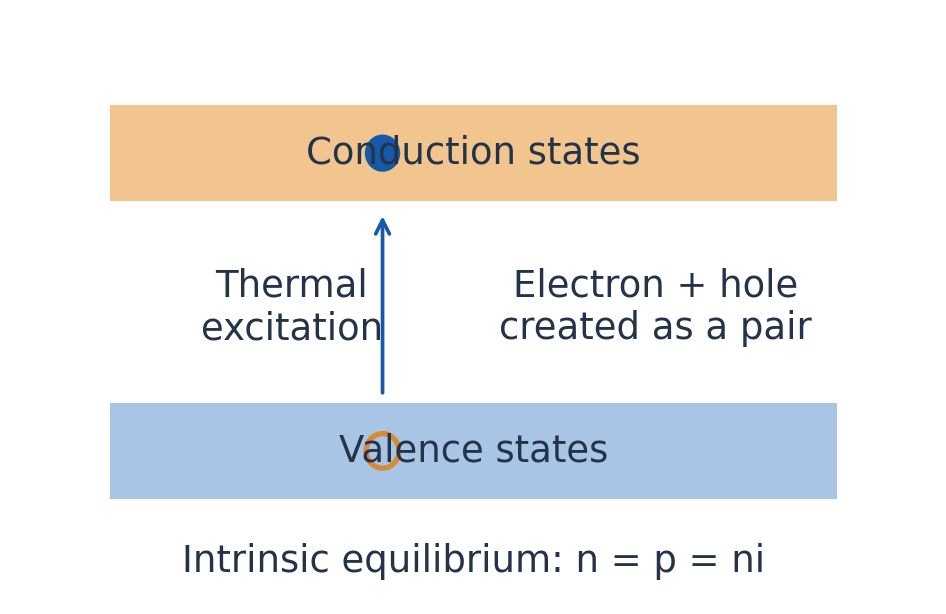
Thermal excitation can create a conduction electron and a valence-band hole. A hole represents an unoccupied electronic state that behaves as a positive mobile carrier; it is not an empty physical cavity moving through the crystal. In a uniform intrinsic equilibrium model, n = p = ni and np = ni². The intrinsic concentration depends strongly on material and temperature. Recombination removes electron-hole pairs, balancing generation at equilibrium. Intrinsic does not mean zero carriers, and one room-temperature concentration cannot be applied unchanged at every temperature.
Worked problem 1.2: Intrinsic carrier balance
Route: EE/ECE
Problem. At one temperature ni = 1.0e16 m^-3. Find n, p and the equilibrium product in intrinsic material.
Answer and explanation. Intrinsic n = p = 1.0e16 m^-3. Their product is 1.0e32 m^-6. These values belong to the specified temperature, not every material state.
5. Donor, acceptor and compensated doping
Study route: CSE, EE, ECE
A substitutional donor such as phosphorus in silicon can supply a mobile electron and remain as a fixed positive ionized donor. An acceptor such as boron can accept an electron, leaving a mobile hole and a fixed negative ionized acceptor. The n-type/p-type label identifies majority mobile carriers, not a net charge assigned to the whole specimen. The dopant atom normally remains in the lattice during ordinary electronic current flow.

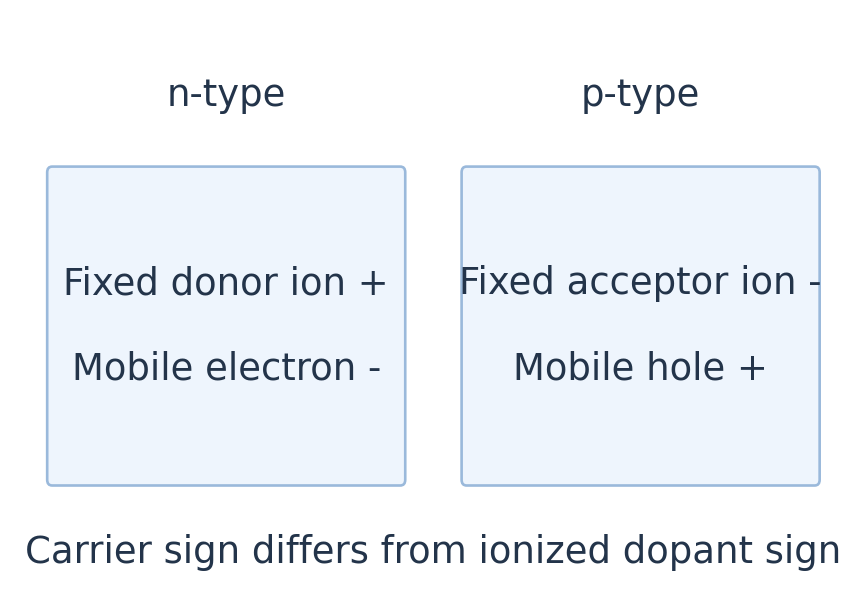
Charge neutrality is p + ND+ = n + NA-. With complete ionization, thermal equilibrium and strongly dominant donors, n approximately equals ND and p approximately equals ni²/ND; acceptor dominance gives the counterpart. When both impurity types are present, use the net balance rather than simply adding their concentrations. Low-temperature freeze-out, high-temperature intrinsic behaviour and heavy doping can invalidate the simplest estimates. Explain the carrier, fixed ion, neutrality condition and applicable approximation together.
Worked problem 1.3: Majority and minority populations in n-type silicon
Route: CSE
Problem. A supplied nondegenerate thermal-equilibrium silicon model has fully ionised donors ND = 1 × 10^21 m^-3, no acceptors and ni = 1 × 10^16 m^-3. ND is much greater than ni. Estimate n and p, then identify the majority carrier.
Working. Electron estimate n ≈ ND = 1 × 10^21
m^-3. Minority holes p ≈ ni²/n = (1 × 10^16)^2/(1 × 10^21) = 1 × 10^11 m^-3.
Answer and explanation. n ≈ 1 × 10^21 m^-3; p ≈ 1 × 10^11 m^-3; electrons are majority carriers.
Worked problem 1.4: Compensated majority concentration
Route: EE/ECE
Problem. Assume full ionization, equilibrium and strong net donor dominance: ND = 7e21, NA = 2e21 and ni = 1e16, all concentrations in m^-3. Estimate n and p.
Answer and explanation. Net donor concentration = 5e21 m^-3, so n approximately equals 5e21. Then p = ni²/n = 2e10 m^-3. The much smaller p supports the majority approximation.
6. Carrier transport and hardware material selection
Study route: CSE, EE, ECE
In a low-field scalar model, sigma = q(n mu(n) + p mu(p)). Both carrier concentration and mobility matter. A higher dopant concentration can raise carrier density while also changing scattering and mobility, so concentration alone cannot rank all specimens. Carrier densities and mobilities must use compatible units: 1 m³ contains 10^6 cm³, and 1 cm²/(V s) equals 10^-4
m²/(V s).

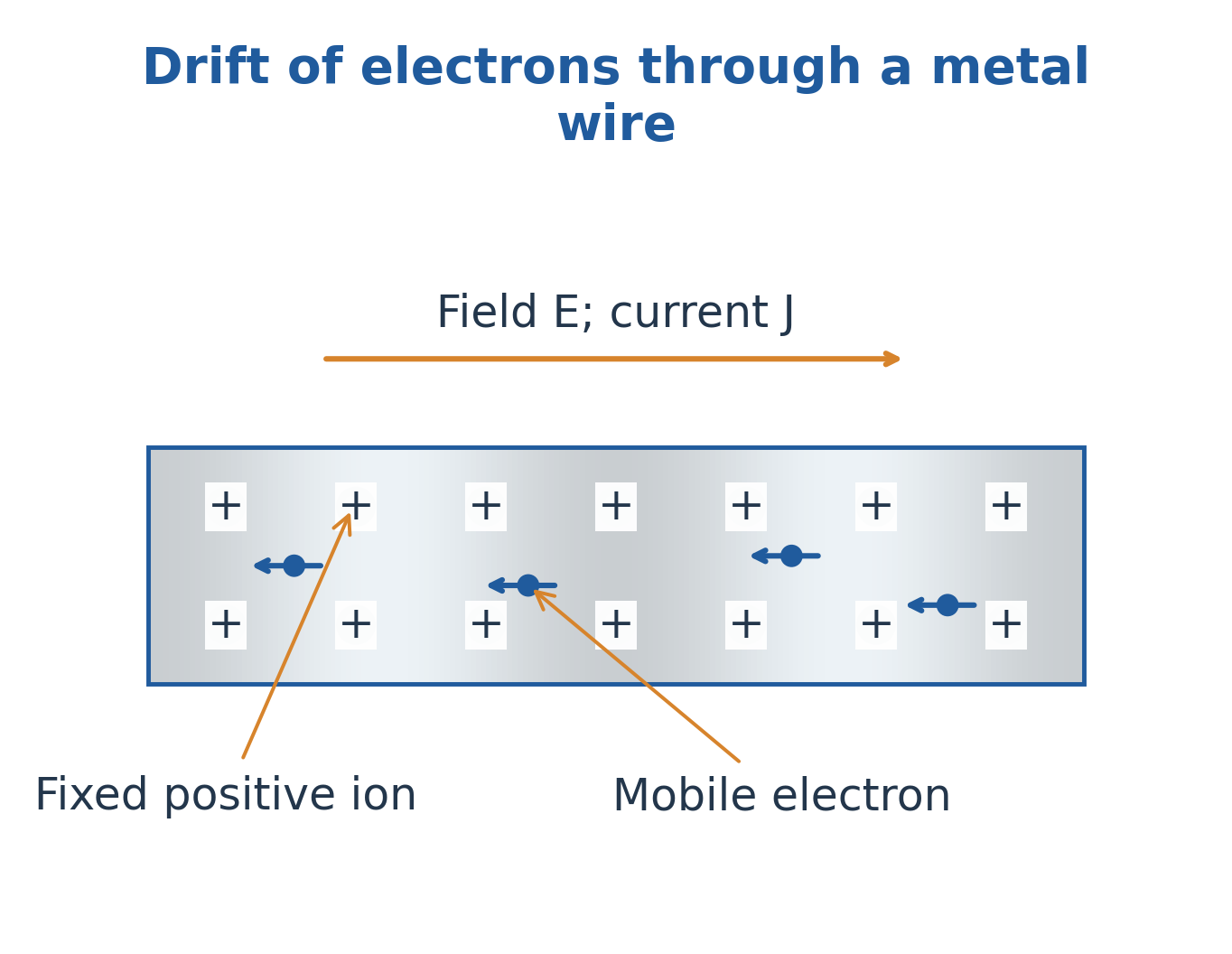

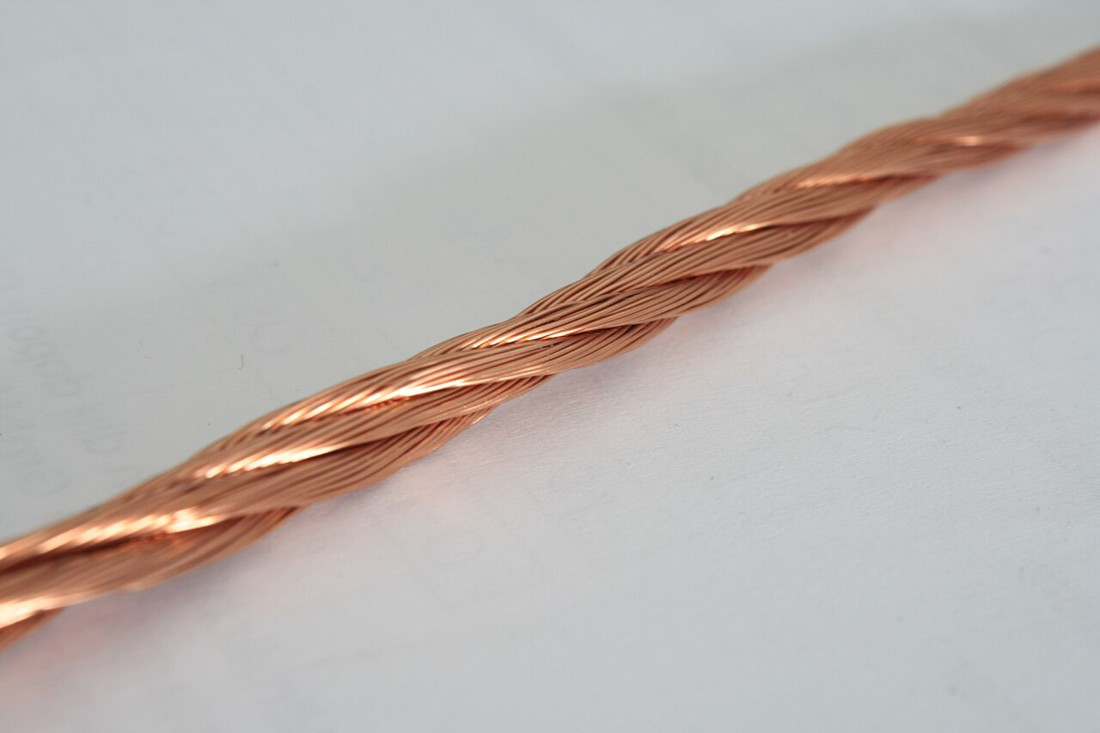
A conductor is selected for acceptable voltage drop, heating and joining; a semiconductor for controllable transport; a dielectric for charge separation and insulation. For a track, R = rho L/A, voltage drop = IR and Joule power = I²R in the stated DC model. Trace cross-section, temperature and surface condition matter. Passing a simple resistance calculation does not certify fatigue, corrosion or every high-frequency requirement.
Worked problem 1.5: Compute both carrier contributions to conductivity
Route: CSE
Problem. A supplied low-field silicon model has n = 1 × 10^21 m^-3, p = 1 × 10^11 m^-3, μn = 0.14 m²/(V s), μp = 0.05 m²/(V s) and q = 1.602 × 10^-19 C. Find conductivity and resistivity.
Working. Electron contribution qnμn = 22.428 S/m. Hole contribution qpμp = 8.01 × 10^-10
S/m.
Answer and explanation. σ = 22.428 S/m; ρ = 0.0445871 Ω m.
Worked problem 1.6: Conductivity with consistent units
Route: EE/ECE
Problem. An electron-dominated sample has n = 1e16 cm^-3 and mobility 1000 cm²/(V s). Use q = 1.60e-19 C. Find conductivity in S/m.
Answer and explanation. Convert n to 1e22 m^-3 and mobility to 0.10 m²/(V s). Sigma = q n mu = 160 S/m. Mixing the original centimetre values with metre geometry would give an inconsistent result.
7. PCB materials, laminates and interconnections
Study route: CSE
A printed circuit board combines patterned conductors with insulating support. Copper tracks and pads carry intended current. Glass-fibre-reinforced epoxy is a common rigid laminate family; the glass reinforces the board and cured epoxy binds it and contributes electrical separation. A plated via provides an intended conductive connection between layers; a drilled hole without plating does not perform the same electrical function. Flexible constructions can use suitable polymer films.

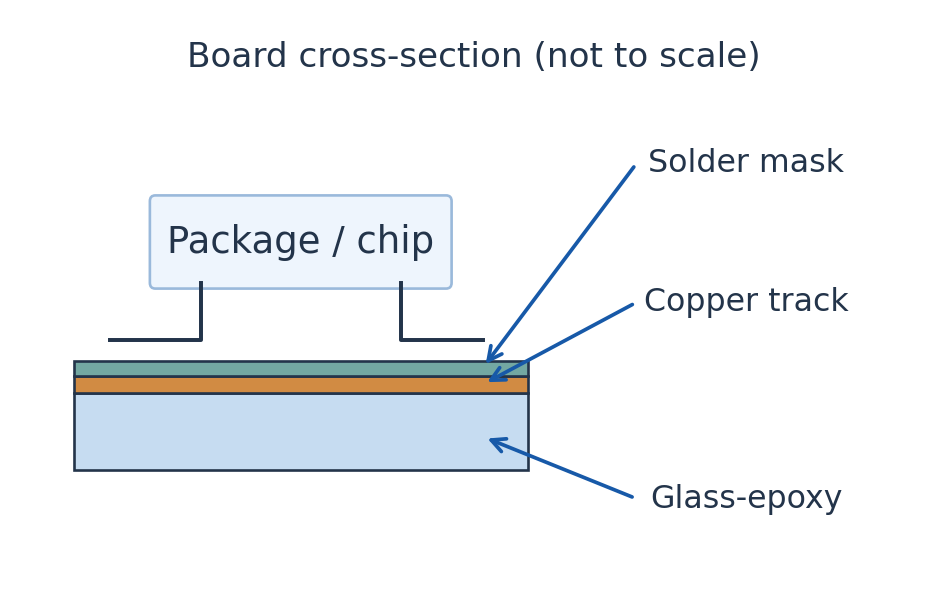


Solder mask protects selected regions while leaving joining areas exposed; surface finishes preserve usable contact surfaces. Laminate permittivity, dielectric loss, glass-transition behaviour, moisture uptake and thermal expansion depend on grade and construction. FR-4 is not one universal property value. Thermal mismatch between board, metal and package can load interfaces during processing or service. Select the complete laminate/interconnection system rather than assuming the visible board colour determines performance.
Worked problem 1.7: Find copper-track drop and resistive loss
Route: CSE
Problem. A uniform copper trace is 100 mm long, 1 mm wide and 35 µm thick. Supplied ρ = 1.7 × 10^-8 Ω m applies at the reference temperature. At 2 A, find resistance, voltage drop and bulk heating power.
Working. Cross-section is 0.001 × 3.5 × 10^-5 = 3.5 × 10^-8 m²; length is 0.1 m. Bulk resistance is 0.0485714 Ω.
Answer and explanation. R 0.0485714 Ω; drop 0.0971429 V; loss 0.194286 W.
8. Solder alloys, flux, wetting and joint defects
Study route: CSE
Soldering joins compatible surfaces using a molten filler alloy without melting the entire base assembly. Lead-free Sn-Ag-Cu alloys are common examples, but alloy composition and solder-paste composition are different inventories: paste also contains flux and other formulation constituents. A specified mass percentage needs its actual denominator.

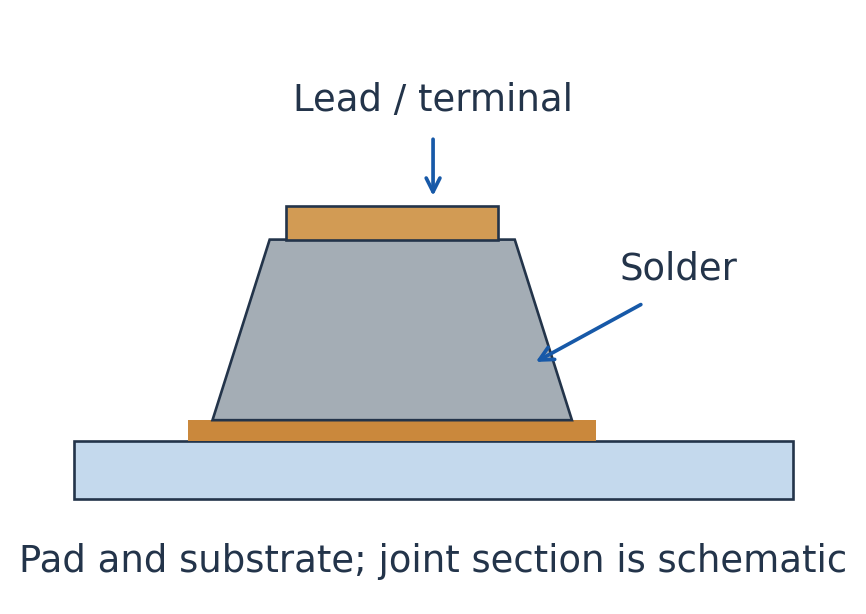
Oxides and contamination can obstruct wetting. Flux supports oxide removal and limits reoxidation during the intended process, enabling molten solder to contact and react with the surfaces. Controlled intermetallic formation supports the joint, while excessive growth or incompatible chemistry can weaken it. A bridge creates an unintended connection; a crack interrupts a desired path; a void removes part of the joint volume. Good appearance alone does not prove internal integrity. Process temperature/time, cleanliness, alloy compatibility and inspection must be connected to the specific defect mechanism.
| Joint issue | Mechanism / check |
|---|---|
| Poor wetting | Oxide/contamination or incompatible process |
| Bridge | Unintended conducting connection |
| Crack | Interrupted mechanical/electrical path |
| Void | Missing volume; location matters as well as fraction |
Worked problem 1.8: Mass balance for a supplied tin-based alloy
Route: CSE
Problem. A supplied tin-based alloy batch has total mass 200 g, silver fraction 0.03 and copper fraction 0.005 by mass; the balance is tin. Calculate constituent masses and identify the tin percentage.
Working. Tin fraction is 1 – 0.03 – 0.005 = 0.965. Silver mass is 200 × 0.03 = 6 g; copper mass is 1 g.
Answer and explanation. Ag 6 g; Cu 1 g; Sn 193 g (96.5%).
Worked problem 1.9: Quantify a defined joint void-volume fraction
Route: CSE
Problem. A supplied three-dimensional joint model has envelope volume 2 mm3, of which 0.12 mm3 is explicitly identified as void. Find represented solid volume and void-volume percentage.
Working. Solid material volume is 2 – 0.12 = 1.88 mm3. Void fraction is 0.12/2 = 0.06.
Answer and explanation. Solid volume 1.88 mm3; void volume 6%.
9. Insulation, dielectric polarization and electrical limits
Study route: CSE
Insulating materials limit unwanted current while tolerating mechanical, thermal and environmental conditions. Polymers provide flexible or processable structures; ceramics and glass provide other combinations of rigidity, heat resistance and electrical behaviour. Surface leakage across a contaminated film differs from current through the bulk thickness. Neither path has infinite resistance under all conditions.

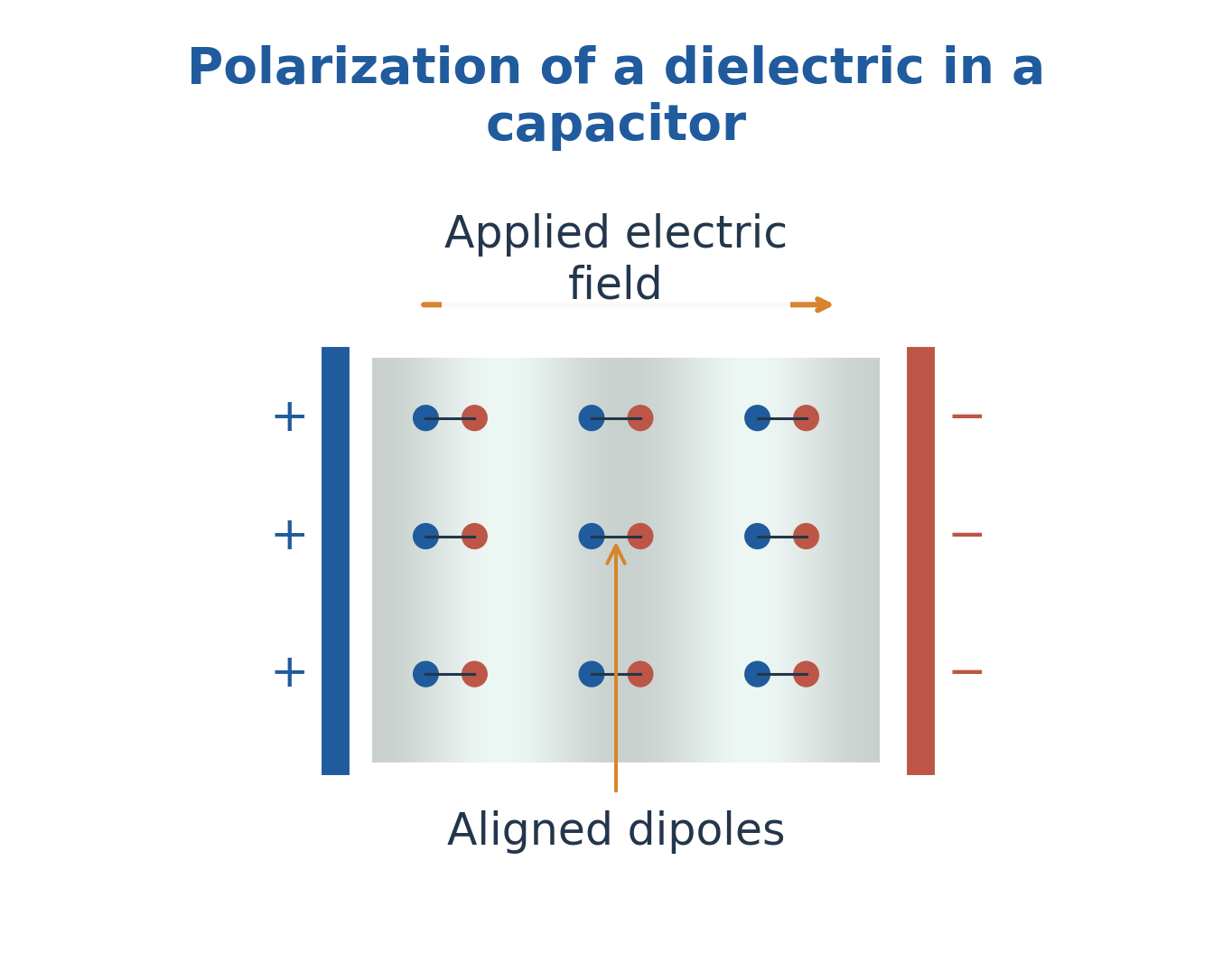
A dielectric polarizes under an electric field through electronic, ionic, orientational or interfacial mechanisms. For a fully filled ideal parallel-plate capacitor, C = epsilon0 epsilon(r) A/d, Q = CV and U = CV²/2 at maintained voltage. Permittivity describes charge-storage response, dielectric loss describes dissipation, and breakdown strength concerns electrical failure under stated conditions. High permittivity alone cannot establish low leakage or high allowable voltage. Geometry, frequency, defects, moisture and temperature must accompany material selection.
Worked problem 1.10: Parallel plates with a supplied dielectric
Route: CSE
Problem. An ideal fully filled parallel-plate model has εr = 4, overlapping area 100 mm², separation 0.2 mm and maintained voltage 10 V. Use ε0 = 8.854 × 10^-12 F/m. Find capacitance, plate-charge magnitude and energy.
Working. Convert A = 0.0001 m² and d = 0.0002 m. C = ε0εrA/d = 1.7708 × 10^-11 F = 17.708 pF.
Answer and explanation. C 17.708 pF; |Q| 1.7708 × 10^-10 C; U 8.854 × 10^-10 J.
10. Corrosion, migration and electronic reliability
Study route: CSE
Wet corrosion couples anodic metal oxidation with cathodic reduction through electronic and ionic paths. Galvanic attack requires a suitable electrochemical difference, electrical connection and electrolyte. Moisture and ionic contamination can support leakage and electrochemical migration: metal dissolves at an anodic region, ions move through a surface electrolyte and metal can deposit elsewhere. Deposition growth and ionic transport are related but distinct steps.

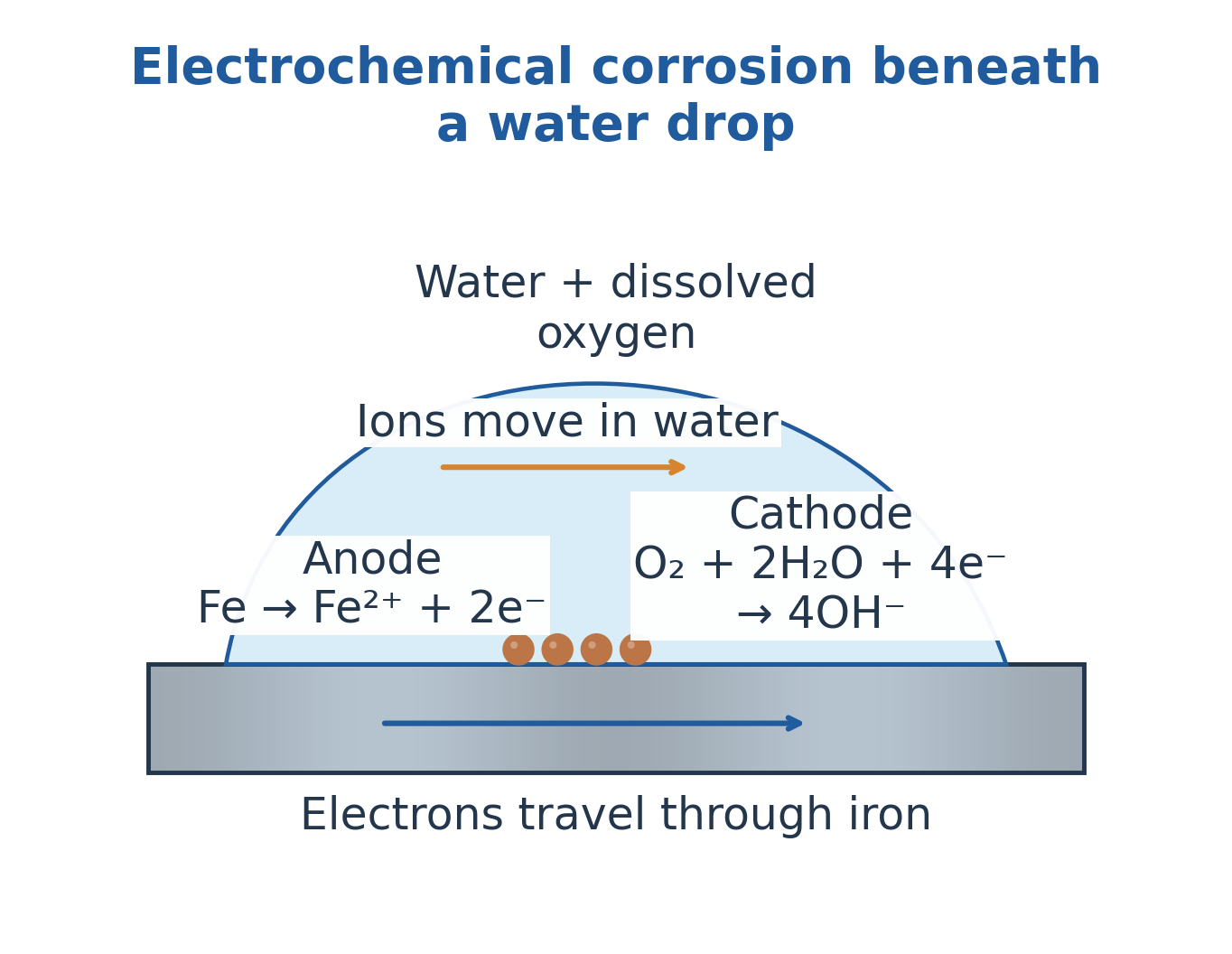
Protection uses compatible materials, cleanliness, environmental barriers, appropriate finishes and control of thermal/mechanical stress. A coating must cover the intended region without preventing required contact. Reliability means maintaining required function under stated conditions over time, not merely passing one initial reading. Diagnose the actual failure path before selecting a remedy. A test-cohort survival fraction reports that cohort; it cannot be extrapolated directly into unlimited service lifetime.
Worked problem 1.11: Report an observed survival fraction correctly
Route: CSE
Problem. A supplied test starts with 200 specimens. At the stated 1000 h observation, 6 have failed the defined function and none were removed or censored. Find observed surviving and failed fractions.
Working. Surviving specimens are 200 – 6 = 194. Observed surviving fraction is 194/200 = 0.97 = 97%.
Answer and explanation. Observed surviving 97%; failed 3% at 1000 h.
11. Compound and wide-bandgap semiconductors
Study route: EE, ECE
Compound semiconductors combine elements to tune electronic and optical properties. GaAs and InP are important III-V systems; GaN and SiC are prominent wide-bandgap materials. A direct bandgap permits radiative transitions without the momentum assistance required in a simple indirect-gap description. This helps explain applications of suitable compounds in emitters, photodetectors and high-frequency devices.

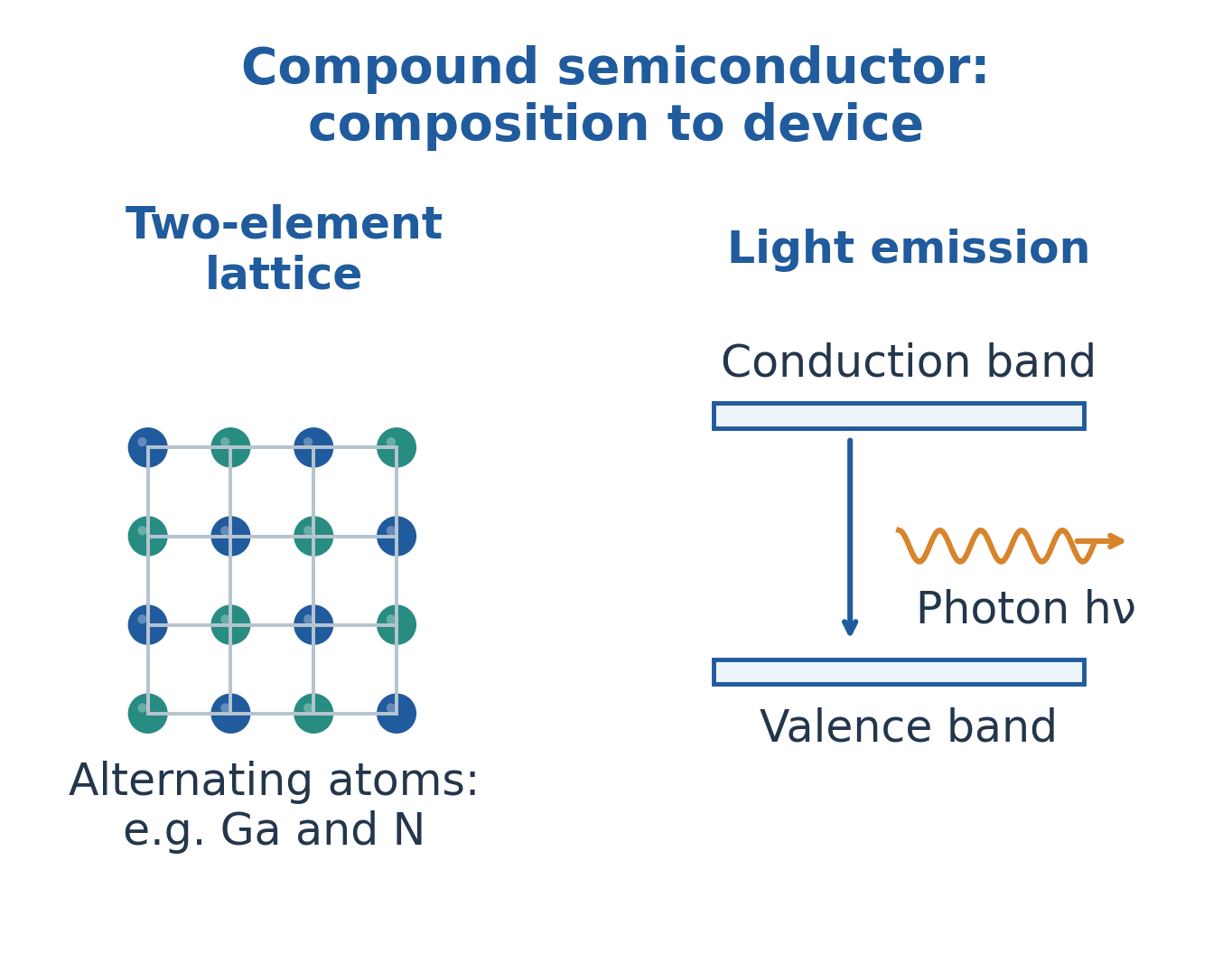
A wider gap can support a lower intrinsic carrier population and useful high-field or high-temperature operation, but it is not a complete device rating. Crystal defects, thermal conductivity, contacts and interfaces also matter. Gallium nitride chemistry and processing differ from those of elemental silicon. For a specified optical transition, photon energy E = hc/lambda relates energy to wavelength; it does not determine emission efficiency or usable output power. Select the material through the required electronic, optical and thermal functions together.
Worked problem 1.12: Bandgap and photons
Route: EE/ECE
Problem. A supplied direct transition has energy 2.0 eV. Use hc = 1240 eV nm to estimate wavelength.
Answer and explanation. lambda = 1240/2.0 = 620 nm. This is the photon-energy relation for the supplied transition. It does not determine emission efficiency, spectral width or the full device power.
Worked problem 1.13: Gap comparison
Route: EE/ECE
Problem. Two supplied transitions are 1.5 eV and 3.0 eV. Use hc = 1240 eV nm. Find the associated wavelengths.
Answer and explanation. Wavelengths are 826.7 nm and 413.3 nm. Doubling photon energy halves wavelength. The comparison does not itself determine real emission efficiency or device operating temperature.
12. Chemical vapour deposition: transport and surface reaction
Study route: EE, ECE
CVD delivers volatile precursors to a substrate and forms solid material through chemical reaction. The sequence includes delivery and mixing, transport to the surface, adsorption/reaction, incorporation into the film and removal of gaseous by-products. A simplified silicon deposition balance is SiH4 -> Si + 2H2. It describes net chemistry rather than a complete operating recipe.


At some conditions, surface reaction limits growth; at others, transport of reactants or products becomes important. Substrate temperature, precursor purity, surface preparation and flow distribution affect rate and uniformity. An epitaxial film follows a crystalline relationship with its substrate, but CVD does not automatically mean every deposited film is epitaxial. Thickness, composition, adhesion, contamination and defects require separate characterization. A uniform visible coating is not proof of electronic-grade purity.
Worked problem 1.14: CVD thickness
Route: EE/ECE
Problem. A uniform film grows at 12 nm/min for 25 min with zero initial thickness. Find final thickness.
Answer and explanation. Thickness = rate x time = 12 x 25 = 300 nm = 0.300 micrometre. The constant-rate assumption is supplied; nucleation delay or depletion would require a different growth model.
Worked problem 1.15: Precursor balance
Route: EE/ECE
Problem. For ideal SiH4 -> Si + 2H2, how many moles of H2 accompany 0.40 mol deposited silicon?
Answer and explanation. The balanced ratio is 2 mol H2 per mole Si, so H2 = 0.80 mol. This is the net reaction balance, not a claim of complete precursor utilization in an actual reactor.
13. Molecular beam epitaxy and interface quality
Study route: EE, ECE
MBE supplies controlled atomic or molecular beams to a clean crystalline substrate in very high vacuum. Heated sources or suitable beam systems deliver species, while shutters help define layers. Surface migration and incorporation under suitable conditions produce epitaxial growth. Crystalline alignment is important: depositing atoms on a surface is not enough to guarantee the intended epitaxial structure.

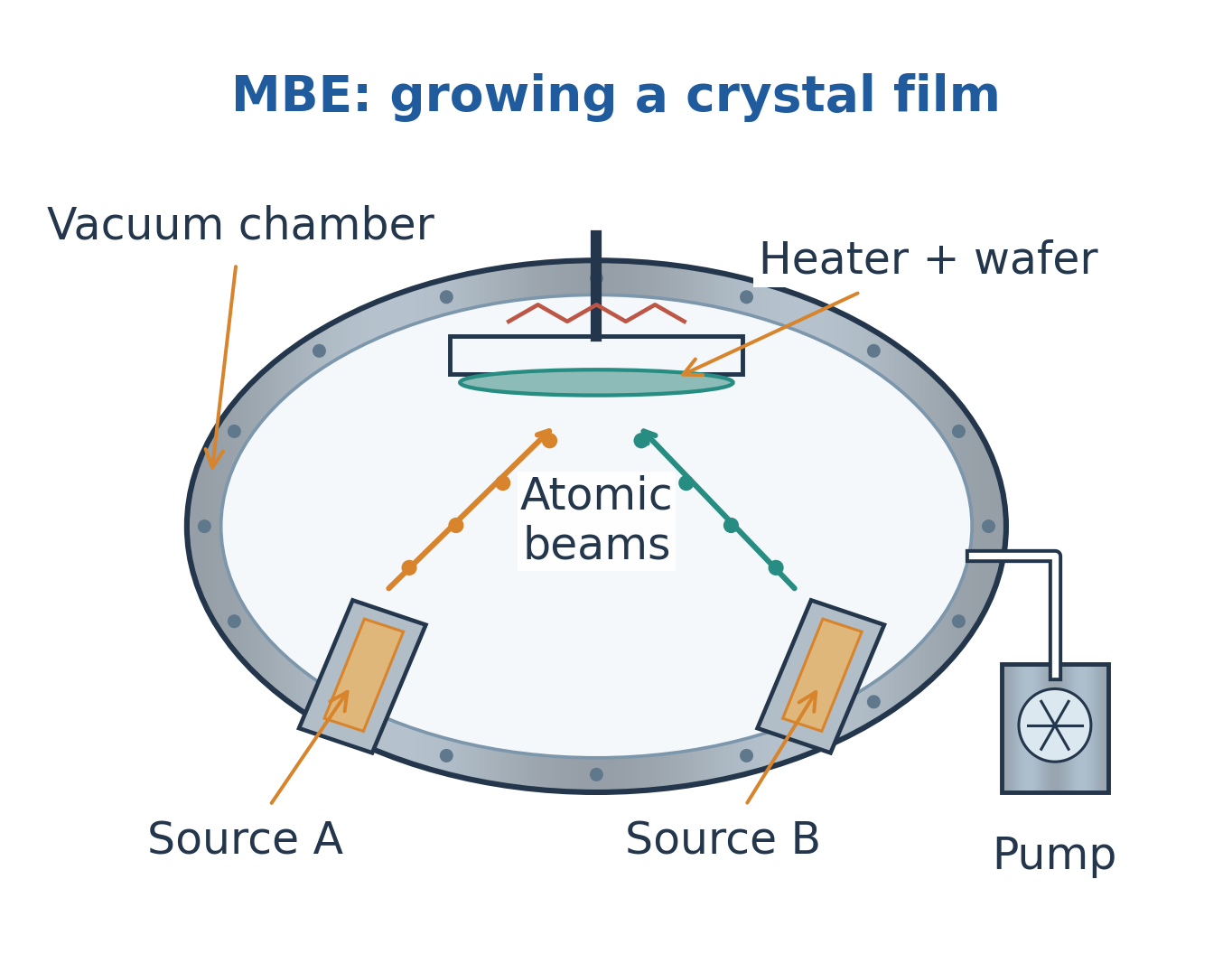
The method offers fine control of composition and layered structures, but purity, throughput and interface control remain practical constraints. Lattice mismatch can introduce strain; sufficiently large mismatch or thickness can lead to defects and relaxation. CVD emphasizes volatile-precursor reaction chemistry, while MBE emphasizes controlled beams and surface incorporation in vacuum. Both need appropriate substrate preparation. Distinguish thickness control, chemical purity and structural perfection: success in one measurement does not establish the other two.
| Aspect | CVD | MBE |
|---|---|---|
| Supply | Volatile precursors | Atomic/molecular beams |
| Main description | Reaction at/near substrate | Surface incorporation in vacuum |
| Common concern | Chemistry + transport | Flux + crystal interface |
Worked problem 1.16: MBE layered growth
Route: EE/ECE
Problem. A supplied constant-growth model uses 0.25 nm/s for a first layer over 40 s and 0.10 nm/s for a second layer over 60 s. Find layer and total thicknesses.
Answer and explanation. Layer thicknesses are 10 nm and 6 nm; total = 16 nm. Shutter transients, intermixing and roughness are excluded by the model, and thickness alone cannot establish interface quality.
14. Portland cement composition and clinker roles
Study route: CE
Portland cement is a hydraulic binder. Its main clinker phases are tricalcium silicate C3S, dicalcium silicate C2S, tricalcium aluminate C3A and tetracalcium aluminoferrite C4AF. In cement notation, C = CaO, S = SiO2, A = Al2O3 and F = Fe2O3. These are oxide abbreviations, not ordinary element symbols. Small gypsum addition helps regulate rapid aluminate reaction.

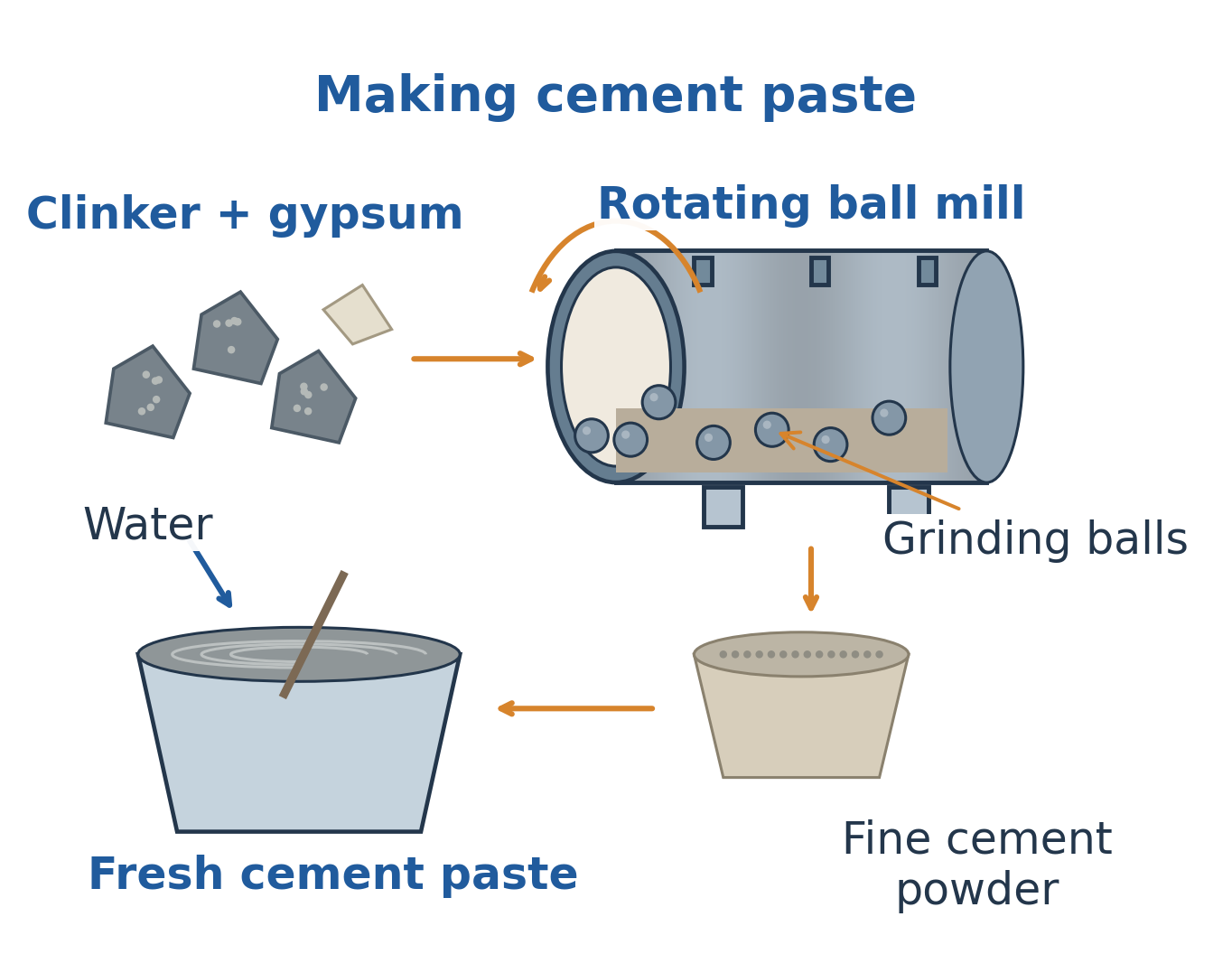
C3S reacts comparatively rapidly and contributes strongly to early strength and heat evolution. C2S reacts more slowly and contributes to later strength. C3A is highly reactive with water and interacts strongly with sulfate chemistry; C4AF contributes to clinker formation and hydration products. Actual phase proportions and fineness change cement behaviour. Cement is the binder; concrete additionally contains water, fine/coarse aggregate and possibly additions/admixtures. Distinguish clinker-phase roles before discussing setting, hardening and durability.
| Clinker phase | Main introductory role |
|---|---|
| C3S | Early reaction, heat and strength |
| C2S | Slower, later strength contribution |
| C3A | Rapid sulfate-sensitive reaction |
| C4AF | Clinker formation and hydration products |
Worked problem 1.17: Read cement notation
Route: CE
Problem. In cement notation C3S and C2S, what do C and S represent, and which typically contributes more strongly to early strength?
Answer and explanation. C represents CaO and S represents SiO2. C3S generally reacts faster and contributes strongly to early strength; C2S contributes more slowly. The symbols here are oxide abbreviations, not carbon and sulfur atoms.
15. Hydration, setting, hardening and curing
Study route: CE
Silicate hydration produces calcium-silicate-hydrate (C-S-H), the main binding phase, and calcium hydroxide. C-S-H has variable composition, so a single exact molecular formula is an approximation. Aluminate and sulfate reactions form ettringite while sulfate is available; later phase development depends on the chemical conditions. Heat evolution and product growth change the paste from a workable suspension to a load-bearing network.

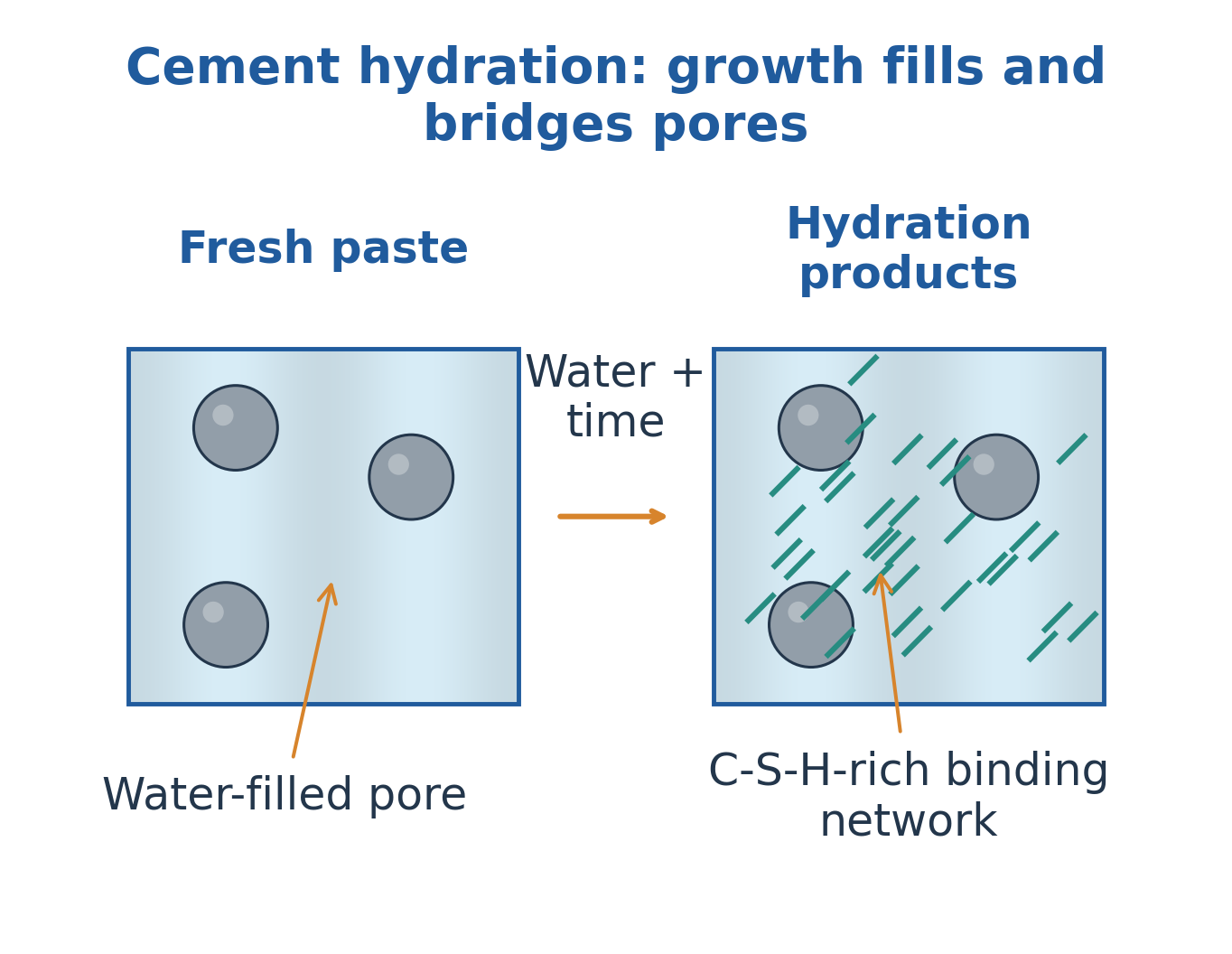
Setting is loss of plasticity, while hardening is continued strength development. Curing maintains suitable moisture and temperature for hydration; it is not simply allowing the paste to dry. Excess mixing water can leave capillary porosity after drying, affecting strength and ingress. Water/cement ratio is a mass ratio and must be distinguished from water/total-binder ratio when additions are present. Explain a failure caused by inadequate curing through interrupted hydration and increased permeability, not only through a statement that the concrete looks dry.
Hydration chemistry in an examination answer
A simplified illustrative silicate balance is 2C3S + 6H -> C3S2H3 + 3CH, using H = H2O and CH = Ca(OH)2 in cement notation. The represented hydrate formula is an idealization of variable-composition C-S-H. A comparable C2S balance produces less CH per two silicate units. Use these equations to explain products and binding, not to claim that all real C-S-H has one fixed molecular composition.
Setting versus long-term performance
Early product formation bridges particles and reduces workability; continued hydration fills parts of the original water-filled space and develops a stronger network. Temperature changes rate and thermal stress, while moisture loss can interrupt reaction. A specimen can set yet remain weak, and high early strength does not automatically establish low permeability or resistance to every exposure. Curing, mixing-water ratio and the actual exposure should appear in the same explanation.
Worked problem 1.18: Cement water ratio
Route: CE
Problem. A mix contains 360 kg cement and 162 kg water. Find water/cement ratio and water needed at ratio 0.42.
Answer and explanation. Use water mass/cement mass: 162/360 = 0.45. At 0.42, water = 0.42 x 360 = 151.2 kg, a reduction of 10.8 kg. This calculation does not independently predict strength.
Worked problem 1.19: Curing diagnosis
Route: CE
Problem. Two identical cement pastes are prepared. One is maintained moist and the other dries rapidly. Explain why equal initial water/cement ratio does not guarantee equal later strength.
Answer and explanation. Moist curing supports continuing hydration. Early drying can limit reaction and increase cracking or connected porosity. Initial proportions do not specify the complete curing history, so the two systems need not develop the same structure.
16. Chemical admixtures and blended concrete
Study route: CE
Plasticizers and superplasticizers disperse cement particles and reduce the water needed for a required workability. Retarders delay setting; accelerators promote early reaction; air-entraining agents stabilize suitably distributed small bubbles. Compatibility depends on cement chemistry, dose, temperature and the complete mixture. Overdosing can produce unwanted setting or air changes, so more admixture does not automatically mean better concrete.

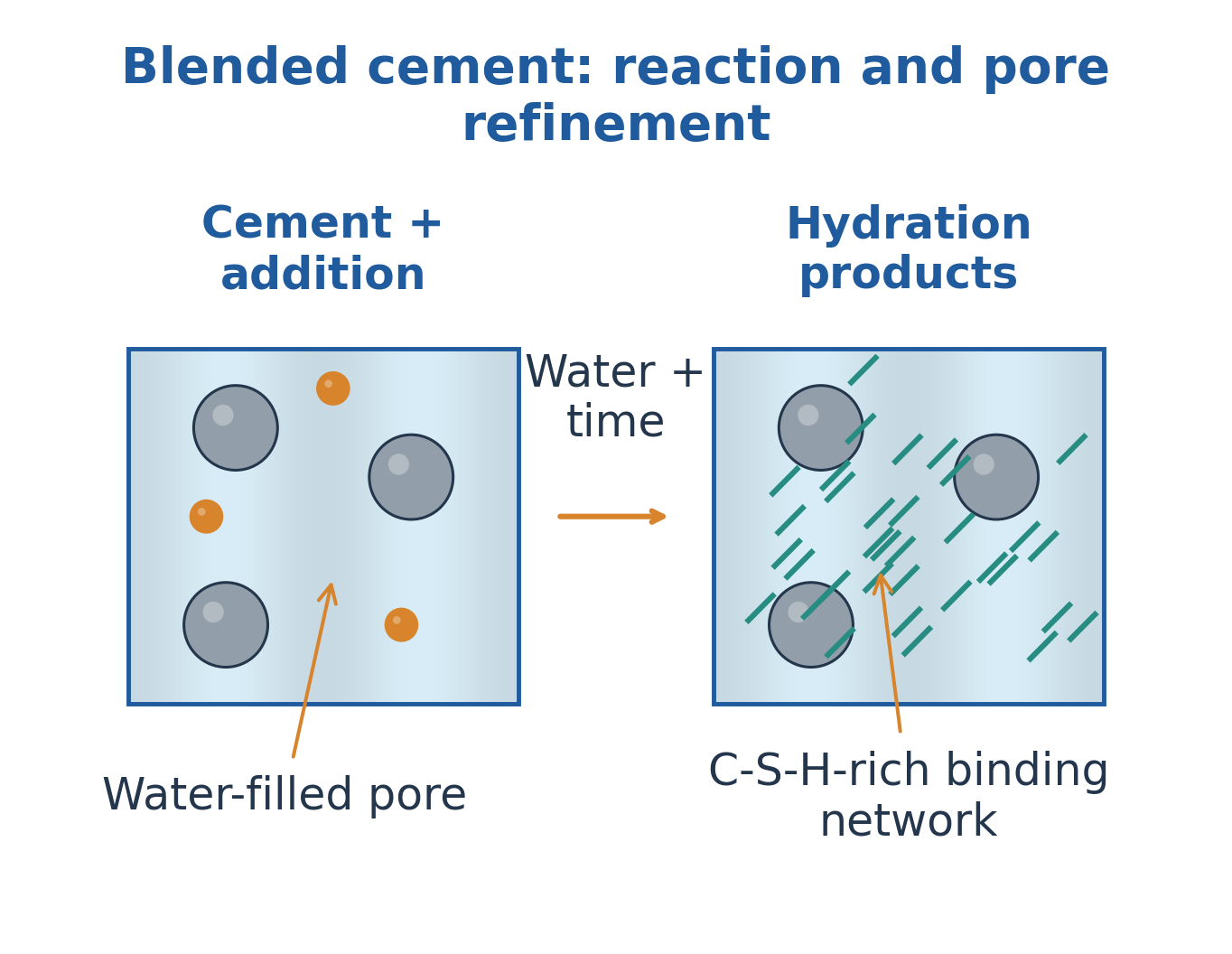
Fly ash and silica fume can react pozzolanically with calcium hydroxide to form additional binding products. Silica fume also affects particle packing because of its fineness. Slag is a latent hydraulic material activated in a suitable cement environment. Replacement level, reactivity and curing control heat, early/later strength and transport properties. Reduced clinker fraction can lower one environmental burden, but the full comparison also needs processing, transport and equivalent service performance. Name the chemical action rather than treating all mineral additions as inert filler.
Worked problem 1.20: Clinker replacement
Route: CE
Problem. A 500 kg binder contains 100 kg fly ash and 25 kg silica fume. Find replacement fraction and clinker-containing cement fraction.
Answer and explanation. Supplementary material = 125 kg. Replacement = 125/500 = 25%; remaining cement = 375 kg or 75%. The result is a mass inventory, not an automatically equal carbon reduction.
17. Lime, gypsum and plaster of Paris
Study route: CE
Lime manufacture involves calcination: CaCO3 -> CaO + CO2. Slaking is CaO + H2O -> Ca(OH)2 and releases heat. In suitable air-lime applications, carbonation converts calcium hydroxide toward calcium carbonate. Water supply, particle condition and carbon-dioxide access affect reaction and hardening; an air-lime mortar is not chemically identical to Portland cement concrete.

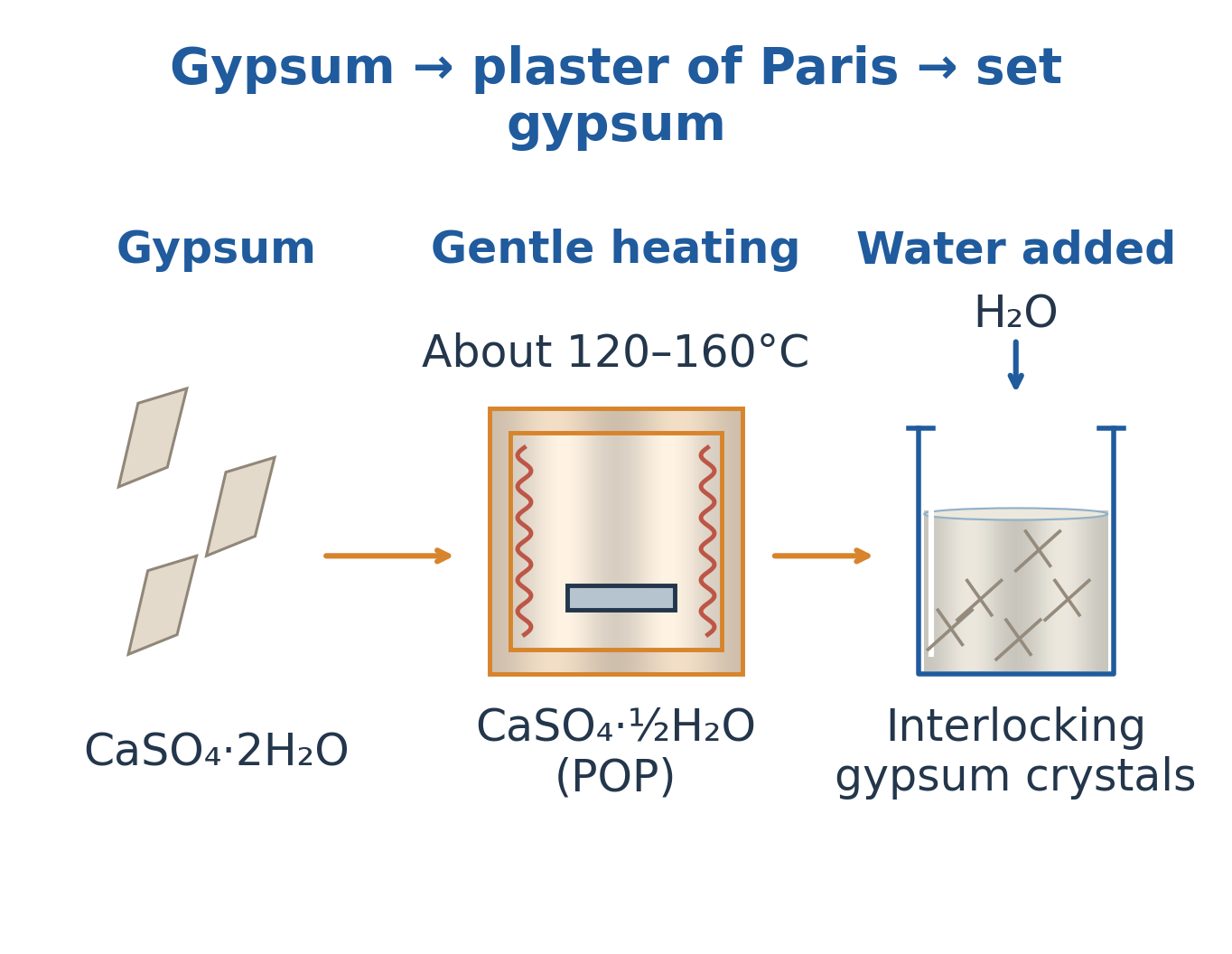
Gypsum is CaSO4·2H2O. Controlled partial dehydration produces plaster of Paris, commonly represented as CaSO4·0.5H2O. On adding water, hemihydrate converts toward gypsum and interlocking crystals develop rigidity: CaSO4·0.5H2O + 1.5H2O -> CaSO4·2H2O. Mixing water can exceed chemically combined water, leaving porosity after drying. POP is useful for moulds and indoor finishes but is not a general replacement for durable structural concrete. Explain dehydration, rehydration and crystal interlocking as separate stages.
Distinguish the setting mechanisms
Lime-based carbonation requires carbon-dioxide access, while POP rehydrates toward gypsum and develops crystal interlocking. Portland cement develops hydraulic binding through its hydration network. All three may appear to become hard, but they do not use one identical chemical mechanism. This distinction helps choose a material for an indoor mould, a breathable mortar or structural concrete. Excess water, incomplete reaction and unsuitable exposure affect them differently.
Worked problem 1.21: Plaster hydration
Route: CE
Problem. Using supplied molar masses 145 g/mol for hemihydrate and 172 g/mol for gypsum, find chemical water uptake for 290 g POP.
Answer and explanation. Two moles of hemihydrate require 2 x (172-145) = 54 g water to give 344 g gypsum. Mixing water in a real paste may exceed chemically combined water.
18. Ceramics, firing and refractory selection
Study route: CE
Ceramics are inorganic nonmetallic materials with substantial ionic/covalent bonding. Clay-based products are prepared, shaped, dried and fired. Firing promotes reactions, sintering and sometimes glassy-phase formation. Porosity affects water absorption, permeability and strength; glazing changes the surface but does not remove every bulk flaw. Brittleness reflects limited plastic accommodation together with flaws and stress concentration.

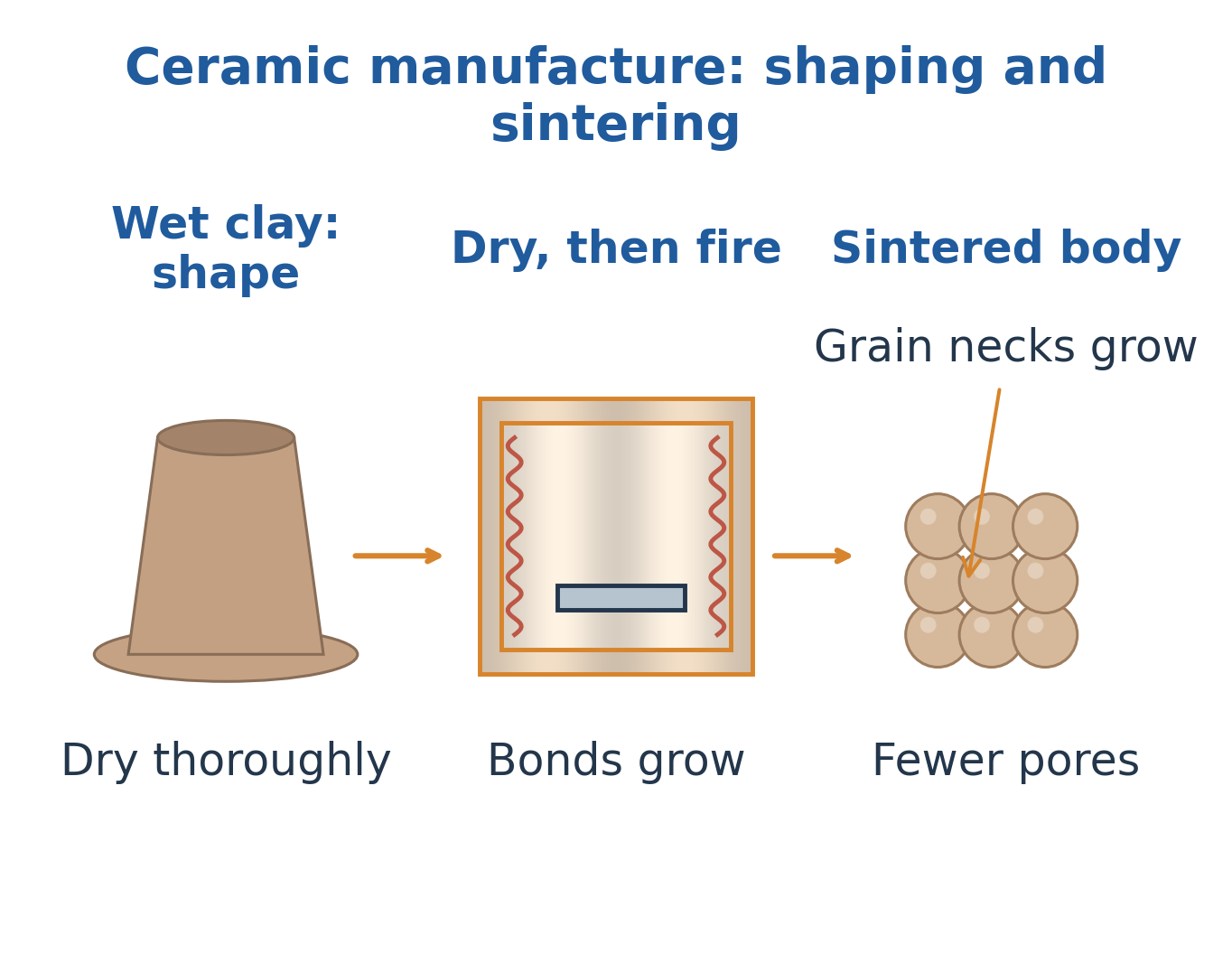
Refractories retain useful properties at high temperature. Silica-rich acidic materials suit compatible acidic conditions; magnesia-rich basic materials suit compatible basic slags; alumina-rich and other systems are selected for specific service. Chemical compatibility, thermal shock, creep under load and dimensional stability matter alongside refractoriness. A material can survive temperature yet react destructively with slag. Compare the contacting chemistry and thermal/mechanical exposure before choosing a refractory, and explain why a single melting-point ranking is insufficient.
Worked problem 1.22: Refractory selection
Route: CE
Problem. Why can a highly heat-resistant silica refractory fail against a basic slag?
Answer and explanation. Temperature resistance and chemical compatibility are separate requirements. Acidic silica can react with a basic slag, changing or dissolving the protective structure. Select using slag chemistry, thermal cycling and load, not melting resistance alone.
19. Engineering metals: iron, aluminium, copper and titanium
Study route: ME
Iron offers a versatile basis for steels and cast irons, with properties strongly affected by carbon and alloying. Aluminium combines low density with an oxide film that often supports corrosion resistance; its modulus and joining behaviour differ from steel. Copper offers high electrical/thermal conductivity and useful ductility, but alloying and defects change conductivity. Titanium provides useful specific properties and a stable oxide in appropriate environments, while processing and cost impose constraints.

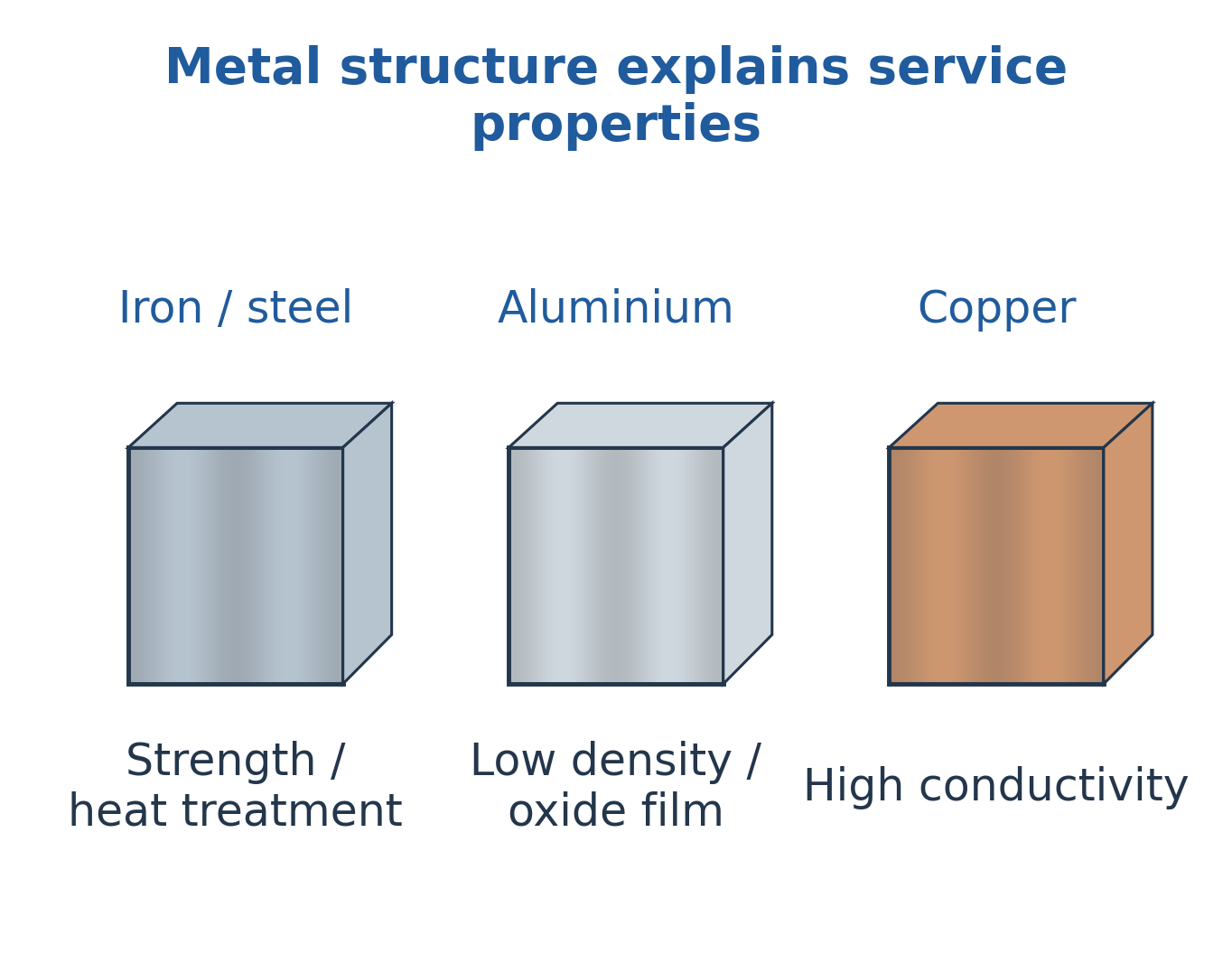
Selection must connect bonding, composition and structure to the intended duty. Low density alone does not establish the lowest required component mass; stiffness, allowable stress and geometry also matter. A protective oxide can improve corrosion behaviour while obstructing electrical contact or wetting. Use a consistent comparison of density, strength, stiffness, conductivity, temperature and corrosion response rather than saying one metal is universally best.
Read a material-selection question systematically
First identify what limits the component: stiffness, strength, electrical loss, temperature, weight or corrosion. Then compare candidates on a consistent property basis and state the trade-off. Aluminium can reduce mass but may require a different section to meet stiffness; copper can suit a current path but may be less attractive where density dominates; titanium can be useful where specific performance and environmental resistance justify processing cost. Element identity is only the starting point: alloy grade and treatment determine the usable material state.
Worked problem 1.23: Specific-property comparison
Route: ME
Problem. Supplied strengths are 240 MPa for metal A at density 2.7 Mg/m³ and 600 MPa for metal B at 7.8 Mg/m³. Compare strength/density indices.
Answer and explanation. The indices are 88.9 and 76.9 in consistent ratio units. A has the higher supplied specific-strength index. Stiffness, geometry, corrosion and processing still matter before choosing an actual component.
20. Alloy formation: solid solutions and second phases
Study route: ME
An alloy contains at least two elements, with at least one metallic constituent. In a substitutional solid solution, solute atoms replace host atoms. In an interstitial solution, sufficiently small atoms occupy spaces between host atoms; carbon in iron is a central example. Solubility depends on structure and chemistry, so arbitrary amounts cannot always dissolve into one homogeneous phase.

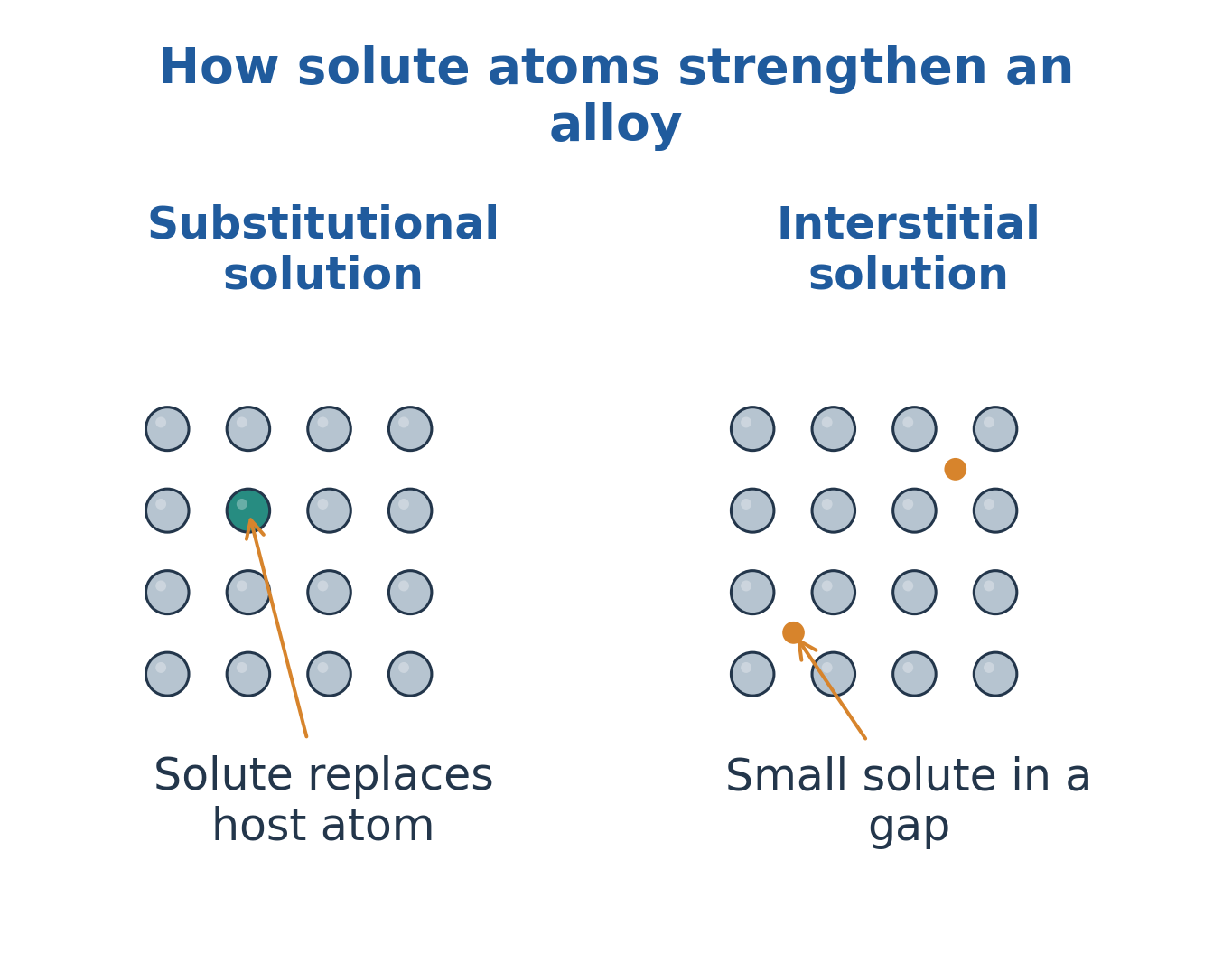


A second phase has a distinct structure or composition; an intermetallic compound has a more specific chemical/structural arrangement. Brass is principally Cu-Zn, bronze conventionally Cu-Sn, and steels are Fe-C-based materials with possible additional elements. Solute strain fields and particles can obstruct dislocations. More alloying does not automatically improve every property: strength can rise while ductility or conductivity falls. Distinguish the overall alloy composition from the compositions of its individual phases.
Worked problem 1.24: Alloy inventory
Route: ME
Problem. How much copper and zinc form 8 kg of an ideal 70/30 mass-percent brass?
Answer and explanation. Copper = 0.70 x 8 = 5.6 kg; zinc = 0.30 x 8 = 2.4 kg. They sum to 8 kg. No melting loss or composition change is included in this supplied mass model.
21. Reading phase diagrams and calculating phase fractions
Study route: ME
An equilibrium binary phase diagram shows stable phases versus temperature and composition at stated pressure. Liquidus separates fully liquid from liquid-plus-solid conditions; solidus separates fully solid from partially liquid conditions. In a two-phase region, a horizontal tie line gives phase compositions at its ends. A eutectic reaction converts one liquid into two solid phases at the eutectic condition; this differs from an isomorphous solid-solution lens.


For alpha + beta, w(alpha) = [C(beta)-C0]/[C(beta)-C(alpha)] and w(beta) = [C0-C(alpha)]/[C(beta)-C(alpha)]. Use the same mass or mole basis throughout. Fractions must lie between zero and one, add to one, and reconstruct the bulk composition. Equilibrium phase diagrams do not automatically predict a rapidly quenched microstructure: kinetics may prevent equilibrium products from forming. Identify phases, compositions and quantities in that order.
Derive the lever rule
Let total mass be one unit. Then w(alpha) + w(beta) = 1 and conservation of component B gives C0 = w(alpha)C(alpha) + w(beta)C(beta). Substitute w(beta) = 1-w(alpha) and rearrange to obtain the formula above. The numerator is the opposite tie-line arm, which explains the lever-rule name. If the bulk composition lies outside the two-phase interval, the formula would give an invalid fraction; identify the correct phase field before calculating.
Eutectic and kinetic distinctions
At a binary eutectic condition, one liquid transforms into two solid phases. Above and below that point, follow the appropriate phase fields rather than using a single solid-solution diagram for all alloys. Rapid cooling can suppress diffusion and change product scale or phase selection. Consequently, equilibrium diagrams provide a thermodynamic map, while cooling history and transformation kinetics determine whether the material follows that map closely.
Worked problem 1.25: Lever rule
Route: ME
Problem. At a tie line, alpha is 20 wt% B, beta 80 wt% B and bulk alloy 35 wt% B. Find phase mass fractions.
Answer and explanation. w(alpha) = (80-35)/(80-20) = 0.75. w(beta) = (35-20)/60 = 0.25. Check composition: 0.75 x 20 + 0.25 x 80 = 35 wt% B.
22. Heat treatment: annealing, normalizing, quenching and tempering
Study route: ME
Heat treatment changes microstructure through a controlled thermal history. In steel, suitable heating can produce austenite; subsequent cooling rate influences transformation products. Slow cooling allows diffusional changes, whereas rapid quenching can form hard martensite in a suitable steel. Martensitic transformation is not simply the precipitation of additional carbon particles.

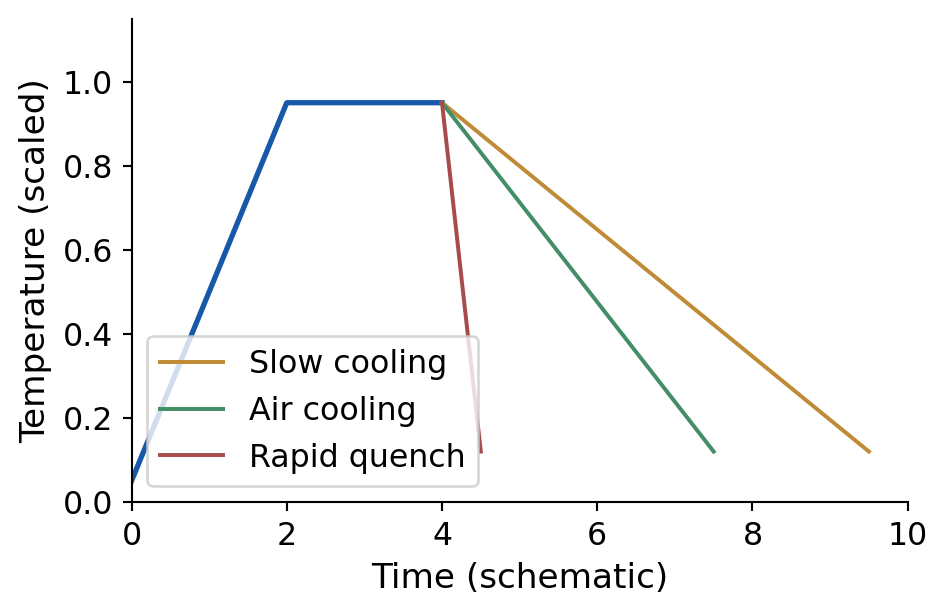
Annealing can promote recovery, recrystallization or other softening/equilibration according to the chosen treatment. Normalizing uses air cooling after suitable austenitization and can refine the resulting structure. Quenching can increase hardness but introduce stress and brittleness; tempering reheats quenched steel below the relevant transformation range to adjust properties and reduce brittleness. Temperature, holding time, composition, section size and cooling medium matter. Describe the complete heating-holding-cooling sequence and the resulting structure rather than defining heat treatment as heating alone.
Why holding time and section size matter
The furnace temperature is not instantly the same as the temperature everywhere inside a component. Holding allows thermal equalization and the intended transformations or dissolution to proceed. During quenching, the surface and centre can cool at different rates, creating gradients, residual stress and nonuniform structure. A treatment successful for a thin specimen may not give the same through-thickness response in a thick part. Identify the purpose of each stage instead of assigning one universal time or temperature to every steel.
| Treatment | Key distinction |
|---|---|
| Annealing | Controlled softening/equilibration route |
| Normalizing | Suitable heating then air cooling |
| Quenching | Rapid cooling; hard structures may form |
| Tempering | Reheat quenched steel to adjust property balance |
Worked problem 1.26: Heat-treatment sequence
Route: ME
Problem. A suitable steel is quenched to high hardness but excessive brittleness. Which subsequent operation can adjust the property balance, and why is it not simply another quench?
Answer and explanation. Tempering uses controlled reheating and holding below the relevant transformation range to modify the quenched structure and reduce brittleness. It is a distinct thermal stage, and its temperature/time must match the required properties.
23. Strengthening by solid solution, precipitation and work hardening
Study route: ME
Plastic deformation commonly involves dislocation motion. Solid-solution strengthening arises because solute-related distortions interact with dislocations. Precipitation hardening uses a controlled distribution of second-phase particles to resist motion. A typical sequence is solution treatment, quenching to retain a supersaturated state and ageing to develop strengthening precipitates. The exact treatment depends on the alloy system.

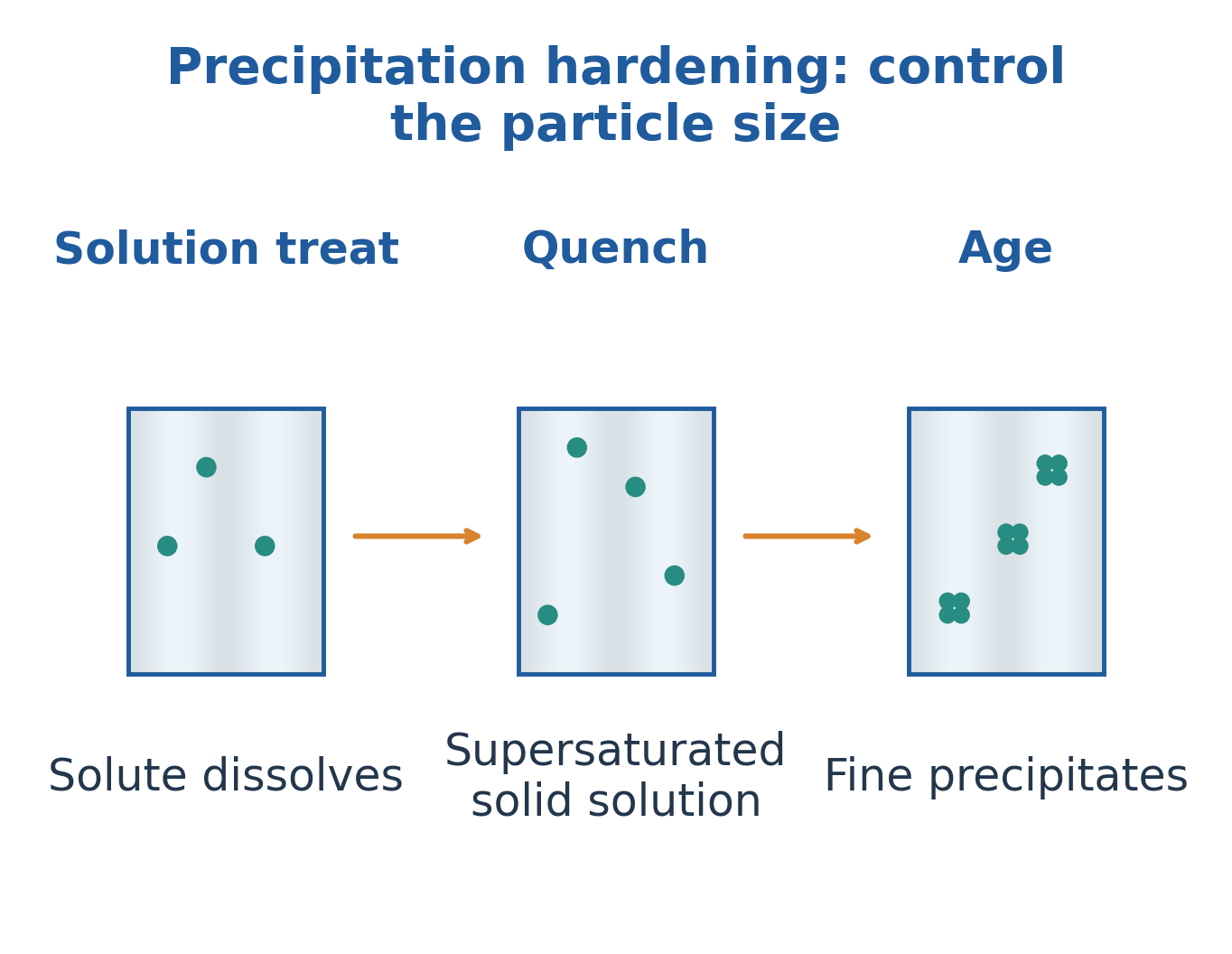
Over-ageing can coarsen particles and reduce strengthening. Work hardening increases dislocation density through plastic deformation; interactions make further deformation harder and usually reduce remaining ductility. Grain boundaries also impede slip, though simple grain-size relations have limits. These mechanisms do not create identical microstructures. A cold-worked alloy can soften during recovery/recrystallization, whereas an aged alloy can lose strength through precipitate evolution. Identify the structure and thermal history before diagnosing a strength change.
Worked problem 1.27: Ageing diagnosis
Route: ME
Problem. An age-hardened alloy loses strength after prolonged heat exposure. Give a mechanism.
Answer and explanation. Precipitates can coarsen during over-ageing, changing spacing and their resistance to dislocation motion. Compare thermal history and microstructure. Do not infer that the total alloying-element mass necessarily disappeared.
Worked problem 1.28: Cold-work reduction
Route: ME
Problem. A bar is plastically reduced from 100 mm² to 70 mm² area. Calculate percentage cold-work area reduction and explain the expected mechanism.
Answer and explanation. Reduction = 100(100-70)/100 = 30%. Plastic deformation increases dislocation interactions and can raise strength while reducing remaining ductility. The percentage is not an equal percentage rise in strength.
24. Non-destructive testing: chemical principles and method limits
Study route: ME
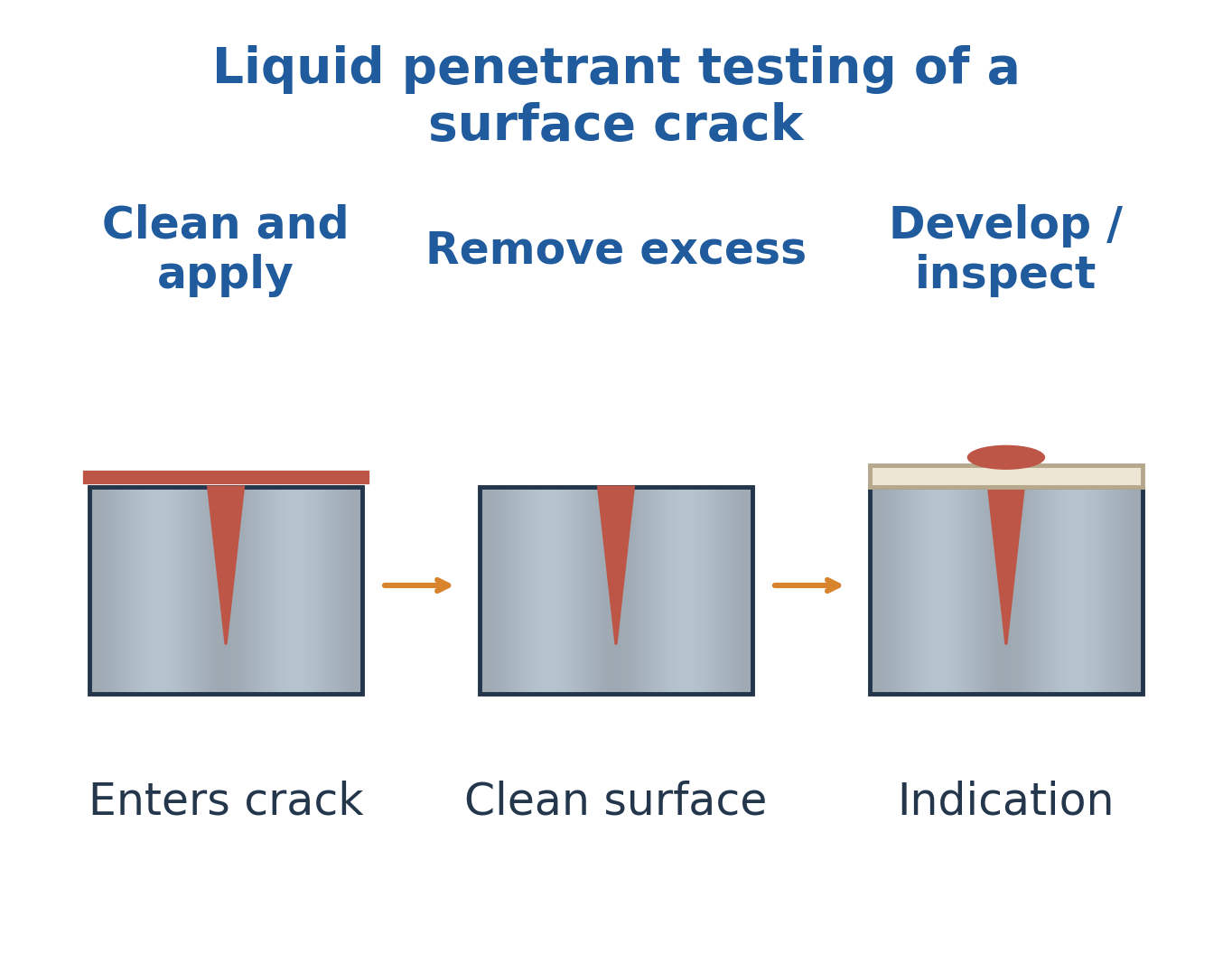
Liquid-penetrant testing uses wetting and capillary entry into accessible surface-breaking flaws. The sequence is cleaning, penetrant application and dwell, excess removal, development and inspection. A developer makes retained penetrant easier to see. The method suits appropriate nonporous surfaces, but cannot reveal a completely sealed internal crack. Poor cleaning, excessive removal or unsuitable surface condition can produce false or missed indications.

Magnetic-particle testing detects flux leakage near discontinuities in suitable ferromagnetic materials. Ultrasonic testing uses acoustic propagation/reflection, while radiography uses differential radiation attenuation. These are not all chemical colour reactions, and their suitability differs by material, geometry and defect orientation. Non-destructive does not mean that a method detects every defect. State material compatibility, defect location, detection principle and limitations before recommending a technique.
Interpreting an NDT indication
An indication is evidence to evaluate, not automatically a confirmed crack of known size. Geometry, roughness and retained contamination can also affect a response. Reinspect with suitable preparation or a complementary method when the result is ambiguous. Penetrant methods emphasize accessible surface paths, magnetic methods need magnetic response, ultrasound needs useful acoustic coupling and geometry, and radiography depends on attenuation contrast. A complete answer gives the method, the defect it can reveal, the important limitation and a reason for selecting it.
| Method | Material / defect boundary |
|---|---|
| Liquid penetrant | Accessible surface-breaking flaws; nonporous surface |
| Magnetic particle | Suitable ferromagnetic material; flux leakage |
| Ultrasonic | Acoustic reflections; geometry/coupling matter |
| Radiographic | Attenuation contrast; orientation and safety matter |
Worked problem 1.29: NDT choice
Route: ME
Problem. Choose a method to reveal surface-breaking cracks on a clean nonporous nonmagnetic part.
Answer and explanation. Liquid-penetrant testing is suitable for accessible surface-breaking defects: wet, allow capillary entry, remove excess and develop indications. Magnetic-particle testing requires a suitably ferromagnetic part. A penetrant cannot reveal an entirely sealed internal crack.
25. Textile fibre classification and natural-fibre chemistry
Study route: TX
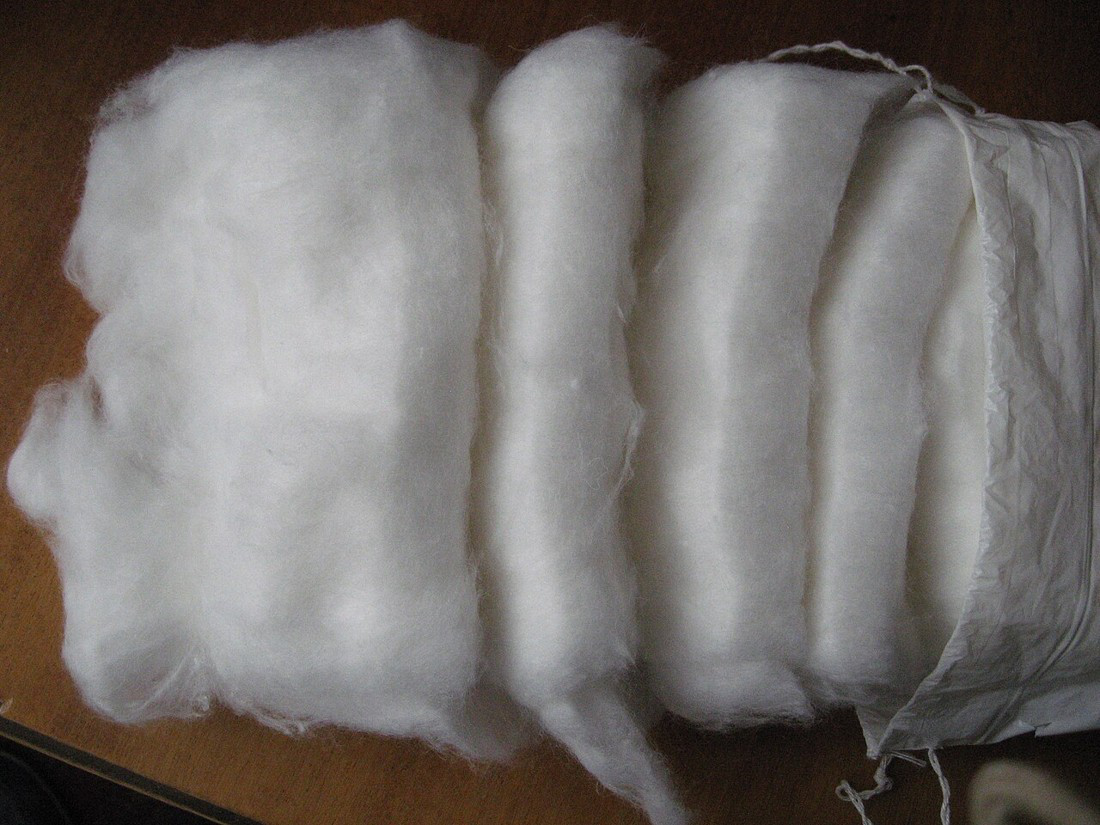
Plant fibres include cotton and jute. Cotton is predominantly cellulose, whose beta-(1->4)-linked glucose chains carry many hydroxyl groups. Jute is a lignocellulosic bast fibre containing cellulose, hemicellulose and lignin. Animal fibres include wool and silk: wool contains keratin with important disulfide cross-links, while silk is rich in fibroin with ordered protein regions that contribute to strength.

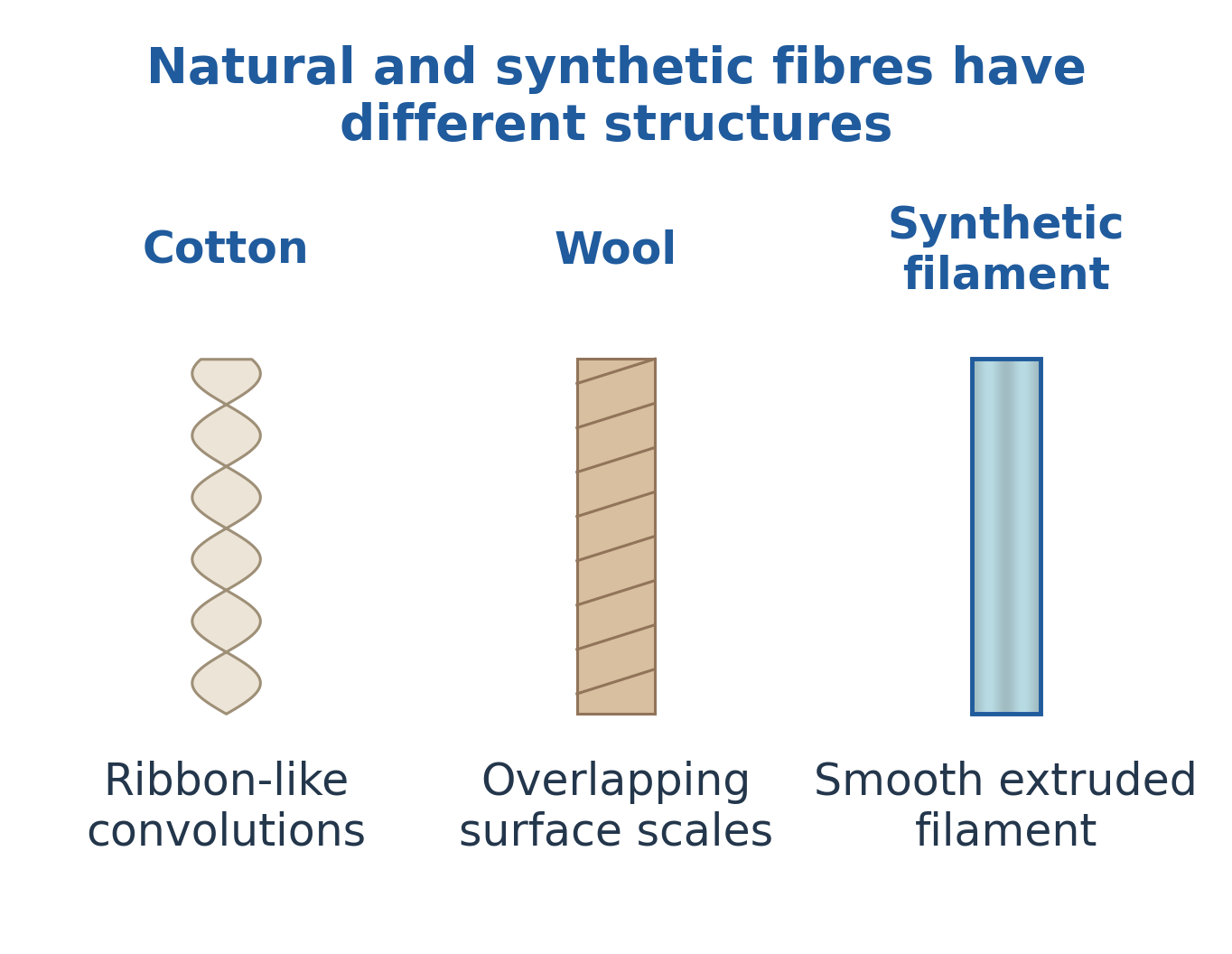

Cellulose hydroxyls support hydrogen bonding with water and influence chemical modification. Protein fibres have peptide backbones and side groups whose charge/reactivity changes with conditions. Processing sensitivity therefore differs: strong conditions suitable for one cellulosic fabric may damage a protein fibre. Regenerated cellulose is processed natural cellulose formed into a new fibre; it is distinct from a fully synthetic carbon-chain polymer. Classify by source and chemical structure together.
| Natural fibre | Principal chemistry |
|---|---|
| Cotton | Cellulose |
| Jute | Cellulose + hemicellulose + lignin |
| Natural fibre | Principal chemistry |
|---|---|
| Wool | Keratin protein; disulfide links |
| Silk | Fibroin-rich protein structure |
Worked problem 1.30: Fibre chemical identification
Route: TX
Problem. A fibre is predominantly cellulose; another is predominantly keratin. Identify representative fibres and an important chemical distinction.
Answer and explanation. Cotton is a representative cellulose fibre; wool is keratin based. Cellulose has hydroxyl-rich carbohydrate chains, while wool has peptide structures and important disulfide links. Their chemical processing responses are therefore different.
26. Synthetic fibres: nylon, polyester and acrylic
Study route: TX
Nylon is a polyamide whose amide groups support interchain hydrogen bonding. Polyester such as PET contains ester links and aromatic units; chain packing and relatively hydrophobic character affect sorption and dyeing. Acrylic fibres are based mainly on polyacrylonitrile, with formulation/comonomers influencing processing and properties. These are different polymer families, not interchangeable names for plastic thread.


Functional groups determine possible interactions and chemical sensitivity, while molecular mass, orientation and crystallinity modify performance. A polymer can have suitable chemistry yet produce a weak fibre if processing gives poor organization or defects. Nylon/polyester commonly arise through step-growth chemistry, whereas acrylonitrile commonly polymerizes by chain growth. That background identifies the fibre chemistry; the detailed polymerization and spinning syllabus belongs to the later textile unit. Compare fibre response using composition, accessible groups, morphology and test conditions.
Chemical resistance and heat response
Polyester ester links can undergo hydrolysis under sufficiently severe conditions; polyamide response depends on amide chemistry, absorbed moisture and environment. Protein fibres and cellulosic fibres respond differently because their backbones and reactive groups differ. A statement that a fibre is synthetic does not specify resistance to every acid, alkali or solvent. Melting, softening and chemical degradation are different events, and test temperature/time must accompany a claim of stability.
Worked problem 1.31: Blend composition
Route: TX
Problem. A 250 g fabric is 60 wt% cotton and 40 wt% polyester. Find each fibre mass.
Answer and explanation. Cotton = 150 g; polyester = 100 g. Cotton provides cellulose hydroxyl-rich chemistry, whereas PET contains polyester chains. A blend is not a new single copolymer merely because fibres are mixed.
27. Fibre morphology, orientation and structure-property relationships
Study route: TX
A fibre contains organized chains with crystalline and amorphous regions. Ordered packing restricts motion and access; less-ordered regions allow greater segmental movement and often greater penetrant access. Orientation aligns chains and load-bearing structures along the fibre axis. Drawing can increase axial strength, but excessive treatment can damage fibres or reduce useful extensibility.

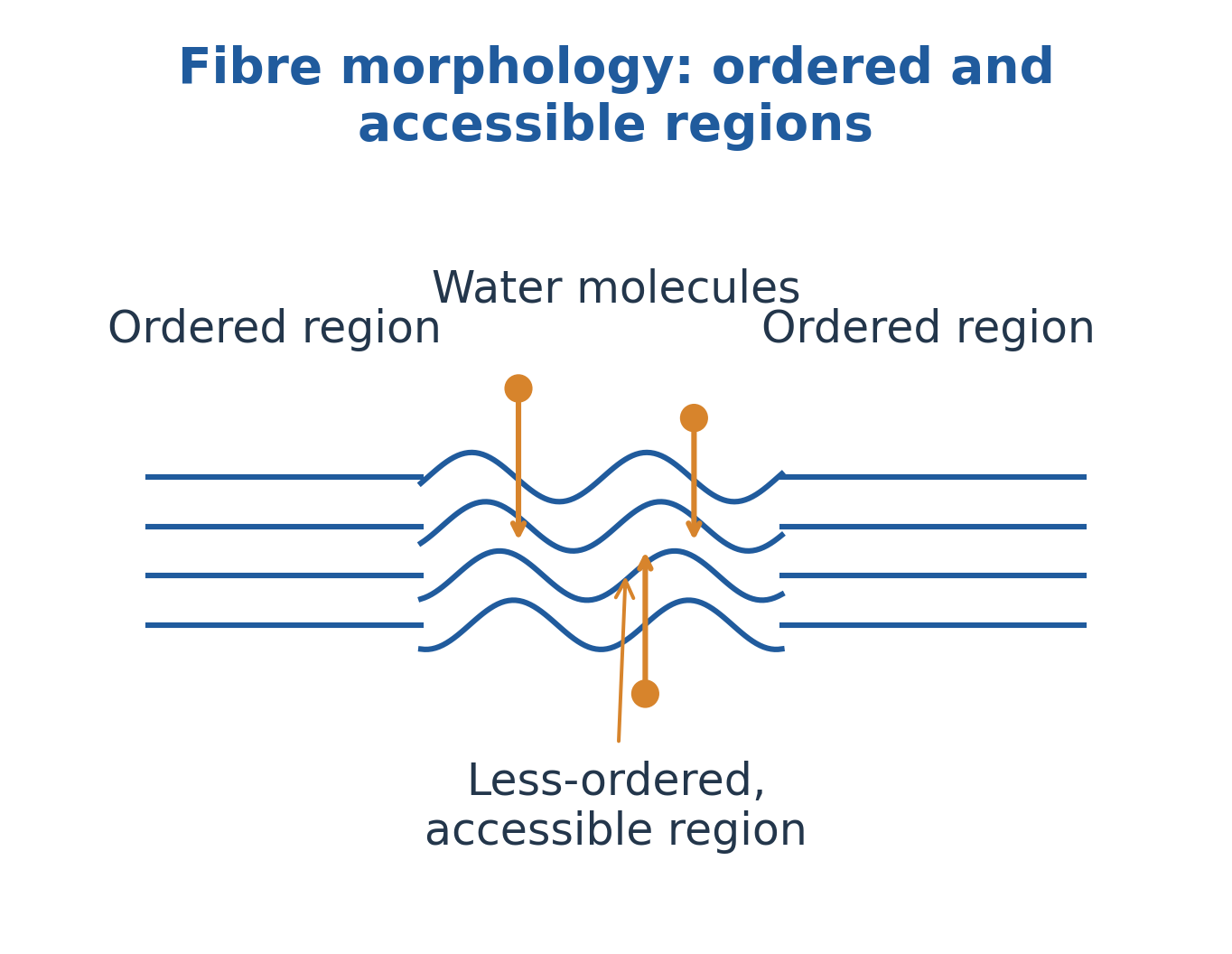
Cross-section, voids, surface structure and chemical accessibility affect handling and processing. Wool scales help explain felting; cotton morphology and hydroxyl-rich chemistry help explain absorption and wet processing. Strength, elasticity, abrasion, dimensional change and dye diffusion follow from several structural features together. High crystallinity does not imply zero moisture uptake, and a smooth external appearance does not prove an internally defect-free fibre. Relate a measured property to both chemical groups and physical organization.
Connect morphology to a property comparison
An oriented chain network can carry axial load effectively, whereas defects and misalignment interrupt that load path. Ordered regions can restrict swelling and dye access while less-ordered regions permit diffusion and segmental motion. The balance influences strength, elongation, handle, thermal shrinkage and chemical treatment. Two fabrics made from the same polymer can therefore differ because spinning, drawing and finishing produced different morphology. Describe the actual chemical and structural cause rather than using thickness or gloss as the only explanation.
Worked problem 1.32: Swelling explanation
Route: TX
Problem. Why may two fibres of similar diameter show different water uptake?
Answer and explanation. Accessible polar groups, crystallinity, amorphous regions and surface treatment differ. Diameter alone does not specify sorption. Compare conditioned mass on a dry-mass basis under the same humidity and temperature.
28. Moisture absorption, regain, content and swelling
Study route: TX
Moisture regain = 100(mconditioned-mdry)/mdry. Moisture content = 100(mconditioned-mdry)/mconditioned. The same water mass produces different percentages because the denominators differ. State conditioning humidity/temperature and the dry-mass method. Surface liquid, absorbed water and retained processing chemicals should not be silently treated as equivalent measurements.

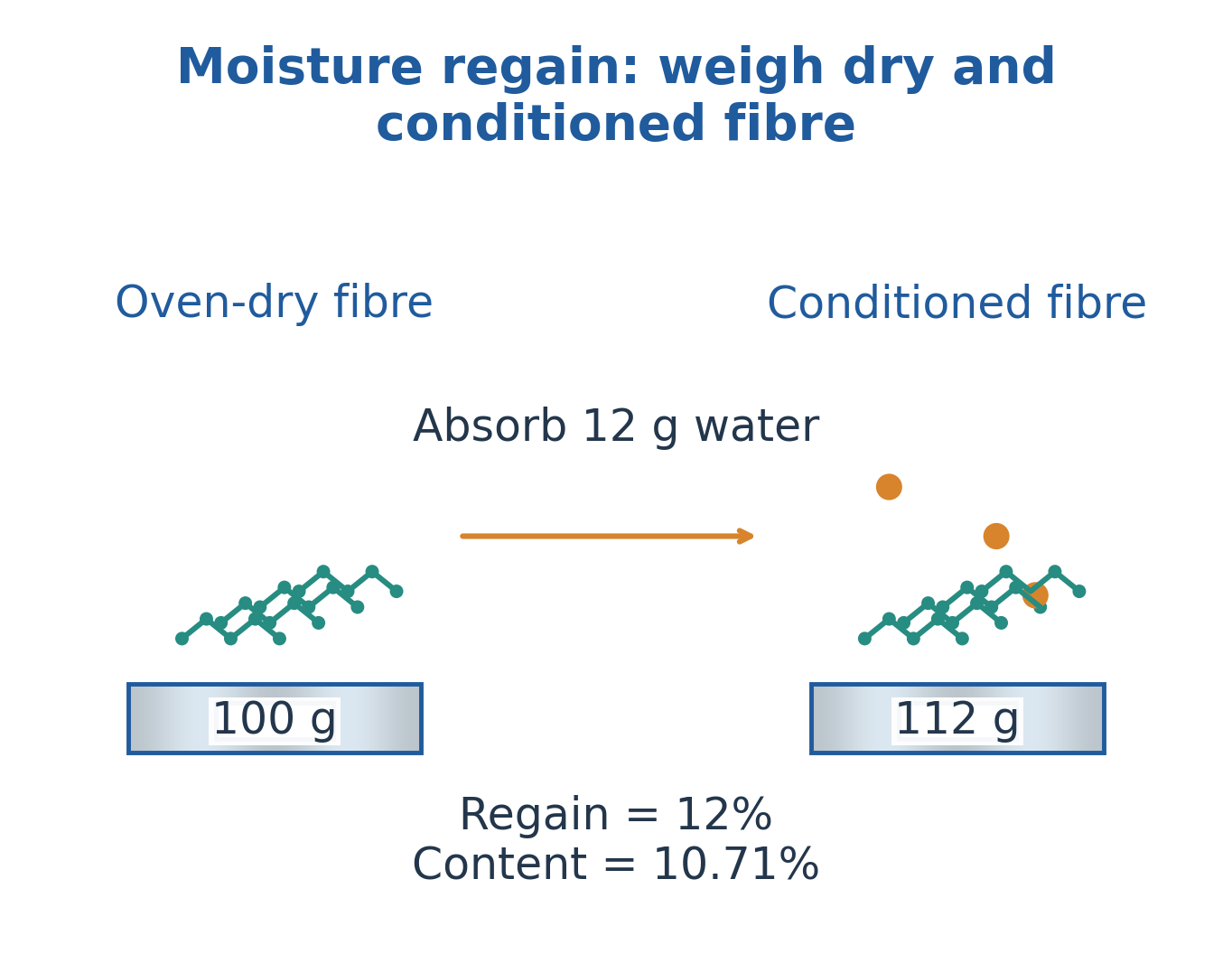
Water can hydrogen-bond with accessible groups, enter less-ordered regions and produce swelling or plasticization. This can change dimensions, comfort, static accumulation and mechanical response. The effect depends on fibre chemistry and morphology; nominal fibre diameter alone cannot predict uptake. A water-repellent surface treatment changes wetting without necessarily eliminating internal sorption. A good explanation connects accessible groups -> water interaction -> chain/structure change -> observed property.
Worked problem 1.33: Moisture definitions
Route: TX
Problem. A fibre sample weighs 11 g conditioned and 10 g oven dry. Find regain and moisture content.
Answer and explanation. Water mass = 1 g. Regain = 100 x 1/10 = 10%; moisture content = 100 x 1/11 = 9.09%. Different denominators explain the difference.
Worked problem 1.34: Convert regain to moisture content
Route: TX
Problem. A fibre has 12% moisture regain. Express its wet-basis moisture content using a convenient 100 g dry basis.
Answer and explanation. At 100 g dry mass, water = 12 g and moist mass = 112 g. Moisture content = 100 x 12/112 = 10.71%. Regain and content must not be reported as interchangeable percentages.
29. Carbohydrates: classification, glycosidic bonds and functions
Study route: BT
Monosaccharides include glucose and fructose; disaccharides include sucrose and lactose; polysaccharides include starch, glycogen and cellulose. Sugar units connect through glycosidic bonds. The anomeric configuration and bond position matter: alpha-linked storage polymers and beta-(1->4)-linked cellulose have different organization and biological behaviour even when built from glucose.

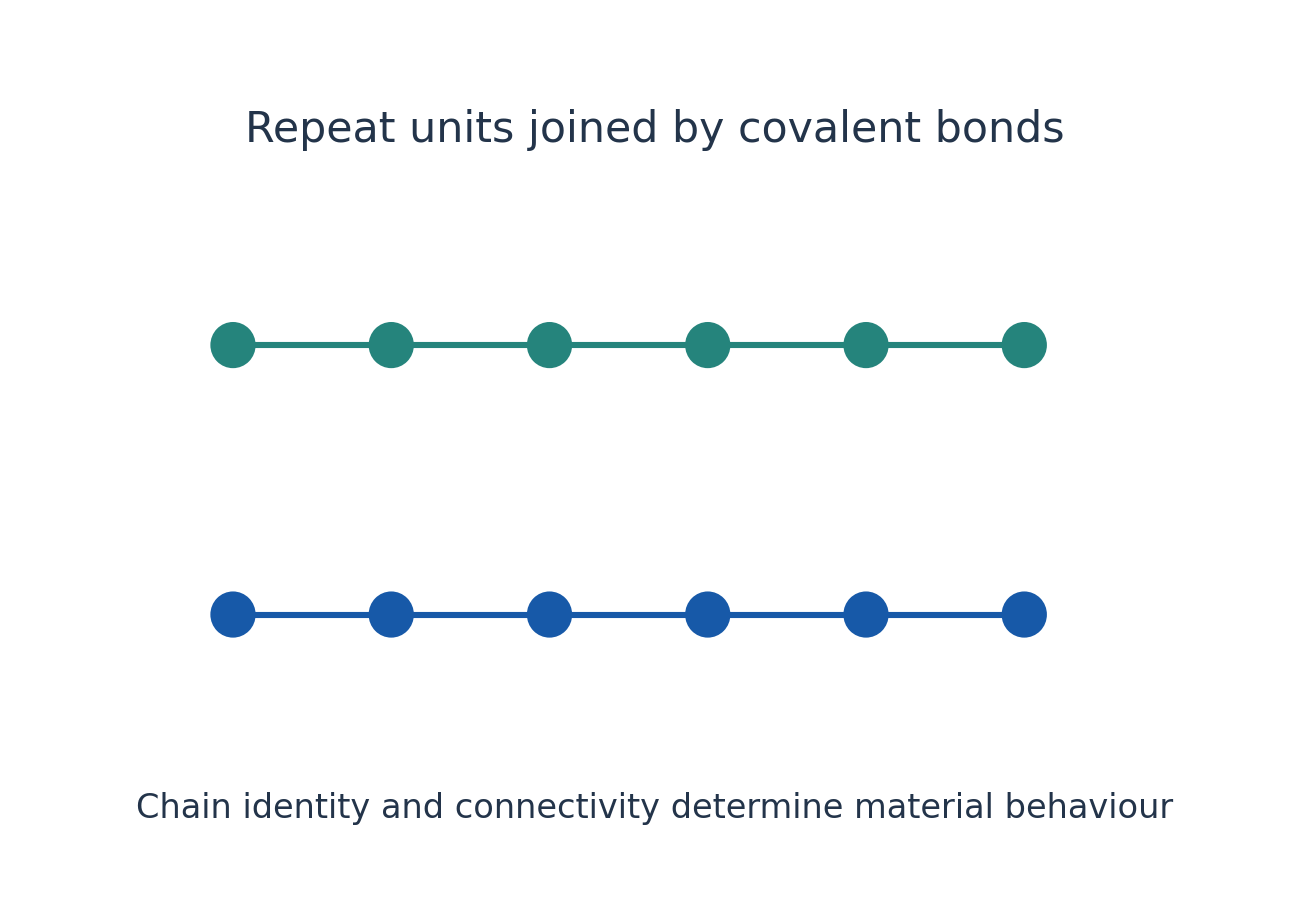

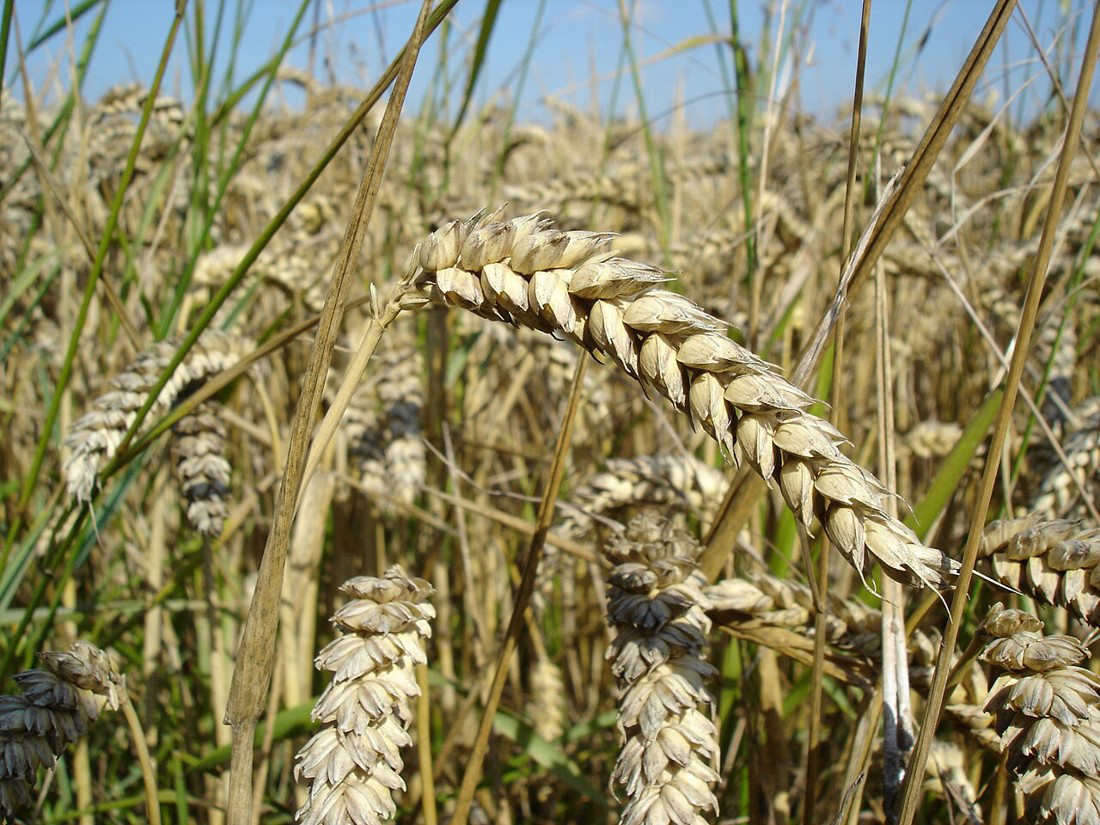
Starch contains amylose and branched amylopectin; glycogen is highly branched and supports accessible storage. Cellulose forms extended chains with strong collective hydrogen bonding and structural function. Reducing behaviour depends on an available appropriate anomeric centre, not sweetness or merely being a carbohydrate. Draw the monomer/linkage idea, state branching and then connect to storage, recognition or structural role. Composition alone does not capture the effect of linkage geometry.
Linkage-based comparison
Starch and cellulose illustrate why identical monomer identity does not imply identical properties. Alpha-linked starch structures support storage and differ in branching, whereas cellulose chains have beta-(1->4) connectivity that supports extended association. Glycogen has extensive branching, creating many chain ends useful in biological storage mobilization. State the bond geometry and branching before discussing the function. A disaccharide can also differ in reducing behaviour depending on whether the relevant anomeric centres remain available or participate in the linkage.
30. Amino-acid chemistry, zwitterions and peptide bonds
Study route: BT
A typical alpha-amino acid has amino and carboxyl groups plus hydrogen and a side chain attached to the alpha carbon. In suitable aqueous conditions, internal acid-base transfer gives a zwitterionic form with both positive and negative groups. Net charge changes with pH and ionizable side groups. The isoelectric point is the pH of zero average net charge for the specified species, not the absence of charged groups.

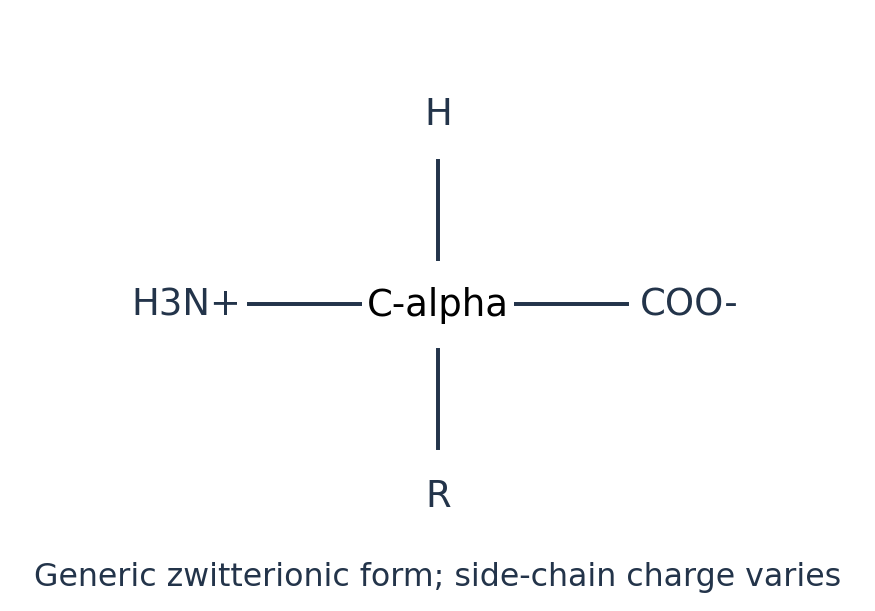

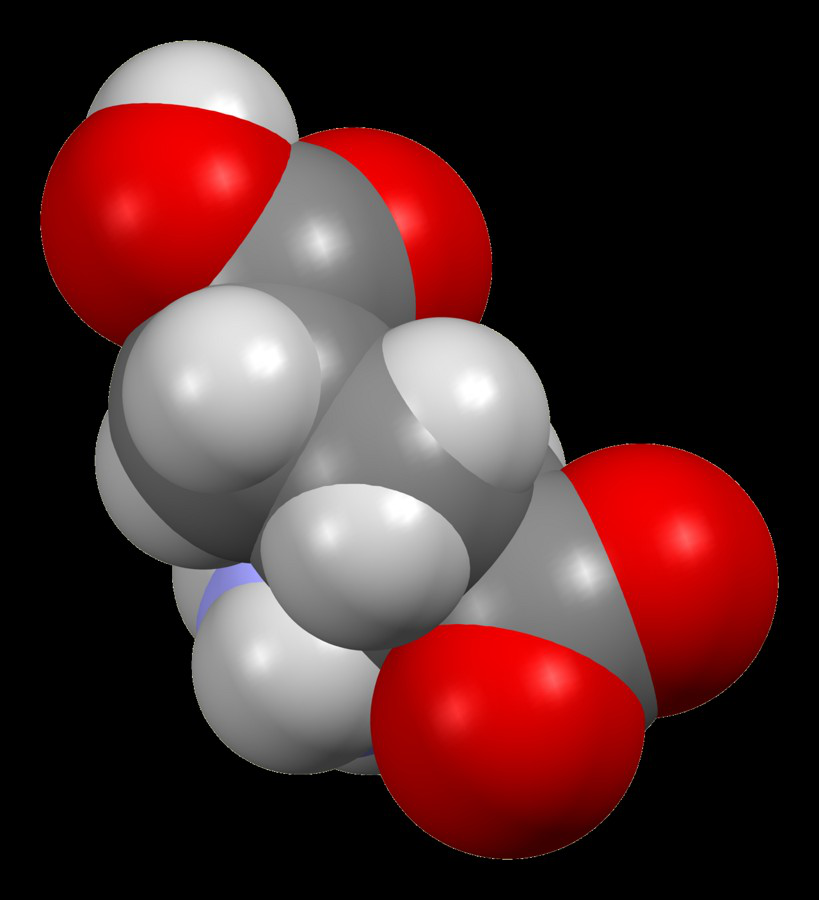
A peptide bond joins the carboxyl group of one amino acid to the amino group of another through condensation. A linear chain has N-terminal and C-terminal directionality, and n residues require n-1 backbone peptide links when no extra cross-links are counted. Side chains provide chemical diversity. Hydrolysis cleaves peptide bonds, whereas changes in folding can occur without complete backbone cleavage. Keep these distinctions when explaining protein processing or loss of activity.
Worked problem 1.35: Peptide links
Route: BT
Problem. How many peptide bonds join a single linear chain of 120 amino-acid residues?
Answer and explanation. A linear chain has one fewer link than residues: 119 peptide bonds, ignoring additional cross-links. Hydrolysis of all these links differs from denaturation, which can disrupt folding without cleaving the backbone.
Worked problem 1.36: Zwitterion versus uncharged groups
Route: BT
Problem. Can an amino acid have zero net charge while containing charged groups? Distinguish this from a molecule with no charged groups.
Answer and explanation. Yes. A zwitterionic form can contain positive and negative groups whose charges balance. Zero net charge does not mean each functional group is neutral; pH and side-chain ionization determine the actual charge distribution.
31. Protein levels, folding and denaturation
Study route: BT
Primary structure is amino-acid sequence. Secondary structure includes alpha helices and beta sheets, stabilized largely by backbone hydrogen bonding. Tertiary structure is the three-dimensional organization of one polypeptide. Quaternary structure describes associated subunits when present; not every protein has it. Sequence provides chemical possibilities, while the environment and interactions influence the folded state.

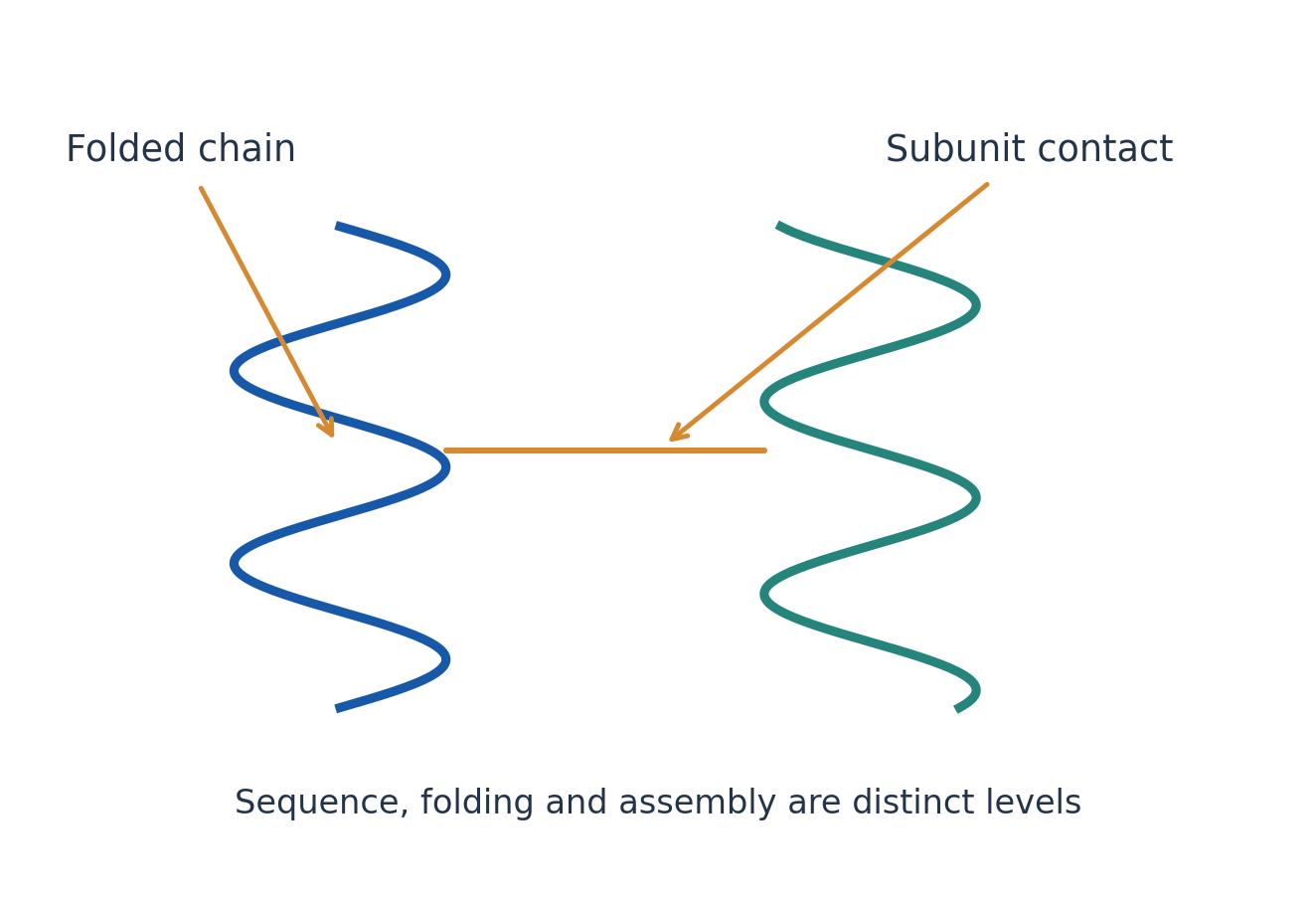
Hydrophobic packing, hydrogen bonds, ionic interactions, van der Waals contacts and sometimes disulfide bridges stabilize organization. Denaturation disrupts higher-order structure and can reduce activity without cleaving every peptide bond. Temperature, pH, solvent and interfaces can affect stability. Refolding is possible for some systems under suitable conditions, but aggregation or chemical damage can make recovery incomplete. Explain the level altered and the interactions involved rather than defining denaturation as simply heating a protein.
Denaturation versus chemical cleavage
Loss of native activity after a pH or temperature change can reflect disrupted folding, aggregation, cofactor changes or chemical damage. It does not prove that all peptide bonds were hydrolysed. Conversely, hydrolysis changes the covalent chain into smaller fragments even if the fragments remain soluble. When interpreting an experiment, separate solubility, molecular identity, folding and functional activity; no single visual observation establishes every one of these properties.
| Protein level | What it describes |
|---|---|
| Primary | Amino-acid sequence |
| Secondary | Local helices/sheets |
| Tertiary | Fold of one polypeptide |
| Quaternary | Associated subunits, when present |
32. Lipids: fatty acids, phospholipids and sterols
Study route: BT
Fatty acids contain a hydrocarbon region and a carboxyl group. Saturated chains lack carbon-carbon double bonds; cis double bonds can bend chains and alter packing. Triacylglycerols are esters of glycerol with three fatty acids and serve important storage roles. Chemical structure, not only chain length, influences melting and oxidative behaviour.

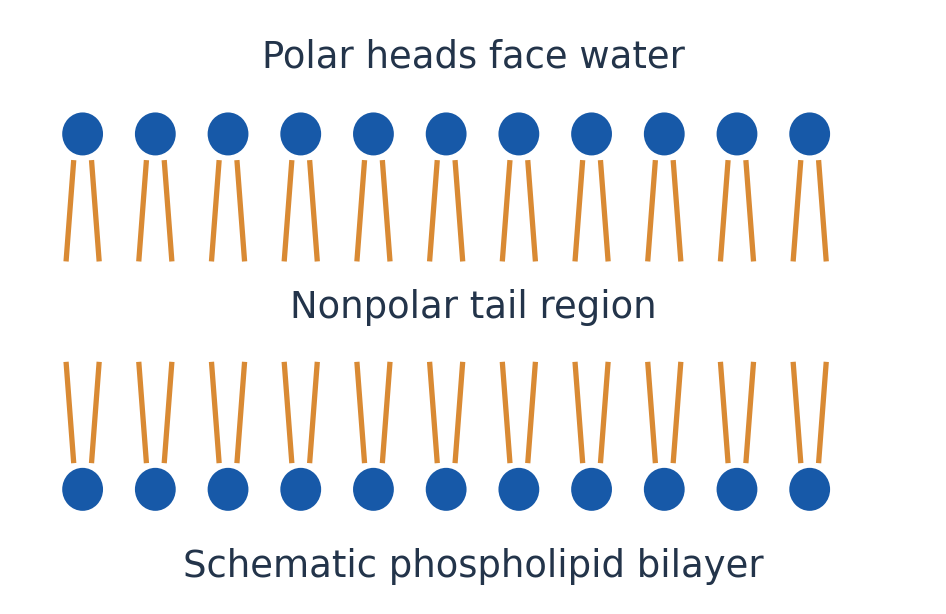

Phospholipids combine polar head regions and nonpolar tails. Their amphiphilic organization supports bilayers in water, with hydrophobic tails sheltered and polar groups exposed. Sterols have a fused-ring framework; cholesterol influences membrane organization and supplies precursors for other biological compounds. Lipids are chemically diverse and are not one ordinary repeating-monomer polymer family. Distinguish storage, membrane and signalling-related roles. A change in saturation can alter packing, but biological membrane behaviour depends on the complete mixture and temperature.
Worked problem 1.37: Classify three lipid structures
Route: BT
Problem. Match triacylglycerol, phospholipid and sterol with energy storage, bilayer-forming amphiphilic organization and a fused-ring framework.
Answer and explanation. Triacylglycerol matches storage; a suitable phospholipid matches bilayer organization; a sterol has the fused-ring framework. Lipids are chemically diverse, so these structures should not all be described as one repeat-unit polymer.
33. Nucleotides, DNA and RNA organization
Study route: BT
A nucleotide contains a base, pentose sugar and phosphate; a nucleoside contains base plus sugar without phosphate. Phosphodiester links form a directional sugar-phosphate backbone. DNA uses deoxyribose and commonly A, T, G and C; RNA uses ribose and commonly U instead of T. A difference in sugar chemistry can affect stability and reactivity as well as classification.

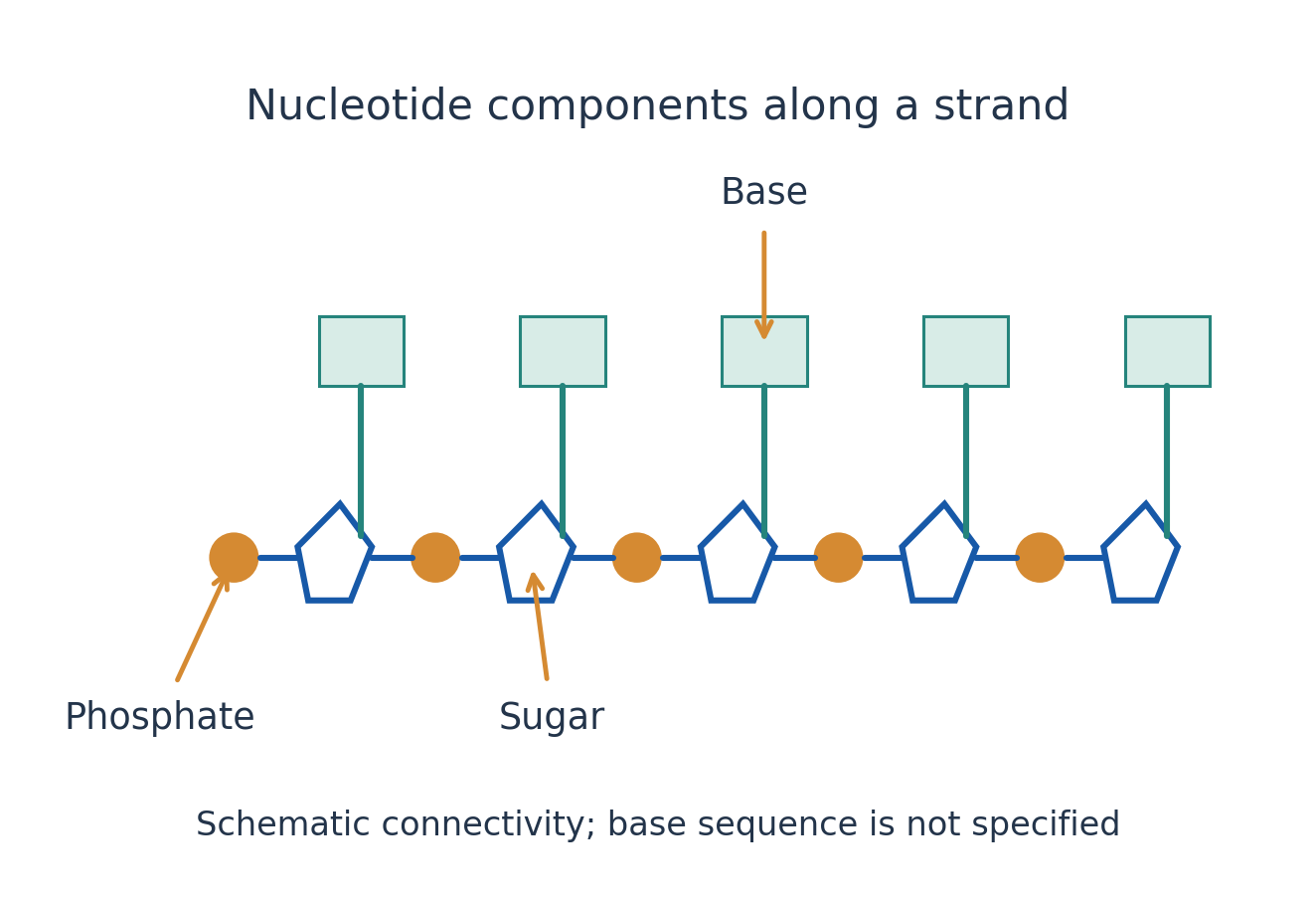
In a standard DNA duplex, strands run antiparallel and bases pair complementarily: A-T and G-C. A sequence written 5-prime to 3-prime must be complemented with direction shown. RNA is often single stranded but can form structured paired regions; single stranded does not mean unstructured. Base sequence carries information, while backbone connectivity and pairing support recognition and copying. Count nucleotides, bases and base pairs on their own clearly stated bases rather than treating those counts as identical.
Worked problem 1.38: DNA complement
Route: BT
Problem. For the strand 5-prime ATGC 3-prime, write its paired complementary strand with direction.
Answer and explanation. The aligned complementary strand is 3-prime TACG 5-prime. Written in its own 5-prime-to-3-prime direction it is 5-prime GCAT 3-prime. Complementarity and antiparallel orientation must both be respected.
Worked problem 1.39: Nucleotide identification
Route: BT
Problem. A component contains ribose, adenine and one phosphate. Is it a nucleoside or nucleotide?
Answer and explanation. It is a nucleotide, adenosine monophosphate. Removing phosphate gives the nucleoside adenosine. Sugar identity distinguishes ribose-based from deoxyribose-based forms; adenine alone does not specify DNA or RNA.
Worked problem 1.40: Double-stranded DNA base balance
Route: BT
Problem. A standard double-stranded DNA sample has 30% adenine among all bases. Find T, G and C percentages assuming complementary pairing.
Answer and explanation. A = T gives T = 30%. The remaining 40% is G plus C, so G = C = 20%. These relations concern the whole complementary double-stranded sample, not every possible single strand.
34. Vitamins, coenzymes and biomolecular forces
Study route: BT
Vitamins are required organic micronutrients, many of which supply precursors for coenzymes. NAD+/NADH transfers redox equivalents; coenzyme A transfers acyl groups. A cofactor can be an inorganic ion or an organic coenzyme according to the enzyme system. ATP is a nucleotide used in coupled energy transfer; it is not itself a vitamin. A small required quantity does not imply an unimportant role.

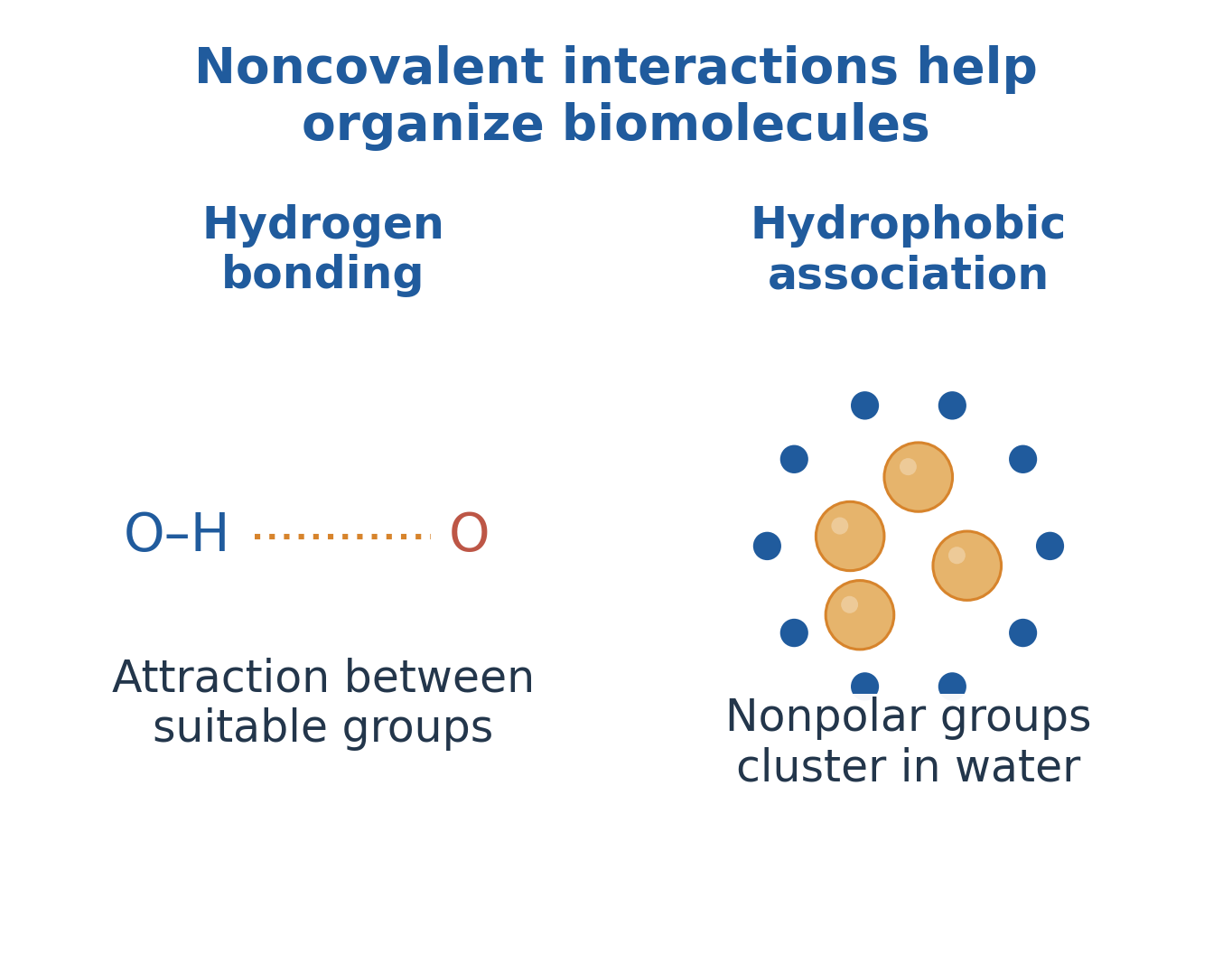
Hydrogen bonds involve suitable donors/acceptors; ionic interactions depend on charge and solution conditions; van der Waals contacts become important collectively at close separation. The hydrophobic effect is solvent-mediated association of nonpolar regions in water, not a newly formed covalent bond. These forces help organize proteins, membranes and nucleic-acid assemblies. Temperature, pH and salt alter their balance. Explain biological function through covalent identity plus noncovalent organization rather than listing molecular formulas alone.
Coenzyme role and chemical form
NAD+ accepts reducing equivalents in suitable enzyme-catalysed reactions to form NADH; its return to the oxidized form supports continuing metabolic redox cycles. Coenzyme A carries acyl groups through a reactive terminal region. A coenzyme is not simply a nutrient added in bulk to increase every reaction rate. Its chemical form, binding and regeneration matter. Vitamins can supply precursors, but inorganic metal cofactors and organic coenzymes remain distinct categories.
35. Reaction stoichiometry, quotient and chemical equilibrium
Study route: CH
A balanced equation conserves each element and charge. Reaction extent relates changes in species amounts through their stoichiometric coefficients. Equilibrium is dynamic: forward and reverse reactions continue at equal rates. The reaction quotient Q uses activities raised to stoichiometric powers; at equilibrium Q = K at the stated temperature. Pure solids and pure liquids usually have unit activity in the corresponding standard-state treatment.

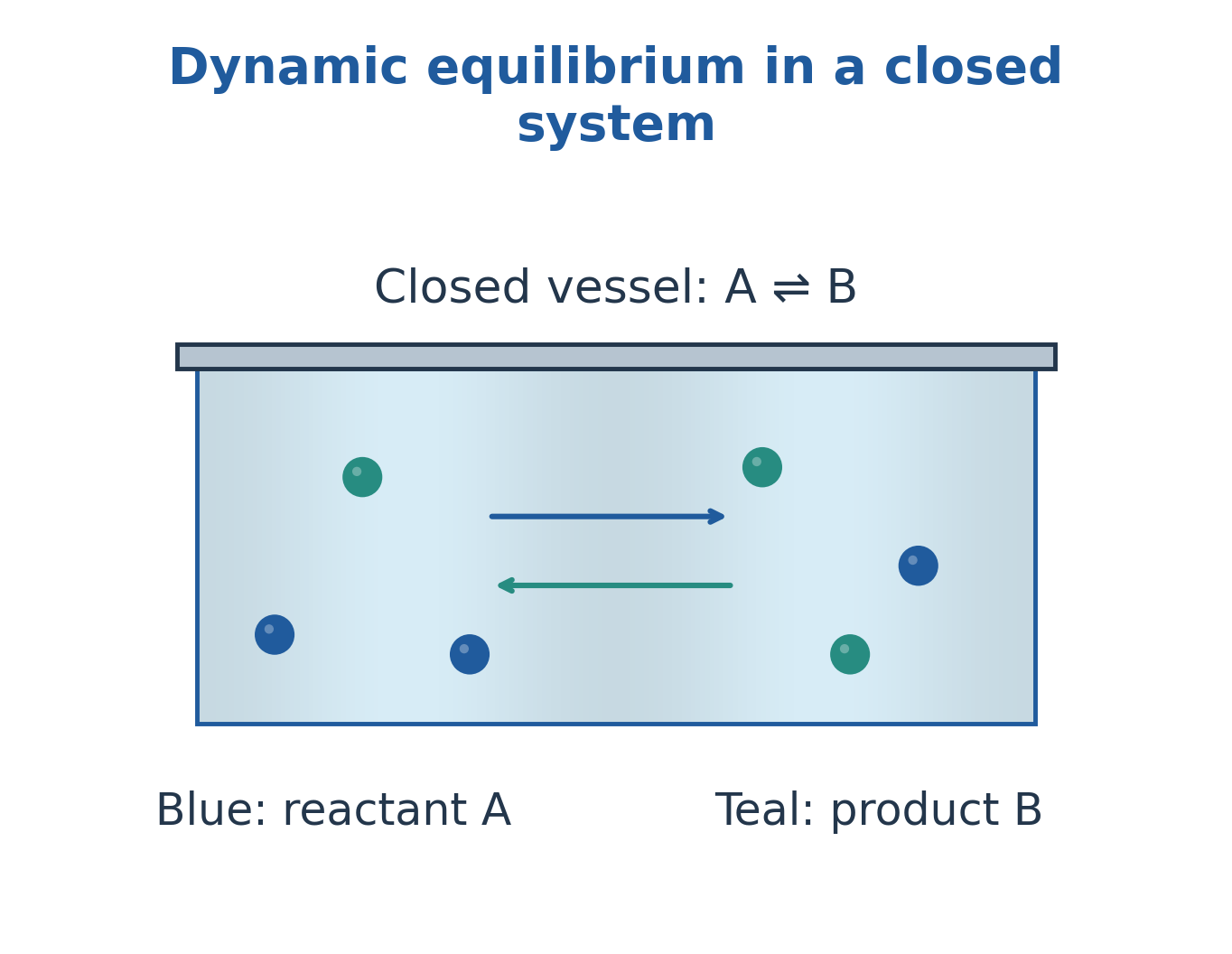
If Q differs from K, the thermodynamically favoured direction tends toward equilibrium under the stated constraints. A catalyst changes the rate of approach, not K for the same reaction and temperature. Stoichiometric coefficients do not automatically equal experimentally determined kinetic orders. Conversion measures consumption of a defined reactant; yield and selectivity need their own denominators and product definitions. Begin an industrial balance with the equation and a clear feed/product basis.
Worked problem 1.41: Reaction quotient and direction
Route: CH
Problem. For A <-> B in an ideal dilute model, K = 4 and current activities are a(A) = 0.50, a(B) = 0.50. Find Q and the favoured direction.
Answer and explanation. Q = a(B)/a(A) = 1. Since Q is less than K, forward conversion toward B is favoured under the stated conditions. At equilibrium Q will equal 4; forward and reverse molecular events do not stop.
36. Le Chatelier principle and industrial operating choices
Study route: CH
Le Chatelier reasoning predicts qualitative response when an equilibrium system is disturbed. Adding a reactant activity can favour its consumption; removing product can favour further formation. Compression can favour fewer gas moles when gas activities change appropriately. If gas-mole totals are equal, a simple pressure-shift claim may not apply. An inert gas has different effects at fixed volume and fixed pressure, so the operating constraint matters.

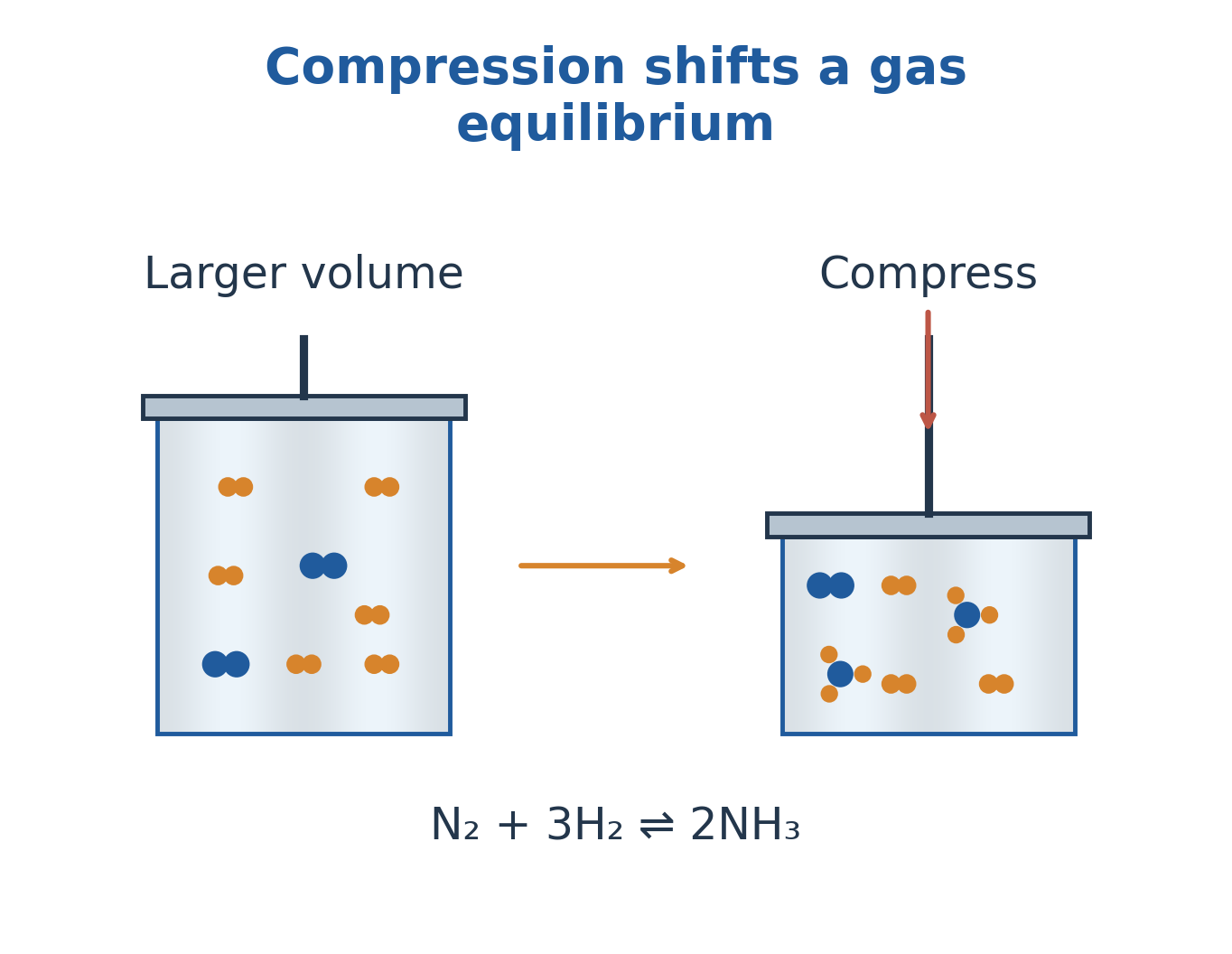
For an exothermic reaction, lower temperature can favour equilibrium product while reducing reaction rate. Industrial operation balances equilibrium, kinetics, separation, safety and energy. The catalyst helps attain a useful rate; it does not increase the equilibrium constant at fixed temperature. High pressure also has compression and equipment costs. Separate single-pass reactor conversion from overall utilization with separation and recycle. An equilibrium-favourable condition is not automatically the most economical operating point.
| Change | Equilibrium reasoning |
|---|---|
| Temperature | Changes K; direction depends on reaction enthalpy |
| Composition | Changes Q; net reaction responds toward K |
| Catalyst | Changes approach rate, not K at fixed T |
Worked problem 1.42: Pressure and catalyst distinction
Route: CH
Problem. For N2 + 3H2 <-> 2NH3, explain the simple equilibrium effect of compression and the separate role of a catalyst.
Answer and explanation. Compression can favour the two-mole gas-product side relative to the four-mole reactant side. A catalyst changes rates of approach to equilibrium and does not change K at fixed temperature. These are different mechanisms.
37. Enthalpy, entropy and Gibbs free energy
Study route: CH
Enthalpy is H = U + pV; heat transferred at constant pressure equals enthalpy change under the appropriate work assumptions. Entropy describes the thermodynamic distribution of energy and accessible states; spontaneous total change increases total entropy. For constant temperature and pressure, Delta G = Delta H – T Delta S is the relevant free-energy relation. Use absolute kelvin and compatible energy units.

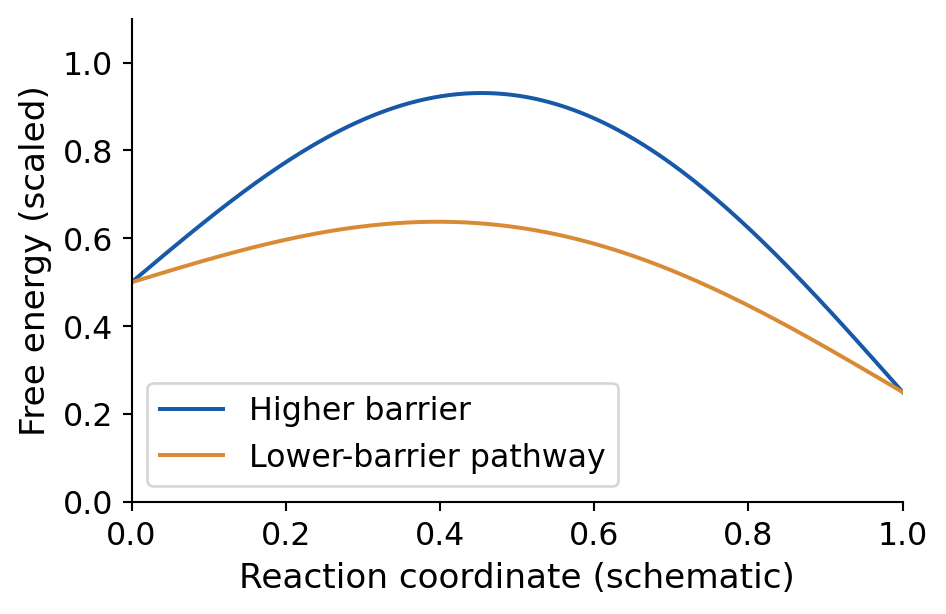
Actual reaction free energy is Delta G = Delta G° + RT ln Q. At equilibrium Delta G = 0, so Delta G° = -RT ln K. A negative standard value does not guarantee negative actual Delta G at every composition. Negative free energy indicates thermodynamic favourability, not a fast rate. A high activation barrier can keep a favourable reaction slow. State temperature, composition/standard-state convention and the distinction between driving force and kinetics in a complete answer.
From energy balance to spontaneity
A system can release heat yet fail to favour the forward reaction at a particular temperature if the entropy contribution is sufficiently unfavourable. Conversely, an endothermic process can be favoured when a positive entropy contribution outweighs the enthalpy term. Delta G describes the stated temperature-pressure-composition conditions; it does not claim that the products form instantly. Combining the Gibbs and Arrhenius descriptions distinguishes the thermodynamic destination from the kinetic route.
Worked problem 1.43: Free energy from equilibrium constant
Route: CH
Problem. A reaction has K = 10 at 300 K. Use R = 8.314 J/(mol K) to find standard Gibbs free energy.
Answer and explanation. Delta G° = -RT ln K = -5743 J/mol = -5.74 kJ/mol. Actual Delta G also depends on Q, and this thermodynamic result does not specify reaction speed.
38. Reaction rate, order, activation energy and Arrhenius law
Study route: CH
A rate law relates rate to reactant quantities under specified conditions. For a first-order disappearance, -dA/dt = kA and ln(A0/At) = kt; the half-life is ln2/k. Order is measured experimentally rather than read automatically from the overall equation. Temperature, concentration, catalysts, physical contact and transport can influence observed rate.

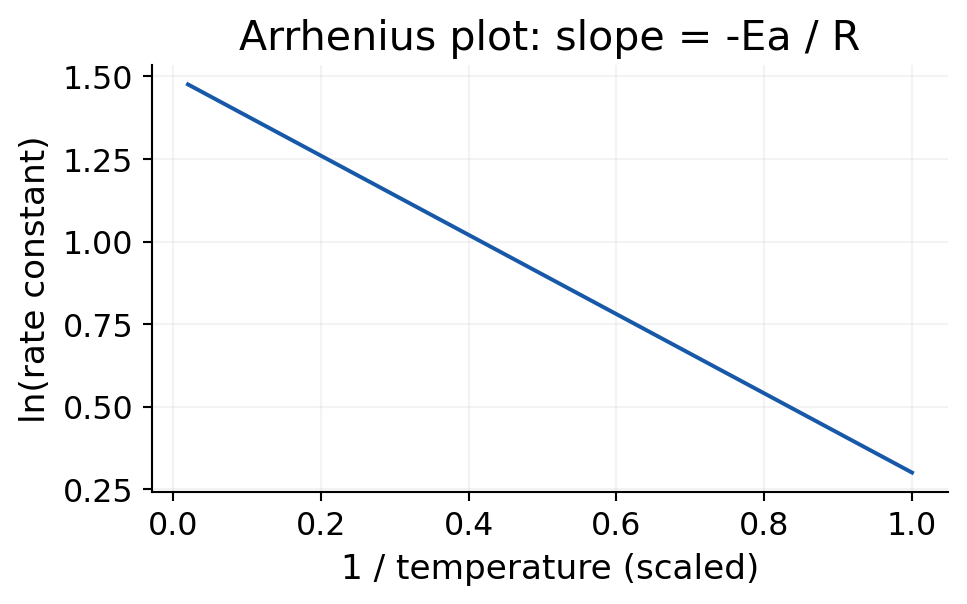
The Arrhenius model k = A exp(-Ea/RT) gives ln(k2/k1) = Ea/R(1/T1-1/T2) when the barrier and prefactor are approximately constant across the interval. A plot of ln k against 1/T has slope -Ea/R. A catalyst provides a different pathway with a changed effective barrier without changing the net reaction free energy. An observed rate can also be limited by mass or heat transfer. A simple model should not be extrapolated through a mechanism change or uncontrolled temperature rise.
Worked problem 1.44: Arrhenius temperature ratio
Route: CH
Problem. Use Ea = 50000 J/mol and R = 8.314 J/(mol K). Find k330/k300 for a constant-barrier Arrhenius model.
Answer and explanation. ln(k330/k300) = (50000/8.314)(1/300-1/330) = 1.822. The ratio is 6.19. Use absolute temperature and restrict the conclusion to the stated kinetic model.
39. Ammonia manufacture: equilibrium, separation and recycle
Study route: CH
The Haber-type overall reaction is N2 + 3H2 <-> 2NH3. It is exothermic and produces fewer gas molecules. Increased pressure can favour ammonia equilibrium; a lower temperature favours exothermic conversion but can slow kinetics. A suitable promoted iron-based catalytic system permits a practical rate at a compromise condition. Feed preparation removes species that would poison or disrupt the process.

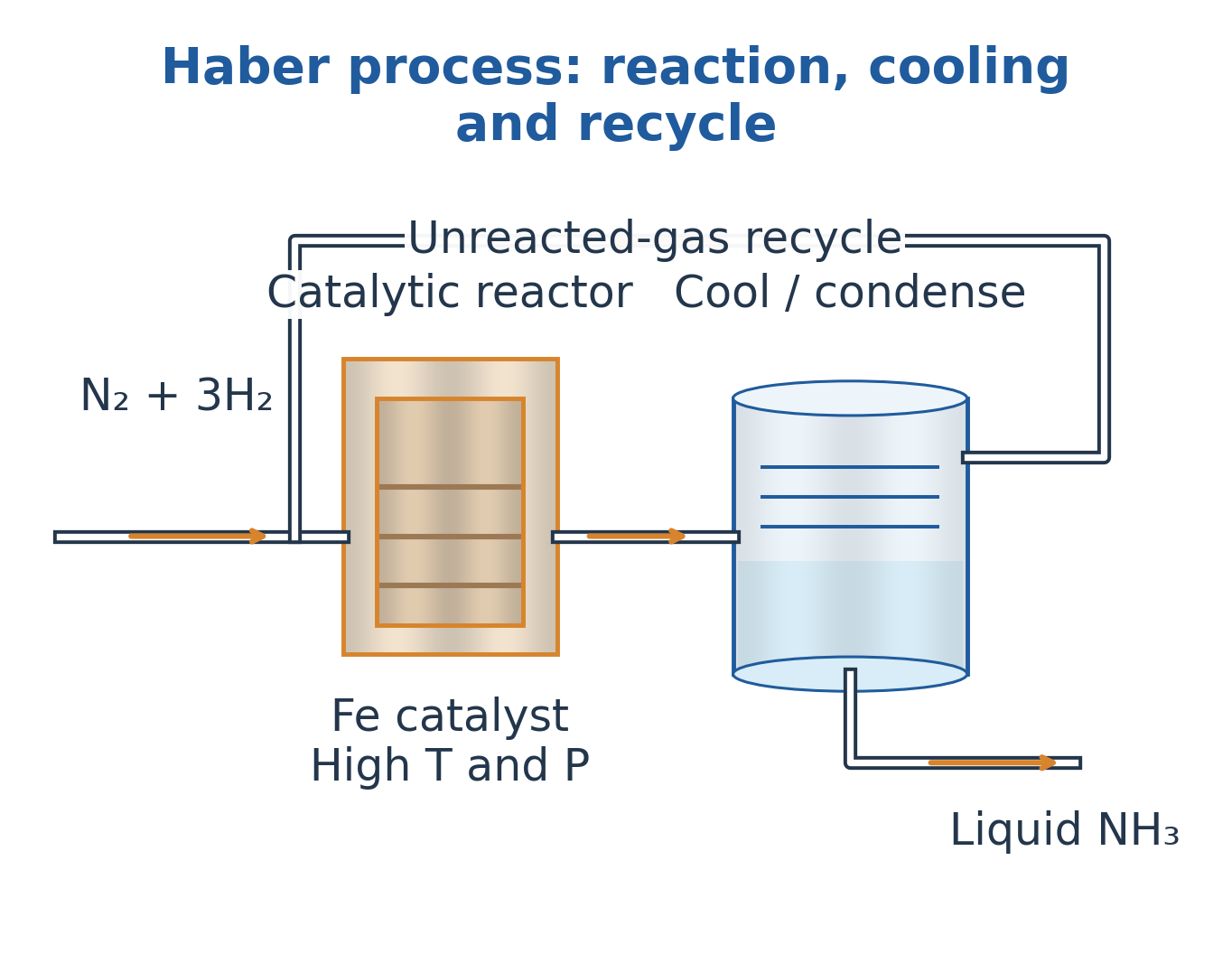
After reaction, cooling/separation removes ammonia and unreacted gas can be recycled. Recycle improves overall feed use without changing K. Inert species can accumulate if they have no exit, so a purge may be needed, losing some reactants along with inerts. Distinguish fresh feed, reactor feed, product, recycle and purge on the process sketch. Compression energy, heat recovery, catalyst condition and product specification belong to the full engineering choice.
Worked problem 1.45: Single-pass ammonia balance
Route: CH
Problem. A reactor receives 10 mol N2 and 30 mol H2. If 20% of entering N2 reacts only to NH3, find NH3 and unreacted feed amounts.
Answer and explanation. N2 consumed = 2 mol; H2 consumed = 6 mol. NH3 produced = 4 mol. Unreacted N2 = 8 mol and H2 = 24 mol. Product separation and recycle affect the overall process balance but not this one-pass stoichiometry.
40. Nitric acid and sulfuric acid manufacture
Study route: CH
Nitric-acid manufacture oxidizes ammonia catalytically toward NO: 4NH3 + 5O2 -> 4NO + 6H2O. Subsequent oxidation gives 2NO + O2 -> 2NO2. Absorption chemistry with water and oxygen produces acid; 3NO2 + H2O -> 2HNO3 + NO illustrates NO regeneration, with further oxidation supporting recovery. The overall ideal balance is NH3 + 2O2 -> HNO3 + H2O. Reaction and absorption are separate operations.


Sulfuric-acid manufacture forms SO2, then catalytically oxidizes 2SO2 + O2 <-> 2SO3, commonly using a suitable vanadium-oxide catalytic system. Controlled absorption into concentrated acid forms an oleum-containing stream that can be adjusted with water. Direct water addition is not the full practical absorption route because acid mist is difficult to manage. Explain gas cleaning, catalytic conversion, heat/separation control and absorption; a balanced net equation alone is not a complete process description.
Why absorption and recycle appear on the diagram
Nitrogen-oxide absorption can regenerate NO, which is reoxidized and returned to useful conversion rather than treated as an unrelated product. Sulfur-trioxide handling similarly requires a controlled absorption operation; the simple hydration equation hides the practical mist problem. Industrial introductory answers should identify the chemical conversion, the phase contacted during absorption, the desired product stream and any regenerated species. This connects the equations to the process without requiring an advanced plant-design calculation.
41. Soil components, texture and the soil environment
Study route: AG
Soil contains mineral particles, organic matter, water, air and organisms. Sand, silt and clay size fractions influence drainage, aeration and water retention. Texture describes the particle-size distribution, whereas structure describes how particles aggregate. A soil can have a given texture yet different pore organization and management response.

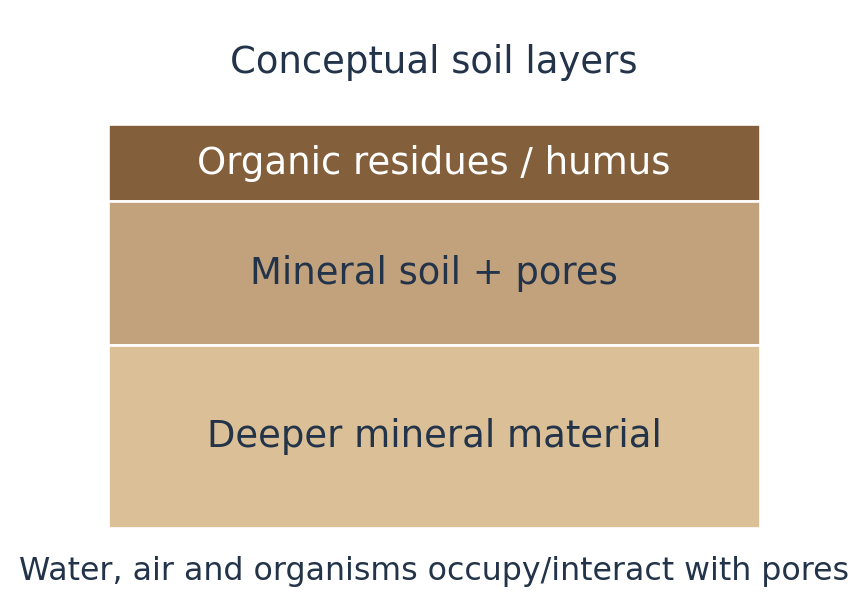

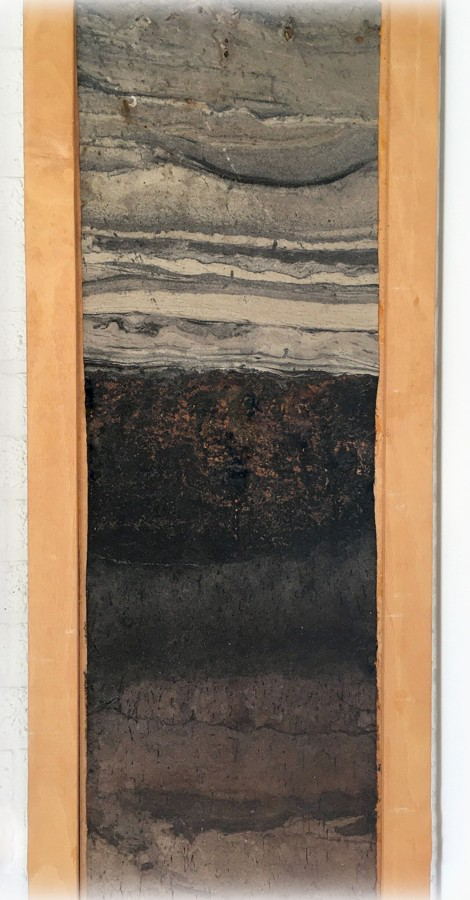
Soil solution supplies dissolved species to roots; solids and organisms store, exchange or transform nutrients. Gas-filled pores support oxygen transfer where aeration is needed. Excess water can alter redox conditions, while drying changes concentration and microbial activity. Total elemental content is not identical to plant-available content. Sustainable diagnosis therefore combines physical conditions, chemical forms and biological activity rather than ranking fertility from one chemical number.
42. Organic matter, humus, colloids and cation exchange
Study route: AG
Organic matter includes fresh residues, decomposing fractions, organisms and more persistent humus. Decomposition can release nutrients, while microbial growth can temporarily immobilize them. Humus contributes to aggregation, water retention and charged surfaces. Its effects depend on quality, decomposition state and the surrounding soil.

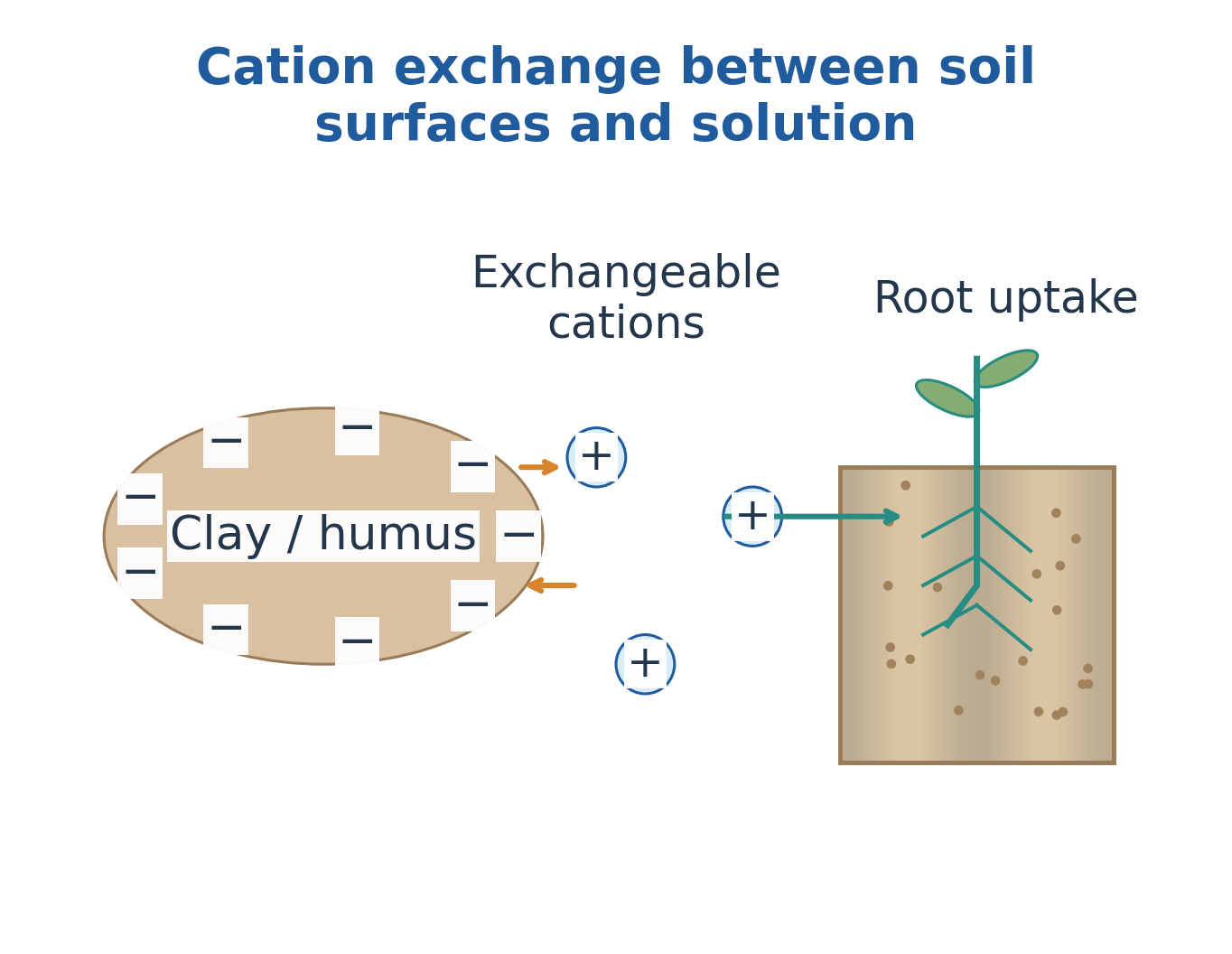
Clay and humus colloids carry exchange sites that retain cations such as Ca2+, Mg2+, K+ and NH4+. Cation-exchange capacity is commonly expressed as cmol(c)/kg, a quantity of charge per soil mass. Root uptake draws from solution, while exchange and dissolution can replenish it. High capacity is not the same as immediate nutrient availability. Nitrate is often more mobile in predominantly negatively charged soils. Mineralogy, pH and organic matter determine retention; a charge-equivalent basis is essential when comparing monovalent and divalent ions.
Exchange is reversible, not permanent nutrient creation
A cation on an exchange site can be displaced by other ions according to the surrounding solution and surface chemistry. Fertilizer addition can change the solution and occupancy, while root uptake changes the solution demand. CEC describes a reservoir of exchangeable charge and does not create additional nutrient atoms. Compare monovalent and divalent ions using charge equivalents, and distinguish capacity from which nutrients currently occupy that capacity.
Worked problem 1.46: Exchange capacity
Route: AG
Problem. A 2 kg soil sample has CEC 15 cmol(c)/kg. Find total exchange charge in mol(c).
Answer and explanation. Total = 2 x 15 = 30 cmol(c) = 0.30 mol(c). If occupied entirely by divalent calcium, this corresponds to 0.15 mol Ca2+ on the stated ideal charge basis.
43. Soil pH, essential nutrients and fertility
Study route: AG
Soil pH = -log10(hydrogen-ion activity). A one-unit decrease represents a tenfold increase in that activity, but does not directly give the amount of amendment required because soils buffer added acid/base. pH influences nutrient solubility, surface charge and microbial processes. Acid conditions can increase aluminium-related constraints; alkaline conditions can reduce availability of several micronutrients.

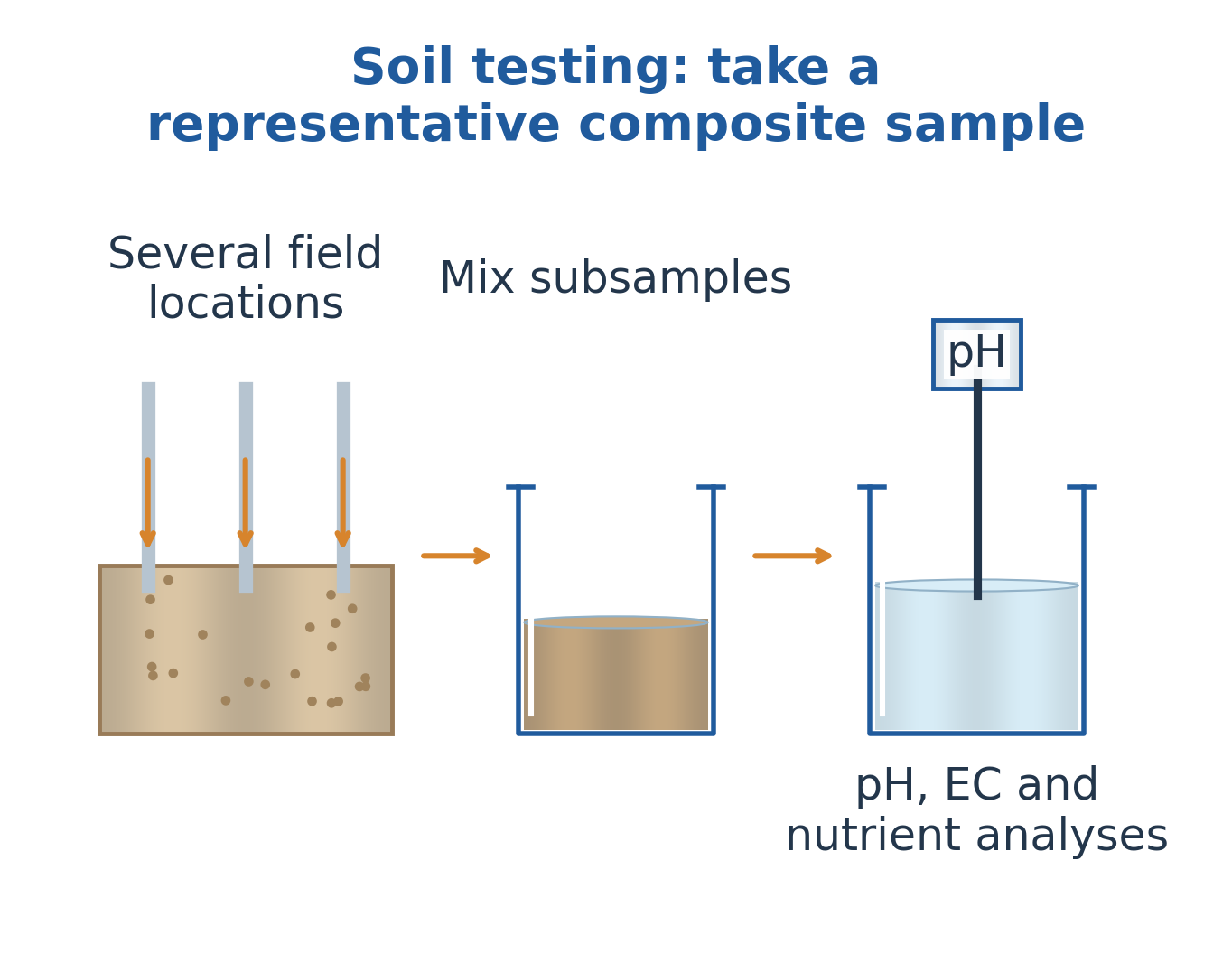
Essential macronutrients include C, H, O, N, P, K, Ca, Mg and S. Essential micronutrients include Fe, Mn, Zn, Cu, B, Mo, Cl and Ni. The distinction concerns required amount, not importance. Fertility is the ability to supply nutrients in appropriate available forms; productivity also depends on water, structure and other conditions. No single pH maximizes every nutrient for every crop. Interpret soil tests with crop requirement and extraction method rather than equating total nutrient mass with usable supply.
Worked problem 1.47: Soil pH change
Route: AG
Problem. Compare hydrogen-ion activities at pH 5 and pH 7.
Answer and explanation. Since pH = -log10(activity), activity at pH 5 is 10^2 = 100 times that at pH 7. This ratio does not give the lime requirement, which also depends on soil buffering.
44. Salinity, sodicity and sustainable soil correction
Study route: AG
Salinity concerns excess soluble salts, which make water uptake more difficult through osmotic effects. Sodicity concerns excessive exchangeable sodium and can disperse clay, damaging structure and infiltration. They can coexist but are different diagnoses. Electrical conductivity screens overall dissolved ionic content; it does not identify every ion or directly measure exchangeable sodium.

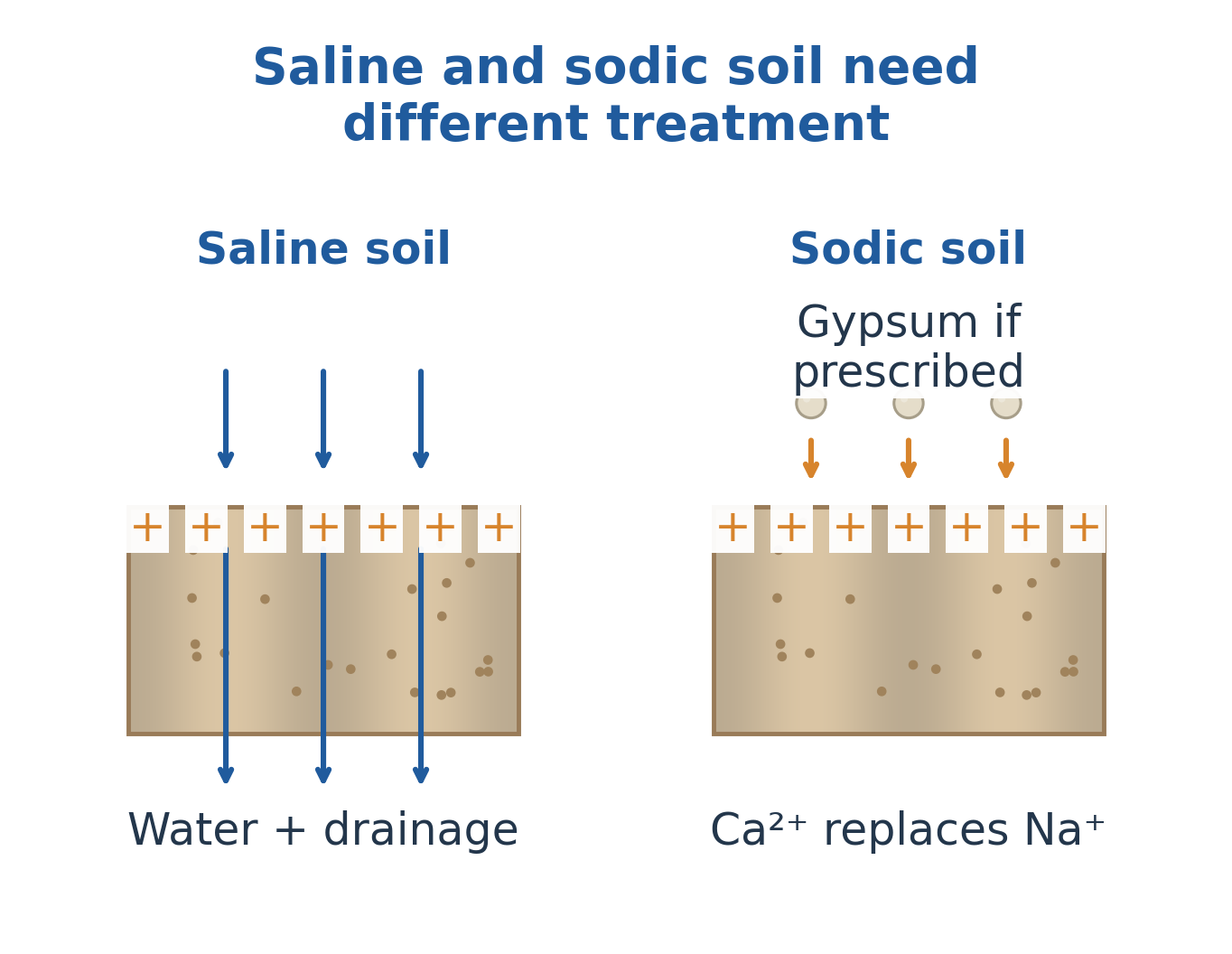
Drainage and appropriate leaching can remove soluble salts when water quality and site conditions permit. Gypsum can supply calcium for some sodic-soil reclamation systems, helping displace sodium that must then leave through suitable water movement. Liming can neutralize excess acidity in appropriate soils. Neither amendment is a universal remedy. Assess soil chemistry, water quality, crop tolerance and drainage before choosing treatment, then monitor the actual response rather than relying on an initial amendment dose alone.
| Condition | Main issue |
|---|---|
| Salinity | Excess soluble salts; osmotic difficulty |
| Sodicity | Exchangeable sodium; structure/infiltration |
| Acidity | pH and buffering; nutrient/metal chemistry |
Worked problem 1.48: Salinity versus sodicity
Route: AG
Problem. A soil has high soluble salts but no evidence yet of high exchangeable sodium. Should it automatically be called sodic?
Answer and explanation. No. Salinity concerns soluble salt content; sodicity concerns exchangeable sodium and structural effects. Assess conductivity and relevant sodium/soil measures separately before selecting drainage, leaching or amendment strategies.
Worked problem 1.49: Exchangeable sodium percentage
Route: AG
Problem. A soil has CEC = 20 cmol(c)/kg and exchangeable sodium = 3 cmol(c)/kg on the same basis. Calculate sodium percentage of exchange capacity.
Answer and explanation. Percentage = 100 x 3/20 = 15%. This describes a charge-occupancy ratio; it is not the percentage of soil mass that is sodium, nor a complete stand-alone crop suitability assessment.
45. Soil testing, pollution and management
Study route: AG
A basic soil-testing plan separates unlike field areas, collects representative subsamples at a stated depth, uses clean tools and records location/history. Suitable extraction and calibrated methods measure pH, EC, organic-carbon indices and available nutrient indices. Sampling error can outweigh instrument precision. A valid comparison keeps depth, method and reporting basis consistent.

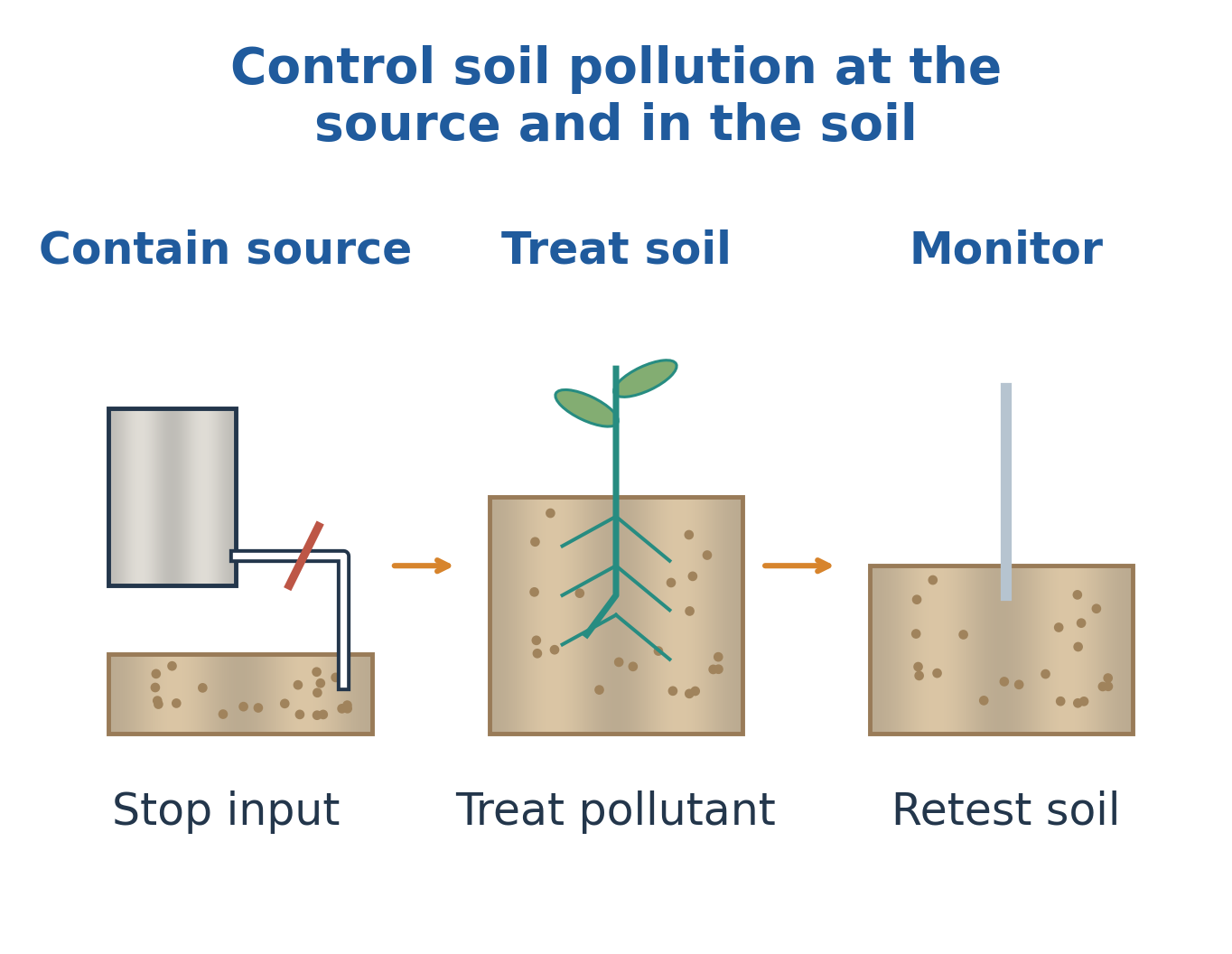
Pollution can arise from industrial inputs, contaminated irrigation, unsuitable wastes or excessive agrochemical use. Chemical form, pH, redox, sorption and organic matter control mobility and exposure. Strong sorption can reduce immediate mobility without removing the contaminant. Sustainable management combines balanced nutrients, suitable organic amendments, erosion control, rotation, water management and measured pollution control. Remediation can remove, immobilize or transform particular contaminants; metals cannot be destroyed as elements. State the target and verified outcome instead of promising that one amendment cures every soil problem.
A practical interpretation sequence
Check that the sample represents the field area and that units and extraction methods match the interpretation system. Identify whether the main concern is acidity, salinity, sodium, a nutrient deficiency or a contaminant. Select a mechanism-based management response, then resample using comparable conditions to assess progress. A numerical average can hide a local polluted patch or a different soil zone. Where location matters, retain separate samples rather than combining unlike areas into one apparently moderate result.
Worked problem 1.50: Composite sample arithmetic
Route: AG
Problem. Five equal 100 g dry subsamples have measured concentrations 10, 12, 14, 16 and 18 mg/kg of a defined analyte. Find the ideal equal-mass composite concentration.
Answer and explanation. The equal-mass mean is (10+12+14+16+18)/5 = 14 mg/kg. The average does not show spatial variability; keeping separate samples may be necessary when locating a polluted patch.
FORMULAS AND MODEL CONDITIONS
| Topic | Relation / condition |
|---|---|
| Resistance | R = rho L/A; sigma = 1/rho |
| Carrier transport | sigma = q(n mu(n) + p mu(p)); use consistent carrier-density units |
| Doping | n approximately ND or p approximately NA only with suitable ionization and dominance |
| Capacitor | C = epsilon0 epsilon(r) A/d; U = CV²/2 at specified voltage |
| Lever rule | w(alpha) = [C(beta)-C0]/[C(beta)-C(alpha)] |
| Moisture | Regain = water/dry mass; content = water/moist mass |
| Soil pH | pH = -log10(hydrogen-ion activity) |
| Free energy | Delta G = Delta H – T Delta S = Delta G° + RT ln Q |
| Equilibrium | Delta G° = -RT ln K; use activities in Q and K |
| Arrhenius | ln(k2/k1) = Ea/R (1/T1 – 1/T2) |
| Cement | Water/cement ratio = water mass/cement mass; distinguish total binder |
| Film growth | Thickness = growth rate x time in the supplied constant-rate model |
| Linear peptide | n amino-acid residues require n-1 backbone peptide bonds |
| Exchange charge | Charge capacity = soil mass x capacity per mass; retain charge units |
Constants: q = 1.602 x 10^-19 C; epsilon0 = 8.854 x 10^-12 F/m; R = 8.314 J/(mol K); hc approximately 1240 eV nm. Constants do not remove the need to select a valid physical model.
UNIT CONVERSIONS AND CHECKS
| Quantity | Useful conversion / check |
|---|---|
| Carrier density | 1 cm^-3 = 10^6 m^-3 |
| Mobility | 1 cm²/(V s) = 10^-4 m²/(V s) |
| Dimensions | 1 mm² = 10^-6 m²; 1 nm = 10^-9 m |
| Fractions | State mass, mole, volume or charge basis; do not mix denominators |
| Temperature | Thermodynamic and Arrhenius equations use absolute kelvin |
BEFORE USING A FORMULA
Confirm the material state, geometry, reference temperature and equilibrium/ionization assumptions. For phase fractions, identify the two-phase region first. For moisture, state the wet or dry mass basis. For soil exchange, retain charge-equivalent units.
Check the result against a balance: phase fractions add to one, a material inventory conserves mass, complementary base counts use the specified DNA model, and reaction equations conserve atoms and charge. A correct model result does not independently establish every service property.
ANSWERED REVISION: ALL STUDY ROUTES
Use these answers after revising your assigned theory and worked problems. Each question tests a distinction that commonly causes an incomplete examination answer.
CE: What develops cement strength?
Hydration develops binding products, especially C-S-H. Setting is loss of plasticity; hardening continues as structure develops. Curing maintains reaction conditions. Dry appearance alone cannot establish adequate hydration, strength or durability.
ME: Why temper after quenching?
Quenching can create a hard but brittle, stressed structure in suitable steel. Controlled tempering adjusts that structure and property balance. Composition, section size, temperature, holding time and cooling history determine the result.
EE/ECE: How do CVD and MBE differ?
CVD uses volatile-precursor reaction and gas transport. MBE supplies controlled beams to a clean crystalline surface in high vacuum. Both need interface control; accurate thickness does not establish purity or defect-free growth.
CSE: Can capacitance prove insulation quality?
No. Permittivity, loss, leakage and breakdown describe different properties. Geometry, temperature, frequency and contamination matter. A correct ideal capacitance cannot establish the resistance of a contaminated surface or a safe operating voltage.
TX: Why distinguish regain and content?
Regain divides water mass by dry mass; content divides by moist mass. Chemistry, accessible morphology and conditioning determine uptake. Diameter alone cannot predict swelling or the resulting mechanical and electrical changes.
BT: Is denaturation the same as hydrolysis?
No. Denaturation changes higher-order organization and can reduce activity without cleaving every peptide bond. Hydrolysis breaks backbone links. Solubility, molecular identity, folding and function are separate observations requiring appropriate evidence.
CH: Does favourable equilibrium mean fast reaction?
No. Gibbs free energy and K concern thermodynamics, while barriers and transport affect rate. A catalyst changes approach rate without changing K at fixed temperature. Industrial choices also consider energy, separation and recycle.
AG: Are salinity, sodicity and CEC identical?
No. Salinity concerns soluble salts; sodicity concerns exchangeable sodium and structural effects; CEC describes exchangeable charge capacity. Representative tests, crop requirements, water quality and drainage guide a mechanism-based management response.
46. DETAILED CONCEPT CONNECTIONS AND APPLICATIONS
46.1 From atomic bonding to a material-selection decision
Relevant routes: CSE, EE, ECE and ME. Bonding explains an important part of material behaviour, but a useful engineering explanation must continue beyond the isolated atom. Copper and silicon both contain electrons, yet their electronic states and carrier populations support different electrical functions. A metal can provide a low-resistance interconnection, while a semiconductor supports controllable carrier populations. Similarly, strong ionic or covalent bonding in a ceramic does not imply metallic conduction. Identify the available carriers and their mobility before connecting bonding to an electrical measurement. Bond strength, stiffness, hardness and conductivity are related to structure through different mechanisms.
The distinction between a grain and a phase becomes important when interpreting real specimens. A sample can contain many differently oriented grains of one phase. It can also contain two phases, each with its own grains and composition. A micrograph showing boundaries therefore does not by itself establish how many chemical phases exist. Processing changes grain size, defect arrangements and phase distribution, while chemical analysis establishes composition on a specified sampling scale. These descriptions complement one another. Using only the overall alloy name conceals structural differences that can explain why two nominally similar specimens perform differently.
For a component, extend the reasoning to its surface and interfaces. An oxide may protect an underlying metal from further reaction while increasing electrical contact resistance. A clean bulk conductor can therefore form an unsatisfactory connector if its joining surface is unsuitable. A strong fibre may transfer load poorly through a weak surrounding interface. The complete chain is composition, processing, structure, interface condition, measured property and useful function. When several candidate materials satisfy one property requirement, compare the remaining constraints instead of declaring one universally superior from a single number.
46.2 Keep specimen resistance separate from conductivity
Relevant routes: CSE, EE and ECE. A resistance measurement describes a particular current path. The same material can form a short thick conductor or a long thin conductor, and those specimens need not have the same resistance. In the uniform ohmic model, R = rho × L/A. Resistivity rho carries the units ohm metre, whereas specimen resistance carries ohms. Conductivity is the reciprocal of resistivity for the stated scalar model. These definitions prevent a common mistake: interpreting a lower measured resistance as proof of a more conductive material without first comparing dimensions and measurement conditions.
Consider two tracks with identical material state and temperature. Doubling length doubles ideal bulk resistance; doubling cross-sectional area halves it. At a fixed current, the longer track also has twice the ideal voltage drop and twice the bulk heating power. However, the temperature rise does not follow from electrical power alone. Heat transfer, surrounding materials, mounting and operating time also matter. The calculated P = I²R is the rate of electrical energy dissipation within the assumed model. It does not independently establish the operating temperature or permissible continuous current of a practical assembly.
Unit conversion should precede substitution. One square millimetre is 10^-6 m², because both dimensions must be converted. A thickness in micrometres must likewise be expressed consistently with width and length. Contact resistance adds another limitation: a two-terminal measurement may include interfaces as well as bulk material. State whether the question neglects those contributions. This makes a result reviewable and explains why a theoretically correct bulk calculation can differ from the measured resistance of a joined, oxidized or damaged conductor.
46.3 Explain doping through neutrality and carrier balance
Relevant routes: CSE, EE and ECE. Donor and acceptor terminology describes how impurities influence electronic carriers. An ionized donor is a fixed positive centre associated with the supply of a mobile electron. An ionized acceptor is a fixed negative centre associated with hole creation. The resulting n-type or p-type material is not simply a macroscopic negatively or positively charged object. Charge neutrality accounts for fixed dopant ions and mobile carriers together. Drawing both species helps distinguish an electron current from the physical motion of impurity atoms through the crystal.
The approximation n approximately equals ND minus NA requires sufficiently strong net donor dominance and suitable ionization and equilibrium conditions. The corresponding minority-hole estimate follows from p = ni²/n. Adding donor and acceptor concentrations instead of taking their net charge balance would give the wrong majority estimate. At low temperature, incomplete ionization can matter; at higher temperature, intrinsic generation can become important. The supplied assumptions therefore belong to the answer. An arithmetic result without those assumptions may suggest a degree of generality that the simple model does not have.
Conductivity introduces mobility as a separate variable. Sigma = q(n × mu_n + p × mu_p) contains both carrier populations and their responses to an applied field. A sample with more dopants does not automatically have a proportionally greater conductivity because scattering and mobility can change. Check density units before multiplying: 1 cm^-3 = 10^6 m^-3, while 1 cm²/(V s) = 10^-4 m²/(V s). Combining centimetre-based mobility with metre-based density silently changes the numerical result. Consistent units and a stated low-field model are essential parts of the physical interpretation.
46.4 Treat a printed circuit board as a chemical assembly
Relevant route: CSE. A printed circuit board places different materials next to one another to perform different functions. Copper tracks provide intended current paths, while the laminate provides support and electrical separation. Glass reinforcement and cured epoxy contribute differently to mechanical and dielectric behaviour. A plated via connects selected layers; the physical presence of a drilled hole is insufficient without the required conducting connection. Solder mask protects chosen areas while exposed pads remain available for joining. Describing only the visible metal pattern leaves much of the board’s materials chemistry unexplained.
Soldering requires a usable interface as well as a suitable alloy. Surface oxides interfere with wetting, while flux assists surface preparation under the relevant process conditions. The solder must contact appropriate pad and terminal surfaces and develop a joint whose structure can withstand service. Voids, incomplete wetting and cracks are different defect descriptions. A measured void fraction reports the amount of a defined empty region relative to a chosen volume; it does not automatically predict failure probability. Geometry, location and loading determine how a defect affects the joint.
Reliability connects these materials to time and environment. Moisture and ionic contamination can support unwanted conduction or electrochemical migration. Thermal expansion mismatch can load joints and interfaces repeatedly. A dielectric can have a suitable ideal permittivity while still failing a leakage or breakdown requirement. Similarly, a ninety-seven percent observed surviving fraction at a stated test time is a result for that sample and protocol, not proof of indefinite service life. Explain the function, exposure, failure criterion and measured outcome together when discussing hardware reliability.
46.5 Compare semiconductor growth routes using separate quality measures
Relevant route: EE/ECE. A semiconductor film needs more than the correct chemical name. Its thickness, composition, contamination, crystallographic relationship and defect structure can each influence function. Chemical vapour deposition delivers volatile reactants and depends on transport and surface chemistry. Molecular beam epitaxy supplies controlled beams to a suitable crystalline substrate in a high-vacuum environment. Both methods need substrate preparation and interface control. Neither name alone establishes that a particular deposited layer has the required purity, uniformity or electronic quality.
A constant growth-rate calculation gives thickness by multiplying rate and time. If one layer grows to ten nanometres and a second to six nanometres, the ideal total is sixteen nanometres. That result does not establish whether the layers intermix or have abrupt interfaces. Likewise, the net silicon deposition equation SiH4 -> Si + 2H2 provides a stoichiometric relation, but it does not state the fraction of incoming precursor incorporated into useful film. Material balance, growth kinetics and structural characterization answer different questions about the same deposition process.
Compound and wide-bandgap semiconductors add compositional and application choices. An energy-gap comparison can help explain possible optical or high-field roles, but gap magnitude alone does not rank every device. Contacts, defects, thermal behaviour and fabrication constraints still matter. For a photon calculation, E(eV) approximately equals 1240/lambda(nm) connects wavelength with energy. The relation concerns an individual photon’s energy. It does not establish luminous output, carrier collection or conversion efficiency without additional information about the complete device and its operating conditions.
46.6 Follow cement from powder to a load-bearing network
Relevant route: CE. Cement hydration changes both chemical composition and microstructure. Water permits reactions at clinker particles, and the resulting products develop within the paste. Calcium-silicate-hydrate provides much of the binding network, while other products influence the chemical and physical environment. The familiar clinker notation must be read correctly: C denotes calcium oxide and S denotes silicon dioxide. Reading C3S as an ordinary carbon-sulfur molecular formula would therefore misidentify the material before the reaction discussion even begins. State the notation before using abbreviated hydration equations.
Setting and hardening describe different observations. Setting concerns loss of plasticity and the development of rigidity. Hardening concerns continued strength development as hydration and structure evolution proceed. A paste may set before it has developed sufficient strength for its intended loading. Curing maintains conditions that allow the reactions to continue; rapid drying can interrupt development and promote defects. The same initial mixture can therefore produce different later properties under different moisture and temperature histories. Initial proportions are a starting condition rather than a complete description of the final material.
Water also creates a balance between processing and structure. Enough mixing water is needed for workable placement and reaction, but excess water can contribute to capillary space after drying. A lower water/cement ratio is not an isolated guarantee of a better structure if the mix cannot be placed or compacted appropriately. Explain workability, hydration, curing and pore connectivity together. When additions are used, distinguish water/cement ratio from water/total-binder ratio. Changing the denominator changes the reported ratio and can otherwise conceal a meaningful difference between two concrete mixtures.
46.7 Distinguish admixtures, mineral additions and other binders
Relevant route: CE. Chemical admixtures change particular aspects of fresh or developing concrete behaviour. A dispersing agent can reduce the water needed for a specified workability, while a retarder changes setting behaviour and an air-entraining agent stabilizes an appropriate bubble system. These functions depend on compatibility with the cement and complete formulation. More additive is not automatically better. A useful explanation names the intended mechanism, the measured property and the possible consequence of an unsuitable dose or interaction, rather than treating every admixture as a general strength enhancer.
Mineral additions contribute through different mechanisms. A pozzolanic addition can react with calcium hydroxide to form further binding products, while a latent hydraulic material has its own activation-dependent reaction behaviour. Fine particles can also influence packing. A replacement fraction is first a mass-accounting quantity: replacing one quarter of the binder mass does not prove that strength, heat release or environmental impact changes by exactly one quarter. Reactivity, curing, processing and equivalent useful service all affect the final comparison. Keep composition, chemical action and performance as linked but distinct descriptions.
Lime and plaster of Paris provide a useful mechanism comparison. Lime slaking forms calcium hydroxide, and suitable air-lime hardening involves carbonation. Plaster hemihydrate rehydrates toward gypsum and develops interlocking crystals. Portland cement instead forms a hydraulic hydration network. All may produce a rigid material, yet their reactions and exposure requirements differ. A ceramic refractory introduces another distinction: surviving high temperature does not imply chemical compatibility with the contacting slag. Choose using reaction conditions, moisture, thermal cycling and service chemistry rather than appearance or one melting-temperature figure.
46.8 Choose a metal using the limiting component requirement
Relevant route: ME. Material selection begins with the duty the component must satisfy. A current-carrying part may be limited by electrical loss, a structural member by stiffness or allowable stress, and a hot component by temperature-dependent deformation and environmental attack. Density alone cannot resolve all these choices. A lighter material may require a larger section to satisfy a stiffness constraint. Similarly, a strong alloy may offer a useful strength-to-density ratio but introduce joining, cost or corrosion constraints. State what limits the design before comparing material indices.
The supplied specific-strength example divides strength by density on a consistent basis. It identifies which candidate has the larger stated ratio, but does not directly compute the mass of every possible component. Geometry and the mode of loading remain necessary. Copper’s conductivity, aluminium’s low density, steel’s structural versatility and titanium’s useful environmental response describe different attractions. Each depends on actual alloy grade and material condition. A protective oxide can benefit corrosion performance while making an electrical or joining interface harder to manage, showing why the same feature can have different practical consequences.
Alloying likewise involves trade-offs. Solute atoms and second-phase particles can impede dislocation motion, increasing strength in a suitable structure. They can also affect ductility, conductivity or chemical behaviour. The overall alloy composition does not specify the composition of each phase, and the same bulk composition can develop different structures after different processing histories. A complete selection answer therefore includes the chemical family, the relevant microstructure and treatment, the controlling property, and the service environment. This turns a list of metals into an explanation of why a particular material state is suitable.
46.9 Use conservation to understand phase fractions
Relevant route: ME. A two-phase equilibrium region contains phases with compositions fixed by the tie-line endpoints at the selected temperature. The bulk alloy composition lies between those endpoints. The amounts of the two phases must satisfy both total-mass conservation and conservation of the selected component. These balances lead to the lever rule. The phase nearer the bulk composition has the larger fraction, which provides a useful visual check. A numerical formula should be applied only after identifying the correct phase field and reading the endpoints on the same composition basis.
For alpha at twenty weight percent B, beta at eighty weight percent B and a bulk composition of thirty-five weight percent B, alpha has mass fraction 0.75 and beta has 0.25. Multiplying and adding their component contributions reconstructs the bulk composition. This reconstruction is a stronger check than merely seeing that the fractions add to one, because both conditions must hold. A negative phase fraction indicates an unsuitable phase region, endpoint reading or arithmetic setup. The lever rule cannot make an outside composition physically belong to the selected two-phase interval.
An equilibrium diagram describes a thermodynamic arrangement; a processing path also involves time. Rapid quenching can suppress transformations requiring diffusion and produce structures that differ from equilibrium expectations. A phase diagram alone therefore does not determine the final hardness of a quenched component. Temperature, holding time, cooling rate and section size must enter the explanation. When answering a question, distinguish the equilibrium phases and compositions from the transformation products actually expected under the stated cooling conditions. This keeps thermodynamic balance and processing kinetics connected without treating them as interchangeable information.
46.10 Link strengthening, heat treatment and inspection
Relevant route: ME. Different strengthening processes obstruct plastic deformation through different structures. Solid-solution strengthening uses interactions associated with solute atoms. Work hardening changes the dislocation population through plastic deformation. Precipitation hardening develops a controlled particle distribution through an alloy-dependent thermal sequence. Calling all three hardening does not make their microscopic mechanisms identical. A specimen can lose strength during heating because recovery or recrystallization changes a cold-worked structure, or because precipitate coarsening reduces the strengthening effect in an aged alloy. Diagnosis requires the preceding material and processing history.
Quenching and tempering also have separate purposes. A suitable steel can form a hard but brittle quenched structure, while controlled tempering adjusts the resulting property balance. The temperature recorded by a furnace is not instantaneously the temperature at every point inside a thick component. Holding and section size therefore matter, as do differences between surface and centre cooling rates. A heat-treatment description should follow heating, holding and cooling through the intended structural change. Simply stating that the metal was heated omits the information needed to explain its final properties.
Inspection evaluates the resulting component within a method’s detection limits. Liquid penetrant can reveal accessible surface-breaking paths on suitable nonporous surfaces but cannot reveal a completely sealed internal flaw through capillary action. Magnetic-particle testing requires appropriate magnetic material behaviour. Ultrasound and radiography rely on other interactions and have geometry-dependent limitations. An indication is evidence to interpret rather than a complete description of defect type, size and service consequence. Select a method by material, suspected defect location and detection principle, and explain what an apparently satisfactory result leaves untested.
46.11 Connect textile chemistry with accessible morphology
Relevant route: TX. Fibre classification becomes more useful when connected to reactive groups. Cotton contains cellulose chains rich in hydroxyl groups, while wool contains protein structures with different ionizable groups and cross-linking. Jute includes additional plant constituents alongside cellulose, and silk has a different protein organization from wool. Consequently, natural origin alone does not imply identical chemical response. Processing conditions suitable for one fibre may damage another. Classify the fibre by both source and principal chemical structure before discussing moisture, dyeing, chemical resistance or mechanical properties.
Synthetic fibres also require chemical distinctions. Nylon contains amide links, polyester contains ester links and acrylic fibres are based mainly on acrylonitrile-derived structures. These groups create different interaction possibilities, while orientation, crystallinity and accessible less-ordered regions modify the final response. Two fibres with similar external diameter can therefore differ in water uptake and strength. Surface smoothness does not reveal every internal void or defect. A useful comparison names the chemical groups, the morphology and the test environment instead of assigning all synthetic fibres one universal hydrophobicity or resistance ranking.
Drawing and other processing steps can align chains and change load transfer along the fibre axis. Greater organization can improve some axial properties while restricting access for water or dye molecules. Excess treatment may damage the structure or reduce useful extension. A fibre blend adds another level: physically mixing cotton and polyester combines fibre populations but does not automatically create a new copolymer. Mass fractions describe how much of each is present; they do not prove a proportional interpolation of every fabric property. The interfaces, construction and finishing history still influence the measured response.
46.12 Derive moisture percentages from a common mass balance
Relevant route: TX. Let dry fibre mass be D and absorbed water mass be W under the specified conditioning procedure. The conditioned mass is D plus W. Moisture regain is 100W/D, while moisture content is 100W/(D + W). Because the second denominator includes the absorbed water, the reported content is smaller than the regain for the same positive water mass. This is a denominator effect rather than a disagreement between experiments. Always state which convention is used before comparing values from different tables or calculations.
If regain is r percent, use a convenient dry basis of one hundred mass units. Water then equals r and conditioned mass equals one hundred plus r. The content is therefore 100r/(100 + r) percent. For twelve percent regain, this gives approximately 10.71 percent content. The inverse conversion follows from the same balance: if content is c percent, regain is 100c/(100 – c) percent within the relevant mass model. These relations require the same dry-mass definition and water assignment; they do not correct for retained finish or other volatile components automatically.
Water interaction also affects function. Accessible polar groups can associate with water, and uptake into less-ordered regions can produce swelling or plasticization. The resulting dimensional or mechanical change depends on morphology as well as chemical composition. A water-repellent surface can change initial wetting without eliminating all internal sorption. Conditioning temperature and humidity belong to the measurement, while the drying method defines the reference mass. Comparing wet fabric with oven-dry fabric under unspecified procedures can mix surface water, absorbed moisture and other mass changes into one misleading percentage.
46.13 Explain carbohydrate and protein function through connectivity
Relevant route: BT. The identity of a biomolecular building block is only part of its description. Starch and cellulose can both involve glucose yet differ because their glycosidic connectivity and organization differ. Branching also changes the number of accessible chain ends and the arrangement of a storage polymer. A structural answer should therefore identify linkage direction, configuration and branching before connecting the polymer to storage or support. Saying that two materials contain the same sugar does not explain why their properties or biological processing differ.
Protein chemistry makes the same point through sequence and folding. A linear chain of n amino-acid residues has n minus one backbone peptide bonds when additional cross-links are excluded. That count describes covalent connectivity. Secondary, tertiary and possible quaternary structures describe higher levels of organization supported by several interactions. Denaturation can disrupt those levels without cleaving every peptide bond. A sample that loses activity after heating has therefore not automatically undergone complete hydrolysis. Solubility, chain integrity and biological function are different observations and should be reported separately.
The environment changes molecular interactions. Amino-acid groups can change protonation with pH, and a zero average net charge can coexist with positively and negatively charged groups in a zwitterionic description. Hydrophobic association, hydrogen bonding, ionic interactions and disulfide links make different contributions to protein structure. A change in pH or temperature can alter that balance, sometimes permitting recovery and sometimes leading to aggregation or other irreversible changes. A good explanation names the affected level and interaction rather than defining every loss of protein function as the same chemical reaction.
46.14 Keep molecular identity, assembly and information distinct
Relevant route: BT. Lipids illustrate how different chemical frameworks can share broad biological roles without forming one repeating-monomer family. Triacylglycerols serve storage functions, suitable phospholipids form amphiphilic assemblies and sterols contain fused-ring structures. In water, a phospholipid’s polar and nonpolar regions support bilayer organization. This assembly depends on the surrounding environment and mixture, not only on drawing one isolated molecule. Saturation and chain shape influence packing, but temperature and the complete membrane composition also matter when explaining fluidity or permeability.
Nucleic acids require a different set of distinctions. A base joined to a sugar is a nucleoside; including phosphate gives a nucleotide. Backbone connectivity supplies directionality, while base sequence carries information. Complementary DNA strands run antiparallel, so both pairing and orientation must be shown when writing a complement. For the supplied ATGC example, the aligned partner and the partner rewritten in its own five-prime-to-three-prime direction appear in different orders. Omitting direction can conceal an error even when every individual base has been paired with its expected partner.
Vitamins and coenzymes add chemical roles beyond structural building blocks. A vitamin can supply a precursor for an active coenzyme form. NAD+/NADH supports appropriate redox transfers, while coenzyme A participates in acyl-group transfer. Their useful roles depend on chemical form, enzyme interaction and regeneration. ATP is a nucleotide used in coupled energy transfer rather than a vitamin. This classification keeps nutrient identity, catalytic assistance and energy coupling separate. In an answer, connect each molecule to the type of chemical transformation or organization it supports instead of listing names without functions.
46.15 Separate reaction direction from reaction speed
Relevant route: CH. A balanced chemical equation specifies conservation and stoichiometry, while an equilibrium expression compares activities according to those coefficients. The reaction quotient Q describes the current state in the chosen model, and K describes equilibrium at the specified temperature. If Q is smaller than K for the written reaction, forward progress is thermodynamically favoured under the stated constraints. At equilibrium, forward and reverse events continue at equal rates. Equal rates do not mean equal concentrations, and equilibrium does not mean that all molecular reactions have stopped.
The free-energy relations make this distinction quantitative. Delta G = Delta G° + RT ln Q describes the actual composition dependence, while Delta G° = -RT ln K connects the standard-state value to equilibrium. A negative standard free energy does not guarantee a negative actual free energy for every composition. Use kelvin and compatible energy units, and distinguish a natural logarithm from a base-ten logarithm. These details determine the numerical result and the interpretation of direction. They do not, however, supply the time needed for an appreciable reaction to occur.
Rate depends on a kinetic pathway and can also depend on transport. A catalyst changes the pathway and the approach to equilibrium without changing K at fixed temperature for the same reaction. The Arrhenius model predicts a temperature-dependent rate constant within its assumed mechanism and parameter interval. An industrial reactor also has heat and mass-transfer conditions that can limit observed performance. Consequently, a favourable thermodynamic direction, a large equilibrium constant and a fast laboratory rate are separate pieces of information. A complete explanation identifies which one the question or measurement actually establishes.
46.16 Read industrial process diagrams as material balances
Relevant route: CH. Ammonia manufacture connects equilibrium, kinetics and separation. The ideal reaction consumes one mole of nitrogen for three moles of hydrogen and forms two moles of ammonia. Increased pressure can favour the side with fewer gas molecules under the simple equilibrium argument, while lower temperature favours this exothermic conversion but can slow reaction. Catalysis supports a practical rate. Feed preparation, compression and heat management then determine whether the chosen operating conditions are useful within the complete process rather than only within an equilibrium expression.
Product separation and recycle change overall utilization without changing the reaction equilibrium constant. A one-pass balance accounts for the quantities entering and leaving the reactor during that pass. Recycled gas becomes part of the next reactor feed, so reactor feed and fresh feed are not identical streams. Inerts can accumulate if no suitable exit is provided, making a purge relevant. The purge removes some useful reactants as well as unwanted accumulated material. Distinguish product formation, recovery and feed consumption before reporting conversion or yield, because those quantities can use different denominators.
Acid manufacture likewise needs more than a net equation. In nitric-acid production, catalytic oxidation, further nitrogen-oxide conversion and absorption have separate roles. Regenerated NO can be reoxidized rather than treated as a final unrelated waste stream. Sulfuric-acid manufacture combines sulfur-oxide formation, catalytic conversion and controlled absorption. A simple hydration equation does not describe the practical management of acid mist. A labelled diagram should therefore identify reacting species, the contacting phases and the useful product stream, connecting chemical equations to separation and recycle without implying that one vessel performs every operation identically.
46.17 Interpret soil measurements through reservoirs and availability
Relevant route: AG. Soil is a coupled system of mineral solids, organic matter, water, air and organisms. Texture describes particle-size distribution, whereas structure describes aggregation and pore arrangement. Two soils with similar texture can therefore differ in infiltration and aeration. Water-filled and gas-filled pore space changes with weather and management, influencing transport, oxygen supply and redox conditions. A photograph of a soil profile can show horizons and physical differences, but colour alone does not quantify plant-available nutrients or identify every contaminant. Chemical measurements need a stated sampling and analytical basis.
Cation-exchange capacity describes exchangeable charge capacity per mass, not the number of nutrient atoms created by the soil. An exchange site can release one cation as another occupies it, according to the surrounding chemistry. For divalent calcium, one mole of ions represents two moles of positive charge. Thus 0.30 mol of exchange charge would correspond to 0.15 mol of calcium ions if occupied entirely by calcium in the stated ideal balance. Distinguish capacity, current occupancy and dissolved availability; a large exchange reservoir need not mean that every required nutrient is immediately available in a suitable proportion.
Organic matter adds both structural and chemical effects. Decomposition can release nutrients, while microbial growth can temporarily immobilize them. Humus contributes charged surfaces and can affect aggregation and water retention. Total elemental analysis therefore cannot substitute directly for a suitable plant-availability test. Extraction method, crop requirements and soil conditions influence interpretation. A fertility explanation should connect the soil reservoir to solution supply and root access, then include water and physical conditions. Increasing one total nutrient number does not automatically overcome poor aeration, unsuitable pH or a different limiting nutrient.
46.18 Diagnose soil constraints before choosing an amendment
Relevant route: AG. Soil pH measures hydrogen-ion activity logarithmically. A change from pH seven to pH five corresponds to a hundredfold increase in that activity. This ratio does not give the amendment mass needed to change the soil, because buffering and exchange reactions also matter. Nutrient solubility, metal-related constraints and biological processes respond differently across conditions. No single pH observation independently specifies total fertility or the best treatment for every crop. Interpret it with the method, soil properties and intended use rather than converting a logarithmic difference directly into a fertilizer or lime dose.
Salinity and sodicity require separate diagnoses. Excess soluble salts can create osmotic difficulty for water uptake, while excessive exchangeable sodium can damage aggregation and infiltration. Electrical conductivity is useful for overall dissolved ionic content but does not identify each ion or establish the exchangeable-sodium fraction by itself. Appropriate drainage and leaching can address soluble salts under suitable conditions. Calcium supplied by gypsum may help certain sodic systems, but displaced sodium must have a route out. Liming addresses suitable acidity problems through a different mechanism. These treatments cannot be assigned interchangeably from a general description of poor soil.
Representative sampling is part of the chemical result. Equal-mass subsamples can produce a meaningful composite average for a suitably uniform area, but mixing unlike zones can hide local contamination or a separate management need. Use clean tools, stated depth and comparable methods, and retain spatial information when it affects the decision. Pollution management should identify whether the objective is removal, immobilization or transformation of a specified contaminant. Metals remain elements even when their mobility changes. Follow treatment with comparable measurements so that the claimed outcome matches what was actually assessed.