ECE Notes are useful for AKTU B.Tech 7th Semester Electronics and Communication Engineering students who want subject-wise study material for semester preparation, internal assessments, university examinations, and quick revision.
The 7th semester includes advanced Electronics and Communication Engineering subjects along with Department Elective-I options covering areas such as wireless communication, information theory, microwave engineering, radar systems, and drone systems.
Students looking for AKTU B.Tech 7th Semester ECE Notes can use this page as a subject-wise guide and combine the notes with the prescribed syllabus and previous-year question papers for better exam preparation.
Students can also explore AKTU notes, PYQs, syllabus resources, and other academic materials through NotesGallery. For official university notices, examination updates, circulars, and authoritative academic information, students should refer to the AKTU Official Website.
Download Electronics Engineering /Electronics And Communication Engineering /Electronics And Telecommunication Engineering All Subjects Notes
Note:
PDF 1 ≠ Unit 1. Each collection may contain complete,
unit-wise, part-wise, or mixed notes.
Wireless & Mobile Communication
| Multiple Notes Resources | Download Links |
|---|---|
| Collection : Quantum | |
| Collection 2: Handwritten | |
| Collection 3: Digital | |
| Collection 4: Digital | |
| Collection 5: MRCET Notes |
Microwave & Radar Engineering
| Multiple Notes Resources | Download Links |
|---|---|
| Collection 1: Handwritten | |
| Collection 2: Handwritten | |
| Collection 3: Digital | |
| Collection 4: Digital | |
| Collection 5: MRCET Notes | |
| Collection 6: Ramswaroop Notes | |
| Collection 7: Quantum |
Drone Systems: Design, Control & Navigation
| Multiple Notes Resources | Download Links |
|---|---|
| Collection 1 | Coming soon… |
Information Theory & Coding
| Multiple Notes Resources | Download Links |
|---|---|
| Collection 1: Handwritten | |
| Collection 2: Handwritten | |
| Collection 3: Digital | |
| Collection 4: Handwritten |
VLSI Design
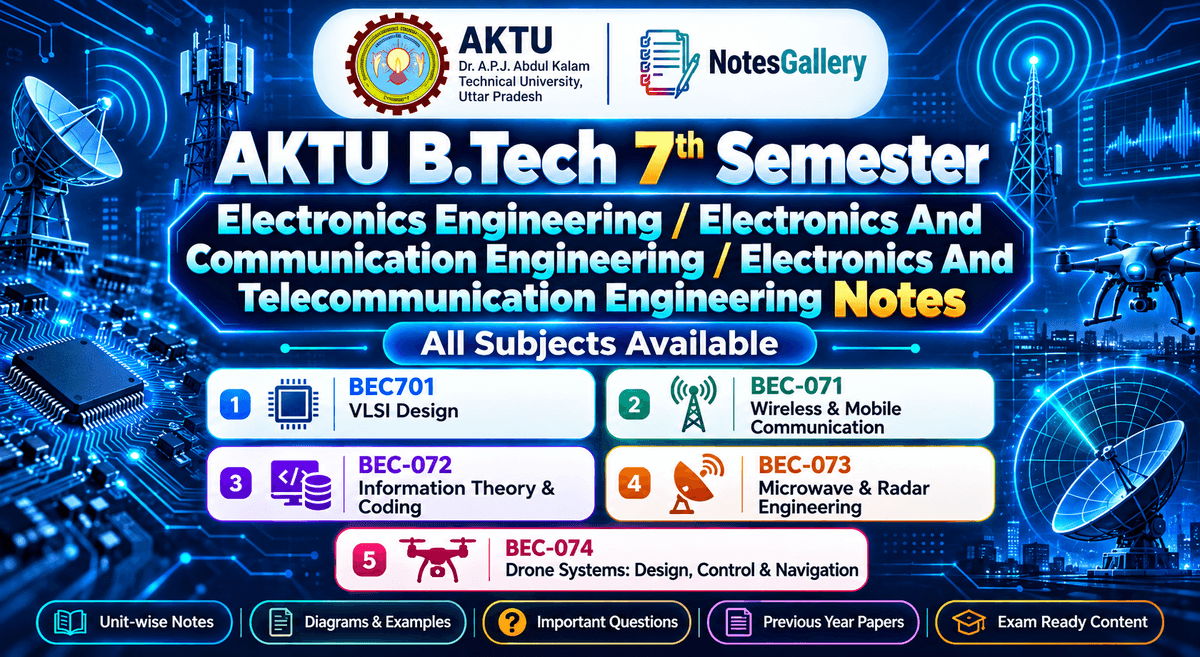
AKTU B.Tech 7th Semester ECE Subjects
Based on the provided subject list, the visible subjects include VLSI Design along with four Department Elective-I options.
| Subject Code | Subject Name | Category |
|---|---|---|
| BEC701 | VLSI Design | Main Subject |
| BEC-071 | Wireless & Mobile Communication | Department Elective-I |
| BEC-072 | Information Theory & Coding | Department Elective-I |
| BEC-073 | Microwave & Radar Engineering | Department Elective-I |
| BEC-074 | Drone Systems: Design, Control & Navigation | Department Elective-I |
Students should study the Department Elective-I subject allotted or selected according to their college and curriculum.
BEC701 VLSI Design Notes
VLSI Design is an important subject for ECE students because it introduces the principles used in designing highly integrated electronic circuits and semiconductor systems.
VLSI stands for Very Large Scale Integration.
It deals with integrating a very large number of electronic components and transistors onto a single integrated circuit.
Important areas may include:
- VLSI fundamentals
- MOS technology
- CMOS circuits
- logic design
- transistor-level design
- fabrication concepts
- layout design
- digital integrated circuits
- timing
- power consumption
VLSI Design is highly relevant to:
- semiconductor engineering
- chip design
- embedded systems
- processors
- digital electronics
- integrated circuit development
Meaning of VLSI
Very Large Scale Integration refers to the process of integrating a large number of transistors and electronic components on a single semiconductor chip.
Modern electronic devices depend heavily on VLSI technology.
Applications may include:
- microprocessors
- memory chips
- mobile devices
- digital signal processors
- communication systems
- embedded devices
Importance of VLSI Design
VLSI technology helps engineers develop circuits that are:
- compact
- fast
- energy-efficient
- reliable
- suitable for mass production
It plays a major role in modern electronics and communication technology.
MOS Technology
MOS technology is widely used in integrated-circuit design.
MOS generally refers to:
Metal-Oxide-Semiconductor
MOS-based devices form the foundation of many digital integrated circuits.
Students may study:
- MOS transistor operation
- switching behaviour
- circuit characteristics
- fabrication-related concepts
CMOS Technology
CMOS stands for Complementary Metal-Oxide-Semiconductor.
CMOS technology is widely used because of advantages such as:
- low power consumption
- high noise immunity
- high integration capability
CMOS circuits are commonly used in digital electronics.
VLSI Design Flow
A general VLSI design flow may include:
- Specification
- Architecture design
- Logic design
- Circuit design
- Layout design
- Verification
- Fabrication
- Testing
Understanding the complete design process is important for VLSI preparation.
VLSI Applications
VLSI is used in:
- smartphones
- computers
- communication devices
- medical electronics
- automotive electronics
- consumer electronics
- industrial systems
BEC-071 Wireless & Mobile Communication Notes
Wireless & Mobile Communication is a Department Elective-I subject that focuses on communication systems in which information is transmitted without physical wired connections.
Wireless communication is one of the most important areas of modern ECE because it supports:
- mobile networks
- wireless internet
- satellite communication
- IoT
- wireless sensor systems
Meaning of Wireless Communication
Wireless Communication refers to the transmission of information using electromagnetic waves without requiring physical cables between transmitter and receiver.
A basic wireless system may be represented as:
Source → Transmitter → Wireless Channel → Receiver → Destination
Mobile Communication
Mobile Communication enables users to communicate while moving from one location to another.
It forms the basis of:
- mobile phones
- cellular networks
- mobile data services
- wireless communication systems
Cellular Communication
Cellular networks divide a large geographic region into smaller areas called cells.
Each cell is served by communication infrastructure that supports users within that region.
The cellular concept helps:
- improve coverage
- reuse frequencies
- support many users
- manage mobility
Frequency Reuse
Frequency Reuse allows the same frequency channels to be used in different cells that are sufficiently separated.
This helps increase network capacity.
Handoff
A Handoff or handover occurs when an active mobile connection is transferred from one cell or base station to another as the user moves.
Effective handoff helps maintain continuous communication.
Wireless Channel
Wireless signals may be affected by:
- reflection
- diffraction
- scattering
- fading
- interference
These factors influence signal quality.
Fading
Fading refers to variation in received signal strength due to propagation conditions.
Understanding fading is important in wireless-system design.
Multiple Access Techniques
Wireless networks may use techniques that allow multiple users to share communication resources.
Students may study broad concepts related to:
- FDMA
- TDMA
- CDMA
- other multiple-access approaches
Applications of Wireless Communication
Applications include:
- smartphones
- Wi-Fi
- satellite systems
- wireless sensor networks
- emergency communication
- IoT
BEC-072 Information Theory & Coding Notes
Information Theory & Coding focuses on the mathematical principles of information, communication efficiency, and error-control techniques.
The subject helps students understand how information can be:
- measured
- represented
- compressed
- transmitted
- protected against errors
Meaning of Information Theory
Information Theory studies the quantitative representation and transmission of information.
It helps answer questions such as:
- How much information is contained in a message?
- How efficiently can data be encoded?
- How reliably can information be transmitted?
Information
Information reduces uncertainty.
In communication systems, information may be represented through:
- symbols
- binary digits
- signals
- code words
Entropy
Entropy is an important concept in Information Theory.
It broadly measures the average uncertainty or information associated with a source.
Higher uncertainty generally corresponds to greater information content.
Source Coding
Source coding focuses on representing information efficiently.
Its objective may include:
- reducing redundancy
- reducing data size
- improving transmission efficiency
Channel Coding
Channel coding adds controlled redundancy to transmitted information so that errors can be detected or corrected.
This helps improve communication reliability.
Source Coding vs Channel Coding
| Source Coding | Channel Coding |
|---|---|
| Reduces unnecessary redundancy | Adds controlled redundancy |
| Improves efficiency | Improves reliability |
| Used for compression | Used for error control |
Error Detection
Error-detection techniques help identify whether transmitted data has been corrupted.
Error Correction
Error-correction techniques allow a receiver to detect and correct certain transmission errors.
Coding Techniques
Depending on the syllabus, students may encounter concepts related to:
- block codes
- linear codes
- cyclic codes
- convolutional codes
The exact depth should be prepared according to the prescribed course syllabus.
Applications of Information Theory
Information Theory is used in:
- digital communication
- data compression
- storage systems
- error-control coding
- computer networks
BEC-073 Microwave & Radar Engineering Notes
Microwave & Radar Engineering focuses on high-frequency electromagnetic systems and radar-based detection technologies.
This subject is important for students interested in:
- communication
- radar
- defence electronics
- satellite systems
- high-frequency circuits
Meaning of Microwave Engineering
Microwave Engineering deals with electromagnetic waves in microwave frequency ranges and the devices and systems used to generate, transmit, and process them.
Microwave technology is widely used in:
- radar
- satellite communication
- wireless systems
- navigation
- sensing
Microwave Components
Students may study components such as:
- waveguides
- resonators
- microwave generators
- microwave amplifiers
- antennas
Waveguide
A Waveguide is a structure used to guide electromagnetic waves, especially at high frequencies.
Waveguides are important because conventional transmission structures may become less effective at microwave frequencies.
Microwave Sources
Microwave systems require sources capable of generating high-frequency signals.
Depending on the syllabus, students may study different microwave-generation devices.
Radar
Radar stands for Radio Detection and Ranging.
Radar uses electromagnetic waves to detect objects and estimate information such as:
- distance
- direction
- speed
Basic Radar Principle
A simplified radar process is:
Transmit Signal → Signal Reflects from Target → Receive Echo → Analyse Target
Radar Range
Radar systems estimate the distance of an object by measuring the time taken for the transmitted signal to return after reflection.
Applications of Radar
Radar may be used in:
- aviation
- weather monitoring
- defence
- navigation
- traffic monitoring
- maritime systems
Doppler Effect in Radar
The Doppler Effect can be used to estimate relative velocity.
If a target moves relative to the radar system, the frequency of the reflected signal may shift.
This concept is important in speed measurement and moving-target detection.
Microwave Communication
Microwave frequencies can support communication systems because they offer:
- large bandwidth
- directional transmission
- suitability for high-data-rate links
Microwave & Radar Engineering Applications
Applications may include:
- satellite communication
- aircraft radar
- weather radar
- defence systems
- remote sensing
- navigation
BEC-074 Drone Systems: Design, Control & Navigation Notes
Drone Systems: Design, Control & Navigation is a modern Department Elective-I subject focusing on unmanned aerial systems and the technologies required to design and operate them.
A drone system combines:
- aerodynamics
- electronics
- sensors
- embedded systems
- communication
- control systems
- navigation
Meaning of Drone
A Drone is an unmanned aerial vehicle that can be controlled remotely or operate using automated control systems.
Drones may be used for:
- photography
- surveying
- agriculture
- inspection
- mapping
- monitoring
- delivery
- emergency response
Major Components of a Drone
A drone may include:
- frame
- motors
- propellers
- electronic speed controllers
- flight controller
- battery
- sensors
- communication system
Drone Frame
The frame provides the physical structure of the drone.
It supports components such as:
- motors
- battery
- electronics
- sensors
Motors and Propellers
Motors rotate the propellers and generate the thrust required for flight.
The speed of different motors can be adjusted to control movement.
Electronic Speed Controller
An Electronic Speed Controller (ESC) controls the speed of the drone’s motors.
The flight controller sends commands to the ESCs.
Flight Controller
The Flight Controller is one of the most important components of a drone.
It receives information from:
- sensors
- pilot inputs
- navigation systems
and adjusts the motors accordingly.
Sensors in Drone Systems
Common sensors may include:
- accelerometer
- gyroscope
- magnetometer
- GPS
- altitude sensors
These help the drone maintain stability and determine position.
Drone Control
Drone control involves managing movement along different axes.
Important movements may include:
- roll
- pitch
- yaw
- altitude
Roll
Roll refers to rotational movement around the longitudinal axis.
Pitch
Pitch refers to movement that tilts the drone forward or backward.
Yaw
Yaw rotates the drone left or right around the vertical axis.
Navigation
Drone navigation involves determining:
- position
- direction
- destination
- path
Navigation may use:
- GPS
- inertial sensors
- maps
- onboard computing
GPS-Based Navigation
GPS provides location information that can support:
- waypoint navigation
- return-to-home
- position holding
- route planning
Autonomous Drone Systems
Autonomous drones may perform some tasks without continuous manual control.
They may use:
- sensors
- control algorithms
- navigation systems
- onboard processors
Drone Communication
Communication links may be used for:
- control commands
- telemetry
- video transmission
- status information
Reliable communication is important for safe operation.
Applications of Drone Systems
Drones may be used in:
- agriculture
- infrastructure inspection
- photography
- environmental monitoring
- mapping
- disaster management
- industrial inspection
Challenges in Drone Systems
Challenges may include:
- battery life
- communication range
- stability
- navigation accuracy
- weather conditions
- safety
Importance of ECE Notes for AKTU Students
Well-organised ECE Notes can help students:
- understand technical concepts
- revise unit-wise topics
- prepare important definitions
- study diagrams
- practise analytical questions
- save time during final revision
The 7th semester includes advanced technical subjects, so students should combine notes with conceptual understanding and problem-solving practice.
How to Prepare AKTU B.Tech 7th Semester ECE Notes
Start With the Syllabus
Before beginning preparation, check the prescribed syllabus for your selected subjects.
Divide the syllabus into:
- units
- theoretical topics
- numerical topics
- diagrams
- derivations
- applications
Prepare Unit-Wise Notes
Study one unit at a time.
Prepare concise notes containing:
- definitions
- formulas
- diagrams
- important concepts
- differences
Focus on Diagrams
ECE subjects often require clear technical diagrams.
Students should practise diagrams related to:
- VLSI circuits
- wireless systems
- coding systems
- microwave systems
- radar
- drone architecture
Practice Numerical Problems
Where applicable, practise numerical questions involving:
- communication systems
- coding
- radar
- microwave concepts
- circuit analysis
Understand Applications
Connect theoretical concepts with practical applications.
For example:
- VLSI in chip design
- wireless communication in mobile networks
- coding in digital communication
- radar in navigation
- drones in monitoring and automation
Solve Previous-Year Questions
PYQs can help students understand:
- question pattern
- important concepts
- expected answer length
- numerical-question style
Students should still prepare the complete prescribed syllabus rather than depending only on PYQs.
Quick Revision Strategy for ECE Notes
For final revision, students can divide preparation according to their subjects.
VLSI Design
Revise:
- VLSI fundamentals
- MOS
- CMOS
- design flow
- logic circuits
- layout concepts
Wireless & Mobile Communication
Revise:
- cellular systems
- frequency reuse
- handoff
- fading
- multiple access
- mobile communication
Information Theory & Coding
Revise:
- information
- entropy
- source coding
- channel coding
- error detection
- error correction
Microwave & Radar Engineering
Revise:
- microwave fundamentals
- waveguides
- microwave components
- radar principles
- radar range
- Doppler effect
Drone Systems
Revise:
- drone components
- flight controller
- sensors
- roll, pitch, and yaw
- control systems
- GPS navigation
- autonomous operation
Why Use NotesGallery for ECE Notes?
Students looking for ECE Notes can explore academic resources on NotesGallery.
NotesGallery can help students find:
- AKTU B.Tech Notes
- semester-wise notes
- subject-wise study materials
- previous-year question papers
- syllabus resources
- exam preparation content
Using subject-wise resources can make semester preparation more organised.
Useful Resources for AKTU B.Tech ECE Students
Students can explore AKTU B.Tech 7th Semester ECE Notes and other study resources through NotesGallery.
For official university notices, examination announcements, circulars, and authoritative academic information, students should refer to the AKTU Official Website.
NotesGallery is an independent educational resource platform and should not be considered the official website of Dr. A.P.J. Abdul Kalam Technical University.
For official examination notices and syllabus updates, visit the AKTU official website.
Frequently Asked Questions
What are ECE Notes?
ECE Notes are subject-wise study materials for Electronics and Communication Engineering students that help with conceptual understanding, revision, internal assessments, and semester examinations.
Which subjects are shown for AKTU B.Tech 7th Semester ECE?
Based on the provided subject list, the visible subjects are VLSI Design (BEC701) along with the Department Elective-I options Wireless & Mobile Communication (BEC-071), Information Theory & Coding (BEC-072), Microwave & Radar Engineering (BEC-073), and Drone Systems: Design, Control & Navigation (BEC-074).
What is the subject code of VLSI Design?
The provided subject code for VLSI Design is BEC701.
What is the subject code of Wireless & Mobile Communication?
The provided subject code for Wireless & Mobile Communication is BEC-071.
What is the subject code of Information Theory & Coding?
The provided subject code for Information Theory & Coding is BEC-072.
What is the subject code of Microwave & Radar Engineering?
The provided subject code for Microwave & Radar Engineering is BEC-073.
What is the subject code of Drone Systems: Design, Control & Navigation?
The provided subject code for Drone Systems: Design, Control & Navigation is BEC-074.
Where can I find AKTU B.Tech 7th Semester ECE Notes?
Students can explore subject-wise AKTU study materials and other academic resources through NotesGallery.
How should I prepare ECE Notes for the AKTU 7th Semester examination?
Start with the prescribed syllabus, study each subject unit-wise, prepare concise revision notes, practise important diagrams and numerical problems, understand real-world applications, and solve previous-year questions after completing each major topic.