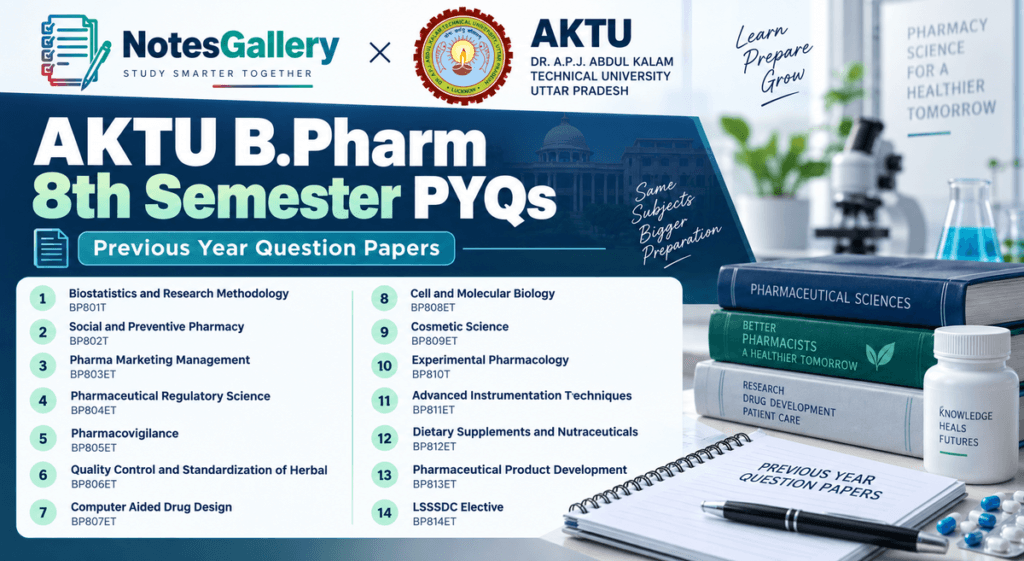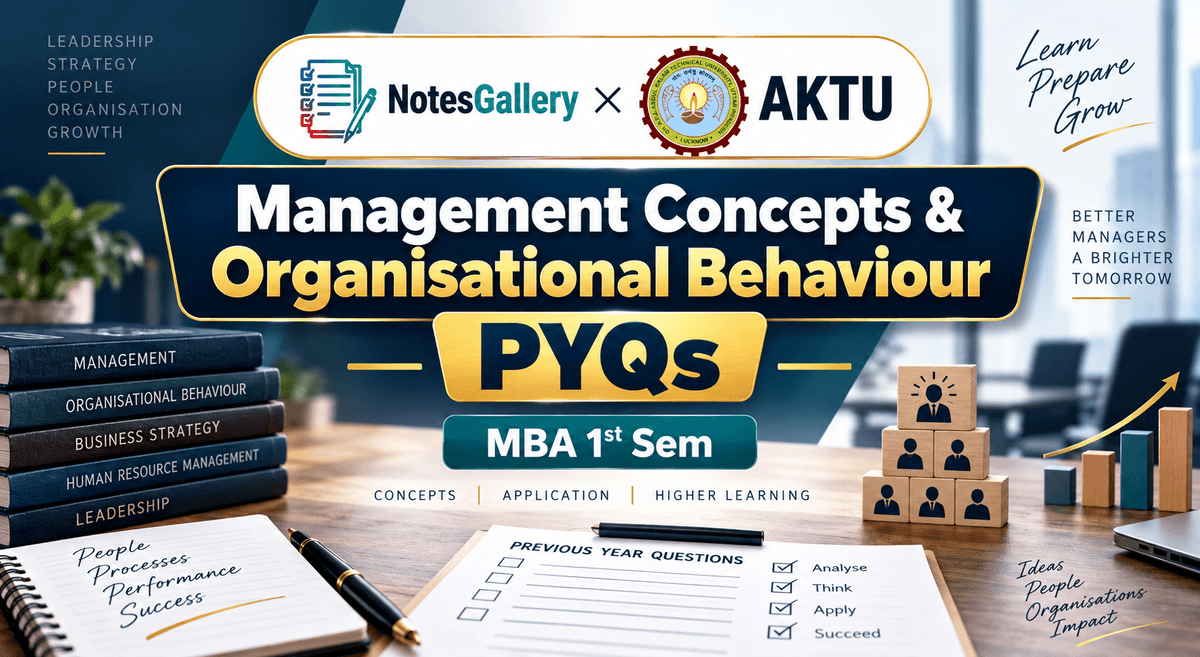
Management Concepts & Organisational Behaviour is one of the core subjects of AKTU MBA 1st Semester. It introduces students to the basic principles of management and explains how individuals and groups behave inside organisations. The subject combines managerial concepts such as planning, organising, directing, controlling, decision-making, leadership, motivation, communication, group behaviour, organisational culture, and change.
Practicing Management Concepts & Organisational Behaviour PYQs helps students understand the type of questions asked in previous AKTU examinations, identify concepts that require detailed preparation, and improve descriptive answer-writing.
Students can explore MBA previous-year question papers and other academic resources on NotesGallery. For official examination notices, circulars, academic announcements, and authoritative university information, students should refer to the AKTU Official Website.
AKTU MBA 1st Semester Subjects
Management Concepts & Organisational Behaviour is studied along with other important MBA 1st Semester subjects.
| Subject |
|---|
| Management Concepts & Organisational Behaviour |
| Managerial Economics |
| Financial Accounting & Analysis |
| Business Statistics & Analytics |
| Marketing Management |
| Creativity, Innovation and Entrepreneurship |
| Business Communication |
Together, these subjects build the foundation for understanding management, economics, accounting, analytics, marketing, entrepreneurship, and professional communication.
About Management Concepts & Organisational Behaviour
The subject can broadly be understood through two interconnected areas: Management Concepts and Organisational Behaviour.
Management Concepts explains how managers plan activities, organise resources, make decisions, guide employees, and control organisational performance.
Organisational Behaviour focuses on people inside organisations and studies how personality, perception, motivation, leadership, communication, groups, conflict, and organisational culture influence workplace behaviour.
For MBA students, understanding both areas is important because successful management requires knowledge of organisational processes as well as human behaviour.
Meaning and Nature of Management
Management is the process of coordinating people and organisational resources to achieve defined objectives effectively and efficiently.
Important characteristics of management include:
- goal-oriented activity
- continuous process
- coordination of resources
- decision-making
- working through people
- adaptability
- effectiveness and efficiency
Previous-year questions may ask students to explain the meaning, nature, characteristics, importance, or scope of management.
Functions of Management
The major functions of management include:
- Planning
- Organising
- Staffing
- Directing
- Controlling
These functions are interconnected and together form the management process.
Planning
Planning means deciding in advance what needs to be achieved and how it will be achieved.
It involves:
- setting objectives
- determining future actions
- selecting alternatives
- allocating resources
- preparing plans
Students should prepare the meaning, importance, process, advantages, and limitations of planning.
Organising
Organising involves arranging work, responsibilities, authority, and resources so that organisational objectives can be achieved systematically.
Important concepts include:
- division of work
- departmentalisation
- authority
- responsibility
- delegation
- coordination
- organisational structure
Staffing
Staffing deals with placing suitable people in suitable positions.
It may involve:
- manpower planning
- recruitment
- selection
- training
- development
- performance assessment
Directing
Directing focuses on guiding and influencing employees toward organisational goals.
It includes:
- leadership
- motivation
- communication
- supervision
Controlling
Controlling ensures that actual performance is consistent with planned objectives.
A basic controlling process involves:
- Setting performance standards
- Measuring actual performance
- Comparing actual performance with standards
- Identifying deviations
- Taking corrective action
Levels of Management
Management is commonly understood at three levels:
Top-Level Management
Top-level managers are responsible for major organisational decisions, long-term objectives, policies, and overall direction.
Middle-Level Management
Middle-level managers connect top management with operational employees and help implement organisational strategies.
Lower-Level Management
Lower or supervisory managers directly supervise day-to-day work and employees.
Questions may ask students to explain or compare these different levels of management.
Management Theories and Approaches
Different management approaches explain how organisations can be managed efficiently.
Students should understand concepts associated with:
- classical management approach
- scientific management
- administrative management
- human-relations approach
- behavioural approach
- modern management approaches
While preparing PYQs, students should focus on the central idea, contribution, and managerial relevance of important theories rather than memorising only their names.
Decision-Making
Decision-making is an important responsibility of managers.
A basic decision-making process includes:
- Identifying the problem
- Collecting information
- Developing possible alternatives
- Evaluating alternatives
- Selecting an appropriate alternative
- Implementing the decision
- Reviewing the result
Students should understand how effective decision-making supports organisational performance.
Meaning of Organisational Behaviour
Organisational Behaviour (OB) studies the behaviour of individuals and groups within organisations.
It helps managers understand:
- employee behaviour
- motivation
- interpersonal relationships
- leadership
- teamwork
- communication
- conflict
- organisational culture
- organisational change
Organisational Behaviour can be studied at:
- individual level
- group level
- organisational level
Individual Behaviour
Personality
Personality refers to the patterns of behaviour, thinking, and emotional responses that distinguish one person from another.
In organisations, personality can influence:
- communication
- leadership
- teamwork
- decision-making
- response to stress
- interpersonal relationships
Students should prepare the meaning, determinants, characteristics, and organisational importance of personality.
Perception
Perception is the process through which individuals select, organise, and interpret information.
Different people may interpret the same situation differently because of:
- past experience
- expectations
- attitudes
- personal background
- motivation
Perception can influence workplace decisions and relationships.
Attitude
Attitude represents an individual’s evaluation or feeling toward a person, situation, object, or idea.
Work-related attitudes can influence:
- job satisfaction
- organisational commitment
- motivation
- employee behaviour
- performance
Learning
Learning refers to a relatively lasting change in knowledge or behaviour resulting from experience.
In organisations, learning supports:
- training
- skill development
- performance improvement
- behavioural change
Motivation
Motivation encourages individuals to direct their efforts toward particular goals.
Motivation can influence:
- performance
- productivity
- job satisfaction
- commitment
- employee engagement
Students should prepare important motivation theories and their managerial applications.
Maslow’s Need Hierarchy
Maslow classified human needs into a hierarchy:
- Physiological needs
- Safety needs
- Social needs
- Esteem needs
- Self-actualisation needs
The theory suggests that different levels of needs can influence human behaviour.
Herzberg’s Two-Factor Theory
Herzberg divided workplace factors into:
- hygiene factors
- motivator factors
Hygiene factors mainly help prevent dissatisfaction, while motivators are more directly associated with satisfaction and achievement.
McGregor’s Theory X and Theory Y
Theory X assumes that employees may avoid work and need close supervision.
Theory Y assumes that employees can accept responsibility, exercise self-direction, and contribute creatively when suitable conditions exist.
These contrasting assumptions are commonly used to understand different managerial approaches.
Leadership
Leadership is the ability to influence and guide people toward organisational objectives.
Students should understand:
- meaning of leadership
- importance of leadership
- leadership qualities
- leadership styles
- difference between management and leadership
Leadership Styles
Commonly discussed leadership styles include:
- autocratic leadership
- democratic leadership
- laissez-faire leadership
Each style differs in the level of employee participation and managerial control.
Group Behaviour
Employees often work in groups and teams.
Important group-related concepts include:
- formal groups
- informal groups
- group norms
- group cohesiveness
- group development
- teamwork
- group decision-making
Formal and Informal Groups
Formal groups are intentionally created by an organisation to perform defined tasks.
Informal groups develop naturally through social interactions and relationships among employees.
Both can influence organisational behaviour and performance.
Communication
Communication is the process through which information and understanding are exchanged.
A basic communication process can be represented as:
Sender → Message → Medium → Receiver → Feedback
Students should prepare:
- importance of communication
- communication process
- types of communication
- formal and informal communication
- barriers to communication
- methods of improving communication
Barriers to Communication
Common barriers may include:
- unclear messages
- poor listening
- language differences
- inappropriate communication channels
- information overload
- organisational hierarchy
- psychological barriers
Questions on barriers and methods of improving communication are useful for descriptive PYQ practice.
Conflict Management
Conflict may arise when individuals or groups have incompatible interests, goals, expectations, or perceptions.
Possible causes include:
- differences in objectives
- limited resources
- communication problems
- personality differences
- unclear roles
- organisational change
Managers should understand the cause of conflict before selecting an appropriate method for managing it.
Students should also understand that conflict can produce both constructive and negative effects depending on how it is handled.
Organisational Culture
Organisational culture refers to shared values, beliefs, norms, and behavioural expectations within an organisation.
Culture can influence:
- employee behaviour
- communication
- decision-making
- workplace relationships
- organisational identity
- acceptance of change
A strong understanding of organisational culture helps explain why employees in different organisations may respond differently to similar situations.
Organisational Change
Organisations need to adapt to changes in:
- technology
- competition
- customer expectations
- workforce
- economic environment
- organisational strategy
Employees may resist change because of:
- uncertainty
- fear
- habit
- lack of information
- concern about responsibilities
- perceived loss of status or authority
Better communication, employee participation, training, and support can help organisations manage change more effectively.
Relationship With Other MBA 1st Semester Subjects
Management Concepts & Organisational Behaviour provides a management foundation that connects naturally with other Semester 1 subjects.
Managerial Economics
Managerial Economics helps students understand economic concepts used in managerial decision-making. It complements management studies by adding economic reasoning to business decisions.
Financial Accounting & Analysis
Financial Accounting & Analysis develops understanding of financial information and its use in business decisions. Managers often rely on accounting information when planning and controlling organisational activities.
Business Statistics & Analytics
Business Statistics & Analytics introduces quantitative methods used to interpret business data and support managerial decisions.
Marketing Management
Marketing Management focuses on markets, consumers, products, and marketing strategies. Management and organisational concepts help students understand how marketing teams and business units operate within organisations.
Creativity, Innovation and Entrepreneurship
Creativity, Innovation and Entrepreneurship develops an understanding of innovative thinking, opportunity identification, and entrepreneurial behaviour.
Business Communication
Business Communication develops professional communication skills, which are directly connected with leadership, teamwork, negotiation, and organisational behaviour.
Students can explore these MBA subjects and related resources through NotesGallery.
Why Solve Management Concepts & Organisational Behaviour PYQs?
Understand the Examination Pattern
PYQs help students understand whether concepts have previously been asked as:
- definitions
- short notes
- comparisons
- descriptive answers
- theory-based questions
- managerial applications
- long-answer questions
Identify Important Concepts
Topics appearing repeatedly across previous papers can be marked for additional revision.
However, students should continue preparing the complete prescribed syllabus.
Improve Descriptive Answer Writing
This subject contains many theoretical questions.
A strong answer can usually include:
- Definition
- Explanation
- Major elements or characteristics
- Relevant theory or process
- Example where appropriate
- Importance or application
- Short conclusion where useful
Improve Comparison-Based Questions
Students should prepare comparisons such as:
- Theory X vs Theory Y
- formal vs informal groups
- management vs leadership
- autocratic vs democratic leadership
- different motivation theories
- different management approaches
Tables can make these comparisons easier to revise.
Important Topics for Exam Preparation
While practicing Management Concepts & Organisational Behaviour PYQs, students should give special attention to:
- meaning and nature of management
- functions of management
- levels of management
- planning
- organising
- staffing
- directing
- controlling
- management theories
- decision-making
- organisational behaviour
- personality
- perception
- attitude
- learning
- motivation
- Maslow’s Need Hierarchy
- Herzberg’s Two-Factor Theory
- Theory X and Theory Y
- leadership
- leadership styles
- groups and teams
- communication
- communication barriers
- conflict management
- organisational culture
- organisational change
These should be prepared along with the complete syllabus rather than treated as the only exam topics.
How to Practice Management Concepts & Organisational Behaviour PYQs
Step 1: Complete One Topic
Study the topic properly from your notes or prescribed study material.
Step 2: Find Related PYQs
Locate previous questions from the same topic.
Step 3: Attempt Without Notes
Write the complete answer independently.
Step 4: Check Your Answer
Verify whether you included:
- definition
- key characteristics
- theory
- process
- advantages or limitations where relevant
- examples
- managerial application
Step 5: Maintain a Weak-Topic List
Record the topics that are difficult to explain without assistance.
Step 6: Attempt a Full Paper
After completing most of the syllabus, solve a complete previous-year paper within a fixed time.
This helps improve:
- recall
- answer-writing speed
- presentation
- time management
Quick Revision Strategy
For final revision, divide the subject into four areas.
Management Fundamentals
Revise:
- meaning of management
- functions
- management levels
- planning
- organising
- decision-making
- controlling
- management theories
Individual Behaviour
Revise:
- personality
- perception
- attitude
- learning
- motivation
Group Behaviour
Revise:
- leadership
- groups
- teams
- communication
- conflict
Organisational Concepts
Revise:
- organisational culture
- organisational change
- employee behaviour
- organisational effectiveness
After revision, attempt selected PYQs without referring to answers.
Useful Resources for AKTU MBA Students
Students can explore MBA previous-year question papers, notes, and other study materials on NotesGallery.
For official university notices, examination announcements, circulars, and authoritative academic information, students should refer to the AKTU Official Website.
NotesGallery is an independent educational resource platform and should not be considered the official website of Dr. A.P.J. Abdul Kalam Technical University.
WordPress Tags
Management Concepts & Organisational Behaviour, AKTU MBA 1st Sem, AKTU MBA 1st Semester PYQs, MBA 1st Semester PYQs, AKTU MBA PYQs, Managerial Economics, Financial Accounting & Analysis, Business Statistics & Analytics, Marketing Management, Creativity Innovation and Entrepreneurship, Business Communication, MBA Previous Year Papers, AKTU Previous Year Papers, NotesGallery
| Year | Odd Semester |
|---|---|
| 2020-21 | Download PDF |
| 2021-22 | Download PDF |
| 2022-23 | Download PDF |
| 2023-24 | N/A |
| 2024-25 | Download PDF |
| 2025-26 | Download PDF |
Frequently Asked Questions
What is Management Concepts & Organisational Behaviour?
Management Concepts & Organisational Behaviour is an MBA subject that combines basic management principles with the study of individual, group, and organisational behaviour.
What are the other subjects in AKTU MBA 1st Semester?
The other Semester 1 subjects shown alongside Management Concepts & Organisational Behaviour are Managerial Economics, Financial Accounting & Analysis, Business Statistics & Analytics, Marketing Management, Creativity, Innovation and Entrepreneurship, and Business Communication.
Where can I find Management Concepts & Organisational Behaviour PYQs?
Students can explore AKTU MBA previous-year papers and related resources through NotesGallery and use them alongside regular notes for exam preparation.
What is the official website of AKTU?
Students should refer to the AKTU Official Website for official university notices, examination announcements, circulars, and other authoritative information.
Which topics are important in Management Concepts & Organisational Behaviour?
Important areas include management functions, management theories, decision-making, personality, perception, motivation, leadership, communication, group behaviour, conflict, organisational culture, and organisational change.
How should I prepare this subject using PYQs?
Complete a topic first, solve related previous-year questions without notes, identify missing concepts, and revise weak areas before attempting a complete paper.
Should I prepare only repeated questions?
No. Repeated questions can help identify topics that deserve additional revision, but complete syllabus preparation remains important.