Course: Environment & Sustainability
University: AKTU
Programme: B.Tech First Year | Semester I & II
Course Codes: AAC101 / AAC201
Unit: I – Environment and Ecosystems
Common Streams: CSE, EE, ECE, CE, ME, BT, CH, TX & AG
Website: www.notesgallery.com
Unit I Introduction
Environment and Ecosystems explains how living organisms interact with air, water, land and one another. It connects familiar places—a campus garden, pond, riverbank or tree patch—with the ecological processes that support life.
The unit develops the language needed to describe ecosystem structure, feeding relationships, energy flow and biodiversity. Local examples and observation tasks show why conservation concerns everyday surroundings as well as distant forests.
These Environment and Sustainability Unit 1 Notes retain the unit’s explanations, examples, comparisons, activities, numerical problems and revision questions.
Syllabus Coverage
| Required Topic | PDF Pages |
|---|---|
| Environment: meaning and components | 2–3 |
| Abiotic factors and soil | 4 |
| Ecosystem: definition and organisation | 5 |
| Biotic structure and functional groups | 6 |
| Pond and woodland illustrations | 7–8 |
| Local ecosystem types and functions | 9–10 |
| Grazing and detrital food chains | 11–12 |
| Food webs and trophic relationships | 13 |
| Energy flow and ecological pyramids | 14–15 |
| Biodiversity: meaning and levels | 16 |
| Importance and ecosystem benefits | 17 |
| Threats and habitat fragmentation | 18–19 |
| Conservation and local awareness | 20–22 |
| Solved cases and quick revision | 23–24 |
Shared Scope
These notes cover the common Unit I syllabus for all nine listed streams. Constructed examples are identified clearly. Illustrations explain concepts; they are not photographs or records of an actual field visit.
Learning Outcomes
- Define environment and distinguish its four interacting components.
- Identify abiotic factors, producers, consumers and decomposers.
- Explain ecosystem structure and basic functions using a local example.
- Draw a food chain and read food-web arrows correctly.
- Explain one-way energy flow and declining transfer between trophic levels.
- Distinguish genetic, species and ecosystem diversity.
- Describe biodiversity benefits, threats and conservation approaches.
- Prepare a careful observation report without inventing species or measurements.
Key Vocabulary
| Term | Meaning |
|---|---|
| Abiotic | Non-living environmental factor |
| Biotic | Living component of a system |
| Ecosystem | Organisms interacting with their physical setting |
| Trophic level | Feeding position in a pathway |
| Detritus | Dead organic material and wastes |
| Biodiversity | Variation within and among life forms and ecosystems |
| Conservation | Protection and responsible maintenance of nature |
Core Study Question
What lives here, what conditions support it, how do food and energy move, and what changes could damage or protect the system?
Ask these questions for every local example in these Environment and Sustainability Unit 1 Notes.
1. Understanding Environment
1.1 Meaning
The environment is the set of surrounding conditions and influences that affect an organism or a system. In environmental studies, this includes physical, chemical and biological surroundings and the ways human activities alter them. It is wider than scenery, greenery or the air outside a building.
For a plant, light, temperature, soil moisture, mineral nutrients, neighbouring organisms and human disturbance can all be relevant. For a pond fish, water conditions, food, shelter and interactions with other organisms matter. The relevant surroundings depend on the organism and the question being studied.
1.2 Natural and Human-Modified Settings
A forest, river and grassland are familiar natural-system examples. A crop field, reservoir, urban park or campus pond is modified or maintained by people. Human management does not remove ecological interactions: organisms still require resources and exchange matter and energy with their surroundings.
| Setting | Environmental Influences |
|---|---|
| Campus tree patch | Sunlight, soil, rain, insects, birds, pruning and foot traffic |
| Urban pond | Water depth, aquatic plants, organisms, inflows and bank disturbance |
| Cultivated field | Crop plants, soil organisms, rainfall or irrigation and management |
| Roadside verge | Heat, dust, water availability, vegetation and traffic-related disturbance |
Remember
Environment is not a synonym for ecosystem. Environment describes surrounding conditions; an ecosystem emphasises interactions between a community and its non-living setting as a functional unit.
1.3 Why Environmental Study Matters
Interdependence
A change in one part of a place can affect other parts. Removing bank vegetation may expose soil; rain may carry more sediment into a pond; reduced light may affect submerged plants. These are plausible pathways to investigate, not proof that every cleared bank produces the same outcome.
Human dependence
People depend on ecological processes for food production, water regulation, soil formation and many cultural benefits. Engineering decisions about land, drainage, buildings and materials can influence these processes. Understanding the local system helps identify impacts before a change is made.
1.4 Environmental Responsibility
Responsibility begins with accurate observation and proportionate action. A student can report a blocked drain, avoid disturbing a nest and support appropriate habitat maintenance. An unfamiliar organism should not be removed merely because it looks untidy or is not recognised.
Worked example: a paved courtyard
Suppose part of a vegetated courtyard is paved. Possible changes include less exposed soil, different surface heating, altered rainwater infiltration and reduced plant cover. The actual effect depends on the paving, drainage, surrounding habitat and maintenance. A useful assessment compares these conditions rather than assuming that one photograph proves the whole impact.
Quick self-check
Question: Is a campus garden an environment worth studying even though people planted it?
Answer: Yes. It contains living organisms, non-living conditions and human influences. It can support feeding, decomposition and other ecological interactions, although management shapes its structure.
Useful answer pattern
Define the term, name the relevant components, explain one interaction and connect it to a local example. Avoid describing the environment only as “everything around us” without showing what that means.
2. Four Environmental Components
The atmosphere, hydrosphere, lithosphere and biosphere provide a convenient way to organise environmental study. They interact continuously. These names do not imply four sealed compartments or identical boundaries at every scale.

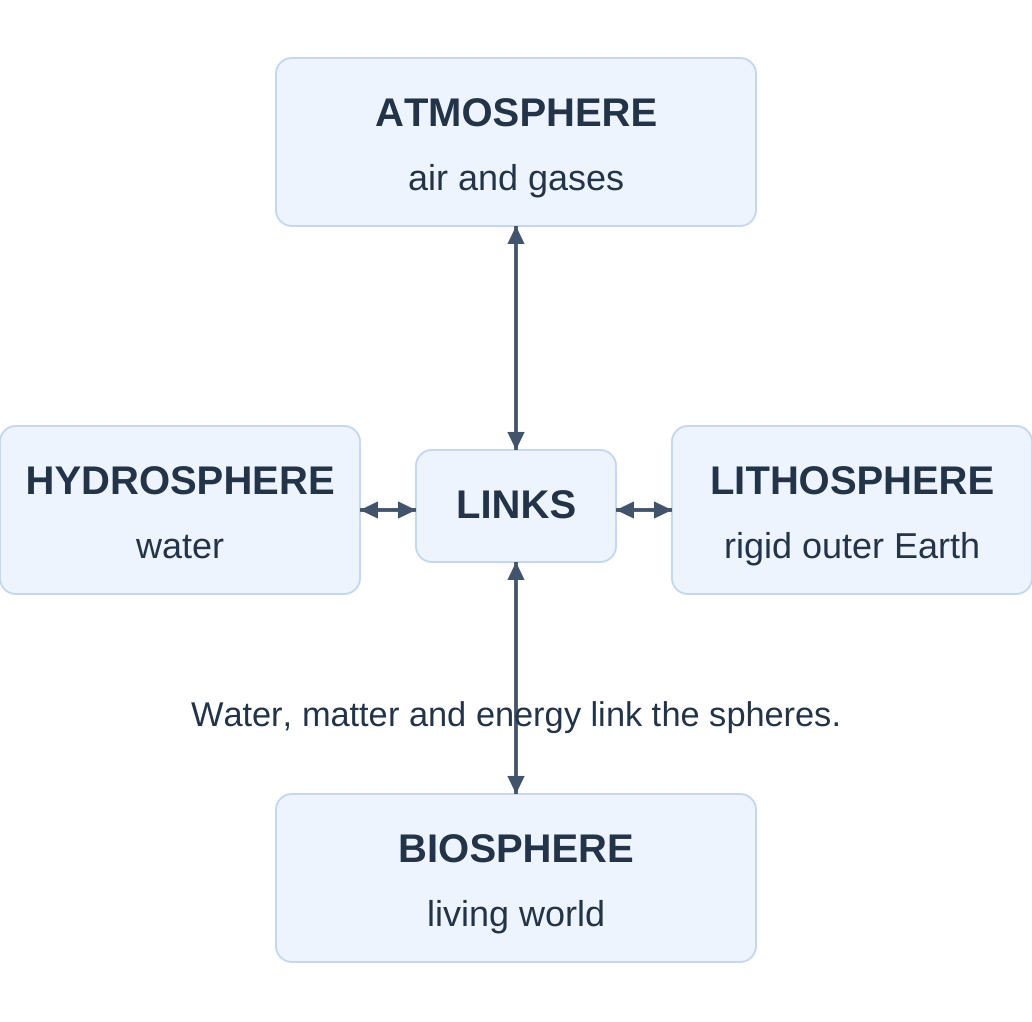
Diagram labels
| Component | Label Meaning |
|---|---|
| Atmosphere | Air and gases |
| Hydrosphere | Water |
| Lithosphere | Rigid outer Earth |
| Biosphere | Living world |
| Links | Water, matter and energy link the spheres |
2.1 Atmosphere
The atmosphere is the gaseous envelope surrounding Earth. It provides gases involved in life processes, carries water vapour and influences weather and temperature conditions. Air is a mixture; oxygen is important for aerobic respiration, while carbon dioxide supplies carbon for photosynthesis.
The atmosphere also receives gases from respiration and decomposition. A tree therefore interacts with the atmosphere both when photosynthesising and when respiring. Avoid the incorrect idea that plants only take in carbon dioxide and never use oxygen.
2.2 Hydrosphere
The hydrosphere includes Earth’s water in liquid, solid and gaseous forms and its stores and movement. Rivers, lakes, groundwater, soil water, ice and water vapour are connected parts of the wider water system.
2.3 Lithosphere and Biosphere
Lithosphere
The lithosphere is Earth’s rigid outer layer, including the crust and uppermost rigid mantle. In a local ecological study, its near-surface materials provide mineral substrates and the parent materials from which soils develop. Soil is an important interface, but it is not the whole lithosphere.
Biosphere
The biosphere comprises the living world and the regions where life occurs. It includes microorganisms, fungi, plants and animals, together with their ecological relationships. Organisms occupy parts of land, water and air; the biosphere overlaps the other components rather than sitting apart from them.
2.4 A Linked Local Example
| Component | Link in a Campus Tree |
|---|---|
| Atmosphere | Leaves exchange gases; rain and weather influence the tree |
| Hydrosphere | Roots take up water; leaves release water vapour |
| Lithosphere | Near-surface minerals and soil support roots and supply nutrients |
| Biosphere | The tree interacts with fungi, insects, birds and other organisms |
Water can move from the atmosphere to land as precipitation, enter soil and later return through evaporation or plant transpiration. Mineral nutrients can enter organisms and later return through decomposition. Different exchanges occur on different timescales.
Common confusion
Incorrect: “The biosphere means all forests.”
Correction: Forests are part of the biosphere, but aquatic organisms, grasslands, soil microbes and many other living systems are included too.
Memory cue
Air → atmosphere; water → hydrosphere; rigid outer Earth → lithosphere; living world → biosphere.
Then add the important point: all four interact.
3. Abiotic Conditions
3.1 Meaning
Abiotic factors are non-living physical and chemical conditions that influence organisms. Important examples include light, temperature, water availability, soil texture, oxygen availability, salinity and pH. Their importance depends on the organism and the habitat.
| Factor | Ecological Relevance |
|---|---|
| Light | Supports photosynthesis; varies with shade, depth and season |
| Temperature | Influences biological processes and water conditions |
| Water | Needed for cells and transport; availability differs across habitats |
| Oxygen | Required for aerobic respiration; supply can be limited in waterlogged settings |
| pH / salinity | Influence chemical conditions and which organisms can tolerate a site |
| Soil properties | Affect rooting, drainage, water retention and nutrient availability |
3.2 Conditions Vary Within a Site
The shaded side of a building may differ from an exposed verge. A shallow pond edge differs from its deeper centre. Such small-scale variation creates different opportunities and constraints. A single reading taken at one point should not automatically represent the whole site.
3.3 Resource and Condition
A resource is something organisms use, such as food, water or mineral nutrients. A condition influences their functioning, such as temperature. The categories help thinking, but the practical task is to identify what limits or supports organisms in the actual setting.
Observation rule
“Shaded ground” is directly visible. “Cooler soil” requires a suitable comparison or measurement. Describe a likely effect as a possibility until evidence supports it.
3.4 Soil: A Living Interface

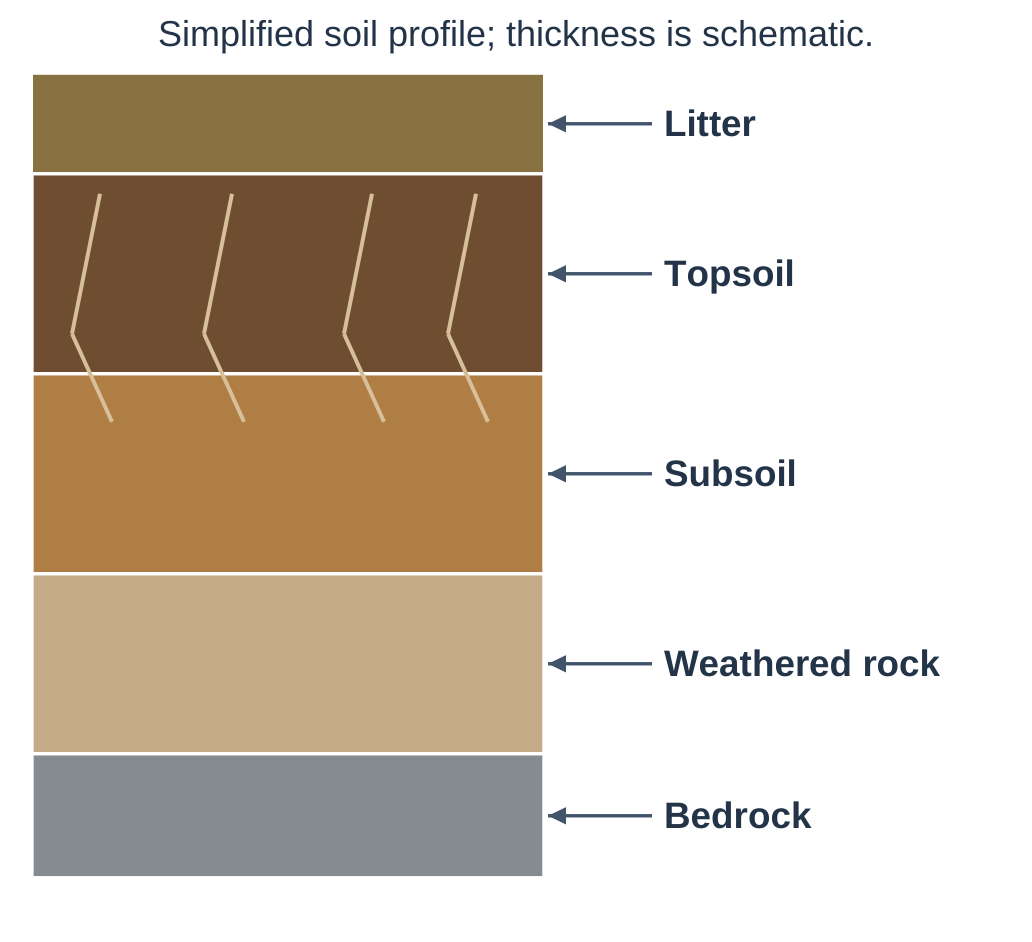
Diagram layers, from top to bottom:
- Litter.
- Topsoil.
- Subsoil.
- Weathered rock.
- Bedrock.
The soil profile is simplified and its thickness is schematic.
Soil contains mineral particles, organic material, water, air and organisms. Its properties emerge from interactions among parent material, climate, organisms, relief and time. Not every site shows all the simplified layers in the figure.
Topsoil and organic matter
Surface litter supplies material for decomposition. Organic matter can influence aggregation, water retention and nutrient availability. Roots, soil animals, fungi and bacteria contribute to the soil system. A “clean” surface stripped of all litter is not necessarily ecologically healthier.
Compaction and water
Repeated trampling or heavy loads can reduce pore space and change infiltration or aeration. The response depends on soil type and moisture. Protecting a root zone may require managing foot traffic rather than simply adding more water.
Worked interpretation
Two nearby beds contain different plant growth. One is shaded and heavily trampled; the other is open and protected. Light, compaction, moisture and management could all contribute. A careful explanation identifies alternatives instead of assigning a single cause from appearance alone.
4. What Is an Ecosystem?
4.1 Definition
An ecosystem is a functional system in which organisms interact with one another and with their physical and chemical surroundings. Its living community and abiotic setting are considered together. A pond, woodland patch, river reach or managed field can be studied at an appropriate scale.
An ecosystem is identified by relationships and processes, not merely by a list of species. Plants capture energy, consumers feed, organisms respire, dead matter decomposes and materials move between living and non-living pools.

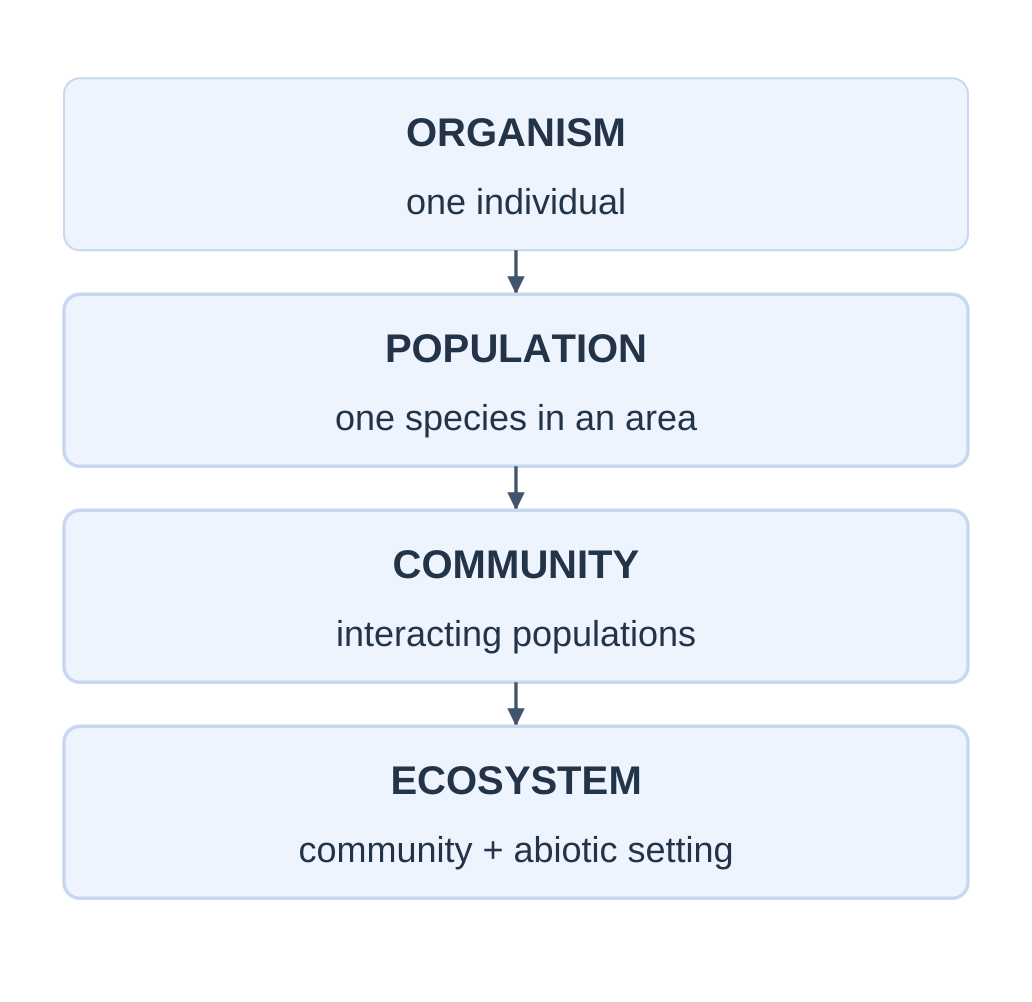
| Diagram Level | Meaning |
|---|---|
| Organism | One individual |
| Population | One species in an area |
| Community | Interacting populations |
| Ecosystem | Community + abiotic setting |
4.2 Organism and Population
An organism is one individual. A population is a group of individuals of the same species in a defined area and time. “All frogs in a pond” may describe more than one species; identify the species before calling it one population.
4.3 Community
A community consists of populations of different species that occur and interact in an area. It includes microorganisms and less conspicuous organisms, not only visible trees, birds and mammals.
4.4 Boundaries, Habitat and Niche
A chosen study boundary
An ecosystem can exchange organisms, water, gases, matter and energy with its surroundings. A fence or shoreline may be a useful study boundary, but it does not stop every exchange. Explain the boundary chosen and what crosses it.
| Term | Meaning and Example |
|---|---|
| Habitat | The place or type of site where an organism lives; a pond margin may be a habitat |
| Niche | How an organism uses resources and interacts with conditions and other organisms |
| Community | The living populations considered together |
| Ecosystem | The community plus its interacting abiotic setting |
Habitat is often explained as an organism’s “address,” while niche concerns its ecological role and requirements. The analogy is useful, but a niche is more than a job title: it includes resource use and responses to conditions.
4.5 Natural and Managed Ecosystems
A managed field receives interventions such as sowing, irrigation or harvesting. A campus pond may receive maintenance and altered inflows. Management changes the system, but food relationships and abiotic influences still operate. Describe both ecological and human inputs when relevant.
Worked classification
- One grasshopper: organism.
- Individuals of one grasshopper species in the field: population.
- Grass, insects, birds, fungi and microbes together: community.
- Those organisms interacting with soil, air, light and water: ecosystem.
Common error
A community is the living component. Adding the relevant abiotic setting and interactions gives an ecosystem. Do not define an ecosystem as “all animals living together.”
5. Ecosystem Structure
Structure concerns what components are present and how they are arranged. It includes abiotic conditions, species composition, functional groups and spatial features such as tree canopy, ground vegetation or pond zones. Function concerns what processes occur.

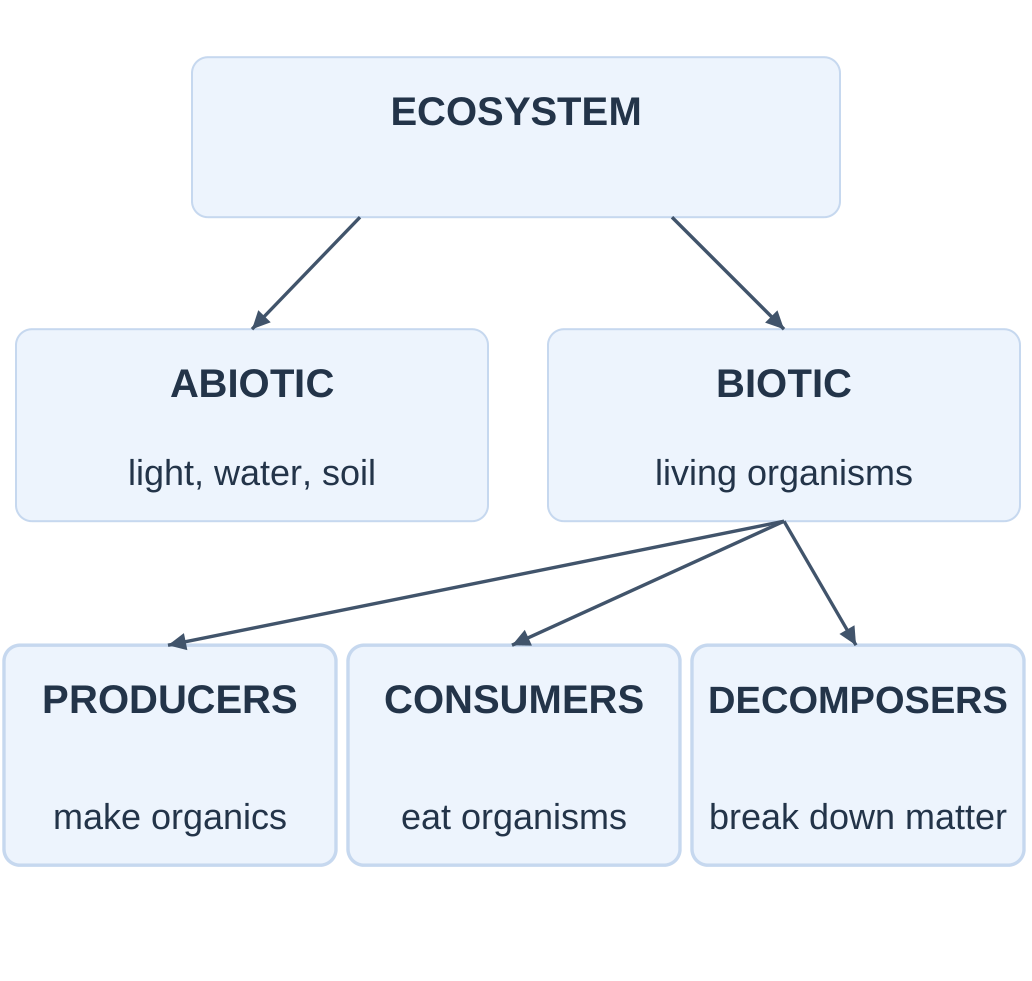
Diagram classification
- Ecosystem
- Abiotic: Light, water and soil.
- Biotic: Living organisms.
- Producers: Make organic matter.
- Consumers: Eat organisms.
- Decomposers: Break down matter.
5.1 Producers
Primary producers build organic matter from inorganic materials using an energy source. In most familiar local ecosystems, green plants and algae use sunlight through photosynthesis. Producers transform energy; they do not create energy from nothing.
A pond may contain microscopic algae as well as rooted aquatic plants. A grassland may be dominated by grasses and other herbs. Producer identity depends on the habitat; “plants” should not be reduced only to large trees.
5.2 Consumers
Consumers obtain organic matter by feeding on organisms or their products. Herbivores feed on producers; carnivores feed on animals; omnivores use more than one kind of food. The same species may occupy different feeding positions depending on its diet.
5.3 Decomposers and Detritivores
Decomposers
Fungi and bacteria are important decomposers. They break down organic material and make some nutrients available again through their activity. They also respire and require energy; they are not a route by which usable energy is returned to the Sun or endlessly recycled.
Detritivores
Detritivores ingest or fragment dead organic material. Earthworms and some other soil invertebrates can perform this role. They help process litter, but the distinction from microbial decomposition should be retained: not every organism near a dead leaf performs the same function.
| Group | Main Role | Example |
|---|---|---|
| Producer | Builds organic matter | Grass / algae |
| Herbivore | Consumes producers | Leaf-eating insect |
| Carnivore | Consumes animals | Frog eating insects |
| Omnivore | Uses varied foods | A bird with mixed diet |
| Detritivore | Processes detritus | Earthworm |
| Decomposer | Microbial breakdown | Fungi / bacteria |
5.4 Structure Is More Than Categories
A woodland’s canopy, shrub and ground layers provide different conditions. A pond’s shallow edge and open water differ in light, depth and shelter. Two sites can contain similar broad groups while differing greatly in habitat quality and species composition.
Self-check
Question: Are decomposers simply the “last animal” in a food chain?
Answer: No. Many are microorganisms or fungi. Dead material enters decomposition from many feeding levels, so their role is not captured by placing one animal at a single final step.
6. Pond Ecosystem

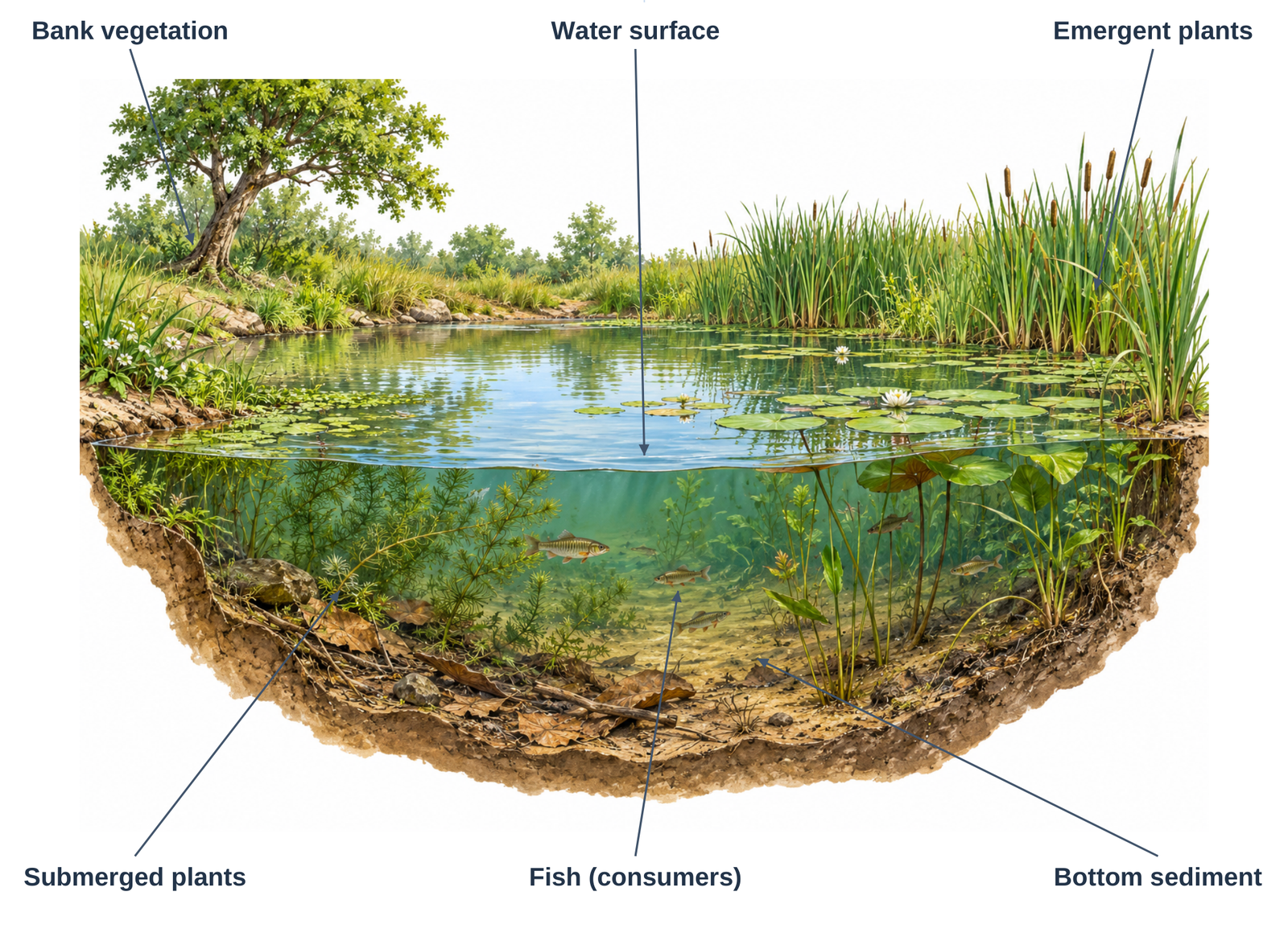
Illustration labels:
- Bank vegetation.
- Water surface.
- Emergent plants.
- Submerged plants.
- Fish: consumers.
- Bottom sediment.
A pond brings water, sediment, light and a living community together. Rooted plants and algae can act as producers; animals use food and shelter; microbes process organic material. The drawing is a general illustration, not a species inventory of a particular pond.
6.1 Reading the Illustration
Emergent plants extend above the water. Submerged plants grow below the surface. Fish are consumers, although their exact diet depends on species and life stage. Bottom sediment can contain mineral material, organic remains and organisms not visible in this view.
Do not infer from appearance
Clear-looking water is not proof that all chemical or microbial conditions are suitable. A picture cannot establish dissolved oxygen, nutrient concentration or water quality.
6.2 Structure and Function
| Component | Possible Role |
|---|---|
| Light and water | Conditions supporting aquatic life |
| Aquatic plants / algae | Organic-matter production |
| Animals | Consumption and interactions |
| Sediment and dead matter | Material for detrital processes |
| Microorganisms | Decomposition and nutrient transformations |
Photosynthesis can add oxygen in illuminated parts, while respiration uses oxygen. Conditions can change with depth, time, temperature and organic loading. A single daytime observation does not represent every part of the pond or its full daily cycle.
Local question: Identify visible inflows and surrounding land use. What water, sediment or nutrients might enter from the catchment?
7. Woodland Ecosystem

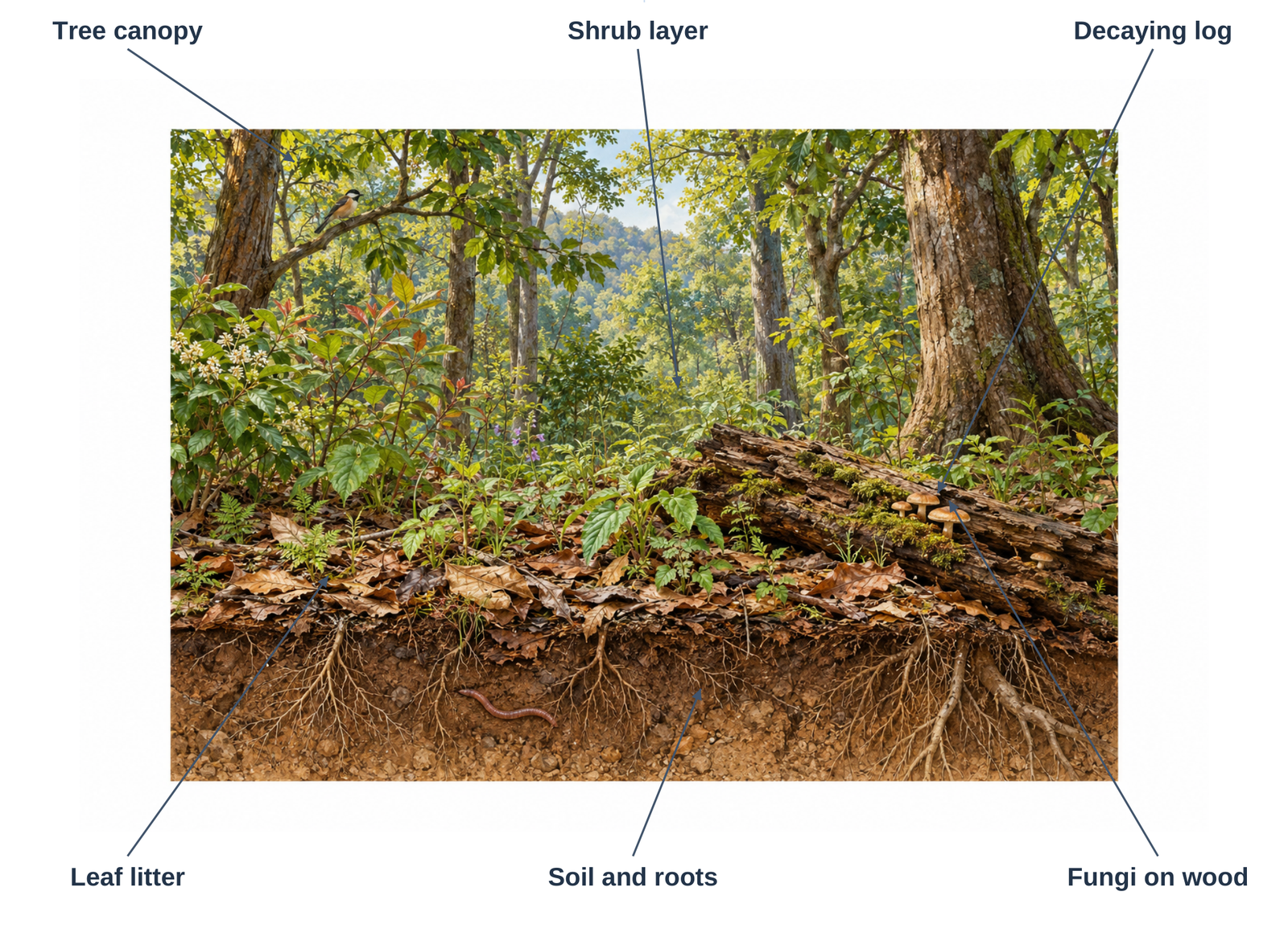
Illustration labels:
- Tree canopy.
- Shrub layer.
- Decaying log.
- Leaf litter.
- Soil and roots.
- Fungi on wood.
A woodland has vegetation at different heights. Trees modify light and near-ground conditions; shrubs and herbs occupy other spaces; litter supplies dead organic material. The soil and its organisms are part of the ecosystem rather than an inert base.
7.1 Litter and Dead Wood
Fallen leaves and a decaying log can support detrital processes and provide habitat. Fungi on the log indicate an association with organic material; the illustration does not identify a species or show the entire microbial community.
Observation caution
Not every fungus is a decomposer, and not every bird eats the same food. Use a broad role only where the organism’s identity or feeding evidence supports it.
7.2 Why Structure Matters
Canopy cover, shrub patches and ground vegetation create spatial variation. A shaded, litter-covered patch may differ from a bare compacted path in moisture, temperature and habitat opportunities. The actual differences should be observed or measured rather than assumed.
| Feature | Ecological Relevance |
|---|---|
| Canopy | Light interception and habitat |
| Shrubs / herbs | Additional plant diversity and shelter |
| Litter / dead wood | Organic inputs and microhabitats |
| Roots / soil | Water and nutrient relations |
Management question: Would removing all undergrowth and litter improve the site?
It may simplify maintenance but can remove habitat and organic inputs. Any intervention should consider safety, access and ecological function together.
8. Other Local Ecosystems
8.1 Grassland and Open Vegetation
Grasslands and other open habitats can support grasses, herbs, insects, soil organisms and their consumers. An open habitat is not automatically a damaged forest. The appropriate vegetation and management depend on local ecology, history and conservation goals.
A small unmanaged campus verge may contain flowering plants and insects even when it looks less orderly than a lawn. Conversely, a patch dominated by one unsuitable invasive plant may offer a different set of interactions. Appearance alone does not establish ecological value.
8.2 Managed Fields
Crop fields are ecosystems shaped by planting, harvesting, irrigation and other management. They contain crop organisms, non-crop plants, consumers, soil organisms and abiotic conditions. Inputs and harvests move material across the study boundary.
8.3 Urban Green Spaces
Parks, gardens, roadside trees and connected tree patches can provide habitat and local benefits. Their value depends on composition, structure, connectivity and maintenance, not simply the total count of planted saplings.
| Place | Useful Observation |
|---|---|
| Open verge | Flowering plants, insects and mowing pattern |
| Crop field | Crop stage, margins, soil cover and management |
| Park | Tree diversity, shrub cover, disturbance and access |
| Riverbank | Vegetation, exposed soil, flow and human use |
Avoid a common assumption
Planting trees is not appropriate in every naturally open habitat. Conservation should protect the ecological character of the site rather than apply one visual ideal everywhere.
8.4 Comparing Ecosystems
| Feature | Pond | Woodland |
|---|---|---|
| Main medium | Water and sediment | Air, soil and vegetation |
| Producers | Algae and aquatic plants | Trees, shrubs and herbs |
| Structure | Depth and shoreline variation | Vertical and ground-layer variation |
| Dead matter | Settles or moves in water | Litter and dead wood |
| Connections | Runoff, inflows and outflows | Movement of organisms, water and materials |
8.5 A Shared Method
For any site, identify a boundary, abiotic conditions, living groups, feeding links, dead-matter pathways and external influences. Then describe one interaction that connects these observations. This method is more useful than memorising a different disconnected list for every ecosystem.
Worked comparison
Two green campus areas have different structures. Site A is a closely mown lawn with a few ornamental trees. Site B contains herbs, shrubs, litter and several tree species. These observations suggest differences in habitat opportunities, but they do not establish exact biodiversity or conservation priority without a suitable survey.
Practice question
Why might a small pond matter on an urban campus?
It may provide aquatic habitat, interact with local water movement and support learning or recreation. Its benefits depend on condition and management; a pond receiving polluted inflows also requires responsible attention.
Local focus
A place does not need to be remote, large or visually spectacular to contain ecological interactions worth understanding.
9. Basic Ecosystem Functions
Ecosystem functions are processes arising from the system’s components and interactions. Four useful organising ideas are production of organic matter, decomposition, energy transfer and nutrient cycling. They operate together rather than as isolated chapters.

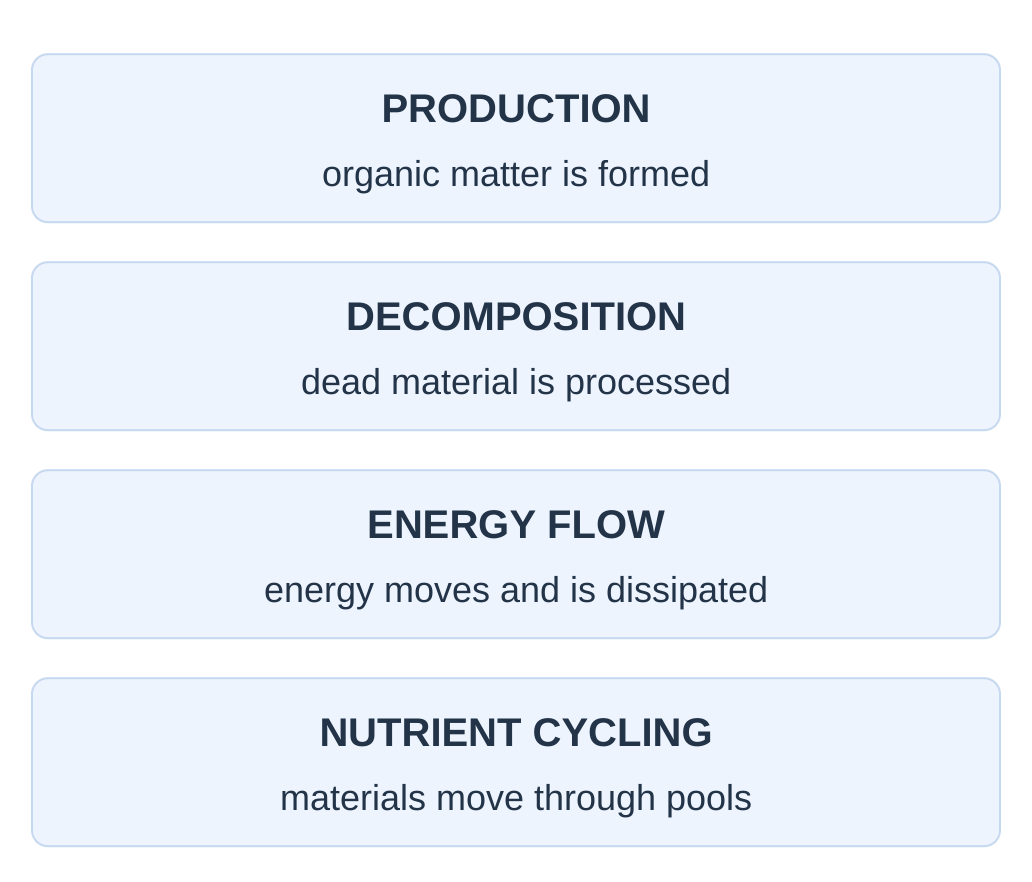
| Function | Diagram Description |
|---|---|
| Production | Organic matter is formed |
| Decomposition | Dead material is processed |
| Energy flow | Energy moves and is dissipated |
| Nutrient cycling | Materials move through pools |
9.1 Primary Production
Primary producers convert an energy source into chemical energy stored in organic matter. In a sunlit pond or garden, photosynthesis is the main familiar example. Producer respiration uses part of the captured energy; remaining production can support growth and other pathways.
9.2 Production versus Standing Amount
Production describes formation over time. The amount of living material present at one moment is a standing stock, often described as biomass. A small rapidly renewed producer stock can still support substantial production, so the two terms should not be treated as identical.
Awareness level
The syllabus asks for basic function and energy-flow concepts. Understand the relationships before attempting advanced productivity measurements or ecological modelling.
9.3 Decomposition and Reuse of Matter
Dead leaves, remains and wastes contain organic material. Fragmentation, leaching and microbial activity can change that material. Decomposer activity returns some nutrients to forms available to producers, while other material may remain stored or move elsewhere.
Conditions influence the process
Moisture, temperature, oxygen conditions and the nature of the material influence decomposition. More water does not always mean faster breakdown: persistent waterlogging can limit oxygen for aerobic processes. Avoid a single rule that ignores the site and organisms involved.
9.4 Nutrient Cycling
Nutrients move between organisms and environmental pools through uptake, feeding, waste production and decomposition. Matter can be reused, but a local ecosystem is not perfectly closed: materials can enter, leave or remain stored.
9.5 Energy Flow
Energy enters most familiar systems as sunlight, is captured by producers and reaches other organisms through organic matter. Organisms use energy in metabolism and release heat. The same usable energy does not circulate indefinitely like a nutrient atom.
Integrated example: a fallen leaf
A leaf contains organic material produced by the plant. After it falls, detritivores and microbes may process it. Some nutrients can later become available for uptake. Energy associated with the organic material supports biological activity and is progressively dissipated as heat. Nutrient reuse and energy dissipation describe different aspects of the same event.
Self-check
Can decomposition be omitted from an ecosystem explanation?
No. Feeding on living material is only one pathway. Dead matter and microbial processes connect multiple parts of the system and are essential to understanding material turnover.
10. Food Chains
10.1 Definition
A food chain represents one feeding pathway through which organic matter and associated energy move. In a conventional feeding diagram, the arrow points from the food or prey toward the consumer. It shows the direction of transfer, not the direction in which a predator chases prey.

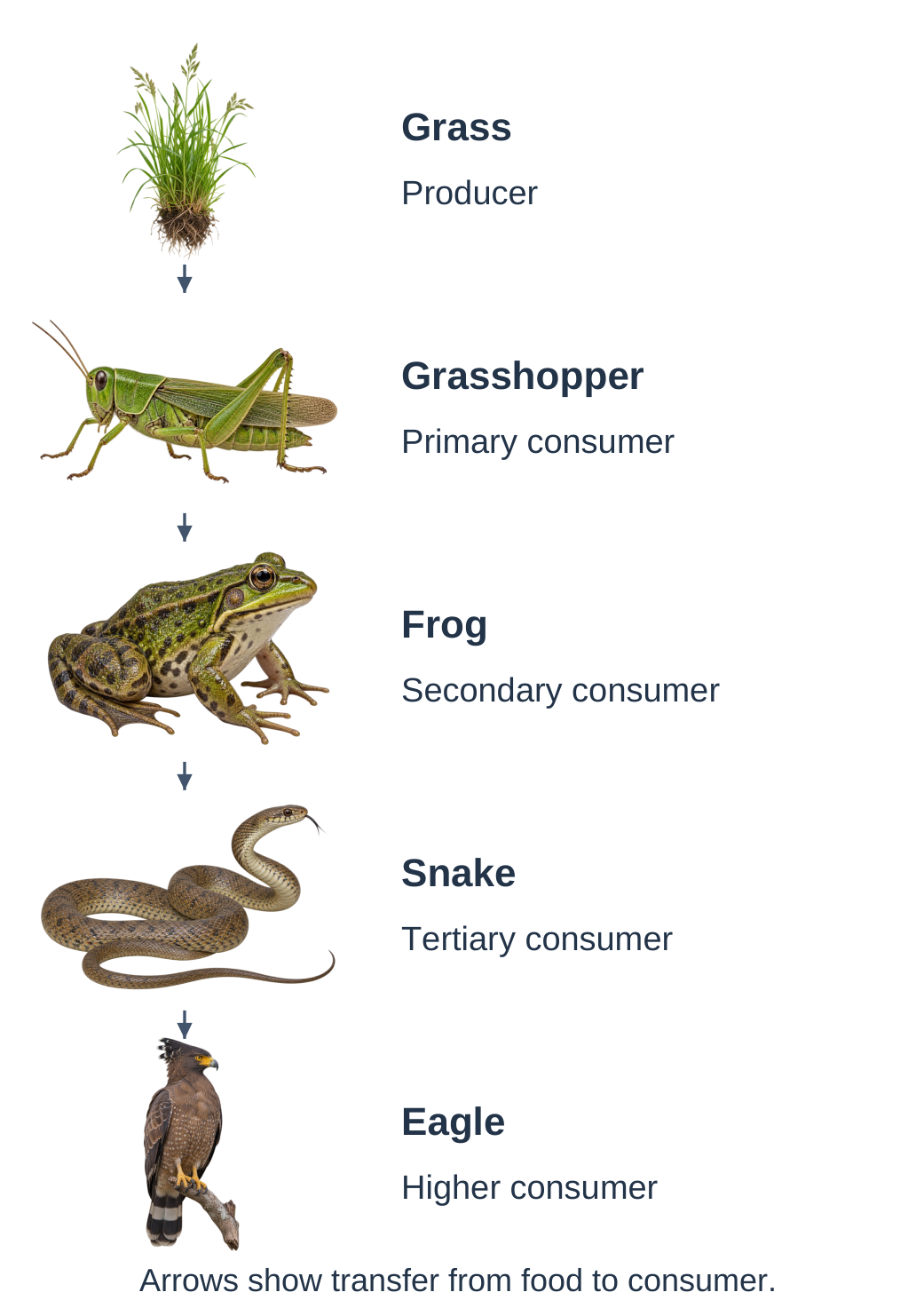
| Organism | Role in the Illustrated Pathway |
|---|---|
| Grass | Producer |
| Grasshopper | Primary consumer |
| Frog | Secondary consumer |
| Snake | Tertiary consumer |
| Eagle | Higher consumer |
Pathway: Grass → grasshopper → frog → snake → eagle.
Arrows show transfer from food to consumer.
10.2 Grazing Food Chain
A grazing food chain begins with living producers. A herbivore consumes producer material, and other consumers may feed on it. The diagram is a simplified possible pathway; it is not a claim that every frog, snake or eagle has an identical diet.
Sunlight can be drawn as an input to the producer, but the Sun is not an organism or a feeding level. Do not count it as the first trophic level.
10.3 Trophic Levels
| Position | Meaning in the Pathway |
|---|---|
| First | Producer: builds organic matter |
| Second | Primary consumer: feeds on producers |
| Third | Secondary consumer: feeds on primary consumers |
| Fourth and above | Successive consumer positions in that pathway |
A role belongs to a pathway
A feeding position is determined by what is being consumed. An omnivore can feed at more than one level. It is therefore misleading to assign every individual of a mixed-feeding species one permanent simple position without explaining its diet.
Worked reading exercise
Pathway: Algae → small grazing aquatic animal → small fish → fish-eating bird.
Producer: Algae.
Primary consumer: The grazer.
Secondary consumer: The fish in this pathway.
Arrow meaning: Food and associated energy move to the organism on the right.
10.4 What a Chain Leaves Out
A real consumer may eat several foods. Organisms produce wastes and eventually die. Decomposers act on material from many levels. A single chain hides alternative feeding links and the detrital pathway, so it is a useful introduction rather than a complete ecosystem map.
Practice with answer
Question: In grass → grasshopper → frog, should the arrow between frog and grasshopper point toward the grasshopper?
Answer: No. The frog consumes the grasshopper, so the transfer arrow points grasshopper → frog.
Memory cue
Ask “Who receives this food?” The arrowhead points to that consumer. Use one arrow convention consistently throughout an answer.
11. Detrital Pathways
11.1 Starting with Dead Matter
A detrital pathway begins with dead organic material and wastes rather than direct grazing on living producers. Fallen leaves, dead roots, wood and animal remains can supply detritus. Detritivores, decomposers and their consumers participate in a network of processes.

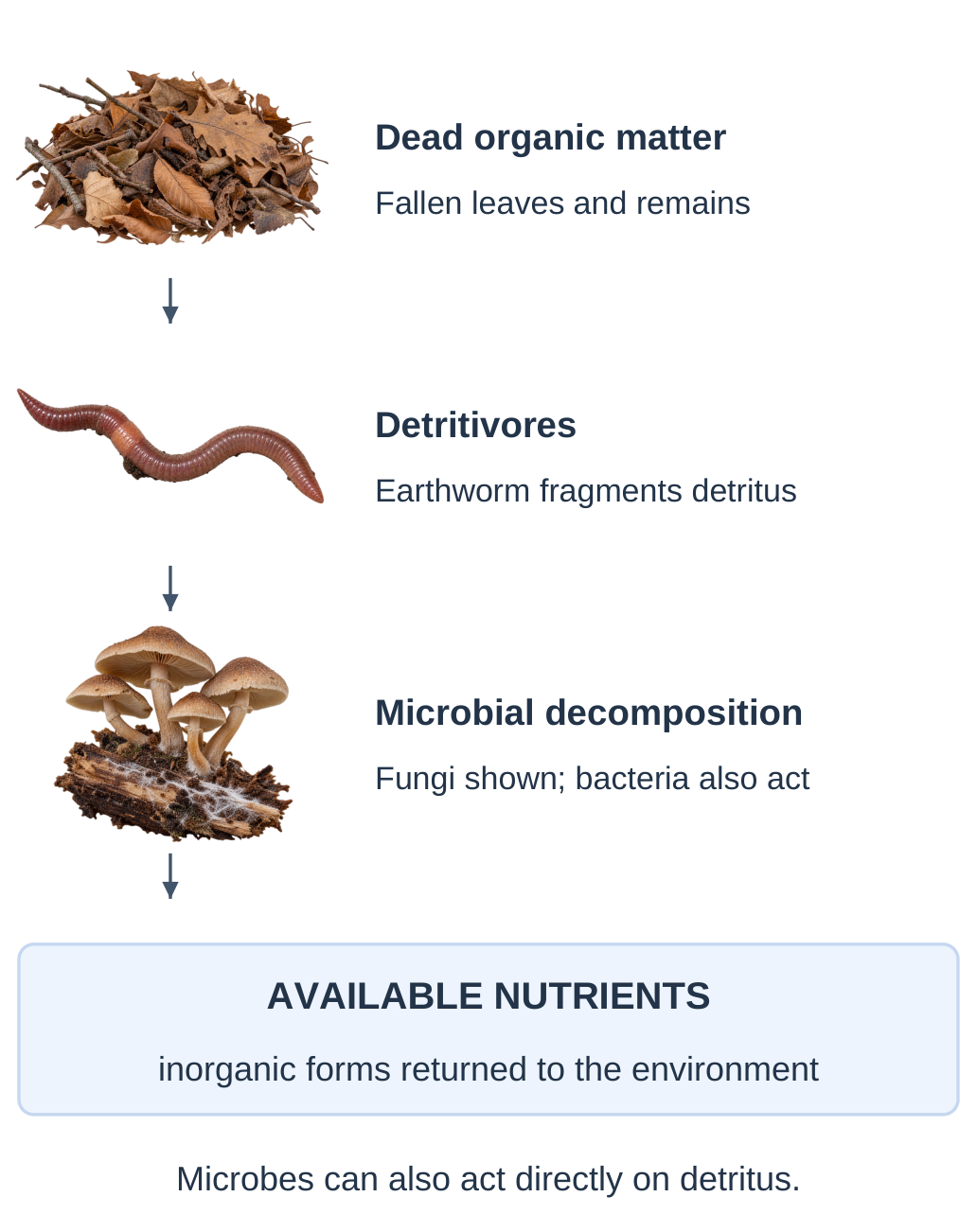
| Diagram Component | Description |
|---|---|
| Dead organic matter | Fallen leaves and remains |
| Detritivores | Earthworm fragments detritus |
| Microbial decomposition | Fungi shown; bacteria also act |
| Available nutrients | Inorganic forms returned to the environment |
Microbes can also act directly on detritus.
11.2 Parallel Routes
Microbes may act directly on detritus. Detritivores can fragment material and affect its accessibility. Some organisms feed on microbes or on detritivores. Real detrital systems are webs, not a rigid assembly line in which every item passes through identical stages.
Important distinction
The final nutrient pool is a material pathway, not an extra animal or a new consumer trophic level. Nutrient availability and energy transfer must be explained separately.
11.3 Comparing the Pathways
| Feature | Grazing | Detrital |
|---|---|---|
| Starting material | Living producer tissue | Dead organic material / wastes |
| Early users | Herbivores | Microbes and detritivores |
| Visible example | Insect eating a leaf | Processing fallen litter |
| Wider connection | Can supply dead material | Receives inputs from many levels |
11.4 Why Litter Matters
A leaf on the ground is no longer living plant tissue, but it still contains organic material. Removing all litter changes inputs to the soil community. The appropriate amount and management depend on the site, fire considerations, access and other responsibilities; avoid a universal instruction to leave every waste material where it falls.
11.5 Decomposers Are Consumers of Energy
Microorganisms use chemical energy associated with organic matter and release heat through metabolism. They do not recycle usable energy back into sunlight. Their contribution to nutrient cycling should not be described as “energy returning to plants.”
Worked classification
- A caterpillar eats a living leaf: grazing.
- A fungus grows through fallen wood: microbial decomposition associated with dead matter.
- A bird eats an earthworm: a consumer link that can connect with detrital processing.
- A root takes up a mineral nutrient: uptake, not predation.
Short-answer practice
Explain why decomposers connect several trophic levels.
Answer cue: Plants, herbivores and carnivores all produce organic remains and wastes; decomposers can process material originating from these different sources.
12. Food Webs
12.1 Definition
A food web combines interconnected feeding pathways. It represents the fact that a food source may support several consumers and a consumer may use several foods. The network is a model of selected relationships, not a complete account of every interaction.

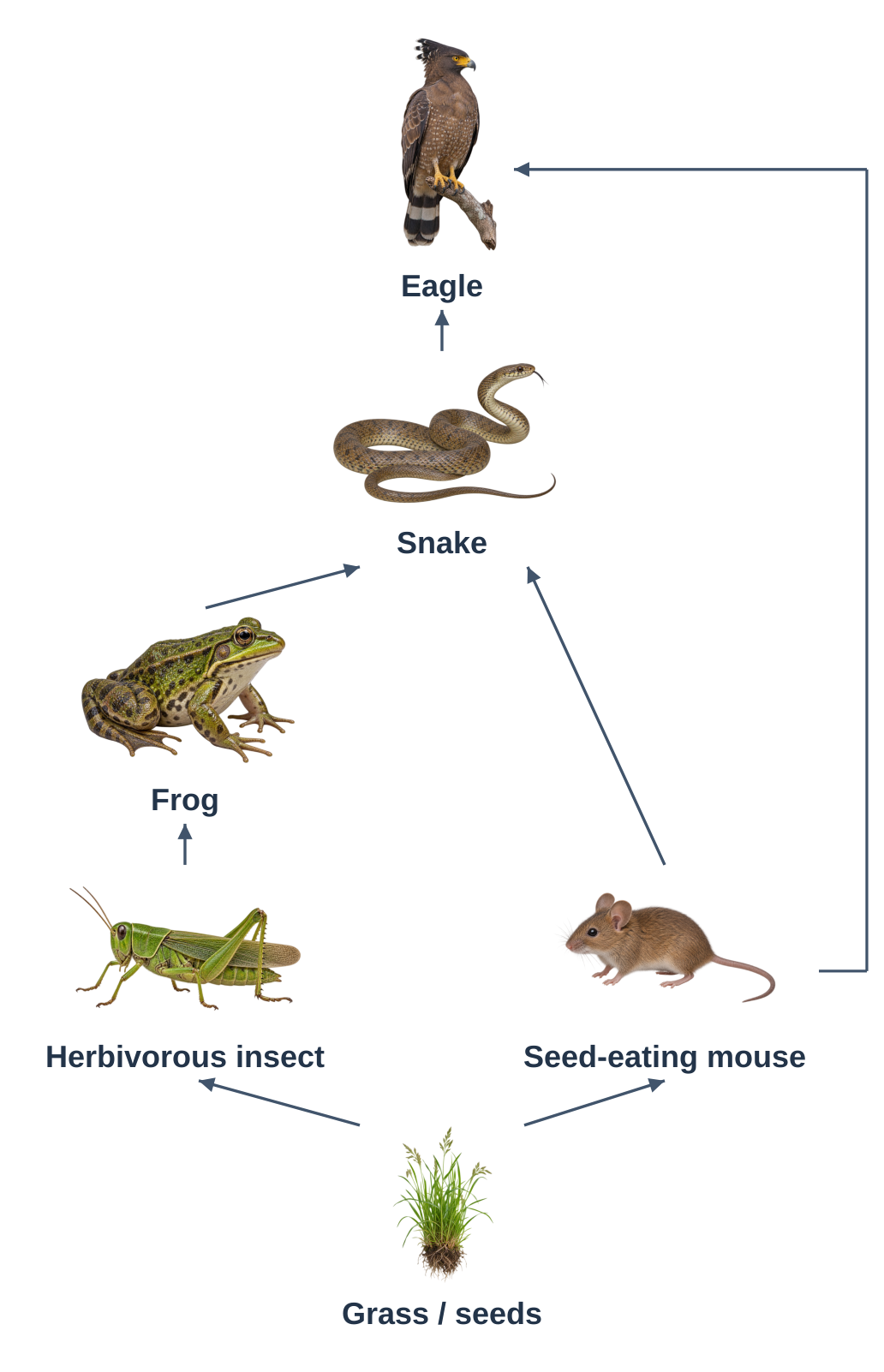
Organisms labelled in the diagram:
- Grass / seeds.
- Herbivorous insect.
- Seed-eating mouse.
- Frog.
- Snake.
- Eagle.
Two routes to the eagle are grass/seeds → mouse → eagle and grass → herbivorous insect → frog → snake → eagle. The mouse can also supply the snake. These are possible feeding links used for learning; a field study must verify the actual organisms and diets.
Read every arrow
A line crossing a page is not automatically a link to every nearby box. Follow the arrow from its starting organism to its arrowhead. In this diagram, no link means that feeding relationship is not being shown.
12.2 Interpreting a Change
Direct and indirect effects
Removing a consumer may change pressure on its food, while also removing a food source for another organism. The actual response depends on alternative foods, competition, movement, timing and other conditions. A simple web suggests hypotheses; it does not guarantee a numerical outcome.
Worked disturbance question
Suppose insect abundance falls. A frog that relies on those insects may have less food. A predator might switch to another prey if its biology allows. Producer effects depend on which insects declined and what else changed. “All plants will increase” is too strong without additional evidence.
12.3 A Web Is Not a Stability Guarantee
Alternative pathways can sometimes buffer a change, but more lines in a drawing do not automatically prove greater stability. Link strengths, species roles and the kind of disturbance matter. Keep the explanation at a careful conceptual level.
| Food Chain | Food Web |
|---|---|
| One selected pathway | Several connected pathways |
| Easy to introduce trophic positions | Shows alternative foods and shared consumers |
| Hides many real relationships | Still simplifies the actual ecosystem |
| Useful for a focused example | Useful for discussing indirect effects |
12.4 Diagram-Drawing Checklist
- Name the ecosystem or state that the example is conceptual.
- Place producers at the beginning of feeding pathways.
- Use food → consumer arrows consistently.
- Avoid unsupported links and crossing labels.
- Explain one pathway in words below the diagram.
Self-check: In the illustrated web, is the eagle always at one fixed numbered level?
No. Different pathways reaching it have different lengths.
13. Energy Flow
13.1 Energy Enters and Is Transformed
In most familiar local ecosystems, sunlight supplies the main external energy input. Producers capture part of it in chemical forms. Organisms use energy for maintenance, growth and other processes; feeding transfers some organic material and associated energy to consumers.

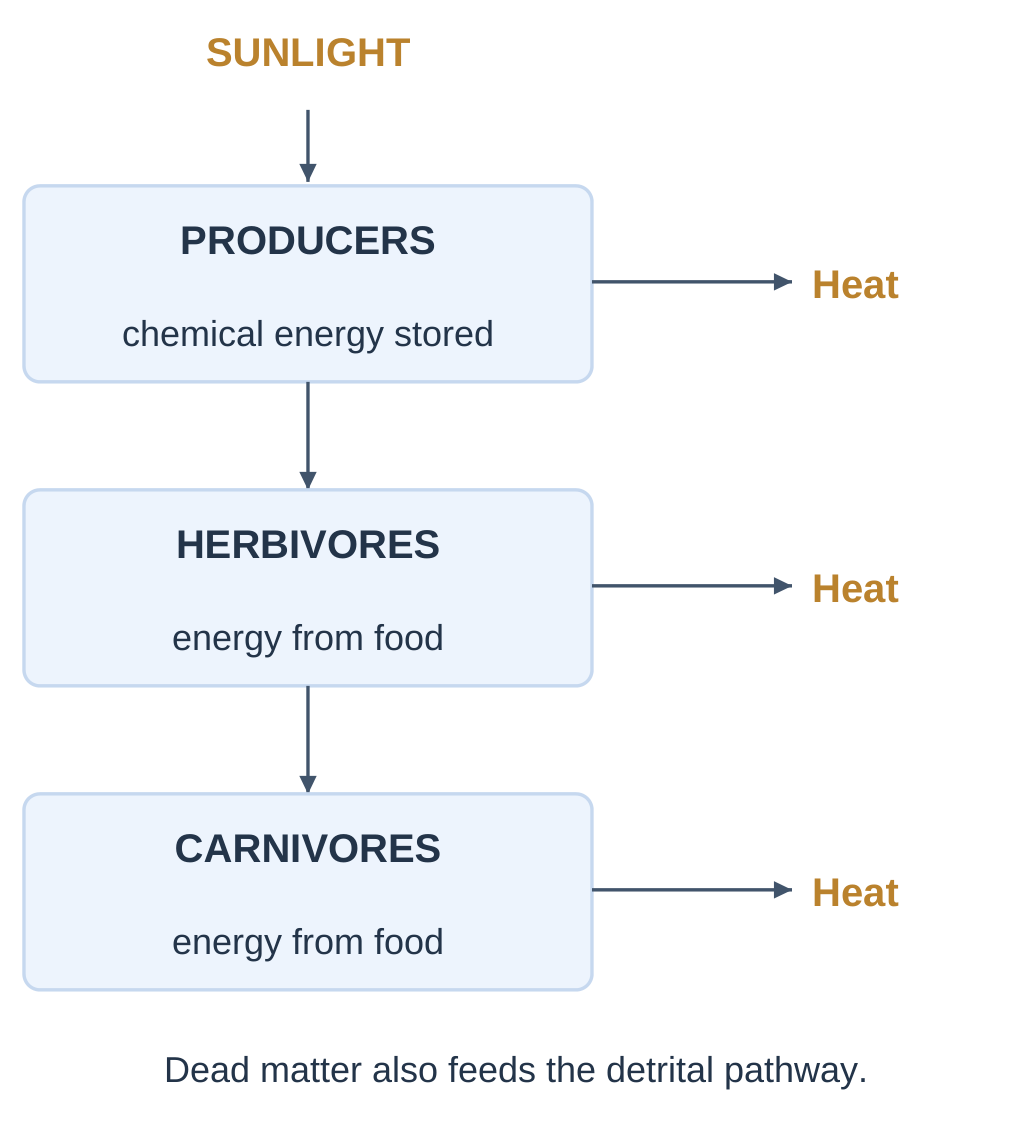
Diagram pathway: Sunlight → producers → herbivores → carnivores.
- Producers: chemical energy stored.
- Herbivores: energy from food.
- Carnivores: energy from food.
- Heat is released from the illustrated living groups.
- Dead matter also feeds the detrital pathway.
13.2 Why Flow Is One-Way
Heat dissipated to the surroundings is not simply captured again by producers to rebuild the same food energy. A continuing external input is therefore needed to sustain the familiar photosynthesis-based pathway. Energy is transformed and conserved physically, but its availability for biological work changes.
Correct wording
Producers capture and transform energy; they do not create it. Decomposers reuse nutrients through material transformations, but they do not make energy circulate endlessly.
13.3 Transfer Between Levels
Why less reaches the next level
Not all producer or prey material is eaten. Not all eaten material is assimilated. Organisms also use assimilated energy in respiration. Consequently, only part becomes new biomass or production available to another feeding level. Some unused material enters the detrital pathway.
13.4 The Approximate 10% Model
Introductory teaching often uses a 10% transfer assumption to illustrate declining energy through successive trophic levels. Real efficiencies vary with organisms, food and conditions. Use 10% as a stated simplification in a supplied numerical problem, not a universal exact measurement.
If 10,000 units are available at producers and each transfer is assumed to be 10%, the next levels contain 1,000, 100 and 10 units in the same defined context. The starting quantity must be producer-level available energy, not automatically all sunlight falling on the site.
13.5 What Happens to the Remainder?
Do not state that every untransferred unit instantly becomes heat at that link. Some material was not consumed, some was not assimilated and some may enter detritus; respiration dissipates heat. Over time, ecosystem energy use is associated with heat dissipation, but the immediate pathways differ.
Common errors to correct
| Error | Correction |
|---|---|
| Energy is recycled like nutrients | Matter can be reused; usable energy has a directional flow |
| All sunlight becomes plant food | Only part is captured and stored |
| Exactly 10% always transfers | A simplified model; actual efficiency varies |
| Decomposers return energy to plants | They contribute to nutrient turnover and also use energy |
14. Pyramids and Energy Examples
14.1 An Energy Pyramid
An energy pyramid represents energy transfer or production across trophic levels using a consistent area and time basis. It is upright because energy available to successive levels declines. Do not confuse it with a snapshot of how many organisms are visible.

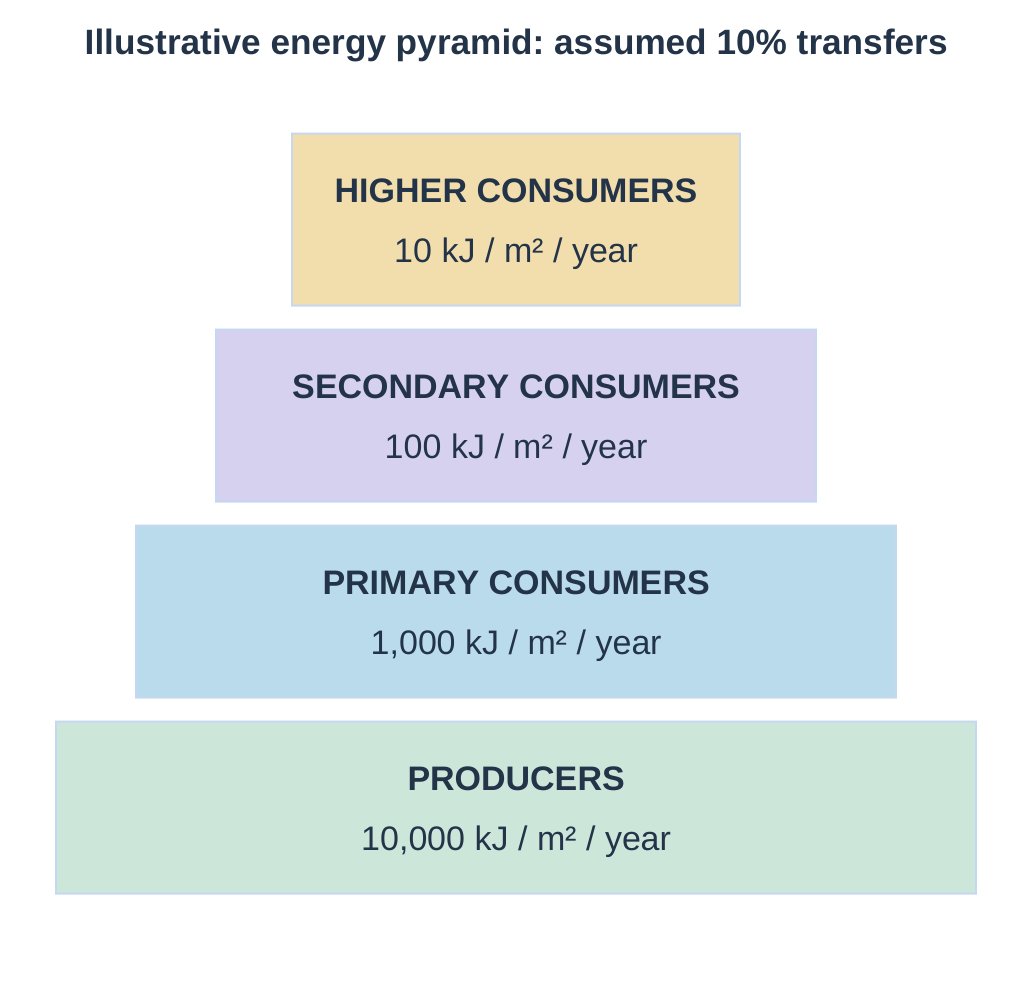
| Trophic Group | Illustrative Value |
|---|---|
| Producers | 10,000 kJ/m²/year |
| Primary consumers | 1,000 kJ/m²/year |
| Secondary consumers | 100 kJ/m²/year |
| Higher consumers | 10 kJ/m²/year |
Diagram assumption: Illustrative energy pyramid with assumed 10% transfers.
14.2 Other Ecological Pyramids
A pyramid of numbers concerns counts. A biomass pyramid concerns standing living mass at a time. These can have shapes different from an energy pyramid. For example, one large tree can support many insects, so numbers alone do not describe available energy.
A rapidly renewed aquatic producer stock can be small at one instant while supporting consumers over time. This explains why standing biomass and production should not be interchanged. No advanced calculations are required to understand that distinction.
14.3 Solved Numerical Examples
Example 1: forward transfer
Given: Producer-level energy = 20,000 kJ in a defined area and period; each transfer is assumed to be 10%.
Primary consumers:
20,000 × 0.10 = 2,000 kJ.
Secondary consumers:
2,000 × 0.10 = 200 kJ.
Third consumer transfer:
200 × 0.10 = 20 kJ.
Each step uses the preceding level. Multiplying 20,000 by 10% only once does not give the third consumer level. State how many feeding transfers occur.
Example 2: measured efficiency
Constructed values: Lower-level production = 5,000 units; next-level production = 600 units, with a comparable basis.
Transfer efficiency:
(600 / 5,000) × 100 = 12%.
The calculation illustrates that an observed or supplied efficiency need not equal the 10% teaching assumption.
Example 3: working backwards
If secondary consumers have 150 units under a 10% assumption for two transfers, primary consumers require:
150 / 0.10 = 1,500 units.
Producers require:
1,500 / 0.10 = 15,000 units.
This reverses the model; it is not a prediction of a real site without data.
Practice and answer
Question: With 8,000 producer units and two 10% transfers, what reaches secondary consumers?
Answer:
8,000 × 0.10 × 0.10 = 80 units.
Keep the same measurement context and do not add trophic levels that the problem did not specify.
Exam caution
Label the pyramid and its units. Write “assumed 10% transfer” where appropriate. Energy is a flow or production quantity over a stated basis, not merely a count of animals.
15. Biodiversity: Meaning and Levels
15.1 Meaning
Biodiversity is variation in the living world, including variation within species, among species and among ecosystems. It includes microorganisms and ecological relationships, not only large or attractive animals. A site’s greenness alone does not measure all its biodiversity.

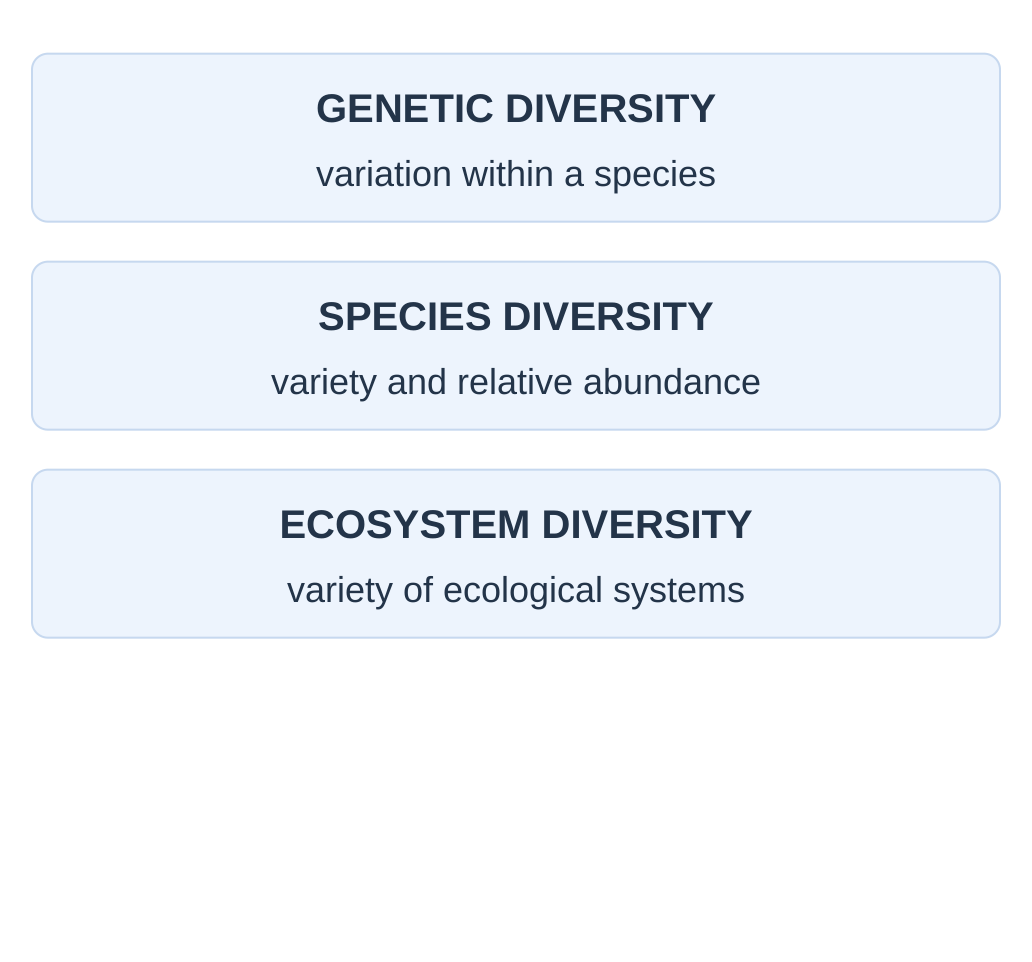
| Level | Diagram Description |
|---|---|
| Genetic diversity | Variation within a species |
| Species diversity | Variety and relative abundance |
| Ecosystem diversity | Variety of ecological systems |
15.2 Genetic Diversity
Genetic diversity refers to differences within a species. Different varieties of a crop can illustrate this level when they belong to the same species. Such variation can influence traits and responses to changing conditions, although the value of a particular trait depends on context.
15.3 Species Diversity
Species diversity includes the variety of species and how individuals are distributed among them. Species richness is the number of species recorded. Evenness concerns their relative abundances. Richness alone does not express every aspect of diversity.
Classification check
Two varieties of one rice species illustrate within-species variation. A tree, a butterfly and a fungus illustrate different species. A pond and a woodland illustrate ecosystem variation.
15.4 Richness, Evenness and Scale
A constructed comparison
| Patch | Species A | Species B |
|---|---|---|
| X | 20 individuals | 20 individuals |
| Y | 39 individuals | 1 individual |
Both patches contain two recorded species, so their observed richness is the same. Patch X is more even in this constructed example. The table does not by itself establish habitat quality or conservation priority, because species identity and wider context also matter.
15.5 Ecosystem Diversity
A landscape containing wetlands, woodland, grassland and flowing-water habitats has variation among ecological systems. Protecting this variety can preserve different conditions and interactions. One habitat type should not automatically be converted to another in the name of making everything look equally green.
15.6 Observed Diversity Is Incomplete
What a student records depends on time, season, effort, methods and identification skill. A short daytime visit can miss nocturnal organisms, microbes or seasonal plants. “Not observed” is not the same as “absent.”
Worked observation language
Overclaim: “Only five species live in this park.”
Better: “Five recognisable organism types were recorded during a 20-minute visit; several could not be identified to species.”
If species identity is uncertain, do not relabel an organism type as a confirmed species.
Memory cue
Within → between → among systems: variation within a species, differences between species, and variation among ecosystems. Use a separate example for each level.
16. Why Biodiversity Matters
16.1 Ecological Relationships
Biodiversity is linked with feeding, pollination, decomposition, nutrient turnover and many other processes. Different organisms contribute in different ways, and the effects of losing a species depend on its role, interactions and the conditions. Avoid claiming that every species performs an identical interchangeable function.

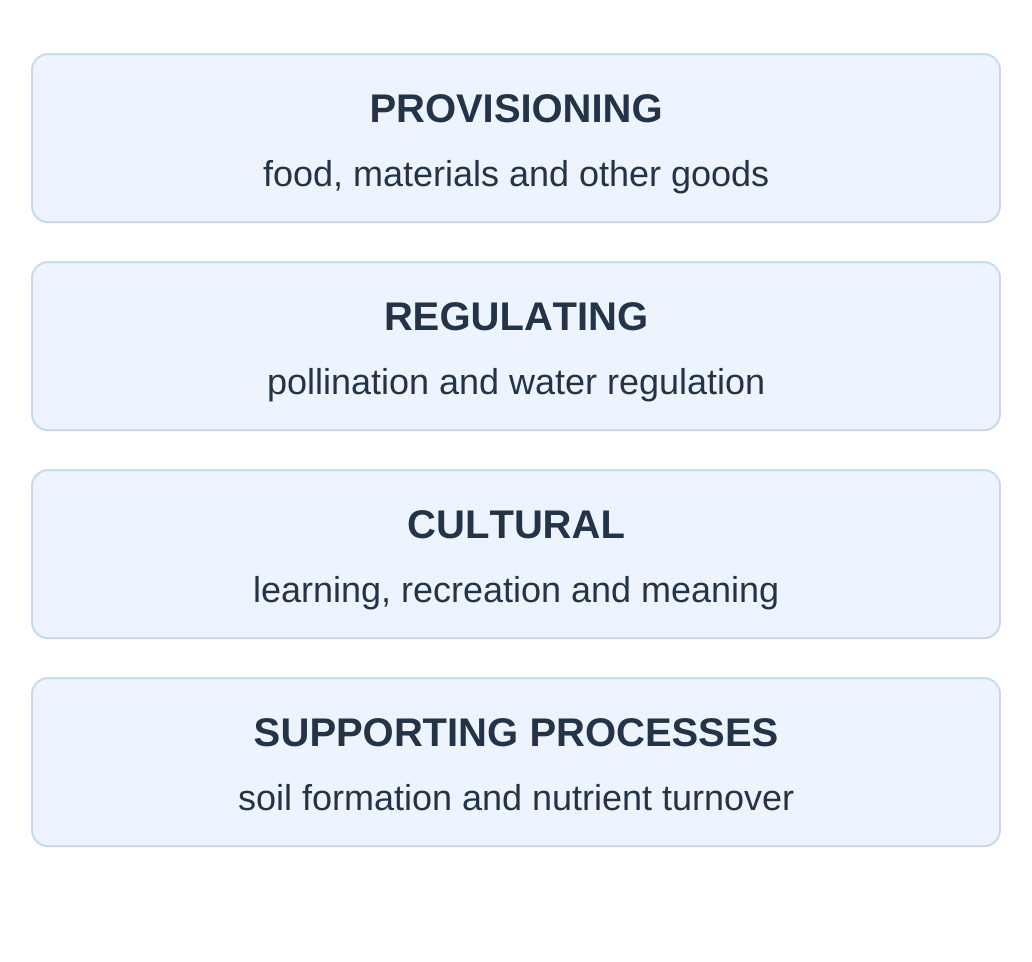
| Category | Diagram Examples |
|---|---|
| Provisioning | Food, materials and other goods |
| Regulating | Pollination and water regulation |
| Cultural | Learning, recreation and meaning |
| Supporting processes | Soil formation and nutrient turnover |
16.2 Ecosystem Services
Ecosystem services are benefits people obtain from ecological systems. Examples include food, pollination, moderation of some environmental effects, recreation and learning. The supporting-process category is a familiar teaching framework; classifications differ, so explain the actual process and benefit.
A benefit is not unlimited. A wetland may influence water storage and habitat, but its effect depends on location, condition and scale. It should not be described as a device that automatically removes every pollutant or prevents every flood.
16.3 Values Beyond a Price Tag
Direct and future-use value
Plants, animals and microorganisms contribute food, materials, genetic resources and knowledge. Diversity can provide options for future learning and use. Do not invent a medical benefit for a local organism or recommend using it as a remedy merely to demonstrate value.
Cultural and educational value
Local places support recreation, observation, identity and traditions. A familiar tree patch can be a learning site even if it has no famous species. Different communities may value the same ecosystem in different ways, which should be considered respectfully.
Ethical or intrinsic value
Conservation can recognise that living organisms have value beyond immediate human use. An organism need not be profitable, beautiful or popular to deserve consideration. Ethical responsibility includes avoiding unnecessary destruction and considering the consequences of decisions.
16.4 Diversity and Resilience
Variation in traits and responses can sometimes help maintain functions under change. This does not mean that a diverse ecosystem is invulnerable or that a species count alone predicts resilience. The type of disturbance, habitat condition and ecological relationships matter.
Local worked example
A flowering patch can provide resources for some insects and opportunities for student observation. If it is replaced by a single decorative surface, these particular opportunities may be lost. The assessment should record what is present and consider maintenance, access and appropriate habitat goals before choosing an action.
A strong importance answer
Connect biodiversity to an ecological process, a human benefit and an ethical consideration. Give a local example and avoid unsupported claims of guaranteed protection or unlimited benefit.
17. Habitat Loss and Fragmentation

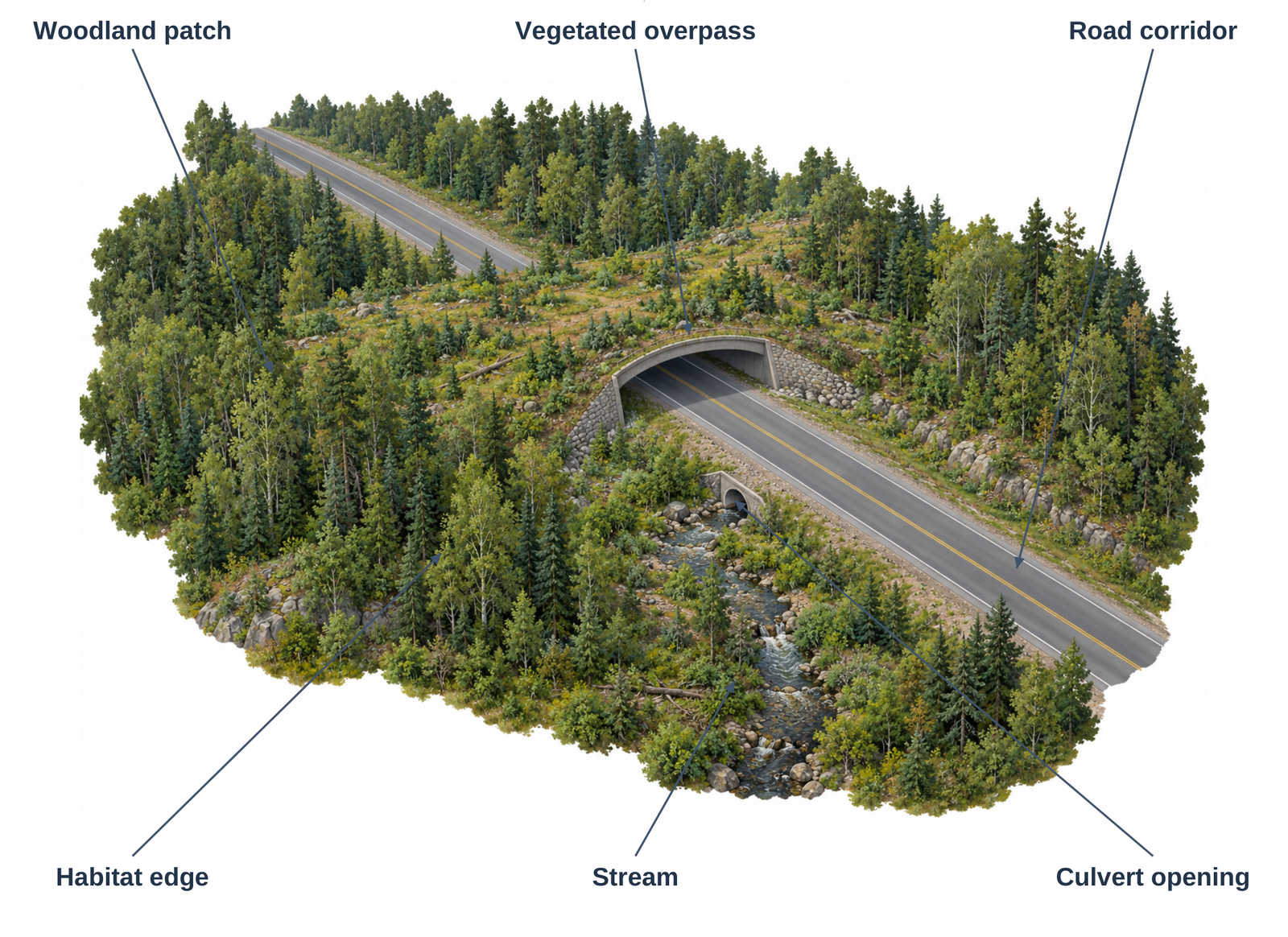
Illustration labels:
- Woodland patch.
- Vegetated overpass.
- Road corridor.
- Habitat edge.
- Stream.
- Culvert opening.
Habitat loss removes suitable living space. Degradation reduces its condition. Fragmentation separates a habitat into smaller or more isolated pieces. These processes can occur together but are not identical.
17.1 Reading the Landscape
A road creates an opening and habitat edges. It may affect movement, disturbance and access to resources. The crossing illustrates one possible mitigation; actual design requires knowledge of the organisms, landscape and road conditions.
Do not overclaim
A green bridge is not proof that connectivity has been restored for every species. Location, design, maintenance and monitoring determine usefulness.
17.2 Think Beyond Patch Area
Two patches with the same total tree cover can differ in separation, edge conditions and connection to other habitats. Some organisms may cross an opening; others may be less able to do so. Effects should not be assumed identical for plants, insects, amphibians and mammals.
| Issue | Question to Investigate |
|---|---|
| Loss | How much suitable habitat remains? |
| Condition | What has changed inside it? |
| Isolation | Can organisms or materials move? |
| Mitigation | Is the proposed connection appropriate? |
Local application: Before a campus path or building is proposed, map existing vegetation, drainage and important habitat features. Avoiding damage is often preferable to assuming a later plantation can replace every lost interaction.
18. Other Threats to Biodiversity
18.1 Over-Exploitation
Over-exploitation occurs when removal or use exceeds what a population or system can sustain under the relevant conditions. Excessive harvesting, collection or hunting can reduce organisms and alter relationships. The appropriate limit depends on the species and system; the key idea is unsustainable pressure.
18.2 Pollution and Altered Conditions
Unwanted substances or physical changes can affect habitats and organisms. Nutrient-rich inflows, for example, may change aquatic growth and oxygen conditions. A full explanation of pollution types belongs to a later unit; here, focus on how changing conditions can threaten biodiversity.
18.3 Invasive Alien Species
An alien species occurs outside its natural distribution through introduction. An invasive alien species causes or threatens harmful ecological effects in the relevant context. Not every non-native organism is invasive, and not every rapidly growing native plant is alien.
Potential effects include competition, predation, habitat alteration or disease-related interactions. Correct identification and local evidence matter. A student should record an unfamiliar dominant plant and seek reliable identification rather than declare it invasive from appearance alone.
18.4 Climate-Related Change
Changes in temperature, rainfall or seasonal patterns can alter suitable conditions and the timing of ecological events. Effects interact with habitat loss and other pressures. Climate mechanisms are studied later; this unit requires recognition of the biodiversity connection.
Keep the terms distinct
A threat is a potential or ongoing pressure. A confirmed ecological effect needs evidence. State what was observed, what is inferred and what further information is needed.
18.5 Combined and Indirect Effects
| Pressure | Possible Ecological Pathway |
|---|---|
| Excessive removal | Fewer organisms and altered feeding relationships |
| Pollution | Changed conditions, stress or loss of suitable habitat |
| Invasive alien organism | Competition or changes in local interactions |
| Climate-related change | Shifts in suitable conditions or timing |
| Fragmentation | Separation and altered movement opportunities |
Co-extinction: a linked risk
When organisms depend closely on one another, loss of one can threaten another. The relationship must actually be sufficiently dependent; a simple food link does not prove that either species has no alternatives. Use the idea to explain interconnected risk rather than predict every outcome from one arrow.
Several pressures can reinforce one another
A small isolated habitat may be less able to accommodate additional disturbance. A pond receiving organic inputs may also experience seasonal changes in water level and temperature. Investigate the combination rather than insisting that one visible factor explains every change.
Worked campus case
A pond has dense surface growth, litter on the bank and fewer visible fish than during an earlier visit. These observations suggest questions about inflows, oxygen, visibility, season and disturbance. They do not establish that one plant caused fish mortality. Record conditions and refer the concern to the responsible campus team.
Practice
Question: Why is “remove every non-native plant” an inadequate conservation plan?
Answer: Alien origin alone does not establish harmful invasion. Actions need identification, evidence, ecological context and an appropriate management plan.
19. Conservation: Need and Approaches
19.1 What Conservation Means
Conservation includes protecting biodiversity, maintaining ecological processes and using biological resources responsibly where appropriate. It is wider than keeping individual animals alive or planting any available tree. Habitat, interactions and long-term maintenance matter.
19.2 In Situ Conservation
In situ conservation protects organisms in their natural surroundings and maintains the ecological context in which they live. Protecting a habitat can conserve many interacting species and processes together. Protected habitats, community stewardship and appropriate landscape management can contribute.
19.3 Ex Situ Conservation
Ex situ conservation maintains biological material or organisms outside their natural habitat for a defined conservation purpose. Examples can include suitable seed banks, botanical collections and carefully managed conservation-breeding programmes. Not every display collection automatically serves a conservation objective.
| In Situ | Ex Situ |
|---|---|
| Within the natural setting | Outside the natural setting |
| Protects habitat and interactions | Can preserve material or selected populations |
| Example: maintaining a habitat | Example: a suitable conservation seed collection |
| Needs management and monitoring | Needs expertise and long-term resources |
Complementary approaches
Ex situ measures can support a wider conservation plan but do not replace protecting suitable habitats. Success depends on the organism, objective, feasibility and follow-through.
19.4 From Protection to Restoration

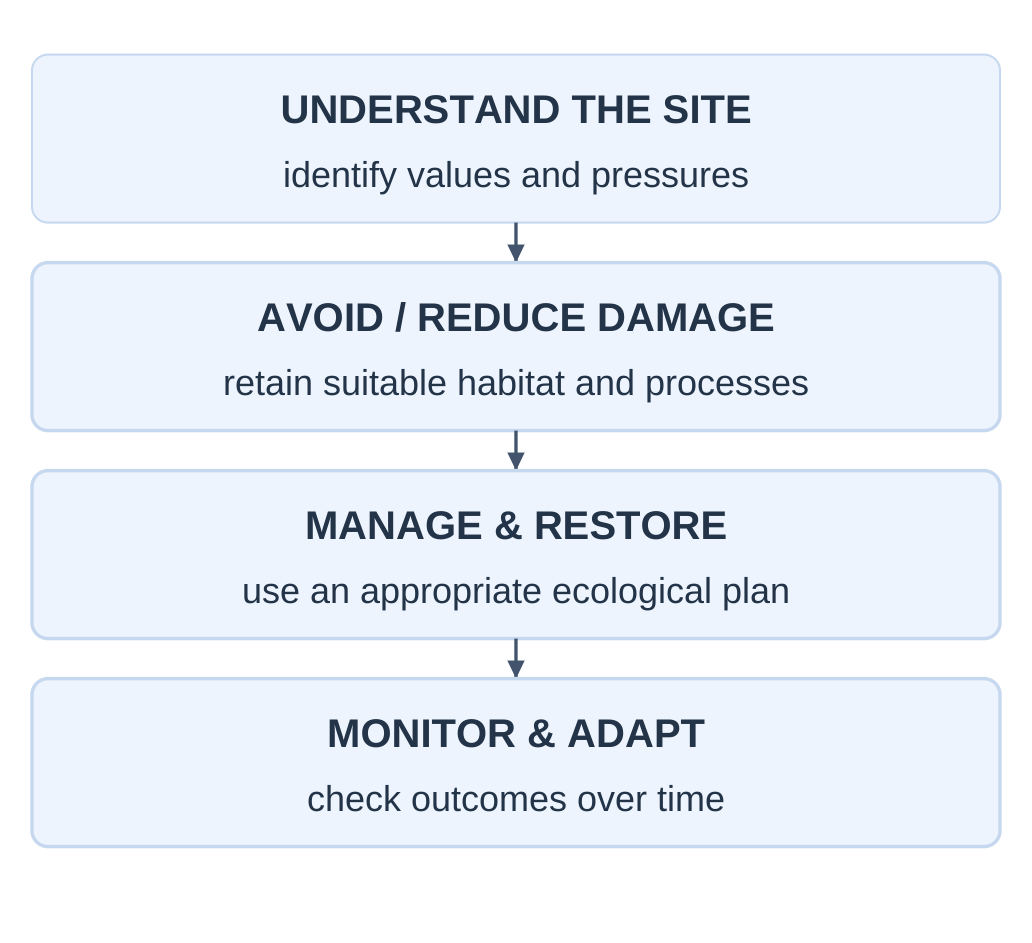
| Stage | Diagram Description |
|---|---|
| Understand the site | Identify values and pressures |
| Avoid / reduce damage | Retain suitable habitat and processes |
| Manage and restore | Use an appropriate ecological plan |
| Monitor and adapt | Check outcomes over time |
Restoration is more than planting
Restoration seeks to assist recovery of a degraded system. Depending on the site, it may involve reducing disturbance, restoring water conditions, removing an identified harmful pressure or enabling suitable vegetation recovery. The target should reflect the local ecosystem, not just a desired appearance.
19.5 Monitoring
Monitor whether the action is working: survival and growth of suitable plants, habitat condition, recurring pressures or other relevant indicators. A one-day event photograph does not establish long-term success. Record the action, responsibility and follow-up.
Worked conservation choice
A campus has an existing native tree patch with litter and undergrowth. Before replacing it with a decorative lawn, assess habitat features, access needs and ecological consequences. Retaining a functioning patch may protect relationships that a new plantation would take time to develop.
Student role: Observe, report, help with an approved plan and maintain records. Do not collect wildlife, release organisms or move plants between habitats as an unsupervised “conservation” activity.
20. Why Local Ecosystems Matter
The syllabus’s awareness focus is local ecosystems. A useful answer should connect a nearby place with its organisms, abiotic conditions, functions, benefits and pressures. A familiar site can make abstract terms observable without pretending that a short visit reveals everything.

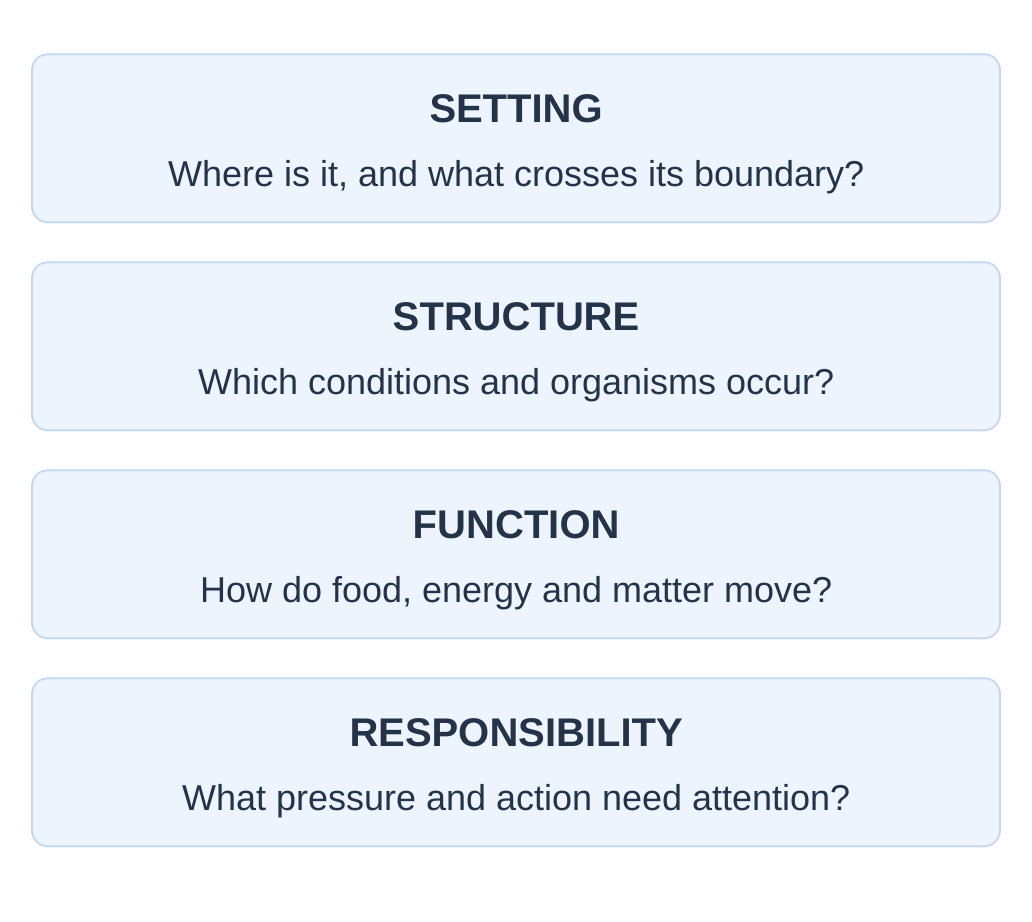
| Study Element | Question |
|---|---|
| Setting | Where is it, and what crosses its boundary? |
| Structure | Which conditions and organisms occur? |
| Function | How do food, energy and matter move? |
| Responsibility | What pressure and action need attention? |
20.1 Campus Habitat Mosaic
A campus may contain buildings, paved surfaces, tree patches, gardens, open verges, ponds and drains. These form a mosaic rather than one uniform habitat. Connections between patches and surrounding land use can influence water movement and organism access.
20.2 Small Sites Can Support Learning
A single tree and its soil zone can demonstrate light interception, roots, insects, litter and decomposition. A larger landscape adds more connections, but small observations remain valuable when their limits are described honestly.
Choose an appropriate scale
A 15-minute classroom exercise can describe a tree patch. It cannot establish the full biodiversity of a city. Match the claim to the area, time and method used.
20.3 Engineering Connections
| Stream | Unit I Connection |
|---|---|
| CSE | Organise observation records and avoid misleading data claims |
| EE | Consider habitat implications of equipment or line placement |
| ECE | Understand the ecological variable before selecting a sensor |
| CE | Consider drainage, soil and habitat connections in site planning |
| ME | Consider noise, access and habitat when locating machinery |
| BT | Recognise living diversity and the limits of identification |
| CH | Link changing chemical conditions with ecological effects |
| TX | Consider how material or process choices connect with local habitats |
| AG | Relate crops, soil organisms and surrounding habitats |
20.4 One Place, Several Responsibilities
A path beside a pond must consider access, drainage, bank stability and habitat. A good design question asks what functions already exist and what could be affected. Ecological knowledge informs the problem definition before a technology or construction solution is chosen.
A practical campus action
Select one observed concern, such as repeated trampling of a root zone. Describe the evidence, identify the responsible maintenance group and propose a feasible approved action. Compare conditions later. Avoid claiming that a small intervention has solved biodiversity loss as a whole.
21. Local Observation Activity
21.1 Purpose and Preparation
Observe a nearby accessible pond, garden, park, riverbank or tree patch to connect Unit I concepts with a real setting. Define a small study boundary, choose a time and prepare a simple record. Follow site access rules and observe without disturbing organisms.
| Record Field | What to Enter |
|---|---|
| Site and boundary | A named patch and its limits |
| Date, time and duration | The actual observation period |
| Conditions | Visible weather, shade and water conditions |
| Abiotic features | Soil, water, substrate and light context |
| Living observations | Identified organisms or descriptive types |
| Interactions | Only links observed or reliably established |
| Pressures | Visible disturbance or land-use effects |
| Limits | Unidentified organisms and unmeasured variables |
21.2 Observe Before Interpreting
“Litter covers part of the ground” is an observation. “The soil has high nutrient content” requires suitable evidence. “A bird was seen carrying an insect” supports a specific feeding observation; a bird merely sitting near an insect does not prove predation.
21.3 Compare Fairly
If comparing two patches, use similar observation duration and methods and record differences in conditions. Unequal effort can create a false appearance of different diversity. Even a fair short comparison remains limited by season, visibility and identification.
Ethical field habit
Use observation and permitted photography. Do not enter unsafe water, handle unfamiliar organisms or damage a nest or plant to obtain a better illustration. Keep sensitive location details appropriately restricted.
21.4 Model Observation Report
The report below is constructed for learning; it does not describe a completed visit.
Campus Tree Patch A — teaching example
Boundary: A small planted patch beside a walkway.
Observation: 20 minutes during daylight.
Structure: Several trees, shrubs, herbs and visible leaf litter. Exposed soil occurred near the path; other parts were covered by vegetation.
Living observations: Birds, crawling insects and fungi on dead wood were represented in the exercise record. Species identity was not confirmed.
Functions: Plants can provide primary production, and litter can supply detrital processes. Exact feeding links were not observed.
Pressure: Repeated foot traffic was noted near one root zone.
Action proposed: Discuss access management with the responsible team.
Limit: No soil tests or complete species survey were conducted.
21.5 Improve the Report with Real Evidence
For your own activity, replace every constructed detail with actual observations. Add a simple labelled site sketch, distinguish confirmed identity from description and record what was not measured. If an organism cannot be identified, use a descriptive label rather than inventing a species name.
Suggested assessment questions
- Are the site boundary and method clear?
- Are observations separated from explanations?
- Are the ecosystem components connected?
- Is the proposed action linked to an observed concern?
- Are limitations and follow-up stated honestly?
A careful short report with clear limits is more useful than a long confident account containing invented measurements or unsupported species lists.
22. Solved Application Cases
Case 1: The “Empty” Patch
Claim: “This patch contains only soil and weeds, so it has no ecosystem.”
Analysis: Soil, plants, microorganisms and their conditions can form an interacting system. The word “weed” describes a plant in a human context, not the absence of ecological function.
Better response: Identify the organisms and habitat features, then assess the proposed land use and impacts.
Case 2: Changing a Pond Bank
Situation: Vegetation is removed from part of a bank.
Possible pathways: Changes in shade, exposed soil, runoff and habitat.
Evidence needed: The extent of removal, slope, rainfall context, sediment observations and relevant water measurements.
Limit: One visual change does not establish every downstream effect.
Case 3: A Food-Web Inference
Question: If one prey becomes scarce, must its predator disappear?
Answer: Not necessarily. The predator may have other foods or move, depending on its biology and the landscape. A specialised dependence could create greater risk. The web helps identify a question; it does not provide a universal prediction.
Case 4: Richness and Survey Effort
A group records eight organism types during an hour at a pond and four types during ten minutes in a garden. It claims the pond is twice as biodiverse.
Correction: Unequal effort, different habitat visibility and uncertain identification make that comparison inadequate. Record methods and avoid turning “types observed” into confirmed total species diversity.
Case-answer structure
State the concept, separate facts from assumptions, explain a plausible relationship and identify what evidence or action is needed next.
22.1 Energy and Conservation Practice
Problem 1: model transfer
Producer-level energy is 12,000 units. With two successive 10% transfers, primary consumers receive 1,200 units and secondary consumers receive 120 units.
The total producer-to-secondary fraction is:
0.10 × 0.10 = 0.01, or 1%.
Problem 2: distinguish quantities
A small algal standing biomass supports consumers over time. Does this disprove declining energy transfer?
Answer: No. Standing biomass is a snapshot; production and energy transfer have a time basis. Rapid replacement of producer biomass can support ongoing consumption.
Problem 3: choose a conservation approach
A habitat contains a plant and its interacting organisms. Which approach best preserves their natural relationships?
Answer cue: In situ protection of suitable habitat and processes. An ex situ collection may support a defined objective but cannot by itself preserve every original interaction.
Problem 4: evaluate a plantation claim
A club plants 100 saplings and announces that biodiversity has been restored.
Correction: Planting count alone does not show survival, suitability, habitat recovery or functioning. Record species choice, maintenance, survival and ecological outcomes over time. Restoration is a process rather than a single event total.
Problem 5: energy or matter?
- A root takes up a mineral nutrient: matter movement.
- A herbivore consumes plant material: transfer of organic matter and energy.
- Respiration releases heat: energy dissipation.
- Microbial breakdown makes nutrients available: a contribution to material cycling.
Check the arrow meaning
Feeding arrows show food → consumer. A nutrient-uptake arrow shows material movement. Label a diagram’s purpose so these conventions are not mixed without explanation.
23. Quick Revision
| Term | Recall Point |
|---|---|
| Environment | Surrounding conditions and influences |
| Four components | Atmosphere, hydrosphere, lithosphere, biosphere |
| Ecosystem | Community interacting with its abiotic setting |
| Producer | Builds organic matter using an energy source |
| Consumer | Obtains organic matter through feeding |
| Decomposer | Processes organic material; helps nutrient turnover |
| Food chain | One selected feeding pathway |
| Food web | Interconnected feeding pathways |
| Energy flow | Directional transfer and heat dissipation |
| Biodiversity | Within-species, species and ecosystem variation |
| Fragmentation | Habitat divided into separated pieces |
| In situ / ex situ | Within / outside the natural setting |
Four distinctions to remember
Community / ecosystem: Living populations / those populations plus abiotic setting and interactions.
Energy / nutrients: Energy becomes less available and dissipates; nutrients can be reused through material pathways.
Richness / evenness: Number of recorded species / their relative abundances.
Observation / inference: What was recorded / the explanation proposed from evidence.
Final concept check
- The Sun is an input, not a trophic organism.
- Decomposers receive material from many levels.
- Not all alien species are invasive.
- “Not seen” does not mean “absent.”
- Planting numbers do not alone prove restoration.
23.1 Examination Practice
Short-answer prompts
- Define environment and name its four components.
- Distinguish abiotic and biotic components.
- Define ecosystem, habitat and community.
- Explain producer, consumer and decomposer.
- State the food-chain arrow convention.
- Distinguish food chain and food web.
- Name three levels of biodiversity.
- Explain in situ and ex situ conservation.
Long-answer and diagram tasks
- Explain ecosystem structure and function using a pond or woodland example.
- Draw a labelled grazing chain and explain its limitations.
- Draw a food web and trace two feeding pathways.
- Explain one-way energy flow and solve a stated 10% transfer problem.
- Discuss biodiversity importance, threats and conservation.
- Describe a local ecosystem and propose a justified action based on observations.
What a good answer includes
Begin with a clear definition. Organise the explanation under relevant headings, add a correctly labelled diagram or comparison and use a concrete example. State assumptions in calculations. For an activity, distinguish the actual observation from an interpretation and acknowledge the method’s limits.
A one-minute oral recap
“An ecosystem combines organisms with their abiotic setting. Producers capture energy, consumers feed and decomposers process dead material. Energy flows and is dissipated as heat, while nutrients move through reusable pools. Biodiversity occurs within species, between species and among ecosystems. Conservation protects suitable habitats, relationships and responsible use.”
Unit I complete
You should now be able to explain a local ecosystem, read its feeding relationships, distinguish energy from nutrient pathways and justify why biodiversity and conservation matter.
Study Resources
Use these Environment and Sustainability Unit 1 Notes for complete unit study, diagram practice, numerical revision and local observation activities.
Additional unit-wise resources are available at www.notesgallery.com.
The university website is https://aktu.ac.in.