Course: Environment & Sustainability
University: AKTU
Programme: B.Tech First Year | Semester I & II
Course Codes: AAC101 / AAC201
Unit: V – Environmental Protection, Law and the Role of Engineers
Common Streams: CSE, EE, ECE, CE, ME, BT, CH, TX & AG
Website: www.notesgallery.com
Unit V Introduction
Environmental Protection, Law and the Role of Engineers brings together prevention, responsible behaviour, institutions and technology. It explains why good engineering considers resources, pollution, ecosystems and the people affected by a design.
The legal section is a brief awareness overview of the Water Act, Air Act and Environment (Protection) Act. The main emphasis is practical: green campuses and buildings, sustainable design, clean technology, environmental ethics and contributions from all nine engineering streams.
These Environment and Sustainability Unit 5 Notes include the unit’s explanations, tables, examples, illustrations, activities, ethical cases and examination questions.
Syllabus Coverage
| Topic | PDF Pages |
|---|---|
| Protection: meaning and measures | 2–4 |
| Environmental laws: awareness overview | 5–7 |
| Role of individuals and society | 8–9 |
| Technology and environmental monitoring | 10 |
| Green campus: concept and action plan | 11–12 |
| Green buildings and passive measures | 13–14 |
| Sustainable engineering design | 15 |
| Clean technology and useful service | 16 |
| Contributions from all nine streams | 17–18 |
| Environmental ethics and cases | 19 |
| Revision and exam questions | 20 |
Shared scope: Common to all nine listed streams. Illustrations are conceptual; numerical examples use clearly stated assumptions.
How to Use This Unit
Read the concept, identify its mechanism and connect it to an appropriate local example. Use the coverage table to locate a topic, then finish with the revision questions.
Learning Outcomes
- Explain environmental protection and cause-based measures.
- Identify the names, years and broad purposes of the three syllabus Acts.
- Distinguish individual, societal and institutional responsibilities.
- Explain green campus and green-building concepts.
- Describe sustainable design and clean technology with practical examples.
- Connect each engineering stream to an appropriate contribution.
- Apply environmental ethics to evidence, risk and fair decisions.
Key Vocabulary
| Term | Meaning |
|---|---|
| Prevention | Avoiding a harmful release or impact before it occurs |
| Environmental law | A legal framework for protection and pollution control |
| Green campus | A campus that manages resources and impacts responsibly |
| Green building | A building designed and operated to reduce impacts while serving occupants |
| Life cycle | Materials, manufacture, use, maintenance and end of life |
| Clean technology | Technology that reduces relevant impacts for a useful service |
| Ethics | Principles guiding responsible and fair conduct |
Study Approach
Connect each concept to a cause, a practical example and a justified response. Read diagram labels and arrow directions before memorising the figure.
Use this approach throughout these Environment and Sustainability Unit 5 Notes.
1. Environmental Protection
1.1 Meaning
Environmental protection includes actions that prevent damage, control pollution, conserve resources and maintain or restore ecological functions. It concerns air, water, land and living systems together. A place is not necessarily protected merely because visible litter has been removed.

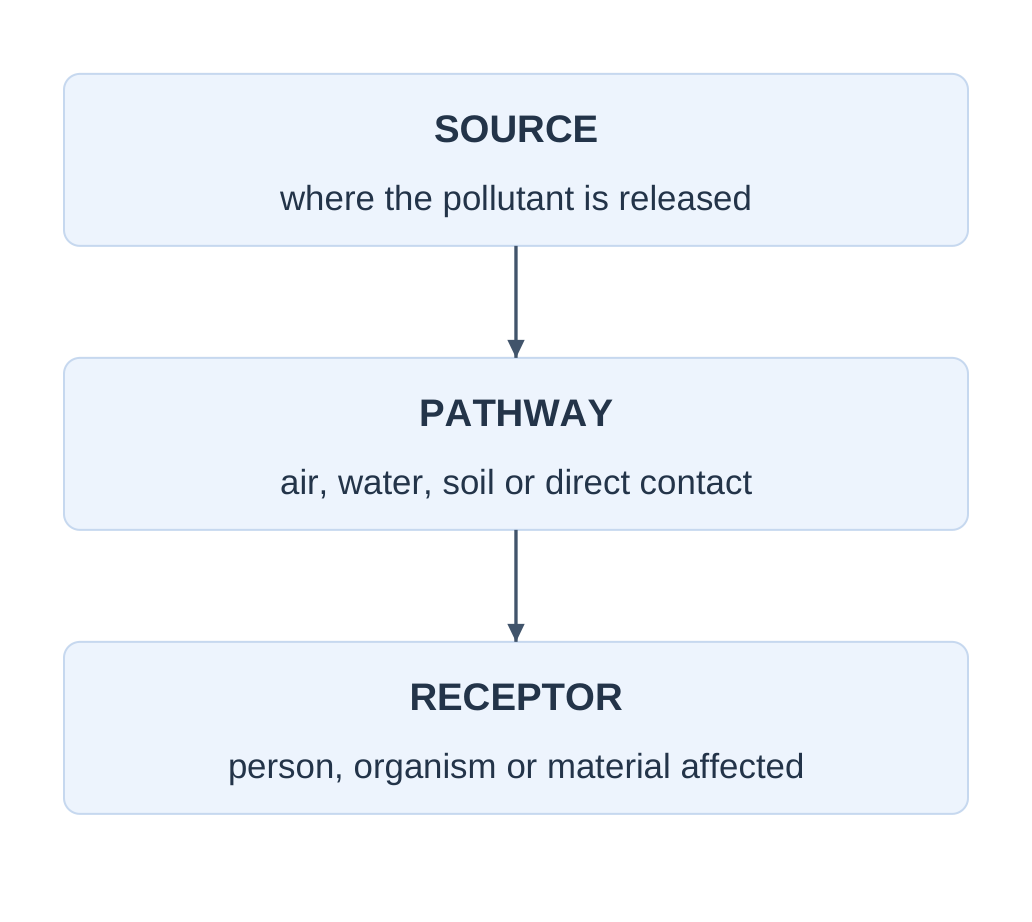
| Diagram Component | Description |
|---|---|
| Source | Where the pollutant is released |
| Pathway | Air, water, soil or direct contact |
| Receptor | Person, organism or material affected |
1.2 Protection and Conservation
Protection often emphasises avoiding harm, while conservation includes careful use and maintenance of resources and ecological systems. The ideas overlap. Repairing a leak conserves water; preventing a contaminated discharge protects water quality. A coordinated plan can do both.
A complete outcome
Ask what happened to the material, water or energy after the action. Washing waste from a clean-looking yard into a drain transfers the problem rather than necessarily solving it.
1.3 Why Protection Needs Planning
Connected systems
An industrial activity can affect air, wastewater, residues and land use. A building influences energy, water, drainage and habitat. Treating only one visible effect can miss a larger impact or create a problem in another medium.
Prevention and restoration
Avoiding avoidable harm is usually preferable to assuming that damage can always be repaired later. Restoration can be valuable, but some ecological losses are slow, uncertain or difficult to reverse. A future planting promise is not an automatic substitute for an established ecosystem.
| Aim | Illustrative Measure |
|---|---|
| Prevent a release | Choose suitable inputs and stop leaks |
| Control remaining pollution | Use appropriate capture or treatment |
| Conserve resources | Avoid unnecessary demand and extend product life |
| Protect ecosystems | Retain suitable habitat and reduce disturbance |
| Verify the result | Use appropriate records and monitoring |
1.4 Shared Responsibility
Individuals, institutions, service providers, government bodies and engineers have different roles. Good intentions are useful but do not replace operating responsibility, maintenance or a dependable downstream waste route.
Self-check
Question: Is installing a treatment unit the same as achieving environmental protection?
Answer: No. It must suit the problem, receive suitable inputs, operate effectively and manage residues. Actual performance needs checking.
2. Prevention Before Correction

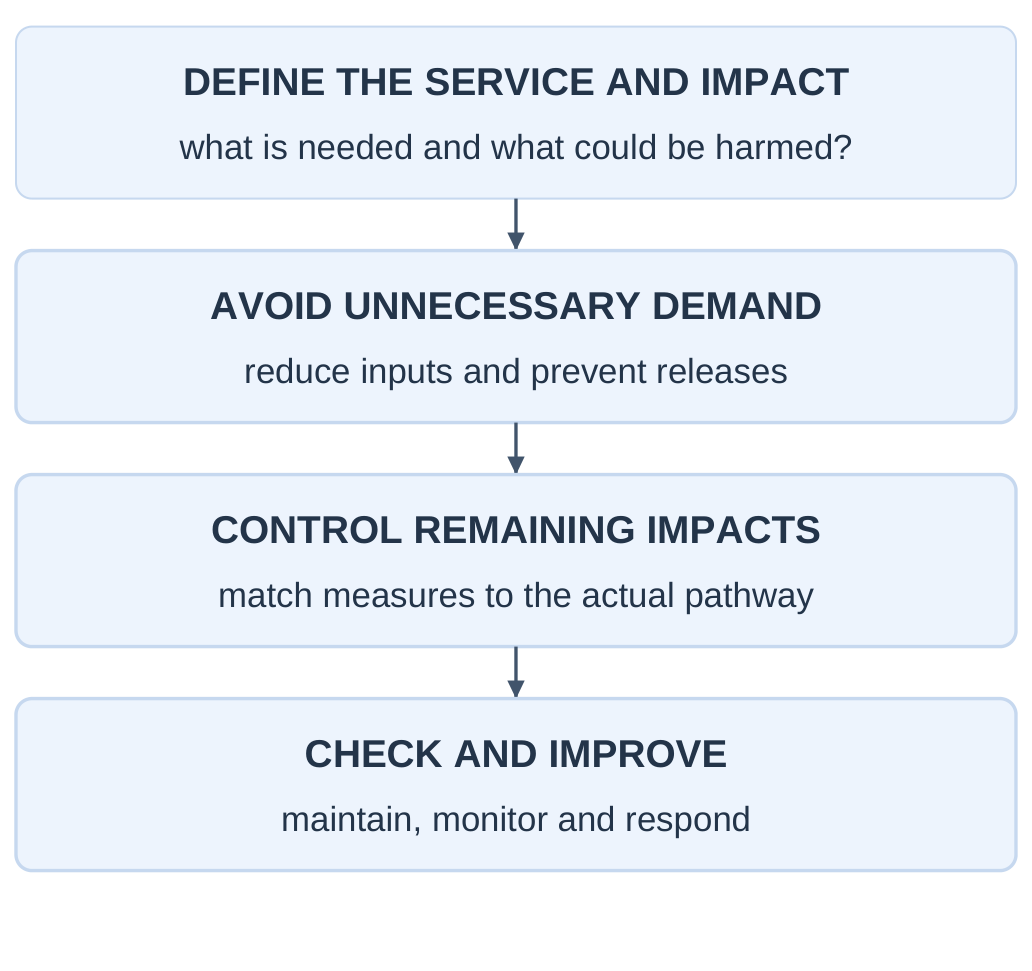
| Stage | Diagram Description |
|---|---|
| Define the service and impact | What is needed and what could be harmed? |
| Avoid unnecessary demand | Reduce inputs and prevent releases |
| Control remaining impacts | Match measures to the actual pathway |
| Check and improve | Maintain, monitor and respond |
2.1 Source Reduction
A change in material, process or operating practice can prevent waste and pollution. Examples include reducing excess input, repairing a leak or improving material handling. Source reduction acts before pollutants become mixed and more difficult to manage.
2.2 End-of-Pipe Measures
Treatment and capture remain necessary for many residual streams. They complement prevention but may require energy, maintenance and disposal of captured material. A filter transfers particles into a residue that still needs management.
2.3 Match the Response
| Observed Issue | Cause-Based Action |
|---|---|
| Repeated tank overflow | Check and repair the control or operating cause |
| Dust from loose material | Contain the material and improve handling |
| Mixed canteen waste | Provide usable segregation and a real collection route |
| Damaged stream-bank vegetation | Assess disturbance and protect or restore suitable cover |
| Persistent equipment noise | Check source condition and acoustic paths |
2.4 Avoid Shifting Burdens
A solution can improve one indicator while worsening another. A water-intensive dust-control method may create contaminated runoff. A new material may reduce weight while making recovery difficult. Evaluate the system and the scale of each relevant impact.
2.5 Operational Responsibility
Specify who inspects, who maintains, how problems are reported and what happens during failure. If no one owns those tasks, a technically sound design can fail in practice. Include ordinary operation rather than describing only ideal conditions.
Worked case
A workshop replaces a solvent-intensive process with a suitable lower-loss method. Evaluate whether the new method meets performance needs, reduces relevant releases and introduces any new waste or energy demands. Do not declare it universally clean simply because one chemical is no longer used.
Strong answer pattern
Problem → mechanism → measure → responsibility → verification.
This turns a list of environmental slogans into a practical protection plan.
Compare prevention and capture
If careful handling prevents 5 kg of usable material from becoming dust, the material remains available for production. Capturing 5 kg after release may create a mixed residue that is harder to reuse. This constructed comparison illustrates where the intervention acts; actual quantities and recovery need measurement.
3. Integrated Protection Measures
| Area | Practical Measures |
|---|---|
| Water | Prevent dumping, maintain collection and treatment, protect sources and repair losses |
| Air | Avoid open burning, control dust, maintain equipment and manage emissions |
| Land and soil | Prevent unsuitable disposal, control erosion and protect useful permeable areas |
| Waste | Reduce demand, segregate, recover suitable materials and manage residues |
| Habitats | Avoid unnecessary disturbance; protect ecological connections and suitable regeneration |
| Noise | Maintain sources, manage timing and use suitable acoustic controls |
3.1 Local Suitability
Measures depend on the site and cause. A recharge structure needs appropriate ground and water-quality conditions. A tree-planting plan should fit the local ecosystem and water supply. A standard-looking solution should not be copied without understanding the problem.
Protect what works
Existing vegetation, drainage paths and serviceable infrastructure may already provide important functions. Assess them before clearing, rebuilding or replacing them in the name of improvement.
3.2 Manage a Project Through Time
Before implementation
Define the boundary, users, affected surroundings and baseline. Compare options, including avoiding the activity or reducing its scale where appropriate. Identify maintenance and eventual recovery requirements before purchase or construction.
During implementation
Manage materials, dust, wastewater, noise and access. Keep relevant streams separate and respond to failures. A design’s environmental intention can be undermined by careless construction or unsuitable temporary arrangements.
During operation
Check actual consumption, releases, condition and service quality. Record faults and corrective action. Compare like-for-like periods and note occupancy, weather or production changes that affect indicators.
At end of life
Plan disassembly, suitable reuse and material recovery where feasible. Identify residues that need special handling. A recyclable material helps only if it can be separated and a real recovery route exists.
A campus improvement example
For a new garden, assess existing habitat, soil, water demand and user access. Choose suitable planting and maintenance. Monitor survival and soil condition, not just the opening-day appearance. Avoid paving or removing valuable existing cover without a reasoned assessment.
What to measure
Select indicators linked to the problem: water per service, electricity per useful activity, material loss, contamination, system reliability or habitat condition. More indicators are not automatically better if they are not meaningful.
Check a linked effect
For a new paved area, review access and function together with runoff, heat, existing vegetation and maintenance. A design can improve one service while reducing infiltration or shade. Consider a suitable layout and materials before assuming that additional paving is environmentally neutral.
4. Environmental Law: Overview
4.1 Why a Legal Framework Is Needed
Pollution can cross property boundaries and affect people who did not choose the activity. Laws create public responsibilities, institutions and mechanisms for protection. Technical knowledge helps implementation, while legal obligations provide an enforceable framework rather than relying only on voluntary goodwill.
| Act: Syllabus Name | Year | Broad Purpose |
|---|---|---|
| Water (Prevention and Control of Pollution) Act | 1974 | Prevent and control water pollution and maintain or restore water wholesomeness |
| Air (Prevention and Control of Pollution) Act | 1981 | Prevent, control and abate air pollution |
| Environment (Protection) Act | 1986 | Provide a broader framework for environmental protection and improvement |
4.2 Awareness-Level Scope
Know the correct name, year, broad aim and connection to environmental management. The Acts operate with amendments, rules, notifications and institutional responsibilities. Their original year is not a claim that the law has remained unchanged since that date.
Keep the answer within scope
This unit does not require section numbers, penalty amounts, permit exemptions or legal procedure. Those details can change and depend on the activity and jurisdiction. The notes focus on the statutory purposes and practical awareness.
4.3 Law, Rules and Practice
Different layers
An Act establishes a legal framework. Rules and other instruments can provide more detailed requirements under that framework. Technical standards, permissions and operating duties need to be identified for the actual activity by the responsible institution and competent authorities.
Institutional roles
The Central Pollution Control Board and state pollution-control institutions form part of India’s pollution-control framework. Their broad work includes coordination, technical functions and implementation responsibilities under relevant laws. They are not interchangeable with a campus maintenance team or a private laboratory.
A useful comparison
| Question | Awareness Answer |
|---|---|
| Why not voluntary action alone? | Impacts can affect others and need public accountability |
| Does a clean appearance prove compliance? | No; relevant requirements and suitable evidence matter |
| Does equipment purchase prove compliance? | No; suitability, operation and applicable duties still matter |
| Does one Act replace every other law? | No; environmental management can involve several connected instruments |
4.4 Engineering Responsibility
An engineer should recognise environmental obligations, keep accurate records and seek appropriate specialist input for real compliance decisions. Hiding a fault or treating an unknown requirement as irrelevant is not responsible professional practice.
Exam distinction
Law sets a public framework; engineering provides practical means to prevent and control impacts. Effective protection needs both suitable systems and accountable implementation.
5. Water Act, 1974: Awareness
5.1 Purpose
The Water (Prevention and Control of Pollution) Act, 1974 addresses prevention and control of water pollution and the maintenance or restoration of water wholesomeness. It established the pollution-control-board framework for these purposes. Study the broad objective rather than trying to memorise legal procedures outside the syllabus.
5.2 Practical Connection
Water-quality protection involves knowing where wastewater arises, how it is collected, what treatment is suitable and where it goes. These are engineering questions that support responsible implementation. A treatment unit must actually function; its name or physical presence does not show the quality of the outlet.

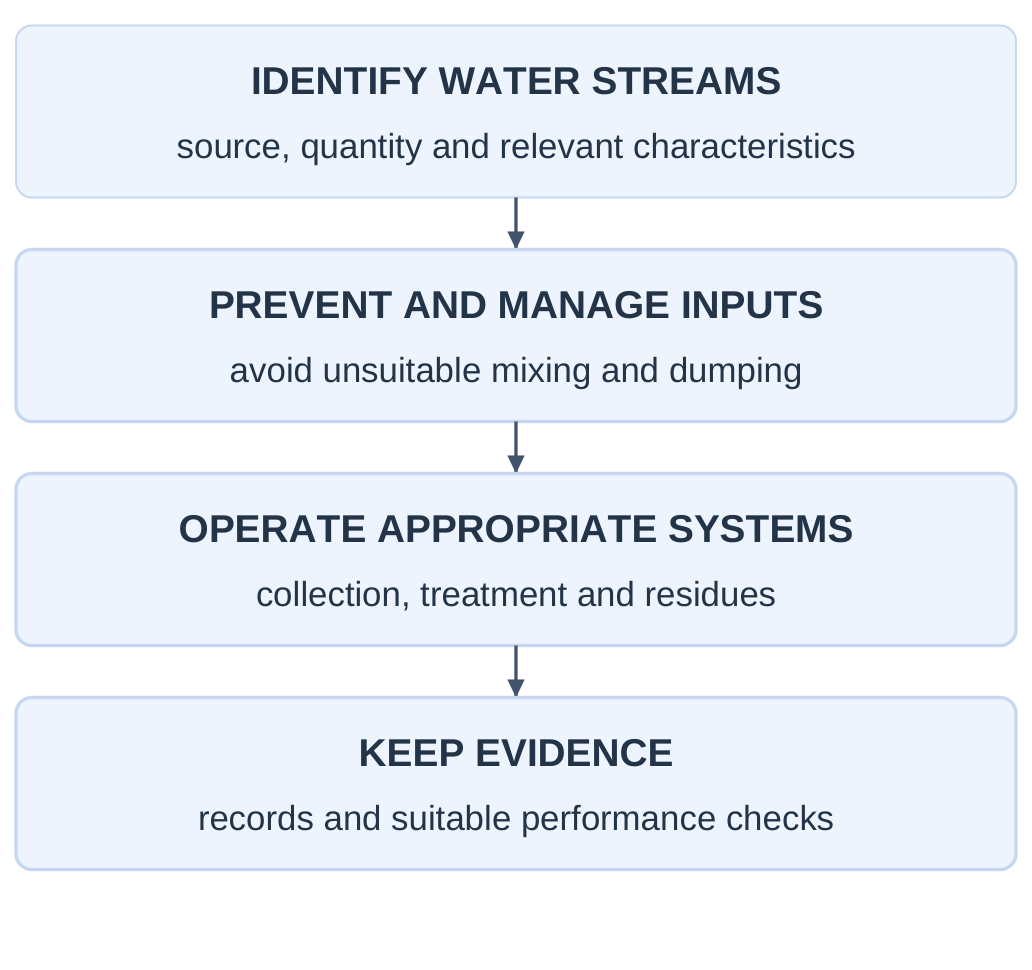
| Stage | Diagram Description |
|---|---|
| Identify water streams | Source, quantity and relevant characteristics |
| Prevent and manage inputs | Avoid unsuitable mixing and dumping |
| Operate appropriate systems | Collection, treatment and residues |
| Keep evidence | Records and suitable performance checks |
5.3 Air Act, 1981: Awareness
Purpose
The Air (Prevention and Control of Pollution) Act, 1981 provides for prevention, control and abatement of air pollution. It works through the relevant institutional framework. The broad study connection is to emission sources, suitable controls, monitoring and accountable operation.
5.4 Practical Connection
Identify combustion, dust and process emissions. Reduce avoidable releases and select controls suited to the pollutant. A particulate filter does not remove every gas. A taller stack changes dispersion; it is not a pollutant-destruction device.
| Water Focus | Air Focus |
|---|---|
| Wastewater and receiving-water condition | Emissions and surrounding-air condition |
| Collection, treatment and discharge route | Source capture, control and release conditions |
| Water sampling and relevant records | Emission or ambient monitoring as appropriate |
| Management of sludge and other residues | Management of captured dust or other residues |
5.5 Same Management Principle
For both media, prevention is important, controls must fit the source and performance needs evidence. Captured pollutants may become another waste stream, so their handling remains part of environmental protection.
Short-answer practice
Question: What is the simplest distinction between the Water and Air Acts?
Answer: Their primary media and purposes: water-pollution prevention and control under the 1974 Act, and air-pollution prevention, control and abatement under the 1981 Act. Both are parts of a wider protection system.
Current-law awareness
Amendments and related instruments form part of the operative framework. Do not infer today’s penalties or exemptions from an Act’s original year or a general classroom example.
6. Environment (Protection) Act
6.1 Name and Purpose
The Environment (Protection) Act, 1986 provides a broad framework for protection and improvement of the environment. It gives the Central Government powers to take environmental-protection measures and supports rules and other instruments concerning relevant environmental matters.
6.2 Broad Framework
The Act is often described as umbrella legislation because its environmental scope is wider than one pollution medium. This does not mean the Water and Air Acts disappear. The practical framework includes several laws and instruments operating together.
| Study Point | Recall |
|---|---|
| Correct title | Environment (Protection) Act, 1986 |
| Main aim | Protect and improve the environment |
| Broad character | Framework extending beyond a single medium |
| Engineering connection | Prevent releases, operate suitable systems and maintain reliable evidence |
| Not required here | Detailed sections, penalties or case-specific legal procedure |
6.3 An Integrated Facility Example
A workshop can create air emissions, wastewater, noise and solid residues. A responsible plan considers all relevant streams and their destinations. Improving one stream while allowing another to be dumped is not an integrated environmental outcome.
Remember the three years
Water: 1974.
Air: 1981.
Environment: 1986.
Associate each year with its correct title and broad purpose, not with an unsupported claim about present-day procedural detail.
6.4 From Awareness to Responsibility
Know the limits of an overview
For an actual project, the responsible organisation must determine current applicable requirements with competent advice and relevant authorities. A general academic description does not establish whether a particular activity needs a permission or meets a standard.
Good records
Keep accurate source information, operating and maintenance records, relevant monitoring and corrective actions. Records support investigation and improvement. Altering or selectively hiding unfavourable observations undermines both technical reliability and accountability.
Model situation
A control device fails during operation. A responsible response is to follow the organisation’s appropriate operating and reporting process, address the cause and record the event accurately. Ignoring the failure because the annual report is due is not a sound environmental or ethical decision.
6.5 Distinguish Three Questions
Scientific: What is released and what could happen?
Engineering: What system can prevent or manage it reliably?
Legal / institutional: What current duties and accountability apply?
The questions connect, but answering one does not automatically answer all three.
Exam outline
Introduce why legal frameworks are needed. Name the three Acts with years and purposes. Mention the role of institutions and the connection to prevention, controls and evidence. Keep the explanation at awareness level and avoid unsupported procedural detail.
Purpose of this section
Recognise the legal framework and act responsibly within a professional team. The objective is environmental awareness, not replacing a current project-specific compliance assessment.
7. Role of Individuals
7.1 Everyday Responsibility
Individuals influence resource demand, litter, segregation, transport and the condition of shared spaces. Useful action connects a specific behaviour to an environmental mechanism, such as preventing a leak or keeping food residues out of an accepted paper stream.
| Activity | Responsible Action |
|---|---|
| Water | Avoid unnecessary flow and report leaks or overflows |
| Energy | Switch off unneeded equipment and use suitable efficient settings |
| Materials | Avoid duplicate purchases; maintain and reuse suitable products |
| Waste | Follow the actual segregation and collection system |
| Transport | Use suitable lower-demand or shared options where practical |
| Nature | Avoid damaging vegetation, nests and local habitat |
7.2 Reporting and Participation
Record the location, time and observable facts of a problem and report through the responsible process. A useful report identifies the issue without inventing a chemical or concentration. Follow up to see whether action was completed.
Maintain essential needs
Conservation should preserve adequate hygiene, safe lighting and accessible facilities. Focus on avoidable loss and suitable service rather than indiscriminate cuts.
7.3 Responsible Communication
Evidence and honesty
Separate observations from interpretations and estimates. Do not present a constructed classroom calculation as a measured campus result. Uncertainty should be stated clearly; it does not prevent useful action when the observation is credible.
7.4 Consumer Choices
Choose a product because it meets a real need and offers suitable durability, maintenance and recovery, not only because of an environmental symbol. Repeatedly purchasing unused reusable products may add material demand without replacing a service.
7.5 Shared Spaces
Keep segregation instructions usable, protect drains from litter and respect maintenance access. A problem recurring after individual effort may require an institutional change, such as a better collection schedule or repair process.
Worked example: leaking tap
Notice a leak, record where it is and report it. If an approved simple measurement is possible, estimate the loss with stated hours and flow. Ask for competent repair and compare after repair. Repeatedly placing a poster beside a known fault does not address the mechanical cause.
What not to claim
A person’s small activity can contribute to improvement, but it does not eliminate all environmental impacts. Report the actual action and useful outcome rather than claiming that one event made a campus entirely green or carbon-neutral.
Memory cue
Notice accurately, avoid unnecessary use, follow the correct route, report clearly and check the outcome.
A useful personal observation
During one week, note an activity where a resource runs without providing a service: an empty-room light, an overflowing tank or repeated duplicate printing. Record the relevant conditions, propose a feasible action and check who can carry it out. Keep the observation specific enough for follow-up.
8. Role of Society and Institutions
8.1 Why Collective Action Matters
Many environmental systems are shared: water supplies, drainage, waste collection, transport and local ecosystems. Individual choices depend on whether reliable services and suitable options exist. Collective action can organise infrastructure, accountability and fair access.

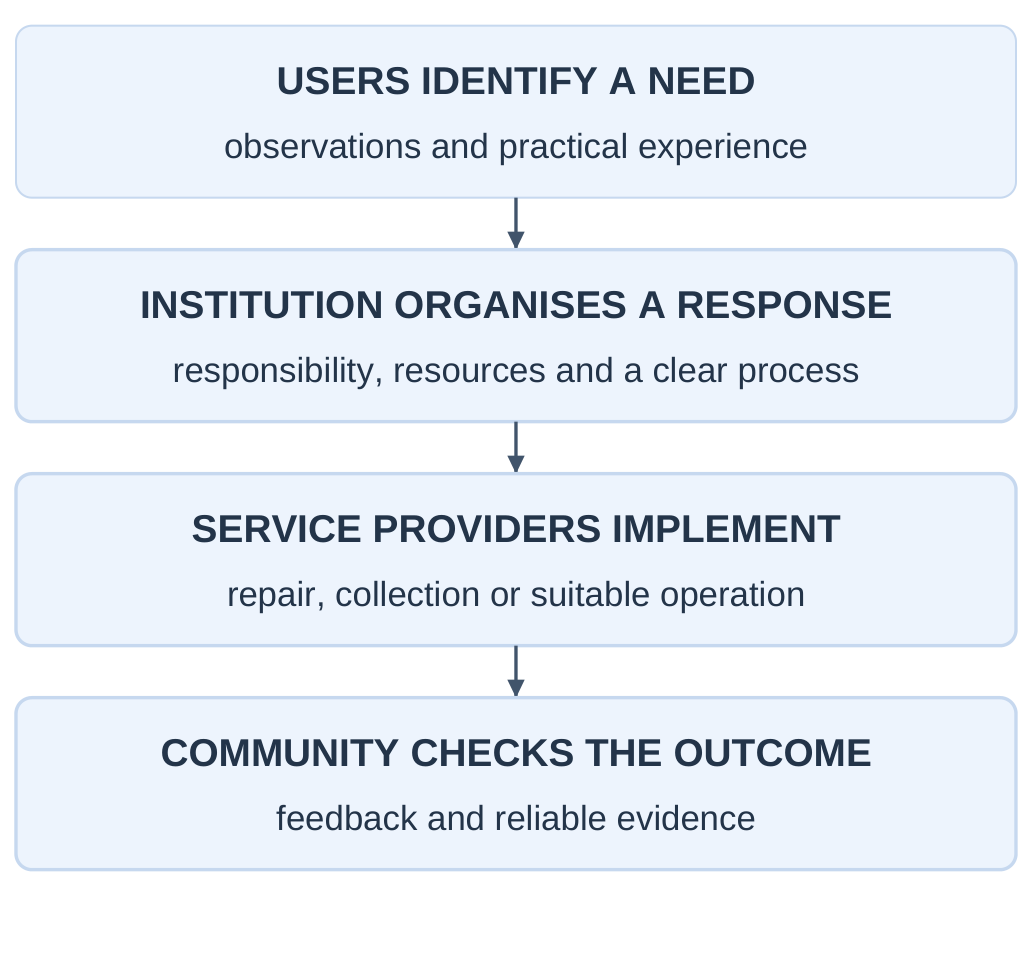
| Stage | Diagram Description |
|---|---|
| Users identify a need | Observations and practical experience |
| Institution organises a response | Responsibility, resources and a clear process |
| Service providers implement | Repair, collection or suitable operation |
| Community checks the outcome | Feedback and reliable evidence |
8.2 Community Knowledge
People who use and maintain a place often know recurring problems. Include workers and affected users when planning changes. A technically attractive design can fail if it ignores actual use, access or collection constraints.
8.3 Practical Collective Measures
| Measure | Why It Helps |
|---|---|
| Reliable collection and segregation | Makes responsible disposal possible |
| Maintenance and reporting system | Connects observations to repair and verification |
| Appropriate procurement | Reduces avoidable material and operating demand |
| Accessible public or shared transport | Provides practical alternatives to unnecessary individual travel |
| Habitat and water-source protection | Addresses shared ecological functions |
8.4 Awareness with Implementation
An event can introduce an action, but continuing arrangements make it effective. A waste drive needs a recipient and a collection route. A planting activity needs suitable species and aftercare. A water campaign needs a repair and monitoring process.
8.5 Equity and Inclusion
Environmental decisions should consider who receives a service, who bears costs and who faces pollution or disruption. Moving an unpleasant activity to a less powerful community is not a complete solution. Include affected groups in suitable decision-making processes.
A society–technology example
A bin sensor may report fill level, but collection still needs a responsible team, suitable vehicles and an accepted destination. The sensor supports a service; it does not replace the social and organisational system.
Exam answer
Explain shared resources, the need for dependable services, participation and accountability. Use one complete example that connects awareness to implementation and follow-up.
Assign ownership
In a shared project, record who owns the equipment, data, maintenance and reporting tasks. A student team may collect observations while facility staff implement repairs. Without clear ownership, a useful pilot can stop when the team changes, leaving equipment or records without continued care.
9. Technology and Monitoring
9.1 Useful Roles
Technology can reduce resource inputs, prevent leaks, improve treatment, recover materials and support environmental observation. Its usefulness depends on an actual problem, suitable design and reliable operation. More equipment is not automatically better environmental management.

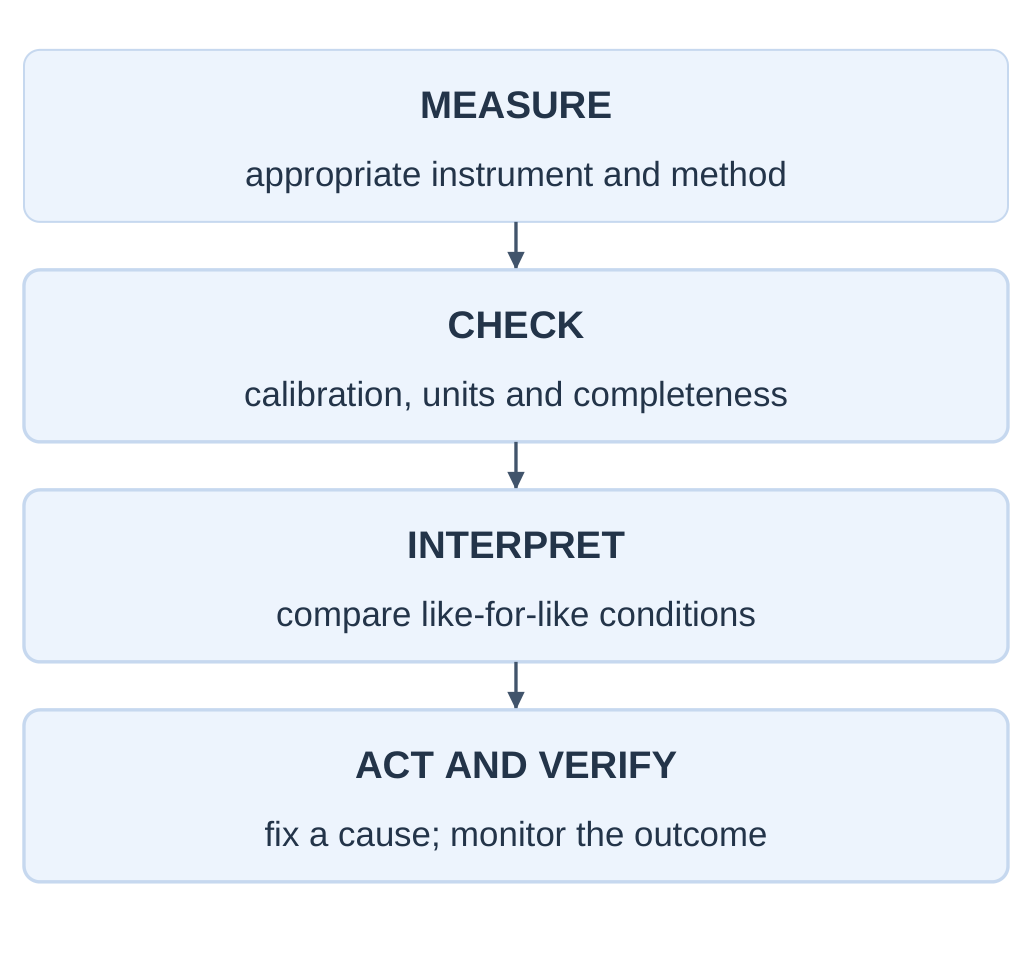
| Stage | Diagram Description |
|---|---|
| Measure | Appropriate instrument and method |
| Check | Calibration, units and completeness |
| Interpret | Compare like-for-like conditions |
| Act and verify | Fix a cause; monitor the outcome |
9.2 Sensor Data Need Context
Location, calibration, range, units and averaging period affect interpretation. A low-cost sensor can support awareness or screening but is not automatically equivalent to a validated reference method. State the method and its limitations.
Measurement is not treatment
A dashboard displays information; it does not remove pollution by itself. Link observations to a responsible action and check whether conditions improve.
9.3 Select Technology Appropriately
| Question | Reason |
|---|---|
| What problem is defined? | Avoid equipment with no useful decision or service |
| Is the method suitable? | Instrument range and accuracy must fit the task |
| Who maintains it? | Calibration, cleaning and repairs affect data and operation |
| What resources are needed? | Power, consumables, skills and replacement parts matter |
| How are failures handled? | Missing or implausible values need a response |
| What happens at end of life? | Plan recovery and special waste routes |
9.4 Example: Water-Use Dashboard
A meter and dashboard can reveal unusual use. The record may suggest a leak, but occupancy or a changed activity can also explain an increase. Investigate the cause, arrange repair where needed and compare afterwards. Data supports judgment rather than replacing it.
9.5 Avoid Technological Overclaiming
An automated system can fail, give biased data or be ignored. Keep manual procedures and responsibilities clear where appropriate. A sophisticated model with poor inputs does not create reliable evidence merely because its output looks precise.
Model answer
Technology supports protection through prevention, efficient service, suitable treatment and reliable monitoring. It must be appropriate, maintained and connected to organisational action. Evaluate the full life cycle, not only the advertised function.
10. Green Campus
10.1 A Connected Campus System

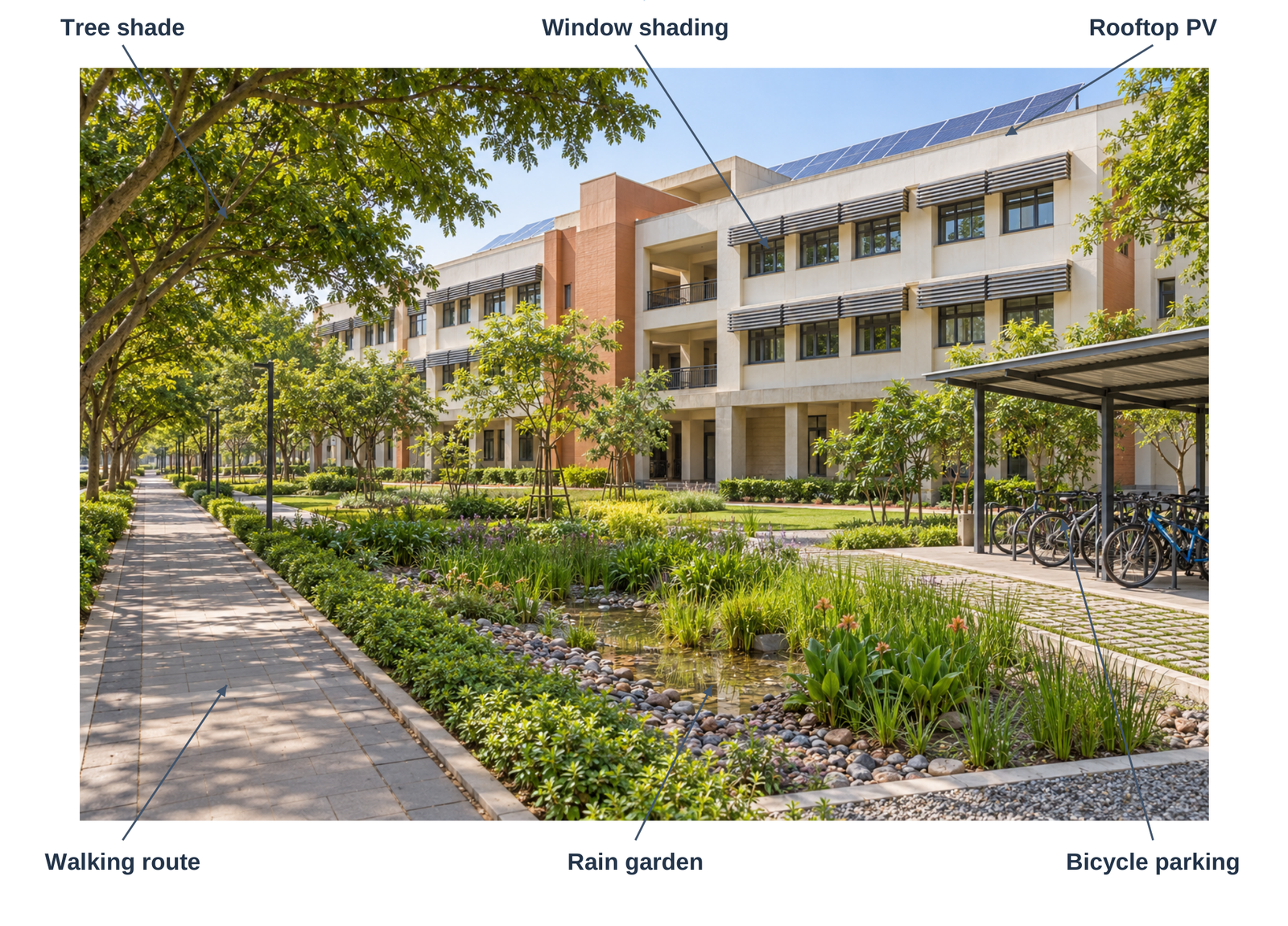
Illustration labels:
- Tree shade.
- Window shading.
- Rooftop PV.
- Walking route.
- Rain garden.
- Bicycle parking.
Meaning
A green campus manages its resource use and environmental impacts while supporting education and well-being. It includes water, energy, materials, waste, transport, biodiversity and maintenance. It is more than a campus with many decorative plants.
Design and daily operation
Suitable buildings and landscape features help, but users, maintenance teams and procurement decisions determine actual performance. A solar installation needs an operator; a rain garden needs site suitability and care; segregation needs a real destination.
What to evaluate
Use indicators tied to useful services and comparable conditions. Check reliability, access and environmental outcomes. A planted area using excessive water or a new system that cannot be maintained can undermine the intended benefits.
Campus as a learning place
Students can observe, record and propose improvements under appropriate supervision. Connect each activity to a real operating need and competent implementation rather than inventing a field result.
11. A Green-Campus Action Plan
| Area | Action | Evidence |
|---|---|---|
| Water | Repair leaks and overflow; assess suitable harvesting | Meter records and fault recurrence |
| Energy | Review avoidable hours and equipment condition | Comparable kWh and service quality |
| Waste | Improve segregation and onward routes | Sample contamination and handover records |
| Mobility | Improve suitable walking, cycling and shared access | Use, accessibility and trip patterns |
| Biodiversity | Protect appropriate existing habitat and manage planting | Survival, habitat condition and maintenance |
11.1 Prioritise
Begin with a specific avoidable loss or reliable maintenance need. Compare likely benefit, feasibility, cost and who can act. Do not install a large new system solely because a visible smaller repair seems less impressive.
One project at a time
A tightly defined action is easier to complete and evaluate. For example, prevent one recurring tank overflow, document the repair and verify the operating result before claiming a broad campus transformation.
11.2 Plan, Implement and Review
Step 1: Define the problem, boundary and users.
Step 2: Record a baseline with a stated method.
Step 3: Compare feasible responses and connected impacts.
Step 4: Assign implementation and maintenance responsibility.
Step 5: Carry out the approved action.
Step 6: Compare outcomes under suitable conditions and record limitations.
11.3 A Complete Waste Example
A canteen has food residues mixed with packaging. Review generation points, collection timing and available treatment. Change instructions and containers to match actual routes, involve workers and check contamination. A compost unit is considered only if appropriate feed, operation and output use can be sustained.
11.4 Indicators and Denominators
Total water or electricity may change when occupancy changes. Report totals and, where useful, a justified service indicator such as litres per meal or kWh per occupied day. Do not hide increased total demand behind a lower per-user number.
Illustrative comparison
Use falls from 1,000 L for 100 meals to 900 L for 100 comparable meals.
This is a 100 L reduction and 10%, with use falling from 10 to 9 L/meal.
If meal numbers differ, recalculate the ratio and report the changed activity level.
Report carefully
State measured values, estimates, dates, changes in conditions and unresolved problems. If follow-up is not complete, label the result as pending rather than claiming a saving.
Choose a maintainable first project
| Candidate | What to Establish First |
|---|---|
| Recurring overflow | Cause, repair owner and a follow-up record |
| New waste stream | Accepted inputs, operator and onward destination |
| Planting programme | Suitable site, water, protection and aftercare |
12. Green Buildings
12.1 Basic Concept
A green building is designed, constructed, operated and eventually managed to reduce relevant environmental impacts while providing suitable conditions for occupants. Energy, water, materials, site, indoor quality and maintenance all contribute.

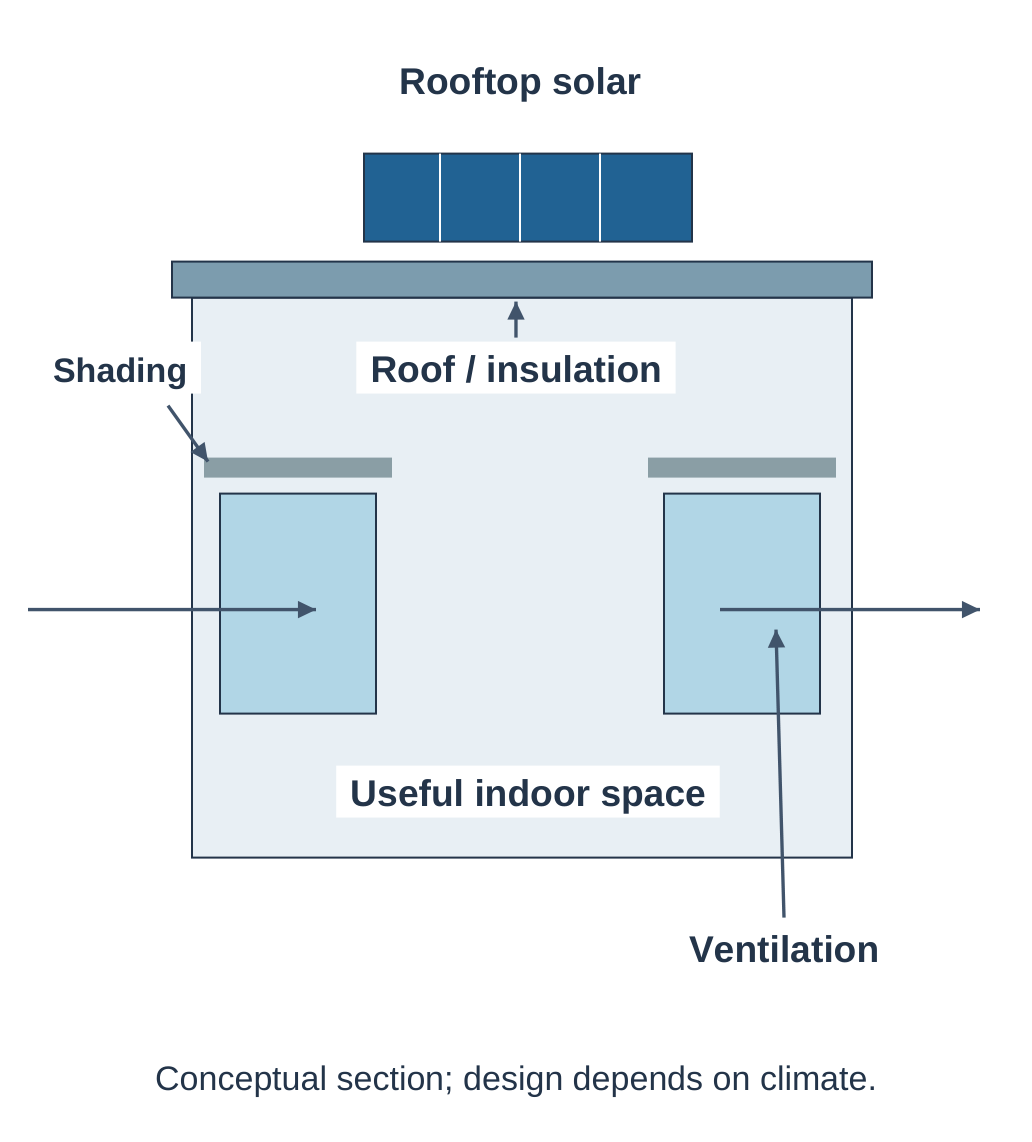
Diagram labels:
- Rooftop solar.
- Roof / insulation.
- Useful indoor space.
- Shading.
- Ventilation.
Diagram note: Conceptual section; design depends on climate.
12.2 Performance Beyond Appearance
A green façade or a few rooftop panels do not establish whole-building performance. A building should meet functional needs, use resources appropriately and have reliable operating arrangements. Actual outcomes can differ from design predictions.
Certification and evidence
A formal rating is a separate assessment under a defined scheme. Do not call an ordinary illustration “certified” or assign a rating without verified evidence.
12.3 Main Building Considerations
| Area | Useful Design Question |
|---|---|
| Site | Can existing drainage, habitat and access be protected? |
| Energy | Can heat gain and unnecessary demand be reduced before sizing equipment? |
| Water | Are fixtures, storage, reuse and harvesting suitable and maintainable? |
| Materials | Are durability, repair, transport and recovery considered? |
| Indoor quality | Are lighting, ventilation, comfort and appropriate materials addressed? |
| Operation | Who monitors, maintains and repairs the systems? |
12.4 Indoor Environmental Quality
Suitable daylight, ventilation and thermal conditions support learning and work. More glazing is not automatically better daylight design: glare and heat gain may increase. Natural ventilation must also consider outdoor conditions, noise and the actual airflow path.
12.5 A Building Is a Service System
Occupant behaviour, control settings and maintenance can change performance. Windows may be blocked, shading may be removed and systems may be run outside intended conditions. Training and usable controls help bridge design and operation.
Exam answer
Define a green building, explain site, energy, water, material and indoor-quality measures, then add operation and maintenance. Use a labelled section to show features, without claiming that every feature suits every location.
13. Passive and Active Measures
13.1 Passive Measures
Passive design uses building form, orientation, shading, insulation, openings and materials to moderate conditions and reduce demand. It works with the local climate and site rather than relying only on powered equipment. A measure useful in one season or climate can be unsuitable in another.
| Measure | Potential Benefit / Caution |
|---|---|
| External shading | Can reduce unwanted solar heat gain; design for orientation and season |
| Roof / wall insulation | Can reduce heat transfer; climate and construction details matter |
| Daylighting | Can reduce lighting demand if glare and heat gain are controlled |
| Natural ventilation | Can support comfort when outdoor conditions and airflow are suitable |
| Appropriate landscape shade | Can improve local comfort; species, water and maintenance matter |
13.2 Active Systems
Efficient lighting, fans, cooling, pumps and control systems provide useful services with powered equipment. Select and operate them for the actual need. Efficient equipment should complement a suitable building design rather than compensate for every avoidable demand.
Simple distinction
Passive measures reduce or moderate the demand through design. Active systems use equipment and energy to provide a service. Many successful buildings combine both.
13.3 Materials and Long-Term Use
Durability and repair
Long useful life can reduce premature replacement, but durability must suit the application. Provide access to maintain parts and avoid unnecessary combinations that prevent repair. A product with an impressive environmental label may still fail early if poorly selected or installed.
13.4 Water Systems
Reduce avoidable demand and leaks before expanding supply. Keep non-potable routes suitable and clearly separated. Rainwater harvesting needs catchment care, first flushing, filtration, storage or assessed recharge, overflow and maintenance.
13.5 Construction Impacts
Manage dust, runoff, noise, material loss and waste during construction. Protect existing trees and drainage where appropriate. A sustainable operating design can be undermined by unnecessary site damage or poor material handling during construction.
Worked room example
A classroom is hot and has glare. Assess sun exposure, shading, window design, occupancy and equipment heat before adding cooling capacity. Appropriate shading and glare control may improve comfort and lower demand, but adequate illumination and ventilation still need to be preserved.
What to compare
Compare useful service, resource use, operating cost, maintenance and occupant experience over a suitable period. Do not infer performance solely from a photo, the building’s age or the presence of solar panels.
Design principle
Reduce unnecessary loads first, then supply the remaining need with suitable efficient systems and responsible operation.
14. Sustainable Engineering Design
14.1 Meaning
Sustainable design considers environmental and social consequences alongside function, reliability and economic viability throughout a system’s life. It asks how to provide the needed service with less avoidable demand, pollution and future burden.

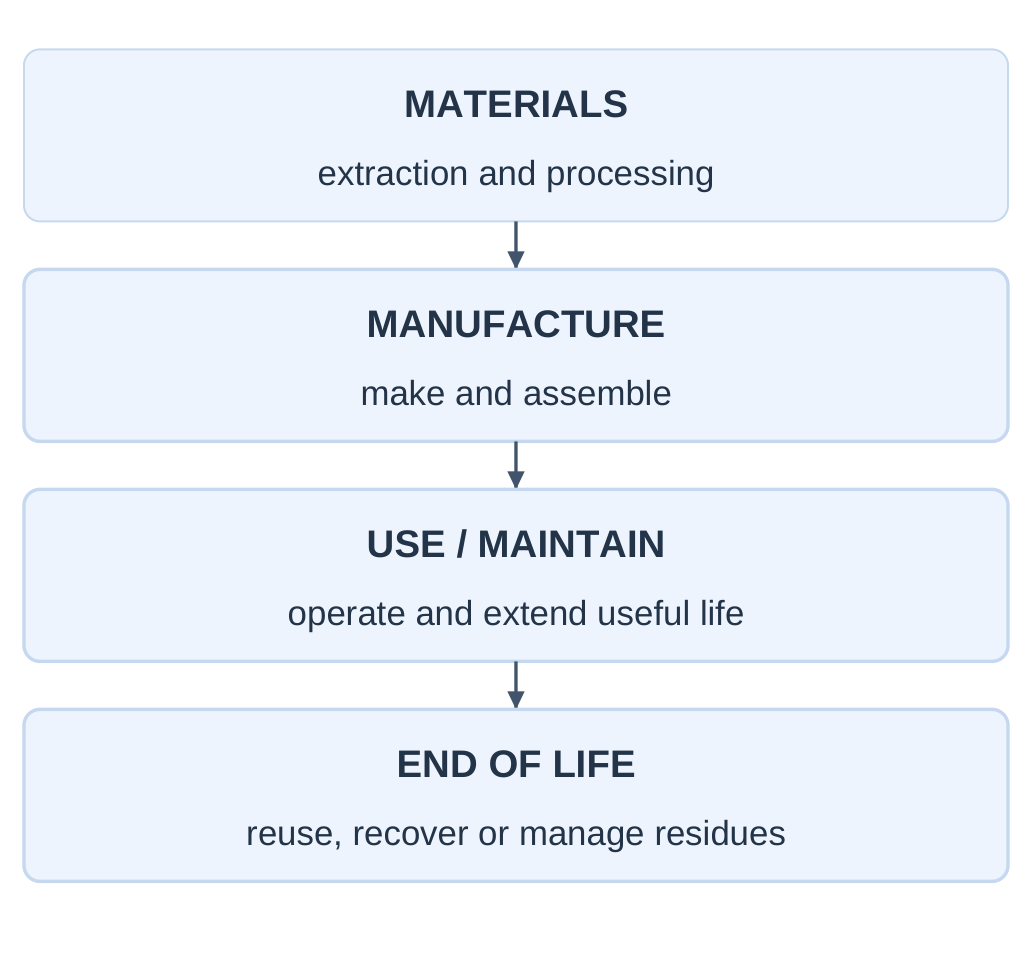
| Stage | Diagram Description |
|---|---|
| Materials | Extraction and processing |
| Manufacture | Make and assemble |
| Use / maintain | Operate and extend useful life |
| End of life | Reuse, recover or manage residues |
14.2 Define the Function
Before choosing a technology, state what users need: suitable illumination, safe water, thermal comfort or dependable mobility. An alternative that uses less material but fails the function is not a fair comparison. Compare options over equivalent service and useful life.
Service-based comparison
Compare “lighting a suitable classroom for a defined period”, not only “one lamp versus one lamp”. Output, operating hours, maintenance and life all affect the result.
14.3 Practical Design Principles
| Principle | Application |
|---|---|
| Prevent waste | Reduce unnecessary input and process loss |
| Use resources efficiently | Provide the required service with less input |
| Design for repair | Make common faults and part replacement manageable |
| Choose suitable materials | Consider performance, durability and relevant impacts |
| Plan recovery | Enable disassembly and real onward routes |
| Protect users and ecosystems | Consider exposure, access, habitat and fairness |
14.4 Evaluate Trade-Offs
Lower operating energy can come with different material requirements. A lightweight composite may be difficult to separate at end of life. A longer-life component may need more initial material. Make the trade-off explicit and use appropriate evidence rather than assuming one metric determines everything.
14.5 Verification After Deployment
A design prediction is not an operating result. Check real energy, water, reliability and user experience under the intended conditions. Keep maintenance records and use feedback for improvement.
Model answer
An engineer supports sustainability by defining the service, comparing life-cycle impacts, preventing avoidable loss, selecting maintainable systems and checking actual outcomes. Ethical judgment and competent collaboration are part of the design process.
Avoid a common mistake
Adding a recycling symbol to a product does not make it recoverable in practice. Separation, collection, processing and a use for recovered material must be feasible.
15. Clean Technology
15.1 Useful Energy Services

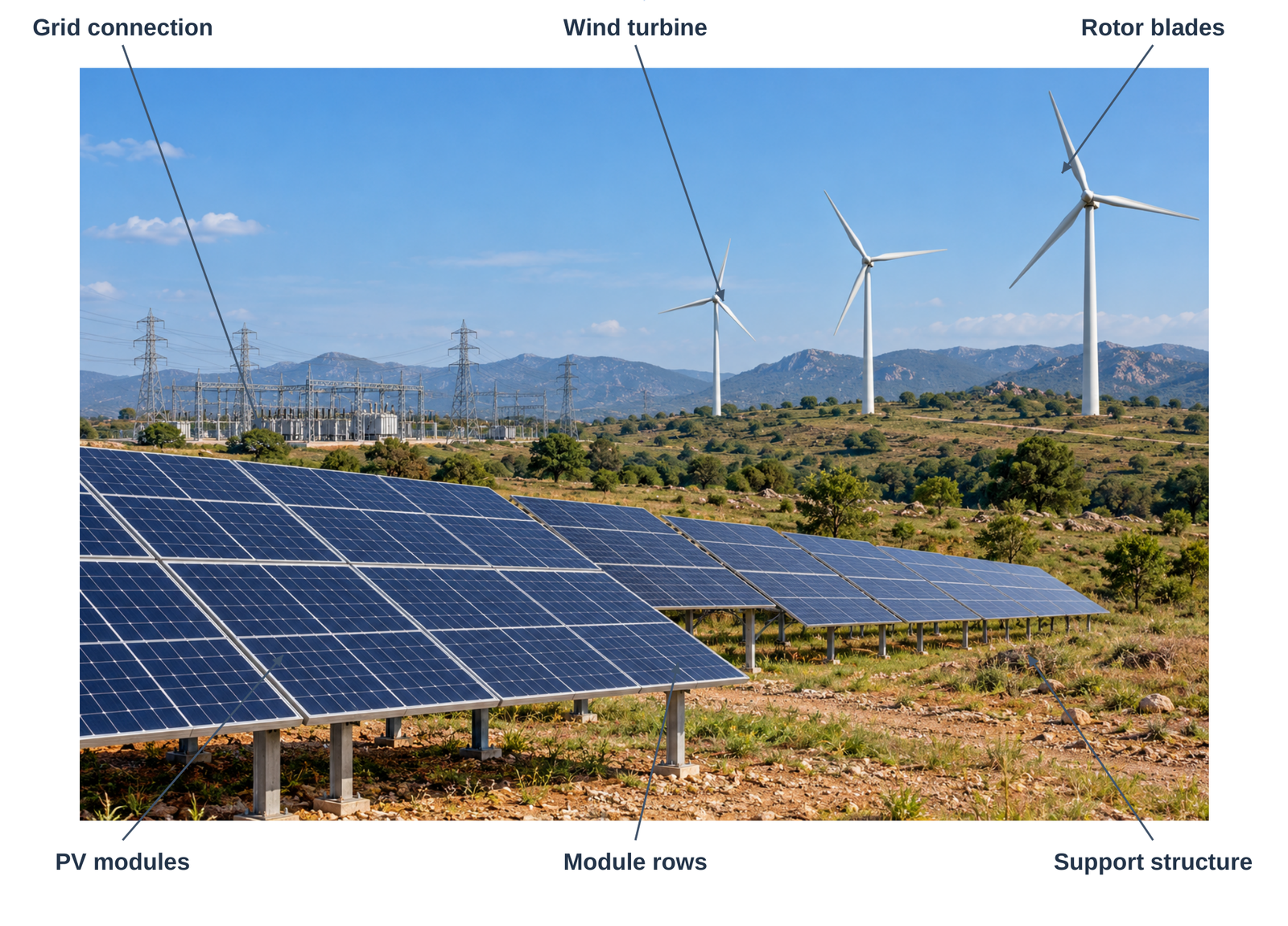
Illustration labels:
- Grid connection.
- Wind turbine.
- Rotor blades.
- PV modules.
- Module rows.
- Support structure.
Meaning
Clean technology reduces relevant environmental impacts while delivering a useful service. Examples include suitable resource-efficient processes, effective treatment, material recovery and low-emission energy. The term describes a purpose and performance, not a guarantee of zero impact.
Prevention and efficiency
A leak-prevention system or process change may be a useful clean-technology measure even when it is less visually dramatic than a new power installation. Evaluate actual avoided losses and reliability.
Check the whole system
Consider inputs, energy, water, emissions, residues, skill needs, maintenance and recovery. A technology that cannot be operated locally can fail to deliver its advertised benefits. A renewable-energy installation does not remove the need to manage demand.
Question to ask
Compared with what baseline, for which useful service, over what period, and with which impacts included?
These questions make a clean-technology claim reviewable.
16. Stream Contributions: I
16.1 CSE: Computer Science
CSE can support environmental data records, dashboards, modelling and efficient digital services. Good software should use appropriate data, transparent assumptions and a useful decision process. A dashboard that displays unreliable values or has no responsible user does not create an environmental improvement by itself.
| Contribution | Practical Example |
|---|---|
| Resource records | Track suitable water or energy data with units and timestamps |
| Data checks | Flag missing or implausible values for review |
| Useful feedback | Connect a recurring fault to a responsible team |
| Responsible computing | Avoid needless hardware replacement and consider energy and e-waste |
16.2 EE: Electrical Engineering
EE contributes through efficient lighting, motors and pumps, appropriate power systems and renewable-energy integration. Measurement, protection, operation and maintenance matter. Reducing demand should preserve the required service and use competent electrical design.
Shared caution
Do not claim a quantified saving merely from installing software, a meter or an efficient motor. Compare actual useful service and operating data under suitable conditions.
16.3 ECE and ME
ECE: Electronics and Communication
ECE can support appropriate sensors, communication networks and control concepts for environmental systems. Instrument range, calibration, location, reliability and data transmission affect results. Devices also need power, maintenance and a responsible end-of-life route.
ME: Mechanical Engineering
ME contributes through efficient equipment, thermal systems, maintenance, material use and suitable manufacturing processes. Preventive maintenance can reduce leaks, vibration, noise and avoidable energy use. Design for repair can extend useful life where appropriate.
| Stream | Awareness Project | What to Verify |
|---|---|---|
| EE | Lighting-operation review | Suitable illumination, operating hours and electricity |
| ECE | Water-level sensing concept | Reliable readings, failure response and maintainability |
| ME | Pump-maintenance review | Required flow, leaks, operating condition and energy |
| CSE | Fault-reporting dashboard | Data quality, responsible action and completed outcomes |
16.4 Collaboration
A water-saving system may need a sensor, electrical protection, software records, a suitable valve or pump and a maintenance team. The stream contributions connect; assigning one label to the project does not make the other skills unnecessary.
Report a contribution accurately
State the engineering function, the environmental mechanism and a verification method. Keep a student concept distinct from a commissioned installation or proven field result.
A joint CSE–EE example
A classroom-energy review combines a useful equipment inventory, suitable power information, operating-hour records and a simple dashboard. EE helps interpret the electrical service; CSE helps organise data and feedback. Both need comparable observations and a maintenance response. The software does not by itself prove an electricity saving.
17. Stream Contributions: II
17.1 CE: Civil Engineering
CE contributes to water supply, sanitation, drainage, buildings, construction management and land-use planning. Suitable design can reduce resource demand, protect water and manage relevant exposure. Site conditions, downstream effects, maintenance and user access must be considered.
17.2 BT: Biotechnology
BT can support appropriate biological treatment, organic-resource recovery and understanding of living processes. Microbial treatment depends on suitable feed and operating conditions. A biological route does not automatically remove every chemical or make a mixed waste safe.
17.3 CH: Chemical Engineering
CH contributes through material and energy balances, process efficiency, suitable substitutions, separation and recovery. Preventing loss upstream can reduce treatment needs. A changed process should be evaluated for performance and new impacts rather than judged only by the removal of one input.
| Stream | Example Question |
|---|---|
| CE | Does a drainage change reduce risk without transferring it downstream? |
| BT | Is the feed suitable for the biological treatment route? |
| CH | Where do materials and energy leave the process, including residues? |
Keep scope appropriate
These are awareness examples of how each branch can contribute. Detailed design requires the relevant technical knowledge, site information and competent supervision.
17.4 TX and AG
TX: Textile Engineering
TX can contribute through efficient fabric and fibre use, lower-loss processing, suitable water and chemical management, durability and recoverable products. A material claim should consider actual production, use, care and end-of-life routes rather than relying only on the word natural or recycled.
AG: Agricultural Engineering
AG can support suitable irrigation, soil and water conservation, equipment efficiency and management of agricultural residues. Measures should fit climate, soil, crop needs and local conditions. Over-extraction of water or removal of protective residues can undermine intended benefits.
| Contribution | Practical Verification |
|---|---|
| Textile material planning | Measure suitable input, usable output and avoidable offcuts |
| Textile water management | Match quality and quantity to the process and treatment route |
| Irrigation improvement | Check soil moisture, crop needs, runoff and actual water use |
| Residue management | Consider existing soil-cover or other uses before diversion |
17.5 All Nine Streams Together
CSE, EE, ECE, CE, ME, BT, CH, TX and AG can contribute through different tools and expertise. The common responsibility is to provide a useful service, prevent avoidable harm, work within competence and verify outcomes honestly.
Exam task
Choose one stream, name a realistic contribution, explain the resource or pollution mechanism and add one maintenance or evidence requirement. Specific reasoning earns more than a long list of fashionable technologies.
18. Environmental Ethics
18.1 Meaning
Environmental ethics concerns responsibilities towards people, other living systems and future generations when decisions affect the environment. It asks not only what can be done, but what should be done and whose interests and risks are considered.
| Principle | Practical Meaning |
|---|---|
| Avoid unnecessary harm | Prevent avoidable releases and disturbance |
| Honesty | Report data, assumptions and failures accurately |
| Equity | Consider who receives benefits and bears burdens |
| Future responsibility | Consider long-term resource and maintenance needs |
| Respect for ecosystems | Recognise ecological value beyond immediate market use |
| Professional competence | Work within skills and seek appropriate expertise |
18.2 Responsibility Under Uncertainty
Lack of complete information is not a reason to ignore a credible concern, nor is it permission to invent a definite result. Record the uncertainty, seek suitable assessment and take proportionate preventive steps through the responsible process.
Legal and ethical duties
Meeting a minimum requirement does not answer every question of fairness, honesty or avoidable harm. Ethics helps evaluate choices within and beyond minimum obligations, while recognising the importance of law.
18.3 Solved Ethical Cases
Case 1: selective reporting
A report includes only favourable readings. The ethical response is to preserve the full relevant record, explain methods and limitations and investigate unusual values. Removing inconvenient evidence without justification misleads decision-makers.
Case 2: waste moved off campus
A contractor offers to remove mixed waste cheaply but gives no suitable destination. Ask for a credible route and accountability. A clean campus boundary does not justify dumping the problem elsewhere.
Case 3: green claim without evidence
A product is marketed as zero-impact because it contains recycled material. A responsible evaluation asks what the claim covers, what evidence supports it and which life-cycle impacts remain. Avoid repeating the claim as a proven fact.
Case 4: a design affects neighbours
A drainage proposal protects one building but may send more water towards nearby homes. Assess connected effects, include affected users appropriately and compare alternatives. Transferring risk to a less powerful group is not a complete sustainability solution.
A decision checklist
- What is the need?
- Who is affected?
- What evidence is reliable?
- What uncertainty remains?
- Can avoidable harm be prevented?
- Who maintains the response?
- How will the outcome be checked and reported?
Core professional habit
Be accurate about what is known, clear about what is assumed and accountable for the consequences of a proposed action.
Future responsibility in practice
A cheap component may be difficult to replace and fail long before the rest of a system. Ethical evaluation asks whether future users will inherit avoidable downtime, waste or repair costs. Consider useful life, available parts and the consequences of failure, not only today’s purchase price.
19. Quick Revision
| Topic | Recall |
|---|---|
| Environmental protection | Prevent harm, control pollution and maintain ecological functions |
| Water Act | 1974; water-pollution prevention and control |
| Air Act | 1981; prevention, control and abatement of air pollution |
| Environment (Protection) Act | 1986; broader protection and improvement framework |
| Individual / society | Responsible use and reporting / reliable shared systems and accountability |
| Technology | Useful prevention, treatment and monitoring with maintenance |
| Green campus | Integrated management of resources, impacts and useful services |
| Green building | Site, energy, water, materials, indoor quality and operation |
| Sustainable design | Life-cycle decisions for function, fairness and reduced harm |
| Ethics | Honesty, equity, competence and future responsibility |
A reusable answer framework
- Define the concept.
- Identify the service, source or affected system.
- Explain the mechanism.
- Propose a suitable action and responsibility.
- Verify actual performance.
- State relevant limits and connected effects.
Do not confuse
A law’s original year with current procedural detail; a sensor with treatment; a planted campus with proven sustainability; an installed device with a verified outcome.
19.1 Possible Exam Questions
Short-answer questions
- Define environmental protection.
- Distinguish source prevention and end-of-pipe control.
- Name the three syllabus Acts with their years and purposes.
- Explain one role of individuals and one of society.
- State how technology supports environmental protection.
- Define a green campus and green building.
- Distinguish passive and active building measures.
- Explain life-cycle thinking.
- Define clean technology with one limitation.
- State four environmental-ethics principles.
Long-answer and diagram tasks
- Explain integrated environmental-protection measures with a campus example.
- Give an awareness overview of the Water, Air and Environment (Protection) Acts.
- Discuss individual, societal and technological roles.
- Describe a green campus and a measurable action plan.
- Draw a labelled green-building section and explain its climate-dependent features.
- Discuss sustainable engineering design and clean technology.
- Explain contributions from all nine engineering streams.
- Analyse an environmental-ethics case using evidence, fairness and responsibility.
Final self-check
Can you connect a measure to a real cause, name who operates it, identify what evidence is needed and explain what remains uncertain?
If so, you can move beyond slogans to a practical environmental answer.
Unit V complete
You should now be able to connect protection, legal awareness, everyday responsibility and engineering judgment to a realistic sustainability plan.
Study Resources
Use these Environment and Sustainability Unit 5 Notes for complete unit study, labelled diagrams, environmental-law awareness, green-campus planning, branch-wise contributions and examination preparation.
Additional unit-wise resources are available at www.notesgallery.com.
The university website is https://aktu.ac.in.