Artificial Intelligence has become a part of everyday student life. From solving coding errors and understanding difficult concepts to improving assignments and generating study notes, AI-powered tools like ChatGPT, Gemini, Claude, and Copilot are increasingly being used by college students across India.
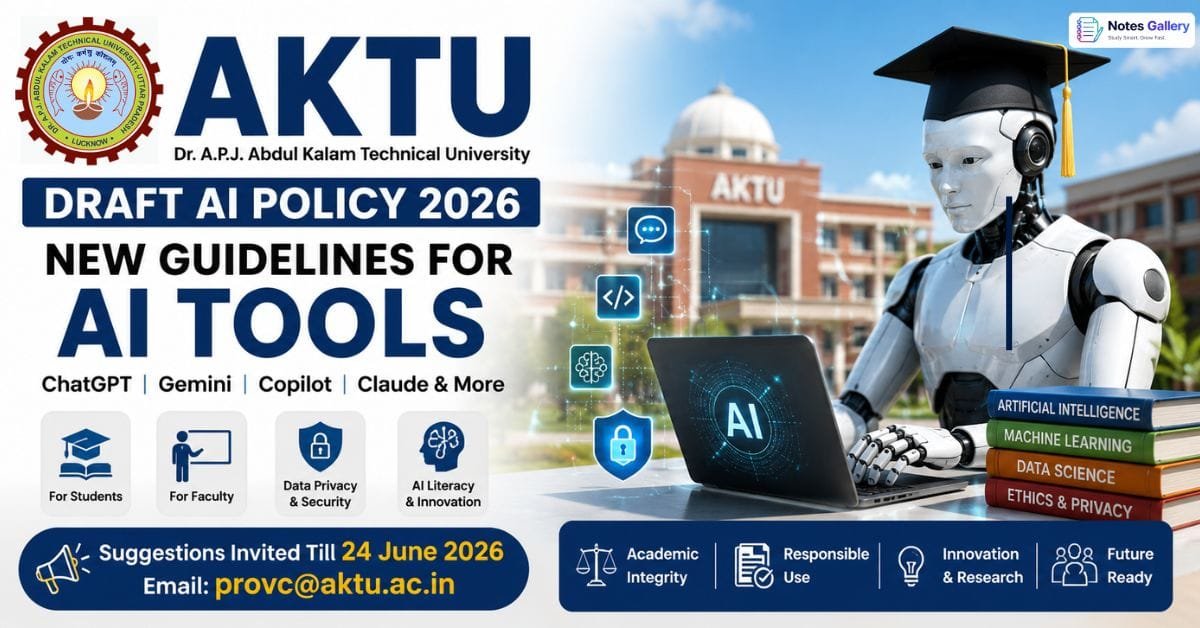
Recognizing this rapid shift, Dr. A.P.J. Abdul Kalam Technical University (AKTU) has released a draft Artificial Intelligence Policy and invited suggestions from stakeholders before final implementation. The proposed framework aims to establish clear rules for how AI can be used in academics, research, examinations, and administrative work across the university and its affiliated colleges.
The move is being seen as one of the most significant steps taken by an Indian state university to address the growing role of artificial intelligence in higher education.
AKTU Releases Draft AI Policy for Students and Faculty
According to the university notification, AKTU is seeking feedback on its proposed Artificial Intelligence Policy before giving it final approval. The policy has been designed to create a balanced approach that encourages innovation while protecting academic integrity and student data.
The university’s draft framework aligns with several national initiatives, including the National Education Policy (NEP) 2020, IndiaAI Mission, UGC recommendations, AICTE guidelines, and India’s Digital Personal Data Protection Act (DPDPA).
As AI adoption continues to expand across educational institutions, AKTU’s initiative reflects a broader effort to prepare students for a technology-driven future while ensuring responsible use of emerging tools.
Why AKTU Felt the Need for an AI Policy
Over the past two years, generative AI tools have transformed how students learn and complete academic tasks. A few simple prompts can now generate essays, programming code, summaries, presentations, and even research assistance.
While these technologies offer clear benefits, they also raise important concerns.
Universities worldwide are facing challenges related to plagiarism, misinformation, fabricated citations, examination integrity, and misuse of confidential data. Without clear guidelines, students often remain unsure about what is acceptable and what could be considered academic misconduct.
AKTU’s proposed policy attempts to remove this confusion by defining how AI tools should be used responsibly within an academic environment.
Students May Continue Using AI for Learning
One of the most student-friendly aspects of the draft policy is that it does not seek to ban AI tools.
Instead, it recognizes that artificial intelligence can support learning when used appropriately.
Students may use AI-powered platforms for activities such as brainstorming ideas, improving language quality, understanding difficult concepts, debugging code, translating educational content, and generating practice questions for self-study.
This approach acknowledges a reality already visible across classrooms: AI has become an educational assistant for many learners.
However, the university emphasizes that students remain responsible for verifying the accuracy of information generated by these tools.
Transparency Could Become a Key Requirement
The draft policy places strong emphasis on transparency.
If AI tools contribute significantly to assignments, projects, reports, coding work, or research-related activities, students may be expected to disclose how the technology was used.
The university believes that transparency helps maintain trust in academic work while allowing students to benefit from modern technology.
Rather than hiding AI usage, students may need to acknowledge it openly whenever required.
This reflects a growing trend seen in universities around the world, where disclosure is becoming an important part of responsible AI usage.
Activities That Could Lead to Disciplinary Action
While the policy supports educational use of AI, it also identifies several practices that are considered unacceptable.
Students are prohibited from using AI during closed-book examinations, generating fake research findings, fabricating references, uploading confidential university content, or using AI to bypass plagiarism checks.
The draft policy makes it clear that academic integrity remains a non-negotiable principle.
AI may assist learning, but it cannot replace genuine effort, critical thinking, or original academic work.
Violations could attract penalties ranging from warnings and assessment penalties to more serious disciplinary action depending on the severity of the offence.
AKTU Wants Students to Become AI-Literate
Beyond regulation, the policy also highlights the importance of AI literacy.
AKTU envisions a future in which students graduate with a strong understanding of how artificial intelligence works, where it can be useful, and what risks it may create.
The proposed framework encourages awareness of topics such as:
- AI ethics and responsible usage
- Privacy and data protection
- Algorithmic bias
- AI hallucinations and misinformation
- Intellectual property concerns
- Critical evaluation of AI-generated content
These skills are increasingly becoming valuable in the modern job market, where employers expect graduates to understand emerging technologies.
Data Privacy Receives Special Attention
A major concern addressed in the draft policy is the protection of personal and institutional information.
The university advises against entering sensitive information into public AI systems.
This includes student records, examination papers, unpublished research data, financial documents, legal records, and other confidential information.
As AI platforms continue to collect and process large volumes of data, privacy awareness is becoming an essential digital skill for students and educators alike.
AI Could Open New Opportunities for Research and Innovation
The policy is not only about restrictions.
AKTU also outlines a vision for strengthening AI research, industry collaboration, and innovation ecosystems.
The university proposes initiatives that could support artificial intelligence research, machine learning projects, advanced computing infrastructure, and industry-academic partnerships.
For students interested in AI, data science, robotics, and emerging technologies, this could create new opportunities for skill development and research participation in the coming years.
What This Means for AKTU Students
The release of the Draft AI Policy 2026 signals that artificial intelligence is becoming a permanent part of higher education.
Instead of resisting technological change, AKTU appears to be focusing on responsible adoption. The university wants students to take advantage of AI’s benefits while maintaining honesty, transparency, and accountability.
For students, the message is straightforward: AI can be used as a powerful learning tool, but academic responsibility still belongs to the individual.
As the university reviews feedback and moves toward final implementation, the policy could shape how AI is used in classrooms, projects, research activities, and examinations across AKTU and affiliated colleges.
also read : AKTU Infosys Makers Lab Internship 2026: Shortlisted Students Asked to Report on June 22
Final Thoughts
Artificial Intelligence is reshaping education faster than most people expected. Universities now face the challenge of encouraging innovation while protecting academic standards.
AKTU’s Draft AI Policy 2026 represents an important step in that direction.
By allowing responsible AI use, promoting digital literacy, protecting data privacy, and reinforcing academic integrity, the university is attempting to create a framework that prepares students for an AI-driven future without compromising educational values.
The policy may still be in draft form, but its impact could influence thousands of students across Uttar Pradesh for years to come.