CSE Notes are useful for AKTU B.Tech 7th Semester Computer Science and Engineering students who want subject-wise study material for semester preparation, internal assessments, university examinations, and quick revision. The 7th semester includes advanced Computer Science subjects along with Departmental Elective-IV options covering areas such as Artificial Intelligence, Internet of Things, Cloud Computing, Network Security, and Application Development.
Students looking for AKTU B.Tech 7th Semester CSE Notes can use this page as a subject-wise guide and combine the notes with the prescribed syllabus and previous-year question papers for better exam preparation.
Students can also explore AKTU notes, PYQs, syllabus resources, and other academic materials through NotesGallery. For official university notices, examination updates, circulars, and authoritative academic information, students should refer to the AKTU Official Website.
Download Computer Science/ Computer Engineering/ Computer Science and Engineering All Subjects Notes
Note:
PDF 1 ≠ Unit 1. Each collection may contain complete,
unit-wise, part-wise, or mixed notes.
Internet of Things
Cloud Computing
| Multiple Notes Resources | Download Links |
|---|---|
| Collection 1: Digital | |
| Collection 2: Digital | |
| Collection 3: Institute Notes | |
| Collection 4: Digital | |
| Collection 5: Digital | |
| Collection 6: Quantum |
Cryptography & Network Security
| Multiple Notes Resources | Download Links |
|---|---|
| Collection 1: Handwritten | |
| Collection 2: Handwritten | |
| Collection 3: Digital | |
| Collection 4: Quantum |
Design and Development of Applications
| Multiple Notes Resources | Download Links |
|---|---|
| Collection 1 | Coming soon… |
Artificial Intelligence
| Multiple Notes Resources | Download Links |
|---|---|
| Collection 1: Digital | |
| Collection 2: Handwritten | |
| Collection 3: Handwritten | |
| Collection 4: Digital | |
| Collection 5: Digital | |
| Collection 6: Question Bank | |
| Collection 7: Quantum | |
| Collection 8: Digital |
AKTU B.Tech 7th Semester CSE Subjects
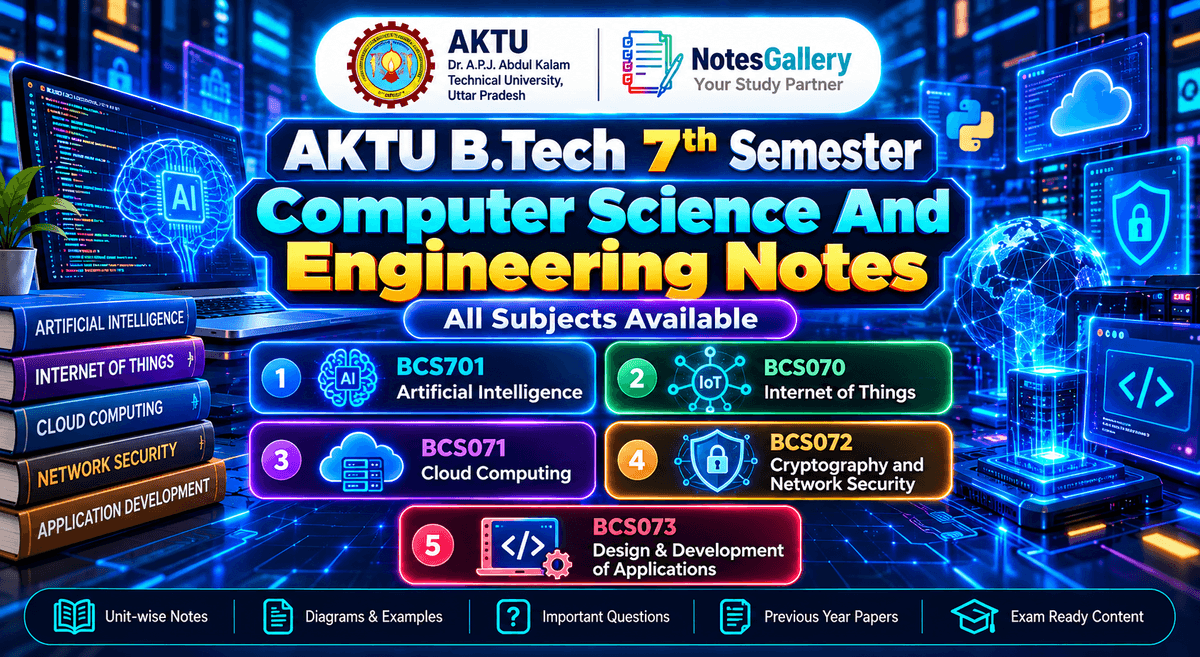
Based on the provided subject list, the visible subjects include Artificial Intelligence along with four Departmental Elective-IV options.
| Subject Code | Subject Name | Category |
|---|---|---|
| BCS701 | Artificial Intelligence | Main Subject |
| BCS070 | Internet of Things | Departmental Elective-IV |
| BCS071 | Cloud Computing | Departmental Elective-IV |
| BCS072 | Cryptography and Network Security | Departmental Elective-IV |
| BCS073 | Design & Development of Applications | Departmental Elective-IV |
Students should study the Departmental Elective-IV subject allotted or selected according to their college and curriculum.
BCS701 Artificial Intelligence Notes
Artificial Intelligence is an important subject for CSE students because it introduces the concepts and techniques used to create systems capable of performing tasks that normally require intelligent decision-making.
Artificial Intelligence broadly deals with developing computer systems capable of:
- problem-solving
- reasoning
- learning
- decision-making
- knowledge representation
- intelligent search
AI concepts are used in many modern applications such as:
- recommendation systems
- virtual assistants
- robotics
- intelligent search
- automation
- healthcare systems
- business analytics
Meaning of Artificial Intelligence
Artificial Intelligence (AI) refers to the development of computer systems that can perform tasks involving aspects of human-like intelligence.
These tasks may include:
- recognising patterns
- solving problems
- making decisions
- understanding information
- learning from experience
Artificial Intelligence is one of the most important areas of modern Computer Science.
Goals of Artificial Intelligence
The broad goals of AI may include:
- developing intelligent systems
- automating complex tasks
- improving decision-making
- solving difficult computational problems
- enabling machines to learn from data
Applications of Artificial Intelligence
AI can be applied in areas such as:
- education
- healthcare
- finance
- manufacturing
- transportation
- cybersecurity
- e-commerce
- robotics
For CSE students, Artificial Intelligence provides a strong foundation for advanced technologies such as Machine Learning and intelligent software systems.
BCS070 Internet of Things Notes
Internet of Things (IoT) is a Departmental Elective-IV subject that focuses on connected physical devices capable of collecting and exchanging data.
IoT combines:
- sensors
- devices
- communication networks
- software
- cloud systems
A basic IoT system may be represented as:
Physical Device → Sensor → Network → Processing System → Application
Meaning of Internet of Things
The Internet of Things refers to a network of physical objects connected through communication technologies so that they can collect, exchange, and sometimes act upon data.
Examples may include:
- smart home devices
- industrial sensors
- wearable devices
- connected vehicles
- smart agriculture systems
Components of IoT
Important IoT components may include:
- sensors
- actuators
- processors
- communication networks
- cloud platforms
- applications
Sensors
Sensors collect information from the physical environment.
Examples may include:
- temperature sensors
- motion sensors
- humidity sensors
- pressure sensors
Actuators
Actuators perform physical actions based on control signals.
For example, an actuator may:
- open a valve
- switch a device
- move a motor
IoT Architecture
A general IoT architecture may involve:
- Device or sensing layer
- Communication layer
- Processing layer
- Application layer
The exact architecture may vary according to the system.
Applications of IoT
IoT is used in:
- smart homes
- smart cities
- healthcare
- agriculture
- manufacturing
- transportation
- environmental monitoring
IoT in Smart Homes
Connected devices can be used to control:
- lighting
- temperature
- security
- appliances
IoT in Healthcare
IoT devices may support:
- patient monitoring
- wearable health devices
- remote healthcare systems
IoT in Industry
Industrial IoT can support:
- equipment monitoring
- predictive maintenance
- automation
- production tracking
Advantages of IoT
Potential advantages include:
- automation
- real-time monitoring
- improved efficiency
- better data collection
- remote control
Challenges of IoT
Common challenges include:
- cybersecurity
- privacy
- device management
- interoperability
- connectivity
BCS071 Cloud Computing Notes
Cloud Computing is another Departmental Elective-IV option in AKTU B.Tech 7th Semester CSE.
Cloud Computing allows users and organisations to access computing resources through network-based services instead of maintaining all infrastructure locally.
These resources may include:
- servers
- storage
- databases
- applications
- computing power
Meaning of Cloud Computing
Cloud Computing refers to delivering computing resources and services over a network, commonly through internet-based infrastructure.
It allows businesses and users to access technology resources when required.
Characteristics of Cloud Computing
Important characteristics may include:
- on-demand access
- scalability
- resource sharing
- network accessibility
- flexible resource allocation
Benefits of Cloud Computing
Cloud Computing may provide:
- lower initial infrastructure cost
- scalability
- remote access
- easier collaboration
- faster deployment
- flexible storage
Cloud Service Models
Common cloud service models include:
- IaaS
- PaaS
- SaaS
Infrastructure as a Service
Infrastructure as a Service (IaaS) provides computing infrastructure such as:
- servers
- storage
- networking
The customer manages more of the software environment.
Platform as a Service
Platform as a Service (PaaS) provides an environment for developing and deploying applications.
It helps developers focus more on application development and less on underlying infrastructure.
Software as a Service
Software as a Service (SaaS) provides ready-to-use applications through network-based access.
Users generally access the software without managing the complete underlying infrastructure.
IaaS vs PaaS vs SaaS
| Service Model | Main Purpose |
|---|---|
| IaaS | Provides computing infrastructure |
| PaaS | Provides application development platform |
| SaaS | Provides ready-to-use software |
Cloud Deployment Models
Cloud deployment models may include:
- Public Cloud
- Private Cloud
- Hybrid Cloud
Public Cloud
Public Cloud services are offered through shared provider infrastructure.
Private Cloud
Private Cloud infrastructure is dedicated to a particular organisation or controlled environment.
Hybrid Cloud
Hybrid Cloud combines elements of public and private cloud systems.
Cloud Computing Applications
Cloud Computing can support:
- web applications
- data storage
- software development
- online collaboration
- business systems
- analytics
Challenges of Cloud Computing
Potential challenges may include:
- cybersecurity
- privacy
- vendor dependency
- service availability
- regulatory requirements
BCS072 Cryptography and Network Security Notes
Cryptography and Network Security focuses on protecting information, computer systems, and communication networks against unauthorised access and attacks.
The subject is important because modern organisations depend heavily on secure digital communication.
Meaning of Cryptography
Cryptography deals with techniques used to protect information by transforming it into a secure form.
A simple concept is:
Plaintext → Encryption → Ciphertext
The authorised receiver can use an appropriate process to recover the original information.
Encryption
Encryption converts readable information into protected form.
It helps prevent unauthorised users from understanding sensitive data.
Decryption
Decryption converts encrypted information back into readable form using an appropriate key or mechanism.
Symmetric Key Cryptography
In Symmetric Key Cryptography, the same or closely related secret key is used for encryption and decryption.
Potential advantages include:
- speed
- efficiency
The major challenge is secure key sharing.
Asymmetric Key Cryptography
Asymmetric Cryptography uses a pair of mathematically related keys, generally referred to as:
- public key
- private key
It can support secure communication and digital signatures.
Symmetric vs Asymmetric Cryptography
| Symmetric Cryptography | Asymmetric Cryptography |
|---|---|
| Uses shared secret key | Uses public-private key pair |
| Generally faster | Generally more computationally intensive |
| Key distribution can be difficult | Supports easier public-key distribution |
| Useful for bulk encryption | Useful for key exchange and digital signatures |
Hashing
A Hash Function converts input data into a fixed-size output.
Hashing can be used for:
- integrity verification
- password-related security mechanisms
- digital signatures
Hashing is different from encryption because it is generally designed as a one-way transformation.
Digital Signature
A Digital Signature helps verify:
- authenticity
- integrity
- origin of digital information
It is commonly associated with public-key cryptographic techniques.
Network Security
Network Security focuses on protecting communication systems and network resources.
It may involve:
- access control
- firewalls
- authentication
- encryption
- monitoring
Common Network Threats
Threats may include:
- malware
- phishing
- unauthorised access
- denial-of-service attacks
- password attacks
Firewall
A Firewall controls network traffic according to defined security rules.
It can help separate trusted and untrusted network environments.
Authentication
Authentication verifies the identity of a user or system.
Examples may include:
- passwords
- security tokens
- multi-factor authentication
Authorization
Authorization determines what an authenticated user is permitted to access.
Authentication vs Authorization
| Authentication | Authorization |
|---|---|
| Verifies identity | Determines permissions |
| Answers “Who are you?” | Answers “What can you access?” |
| Happens first | Follows successful authentication |
Importance of Network Security
Network Security helps protect:
- confidential data
- organisational systems
- user accounts
- financial information
- online services
BCS073 Design & Development of Applications Notes
Design & Development of Applications is a Departmental Elective-IV subject focused on the systematic creation of software applications.
Application development typically involves understanding user requirements and converting them into usable software.
A basic application development process may include:
Requirements → Design → Development → Testing → Deployment → Maintenance
Requirement Analysis
Requirement Analysis determines what users expect from the application.
Requirements may include:
- functional requirements
- non-functional requirements
Clear requirements help reduce development errors.
Functional Requirements
Functional requirements describe what the application should do.
Examples may include:
- user registration
- login
- search
- payment processing
- report generation
Non-Functional Requirements
Non-functional requirements describe how the system should perform.
Examples may include:
- speed
- security
- usability
- reliability
- scalability
Application Design
Application design determines how the system will be structured before development begins.
It may include:
- user interface
- system architecture
- database structure
- application flow
User Interface Design
The user interface determines how users interact with an application.
A good interface should generally be:
- clear
- consistent
- easy to navigate
- responsive
- user-friendly
Application Architecture
Application architecture describes how different components of an application work together.
Components may include:
- frontend
- backend
- database
- APIs
Frontend Development
Frontend Development focuses on the part of an application visible to users.
It may include:
- layouts
- forms
- buttons
- navigation
- user interactions
Backend Development
Backend Development manages server-side processes such as:
- business logic
- authentication
- data processing
- database interaction
Database Integration
Applications often require databases for storing information such as:
- user accounts
- products
- orders
- transactions
Database integration allows applications to store and retrieve information efficiently.
Application Programming Interface
An Application Programming Interface (API) allows software systems or components to communicate with each other.
APIs may be used to:
- retrieve data
- submit information
- integrate external services
- connect frontend and backend systems
Application Testing
Testing helps identify defects before an application is released.
Common testing levels may include:
- Unit Testing
- Integration Testing
- System Testing
- Acceptance Testing
Unit Testing
Unit Testing evaluates individual components.
Integration Testing
Integration Testing checks whether different components work correctly together.
System Testing
System Testing evaluates the complete application.
Acceptance Testing
Acceptance Testing checks whether the application satisfies expected user requirements.
Application Deployment
Deployment makes the developed application available to users.
It may involve:
- configuring infrastructure
- publishing application files
- connecting databases
- testing production environment
Application Maintenance
Applications often require maintenance after deployment.
Maintenance may involve:
- fixing errors
- improving performance
- adding features
- updating security
- adapting to new requirements
Application Security
Security should be considered throughout application development.
Important areas may include:
- authentication
- authorization
- data protection
- secure communication
- input validation
Importance of Design & Development of Applications
The subject can help CSE students understand how software ideas are converted into usable applications.
It is relevant for:
- web development
- mobile applications
- software engineering
- startup development
- enterprise applications
Importance of CSE Notes for AKTU Students
Well-organised CSE Notes can help students:
- understand difficult subjects
- revise unit-wise topics
- prepare important definitions
- study important diagrams
- prepare theoretical questions
- save time during revision
7th Semester CSE subjects are closely related to modern technology and therefore require both conceptual understanding and application-based preparation.
How to Prepare AKTU B.Tech 7th Semester CSE Notes
Start With the Syllabus
Before beginning preparation, check the complete syllabus of each selected subject.
Divide it into:
- units
- important definitions
- numerical topics
- theory topics
- diagrams
- applications
Study Unit-Wise
Complete one unit before moving to the next.
This helps maintain a clear study structure.
Prepare Short Revision Notes
Create short notes containing:
- definitions
- differences
- formulas
- processes
- diagrams
- important points
Understand Applications
For technical subjects, do not prepare only definitions.
Understand how concepts are applied in real systems.
For example:
- AI in intelligent applications
- IoT in smart devices
- Cloud Computing in online applications
- Cryptography in secure communication
- Application Development in software systems
Practice Diagrams
Diagrams can improve answers related to:
- IoT architecture
- Cloud Computing
- cryptographic systems
- application architecture
- Artificial Intelligence processes
Solve Previous-Year Questions
PYQs can help students understand:
- question pattern
- frequently tested concepts
- answer format
- important areas
Students should still prepare the complete prescribed syllabus rather than depending only on PYQs.
Quick Revision Strategy for CSE Notes
For final exam revision, students can divide preparation according to their subjects.
Artificial Intelligence
Revise:
- AI fundamentals
- intelligent systems
- search and reasoning concepts
- applications of AI
Internet of Things
Revise:
- IoT architecture
- sensors
- actuators
- communication
- applications
- security
Cloud Computing
Revise:
- cloud fundamentals
- IaaS
- PaaS
- SaaS
- deployment models
- security concerns
Cryptography and Network Security
Revise:
- encryption
- symmetric cryptography
- asymmetric cryptography
- hashing
- digital signatures
- authentication
- network security
Design & Development of Applications
Revise:
- requirements
- design
- frontend
- backend
- APIs
- testing
- deployment
- maintenance
Why Use NotesGallery for CSE Notes?
Students looking for CSE Notes can explore academic resources on NotesGallery.
NotesGallery can help students access:
- AKTU B.Tech Notes
- semester-wise notes
- subject-wise study materials
- previous-year question papers
- syllabus resources
- exam preparation content
Using subject-wise resources can make semester preparation more organised.
Useful Resources for AKTU B.Tech CSE Students
Students can explore AKTU B.Tech 7th Semester CSE Notes and other study materials through NotesGallery.
For official academic notices, examination announcements, university circulars, and authoritative information, students should refer to the AKTU Official Website.
NotesGallery is an independent educational resource platform and should not be considered the official website of Dr. A.P.J. Abdul Kalam Technical University.
For official examination notices and syllabus updates, visit the AKTU official website.
Frequently Asked Questions
What are CSE Notes?
CSE Notes are subject-wise study materials for Computer Science and Engineering students that help with conceptual learning, semester preparation, revision, and university examinations.
Which subjects are shown for AKTU B.Tech 7th Semester CSE?
Based on the provided subject list, the visible subjects are Artificial Intelligence (BCS701) along with the Departmental Elective-IV options Internet of Things (BCS070), Cloud Computing (BCS071), Cryptography and Network Security (BCS072), and Design & Development of Applications (BCS073).
What is the subject code of Artificial Intelligence?
The provided subject code for Artificial Intelligence is BCS701.
What is the subject code of Internet of Things?
The provided subject code for Internet of Things is BCS070.
What is the subject code of Cloud Computing?
The provided subject code for Cloud Computing is BCS071.
What is the subject code of Cryptography and Network Security?
The provided subject code for Cryptography and Network Security is BCS072.
What is the subject code of Design & Development of Applications?
The provided subject code for Design & Development of Applications is BCS073.
Where can I find AKTU B.Tech 7th Semester CSE Notes?
Students can explore semester-wise and subject-wise AKTU study materials through NotesGallery.
How should I prepare CSE Notes for the AKTU 7th Semester exam?
Start with the prescribed syllabus, study each subject unit-wise, prepare concise revision notes, understand important technical applications, practise diagrams where required, and solve previous-year questions after completing the major topics.