
Professional Communication Unit 2 Notes cover Grammar and Vocabulary for Technical Writing. The unit develops the language needed to describe technical work accurately through clear sentence structure, correct grammar, precise vocabulary and professional expression.
These AAS105/AAS205 notes for AKTU B.Tech 1st Year, Semester I & II apply to CSE, EE, ECE, CE, ME, BT, CH, TX and AG streams.
The examples explain each rule through a correct construction, a common error and a justified revision. Editing activities also distinguish a language error from a missing fact that must be confirmed with the author.
Unit Overview
Technical writing should make the actor, action, time, conditions and result understandable.
This unit connects:
- Parts of speech with their functions in sentences.
- Phrases and clauses with clear sentence construction.
- Subject–verb agreement with the actual subject.
- Tense and aspect with the time relationship of work.
- Articles with sound, countability and reference.
- Vocabulary with precise technical meaning.
- Editing with evidence, organisation and clarity.
- Proofreading with final surface accuracy.
A grammatical correction must preserve the factual meaning. Changing a planned test into a completed test is not a harmless language improvement.
Classroom cases and sample responses are fictional teaching examples. Adapt them to the task using accurate details.
Topics Covered
| Section | Topic | Source PDF pages |
|---|---|---|
| 2.1 | Grammar as a tool for technical meaning | 2 |
| 2.2 | Parts of speech and word functions | 2–3 |
| 2.3 | Sentence structure and clause relationships | 4–5 |
| 2.4 | Subject–verb agreement | 5–6 |
| 2.5 | Tenses and aspect | 6–7 |
| 2.6 | Articles and determiners | 7–8 |
| 2.7 | Common errors and punctuation | 8–9 |
| 2.8 | Technical vocabulary and word formation | 9–10 |
| 2.9 | Precision, tone and style | 10–11 |
| 2.10 | Editing and proofreading techniques | 11–12 |
| 2.11 | Worked editing workshop | 12 |
| 2.12 | Practical grammar and vocabulary exercises | 12–13 |
| 2.13 | Syllabus activity and extended workshop | 13–15 |
| 2.14 | Quick revision and examination practice | 16 |
Learning Outcomes
After studying this unit, you should be able to:
- Identify parts of speech, phrases and clauses in technical sentences.
- Construct clear sentences.
- Repair fragments, run-on sentences and misplaced modifiers.
- Apply subject–verb agreement, tense and article rules.
- Use technical vocabulary, word families and abbreviations accurately.
- Improve precision, coherence and professional tone.
- Edit a technical paragraph without changing its factual meaning.
- Proofread spelling, punctuation, symbols, units and formatting.
- Explain the reason behind a correction.
- Recognise when missing information requires an author query.
Key Vocabulary
| Term | Meaning |
|---|---|
| Clause | A subject–verb construction; the subject can be understood in an imperative |
| Agreement | Matching the subject and finite verb |
| Aspect | How an action is viewed in relation to time |
| Determiner | A word that introduces or specifies a noun |
| Precision | Exactness of expression, or repeatability in a defined technical context |
| Coherence | Logical connection between ideas |
| Proofreading | Final checking of surface details |
Core Study Question
Who does what, when and under which conditions? Does the wording preserve the evidence, and can every correction be explained?
2.1 Grammar as a Tool for Technical Meaning
Grammar organises words so that a reader can identify an action, its performer, conditions and result.
A missing article may make a sentence awkward. A wrong tense or modifier can change the technical meaning.
Compare:
- “Check the cable before switching on the supply.”
- “Check the cable after switching on the supply.”
Both have grammatical structure, but the sequence differs. An editor must preserve the approved procedure rather than choose whichever sentence sounds smoother.
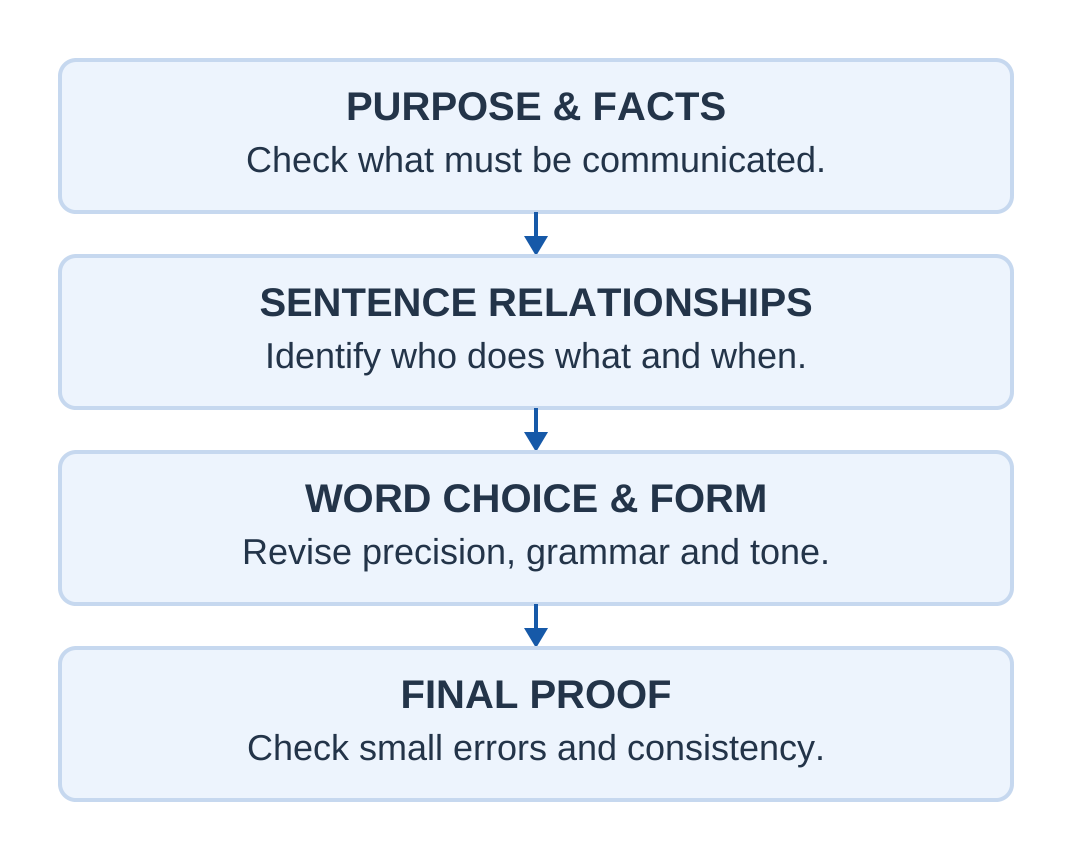
Four Levels of Revision
| Level | Main question |
|---|---|
| Content | Are facts, quantities and claims accurate? |
| Organisation | Do ideas follow a useful order? |
| Sentence construction | Are relationships and references clear? |
| Surface accuracy | Are spelling, punctuation and formatting consistent? |
Worked Example
Draft: “The equipment are good and it worked always.”
Changing are to is repairs agreement, but two technical questions remain:
- What does good mean?
- What evidence supports always?
“The equipment operated during all five recorded trials” is acceptable only if those five observations exist.
Correcting language must not create evidence.
Phrase and Clause
A phrase is a group of words functioning as a unit:
“In the laboratory.”
A clause contains a subject and verb relationship:
“The team recorded the reading.”
An independent clause can stand alone. A dependent clause needs a main clause to complete its meaning.
2.2 Parts of Speech in Context
A part of speech describes a word’s function in a sentence.
In “We test the device,” test is a verb.
In “The test failed,” test is a noun.
Identify function from context rather than an isolated word list.
| Category | Function | Example |
|---|---|---|
| Noun | Names a person, object, process or idea | engineer, sensor, measurement |
| Pronoun | Refers to a noun or participant | it, they, we, which |
| Verb | Expresses an action, event or state | measure, rises, is |
| Adjective | Modifies a noun | stable voltage |
| Adverb | Modifies a verb, adjective or adverb | varies slightly |
| Preposition | Shows a relationship | in, on, between, through |
| Conjunction | Connects words or clauses | and, but, because |
| Interjection | Expresses an exclamation | oh, alas |
Determiners such as a, an, the, this, each and some introduce or specify nouns. Treating them as determiners helps explain articles and quantity expressions.
Nouns and Noun Groups
A count noun can normally be counted:
- One resistor.
- Three samples.
A non-count noun is normally treated as a quantity or collection:
- Equipment.
- Information.
- Advice.
Write “two pieces of equipment,” not “two equipments.”
Write “some information,” not “an information.”
A noun group can contain a determiner and modifiers:
“The revised laboratory safety checklist.”
The head noun is checklist. The group names one checklist.
In “The new pressure sensor records data”:
- Subject head: sensor.
- Determiner: the.
- Modifiers: new and pressure.
- Finite verb: records.
- Object: data.
Pronouns and Clear Reference
A pronoun needs an identifiable referent.
Unclear: “The circuit was connected to the display, and it failed.”
Possible meanings include:
- The display failed.
- The circuit failed.
Choose the version supported by the facts. If the source does not identify the failed component, ask the author.
After a complex explanation, “this result” is often clearer than an unsupported “this.”
Main, Auxiliary and Modal Verbs
A main verb carries the central action or state.
An auxiliary verb helps express tense, aspect, voice or questions. Common auxiliaries include be, have and do.
A modal verb expresses meanings such as ability, possibility, obligation or recommendation.
| Modal | Example |
|---|---|
| Can | The device can detect a change. |
| May | Students may enter after approval. |
| Must | The guard must remain closed. |
| Should | The team should review the draft. |
| Could | The reading could indicate a loose connection. |
A modal takes the base verb:
Correct: “The team must submit.”
Incorrect: “The team must submits.”
The meaning depends on context. “May become hot” expresses possibility, while “may enter” can express permission.
Follow the terminology of an applicable specification when it assigns particular meanings to words.
Adjectives, Adverbs and Comparison
Adjectives describe nouns:
“A precise measurement.”
Adverbs describe manner or degree:
“Measure precisely.”
Avoid double comparatives:
- Smaller, not more smaller.
- Better, not more better.
- More reliable, not reliabler.
A comparison needs a criterion or baseline.
“Option B is cheaper than option A under the quoted conditions” is more informative than “Option B is better.”
Prepositions and Conjunctions
Useful combinations include:
- Depend on.
- Consist of.
- Comply with.
- Responsible for.
- Different from.
- Compare A with B.
Coordinating conjunctions connect equivalent structures:
“The team measured the voltage and recorded the current.”
Subordinating conjunctions introduce a dependent relationship:
“Because the lead was damaged, the test was postponed.”
Avoid unnecessary paired connectors:
Incorrect: “Although the file was short, but it contained all results.”
Correct: “Although the file was short, it contained all results.”
Alternatively:
“The file was short, but it contained all results.”
2.3 Sentence Structure and Clause Relationships
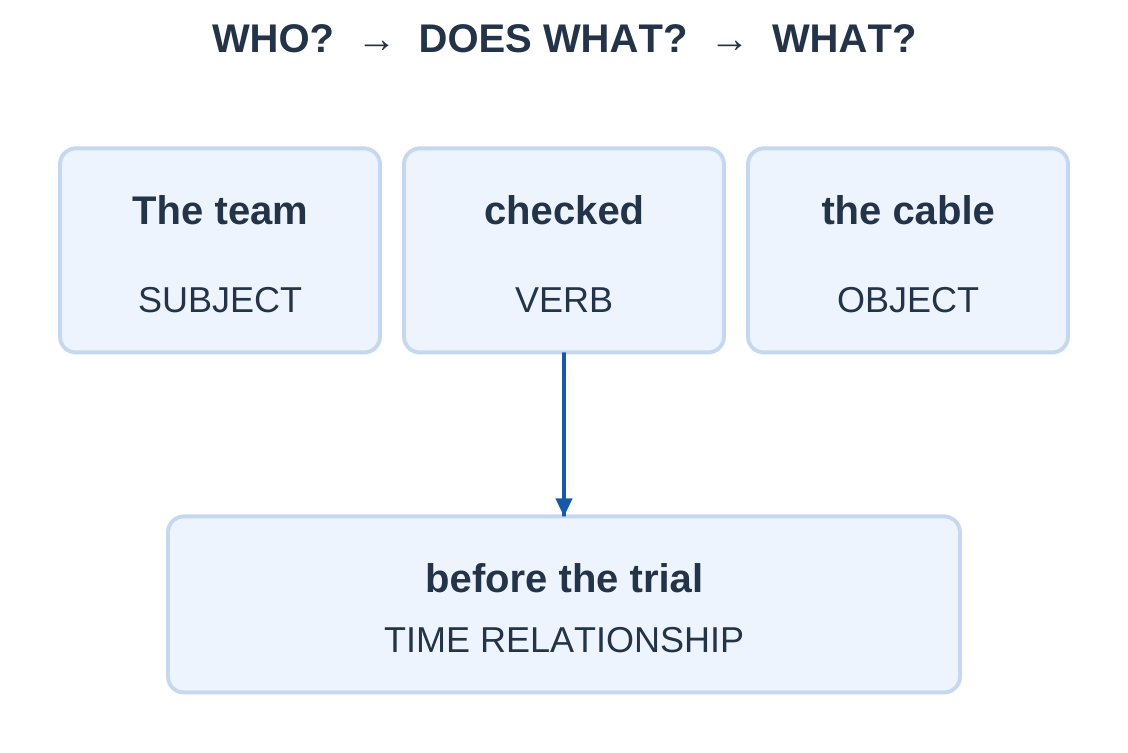
A sentence expresses a complete thought through a grammatical structure.
| Pattern | Example |
|---|---|
| Subject + verb | The motor stopped. |
| Subject + verb + object | The team checked the cable. |
| Subject + linking verb + complement | The cable is damaged. |
| Subject + verb + indirect object + direct object | Meera sent Ravi the report. |
| Subject + verb + object + complement | The review made the instruction clearer. |
Subject, Predicate and Finite Verb
The subject identifies what the clause concerns.
The predicate says something about the subject.
A finite verb is marked for tense or connected to a subject through agreement.
In “The revised instructions are available,” are is finite.
In “To revise the instructions takes time,” to revise is non-finite and occurs within the subject expression.
Imperatives
“Record the reading” has an understood subject, you.
It is a complete instruction, not a fragment.
A report of completed work uses a different construction:
“The reading was recorded.”
Sentence Types
| Type | Structure | Example |
|---|---|---|
| Simple | One independent clause | The temperature rose. |
| Compound | Two or more independent clauses | The cable was intact, but the connector was loose. |
| Complex | A main clause and a dependent clause | Because the connector was loose, the test was delayed. |
| Compound-complex | At least two independent clauses and a dependent clause | When the supply was disconnected, the technician replaced the lead, and the team repeated the test. |
A simple sentence can have a compound subject or predicate:
“Asha and Ravi checked the cable and labelled the connectors.”
It still has one independent clause.
Fragments
A fragment is an incomplete construction presented as a sentence.
Fragment: “Because the measurement was incorrect.”
Repair: “Because the measurement was incorrect, the team repeated the trial.”
Headings and table labels may be phrases. They do not all need full sentence structure.
Run-On Sentences and Comma Splices
Run-on: “The file was missing the team sent another copy.”
Comma splice: “The file was missing, the team sent another copy.”
Possible repairs:
- The file was missing. The team sent another copy.
- The file was missing; the team sent another copy.
- The file was missing, so the team sent another copy.
Choose punctuation and connectors that express the intended relationship.
Parallel Structure
Parallel ideas should use matching grammatical forms.
Weak: “The procedure includes measuring voltage, recording current and to calculate resistance.”
Revised: “The procedure includes measuring voltage, recording current and calculating resistance.”
Another example:
Weak: “Our objectives are to inspect the cable, measurement of voltage and recording the result.”
Revised: “Our objectives are to inspect the cable, measure the voltage and record the result.”
Modifier Placement
A modifier should be close to what it describes.
“We observed the student with the microscope” is ambiguous.
If the intended meaning is confirmed, write:
“Using the microscope, we observed the sample prepared by the student.”
Dangling Modifiers
Faulty: “After checking the cable, the display was switched on.”
The display did not check the cable.
Actor confirmed: “After checking the cable, the technician switched on the display.”
Actor not specified: “After the cable had been checked, the display was switched on.”
Position of Only
- “Only Asha checked the file” limits the person.
- “Asha checked only the file” limits the object.
- “Asha only checked the file” may suggest she did nothing further.
Position can change the factual claim.
2.4 Subject–Verb Agreement
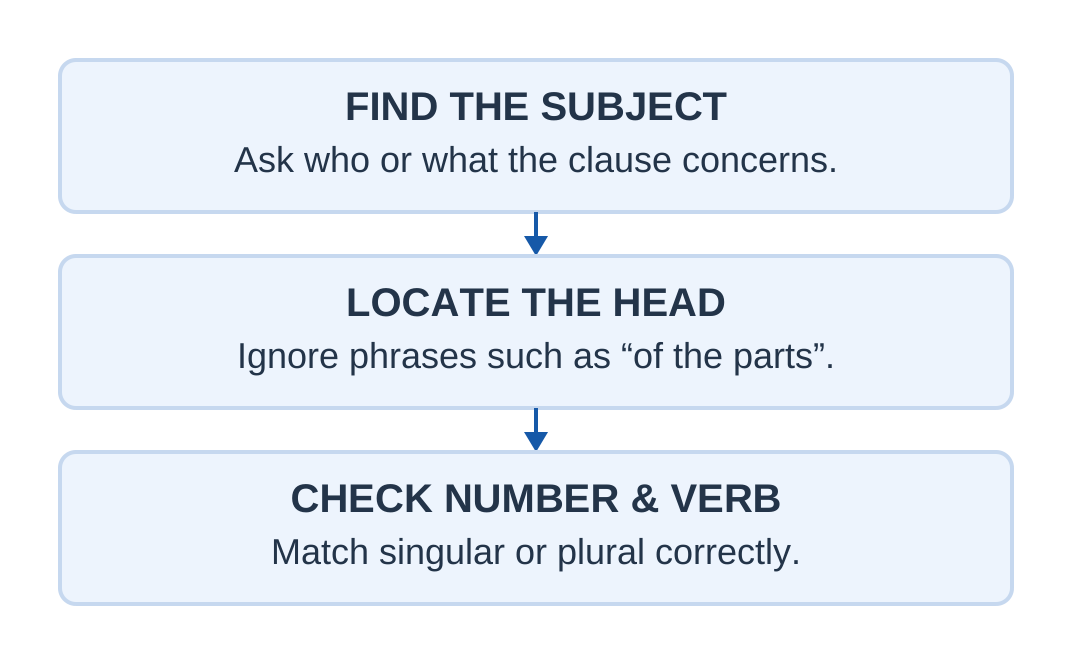
Agreement connects the finite verb with its subject.
Singular: “The sensor works.”
Plural: “The sensors work.”
The closest noun is not always the subject.
Find the Head Noun
“The list of components is attached.”
The head is list, not components.
“The readings from the sensor are inconsistent.”
The head is readings, not sensor.
Joined Subjects
Subjects joined by and normally take plural agreement:
“The pump and the valve are inspected.”
A phrase expressing a single combined concept may take singular agreement when intended as one unit.
With or/nor and mixed numbers, agreement commonly follows the nearer subject:
“Neither the technician nor the students are available.”
A clearer rewrite can avoid awkwardness:
“The technician is unavailable, and so are the students.”
Indefinite Subjects
Each, every, everyone, either and neither normally take singular agreement when they function as subject heads.
- Each sample is labelled.
- Every member has a copy.
- Each of the files is accessible.
A Number Of and The Number Of
“A number of students are absent” means several students.
“The number of absent students is small” refers to one count.
Quantities
A measured quantity treated as one amount often takes a singular verb:
“Ten minutes is sufficient.”
Countable events remain plural:
“Ten separate trials are listed.”
Collective and Non-Count Nouns
“The team has submitted its report” treats the team as one unit.
British usage may allow plural agreement when members are considered separately. Avoid inconsistent switching.
Non-count nouns commonly take singular agreement:
- The equipment is ready.
- The information was incomplete.
- The research has begun.
Usage of data varies by discipline and style. Follow the prescribed convention consistently.
There Is and There Are
- There is one error.
- There are two errors.
For awkward mixed lists, rewrite:
“The room contains a monitor and two sensors.”
Agreement Practice
| Sentence | Correct answer | Reason |
|---|---|---|
| The results of the test show/shows variation. | Show | Results is plural |
| Every student need/needs a log. | Needs | Every student is singular |
| The instructions on the sheet is/are clear. | Are | Instructions is plural |
| Five kilograms is/are the specified total mass. | Is | One specified amount |
| The committee has/have issued its decision. | Has | Committee is treated as a unit |
| A set of tools is/are available. | Is | Set is the head |
2.5 Tenses and Aspect in Technical Writing
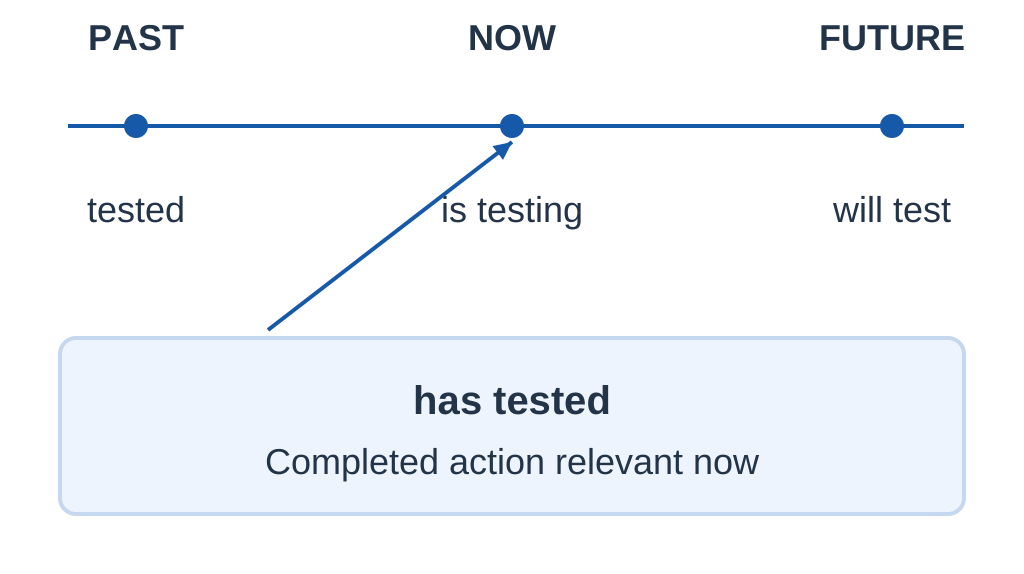
Tense locates a situation in time.
Aspect shows whether it is viewed as ongoing, completed or connected with another time.
Core Forms
| Form | Example | Purpose |
|---|---|---|
| Present simple | The sensor measures temperature. | Function or general description |
| Present progressive | The team is testing the sensor. | Activity in progress |
| Present perfect | The team has completed three trials. | Completed work relevant now |
| Present perfect progressive | The team has been testing since noon. | Continuing activity |
| Past simple | The team tested the sensor yesterday. | Completed past event |
| Past progressive | The team was testing when the supply failed. | Ongoing past context |
| Past perfect | The team had checked the lead before testing began. | Earlier past completion |
| Past perfect progressive | The team had been testing for an hour before the break. | Prior duration |
“The display shows voltage” describes a function.
“The display is showing zero” describes a current observation.
Future Expressions
| Form | Example |
|---|---|
| Will + base form | The team will submit tomorrow. |
| Will be + -ing | At 2 p.m., the team will be presenting. |
| Will have + past participle | By Friday, the team will have completed the review. |
| Will have been + -ing | By noon, the team will have been working for two hours. |
English also uses the present progressive for arrangements and going to for plans or evidence-based expectations.
“We are meeting at 2 p.m.” can describe an arranged future event.
Since and For
Use since with a starting point:
- Since Monday.
- Since morning.
- Since noon.
Use for with a duration:
- For three days.
- For two hours.
Incorrect: “We have worked here since three days.”
Correct: “We have worked here for three days.”
Present Perfect and Finished Past Time
Incorrect: “We have submitted it yesterday.”
Correct: “We submitted it yesterday.”
“We have submitted it” is suitable when present completed status matters and no finished past time is given.
Tense by Report Section
- Completed method: “The team recorded five readings.”
- Document reference: “Table 1 lists the readings.”
- Interpretation: “The observations suggest a difference.”
- Recommendation: “The team should repeat the comparison.”
A report can contain several tenses because it describes different time relationships.
Worked Paragraph
“The team tested the indicator on Monday. Table 1 shows the recorded observations. The review has identified two missing labels, which the team will correct before submission.”
The changes in tense are justified by the different meanings.
Corrections
| Draft | Revision |
|---|---|
| The team has sent the report yesterday. | The team sent the report yesterday. |
| She is knowing the procedure. | She knows the procedure. |
| By the time the meeting began, we checked the agenda. | By the time the meeting began, we had checked the agenda. |
| We are testing when the light went out. | We were testing when the light went out. |
“The team will test” and “The team has tested” are not interchangeable styles.
2.6 Articles and Determiners
Articles identify whether a noun refers to something indefinite, identifiable or general.
- A/an: Indefinite article.
- The: Definite article.
- Zero article: Absence of an article where appropriate.
A and An Depend on Sound
| Correct expression | Reason |
|---|---|
| A sensor | Consonant sound |
| A university | Begins with a y sound |
| A useful method | Begins with a y sound |
| An instrument | Vowel sound |
| An hour | Silent h |
| An LED | Letter L begins with a vowel sound |
| An MRI scan | Letter M begins with a vowel sound |
| A USB drive | Letter U begins with a y sound |
The first sound matters, not simply the written letter.
First Mention and Identifiable Reference
“A sensor was connected to the circuit. The sensor was then calibrated.”
The first mention introduces an item. The second identifies the same item.
“The laboratory door” can also be identifiable from the situation.
Singular Count Nouns
A singular count noun normally needs a determiner in ordinary prose:
“The student used a microscope.”
Labels and restricted notes may follow different conventions.
General and Specific Reference
General:
- Sensors require calibration.
- Information must be accurate.
- Honesty is important.
Specific:
- The sensors in this kit require calibration.
- The information in the report is incomplete.
- The accuracy of this measurement is uncertain.
Non-Count Nouns
Incorrect: “An information was missing.”
Correct: “Some information was missing.”
Alternatively:
“One item of information was missing.”
Other Determiners
| Determiner | Typical use |
|---|---|
| This/that | Singular count or non-count noun |
| These/those | Plural count noun |
| Much | Non-count quantity |
| Many | Count noun |
| Few/little | Can emphasise scarcity |
| A few/a little | Usually emphasises that some amount exists |
“Few readings were available” emphasises scarcity.
“A few readings were available” emphasises that some existed.
Article Exercise
Draft: “Student used an USB device to save report. Report contained a information about sensor.”
Model: “The student used a USB device to save the report. The report contained information about the sensor.”
The definite articles assume those items are identifiable. A different context may require an indefinite first mention.
2.7 Common Errors and Punctuation
Frequent Errors
| Draft | Correction |
|---|---|
| Discuss about the result. | Discuss the result. |
| Return back the tool. | Return the tool. |
| One of the sensor is faulty. | One of the sensors is faulty. |
| The result is more better. | The result is better. |
| Myself Ravi. | My name is Ravi. |
| Please do the needful. | State the exact action required. |
| Revert back tomorrow. | Please reply tomorrow. |
Some expressions are grammatical but vague. Revise them respectfully according to the task and audience.
Commas
A comma can separate introductory material:
“After calibration, the test began.”
It can also separate list items.
Do not arbitrarily divide the subject and verb:
Incorrect: “The updated report, contains five tables.”
Semicolons
A semicolon can join related independent clauses:
“The first file was corrupted; the team sent a replacement.”
Colons
A colon can introduce a list after an appropriate complete introduction:
“Bring three items: the log, the checklist and the report.”
Avoid separating a verb from its object with an unnecessary colon.
Apostrophes
| Form | Meaning |
|---|---|
| The sensor’s label | Label of one sensor |
| The sensors’ labels | Labels of multiple sensors |
| Three sensors | Ordinary plural |
| Its | Possessive |
| It’s | It is or it has |
Draft: “The device lost it’s label and the students report was incomplete.”
One-student version: “The device lost its label, and the student’s report was incomplete.”
If the report belongs to several students, use students’ report.
Relative Clauses and Scope
“The samples that were damaged were removed” restricts the statement to damaged samples.
“The samples, which were damaged, were removed” adds information about the identified samples.
Commas can change the scope of a statement.
Capitalisation and Number Formats
Use consistent:
- Dates.
- Abbreviations.
- Heading styles.
- Number formats.
- Unit conventions.
Check the function of a symbol before changing its case. Units, variables, codes and chemical notation can be case-sensitive.
“A five-minute demonstration” uses singular minute within the modifier.
“The demonstration lasted five minutes” uses the plural.
2.8 Technical Vocabulary and Word Formation
Technical vocabulary names concepts precisely.
Knowing a definition is useful only when the term is applied accurately.
Context Changes Meaning
| Word | Possible meanings |
|---|---|
| Current | Electrical quantity or present time |
| Stress | Mechanical quantity or psychological strain |
| Culture | Microorganism growth or social practices |
| Cell | Battery, biological or spreadsheet unit |
| Model | Physical representation, mathematical description or computational system |
| Work | Everyday task or a defined physical quantity |
| Positive | Greater than zero, a test outcome or favourable judgement |
| Significant | Ordinary importance or a statistical finding |
Do not describe a difference as statistically significant without an appropriate analysis.
Prefixes, Roots and Suffixes
A prefix appears before a base.
A suffix follows a base.
A root carries a central meaning element.
| Element | Meaning | Example |
|---|---|---|
| Re- | Again | Remeasure |
| Pre-/post- | Before/after | Pretest, post-test |
| Inter-/intra- | Between/within | Interdepartmental, intracellular |
| Micro-/macro- | Small/large scale | Microstructure, macrostructure |
| Bio-/thermo- | Life/heat | Biotechnology, thermodynamics |
| -ment | Process or result in relevant words | Measurement |
| -tion | Action or process in relevant words | Calibration |
| -able | Capability | Readable |
| -ity | Quality | Stability |
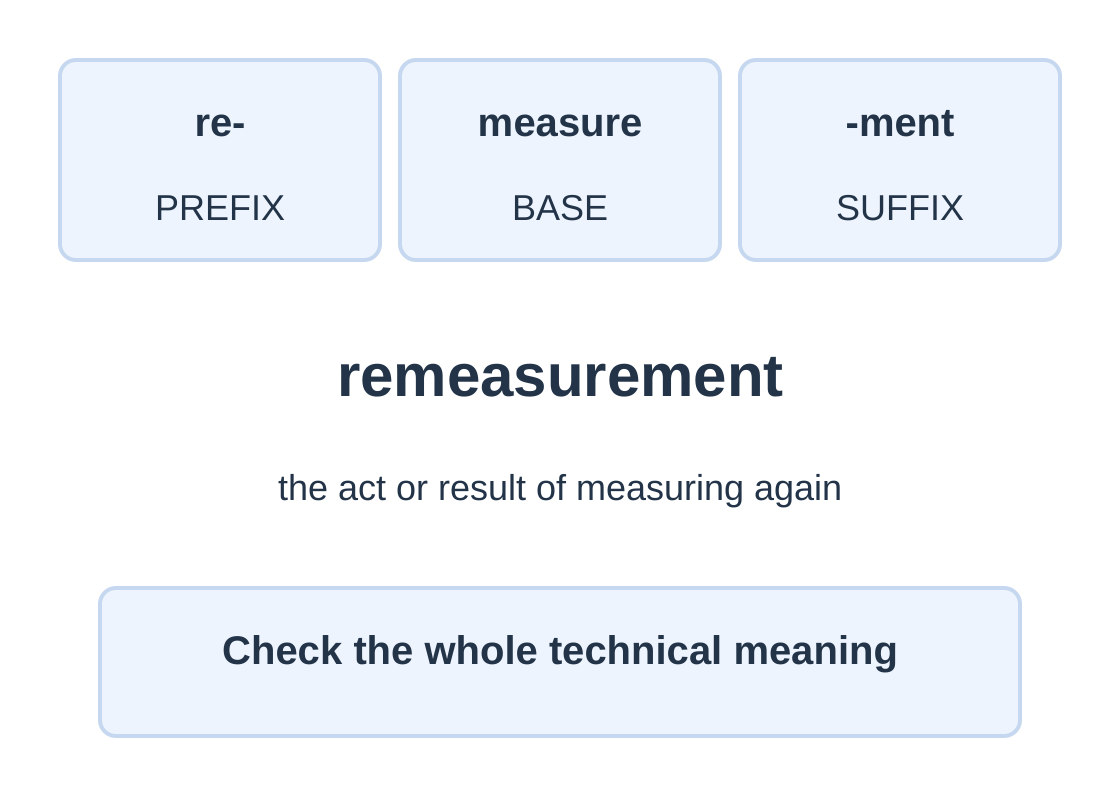
Do not infer every meaning from word parts.
Flammable and inflammable both mean capable of catching fire. The apparent prefix does not create a negative meaning.
Derivation, Conversion and Compounding
| Process | Explanation | Example |
|---|---|---|
| Derivation | Adds an affix to form a related word | Measure → measurement |
| Conversion | Changes grammatical function without a visible affix | Test as noun and verb |
| Compounding | Combines words | Data logger, heat exchanger |
| Abbreviation | Shortens a term | ATS |
An acronym is commonly pronounced as a word; an initialism is pronounced as letters.
For a new audience, introduce a necessary abbreviation:
“Applicant Tracking System (ATS).”
Avoid inventing abbreviations for terms used only once.
Collocations
A collocation is a customary word combination:
- Conduct an experiment.
- Draw a conclusion.
- Meet a deadline.
- Record an observation.
“Do a conclusion” becomes “draw a conclusion.”
Word Families
- Analyse → analysis → analytical.
- Vary → variation → variable.
- Respond → response → responsive.
Check spelling changes when moving between forms.
Affect and Effect
Affect is often a verb meaning influence.
Effect is often a noun meaning result.
Incorrect: “Temperature has an affect on the reading.”
Correct: “Temperature has an effect on the reading.”
More concise:
“Temperature affects the reading.”
Specialised uses exist, so interpret the actual sentence.
2.9 Precision, Tone and Style
Accuracy and Precision
Accuracy concerns closeness to an accepted reference.
Precision concerns closeness among repeated values under specified conditions.
Similar readings may be consistently wrong. Repetition alone does not prove accuracy.
Match Vocabulary to Evidence
| Term | Meaning |
|---|---|
| Observation | Something recorded or directly noted |
| Estimate | An approximate value |
| Assumption | A starting belief taken for granted |
| Inference | A conclusion drawn from evidence |
| Prediction | A statement about an expected outcome |
“The estimated cost is Rs. 500” does not mean a supplier quoted that price.
“The team observed a delay” does not establish its cause.
Concision and Plain Language
| Wordy expression | Concise alternative |
|---|---|
| In order to | To |
| At this point in time | Now |
| Due to the fact that | Because |
| In the event that | If |
Before: “The implementation of a modification to the arrangement was carried out by the team.”
After: “The team modified the arrangement.”
Nominalisations are not always wrong, but unnecessary noun chains can hide the actor and action.
Active and Passive Voice
Active: “The team measured the voltage.”
Passive: “The voltage was measured by the team.”
Choose according to purpose.
“Record the voltage” is direct in an instruction.
“The voltage was recorded at each interval” can foreground the procedure in a method section.
Do not use passive voice to conceal responsibility that the reader needs to know.
Professional Tone
Avoid insults, exaggeration and unsupported promotional claims.
Weak: “The old method is useless.”
Specific: “The earlier method does not record the required time intervals.”
Use language appropriate to the audience without unnecessary complexity.
Coherence
A paragraph should develop one main point through:
- A topic sentence.
- Relevant explanation or evidence.
- A practical implication where useful.
Use connectors accurately:
- Because: reason.
- However: contrast.
- Therefore: justified consequence.
A connector cannot create a logical relationship.
“The file was blue; therefore, the test was successful” remains unsupported.
Scope
“The device failed during this trial” describes an event.
“The device always fails” makes a much broader claim.
Preserve the actual scope of the evidence.
2.10 Editing and Proofreading Techniques
Editing improves content, organisation, reasoning and expression.
Proofreading checks the final text for remaining surface errors.
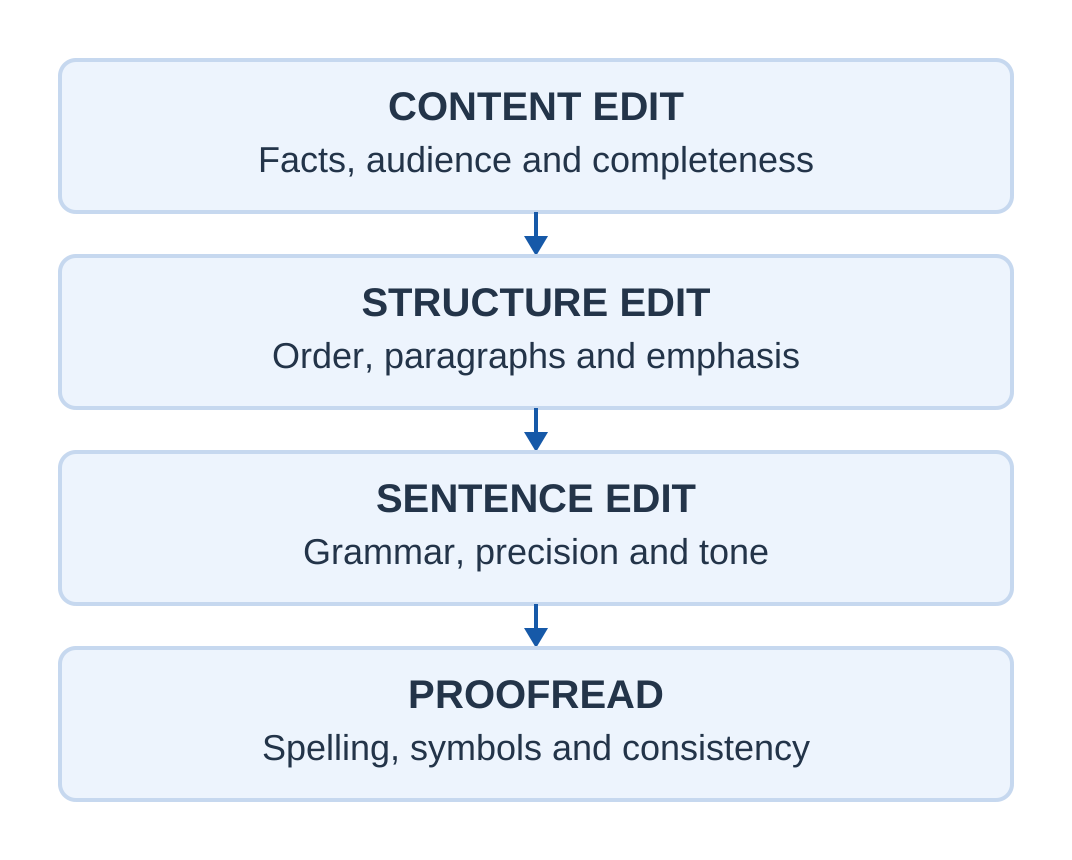
Editing Method
- Identify the reader’s task.
- Check actor, action, object, time, condition and reason.
- Compare technical claims with the supplied record.
- Revise organisation and sentences.
- Correct mechanics.
- Inspect the exported final file.
Focused Passes
Use separate passes for:
- Subject heads and verbs.
- Articles before singular count nouns.
- Pronoun references.
- Quantities and units.
- Figure and table labels.
- Dates, abbreviations and spelling.
Tools and Their Limits
Spellcheck can miss valid but incorrect words:
- Form instead of from.
- Casual instead of causal.
Grammar tools may misunderstand specialist terms or change the intended meaning.
Evaluate suggestions rather than accepting them automatically.
Read aloud, inspect tables separately and ask a peer to paraphrase an instruction.
Practical Checklist
- Meaning: Accurate facts and supported claims.
- Structure: Logical order and focused paragraphs.
- Grammar: Agreement, tense, articles, references and parallelism.
- Vocabulary: Precise terms and suitable collocations.
- Mechanics: Punctuation, spelling, capitalisation and number formats.
- Delivery: Correct file, readable layout and appropriate access.
Peer-Review Comments
A helpful comment identifies:
- Location.
- Observable issue.
- Proposed improvement or clarification.
Unhelpful: “This is bad English.”
Helpful: “In sentence 3, it could refer to the cable or display. Please name the failed component.”
Separate factual queries from definite corrections.
2.11 Worked Editing Workshop
Passage A: Grammar and Clarity
Original:
“The team have tested a equipment yesterday. Each of the readings were record in a sheet. The sensor was accurate because all values was same. We will submitted the report after checking of it.”
Edited model:
“The team tested a piece of equipment yesterday. Each reading was recorded in a sheet. The repeated values were the same, but accuracy against a reference was not assessed. We will submit the report after checking it.”
Explanation
- Past simple fits yesterday.
- Equipment is non-count.
- Each reading takes was.
- Recorded is the required past participle.
- Values takes were.
- Repeated values do not independently establish accuracy.
- Will takes the base form submit.
- After checking it removes unnecessary wording.
Passage B: Reference and Time
Original:
“When Ravi gave Asha the revised drawing, he said it was wrong. After reviewing the diagram, the file was saved. We have sent the drawing last Monday and the team is waiting since two days.”
The first sentence does not specify what was wrong.
A possible revision is:
“Ravi told Asha that the revised drawing contained an incorrect dimension.”
Use that version only if the author confirms the dimension error.
A conservative correction of the remaining sentences is:
“After the diagram had been reviewed, the file was saved. We sent the drawing last Monday, and the team has been waiting for two days.”
Name the reviewer only when known.
Passage C: Concise Professional Style
Original:
“This is to bring to your kind attention that due to the fact that the attachment is not opening, we are not in a position to carry out the completion of the review process.”
Model:
“We cannot complete the review because the attachment will not open. Please send an accessible copy of the revised report.”
Add a version or deadline only when supplied.
Passage D: Unsupported Interpretation
Original:
“The new sensor is extremely superior. It gave 10.0, 10.1 and 10.0, therefore it is absolutely accurate and will never fail.”
Model:
“The three recorded values were 10.0, 10.1 and 10.0 [unit required]. They were close to one another in these trials. Accuracy cannot be assessed without an appropriate reference, and the observations do not establish long-term reliability.”
The unit query remains because the source does not supply it.
Main Editing Principle
Improve the expression of evidence rather than manufacture better evidence.
If a result lacks a unit, a claim lacks support or a sequence is uncertain, identify the gap.
2.12 Practical Grammar and Vocabulary Exercises
Error Correction
| Draft | Corrected version |
|---|---|
| The list of experiment are attached. | The list of experiments is attached. |
| He do not knows the method. | He does not know the method. |
| An university student submitted a information sheet. | A university student submitted an information sheet. |
| The team is working since morning. | The team has been working since morning. |
| The device performs more better than before. | The device performs better than before. |
| The report contains three table’s. | The report contains three tables. |
| After checking the readings, the chart was prepared. | After the readings had been checked, the chart was prepared. |
| The result was different, we repeated the trial. | The result was different, so we repeated the trial. |
For the chart example, an active version can identify the team only if the actor is confirmed.
Choose the Precise Word
| Sentence | Answer |
|---|---|
| The voltage change affected/effected the reading. | Affected |
| Repeated values demonstrate precision/accuracy relative to one another. | Precision |
| The proposed cost is an estimate/observation. | Estimate |
| A result reasoned from observations rather than directly measured is an inference/measurement. | Inference |
| Statistical significance requires analysis/emphasis. | Analysis |
Always check whether the selected term makes the claim stronger than the evidence.
Parallel List Exercise
Draft: “The objectives are calibration of the sensor, to record readings and preparing report.”
Model: “The objectives are to calibrate the sensor, record the readings and prepare the report.”
Audience Adaptation
Explain a feedback loop for:
- A classmate.
- A specialist supervisor.
The beginner version may explain that output information helps adjust a process.
The specialist version may identify the actual variable and control relationship when those facts are available.
Adjust background and terminology while preserving the factual relationship.
2.13 Syllabus Activity and Extended Workshop
Activity: Edit a Technical Paragraph
First mark facts requiring confirmation. Then revise grammar, vocabulary, precision and clarity.
Draft:
“The students has made a test of an useful sensor. It is showing same reading for all three trial yesterday. This prove that the sensor is perfect. The readings was entered by Ravi in the table and it was wrong. After checking the instrument, the report was submitted to teacher. We recommends to use it everywhere.”
Queries Before Editing
- What quantity was measured?
- What unit applies?
- Was the table wrong or were the readings wrong?
- Who checked the instrument?
- What conditions were tested?
- Was there an appropriate reference?
Conservative Revised Version
“The students tested a useful sensor yesterday. It showed the same reading in all three trials, but the quantity, unit and test conditions need to be stated. Identical readings alone do not establish accuracy. Ravi entered the readings in the table; the reported error requires clarification. After the instrument had been checked, the report was submitted to the teacher. Further evaluation is needed before recommending broader use.”
Change Log
- Students has made becomes students tested.
- An useful becomes a useful.
- Past simple matches yesterday.
- Three trial becomes three trials.
- The unsupported perfection claim is removed.
- Readings was would require readings were.
- The unclear it becomes a query.
- The dangling modifier is repaired.
- To teacher becomes to the teacher.
- The universal recommendation is replaced with a limited statement.
The paragraph is not ready for publication until the author resolves the factual queries.
Peer Assessment
Assess:
- Grammatical accuracy.
- Preservation of meaning.
- Technical precision.
- Organisation and clarity.
A well-justified query can be as important as a correct language change.
Sentence-Analysis Lab
Sentence A: “The revised test log contains five readings.”
- Subject group: the revised test log.
- Head noun: log.
- Verb: contains.
- Object: five readings.
- Type: simple.
The plural object does not require a plural verb.
Sentence B: “Because the connector was loose, the team postponed the trial.”
- Dependent clause: because the connector was loose.
- Main clause: the team postponed the trial.
- Type: complex.
Grammar does not independently verify the causal claim.
Sentence C: “The team checked the log, and the supervisor approved the revision.”
- Two independent clauses.
- Joined by and.
- Type: compound.
Sentence D: “After the report had been checked, Asha exported the PDF, and Ravi verified the final labels.”
- One dependent clause.
- Two independent clauses.
- Type: compound-complex.
It can be split into shorter sentences while preserving the verified sequence.
Grammar Changes That Alter Technical Meaning
| Expression | Different meaning |
|---|---|
| Must disconnect | Obligation |
| May disconnect | Permission or possibility in context |
| Can detect | Capability |
| Did detect | Reported event |
| All samples | Entire set |
| Some samples | Part of the set |
| Rose by 5 degrees | Amount of increase |
| Rose to 5 degrees | Final value |
| Before inspection | One sequence |
| After inspection | Different sequence |
Ambiguity in Scope
“The team checked the leads and connectors that were damaged.”
Does the damaged description apply to both groups or only the connectors?
Possible revisions include:
- “The team checked all leads and the damaged connectors.”
- “The team checked the damaged leads and damaged connectors.”
Ask the author which is intended.
“The system did not fail because of overheating” can also be ambiguous.
If supported, write:
“The system failed, but overheating was not identified as the cause.”
Otherwise, query the intended meaning.
Vocabulary Across the Nine Streams
| Stream | Precision check |
|---|---|
| CSE | Distinguish a program error from a hardware fault and state the output |
| EE | Name the electrical quantity and unit |
| ECE | Identify input, output and signal conditions |
| CE | Distinguish an observed crack from a complete structural judgement |
| ME | State the operating condition for vibration or temperature |
| BT | Separate biological observation from an untested explanation |
| CH | Identify process conditions and measured quantities |
| TX | Define the defect category rather than saying bad material |
| AG | State crop, location or observation conditions where relevant |
These are language checks rather than specialist design instructions.
Report-Method Rewrite
Draft:
“We take the sensor and it is connected and then readings was noting down. The same is done many times and found good result.”
Conservative model:
“The team connected the sensor using the approved setup and recorded the readings. The procedure was repeated [number of trials required]. The recorded results are presented in Table 1 [quantity and unit required].”
The revision improves tense and structure while keeping missing facts visible.
- Many times needs a verified count.
- Good result needs an observation and criterion.
- The quantity and unit must be supplied.
- An editor should not add an unsupported method detail.
Proofreading a Table and Caption
Suppose a table has headings “Trial,” “Voltage” and “current,” but no units. Its caption says “Figure 2: Best result.”
Problems include:
- Missing units.
- Inconsistent capitalisation.
- Figure label used for a table.
- Unsupported evaluative wording.
A suitable caption is:
“Table 2. Recorded voltage and current for the three trials.”
Add verified units to the column headings and explain conditions in the surrounding text.
If units are unknown, query them.
Compare decimal points, minus signs and values with the source record after export.
Mixed Grammar Test
| Draft | Correction or response |
|---|---|
| Neither of the two files are readable. | Neither of the two files is readable. |
| The equipment have been checked. | The equipment has been checked. |
| We are using this method since Monday. | We have been using this method since Monday. |
| The sample was kept in an uniform condition. | The sample was kept under a uniform condition, if accurate. |
| The team analysed, compare and documented the results. | The team analysed, compared and documented the results. |
| The report is comprised of five sections. | The report comprises five sections. |
| The sensor gives less errors. | Use fewer errors, with the comparison supported. |
| The team discussed about why the test failed. | The team discussed why the test failed. |
| This proves the design is safe. | Query the reference of this and the supporting evidence. |
| After completing the calculation, the answer was written. | After the calculation had been completed, the answer was written. |
“The report consists of five sections” is another clear alternative.
Independent Writing Task
Write 150–180 words describing a classroom procedure you understand.
Include:
- Purpose.
- Apparatus or materials.
- Sequence.
- Recorded output.
- One limitation.
Use past tense for completed work. Use suitable instructional language for a procedure to be followed.
Review in three passes:
- Underline technical claims and identify their basis.
- Check subjects, finite verbs, articles and pronouns.
- Check units, labels, spelling and final layout.
Ask a peer to explain the sequence without seeing your original notes.
2.14 Quick Revision and Examination Practice
Essential Rules
- Identify a word’s function in its sentence.
- Locate the subject head before choosing agreement.
- Match tense and aspect to the time relationship.
- Choose a/an by sound.
- Check countability and identifiable reference.
- Keep pronoun references clear.
- Use parallel forms for parallel ideas.
- Place modifiers near what they describe.
- Match vocabulary to the evidence.
- Edit meaning and structure before proofreading.
- Inspect the final exported document.
Memory Cues
| Common trap | Recall cue |
|---|---|
| Each of the sensors are | Each is the singular head |
| An useful tool | Sound, not spelling |
| Since two days | Since is a starting point; for is duration |
| Have submitted yesterday | Finished past time normally takes past simple |
| Same values prove accuracy | Repetition concerns precision; accuracy needs a reference |
| Spellcheck is enough | A valid word can still be the wrong word |
Short-Answer Questions
- Define a clause and distinguish it from a phrase.
- Explain a finite verb with an example.
- Distinguish count and non-count nouns.
- State two agreement rules.
- Explain a/an using university and hour.
- Distinguish editing and proofreading.
- Explain accuracy and precision.
- What is a dangling modifier?
- Explain derivation, conversion and compounding.
- Why should a technical comparison state its baseline?
Longer Questions
- Explain simple, compound and complex sentences with examples.
- Describe tense choices in a technical report.
- Correct a passage and justify each change.
- Explain how word formation develops technical vocabulary.
- Revise an unclear paragraph for tone, coherence and precision.
- Explain why missing facts should be queried.
- Describe a staged editing and proofreading workflow.
- Show how grammar changes can alter technical meaning.
Model Answer Structure
For a rule question:
Rule → correct example → common error → explained correction
For an editing task:
Revised text → change log → unresolved queries
If the original is ambiguous, identify the ambiguity and explain any assumption behind a suggested version.
Final Checklist
Actor clear? Action clear? Agreement correct? Time relationship accurate? Articles and references clear? Terms precise? Claims supported? Punctuation and units consistent? Final file proofread?
Frequently Asked Questions
What does Professional Communication Unit 2 cover?
It covers grammar, sentence construction, agreement, tense, articles, punctuation, technical vocabulary, precision, editing and proofreading.
Why does a university take a instead of an?
University begins with a consonant-like y sound. The initial sound determines the article.
Why is the list of components is correct?
The subject head is list, which is singular. Components occurs inside a modifying phrase.
Can one technical report use different tenses?
Yes. Completed methods, current document references and planned actions have different time relationships.
Do identical readings prove accuracy?
No. Similar repeated readings concern precision. Accuracy requires comparison with an appropriate reference.
What should an editor do when a unit or actor is missing?
Ask a specific question or mark the unresolved information. Do not invent a plausible detail.
Is proofreading the same as editing?
No. Editing improves meaning, organisation and expression. Proofreading checks remaining surface details in the final text.
How should grammar exercises be answered?
Give the correction and explain the rule. If the factual meaning is unclear, identify the uncertainty instead of guessing.