Course Code: BP106T
Unit III Introduction
Pharmaceutical Inorganic and Analytical Chemistry Unit 3 Notes explain how a measured reagent volume or an isolated solid mass becomes a quantitative result. The central requirement is a defined chemical reaction. An endpoint colour, a burette reading or a crucible mass has analytical meaning only when it is connected to the correct substance, reaction conditions and stoichiometry. This unit develops that connection through acid-base, precipitation, complexometric and oxidation-reduction reactions, followed by gravimetric isolation and weighing.
The unit begins with titrimetric principles, indicator theories and neutralization curves. It then covers preparation and standardization of hydrochloric acid and sodium hydroxide, including their different primary standards. Aqueous ammonia illustrates why an assay must state its reporting species. Non-aqueous titrations show how solvent behaviour changes apparent acid and base strengths, and sodium benzoate provides a worked application of non-aqueous acidimetry.
Precipitation analysis introduces Mohr, Volhard, modified Volhard and Fajans methods. Although each can involve silver, their endpoint mechanisms differ. One detects a coloured precipitate, another a soluble ferric-thiocyanate complex, and another a surface adsorption change. Gravimetric analysis then replaces a volume measurement with isolation of a stable weighing form, illustrated by barium sulfate and conversions to sulfate or barium content.
The complexometric part explains EDTA, disodium edetate, metal indicators, conditional stability, masking and demasking. Magnesium sulfate and calcium gluconate assays demonstrate the importance of hydration and formula mass. The redox part covers electron balance, acidic permanganate, cerium(IV), direct iodine titration, indirect iodometry and potassium iodate reactions whose factors depend on their medium and final products.
Topics Covered – Complete Syllabus Map
| Sections | Topics |
|---|---|
| 1–3 | Titrimetric foundations, indicator theories and neutralization curves |
| 4–6 | HCl and NaOH standardization; ammonium hydroxide assay |
| 7–9 | Non-aqueous solvents, titrants and sodium benzoate assay |
| 10–11 | Mohr, Volhard, modified Volhard and Fajans methods |
| 12–13 | Gravimetric operations and barium sulfate calculations |
| 14–16 | EDTA, metal indicators, masking, demasking and standardization |
| 17–18 | Magnesium sulfate and calcium gluconate estimation |
| 19–23 | Redox principles, permanganometry, cerimetry and iodine methods |
| 24 | Integrated calculations, corrections and method selection |
Learning outcomes
After studying these Pharmaceutical Inorganic and Analytical Chemistry Unit 3 Notes, you should be able to distinguish equivalence from an observed endpoint; explain both ionization and quinonoid indicator theories; relate indicator selection to titration curves; describe aqueous and non-aqueous titrant standardization; and calculate ammonia and sodium benzoate content. You should also be able to compare precipitation methods, explain the gravimetric sequence, select a metal indicator, distinguish masking from separation, calculate magnesium and calcium-salt assays, and derive redox factors from balanced reactions.
Essential vocabulary
Titrant is the standardized reagent delivered during titration. Analyte is the substance being determined. Equivalence point means stoichiometric reaction completion, whereas endpoint means the observed stopping signal. Back-titration measures reagent remaining after a known excess has reacted. Gravimetry determines content through a material of known weighing composition. A chelate is a metal complex containing ligand rings. Masking prevents an interferent from participating, and demasking releases a previously masked ion. Oxidation involves electron loss or oxidation-number increase, while reduction involves electron gain or oxidation-number decrease.
Central question: How can a measured endpoint volume or precipitate mass be converted into a reliable pharmaceutical assay result?
Read every calculation in the same order: identify the analyte and chemical form, balance the reaction, calculate reagent amount, apply the stoichiometric ratio, convert to the requested reporting species, and finally apply blank, dilution and percentage corrections. Written formulas throughout the article use ordinary chemical symbols and readable mathematical notation. A superscript identifies ionic charge or a power; a subscript identifies a formula count. The same numerical value can describe different quantities, so write units at every meaningful step.
1. Titrimetric analysis: foundation
1.1 Principle
Titrimetry determines an analyte from the volume of a standard reagent required to react with it. A suitable reaction is sufficiently complete, rapid, selective and of known stoichiometry, with a detectable endpoint.
The titrant is delivered from the burette. The analyte is the substance being measured, usually in the conical flask. The standard’s accurately known amount or concentration establishes the titrant strength.
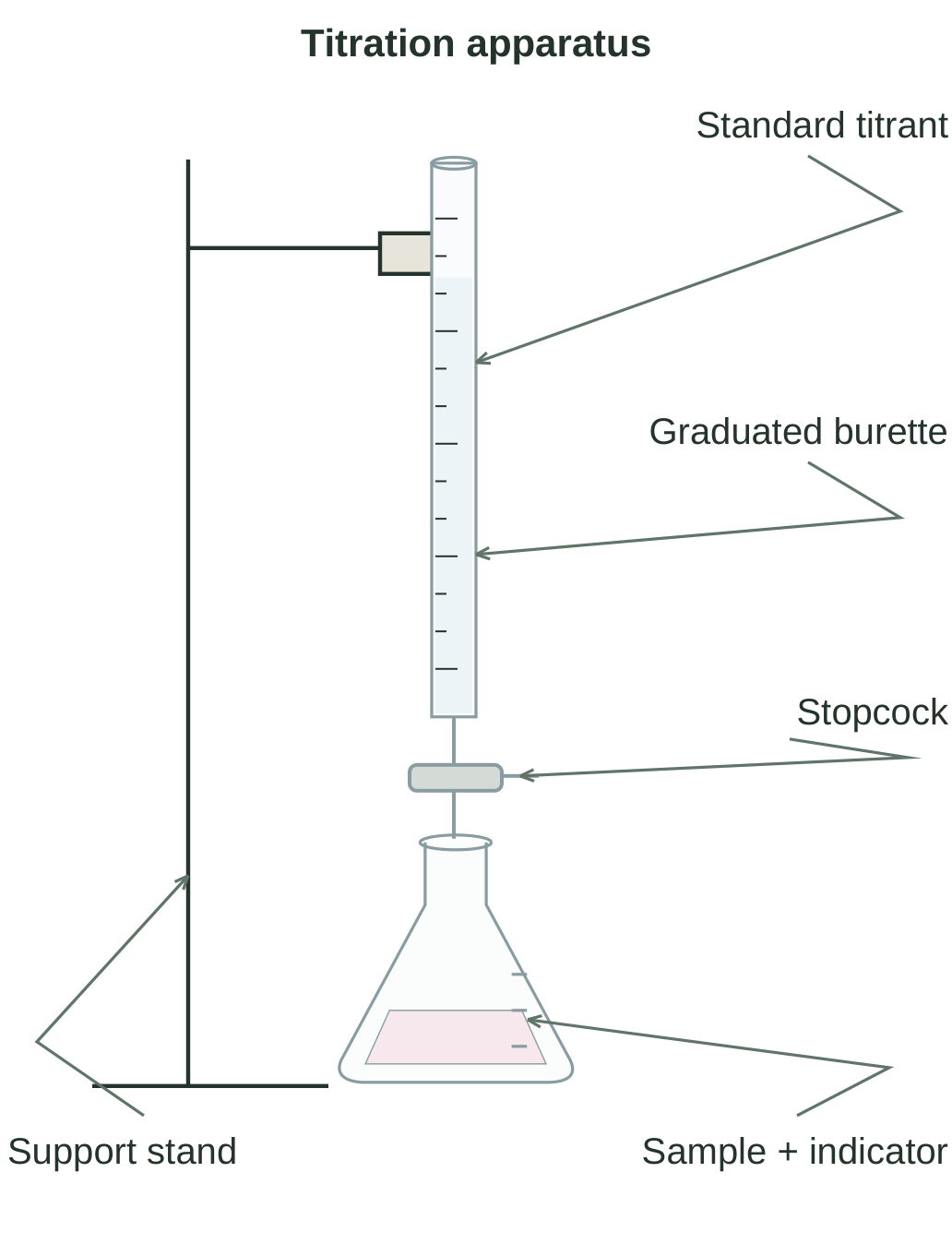
Diagram labels: Titration apparatus; Standard titrant; Graduated burette; Stopcock; Sample + indicator; Support stand.
1.2 Equivalence and endpoint
At equivalence, the reacting amounts satisfy the balanced equation. An indicator or instrumental response identifies an endpoint near equivalence. The difference is endpoint error; a visible colour change is not automatically an exact equivalence point.
A reagent blank reproduces relevant solvents, indicators and reagents without analyte. It corrects their consumption or background when the prescribed method requires it.
1.3 General calculation
For aA + bT → products, nA/a = nT/b.
nA = (a/b) × CT × VT, with CT in mol/L and VT in litres.
Mass analyte = nA × molar mass. Purity (%) = mass found / sample mass × 100, after any required aliquot and basis corrections.
For a 1:1 reaction, mass found (mg) = V(mL) × C(mol/L) × M(g/mol). The numerical units give milligrams directly.
1.4 Factors and equivalent strength
The factor f = actual concentration / nominal concentration. A nominal 0.100 mol/L reagent of f = 0.9980 is actually 0.09980 mol/L.
Normality counts equivalents per litre and depends on the reaction. In acid medium, 1 mol KMnO₄ accepts 5 mol electrons, so 0.020 mol/L KMnO₄ equals 0.100 eq/L for that reaction. In another medium its equivalent strength can differ.
1.5 Good volumetric technique
Condition the burette with titrant and the pipette with the solution to be measured.
Fill the tip and remove air bubbles before the initial reading.
Read the meniscus at eye level; record both readings.
Swirl continuously and add titrant dropwise near the endpoint.
Wash flask walls down with suitable water or solvent without losing sample.
Use independent concordant determinations rather than selecting only favourable readings. Water added to an aqueous titration flask normally changes dilution, not analyte moles. It can nevertheless alter equilibria and indicator behaviour if added excessively or contrary to the method.
1.6 Classification by reaction
| Class | Measured chemical change |
|---|---|
| Acid-base | Proton transfer or neutralization |
| Precipitation | Formation of a sparingly soluble product |
| Complexometric | Formation of a stable metal-ligand complex |
| Redox | Transfer of electrons between reacting species |
Direct titration reacts titrant with analyte. Back-titration adds a measured excess reagent and determines what remains. Displacement titration measures a species released by a stoichiometric reaction.
2. Acid-base indicators
2.1 Ionization theory
Many acid-base indicators are weak organic acids or bases whose protonated and deprotonated forms have different colours.
For an acidic indicator: HIn ⇌ H⁺ + In⁻.
Ka(In) = [H⁺][In⁻]/[HIn], and pH ≈ pKa(In) + log₁₀([In⁻]/[HIn]). Added H⁺ favours HIn; removal of H⁺ favours In⁻.
The visible transition usually occurs while the colour-form ratio changes from approximately 1:10 to 10:1. Thus a simple indicator commonly changes over a range near pKa(In) ± 1.
This range is approximate. Human colour perception, indicator concentration, solvent and the sample’s own colour influence the observed transition.
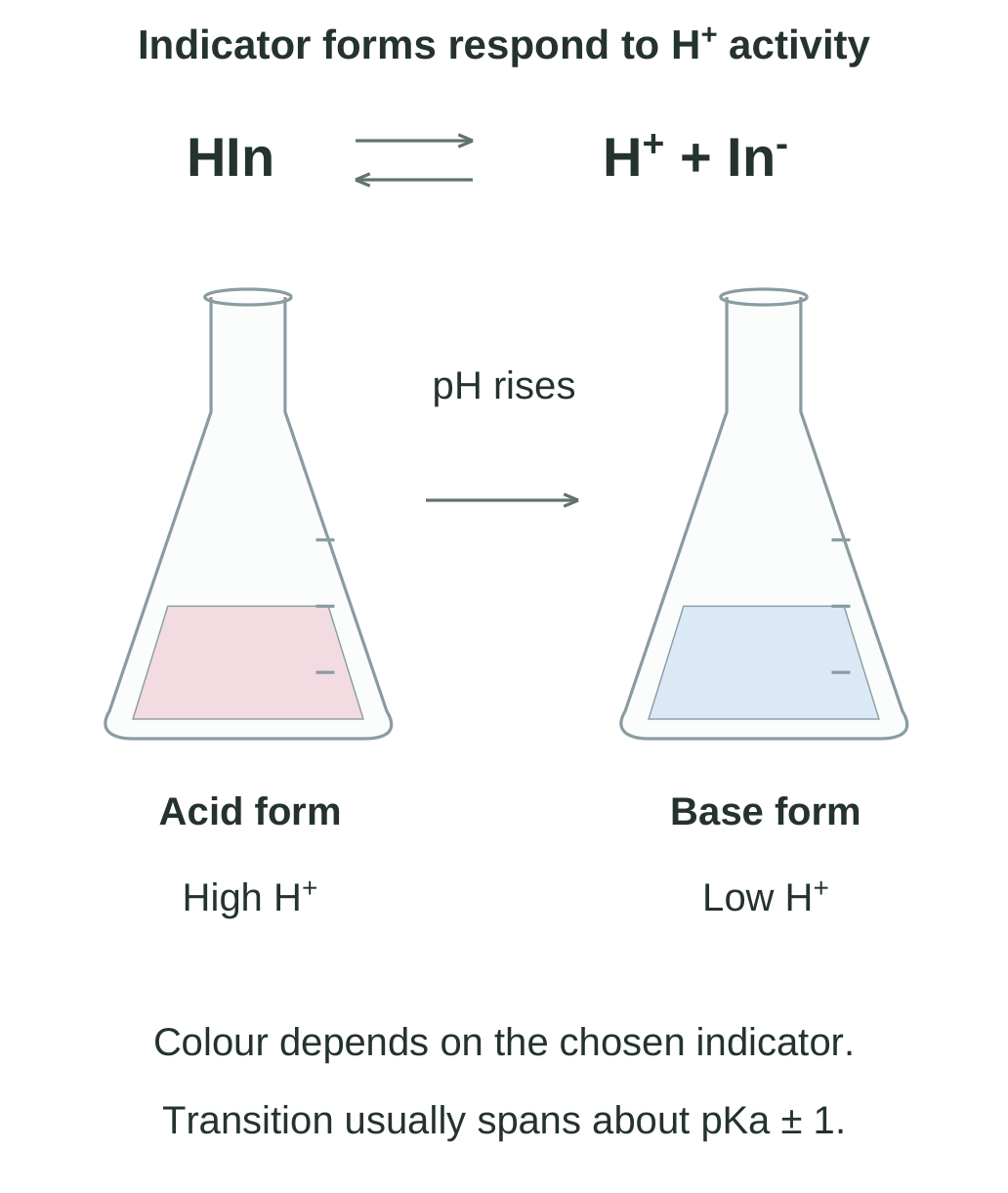
Diagram labels: Indicator forms respond to H⁺ activity; HIn; H⁺ + In⁻; Acid form; Base form; High H⁺; Low H⁺; pH rises; Colour depends on the chosen indicator; Transition usually spans about pKa ± 1.
2.2 Quinonoid theory
Some indicators change between structures with different electronic conjugation, commonly described as benzenoid and quinonoid forms. Protonation or deprotonation shifts the structure and therefore the wavelengths absorbed.
Phenolphthalein is essentially colourless in its usual acidic-to-neutral form and pink in its common alkaline range. Its alkaline colour is linked to a conjugated ionic structure. At extreme alkalinity other equilibria can occur; the simple two-colour description has limits.
The ionization theory explains the equilibrium dependence on pH; structural theory explains why the forms absorb light differently. They complement one another.
2.3 Common transition ranges
| Indicator | Approximate aqueous transition as pH rises |
|---|---|
| Methyl orange | pH 3.1–4.4; red → yellow |
| Methyl red | pH 4.4–6.2; red → yellow |
| Bromothymol blue | pH 6.0–7.6; yellow → blue |
| Phenolphthalein | pH 8.2–10.0; colourless → pink |
Ranges are conventional teaching values; reagent composition and conditions can shift the practical transition. The endpoint colour should follow the actual method, not an improvised mixture of indicators.
2.4 Selection rule
Choose an indicator whose transition lies in the steep part of the titration curve near equivalence. An indicator appropriate for a strong acid/strong base titration may be unsuitable for a weak-base titration.
Weak acid + strong base: equivalence is usually alkaline; phenolphthalein is often suitable.
Strong acid + weak base: equivalence is acidic; an acidic-range indicator may be suitable.
Strong acid + strong base: several indicators can work if their transition falls within the sharp jump.
Very weak systems: the jump may be too small for a reliable visual endpoint.
2.5 Indicator errors
Too much indicator adds an additional acid-base load. Slow mixing, overshooting, CO₂ absorption and an unsuitable transition interval cause errors. A coloured or turbid sample may conceal the endpoint and favour instrumental detection.
Mixed indicators can improve the perceptibility of a selected transition. A universal indicator covers a broad pH range but is not automatically suitable for precise titration endpoints.
Examination point
The best indicator is selected from the curve’s steep region. Do not choose it solely because its colour change is easy to see.
3. Acid-base titrations and curves
3.1 Strong acid with strong base
Consider HCl in the flask and NaOH in the burette. H⁺ + OH⁻ → H₂O.
Before equivalence, excess strong acid determines pH. Near equivalence, a small change in added volume causes a large pH jump. At equivalence in an ideal dilute system at 25°C, pH is approximately 7. Beyond equivalence, excess strong base determines pH.
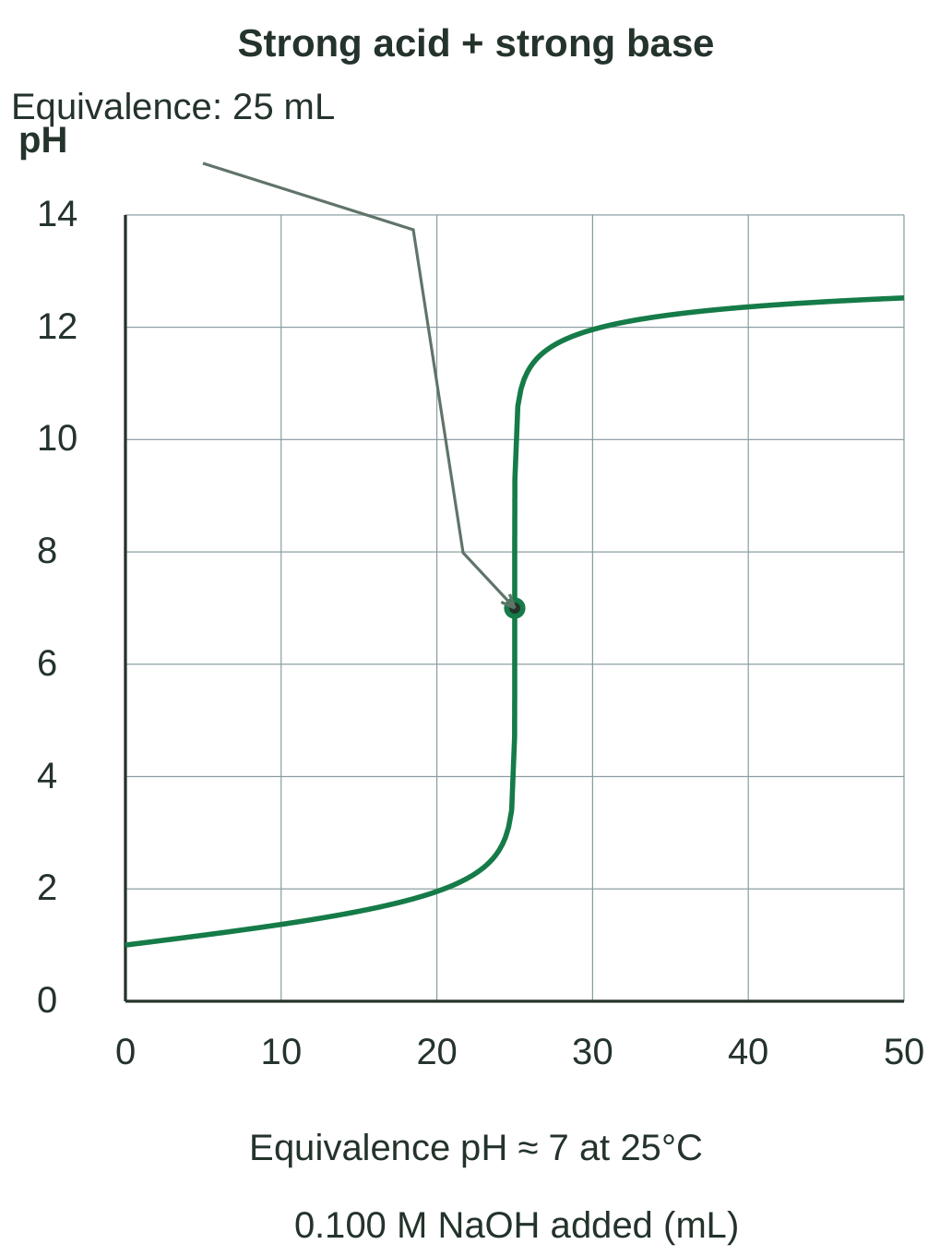
Diagram labels: Strong acid + strong base; pH axis: 0–14; NaOH volume axis: 0–50 mL; Equivalence: 25 mL; Equivalence pH ≈ 7 at 25°C; 0.100 M NaOH added (mL).
For 25.00 mL of 0.1000 mol/L HCl, initial acid = 2.500 mmol. With 0.1000 mol/L NaOH, equivalence volume = 25.00 mL.
At 10.00 mL base added: residual H⁺ = 2.500 − 1.000 = 1.500 mmol in 35.00 mL. [H⁺] = 0.04286 mol/L; pH ≈ 1.37.
At 30.00 mL added: excess OH⁻ = 3.000 − 2.500 = 0.500 mmol in 55.00 mL. pOH ≈ 2.04; pH ≈ 11.96 at 25°C.
3.2 Weak acid with strong base
For acetic acid titrated with NaOH: CH₃COOH + OH⁻ → CH₃COO⁻ + H₂O.
The initial pH is governed by weak-acid dissociation. Before equivalence, the mixture of acid and acetate forms a buffer. At half-equivalence the acid and conjugate-base amounts are equal, so pH ≈ pKa.
At equivalence, acetate hydrolyses: CH₃COO⁻ + H₂O ⇌ CH₃COOH + OH⁻. The solution is alkaline. After equivalence, excess OH⁻ usually dominates.
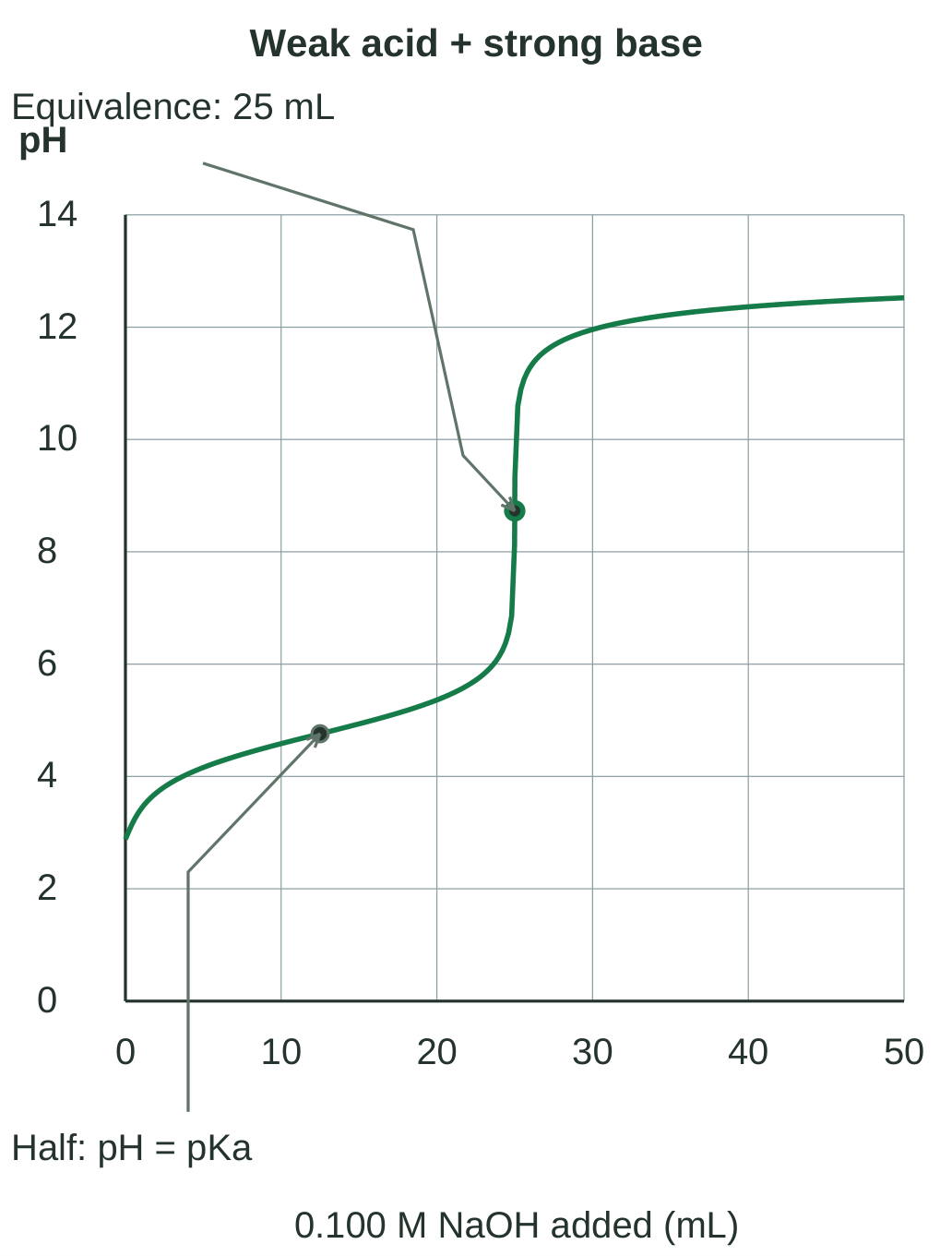
Diagram labels: Weak acid + strong base; pH axis: 0–14; NaOH volume axis: 0–50 mL; Equivalence: 25 mL; Half: pH = pKa; 0.100 M NaOH added (mL).
Example: 25.00 mL of 0.1000 mol/L acetic acid, pKa 4.76, titrated with 0.1000 mol/L NaOH. At 12.50 mL, pH ≈ 4.76. Equivalence occurs at 25.00 mL.
At equivalence, acetate concentration is 2.500 mmol/50.00 mL = 0.0500 mol/L. Kb ≈ 10⁻¹⁴/(1.8 × 10⁻⁵) = 5.56 × 10⁻¹⁰. [OH⁻] ≈ √(KbC) = 5.27 × 10⁻⁶ mol/L, giving pH ≈ 8.72.
3.3 Strong acid with weak base
When ammonia is titrated with HCl, NH₃ + H⁺ → NH₄⁺. Before equivalence, NH₃/NH₄⁺ forms a buffer. At equivalence, ammonium acts as a weak acid and pH is below neutral.
A decreasing pH curve is obtained when acid is added from the burette. Methyl red is commonly useful for an ammonia assay under suitable conditions; phenolphthalein would generally signal too early for complete neutralization.
At half-equivalence, pH ≈ pKa(NH₄⁺). This is not the pKb of ammonia. pKa + pKb = pKw for the conjugate pair.
3.4 Weak acid with weak base
Both reactants have incomplete dissociation and the equivalence region may be poorly defined. The equivalence pH depends on both acid and base strengths; it is not necessarily 7.
Many such systems lack a sufficiently sharp visible jump for accurate indicator titration. A different solvent, instrumental endpoint or another analytical reaction may be preferable.
3.5 Very weak acids and bases
As the analyte becomes very weak or dilute, its response in water becomes less distinguishable from water autoionization, dissolved CO₂ and indicator equilibria. A meaningful stoichiometric reaction may still occur, but endpoint detection can be inadequate.
Non-aqueous titration can increase the apparent acidity or basicity and sharpen the endpoint. It must be matched to the analyte and solvent; replacing water arbitrarily does not guarantee a valid assay.
3.6 Polyprotic and mixed systems
Polyprotic acids can show more than one equivalence point if dissociation steps are sufficiently separated and the chosen conditions permit resolution. Overlapping dissociations may merge the jumps.
Mixtures require selective conditions or multiple resolved reactions. Do not assume that one volume and one endpoint can identify every component separately.
| Combination | Usual equivalence behaviour |
|---|---|
| Strong acid / strong base | Approximately neutral at the relevant temperature |
| Weak acid / strong base | Alkaline because of conjugate-base hydrolysis |
| Strong acid / weak base | Acidic because of conjugate-acid hydrolysis |
| Weak acid / weak base | Depends on both constants; often a poor visual jump |
4. Hydrochloric acid titrant
4.1 Preparation principle
HCl is a strong acid but its stock solution is not normally used as a primary standard. The concentration depends on the supplied stock assay and may change through handling or volatilization.
Prepare an approximate concentration by calculation and controlled dilution; then determine its actual concentration against a suitable primary standard.
CstockVstock = CtargetVfinal. For an illustrative 12 mol/L stock, preparing 1 L of approximately 0.1 mol/L acid requires 0.1 × 1/12 = 0.00833 L, or 8.33 mL stock. The actual stock concentration must be checked rather than assumed from this example.
Add acid to water, allow the solution to return to the calibration temperature and make to the final volume. Label the approximate strength before standardization and the actual strength afterwards.
4.2 Primary standard: sodium carbonate
Suitable anhydrous sodium carbonate has known purity and can be conditioned as required by the standard’s instructions. Its molar mass is approximately 105.99 g/mol.
Na₂CO₃ + 2HCl → 2NaCl + CO₂ + H₂O.
The complete neutralization uses 2 mol HCl per mol carbonate. The carbonate-to-bicarbonate stage consumes only the first mole of H⁺; it is not the full assay endpoint.
4.3 Stepwise standardization
Step 1: accurately weigh a suitable amount of conditioned sodium carbonate and dissolve it quantitatively in water.
Step 2: titrate with the approximate HCl using the prescribed full-neutralization indicator or potentiometric endpoint.
Step 3: near the endpoint, follow the method’s directions for removal of dissolved CO₂ if specified; cool before the final endpoint reading.
Step 4: record the corrected volume and calculate actual HCl concentration from the 2:1 stoichiometry.
Step 5: repeat independent determinations and label the standardized reagent.
An acidic-range indicator such as methyl orange is commonly associated with the complete carbonate neutralization. CO₂ handling influences the endpoint and must be consistent.
4.4 Calculation
CHCl = 2m/(Mcarbonate × VHCl), with m in grams and V in litres, after applicable purity and blank corrections.
Example: 0.13249 g Na₂CO₃ consumes 25.00 mL HCl.
Moles carbonate = 0.13249/105.99 ≈ 0.001250 mol. Moles HCl = 0.002500 mol.
CHCl = 0.002500/0.02500 = 0.1000 mol/L approximately.
4.5 Sources of error
Moisture or incorrect conditioning of the standard, weighing loss, incomplete transfer, use of the first carbonate endpoint and inconsistent CO₂ removal can bias the result.
If a certified standard has an assigned purity, include it in the mole calculation. The weighed mass is not automatically the mass of pure Na₂CO₃.
Standardization is a measurement
A dilution calculation gives the intended concentration. Reaction against a standard gives the actual concentration used in an assay.
5. Sodium hydroxide titrant
5.1 Why standardization is necessary
NaOH is hygroscopic and absorbs CO₂ from air, forming carbonate. Its pellets cannot ordinarily be weighed as an exact primary-standard mass of NaOH. Prepare approximately, then standardize.
For a nominal 0.100 mol/L solution, the theoretical pure-NaOH mass is 0.100 × 40.00 = 4.00 g/L. This is a preparation estimate, not proof of actual concentration.
Use suitably prepared water with low dissolved CO₂, dissolve the approximate amount, allow cooling and make to volume. Protect the solution from atmospheric CO₂ in an appropriate tightly closed container.
5.2 Primary standard: potassium hydrogen phthalate
Potassium hydrogen phthalate, KHP, is a monoprotic acid standard with molar mass approximately 204.22 g/mol. Its acidic hydrogen reacts 1:1 with hydroxide.
KHP + NaOH → potassium sodium phthalate + H₂O.
KHP is used according to its purity and conditioning instructions. Phenolphthalein or a suitable potentiometric endpoint may be used in an applicable standardization method.
5.3 Stepwise standardization
Step 1: accurately weigh conditioned KHP and dissolve it in suitable water.
Step 2: fill the burette with the approximate NaOH, excluding bubbles.
Step 3: titrate with mixing to the prescribed first persistent faint-pink endpoint if phenolphthalein is used.
Step 4: apply any required blank correction and calculate concentration using the 1:1 reaction.
Step 5: obtain concordant results and protect the reagent from CO₂ during storage and use.
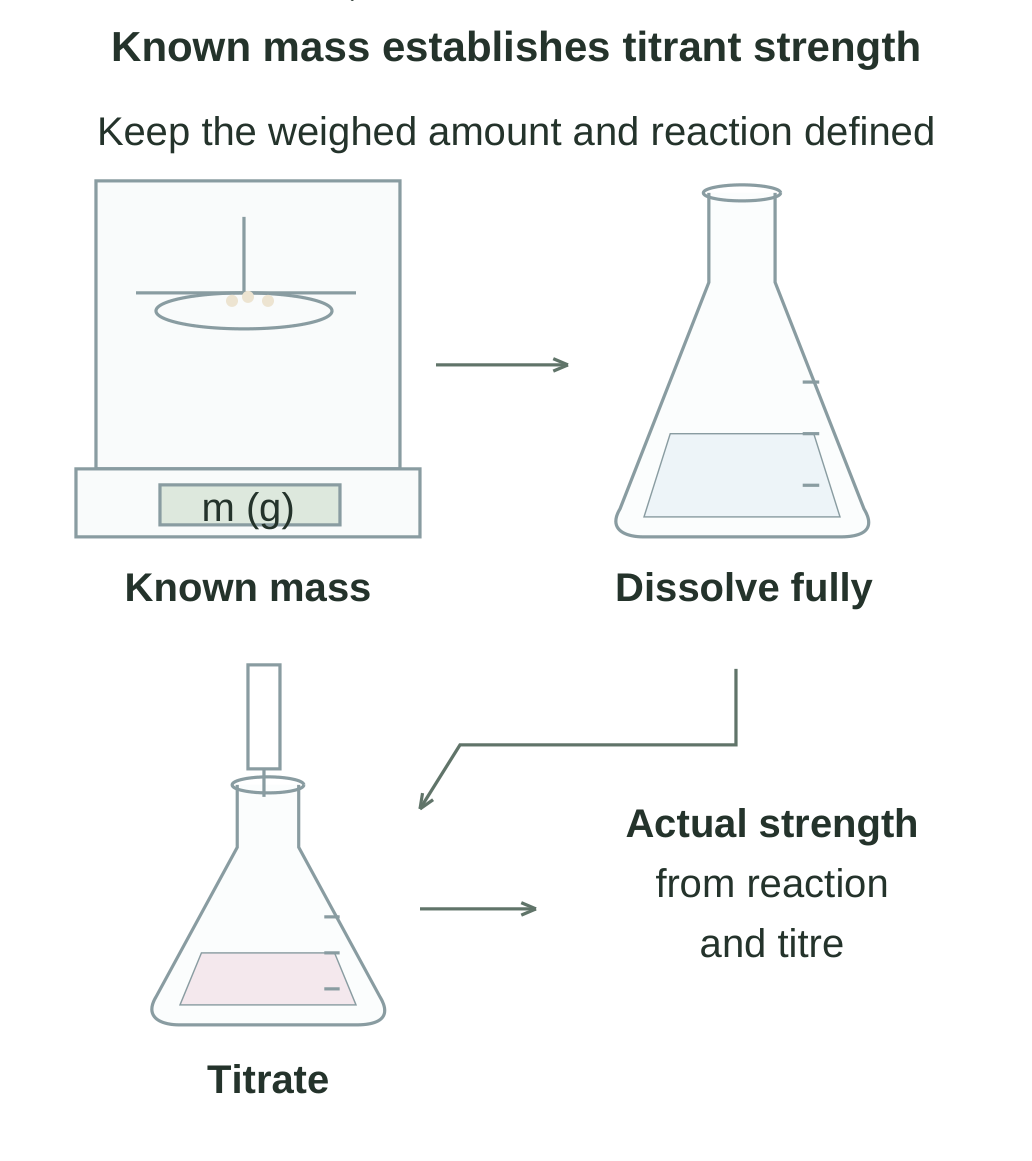
Diagram labels: Known mass establishes titrant strength; m (g); Known mass; Dissolve fully; Titrate; Actual strength from reaction and titre; Keep the weighed amount and reaction defined.
5.4 Worked calculation
0.51055 g KHP consumes 25.10 mL NaOH. KHP moles = 0.51055/204.22 = 0.002500 mol.
CNaOH = 0.002500/0.02510 = 0.09960 mol/L. For nominal 0.1000 mol/L, f = 0.9960.
If this reagent is later used in an assay, use 0.09960 mol/L or multiply the nominal assay factor by 0.9960. Do not correct twice.
5.5 Comparing the two titrants
| Titrant | Standardization principle |
|---|---|
| HCl | 2 mol acid react with 1 mol anhydrous Na₂CO₃ at full neutralization |
| NaOH | 1 mol base reacts with 1 mol KHP |
| Both | Prepare approximately; measure actual strength; document date and factor |
Recheck reagent strength when stability, storage duration or laboratory procedures require it. A clear appearance does not establish that concentration is unchanged.
6. Assay of ammonium hydroxide
6.1 Chemical meaning
The term ammonium hydroxide is commonly used for aqueous ammonia. The main equilibrium is NH₃ + H₂O ⇌ NH₄⁺ + OH⁻; it should not be treated as a bottle containing only isolated NH₄OH molecules.
An acidimetric assay usually expresses the content as NH₃. Verify the stated reporting basis before choosing a molar mass.
6.2 Direct assay principle
NH₃ + HCl → NH₄Cl.
One mole of ammonia consumes one mole of HCl. A suitable acidic-range endpoint detects neutralization of the weak base. Methyl red is commonly used in a suitable method.
6.3 Stepwise method
Step 1: take an accurately measured or weighed sample and transfer promptly to a suitable amount of water, minimizing ammonia loss.
Step 2: add the specified indicator and titrate with standardized HCl, mixing consistently.
Step 3: stop at the prescribed persistent endpoint colour; avoid unnecessary delay or exposure.
Step 4: calculate NH₃ from corrected acid volume and apply any aliquot factor. Because ammonia is volatile, prolonged standing or excessive agitation in an open vessel before reaction can lower the observed result. Some methods capture it in measured excess acid and back-titrate; follow the selected procedure consistently.
6.4 Titration factor and example
NH₃ molar mass ≈ 17.03 g/mol. Each mL of 0.1000 mol/L HCl corresponds to 1.703 mg NH₃.
A 0.5000 g sample consumes 29.20 mL of 0.1000 mol/L HCl. NH₃ found = 29.20 × 1.703 = 49.73 mg.
Assay as NH₃ = 49.73/500.0 × 100 = 9.95% w/w approximately.
This result is not 9.95% NH₄OH: changing the reporting species changes the mass calculation. If a dilution aliquot was used, scale back to the original sample before reporting.
7. Non-aqueous titrations
7.1 Purpose
Non-aqueous acid-base titration uses a solvent system other than predominantly water to improve dissolution, reaction strength or endpoint sharpness. It is especially useful for weak organic acids, weak bases and some salts that are poorly titrated in water.
The analytical reaction is still governed by proton transfer and stoichiometry. The solvent changes solvation, proton donation and acceptance, ion pairing and apparent strength.
7.2 Solvent classification
| Solvent class | Behaviour and examples |
|---|---|
| Protogenic | Proton donating; glacial acetic acid, formic acid |
| Protophilic | Proton accepting; pyridine, dimethylformamide |
| Amphiprotic | Can donate and accept; methanol and ethanol |
| Aprotic | No readily transferable proton in this classification; benzene, chloroform |
These categories describe acid-base behaviour in the selected system. A solvent can have additional chemical properties, including Lewis basicity, polarity and toxicity; acid-base classification is not a complete solvent profile.
7.3 Acidic solvent for weak bases
An acidic solvent can assist protonation of a weak base. Perchloric acid in glacial acetic acid is a common acidic titrant. A simplified solvent reaction is:
HClO₄ + CH₃COOH ⇌ CH₃COOH₂⁺ + ClO₄⁻.
Then B + CH₃COOH₂⁺ → BH⁺ + CH₃COOH.
The protonated solvent acts as an effective acid species. The exact species and extent of ion pairing depend on solvent composition.
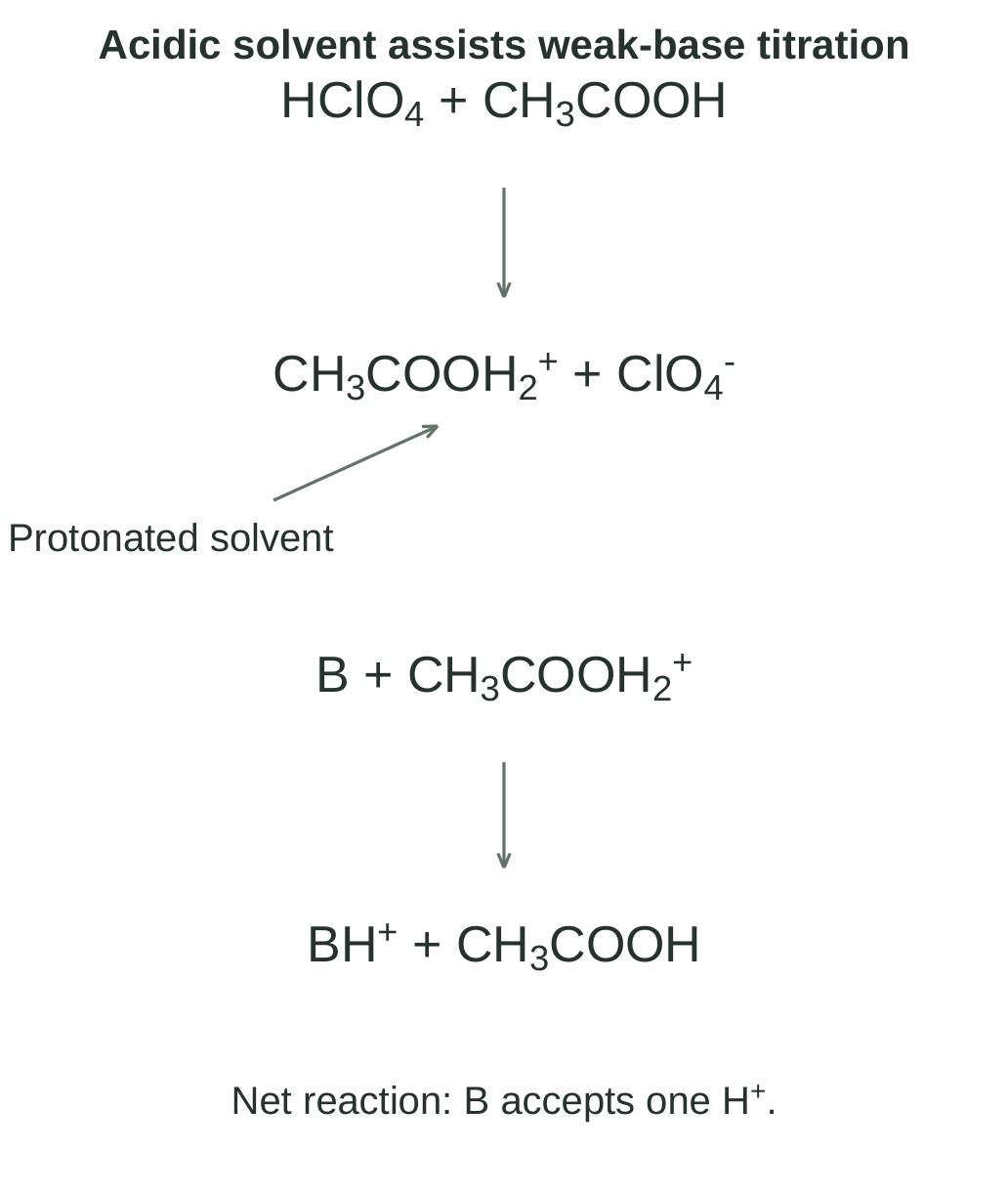
Diagram labels: Acidic solvent assists weak-base titration; HClO₄ + CH₃COOH; CH₃COOH₂⁺ + ClO₄⁻; Protonated solvent; B + CH₃COOH₂⁺; BH⁺ + CH₃COOH; Net reaction: B accepts one H⁺.
7.4 Basic solvent for weak acids
A proton-accepting solvent promotes dissociation or neutralization of a weak acid. Sodium methoxide in a suitable alcohol-based solvent or tetrabutylammonium hydroxide in an appropriate solvent system can be used as basic titrants in applicable methods.
HA + CH₃O⁻ → A⁻ + CH₃OH.
For weak acids, a useful solvent must dissolve the analyte and provide a sufficiently sharp reaction without introducing a large blank or side reaction.
7.5 Levelling and differentiating effects
A levelling solvent makes sufficiently strong acids appear similarly strong because each produces the solvent’s conjugate acid. In water, several strong acids are levelled to H₃O⁺.
A differentiating solvent allows acids or bases to display more distinct apparent strengths. This can help resolve titration behaviour that is indistinguishable in another solvent.
These effects are relative to the solvent; a substance’s apparent strength is not identical in every medium. Ordinary aqueous pH numbers should not be transferred uncritically to a non-aqueous system.
7.6 Solvent selection
Dissolve the analyte and permit the intended stoichiometric reaction.
Provide adequate endpoint separation and low reagent blank.
Avoid reaction with the analyte, titrant or indicator.
Control water content, temperature and solvent purity.
Use suitable compatible apparatus and the prescribed endpoint system.
7.7 Endpoints
Potentiometric detection is widely useful because many non-aqueous systems have indicator or sample-colour complications. A suitable visual indicator, such as crystal violet in some acidimetric methods, may be used when its response is validated in that solvent.
Non-aqueous indicator colours are solvent-dependent. Do not assume that an aqueous transition range or colour sequence directly applies to an organic medium.
8. Acidic and basic non-aqueous titrants
8.1 Perchloric acid in acetic acid
A commonly used nominal concentration is 0.1 mol/L HClO₄ in a controlled glacial-acetic-acid medium. Water content affects its response; reagent preparation must follow a validated laboratory procedure with compatible equipment.
Acetic anhydride may be included in specified formulations to control water through conversion to acetic acid. The order of addition and conditions are important. These notes give the analytical sequence rather than an improvised concentrated-reagent mixing recipe.
8.2 Preparation sequence
Step 1: calculate the intended concentration using the actual stock assay and density.
Step 2: prepare the prescribed solvent composition under the laboratory procedure, controlling moisture and temperature.
Step 3: allow equilibration and make to the specified final volume.
Step 4: standardize against an appropriate primary standard before analytical use.
Step 5: label actual concentration, solvent, factor and date; protect against composition changes.
8.3 Standardization
KHP can be used in an appropriate non-aqueous standardization. The hydrogen phthalate anion accepts one proton to form phthalic acid, so the reaction with HClO₄ is 1:1.
Use the prescribed acetic-acid medium and potentiometric or validated visual endpoint. Determine the solvent/reagent blank where required.
CHClO₄ = mKHP/(204.22 × Vcorrected), using grams and litres, with standard purity included.
Example: 0.40844 g KHP and 20.05 mL corrected titrant volume give C = 0.002000/0.02005 = 0.09975 mol/L.
This use of KHP involves proton acceptance by hydrogen phthalate; its aqueous NaOH standardization involves loss of its acidic proton. The chosen medium and reaction determine how the standard behaves.
8.4 Basic titrant preparation
Sodium methoxide titrant requires a suitable low-water alcohol medium. Water and CO₂ alter its composition and assay performance. A standardized solution may be prepared or obtained according to the method; actual strength must be measured.
Tetrabutylammonium hydroxide is another useful basic titrant in suitable organic solvent systems. The supplied composition and compatibility determine how it is standardized and used.
8.5 Basic titrant standardization
A suitable primary acid such as benzoic acid may be titrated in the prescribed solvent. For a one-proton acid reacting with methoxide, the stoichiometry is 1:1.
CB = m/(Macid × Vcorrected). For benzoic acid, M ≈ 122.12 g/mol. If 0.24424 g consumes 20.10 mL, C ≈ 0.09950 mol/L.
Select an appropriate potentiometric or validated indicator endpoint. The standardization solvent and assay solvent should meet the method’s requirements; an aqueous standardization may not reproduce all non-aqueous blank effects.
8.6 Temperature and blanks
Organic solvents can show significant thermal volume expansion. Standardization and assay should be performed at compatible temperatures, or corrected as the method specifies. An unexplained temperature difference can change the effective concentration per millilitre.
The blank includes the same solvent mixture and added reagents. Subtract a direct-titration blank only when its consumption represents the same endpoint contribution; back-titration blanks are handled according to their actual reaction scheme.
9. Estimation in non-aqueous media
9.1 Weak basic substances
Weak bases such as some amines and nitrogen-containing heterocycles can be titrated with HClO₄ in a suitable acidic solvent. Determine how many basic sites react under the selected conditions; a molecule with several nitrogens does not automatically consume one proton per nitrogen.
Some amine salts require pretreatment or a different solvent because the counterion interferes with titration. The selected method must account for that salt form. Do not introduce a counterion-removal reagent unless it is prescribed.
9.2 Weak acidic substances
Weak organic acids may be titrated with a suitable basic reagent in a proton-accepting or otherwise appropriate solvent. Carboxylic acids, phenolic compounds and certain imide-type substances have different strengths and side-reaction possibilities.
The assay factor depends on the number of protons quantitatively neutralized. A dibasic structure may yield one or two resolved endpoints; its formula alone does not establish the method’s stoichiometry.
9.3 Sodium benzoate principle
Formula: C₇H₅NaO₂; molar mass ≈ 144.11 g/mol. Benzoate is the conjugate base of benzoic acid. In suitable non-aqueous acidimetry it accepts a proton from standardized perchloric acid.
C₆H₅COONa + HClO₄ → C₆H₅COOH + NaClO₄.
One mole sodium benzoate consumes one mole HClO₄. The titrated basic species is benzoate; sodium is the counterion.
9.4 Stepwise sodium benzoate assay
Step 1: accurately weigh the sample on the required reporting basis.
Step 2: dissolve it in the specified glacial-acetic-acid medium.
Step 3: titrate with standardized HClO₄ using a potentiometric endpoint or the validated indicator specified for the method.
Step 4: determine and apply the matching blank correction.
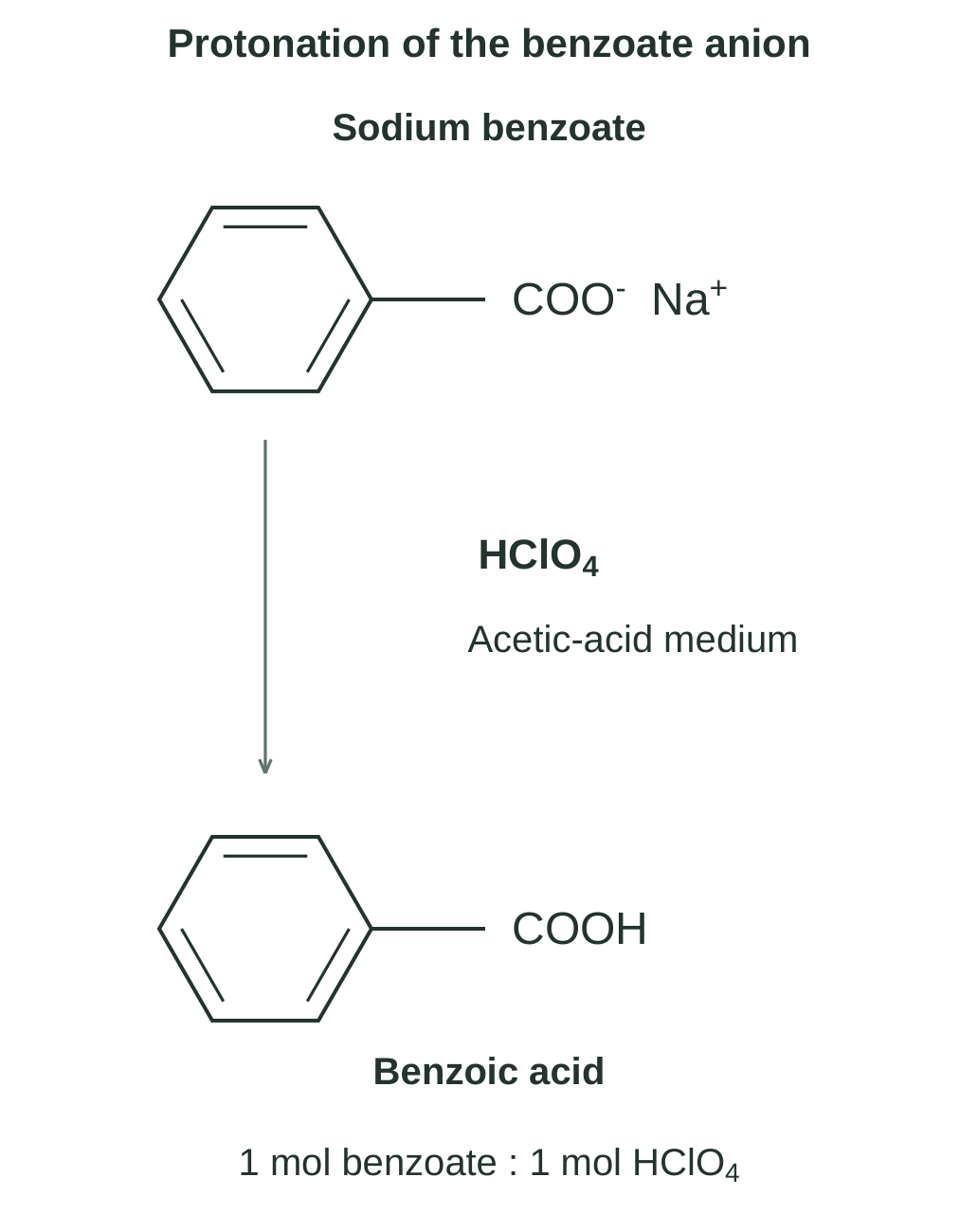
Diagram labels: Protonation of the benzoate anion; COO⁻ Na⁺; COOH; Sodium benzoate; HClO₄; Acetic-acid medium; Benzoic acid; 1 mol benzoate : 1 mol HClO₄.
- Step 5: calculate sodium benzoate content from the 1:1 reaction and any dilution or drying-basis correction.
9.5 Factor and numerical
Each mL of 0.1000 mol/L HClO₄ corresponds to 14.411 mg sodium benzoate.
For a 0.3000 g sample, sample titre = 20.80 mL and blank = 0.10 mL. Corrected volume = 20.70 mL.
Mass found = 20.70 × 14.411 = 298.31 mg. Assay = 298.31/300.0 × 100 = 99.44% approximately.
If actual titrant strength were 0.09975 mol/L, use that value or multiply the nominal factor by 0.9975. A moisture correction is applied only if the required reporting basis calls for it.
9.6 Frequent errors
Using a water-based indicator range in the organic solvent without validation.
Ignoring moisture, thermal expansion or the reagent blank.
Using the mass of benzoic acid instead of sodium benzoate in the factor.
Assuming every weak base reacts 1:1 regardless of the method.
Confusing poor aqueous ionization with absence of acid-base reactivity.
10. Precipitation titrations
10.1 Principle
A precipitation titration uses a reaction that forms a sparingly soluble solid. The reaction should have suitable stoichiometry, sufficiently low solubility, adequate speed and a detectable endpoint.
For argentometry: Ag⁺ + Cl⁻ → AgCl↓.
Ksp(AgCl) = [Ag⁺][Cl⁻] in the dilute concentration approximation. Before equivalence, excess chloride suppresses free silver. At equivalence the two concentrations are related to Ksp; after equivalence, added silver increases free Ag⁺.
10.2 Analytical limitations
Precipitate solubility, adsorption, slow equilibration, light sensitivity and competing precipitations can affect accuracy. Strong complexing agents may increase silver-salt solubility and invalidate a method.
The indicator mechanism distinguishes the main classical methods. A coloured precipitate, a coloured soluble complex and a colour adsorbed onto a surface are different endpoint signals.
10.3 Mohr method
Chloride is titrated directly with standardized AgNO₃ using chromate as indicator. During most of the titration, silver is consumed as AgCl. After chloride is substantially precipitated, slight excess Ag⁺ forms reddish-brown silver chromate.
2Ag⁺ + CrO₄²⁻ → Ag₂CrO₄↓.
The solution must be near neutral or mildly alkaline within the validated method range, commonly about pH 6.5–10. Excess acidity converts chromate toward hydrogen chromate/dichromate, delaying the endpoint. Excess alkalinity can produce silver oxide or other interfering precipitates.
10.4 Mohr sequence
Step 1: measure the chloride sample and establish suitable pH.
Step 2: add the prescribed amount of chromate indicator.
Step 3: titrate with AgNO₃ while mixing until the first persistent reddish-brown endpoint appears.
Step 4: apply the method’s blank and compute chloride from the 1:1 Ag⁺/Cl⁻ reaction.
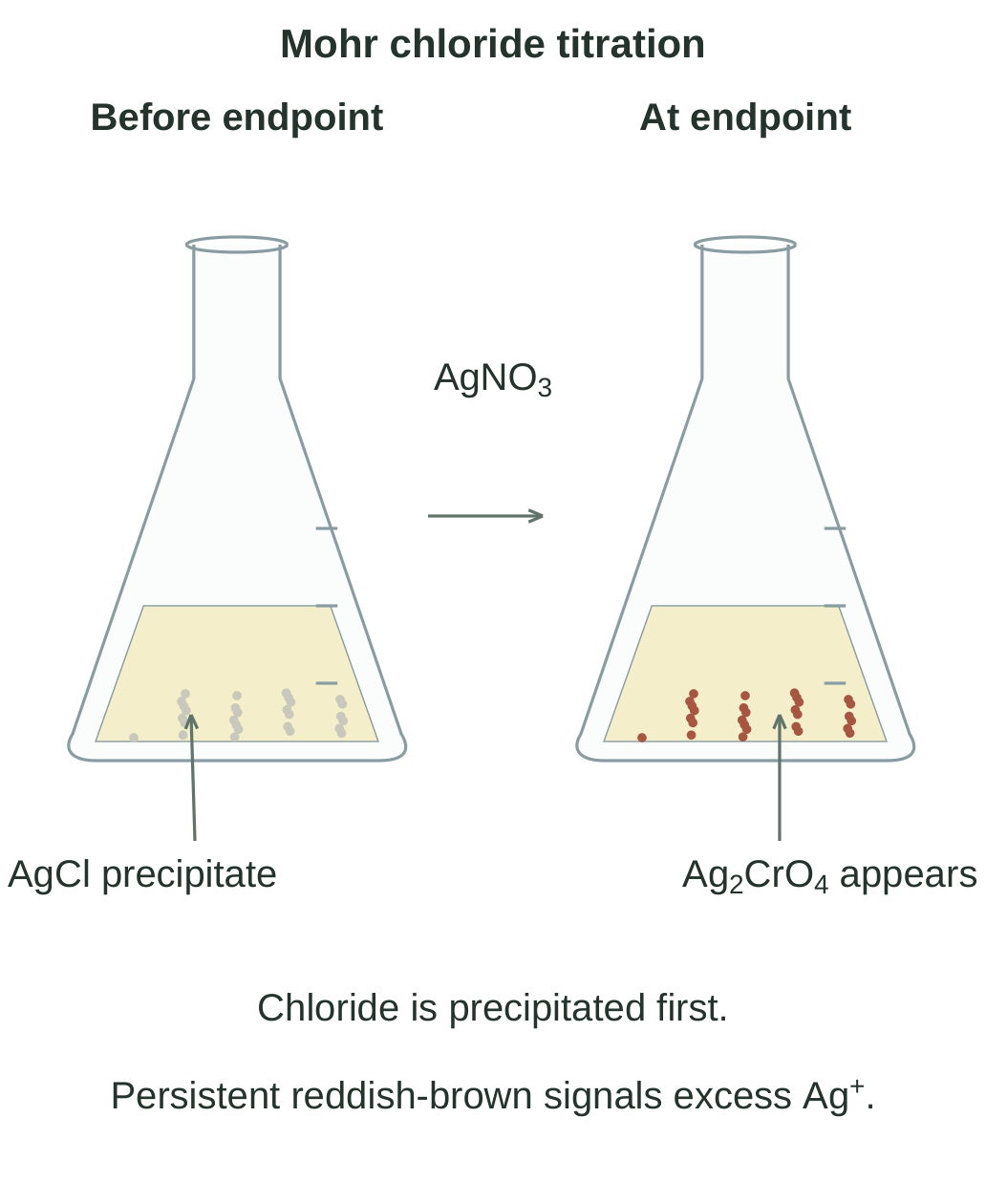
Diagram labels: Mohr chloride titration; Before endpoint; At endpoint; AgNO₃; AgCl precipitate; Ag₂CrO₄ appears; Chloride is precipitated first; Persistent reddish-brown signals excess Ag⁺.
The visible silver-chromate amount requires some excess silver; the blank and indicator amount affect the endpoint error. Do not add arbitrary large quantities of chromate.
10.5 Volhard method
Silver is titrated with standardized thiocyanate in an acidic medium using Fe³⁺ as indicator:
Ag⁺ + SCN⁻ → AgSCN↓.
After silver is consumed, a slight thiocyanate excess forms a red ferric-thiocyanate complex. A simplified endpoint representation is Fe³⁺ + SCN⁻ ⇌ [FeSCN]²⁺.
For chloride, add a known excess of AgNO₃, precipitate AgCl, then back-titrate the excess silver with SCN⁻. Nitric acid is typically used for the acidic medium; HCl would introduce additional chloride.
10.6 Why AgCl is separated
AgSCN is less soluble than AgCl. If thiocyanate contacts unprotected AgCl, it can replace chloride in the solid:
AgCl + SCN⁻ → AgSCN + Cl⁻.
This consumes extra SCN⁻ and may cause a low chloride result in the back-titration. Separating the AgCl before measuring residual silver avoids this exchange under the selected method.
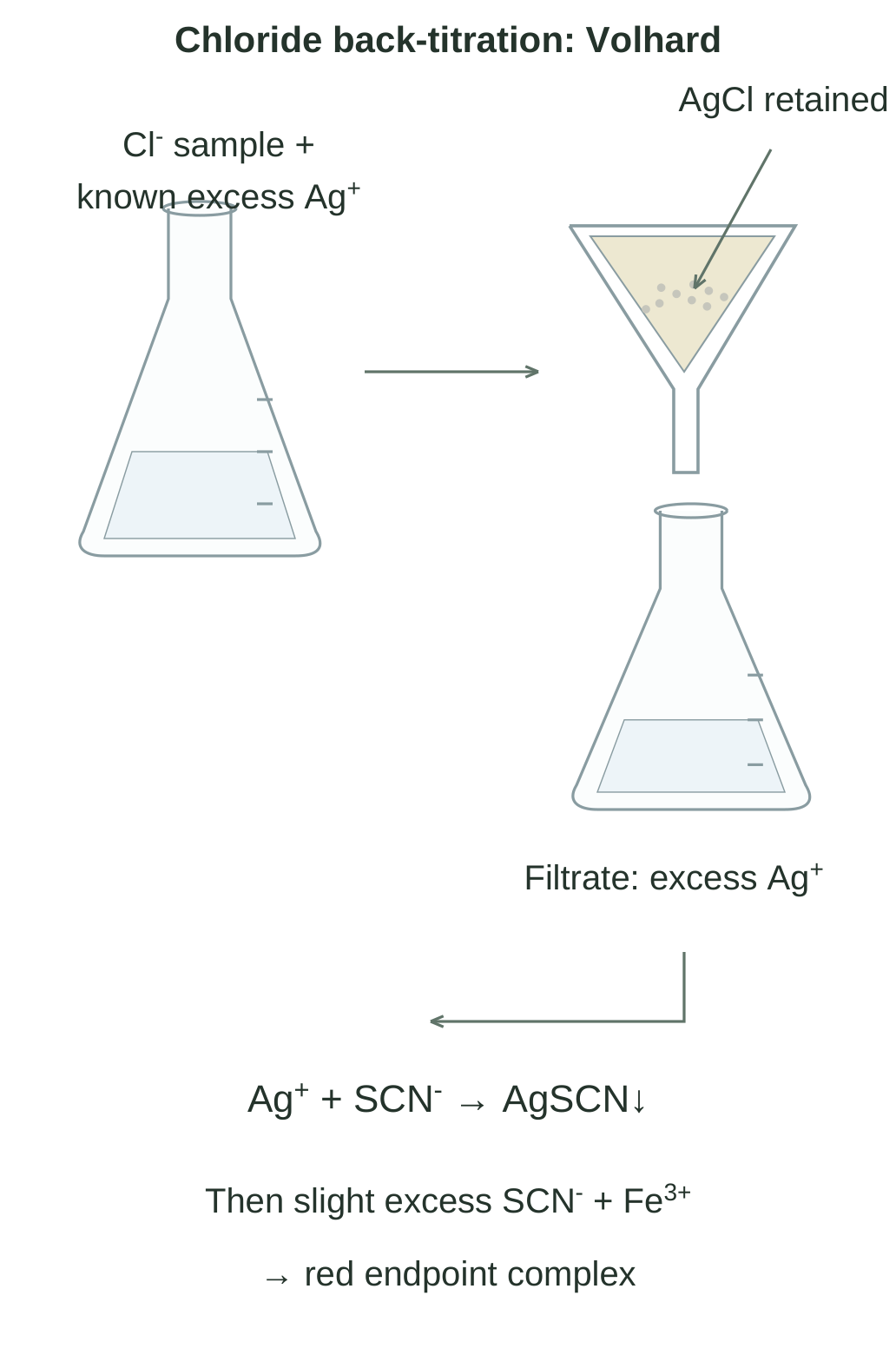
Diagram labels: Chloride back-titration: Volhard; Cl⁻ sample + known excess Ag⁺; AgCl retained; Filtrate: excess Ag⁺; Ag⁺ + SCN⁻ → AgSCN↓; Then slight excess SCN⁻ + Fe³⁺ → red endpoint complex.
10.7 Modified Volhard method
A prescribed immiscible coating medium may surround the AgCl precipitate and reduce its contact with thiocyanate, allowing back-titration without the same filtration step.
Nitrobenzene is the classical coating example. It is a hazardous reagent; substitutions and quantities must be validated rather than improvised. The analytical purpose is protection of the AgCl surface, not removal of chloride from the sample.
10.8 Back-titration calculation
nCl = CAgVAg − CSCNVSCN, with volumes in litres, after applicable corrections.
Example: add 25.00 mL of 0.1000 mol/L AgNO₃; excess silver requires 8.00 mL of 0.1000 mol/L SCN⁻.
Chloride = 2.500 − 0.800 = 1.700 mmol. Expressed as NaCl, mass = 1.700 × 58.44 = 99.35 mg.
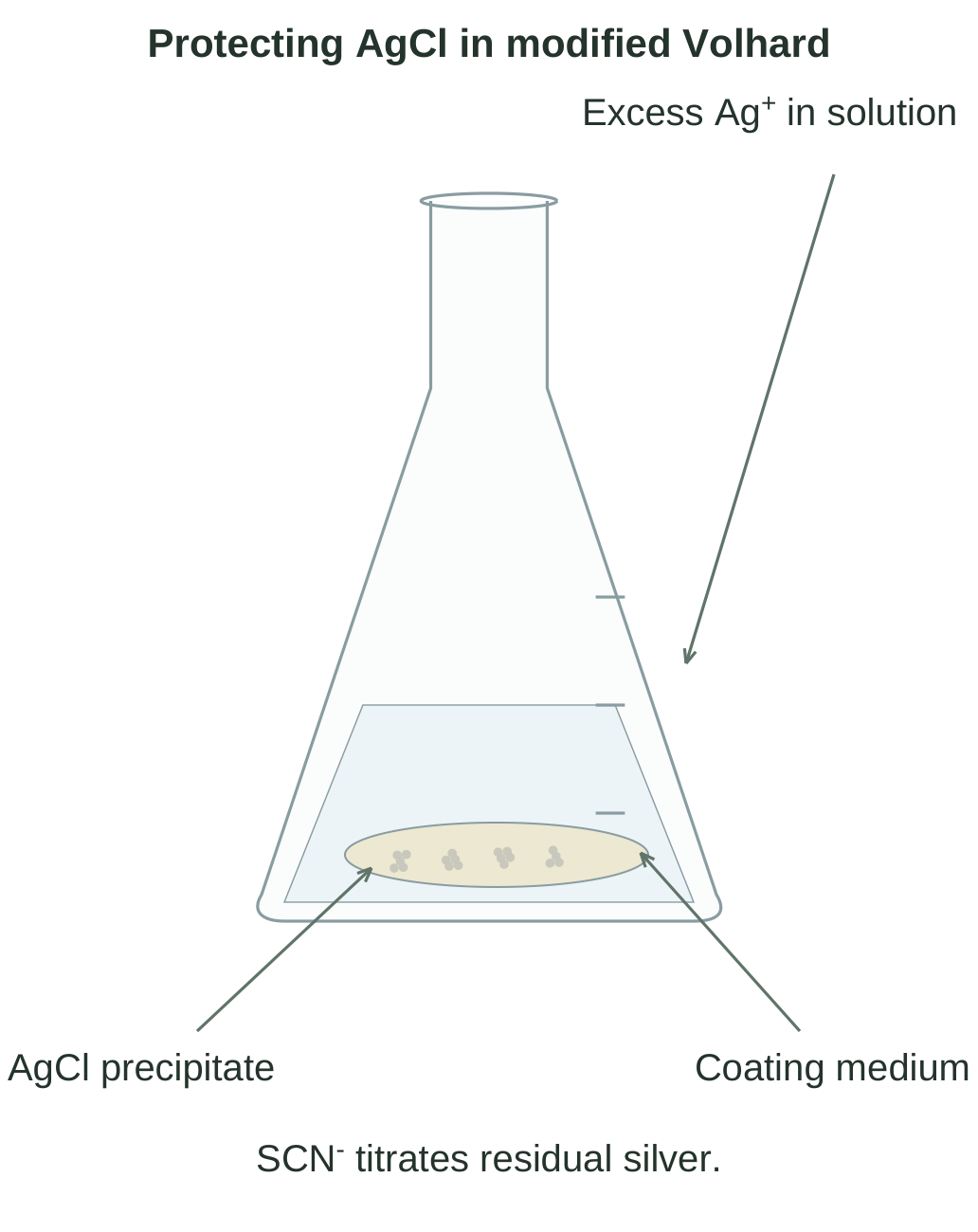
Diagram labels: Protecting AgCl in modified Volhard; AgCl precipitate; Coating medium; Excess Ag⁺ in solution; SCN⁻ titrates residual silver.
This factor assumes all consumed silver represents chloride. Other halides or precipitating anions can invalidate that selectivity.
11. Fajans method and comparisons
11.1 Adsorption-indicator principle
The precipitate surface preferentially adsorbs ions from solution. Before equivalence in chloride titration, AgCl particles carry a surface enriched in adsorbed Cl⁻ and are relatively negative. After slight excess Ag⁺, the surface becomes relatively positive.
A suitable anionic adsorption indicator is then attracted to the positive surface, producing a visible colour on the precipitate. Fluorescein-type indicators are used in suitable chloride methods.
11.2 Requirements
The indicator must be in its suitably ionized form at the selected pH, and the precipitate must have an adequate accessible surface. Excess electrolyte, coagulation, unsuitable pH and sample colour may interfere.
Protect light-sensitive silver halides as directed and maintain consistent mixing. The indicator endpoint depends on surface adsorption, so it is not explained by simply forming a bulk insoluble silver-indicator salt.
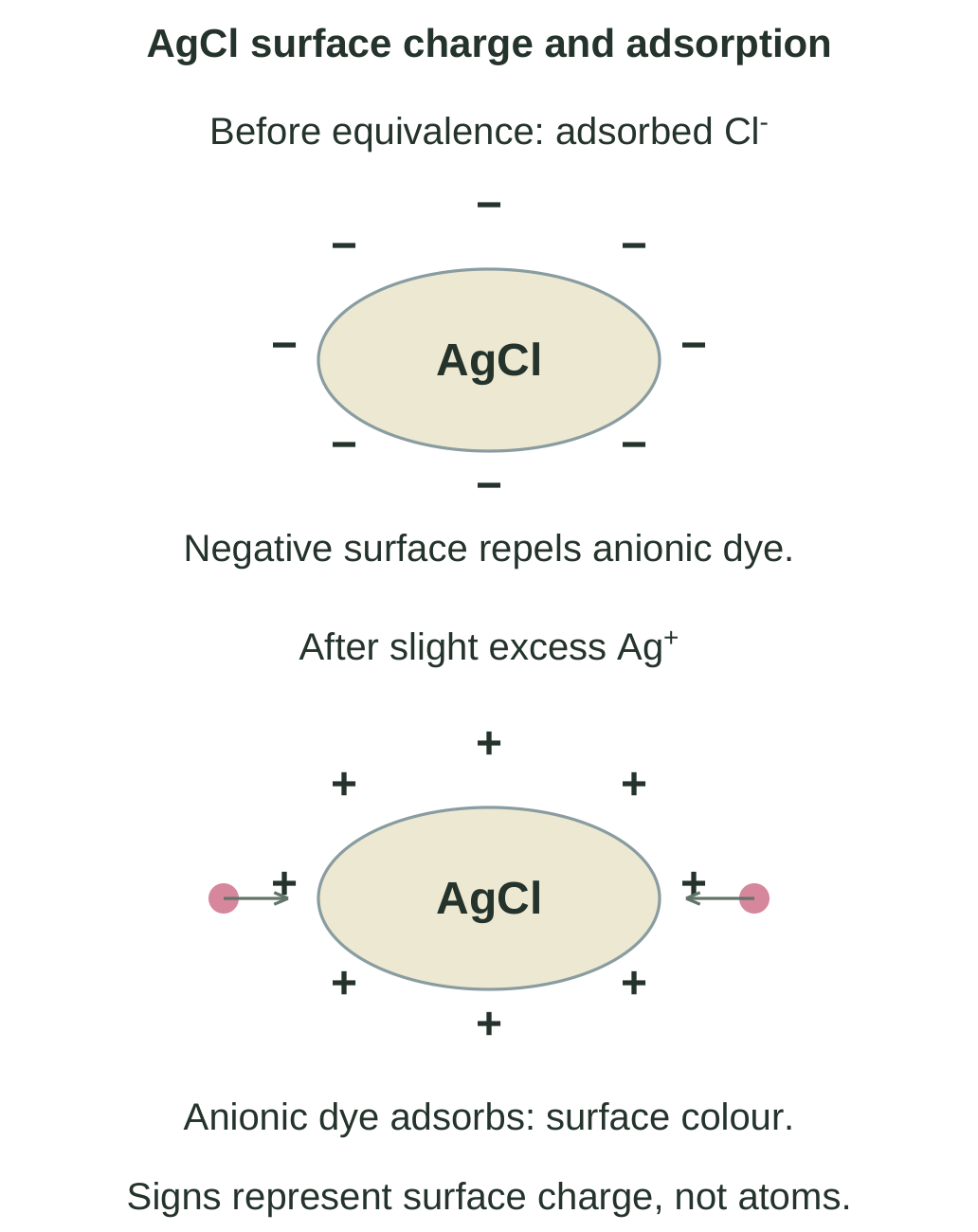
Diagram labels: AgCl surface charge and adsorption; AgCl; Negative charge signs before equivalence; Before equivalence: adsorbed Cl⁻; Negative surface repels anionic dye; Positive charge signs after slight excess Ag⁺; Anionic dye adsorbs: surface colour; Signs represent surface charge, not atoms.
11.3 Stepwise method
Step 1: establish the suitable sample concentration and pH.
Step 2: add the prescribed adsorption indicator.
Step 3: titrate with standardized AgNO₃, mixing to the characteristic persistent surface colour.
Step 4: calculate using the Ag⁺/Cl⁻ stoichiometry and required corrections.
11.4 Method comparison
| Method | Endpoint and conditions |
|---|---|
| Mohr | Reddish-brown Ag₂CrO₄ precipitate; near-neutral medium |
| Volhard | Red Fe³⁺–SCN⁻ complex; acidic medium; chloride usually by back-titration |
| Modified Volhard | Same residual-silver endpoint with prescribed AgCl protection |
| Fajans | Adsorption indicator colours the precipitate surface after charge reversal |
11.5 Direct argentometric example
An illustrative NaCl sample of 0.1500 g requires 25.55 mL AgNO₃; blank = 0.10 mL; actual C = 0.1000 mol/L.
Corrected V = 25.45 mL. NaCl found = 25.45 × 0.1000 × 58.44 = 148.73 mg.
Purity = 148.73/150.0 × 100 = 99.15% approximately. The selected endpoint method must be suitable for the sample matrix.
11.6 Preparing silver and thiocyanate reagents
AgNO₃ solution is prepared approximately, protected from light and standardized against a suitable chloride standard. Thiocyanate solution is standardized against known silver under the appropriate acidic endpoint conditions.
For AgNO₃ standardization, one mole of chloride corresponds to one mole of Ag⁺. For thiocyanate standardization, one mole Ag⁺ corresponds to one mole SCN⁻. Use actual strengths separately in a back-titration; equal nominal labels do not prove equal actual concentrations.
Memory key
Mohr: chromate precipitate. Volhard: ferric-thiocyanate colour. Fajans: adsorption on the precipitate surface.
12. Gravimetric analysis
12.1 Principle
Gravimetry determines an analyte from the mass of a pure material of known composition obtained from it. In precipitation gravimetry, the analyte is converted to a sparingly soluble precipitate, isolated and brought to a stable weighing form.
The weighed product may be the original precipitate or a product formed by drying or ignition. A suitable weighing form has known composition, adequate stability, low solubility and manageable filtration characteristics.
12.2 Step 1: prepare the sample
Take a representative accurately weighed sample. Dissolve it quantitatively or use the prescribed extraction or decomposition procedure. Adjust volume and conditions without losing analyte or introducing the species being measured.
12.3 Step 2: precipitate
Add the precipitating reagent slowly with mixing under controlled concentration, temperature and pH. A modest suitable excess promotes completeness, but too much can increase impurities or unwanted reactions.
Large easily filtered particles are favoured by controlled low supersaturation. Rapid addition to concentrated solutions can produce many very fine particles that retain impurities and pass through filters.
12.4 Step 3: digest the precipitate
Digestion means allowing the precipitate to remain in contact with its mother liquor under specified conditions, often warm. Small particles may dissolve and redeposit on larger ones, improving filterability and reducing some surface contamination.
Digestion is not a guarantee of purity and is unsuitable if it promotes decomposition or loss. Conditions must suit the particular precipitate.
12.5 Step 4: filter and wash
Choose an appropriate filter paper or porous crucible. Transfer the solid quantitatively and wash with a suitable liquid to remove adhering soluble impurities while limiting precipitate dissolution.
Pure water is not always the best wash liquid. Some colloids undergo peptization, becoming dispersed and difficult to retain, if electrolyte is removed. A prescribed electrolyte-containing wash may prevent this.
12.6 Step 5: dry or ignite
Bring the solid to a stable weighing form. Drying removes moisture at suitable temperature; ignition may decompose a precursor or remove filter material. Avoid conditions that volatilize, reduce or contaminate the product.
12.7 Step 6: cool and weigh
Cool in a desiccator before weighing. Reheat, cool and weigh until constant mass within the method’s criterion. A hot crucible gives unstable balance readings; exposure to room air can introduce moisture.
12.8 Gravimetric factor
GF = mass of analyte represented / mass of weighing form, using balanced stoichiometry and molar masses.
Mass analyte = mass weighing form × GF. If an aliquot represents only part of the original sample, apply the dilution factor before calculating percentage.
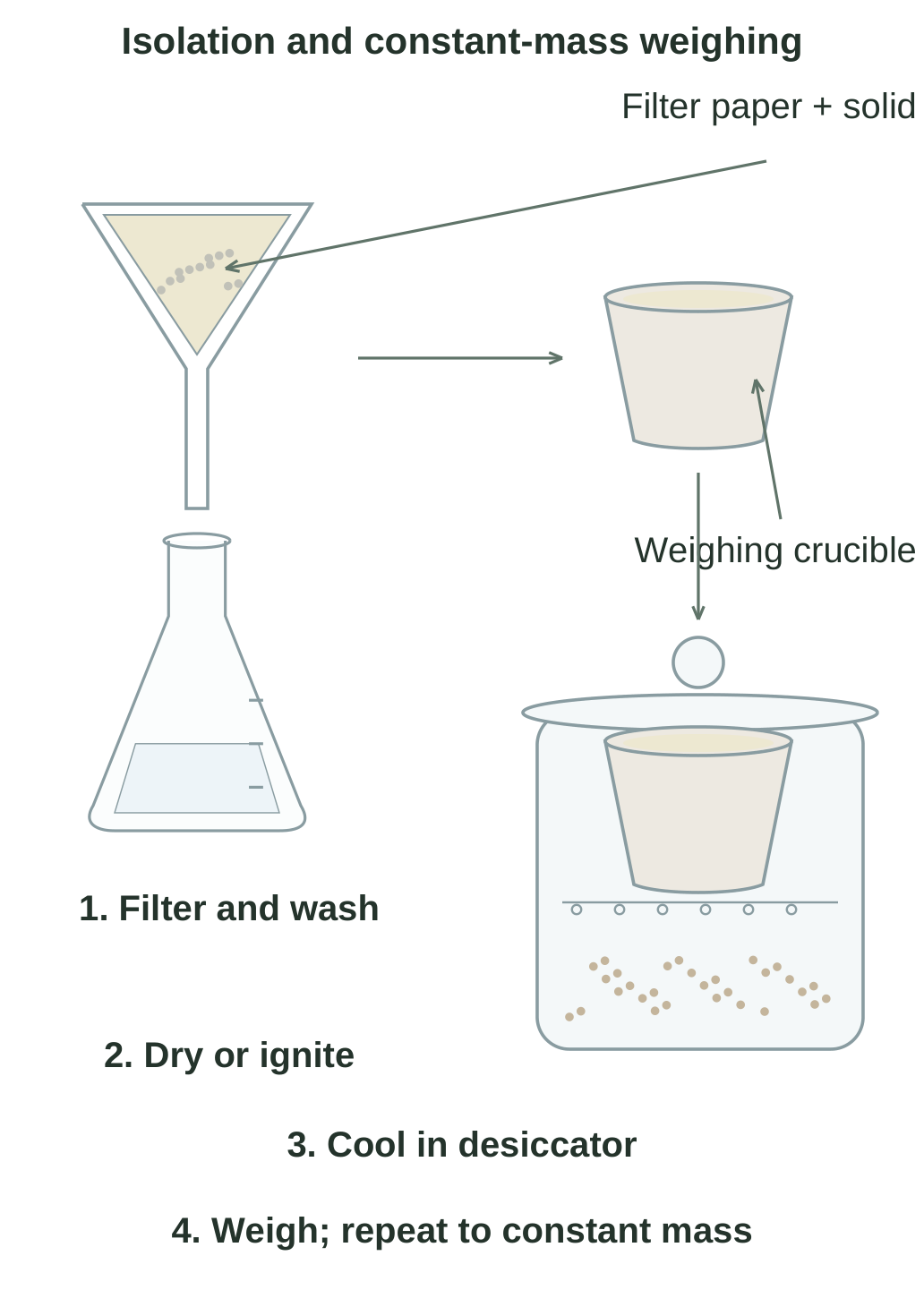
Diagram labels: Isolation and constant-mass weighing; Filter paper + solid; 1. Filter and wash; Weighing crucible; 2. Dry or ignite; 3. Cool in desiccator; 4. Weigh; Repeat to constant mass.
12.9 Contamination mechanisms
| Mechanism | Meaning |
|---|---|
| Surface adsorption | Impurity ions adhere to precipitate surfaces |
| Occlusion | Mother liquor or impurities become trapped during growth |
| Inclusion | Foreign species enter the crystal lattice |
| Post-precipitation | Another solid deposits after the intended precipitate forms |
Coprecipitation is impurity collection during formation of the analytical precipitate. Reprecipitation may improve purity where the precipitate can be suitably dissolved and reformed without analyte loss.
12.10 Error directions
Retained moisture, unremoved salts or an incompletely cleaned crucible tend to increase mass. Incomplete precipitation, dissolution during washing, transfer losses and leakage through the filter tend to decrease recovered mass.
The actual direction can become complicated if the weighing form changes composition; analyse the mechanism rather than memorizing a sign without explanation.
13. Barium sulfate by gravimetry
13.1 Reaction and weighing form
Ba²⁺ + SO₄²⁻ → BaSO₄↓.
Barium sulfate is sparingly soluble and can be used as a stable weighing form under the prescribed conditions. Its molar mass is approximately 233.39 g/mol.
The precipitate mass may be reported as BaSO₄ or converted to sulfate or barium. State the measured species; these are different answers from the same weighed product.
13.2 Sulfate estimation sequence
Step 1: prepare a suitable soluble sulfate sample, controlling interfering ions.
Step 2: under specified warm dilute acidic conditions, add barium chloride solution slowly with stirring.
Step 3: digest the precipitate to improve particle size and test the clear supernatant for completeness as directed.
Step 4: filter quantitatively and wash until relevant soluble contaminants are removed.
Step 5: dry or ignite by the specified procedure, cool in a desiccator and weigh to constant mass.
Step 6: calculate the result from corrected BaSO₄ mass and the relevant factor. Suitable acidity helps suppress some competing barium precipitates. Excessive acidity or unsuitable conditions can affect solubility or recovery. Barium chloride is a soluble barium reagent; it should not be confused with the relatively insoluble BaSO₄ product.
13.3 Weighing calculation
Net precipitate mass = (crucible + product mass) − empty crucible mass, with a reagent blank if required.
Example: empty crucible = 24.6320 g; crucible plus product = 24.8654 g. Net BaSO₄ = 0.2334 g.
As sulfate, GF = 96.06/233.39 ≈ 0.4116. Sulfate represented = 0.2334 × 0.4116 = 0.09607 g.
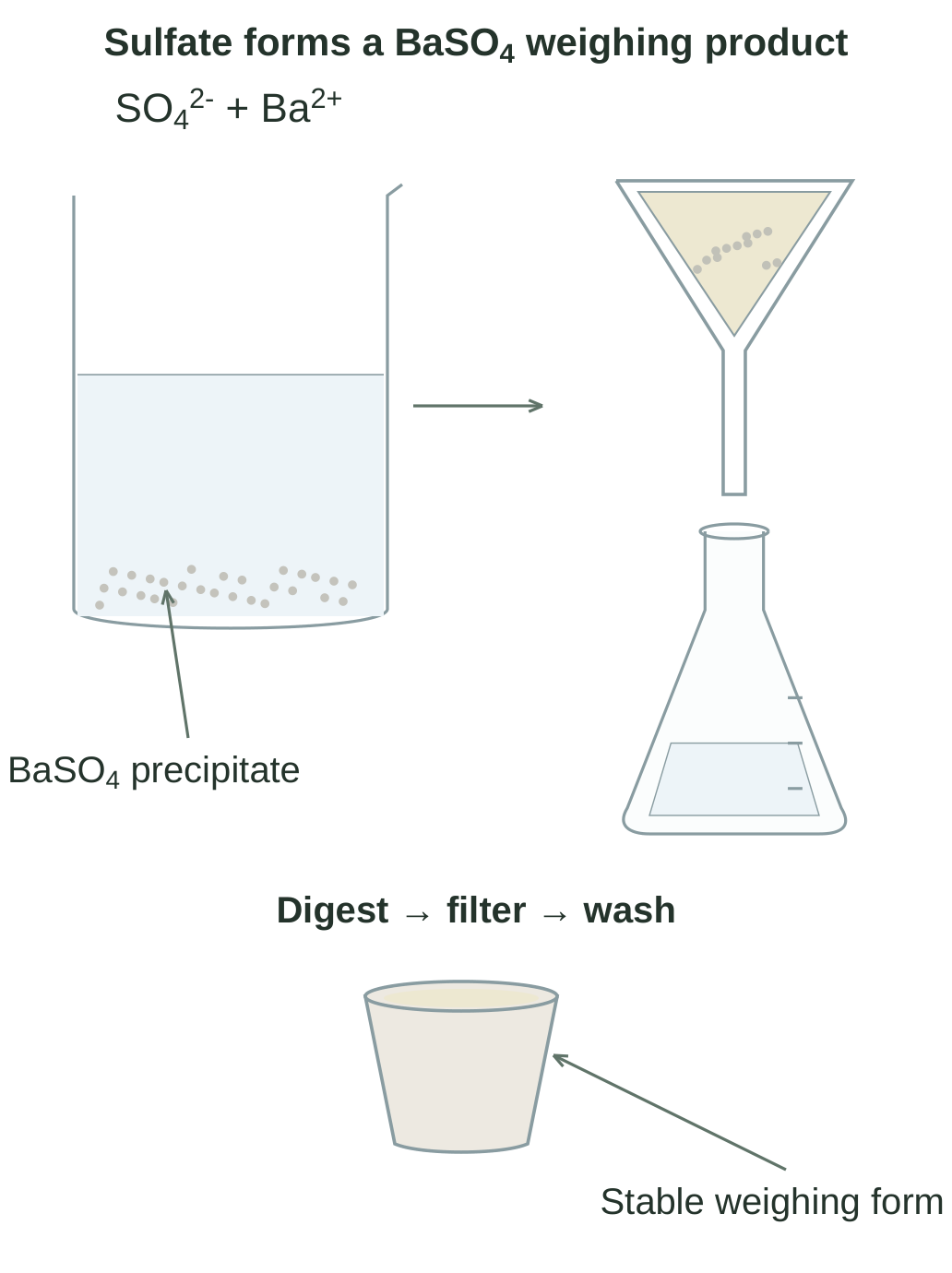
Diagram labels: Sulfate forms a BaSO₄ weighing product; SO₄²⁻ + Ba²⁺; BaSO₄ precipitate; Digest → filter → wash; Stable weighing form.
As barium, GF = 137.33/233.39 ≈ 0.5884. Barium represented ≈ 0.1373 g.
If reported as BaSO₄, no chemical conversion factor is needed; the result is the net mass itself after applicable corrections.
13.4 Example with sample percentage
If 0.2334 g BaSO₄ comes from a 0.5000 g sample without dilution, sulfate content = 0.09607/0.5000 × 100 = 19.21% w/w.
If the precipitated aliquot represented one-fifth of the original dissolved sample, multiply its analyte mass by five before dividing by the original sample mass.
13.5 If the original sample is insoluble BaSO₄
Do not claim that dilute HCl simply dissolves BaSO₄ for a routine assay. An insoluble original material requires an appropriate validated decomposition or fusion if conversion to a soluble analyte is needed.
In this unit, the main gravimetric principle is formation, isolation and weighing of BaSO₄. A known mass fraction of an already isolated pure BaSO₄ material can also be expressed directly by mass, provided the analytical separation and purity are established.
13.6 Specific precautions
Carbon-containing filter material can reduce BaSO₄ under unsuitable ignition conditions, changing the weighing form. Use the prescribed ignition or porous-crucible procedure to maintain the intended composition.
Prevent dust contamination, quantitative-transfer losses and moisture uptake. A white precipitate alone does not establish purity or completion.
14. Complexometric titrations
14.1 Complex formation
A complex contains a central metal ion coordinated to electron-pair-donating ligands. A chelating ligand attaches through more than one donor atom, producing ring structures.
EDTA is a multidentate ligand capable of binding many metal ions in 1:1 metal-to-EDTA complexes. The ratio is one metal ion per ligand, not one EDTA per unit of metal charge.
14.2 EDTA and disodium edetate
EDTA is commonly represented as H₄Y for acid-base bookkeeping, with Y⁴⁻ the fully deprotonated binding form. Disodium EDTA is commonly Na₂H₂Y·2H₂O, molar mass approximately 372.24 g/mol.
For a divalent metal: M²⁺ + Y⁴⁻ ⇌ MY²⁻.
Using the disodium form as written: M²⁺ + H₂Y²⁻ ⇌ MY²⁻ + 2H⁺. A buffer helps manage proton release and maintain the conditions required for complex formation.
14.3 Importance of pH
EDTA exists in several protonation states. At higher pH a larger fraction is in the more strongly available binding forms. The conditional formation constant depends on that fraction and other equilibria.
Kf′ = αY⁴⁻Kf, in a simplified model excluding additional metal side reactions. α is the fraction of uncomplexed EDTA present as Y⁴⁻.
Raising pH does not solve every problem: some metal ions precipitate as hydroxides. Select conditions that allow the intended complex to form without an interfering solid or competing reaction.
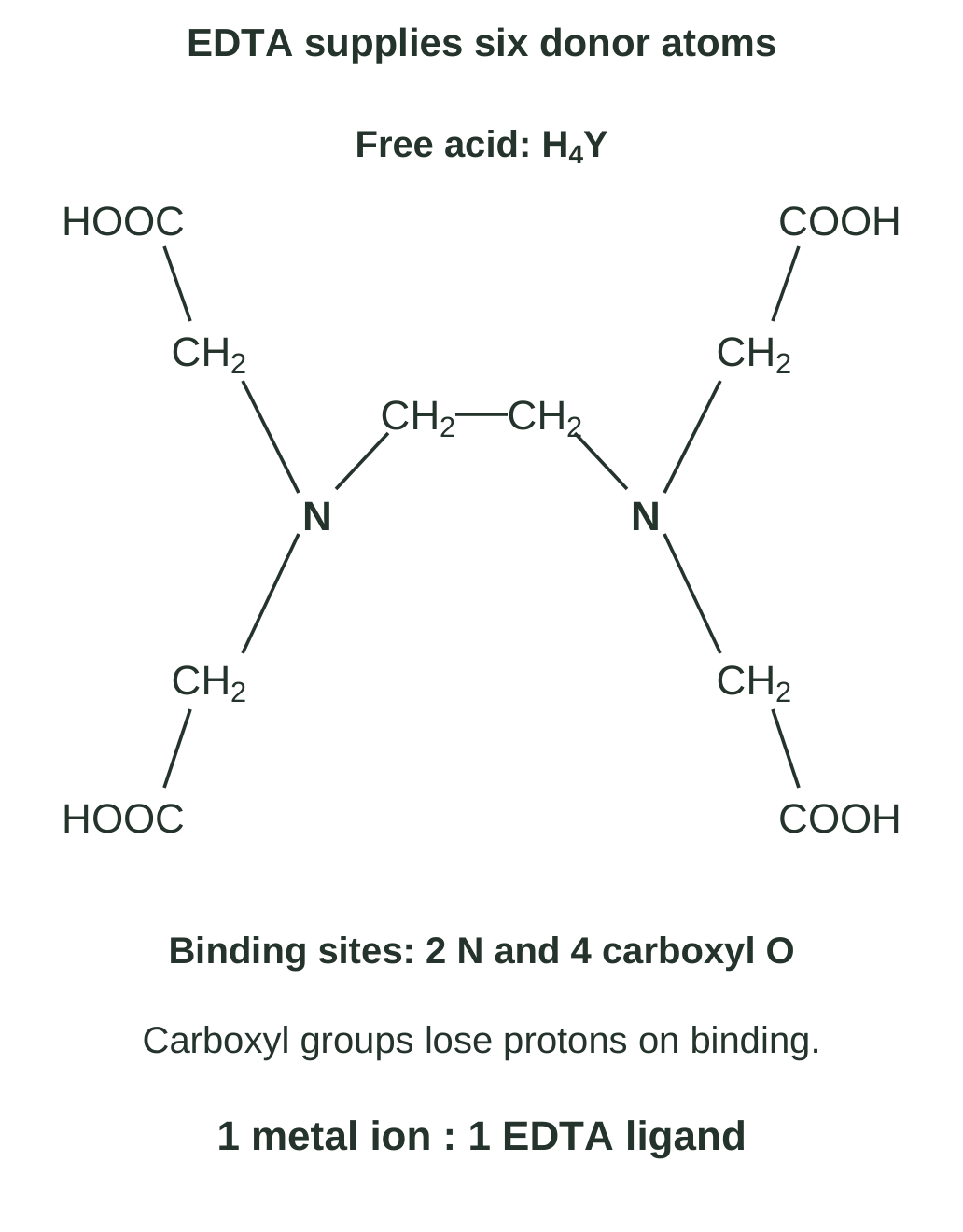
Diagram labels: EDTA supplies six donor atoms; Free acid: H₄Y; Two N atoms; Six CH₂ groups; Two HOOC labels and two COOH labels; Binding sites: 2 N and 4 carboxyl O; Carboxyl groups lose protons on binding; 1 metal ion : 1 EDTA ligand.
14.4 Classification
| Type | Analytical sequence |
|---|---|
| Direct | Metal is titrated directly with EDTA |
| Back | Known excess EDTA is added; remaining EDTA is titrated with a standard metal solution |
| Displacement | Analyte releases a measurable metal from another complex |
| Indirect | Another species is quantified through a related metal-complex reaction |
Direct titration suits a sufficiently rapid reaction and available endpoint. Back-titration can help with slow complex formation, insoluble material after suitable treatment or absence of a good direct indicator.
14.5 Back-titration calculation
If metal and EDTA react 1:1, nmetal = nEDTA added − nEDTA remaining. The second titration must be selective for the excess EDTA under its chosen conditions.
Example: 25.00 mL 0.05000 mol/L EDTA supplies 1.250 mmol. Residual EDTA requires 8.00 mL 0.05000 mol/L standard metal, or 0.400 mmol. Analyte metal = 0.850 mmol.
14.6 Displacement example
A metal with a sufficiently stable EDTA complex can displace magnesium from a magnesium-EDTA complex. The released Mg²⁺ is then titrated, providing a more suitable indicator response in an applicable method.
The reactions must be stoichiometric and the replacement thermodynamically favourable. Displacement is not a universal method for every metal.
15. Metal indicators and selectivity
15.1 Metal-ion indicator principle
A metal indicator forms a coloured complex different from the free indicator. The metal-EDTA complex should be sufficiently more stable than the metal-indicator complex so EDTA can release the free indicator near equivalence.
M–In + EDTA → M–EDTA + In.
The endpoint therefore reports disappearance of available metal from the indicator complex. It depends on pH, competing ions and reaction rate.
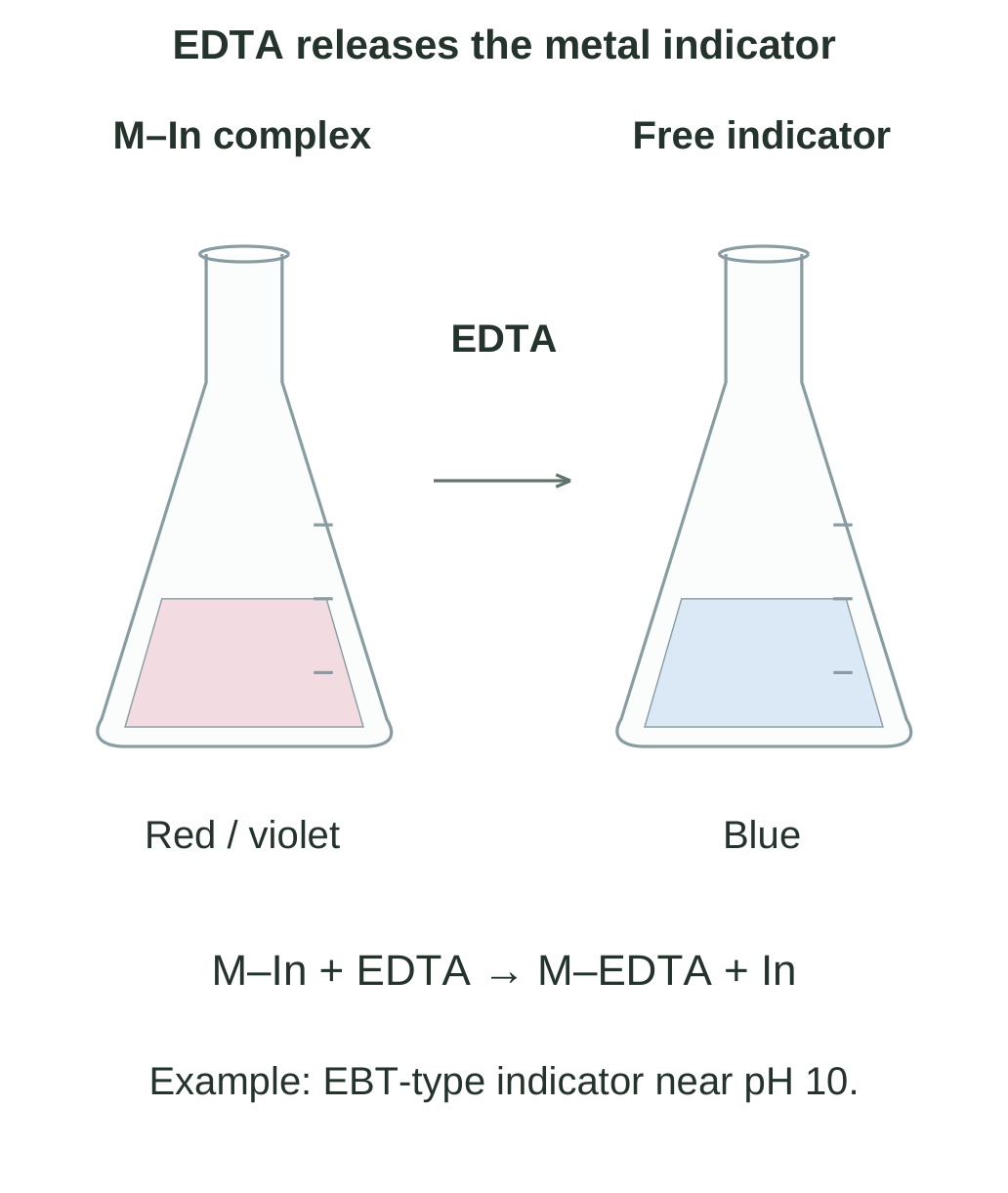
Diagram labels: EDTA releases the metal indicator; M–In complex; Free indicator; EDTA; Red/violet; Blue; M–In + EDTA → M–EDTA + In; Example: EBT-type indicator near pH 10.
15.2 Common indicators
| Indicator | Typical application and response |
|---|---|
| Eriochrome Black T / Mordant Black 11 | Mg-containing titrations near pH 10; red or violet complex → blue free indicator |
| Calcon / calconcarboxylic acid | Calcium under strongly alkaline conditions; pink-red → blue |
| Murexide | Suitable calcium and other metal methods; colours depend on metal and medium |
| Xylenol orange | Selected metals in mildly acidic media; metal-complex colour differs from free yellow indicator |
Screened indicator mixtures can have a different observed endpoint colour from the pure dye. Use the stated reagent and colour criterion for the method; do not mix indicator descriptions from unrelated procedures.
15.3 Masking
Masking reduces an interfering ion’s participation without physically removing it. A masking reagent can form a complex that prevents the interfering ion from consuming titrant or affecting the indicator.
Examples include suitable fluoride complexes of selected metal ions and triethanolamine in validated procedures for certain interferences. Cyanide complexation is a classical masking example for several transition metals, but its serious hazard makes it inappropriate as an improvised classroom reagent.
15.4 Demasking
Demasking releases a masked ion so it becomes available for a later determination. It may involve changing pH, converting the masking ligand or using a reagent that preferentially binds it.
The released ion can then be determined in a separate analytical stage. A demasking reagent must be selective and compatible with the intended titration.
15.5 Masking versus separation
| Operation | What happens to the interfering species |
|---|---|
| Masking | Remains in solution in a less reactive form |
| Demasking | Is released from the masked state |
| Separation | Is physically removed or partitioned away |
| pH selection | Reactivity changes through conditional stability or precipitation |
15.6 Choosing conditions
EDTA reacts with many metals. Selectivity is achieved through appropriate pH, masking, prior separation or a suitable reaction sequence. A single EDTA titre cannot uniquely identify two metals that both react quantitatively at the same endpoint.
For example, a total Ca²⁺ plus Mg²⁺ titration near pH 10 and a separate calcium-selective determination under suitable strongly alkaline conditions can permit magnesium by difference. Validate both measurements and subtraction errors.
16. Preparation and standardization of EDTA
16.1 Preparation
For nominal 0.0500 mol/L disodium EDTA dihydrate:
Mass per litre = 0.0500 × 372.24 = 18.612 g.
Dissolve the appropriate amount in suitable water, make to the final volume at the calibration temperature and mix. Use the actual salt and hydrate form; anhydrous disodium EDTA has a different molar mass.
The calculated mass supplies an approximate reagent. Its actual concentration is standardized against a suitable primary metal standard or a certified metal solution.
16.2 Calcium carbonate route
Suitable high-purity CaCO₃ can provide a known amount of Ca²⁺ after dissolution in a minimum appropriate amount of acid. Remove excess CO₂ and adjust the solution as required for the chosen calcium endpoint.
CaCO₃ + 2H⁺ → Ca²⁺ + CO₂ + H₂O.
Then Ca²⁺ reacts 1:1 with EDTA. Strongly alkaline conditions and a suitable calcium indicator such as calcon can be used in an applicable procedure.
16.3 Stepwise standardization
Step 1: accurately weigh suitable CaCO₃ with its purity included.
Step 2: dissolve quantitatively, remove CO₂ as directed and transfer without loss.
Step 3: establish the prescribed pH and indicator conditions.
Step 4: titrate with EDTA to the defined endpoint, using the method’s reagent-addition sequence.
Step 5: calculate actual concentration from known calcium moles and corrected EDTA volume.
16.4 Calculation
CEDTA = mCaCO₃/(100.09 × VEDTA), grams and litres, for pure CaCO₃ and a 1:1 reaction.
Example: 0.12511 g CaCO₃ consumes 25.05 mL EDTA. Known calcium ≈ 1.250 mmol.
CEDTA ≈ 0.001250/0.02505 = 0.04990 mol/L; f relative to 0.05000 mol/L ≈ 0.9980.
Other suitable standards include appropriately characterized metal solutions. The endpoint conditions must match the metal chosen; a calcium indicator procedure cannot automatically be transferred to zinc.
16.5 Why buffer and endpoint matter
Complex formation can release H⁺, and EDTA protonation depends on pH. Failure to control pH may weaken the reaction or alter the indicator response.
Very high pH may precipitate metal hydroxides. An incorrect indicator may retain the metal too strongly, fail to bind it detectably or change colour independently of equivalence.
17. Estimation of magnesium sulfate
17.1 Formula and reporting basis
Magnesium sulfate may be specified as MgSO₄ or as a hydrate. A common pharmaceutical form is MgSO₄·7H₂O, molar mass approximately 246.47 g/mol. Anhydrous MgSO₄ has molar mass approximately 120.37 g/mol.
Both contain one magnesium ion per formula unit, but equal masses contain different magnesium amounts. State the form before calculating.
17.2 Assay principle
Mg²⁺ + EDTA → Mg–EDTA, with 1:1 molar stoichiometry.
Near pH 10 in a suitable ammoniacal buffer, a magnesium-indicator complex is red/violet and the released free Eriochrome Black T-type indicator is blue. The actual endpoint shade depends on whether a screened mixture is used.
17.3 Stepwise assay
Step 1: accurately weigh the sample and dissolve quantitatively in water as prescribed.
Step 2: add the suitable pH 10 buffer and specified metal indicator.
Step 3: titrate with standardized disodium EDTA while mixing to the persistent free-indicator endpoint.
Step 4: apply the relevant blank and dilution correction, then calculate the stated MgSO₄ form.
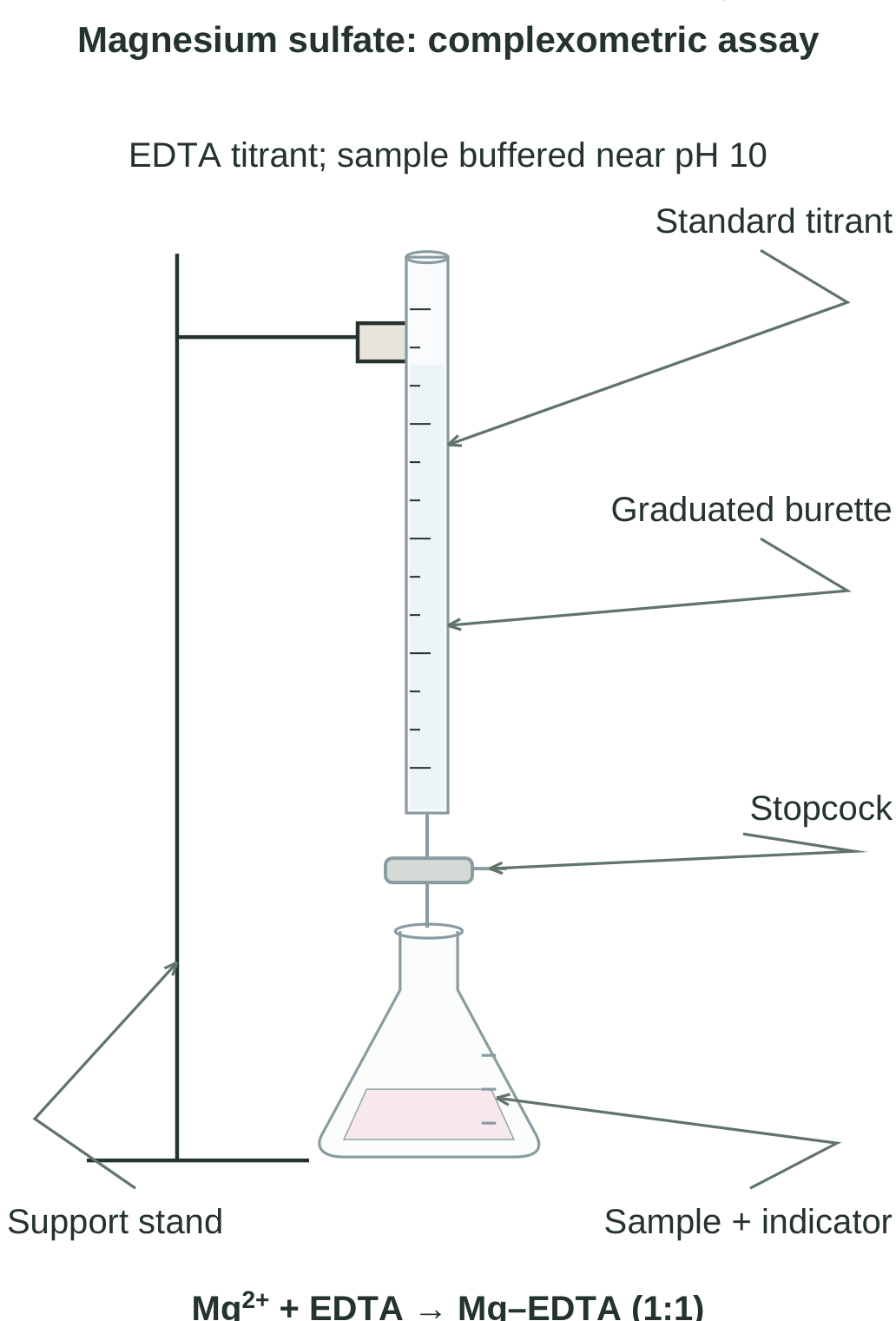
Diagram labels: Magnesium sulfate: complexometric assay; Titration apparatus; Standard titrant; Graduated burette; Stopcock; Sample + indicator; Support stand; EDTA titrant; Sample buffered near pH 10; Mg²⁺ + EDTA → Mg–EDTA (1:1).
17.4 Titration factors
At 0.05000 mol/L EDTA, each mL represents:
12.3235 mg MgSO₄·7H₂O;
6.0185 mg MgSO₄, if reported as anhydrous salt;
1.2153 mg Mg, if reported as elemental magnesium. Only one of these is the appropriate assay factor for a particular reporting basis. EDTA does not separately titrate the sulfate ion in this assay.
17.5 Worked example
For 0.2500 g MgSO₄·7H₂O, corrected EDTA volume = 20.20 mL and actual concentration = 0.05000 mol/L.
Mass found = 20.20 × 12.3235 = 248.93 mg.
Assay = 248.93/250.0 × 100 = 99.57% approximately.
If the sample contains other EDTA-reactive metal ions, they can consume titrant and bias a nonspecific assay unless adequately controlled.
17.6 Important precautions
Use the stated hydrate basis, prevent sample changes caused by unsuitable heating or storage, control pH and avoid excessive buffer-independent alkalinity that may precipitate magnesium hydroxide.
An indistinct endpoint may reflect wrong pH, deteriorated indicator, interfering metals or an unsuitable concentration. Adding more dye is not automatically the solution.
18. Estimation of calcium gluconate
18.1 Identity
Calcium gluconate contains one calcium ion with two gluconate anions. The common monohydrate formula is Ca(C₆H₁₁O₇)₂·H₂O, molar mass approximately 448.4 g/mol. The anhydrous form is approximately 430.37 g/mol.
The assay determines calcium complexometrically and expresses the amount as the specified calcium gluconate form. Gluconate is not counted as a second calcium ion.
18.2 Direct calcium endpoint
After dissolution, calcium reacts 1:1 with EDTA. Under suitable strongly alkaline conditions, a calcium indicator such as calcon gives a pink-to-blue endpoint.
An applicable sequence may titrate most calcium first, then add alkali and the indicator near equivalence to limit indicator exposure to strong alkali. The prescribed sequence matters for the actual method.
18.3 Stepwise direct assay
Step 1: accurately weigh and dissolve the sample using the specified water, temperature and any necessary acid.
Step 2: cool and establish the required final analytical conditions.
Step 3: titrate with standardized EDTA using the prescribed alkali and calcium-indicator sequence.
Step 4: determine the endpoint and corrected volume, then calculate on the stated hydrate basis.
18.4 Factor and worked example
At 0.05000 mol/L EDTA, 1 mL corresponds to 22.420 mg calcium gluconate monohydrate.
A 0.5000 g monohydrate sample requires 22.20 mL corrected EDTA. Mass found = 22.20 × 22.420 = 497.72 mg.
Assay = 497.72/500.0 × 100 = 99.54% approximately.
18.5 Magnesium-assisted endpoint variant
Some applicable calcium methods use a measured magnesium-containing reagent and an ammoniacal metal-indicator endpoint. Magnesium provides a sharper response from the indicator as calcium and magnesium are complexed.
The added magnesium also consumes EDTA and therefore requires the specified correction, often a matching reagent blank. At equal known molarities, its equivalent volume may be subtracted as the method specifies.
Do not combine the blank correction of this variant with a direct-calcon procedure that has no added magnesium. These are different endpoint systems.
18.6 Example of reagent correction
If a matching reagent blank consumes 5.00 mL EDTA and the sample plus reagents consumes 27.20 mL, net calcium-related volume is 22.20 mL, provided the method establishes this subtraction.
Use the actual concentrations if reagent strengths differ. Subtracting 5 mL merely because 5 mL of another solution was added is valid only with the established stoichiometry and strengths.
| Reporting species | One mL of 0.05000 mol/L EDTA represents |
|---|---|
| MgSO₄·7H₂O | 12.3235 mg salt |
| Calcium gluconate monohydrate | 22.420 mg salt |
| Mg²⁺ as element | 1.2153 mg Mg |
| Ca²⁺ as element | 2.004 mg Ca |
Core idea
The metal-to-EDTA ratio is 1:1. Hydration and the chosen reporting species determine the mass factor, while valence does not change this molar ratio.
19. Redox titrations: foundation
19.1 Oxidation and reduction
Oxidation is loss of electrons or an increase in oxidation number. Reduction is gain of electrons or a decrease in oxidation number. They occur together because electrons released by one species are accepted by another.
An oxidizing agent accepts electrons and is reduced. A reducing agent donates electrons and is oxidized.
Fe²⁺ → Fe³⁺ + e⁻ is oxidation.
Ce⁴⁺ + e⁻ → Ce³⁺ is reduction.
Combined: Ce⁴⁺ + Fe²⁺ → Ce³⁺ + Fe³⁺.
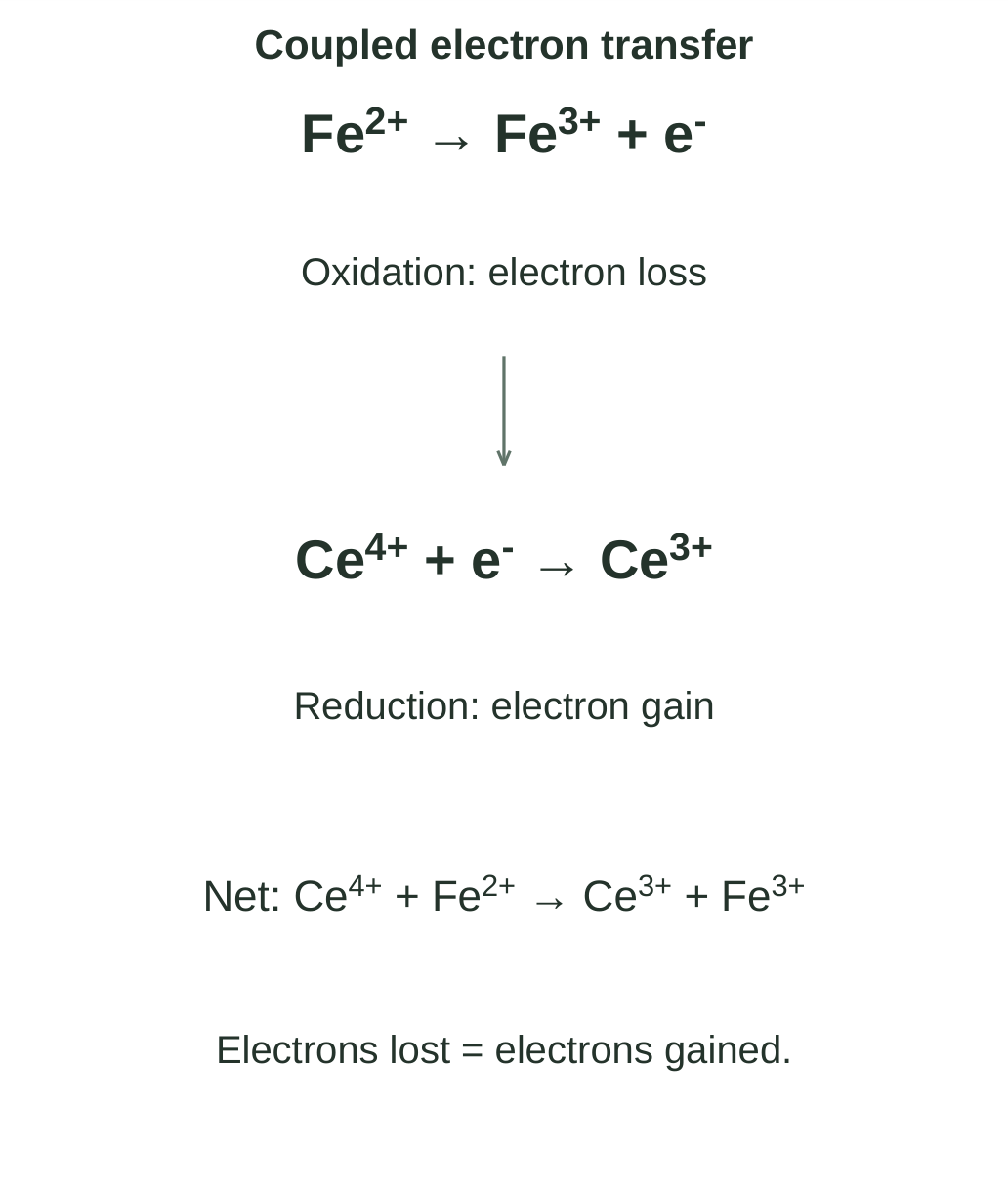
Diagram labels: Coupled electron transfer; Fe²⁺ → Fe³⁺ + e⁻; Oxidation: electron loss; Ce⁴⁺ + e⁻ → Ce³⁺; Reduction: electron gain; Net: Ce⁴⁺ + Fe²⁺ → Ce³⁺ + Fe³⁺; Electrons lost = electrons gained.
19.2 Analytical requirements
The reaction must be rapid enough, sufficiently complete and of known electron stoichiometry. The medium determines the reacting forms and may alter products, formal potentials and endpoint behaviour.
A balanced equation includes atoms, charge and electrons. Never calculate a factor from an unbalanced skeleton reaction.
19.3 Endpoint detection
| Endpoint type | Example |
|---|---|
| Self-indicator | Persistent excess permanganate colour |
| Redox indicator | Ferroin changes according to the solution redox potential |
| Specific indicator | Starch detects iodine/triiodide |
| Instrumental | Potential change measured with suitable electrodes |
Specific iodine detection by starch is not the same mechanism as a general redox indicator undergoing its own oxidation-reduction equilibrium.
19.4 Redox equivalent mass
Equivalent mass = molar mass / electrons transferred per formula unit in the specified reaction.
In acid medium KMnO₄ accepts 5 electrons per permanganate, so its equivalent mass is approximately 158.03/5 = 31.61 g/eq.
Ce⁴⁺ accepts one electron, so its molarity and electron-equivalent concentration have the same numerical value. I₂ accepts two electrons, so 0.050 mol/L I₂ is 0.100 eq/L for its reduction to iodide.
19.5 General electron balance
If oxidant accepts a electrons per mole and analyte releases b per mole, a × noxidant = b × nanalyte.
Use this electron equation or the fully balanced reaction to obtain the mole ratio. A memory factor from a different medium or analyte can give a wrong result.
20. Permanganometry
20.1 Principle and medium
Potassium permanganate is a strong oxidizing titrant. In suitable acidic solution, Mn(VII) in MnO₄⁻ is reduced to Mn²⁺:
MnO₄⁻ + 8H⁺ + 5e⁻ → Mn²⁺ + 4H₂O.
Sulfuric acid is commonly used in applicable methods. HCl can introduce chloride that may be oxidized under the conditions; nitric acid can cause other oxidizing interference. The acid is selected for the actual reaction.
In neutral or insufficiently acidic media, MnO₂ formation can occur. It changes the reaction and may obscure the endpoint; do not use the acidic 5-electron factor automatically in that case.
20.2 Preparation and standardization
KMnO₄ is not ordinarily weighed as a reliable primary standard for solution strength. Prepare an approximate solution, condition and filter it as prescribed to remove interfering material or MnO₂, and protect it appropriately.
A suitable primary oxalate standard, such as sodium oxalate, can establish the strength in acid medium. The oxalate reaction is temperature-dependent and may begin slowly, becoming faster as Mn²⁺ is produced.
2MnO₄⁻ + 5C₂O₄²⁻ + 16H⁺ → 2Mn²⁺ + 10CO₂ + 8H₂O.
20.3 Standardization sequence
Step 1: accurately weigh suitable sodium oxalate and dissolve it in the prescribed dilute sulfuric-acid medium.
Step 2: establish the prescribed warm reaction conditions, commonly around 60–70°C in teaching procedures.
Step 3: titrate with mixing, allowing the initial additions to react before adding more rapidly.
Step 4: near completion, add dropwise to the first faint-pink excess persisting for the method’s stated time.
Step 5: calculate concentration using 2 mol permanganate per 5 mol oxalate.
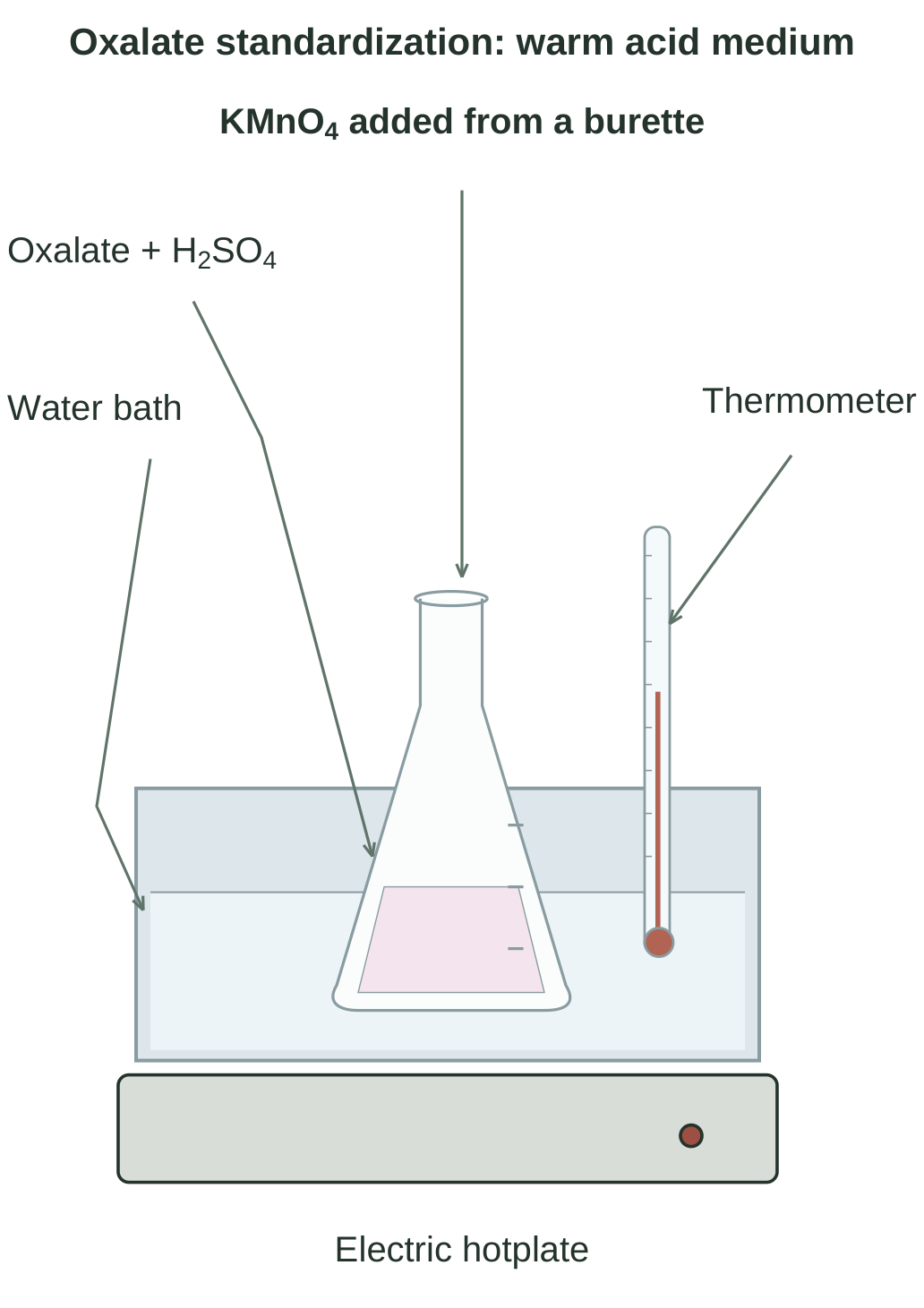
Diagram labels: Oxalate standardization: warm acid medium; Electric hotplate; Thermometer; Water bath; Oxalate + H₂SO₄; KMnO₄ added from a burette.
20.4 Standardization numerical
0.16750 g Na₂C₂O₄, molar mass 134.00 g/mol, gives 1.250 mmol oxalate. It consumes 25.00 mL KMnO₄.
Permanganate amount = (2/5) × 1.250 = 0.5000 mmol.
CKMnO₄ = 0.5000/25.00 = 0.02000 mol/L, or 0.1000 eq/L for the acidic 5-electron reaction.
20.5 Iron(II) determination
MnO₄⁻ + 5Fe²⁺ + 8H⁺ → Mn²⁺ + 5Fe³⁺ + 4H₂O.
One mole permanganate oxidizes five moles Fe²⁺. At 0.02000 mol/L KMnO₄, each mL corresponds to 0.1000 mmol Fe, or approximately 5.5845 mg Fe.
Example: 18.00 mL corresponds to 100.52 mg Fe under this reaction. To report as a particular ferrous salt, use its correct formula and hydrate mass.
20.6 Limitations
Organic contamination, inappropriate acidity, slow kinetics, premature endpoints and prolonged exposure of reducing samples to air can bias results. A persistent brown solid suggests that the intended acidic manganese pathway may not be maintained.
21. Cerimetry
21.1 Principle
Cerimetry uses Ce(IV) as oxidant, commonly in a suitable acidic sulfate medium. The fundamental reduction is Ce⁴⁺ + e⁻ → Ce³⁺.
With iron(II), Ce⁴⁺ + Fe²⁺ → Ce³⁺ + Fe³⁺. The ratio is 1:1, unlike the 1:5 permanganate/Fe²⁺ ratio in acidic permanganometry.
21.2 Titrant and standardization
A suitable cerium(IV) salt is dissolved in the prescribed acidic medium to produce an approximate reagent. Standardize against an appropriate characterized reducing standard or a freshly standardized Fe²⁺ solution through a validated traceability chain.
If a standardized Fe²⁺ solution is used, CCeVce = CFeVfe for the 1:1 reaction, after any corrections. Fe²⁺ solution must be protected against oxidation and its actual concentration known.
21.3 Endpoint
A suitable redox indicator, such as ferroin in applicable methods, changes colour as the potential rises after the reducing analyte is consumed. The common ferroin reduced form is red; the oxidized form is pale blue.
Ce(IV)’s yellow colour may provide information at suitable concentrations, but a faint excess is not always a sufficiently sensitive self-indicator. Use the prescribed indicator or potentiometric detection.
21.4 Calculation example
20.00 mL of 0.1000 mol/L Fe²⁺ requires 19.90 mL Ce(IV). Known Fe²⁺ = 2.000 mmol.
CCe = 2.000/19.90 = 0.1005 mol/L approximately.
For an assay using 15.00 mL of this reagent, Fe represented = 15.00 × 0.1005 × 55.845 ≈ 84.19 mg.
21.5 Comparison with permanganometry
| Property | Permanganometry | Cerimetry |
|---|---|---|
| Oxidant | MnO₄⁻ | Ce(IV) |
| Acidic electron change | 5 per MnO₄⁻ | 1 per Ce(IV) |
| Common endpoint | Faint excess pink | Redox indicator or potential |
| Fe²⁺ mole ratio | 1:5 | 1:1 |
| Important condition | Correct acid pathway | Suitable acidic Ce(IV) medium |
Both methods require complete reaction and control of interfering reducing or oxidizing substances. A reagent’s strong oxidizing power does not make it selective for only one analyte.
22. Iodimetry and iodometry
22.1 Iodimetry: direct iodine titration
Iodimetry uses standardized iodine to titrate a reducing analyte directly. I₂ + 2e⁻ → 2I⁻.
Iodine has limited solubility in water. Dissolving it with iodide forms triiodide: I₂ + I⁻ ⇌ I₃⁻. The usual I₂ notation expresses the oxidizing iodine stoichiometry even when solution speciation includes I₃⁻.
An excess of iodine near the endpoint produces a persistent starch-iodine colour in a suitable method. The first excess iodine is being detected, rather than removal of the reducing analyte by precipitation.
22.2 Preparation and strength
Prepare iodine solution using the prescribed iodide-containing medium, protect against volatilization and light, and standardize against a suitable known reducing reagent or standardized thiosulfate.
I₂ + 2S₂O₃²⁻ → 2I⁻ + S₄O₆²⁻.
Thus one mole iodine consumes two moles thiosulfate. Use the actual thiosulfate concentration; the two reagents have different molarity-to-normality relationships.
22.3 Iodometry: indirect iodine measurement
In iodometry, an oxidizing analyte liberates iodine from excess iodide. The liberated iodine is titrated with standardized sodium thiosulfate.
Oxidant + I⁻ → reduced analyte + I₂, followed by I₂ + 2S₂O₃²⁻ → 2I⁻ + S₄O₆²⁻.
The iodine/thiosulfate reaction is fixed, but the initial analyte/iodide reaction determines the final analyte factor. Write both reactions before calculation.
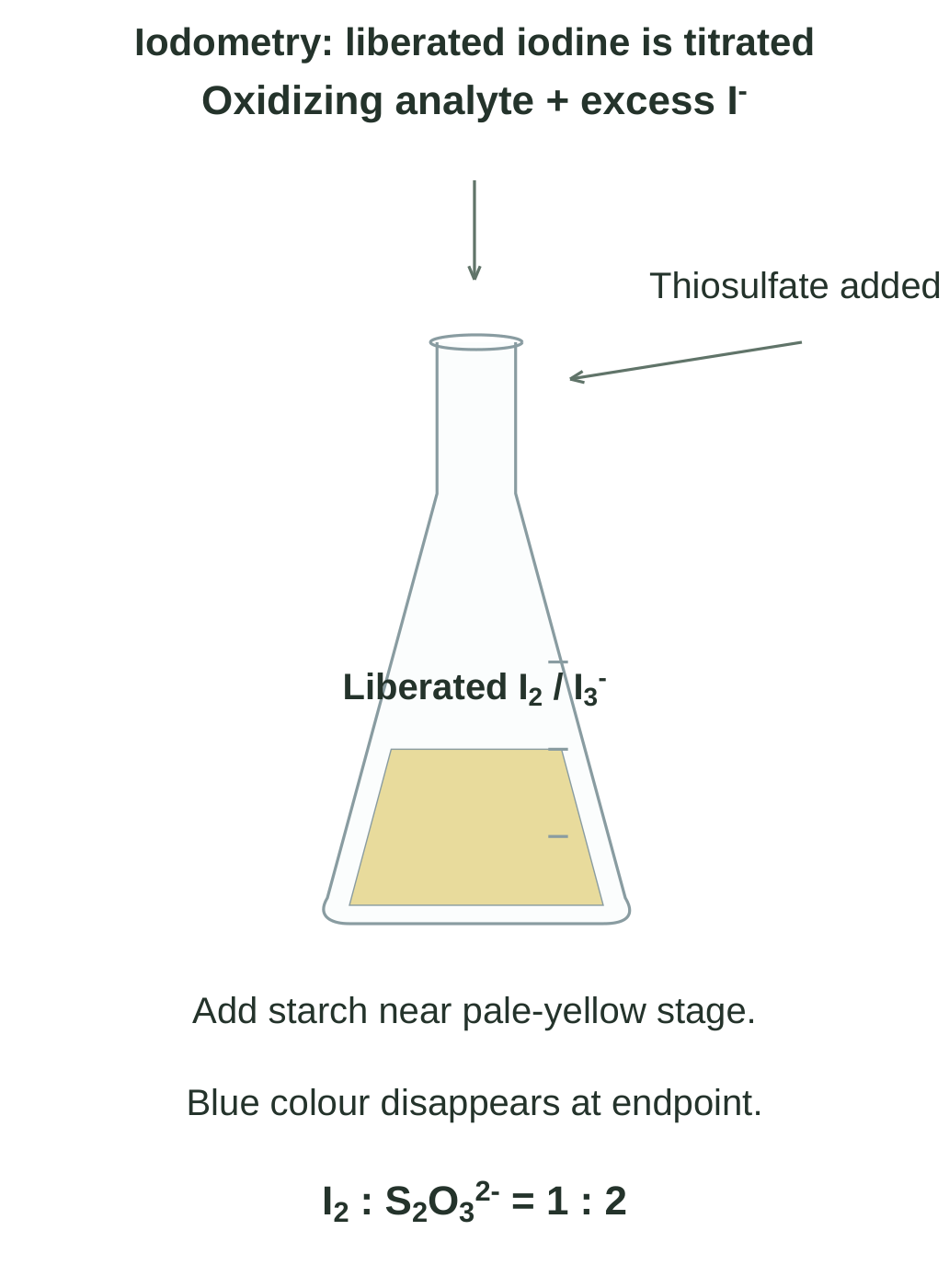
Diagram labels: Iodometry: liberated iodine is titrated; Oxidizing analyte + excess I⁻; Liberated I₂/I₃⁻; Thiosulfate added; Add starch near pale-yellow stage; Blue colour disappears at endpoint; I₂ : S₂O₃²⁻ = 1 : 2.
22.4 Starch and endpoints
Starch gives a sensitive blue complex with iodine-containing species. In iodometric thiosulfate titration it is commonly added near the endpoint when the solution is pale yellow, then titration continues until the blue colour disappears.
Adding starch very early at high iodine concentration can make iodine retention and slow release more troublesome. In direct iodimetry the method may use starch differently; follow that endpoint sequence.
22.5 Thiosulfate preparation
Sodium thiosulfate solution is prepared approximately using the prescribed water and stabilizing conditions, then standardized. Microbial activity, acidity and storage can alter its strength.
In strongly acidic conditions thiosulfate can decompose; acidification of the iodine-liberation stage does not justify excessive acid during the later titration.
22.6 Standardization using KIO₃
Potassium iodate can provide a known iodine amount in the presence of iodide and acid:
IO₃⁻ + 5I⁻ + 6H⁺ → 3I₂ + 3H₂O.
The 3 mol I₂ consume 6 mol thiosulfate per mol iodate. Therefore Cthio = 6nKIO₃/Vthio.
Example: 0.08917 g KIO₃, molar mass ≈ 214.00 g/mol, contains about 0.4167 mmol. It generates iodine requiring 2.500 mmol thiosulfate. If titre = 25.00 mL, Cthio ≈ 0.1000 mol/L.
22.7 Assay example: peroxide
In suitable acidic conditions: H₂O₂ + 2I⁻ + 2H⁺ → I₂ + 2H₂O.
One mole H₂O₂ liberates one mole I₂ and consumes two moles thiosulfate. At 0.1000 mol/L thiosulfate, each mL represents 1.7007 mg H₂O₂.
For 20.00 mL corrected titre, H₂O₂ represented = 34.01 mg. Apply the sample dilution factor and appropriate reporting basis before calculating percentage.
22.8 Practical limitations
Iodine can be lost by volatilization; air oxidation of iodide can add a blank; unsuitable acidity and light can affect the sequence. Keep the reaction conditions, timing and closure of iodine-containing vessels consistent.
| Method | Endpoint direction |
|---|---|
| Iodimetry | Persistent excess iodine, commonly blue with starch |
| Iodometry | Liberated iodine is consumed; blue starch colour disappears |
Memory key
Iodimetry measures a reducing analyte with iodine. Iodometry measures an oxidizing analyte through the iodine it liberates.
23. Titrations with potassium iodate
23.1 Why iodate is useful
KIO₃ is a stable oxidizing reagent available in suitable primary-standard quality. Its molar mass is approximately 214.00 g/mol. The endpoint and stoichiometry depend strongly on the reaction medium and iodine product.
In acidic iodide-containing systems: IO₃⁻ + 5I⁻ + 6H⁺ → 3I₂ + 3H₂O. This reaction is useful for generation of a known iodine amount and thiosulfate standardization.
23.2 Direct oxidation and electron factors
If iodate is reduced from iodine oxidation state +5 to iodide −1, it accepts six electrons per iodate. Its equivalent mass for that reduction is M/6.
If the endpoint product is iodine(+1), such as ICl in a suitable strongly hydrochloric medium, the change is four electrons per iodate. The factor is different; it must come from the balanced reaction.
23.3 Strong hydrochloric-medium iodide titration
A classical iodate method can titrate iodide in sufficiently strong HCl, where iodine formed initially is ultimately converted to iodine monochloride:
IO₃⁻ + 2I⁻ + 6H⁺ + 3Cl⁻ → 3ICl + 3H₂O.
One mole iodate corresponds to two moles of sample iodide in this reaction. This is not the five-iodide iodine-liberation equation used in the thiosulfate-standardization stage.
23.4 Endpoint behaviour
In a prescribed immiscible indicator solvent, molecular iodine initially colours the organic layer. At the endpoint, conversion to the iodine(+1) product removes the characteristic molecular-iodine colour.
The solvent, acid strength, shaking and endpoint conditions are method-specific. A disappearing organic iodine colour should not be described as the same starch endpoint used in routine aqueous iodometry.
23.5 Numerical comparison
For the iodide-to-ICl reaction, 10.00 mL of 0.01000 mol/L KIO₃ is 0.1000 mmol iodate and corresponds to 0.2000 mmol iodide.
If expressed as KI, molar mass ≈ 166.00 g/mol, this represents 33.20 mg KI.
For iodine generation with excess iodide, the same iodate amount generates 0.3000 mmol I₂ and consumes 0.6000 mmol thiosulfate. The two calculations concern different analytical reactions.
23.6 Reagent preparation
A nominal 0.01000 mol/L KIO₃ solution requires 2.1400 g/L for a pure material. Include the certified purity and prescribed conditioning when preparing an accurately known solution.
Protect it from contamination and document concentration. Primary-standard status depends on the actual grade, purity and handling; a chemical name alone does not certify the material.
24. Calculation practice and method selection
24.1 One calculation framework
Identify the reaction → balance it → calculate titrant moles → use the mole ratio → convert to the specified analyte mass → apply corrections → report percentage or concentration.
Direct 1:1 titration: mass (mg) = V × C × M.
Direct general ratio: mass (mg) = V × C × (a/b) × M.
Back-titration: calculate reagent added and reagent remaining in moles before taking their difference.
Gravimetry: net product mass × gravimetric factor × aliquot factor.
24.2 Assay-factor summary
| Specified reagent | Mass represented by 1 mL |
|---|---|
| 0.1000 mol/L HCl | 1.703 mg NH₃, for 1:1 neutralization |
| 0.1000 mol/L HClO₄ | 14.411 mg sodium benzoate, 1:1 |
| 0.1000 mol/L AgNO₃ | 5.844 mg NaCl, 1:1 |
| 0.05000 mol/L EDTA | 12.3235 mg MgSO₄·7H₂O |
| 0.05000 mol/L EDTA | 22.420 mg calcium gluconate monohydrate |
| 0.02000 mol/L KMnO₄ | 5.5845 mg Fe, acidic 1:5 reaction |
| 0.1000 mol/L Ce(IV) | 5.5845 mg Fe, 1:1 reaction |
| 0.1000 mol/L thiosulfate | 1.7007 mg H₂O₂, specified iodometric reaction |
Factors are tied to the stated concentration, analyte form and reaction. Multiply by the actual concentration factor only once.
24.3 Blank correction example
For a direct titration, sample titre = 18.40 mL and reagent blank = 0.20 mL. Applicable corrected titre = 18.20 mL.
If actual concentration is 0.0980 mol/L for nominal 0.1000 mol/L, use either V × 0.0980 × M or V × nominal factor × 0.980. These are equivalent approaches.
24.4 Back-titration with unequal strengths
An analyte consumes a portion of 30.00 mL of 0.1000 mol/L reagent. Residual reagent requires 10.00 mL of 0.08000 mol/L back-titrant in a 1:1 reaction.
Added = 3.000 mmol; remaining = 0.8000 mmol. Consumed = 2.200 mmol.
Subtracting volumes gives 20.00 mL, but multiplying that by either concentration would be wrong. Convert each volume to moles separately.
24.5 Aliquot example
An accurately weighed 0.5000 g sample is dissolved and made to 100.0 mL. A 20.00 mL aliquot contains one-fifth of the original sample. If assay finds 98.0 mg analyte in the aliquot, original analyte = 490.0 mg.
Purity = 490.0/500.0 × 100 = 98.0%. Do not divide aliquot analyte mass directly by the full original mass.
24.6 Choosing the method
| Analytical feature | Suitable consideration |
|---|---|
| Strong aqueous acid or base | Aqueous neutralization with an appropriate endpoint |
| Very weak or insoluble acid/base | Validated non-aqueous titration |
| Chloride | Suitable argentometric method with matrix control |
| Metal ion | EDTA method with pH, indicator and interference control |
| Reducing analyte | Suitable oxidizing titrant such as iodine, Ce(IV) or permanganate |
| Oxidizing analyte | Applicable iodometry or another reducing titrant |
| Stable insoluble weighing form | Gravimetric separation and weighing |
24.7 Final error checklist
Was the correct endpoint selected for the medium?
Is the standard concentration actual rather than merely nominal?
Is the equation balanced in atoms and charge?
Does the factor match the salt and hydrate form?
Were blank, aliquot and purity-basis corrections included once?
Could another ion or compound consume the same reagent?
Quick Revision
Equivalence is stoichiometric; endpoint is observed.
Indicator transition should lie in the steep curve region.
Acidic indicator: HIn ⇌ H⁺ + In⁻.
Weak acid/strong base equivalence is usually alkaline.
Strong acid/weak base equivalence is usually acidic.
HCl: standardize against suitable Na₂CO₃, 2:1 acid/carbonate.
NaOH: standardize against KHP, 1:1.
Aqueous ammonia is commonly assayed as NH₃.
Non-aqueous solvents change apparent acid-base strength.
Sodium benzoate/HClO₄ reacts 1:1.
Mohr: silver chromate endpoint.
Volhard: ferric-thiocyanate endpoint.
Fajans: adsorption-indicator surface colour.
Gravimetry requires a pure known weighing form and constant mass.
BaSO₄ mass must be converted if reporting sulfate or barium.
Metal/EDTA ratio is 1:1; pH controls conditional stability.
Masking prevents interference; demasking releases the ion.
Use the correct hydrate in MgSO₄ and calcium gluconate factors.
Acidic KMnO₄ accepts 5 electrons; Ce(IV) accepts 1.
Iodimetry uses iodine directly; iodometry measures liberated iodine.
I₂ consumes 2 mol thiosulfate per mole.
KIO₃ stoichiometry depends on the medium and product.
Numerical Self-Test
A 1:1 assay uses 15.00 mL of 0.1000 mol/L titrant. Find analyte moles.
Find NaCl represented by 20.00 mL 0.1000 mol/L AgNO₃.
Find MgSO₄·7H₂O represented by 10.00 mL 0.05000 mol/L EDTA.
How many mmol thiosulfate react with 0.50 mmol iodine?
Answers: 1. 1.500 mmol; 2. 116.88 mg; 3. 123.235 mg; 4. 1.00 mmol.
Possible Examination Questions
Long-Answer Questions
Explain indicator theories and compare neutralization curves with indicator selection.
Describe preparation and standardization of HCl and NaOH.
Classify non-aqueous solvents and explain sodium benzoate assay.
Compare Mohr, Volhard, modified Volhard and Fajans methods.
Explain gravimetric operations and BaSO₄ calculations.
Describe EDTA titrations, metal indicators and masking/demasking.
Explain magnesium sulfate and calcium gluconate estimation.
Compare permanganometry, cerimetry, iodimetry, iodometry and iodate methods.
Short Notes
Endpoint versus equivalence point.
Half-equivalence in a weak-acid titration.
Assay of aqueous ammonia.
Levelling and differentiating solvents.
Why AgCl needs protection in chloride back-titration.
Digestion, coprecipitation and constant mass.
pH dependence of EDTA complexes.
Starch addition near an iodometric endpoint.
Medium-dependent redox factors.
Final Self-Check
Can you label a burette, stopcock, filter and crucible? Can you explain the colour change without confusing a precipitate, a soluble complex and an adsorbed dye?
Can you calculate from moles before converting to mass, identify the correct hydrate and distinguish a direct assay from a back-titration?
NotesGallery
Revise equations and green comparison tables. Practise diagrams and calculations independently, keeping the reaction conditions and units visible.
25. Detailed Explanations and Worked Reasoning
25.1 Connecting the Burette Reading to the Chemical Amount
A burette measures the volume delivered between two readings. It does not directly measure analyte mass, and its final reading alone is not the titre unless the initial reading was exactly zero. For an initial reading of 1.20 mL and final reading of 23.65 mL, delivered volume is 22.45 mL. This distinction matters when a burette is refilled or when an analyst begins at a convenient readable position rather than resetting the meniscus unnecessarily.
The amount delivered follows from concentration and volume. A 0.1000 mol/L reagent contains 0.1000 mmol per millilitre. Therefore, 22.45 mL delivers 2.245 mmol. The numerical multiplication is particularly convenient in millimoles, but the meaning remains concentration multiplied by volume. Writing 22.45 × 0.1000 as 2.245 mol would introduce a thousandfold error.
The next step is the reaction ratio. If one mole of analyte reacts with two moles of titrant, 2.245 mmol titrant represents 1.1225 mmol analyte. If the ratio is one-to-one, it represents 2.245 mmol analyte. Only after establishing this ratio should molar mass enter the calculation. Formula mass cannot repair an incorrect mole ratio.
An analytical result also needs a defined sample. A titre from a 10.00 mL aliquot refers initially to that aliquot. If it came from a 100.0 mL preparation, multiply the measured analyte amount by ten to obtain the amount in the complete preparation. This scaling is independent of the chemical stoichiometry and should appear as a separate factor rather than being hidden in an unexplained constant.
25.2 Why a Standardization Factor Must Be Applied Once
The concentration factor compares actual and nominal reagent strength. If a bottle is labelled nominally 0.1000 mol/L but standardization gives 0.09960 mol/L, its factor is 0.9960. Each delivered millilitre contains slightly less reactive substance than the nominal label suggests. The factor modifies amount, not the observed burette volume itself.
Two calculation routes are equivalent. The first uses actual concentration directly: amount = volume × 0.09960. The second uses nominal concentration followed by factor: amount = volume × 0.1000 × 0.9960. Since both products are identical, an analyst should choose one route and show it clearly. Multiplying the actual concentration by 0.9960 again would reduce the calculated amount twice.
For example, a 20.00 mL titre contains 1.992 mmol of a 0.09960 mol/L reagent. Calculating 20.00 × 0.1000 × 0.9960 also gives 1.992 mmol. A result of 1.984 mmol would indicate that a second factor had probably been introduced. This comparison is a useful audit when an assay worksheet already contains a nominal milligram-per-millilitre factor.
A factor should be linked to its standardization date, reagent composition and conditions. It describes the solution tested, not every solution prepared from the same chemical name. A later dilution creates a new concentration requiring its own calculation and appropriate verification. Likewise, a factor measured before substantial solvent evaporation cannot automatically describe the altered reagent afterwards.
25.3 Interpreting Indicator Equilibria Without Memorizing Colours Alone
For an acidic indicator, the equilibrium HIn ⇌ H⁺ + In⁻ connects colour to the relative amounts of two forms. Increasing hydrogen-ion activity shifts the balance toward HIn; decreasing it shifts toward In⁻. The equation does not assign red, yellow, pink or blue universally. Those colours depend on the particular indicator structures.
At pH equal to the indicator pKa, the simple concentration approximation gives equal amounts of acid and base forms. One pH unit below pKa, the base-to-acid ratio is about 0.1; one pH unit above it, the ratio is about 10. These ratios explain the commonly quoted transition interval. They do not mean that every observer perceives equal colour intensity at equal molecular concentration, because the forms can absorb light differently.
The quinonoid explanation addresses that structural difference. A change in protonation can alter conjugation and the wavelengths absorbed. Ionization theory describes how composition responds to acidity; structural theory describes why that compositional change becomes visible. A complete answer can connect both rather than presenting them as mutually exclusive accounts.
Practical indicator choice requires more than knowing its transition range. Sample colour, turbidity, indicator amount and solvent composition influence visibility. A brilliantly visible indicator is unsuitable if it changes before the analyte has reacted quantitatively. Conversely, a theoretically appropriate indicator may require instrumental replacement when the sample masks its colour. The analytical question is whether the observed transition reliably represents the intended reaction completion under the stated conditions.
25.4 Following the Four Regions of a Neutralization Curve
A useful way to study a titration curve is to divide it into initial solution, pre-equivalence, equivalence and post-equivalence regions. The dominating species changes between these regions, so one pH equation cannot generally describe the entire curve. The volume at equivalence follows stoichiometry even when the equivalence pH depends on hydrolysis.
For strong acid titrated with strong base, residual acid determines pH before equivalence. At equivalence, the acid and base have neutralized in the prescribed ratio. Under the ideal dilute assumptions used in the notes at 25°C, the solution is approximately neutral. After equivalence, excess hydroxide determines pH. Both residual amount and total mixed volume are needed for concentration.
For weak acid titrated with strong base, the initial solution is governed by acid dissociation. The pre-equivalence mixture contains acid and its conjugate base, so buffer reasoning becomes appropriate over a suitable range. At half-equivalence, their amounts are equal and pH is approximately pKa. At equivalence, conjugate-base hydrolysis makes the solution alkaline; after equivalence, sufficient excess strong base dominates.
This sequence explains why the half-equivalence equation should not be used at the equivalence point. At half-equivalence, both buffer components remain in appreciable quantities. At equivalence, the original acid has been largely converted to its salt. The change is chemical, not just a different point on a graph. Drawing the curve with those species labelled makes indicator selection much easier than memorizing its shape without explanation.
25.5 Separating Carbonate’s First and Second Neutralization Stages
Carbonate accepts protons in two stages. The first produces bicarbonate, and further protonation ultimately produces carbon dioxide and water under the full-neutralization conditions. Consequently, one mole of sodium carbonate consumes two moles of hydrochloric acid at the complete endpoint. An endpoint corresponding only to the first stage cannot be used with the full two-proton factor.
Suppose 1.000 mmol carbonate is present. Reaching the bicarbonate stage requires approximately 1.000 mmol acid, whereas full neutralization requires 2.000 mmol. If an analyst stops at the first stage but calculates concentration using two acid moles per carbonate, the acid concentration will be overestimated. The measured volume is too small for the assumed reaction completion.
Carbon dioxide complicates the final region because its dissolution and removal influence acidity and endpoint appearance. A procedure may specify warming near the endpoint, cooling and completing the titration. These instructions are part of the method’s control of the carbonate system. They should not be replaced by arbitrary prolonged boiling, which can introduce transfer, evaporation or handling problems.
The sodium carbonate mass must also represent the intended material. Moisture, purity and conditioning affect how many carbonate moles the weighed portion supplies. If the standard has an assigned purity, multiply the weighed mass by that fraction before dividing by molar mass. The word primary standard describes suitability under specified purity and handling conditions; it does not make weighing and endpoint selection irrelevant.
25.6 Explaining Why NaOH Cannot Be Treated Like a Primary Standard
The theoretical mass of pure NaOH needed for one litre of a 0.1000 mol/L solution is 4.000 g. That calculation is chemically correct, but ordinary pellets can contain absorbed water and carbonate. The total pellet mass is therefore not necessarily an accurately known NaOH mass. Standardization determines the concentration of the actual prepared solution.
KHP supplies one titratable acidic proton per formula unit in its aqueous reaction with hydroxide. Its known amount gives a direct one-to-one relationship with NaOH. An accurately weighed 0.40844 g portion corresponds to 2.000 mmol at a molar mass of 204.22 g/mol. If this requires 20.10 mL NaOH, actual concentration is approximately 0.09950 mol/L.
The endpoint must correspond to the selected standardization reaction. A faint persistent phenolphthalein colour is a method-defined observation, not permission to add enough base for a deep permanent pink. Excess titrant after the prescribed endpoint increases the apparent volume and lowers the calculated concentration from the same KHP amount.
Protecting NaOH from carbon dioxide is also a control of composition. Carbonate formation changes how the reagent behaves across different endpoint conditions. A solution should not be assumed unchanged simply because it remains clear. Record actual concentration, factor and date, use appropriate storage, and follow the laboratory’s restandardization practice. The distinction between preparation and standardization applies equally to later assay calculations based on this reagent.
25.7 Understanding the Reporting Basis of Aqueous Ammonia
The expression ammonium hydroxide is widely used for aqueous ammonia, but the equilibrium contains ammonia, ammonium and hydroxide rather than only isolated NH₄OH molecules. Acidimetric assays commonly report ammonia content as NH₃. The reporting basis determines the molar mass used after calculating the amount neutralized.
One mole of ammonia reacts with one mole of hydrochloric acid. A 10.00 mL titre of 0.1000 mol/L HCl therefore represents 1.000 mmol NH₃, or about 17.03 mg. Expressing the same mole amount as a different formula would produce a different mass. That is a reporting conversion, not a change in the observed titration or the number of acid equivalents consumed.
Volatility gives this assay a practical feature not shared by a stable nonvolatile salt. If ammonia escapes before it reacts with the measured acid, less remains to consume titrant. A direct assay can then give a low result. Prompt transfer and the prescribed sample-handling sequence help maintain a representative amount.
A back-titration variant can retain ammonia by reaction with a measured acid excess. The residual acid is determined afterwards. Such a result must be calculated from acid added minus acid remaining, with the applicable reaction ratios. It should not be combined with a direct-titration blank rule without examining the scheme. The central questions remain: what species was captured, what amount reacted, and as which species must the result be reported?
25.8 Using Solvent Classification as Analytical Reasoning
Protogenic, protophilic, amphiprotic and aprotic classifications describe how a solvent participates in proton transfer. A protogenic solvent can donate protons, while a protophilic solvent can accept them. An amphiprotic solvent can participate in both ways. An aprotic solvent lacks a readily transferable proton in this classification, but it may still influence solvation, polarity and ion pairing strongly.
Weak bases may become more readily titratable in a suitable acidic medium because the solvent supports proton transfer to the analyte. Weak acids may be better determined in a suitable proton-accepting environment. The solvent is therefore part of the analytical system. It changes how the reaction proceeds and how the endpoint is observed.
Solubility and reaction completeness are separate requirements. Dissolving an analyte does not prove that its reaction with the selected titrant will be quantitative. Conversely, a favourable proton-transfer reaction cannot be measured accurately if the analyte remains undissolved and reacts slowly or incompletely. A suitable method must satisfy both requirements while keeping blanks and side reactions controlled.
Levelling and differentiating effects are also relative to the solvent. In a levelling medium, sufficiently strong species can appear similar because they generate the same solvent-derived acid or base. A differentiating medium can reveal distinctions hidden elsewhere. Neither term means that a solvent universally makes every acid stronger or weaker. Explain the proton-transfer participants and the analytical purpose rather than using the category as an isolated label.
25.9 Why Water, Temperature and Blanks Matter in Non-Aqueous Titration
Non-aqueous titrations are sensitive to solvent composition because the medium controls proton transfer and endpoint response. Water introduced with a sample, reagent or poorly protected solvent can alter that composition. The effect is not adequately described by saying that water always invalidates every non-aqueous assay; the acceptable amount and its influence depend on the validated system.
Organic solvent volume also varies with temperature. A concentration expressed per litre refers to a defined solution volume, and therefore to relevant temperature conditions. If standardization and assay are conducted under substantially different conditions, a nominal milligram-per-millilitre factor may no longer describe the delivered amount accurately enough for the method.
A matching blank measures reagent consumption or response caused by the solvent mixture and added reagents without analyte. It should contain the relevant components in the required proportions. A water blank cannot automatically stand in for an acetic-acid reagent blank simply because both lack the sample. The background must represent the actual assay chemistry.
When a direct-titration blank consumes the same titrant toward the same endpoint, sample volume minus blank volume can be appropriate. However, that rule should be justified rather than applied automatically to every back-titration. In a back-titration, a blank can represent the whole added reagent in the absence of analyte. The subtraction direction follows the scheme. Writing the blank reaction alongside the sample reaction is often the simplest way to avoid an incorrect correction.
25.10 Deriving the Sodium Benzoate Factor
Sodium benzoate contains the benzoate anion, which accepts a proton to form benzoic acid in the specified non-aqueous acidimetric system. Sodium is the counterion. The balanced assay reaction gives one mole of sodium benzoate per mole of perchloric acid. It does not require an assumed reaction of the sodium ion with the acid.
For 0.1000 mol/L titrant, one millilitre contains 0.1000 mmol acid. Multiplying by 144.11 mg/mmol gives 14.411 mg sodium benzoate. This derivation explains the factor and prevents confusion with the lower molar mass of benzoic acid. The product formed at the endpoint is not automatically the species used to express the sample’s assay.
If sample titre is 20.80 mL and the matching direct blank is 0.10 mL, corrected volume is 20.70 mL. With nominal 0.1000 mol/L acid, this represents about 298.31 mg sodium benzoate. For a 300.0 mg sample, the corresponding percentage is approximately 99.44%. If actual concentration differs, include its factor once or use actual molarity directly.
Water content and reporting basis introduce separate corrections only when required. A dried-basis result differs from an as-received result because the denominator changes, not because the benzoate-to-acid mole ratio changes. Show the measured sample mass, analyte amount and requested basis separately so a reviewer can reconstruct the calculation without guessing which corrections were embedded in the factor.
25.11 Comparing Three Different Silver Endpoint Signals
In the Mohr method, the visible signal is a reddish-brown silver chromate precipitate after chloride has largely reacted. In the Volhard system, the signal is a ferric-thiocyanate colour after residual silver has been consumed. In the Fajans method, an adsorption indicator changes the appearance of the precipitate surface following charge reversal. The endpoint species are different even though silver participates in the analytical reaction.
The medium must support the particular signal. Mohr conditions preserve a suitable chromate response while limiting interfering silver precipitates. Volhard uses an acidic medium compatible with its ferric indicator and thiocyanate reaction. Fajans requires an appropriately ionized dye and a suitable precipitate surface. An indicator cannot simply be transferred from one procedure because the main analyte is still chloride.
For a direct chloride-silver reaction, the mole ratio is one-to-one. In a chloride back-titration, the analyte amount is obtained by subtracting residual silver from silver added. If both reagents have equal actual molarity, a volume difference can simplify the calculation. If they differ, calculate the two amounts separately before subtraction.
An exam comparison should name the titrant, indicator, medium, visible endpoint and distinctive limitation for each method. A statement such as all methods give a red endpoint is too vague: it hides whether the red material is a bulk precipitate, a soluble complex or an adsorbed dye. Those mechanisms explain the required operating conditions and the sources of endpoint error.
25.12 Following the Error Caused by Unprotected AgCl
In a Volhard chloride assay, a known silver excess first precipitates chloride as AgCl. The remaining silver is then measured using thiocyanate. This subtraction assumes that the second titration consumes thiocyanate only in the intended residual-silver reaction until the endpoint. Contact between thiocyanate and unprotected AgCl can disturb that assumption.
Thiocyanate can convert AgCl into less soluble AgSCN, releasing chloride. That reaction consumes additional thiocyanate beyond the amount required for the residual dissolved silver. The analyst may then infer that more silver remained after the original chloride precipitation than actually did. Since chloride is calculated as added silver minus remaining silver, the calculated chloride result becomes lower.
This chain of reasoning is more reliable than memorizing only the phrase low error. Identify the extra reaction, identify which measured volume it increases, and follow that increase through the assay equation. The direction then follows from the mathematics and chemistry together.
Filtration separates the AgCl before the residual-silver titration in a suitable classical sequence. Modified Volhard procedures instead use a prescribed protective coating approach. The purpose is to restrict unwanted contact between thiocyanate and AgCl, not to improve chloride stoichiometry by adding an arbitrary organic liquid. The coating reagent, mixing and endpoint conditions belong to the selected method. A modification must preserve quantitative precipitation and measurement of residual silver rather than merely produce a visibly separated layer.
25.13 Reading a Gravimetric Result as a Chemical Measurement
Gravimetry is sometimes described as a simple weighing method, but the analytical difficulty usually lies before the final balance reading. The sample must yield a product whose composition is known, whose recovery is sufficiently complete and whose contamination is controlled. A very precise mass reading does not make an impure precipitate an accurate measure of analyte.
The precipitated form and weighing form can be identical or different. If a precursor is converted during drying or ignition, the final chemical composition determines the gravimetric factor. The calculation should therefore name the material actually weighed. Using the formula of the first precipitate when the method produces another final form introduces a systematic error even when every balance reading is reproducible.
Constant mass supports the conclusion that the prescribed heating and cooling sequence has reached a stable result within its criterion. It does not establish chemical purity by itself. An impure product may also reach constant mass. Conversely, a clean product that absorbs moisture while standing can fail to give stable measurements unless cooled and handled correctly.
For an unknown containing sulfate, formation of BaSO₄ connects sulfate amount to product mass through a one-to-one mole relationship. The precipitate mass is first corrected for the empty container and any applicable blank. Then the sulfate-to-BaSO₄ molar-mass ratio converts that product mass to sulfate. The final percentage also requires a denominator representing the original sample or the specified reporting basis.
25.14 Digestion, Washing and the Balance Between Purity and Recovery
Controlled precipitation aims to produce particles that are large enough to filter and clean enough to weigh. Rapid formation under high supersaturation often creates many small particles. Their high surface area can retain contaminants and their small size can complicate filtration. Slow controlled addition with suitable mixing and temperature helps manage the process, but conditions remain specific to the analytical precipitate.
Digestion allows the solid to remain in contact with mother liquor under specified conditions. Dissolution and redeposition can favour larger particles and reduce some surface-related problems. This is different from washing, whose purpose is to remove soluble material adhering to the separated precipitate. Both operations can improve the result through different mechanisms.
Excessive washing can dissolve some product and reduce recovery. Unsuitable washing can also disperse colloidal material through peptization, allowing it to pass through the filter. A prescribed wash liquid may include electrolyte to maintain particle behaviour. The best wash is therefore not necessarily the purest available water; it is the liquid that removes relevant contaminants while preserving the product under the method’s conditions.
Coprecipitation collects impurities during formation of the analytical solid. Post-precipitation adds another solid later. Occlusion traps mother liquor or foreign material during crystal growth, whereas inclusion introduces foreign species into the lattice. These distinctions explain why a short rinse cannot solve every contamination mechanism. Some cases require controlled digestion or reprecipitation; others require an earlier change in sample treatment or separation.
25.15 Choosing the Correct Barium Sulfate Conversion
One mole of BaSO₄ contains one mole of sulfate and one mole of barium. The same precipitate can therefore support several reporting choices. If the result is required as BaSO₄, use the corrected product mass directly. If required as sulfate, multiply by approximately 96.06/233.39. If required as barium, multiply by approximately 137.33/233.39.
These ratios are less than one because sulfate and barium are each only part of the complete BaSO₄ formula mass. Together, their approximate masses add to the product mass. That provides a useful rough check on conversions. A sulfate mass larger than the BaSO₄ mass from which it was calculated should immediately prompt inspection of the factor or units.
For 0.46678 g pure BaSO₄, the amount is 2.000 mmol. It represents 0.19212 g sulfate or 0.27466 g barium using the stated molar masses. A question asking for percentage sulfate in a sample cannot be answered by reporting 0.46678 g without conversion. That number describes the weighing form rather than the requested analyte species.
If the precipitate arose from a 25.00 mL aliquot of a 250.0 mL sample solution, multiply the represented analyte mass by ten before relating it to the complete original sample. The gravimetric factor and aliquot factor solve different problems. Write them separately to show both the chemical conversion and the fraction of the original preparation actually measured.
25.16 Why EDTA Stoichiometry Is Independent of Metal Valence
EDTA can coordinate a metal through multiple donor atoms within one ligand molecule. Its multidentate binding explains why a single EDTA molecule can bind one metal ion even when the ion has a charge greater than one. Ligand donor count, metal charge and metal-to-ligand mole ratio are distinct concepts.
In the simple divalent-metal representation, M²⁺ + Y⁴⁻ ⇌ MY²⁻. The charges balance, and the coefficient ratio is one metal to one EDTA. Writing two EDTA molecules merely because the metal has charge +2 would produce an incorrect assay factor. The same one-to-one analytical relationship is used for the magnesium and calcium determinations described in this unit.
Acid-base behaviour still matters. EDTA exists in several protonation states, and the fully deprotonated binding fraction depends on pH. The conditional formation constant incorporates that availability in a simplified description. An intrinsically stable metal-EDTA complex does not imply equally favourable quantitative titration at every pH.
The metal itself may have competing equilibria, including hydroxide precipitation. Raising pH can improve ligand availability while simultaneously making an unwanted solid more likely. Suitable conditions balance these effects. A complete complexometry answer should state the one-to-one mole ratio, explain pH control, identify the indicator and acknowledge relevant interferences. Listing only the ligand’s six donor atoms does not explain why the endpoint is quantitative or why the chosen buffer is required.
25.17 Explaining the Metal-Indicator Endpoint
A metal indicator works by forming a coloured complex that differs from its unbound form. During titration, EDTA progressively binds the analyte metal. Near equivalence, it removes metal from the indicator complex, releasing the free indicator colour. The endpoint is therefore a competition involving metal, EDTA and indicator, rather than a direct colour reaction between EDTA and the dye.
The indicator complex must have appropriate stability. If it is too weak, the sample may not develop a useful initial colour. If too strong, EDTA may not release the dye sharply at the required stage. The chosen pH influences both complexation and indicator protonation, so an endpoint colour quoted without its medium can be misleading.
For a suitable magnesium-containing system near pH 10, an Eriochrome Black T-type endpoint changes from a red or violet metal complex to blue free indicator. A screened mixture can alter the observed shades. Calcium procedures using calcon under strongly alkaline conditions have their own colour sequence and reagent order. These descriptions should not be merged into one universal EDTA endpoint rule.
An indistinct endpoint can arise from the wrong pH, interfering metals, slow reaction, poor indicator condition or unsuitable amounts. Adding more indicator may increase the problem rather than solve it. Explain which equilibrium or observation is failing before deciding how a method should be corrected. In a formal assay, use the prescribed indicator and reagent sequence rather than improvising a mixture of remembered procedures.
25.18 Distinguishing Masking, Demasking and Physical Separation
Masking changes the participation of an interfering species while leaving it in the analytical solution. A masking ligand can hold an ion in a form that does not consume EDTA or disturb the indicator under the chosen conditions. The interferent is still present chemically; its reactivity has been controlled for that stage.
Demasking makes a previously masked ion available for a later determination. A change in conditions or a suitable reagent can release it from the protected form. The second measurement can then address an analyte that was intentionally excluded from the first reaction. Such a sequence is meaningful only when the stages remain selective and their stoichiometry is understood.
Physical separation differs because the interfering species is removed or partitioned into another phase. Filtration of an insoluble interferent is not masking simply because it prevents interference. Likewise, pH control may change conditional stability or promote precipitation without involving a separate masking ligand. An examination answer should identify what happens to the interfering species rather than grouping every selectivity measure under one term.
Difference methods also require care. If one titration measures total calcium plus magnesium and another measures calcium selectively, magnesium may be obtained by subtraction. The total must include the same calcium population represented in the selective result. Errors in both measurements influence the difference, so a small magnesium amount obtained from two large titres may have a relatively large uncertainty. The subtraction cannot compensate for incomplete selectivity in either stage.
25.19 Hydrates and the Mass Represented by an EDTA Titre
An EDTA titre first determines metal amount. Converting that amount into a salt mass requires the correct formula, including its hydration state. Magnesium sulfate heptahydrate and anhydrous magnesium sulfate each contain one magnesium per formula unit, but their molar masses differ substantially. Equal metal amounts therefore represent different masses of the two materials.
One millilitre of 0.05000 mol/L EDTA contains 0.05000 mmol ligand. At one-to-one stoichiometry, that equals 0.05000 mmol magnesium. As MgSO₄·7H₂O, the represented mass is 0.05000 × 246.47 = 12.3235 mg. As MgSO₄, it is 0.05000 × 120.37 = 6.0185 mg. As magnesium alone, it is approximately 1.2153 mg.
The burette reading is identical in these conversions; the reporting species changes. Applying the heptahydrate factor to a result explicitly required as anhydrous salt would overstate that anhydrous mass. Applying an elemental factor to a question asking for the pharmaceutical salt would understate the requested salt mass.
Calcium gluconate follows the same logic. One calcium ion occurs with two gluconate anions in the formula, but only one metal-to-EDTA reaction is counted per formula unit. The monohydrate factor uses approximately 448.4 g/mol. The two gluconate groups do not double the calcium amount. Identify the measured metal first, then the formula represented by each mole, and finally the mass or percentage requested.
25.20 Understanding Added Magnesium in a Calcium Endpoint Variant
Some calcium determinations use a magnesium-containing reagent to obtain a sharper metal-indicator response. Added magnesium can improve endpoint behaviour, but it is also a real EDTA-reactive amount. The final measured titre may therefore include both sample calcium and the introduced magnesium contribution. The method must define how that contribution is corrected.
A matching reagent blank can establish the EDTA consumed by the added magnesium and other relevant reagents in the absence of sample calcium. If the sample preparation consumes 27.20 mL and the appropriate blank consumes 5.00 mL of the same standardized EDTA, the established net calcium-related volume is 22.20 mL. That subtraction is justified by the matching chemistry.
It is not justified simply because 5.00 mL of another reagent was pipetted into the flask. The concentration and reaction ratio of that reagent determine its EDTA equivalent. A 5.00 mL addition can correspond to a very different EDTA volume if the strengths differ. Compare amounts, not just volumes.
A direct calcium-calcon assay without added magnesium has a different endpoint design. Importing a magnesium blank from the other procedure would introduce an artificial correction. State which method is being followed before choosing the endpoint, buffer, indicator, reagent order and calculation. A clear answer explains the role of each reagent and why each correction belongs to that particular analytical sequence.
25.21 Deriving Redox Ratios from Electron Transfer
Oxidation and reduction are linked through electron balance. The oxidant accepts the electrons released by the reducing analyte. To derive a titration ratio, balance each half-reaction and multiply them so the electron counts are equal. The resulting coefficients determine the relationship between titrant amount and analyte amount.
Acidic permanganate accepts five electrons per mole when it forms Mn²⁺. Iron(II) releases one electron when it becomes iron(III). Five Fe²⁺ ions therefore supply the electrons accepted by one permanganate ion. Cerium(IV) accepts one electron per mole, so its reaction with the same iron(II) analyte is one-to-one. The difference follows directly from electron balance.
For 1.000 mmol Fe²⁺, the required acidic permanganate amount is 0.2000 mmol, whereas the required Ce(IV) amount is 1.000 mmol. A direct comparison of their titres without considering concentration and electron stoichiometry would be meaningless. Equal reagent molarity does not mean equal oxidizing equivalents per millilitre.
Normality can simplify equivalent calculations only when the reaction defining the equivalent is specified. A permanganate solution described by its acidic five-electron normality cannot automatically be used with the same equivalent factor when manganese dioxide is the product. The medium determines the pathway. Write the product and electron change explicitly before using a memorized normality or assay factor.
25.22 Following Permanganate Standardization and Its Endpoint
Oxalate standardization illustrates how reaction rate and endpoint colour must be interpreted together. Oxalate supplies two electrons per mole when converted to carbon dioxide. Acidic permanganate accepts five electrons per mole, giving the balanced ratio of two permanganate ions to five oxalate ions. A solution concentration must be derived using that ratio rather than assuming one-to-one reaction.
The reaction can start slowly and accelerate as Mn²⁺ is formed. Suitable warm acidic conditions help the standard react at an appropriate rate. If titrant is added faster than it reacts, an apparent excess colour may temporarily persist even though unreacted oxalate remains. An analyst must distinguish a kinetic delay from a true endpoint.
Near completion, the prescribed faint persistent pink corresponds to a slight permanganate excess after the reducing standard is consumed. A dark purple endpoint represents more excess reagent, not a more accurate observation. Record the endpoint according to the method’s persistence criterion and mixing conditions.
Brown manganese dioxide suggests that the intended acidic pathway may not be maintained. Its formation can change stoichiometry and obscure the visual signal. The correct response is to examine medium and method conditions rather than calculate automatically with the acidic factor. Preparation, conditioning, filtration, standardization and storage together establish a usable permanganate reagent; the purple colour alone is not evidence of an accurately known concentration.
25.23 Keeping Iodimetry and Iodometry Separate
Iodimetry directly measures a reducing analyte using iodine as the oxidizing titrant. Iodometry first allows an oxidizing analyte to liberate iodine from iodide, then measures that iodine with thiosulfate. The names are similar, but the role of the original analyte and the endpoint direction are different.
The common iodine reduction is I₂ + 2e⁻ → 2I⁻. During thiosulfate titration, one mole of iodine consumes two moles of thiosulfate. However, that one-to-two relationship is only the second stage of an iodometric assay. The first reaction establishes how much iodine the original oxidant liberates. Both stages are needed to connect thiosulfate volume to analyte amount.
For the peroxide example, one mole H₂O₂ liberates one mole I₂ and therefore corresponds to two moles thiosulfate. A measured 2.000 mmol thiosulfate represents 1.000 mmol peroxide under that reaction. It does not represent 2.000 mmol peroxide merely because thiosulfate is the reagent delivered from the burette.
Starch detects iodine-containing species sensitively. In a suitable direct iodine titration, persistent excess iodine gives the endpoint colour. In an iodometric thiosulfate titration, that colour disappears as iodine is consumed. Adding starch near the pale-yellow stage in the latter helps avoid problems associated with high iodine loading. The analytical sequence determines whether colour appearance or disappearance is the stopping signal.
25.24 Recognizing the Two Different Potassium Iodate Calculations
Potassium iodate supports different reactions depending on the medium and iodine product. When iodate reacts with excess iodide in acid to generate iodine, one mole iodate produces three moles I₂. Those three iodine moles consume six moles thiosulfate. This relationship is used in the standardization route described in the unit.
In a strongly hydrochloric iodide assay ending in iodine monochloride, the balanced reaction instead relates one mole iodate to two moles sample iodide. The final iodine oxidation state and reactant roles differ from the iodine-generation stage. The coefficient five in the iodine-liberation equation must not be imported into this direct iodide determination.
For 0.1000 mmol iodate, iodine generation produces 0.3000 mmol iodine, equivalent to 0.6000 mmol thiosulfate. In the specified iodide-to-ICl reaction, 0.1000 mmol iodate represents 0.2000 mmol sample iodide. Both calculations are correct for their own balanced reactions. The apparent contradiction disappears once the final product and reaction purpose are stated.
The endpoint also follows the chemistry. Disappearance of molecular iodine colour in a prescribed organic layer during conversion to ICl is not the same observation as disappearance of starch-iodine colour during thiosulfate titration. A complete explanation names the reagent, acid medium, product and detection mechanism. The chemical name potassium iodate alone is insufficient to identify a universal factor or endpoint.
26. Additional Worked Calculation Practice
The following calculations extend the same principles used in Pharmaceutical Inorganic and Analytical Chemistry Unit 3 Notes. They are practice applications of the stated reactions, with the reporting species and assumptions shown explicitly.
Practice 1: Standard Purity in an HCl Standardization
A sodium carbonate portion weighs 0.13249 g and has an assigned purity of 99.80%. Full neutralization consumes 25.00 mL HCl. First obtain pure carbonate mass: 0.13249 × 0.9980 = 0.132225 g approximately. Dividing by 105.99 g/mol gives about 1.2475 mmol carbonate. The complete acid amount is twice this, about 2.4950 mmol. Therefore actual HCl concentration is approximately 2.4950/25.00 = 0.09980 mol/L. Omitting the purity correction would treat the impurity mass as reactive carbonate and slightly overestimate acid strength.
Practice 2: A Nominal Assay Factor and an Actual Concentration
An ammonia determination uses 24.00 mL HCl whose actual concentration is 0.09960 mol/L. A nominal 0.1000 mol/L factor would be 1.703 mg NH₃ per millilitre. Correcting that factor gives 1.703 × 0.9960 = 1.69619 mg/mL. The represented ammonia mass is 24.00 × 1.69619 = 40.7086 mg approximately. Alternatively, 24.00 × 0.09960 × 17.03 gives the same result. These are alternative routes, so the factor must not be applied to the second calculation again.
Practice 3: Dilution Before a Direct Ammonia Titration
A 2.000 g sample is diluted to 100.0 mL, and a 10.00 mL aliquot requires 11.60 mL of 0.1000 mol/L HCl. The aliquot contains 1.160 mmol NH₃, equivalent to 19.7548 mg. Since the aliquot is one-tenth of the preparation, the original sample contains 197.548 mg NH₃. Percentage is 197.548/2000 × 100 = 9.8774%, approximately 9.88% w/w. The tenfold dilution correction belongs between the aliquot result and the original sample percentage, not in the acid-to-ammonia stoichiometry.
Practice 4: Non-Aqueous Standardization With a Reagent Blank
A 0.40844 g KHP standard requires a sample titre of 20.15 mL perchloric acid. The matching reagent blank is 0.10 mL and is subtracted for this direct standardization. Corrected volume is 20.05 mL. KHP amount is 0.40844/204.22 = 0.002000 mol. With one-to-one proton acceptance in the specified medium, acid concentration is 0.002000/0.02005 = 0.09975 mol/L approximately. Using the uncorrected volume would assign analyte reaction to the blank contribution and underestimate the calculated acid strength.
Practice 5: Actual Strength in Sodium Benzoate Assay
A 0.3000 g sodium benzoate sample gives corrected titre 20.70 mL with 0.09975 mol/L HClO₄. Amount is 20.70 × 0.09975 = 2.064825 mmol. Mass is 2.064825 × 144.11 = 297.56 mg approximately. Percentage is 297.56/300.0 × 100 = 99.19% approximately. The value is lower than the result obtained by assuming exactly 0.1000 mol/L acid, because the actual titrant delivers fewer acid moles per millilitre. The sample’s mass basis is assumed unchanged in this calculation.
Practice 6: Chloride Back-Titration With Different Reagent Strengths
A chloride preparation receives 25.00 mL AgNO₃ at 0.09980 mol/L. Residual silver requires 8.10 mL thiocyanate at 0.1005 mol/L in the one-to-one back reaction. Silver added is 2.4950 mmol, and residual silver is 0.81405 mmol. Chloride is therefore 1.68095 mmol. Expressed as NaCl, the represented mass is approximately 1.68095 × 58.44 = 98.23 mg. Subtracting 8.10 from 25.00 before multiplying by one concentration would ignore the difference in actual strengths and give an incorrect answer.
Practice 7: Direct Silver Titration With a Blank
A 0.2000 g NaCl sample requires 34.20 mL AgNO₃; the matching direct blank is 0.10 mL and actual silver concentration is 0.1000 mol/L. Corrected titre is 34.10 mL. Sodium chloride amount is 3.410 mmol, giving mass 3.410 × 58.44 = 199.2804 mg. Purity is 199.2804/200.0 × 100 = 99.6402%, approximately 99.64%. This result assumes that the endpoint method is suitable and that other silver-reactive species do not contribute significantly to the titre.
Practice 8: Gravimetric Blank and Sulfate Conversion
An empty crucible weighs 26.4150 g and the crucible plus BaSO₄ weighs 26.6494 g. A matching gravimetric blank contributes 0.0010 g product-equivalent mass. The raw mass increase is 0.2344 g, so corrected BaSO₄ mass is 0.2334 g. Multiplication by 96.06/233.39 gives approximately 0.09606 g sulfate. If the original sample mass is 0.5000 g without dilution, sulfate percentage is about 19.21%. The blank is subtracted from product mass before the chemical conversion, ensuring that only sample-related product is counted.
Practice 9: Sulfate in an Aliquot
A 1.000 g sample is dissolved to 250.0 mL. A 25.00 mL aliquot produces 0.11670 g BaSO₄ after applicable corrections. The aliquot sulfate is 0.11670 × 96.06/233.39, approximately 0.04803 g. The complete preparation contains ten times this amount, approximately 0.4803 g sulfate. Percentage sulfate is about 48.03%. Dividing aliquot sulfate directly by the original one-gram sample would give a result ten times too low because it would compare only one-tenth of the measured preparation with the entire sample mass.
Practice 10: EDTA Standardization From Calcium Carbonate
A pure CaCO₃ portion of 0.10009 g is converted quantitatively to a suitable calcium solution and requires 20.10 mL EDTA. Calcium amount is exactly 1.000 mmol using the stated molar mass of 100.09 g/mol. Since the calcium-to-EDTA ratio is one-to-one, actual EDTA concentration is 1.000/20.10 = 0.04975 mol/L approximately. Relative to nominal 0.05000 mol/L, the factor is about 0.9950. Calcium’s charge does not require doubling this concentration or halving the represented metal amount.
Practice 11: Magnesium Sulfate With Actual EDTA Strength
A 0.2500 g MgSO₄·7H₂O sample consumes 20.20 mL EDTA at 0.04990 mol/L. Magnesium amount is 20.20 × 0.04990 = 1.00798 mmol. As heptahydrate, mass is 1.00798 × 246.47 = 248.44 mg approximately. Percentage is approximately 99.38%. The nominal factor method gives the same result if 12.3235 mg/mL is multiplied by the EDTA factor 0.9980 once. The molar mass of anhydrous MgSO₄ would be inappropriate for this expressly heptahydrate-based result.
Practice 12: Calcium Gluconate With a Matching Magnesium Blank
In an applicable magnesium-assisted procedure, sample plus reagents consumes 27.30 mL EDTA and the matching reagent blank consumes 5.10 mL of the same solution. Net calcium-related volume is 22.20 mL. At 0.05000 mol/L EDTA, monohydrate mass is 22.20 × 22.420 = 497.724 mg. For a 0.5000 g sample, the result is 99.5448%, approximately 99.54%. The blank correction follows the defined variant; it would not be imported into a direct calcium method that has no corresponding magnesium addition.
Practice 13: EDTA Back-Titration
A metal sample reacts quantitatively with 30.00 mL EDTA at 0.05000 mol/L. Excess ligand requires 8.50 mL of a 0.04000 mol/L standard metal in a one-to-one residual-EDTA reaction. EDTA added is 1.500 mmol, and EDTA remaining is 0.3400 mmol. The sample metal amount is 1.160 mmol when its EDTA ratio is also one-to-one. Multiplying this amount by the requested metal or salt molar mass gives the final reporting mass. Both the first reaction and the residual-ligand measurement must be valid for the chosen matrix.
Practice 14: Acidic Permanganate and Iron
A reducing sample containing Fe²⁺ consumes 16.50 mL KMnO₄ at 0.02000 mol/L under the specified acidic pathway. Permanganate amount is 0.3300 mmol. Multiplication by five gives 1.650 mmol Fe²⁺, corresponding to 1.650 × 55.845 = 92.1443 mg iron. Reporting the result as a ferrous salt would require the molar mass of that specific salt and hydrate. The factor five arises from electron transfer, whereas the later salt conversion arises from the reporting formula.
Practice 15: Checking Cerium(IV) Strength
A 25.00 mL Fe²⁺ standard at 0.1000 mol/L contains 2.500 mmol reducing species. If it requires 24.80 mL Ce(IV), the cerium concentration is 2.500/24.80 = 0.1008 mol/L approximately. In a later assay, 12.00 mL of this reagent represents approximately 1.2097 mmol Fe²⁺, or about 67.56 mg iron. The one-to-one ratio follows from the single-electron changes of both participants. Using the acidic permanganate factor of five here would greatly overstate the sample’s iron amount.
Practice 16: Standardizing Thiosulfate With Iodate
A pure 0.071333 g KIO₃ portion corresponds to approximately 0.33333 mmol iodate using 214.00 g/mol. Under the acidic iodine-generation reaction, it produces 1.0000 mmol I₂, requiring 2.0000 mmol thiosulfate. If the titre is 20.10 mL, thiosulfate concentration is approximately 0.09950 mol/L. The full multiplier from iodate to thiosulfate is six, obtained by combining three iodine molecules per iodate with two thiosulfate ions per iodine molecule. Neither coefficient alone gives the complete standardization ratio.
Practice 17: Peroxide From a Thiosulfate Titre
A peroxide preparation gives a corrected titre of 18.00 mL thiosulfate at 0.1000 mol/L through the specified iodometric reaction. Thiosulfate amount is 1.800 mmol, so peroxide amount is 0.9000 mmol. Using 34.014 g/mol for H₂O₂ gives 30.6126 mg peroxide. Any dilution factor is applied after calculating this aliquot amount. A final percentage also needs the relevant sample mass or defined volume basis. A volume of titrant alone cannot distinguish mass percentage from mass-per-volume concentration without that sample information.
Practice 18: One Iodate Amount, Two Analytical Uses
Take 12.00 mL of 0.01000 mol/L KIO₃, equal to 0.1200 mmol iodate. In acidic iodine generation, it produces 0.3600 mmol I₂ and requires 0.7200 mmol thiosulfate. In the specified strongly hydrochloric iodide-to-ICl assay, it instead represents 0.2400 mmol sample iodide. Expressed as KI, that is 0.2400 × 166.00 = 39.84 mg. The same iodate amount supports different analyte conversions because the balanced reactions have different products and coefficient relationships. Always state which use is intended before writing a numerical factor.
27. Frequently Asked Questions
Why Are Equivalence Point and Endpoint Not Interchangeable?
Equivalence is defined by the balanced chemical reaction. Endpoint is the signal used to decide when to stop adding reagent. The signal may require a small excess or may occur slightly before exact equivalence. Their difference is endpoint error. A well-selected indicator, controlled medium and appropriate blank can make the observed endpoint a reliable measure of equivalence, but the two terms retain different meanings. In an examination, explain both the chemical condition and the observation rather than defining equivalence simply as a colour change.
Can a Colourless Solution Be Assumed Free of Interference?
No. An interfering substance may be colourless yet consume the same titrant or alter equilibria. Other metal ions can react with EDTA, other halides can consume silver, and additional reducing substances can react with an oxidizing titrant. Visual clarity describes appearance, not chemical selectivity. A reliable assay needs appropriate sample preparation, conditions, masking or separation where required. The calculation measures all contributions participating in the defined reaction unless the method specifically distinguishes the intended analyte.
Why Is One-to-One Stoichiometry Not a Universal Rule?
Some important reactions in this unit are one-to-one, including ammonia with HCl, sodium benzoate with perchloric acid, chloride with silver and a metal with EDTA. Others are not: complete carbonate neutralization uses two acid moles, acidic permanganate oxidizes five Fe²⁺ per mole, and iodine consumes two thiosulfate moles. The familiar one-to-one cases should not become a default assumption. Balance atoms and charge, identify the analytical endpoint reaction and derive the ratio before converting the volume into analyte amount.
Does More Indicator Make an Endpoint More Accurate?
Not necessarily. Extra acid-base indicator adds its own acid-base contribution. Extra chromate changes the conditions for a visible Mohr endpoint. A metal indicator can compete with EDTA, and excessive dye can make the final colour difficult to judge. Indicator quantity is therefore a controlled part of the method. A poorly visible endpoint should prompt examination of pH, concentration, sample colour and reagent condition. Increasing dye amount without understanding the problem can change the assay rather than improve it.
Why Is Constant Mass Necessary but Insufficient?
Repeated heating, cooling and weighing can show that the product has reached a stable mass within a specified criterion. This helps control incomplete drying and related changes. However, a contaminated or incorrectly converted solid can also give constant mass. Accurate gravimetry additionally requires complete recovery, known final composition and adequate purity. The result depends on the complete sequence from representative sampling to final weighing. A stable balance number cannot independently establish that the measured product represents only the intended analyte.
Why Does a Hydrate Change the Assay Factor?
A hydrate includes water in its formula mass. One mole of magnesium sulfate heptahydrate and one mole of anhydrous magnesium sulfate each supply one mole of magnesium, but the former weighs more. An EDTA titre determines the same metal amount before the reporting conversion. The factor changes when that amount is expressed as a different salt form. State whether the result is elemental, anhydrous, hydrated, dried-basis or as-received as applicable. These labels define the requested mass or denominator and should not be omitted from the answer.
What Makes an Answer to a Pharmaceutical Assay Question Complete?
A complete answer identifies the analyte and reporting species, states the principle, gives the balanced reaction, describes the required medium and endpoint, and outlines the analytical sequence. It then shows the titration or gravimetric factor, includes a worked calculation where requested, and explains important errors. A diagram supports the apparatus or mechanism, but it does not replace the reaction and calculation. These Pharmaceutical Inorganic and Analytical Chemistry Unit 3 Notes combine those elements so the reason for each reagent and correction remains visible.
How Should These Topics Be Revised Together?
Group the methods by measured change: proton transfer, precipitate formation, metal complexation, electron transfer and isolation of a weighing form. Within each group, compare the endpoint, medium, stoichiometry and dominant source of error. Then solve numerical problems from moles rather than beginning with memorized factors. Pharmaceutical Inorganic and Analytical Chemistry Unit 3 Notes become easier to apply when the shared calculation framework is understood, while the reaction-specific ratios and endpoint mechanisms remain distinct. Practise explaining why a method works as well as recalling its name.