
Indian Knowledge System Unit 4 Notes cover Health, Wellness, Environment and Governance. The unit connects personal well-being, ecological responsibility, administration and ethical action.
These AAS104/AAS204 notes apply to AKTU B.Tech 1st Year, Semester I & II, common to CSE, EE, ECE, CE, ME, BT, CH, TX and AG streams.
Unit Overview
The unit introduces Ayurveda, Charaka, Sushruta, Tridosha, Patanjali’s Ashtanga Yoga, environmental values, sustainability, Kautilya’s Arthashastra, Saptanga and selected ethical themes from the Bhagavad Gita.
It includes three principal case-study themes: Yoga for well-being, Arthashastra-inspired management and learning from the Gita. Environmental and garden-documentation examples provide further applications.
Historical descriptions, traditional concepts, moral principles and measured scientific results answer different questions. Health content here is academic rather than an individual treatment plan.
Topics Covered
| Topic | Source PDF pages |
|---|---|
| Overview, outcomes and vocabulary | 1 |
| Health, wellness, Ayurveda and evidence | 2–8 |
| Patanjali’s eight limbs | 9–12 |
| Wellness programme and Yoga case study | 13–14 |
| Environmental thought and community conservation | 15–16 |
| Sustainability and campus water case | 16–18 |
| Kautilya, Arthashastra and Saptanga | 18–20 |
| Management and resource-store case | 20–21 |
| Gita ethics and honesty-under-pressure case | 21–23 |
| Solved questions and revision | 23–24 |
Learning Outcomes
- Explain the contributions associated with Charaka and Sushruta.
- Describe Tridosha within its traditional conceptual framework.
- Name and distinguish all eight limbs of Patanjali’s Yoga.
- Evaluate a defined wellness claim through evidence and comparison.
- Connect environmental values with measurable resource management.
- Explain the seven constituents of Saptanga.
- Apply selected organisational ideas through a limited modern analogy.
- Analyse an ethical dilemma using responsibility, disciplined action and reflection.
Essential Vocabulary
| Term | Working meaning |
|---|---|
| Ayurveda | Indian medical knowledge tradition |
| Tridosha | Vata, Pitta and Kapha framework |
| Prakriti | Constitutional pattern within Ayurveda |
| Vikriti | Altered condition within that framework |
| Ashtanga | Eight-limbed discipline of Yoga |
| Saptanga | Seven-constituent theory of the state |
| Nishkama karma | Action without attachment to personal reward |
| Lokasangraha | Sustaining or supporting the world or social order |
Study method: Definition → labelled scheme → example → evidence → limitation.
4.1 Health, Wellness and Context
Health concerns physical and mental functioning and the conditions supporting them. Wellness emphasises everyday practices and ongoing efforts to live well.
Supportive habits can coexist with a disease requiring professional care. Absence of a diagnosis does not establish complete well-being.
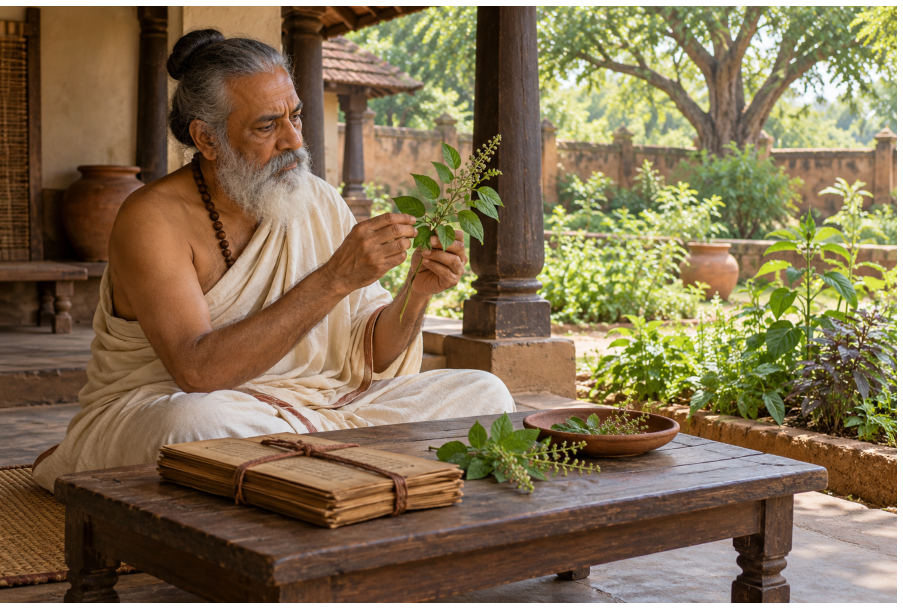
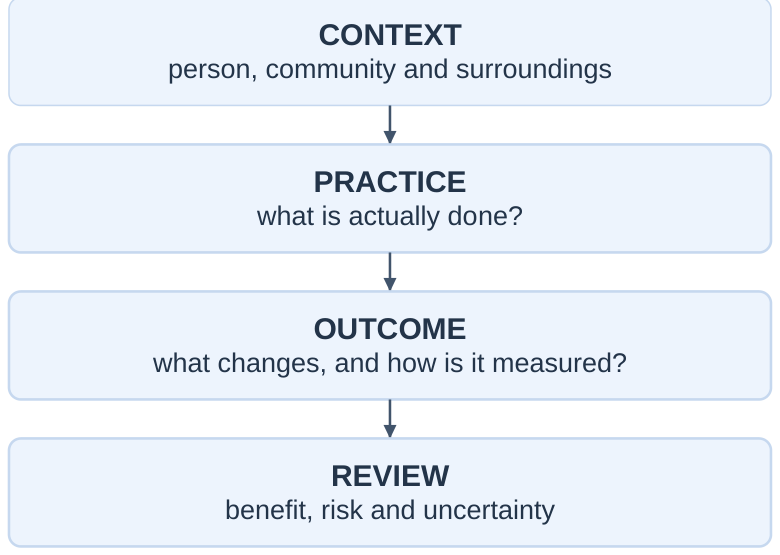
Sleep, food access, movement, workload, accommodation and social support interact. A student cannot solve every sleep difficulty through motivation if the environment remains noisy.
Three Levels of Explanation
| Level | Question |
|---|---|
| Historical | What did a text or community teach? |
| Conceptual | How does a category organise observations? |
| Empirical | Does a defined intervention improve a measured outcome? |
A historical record establishes that an idea existed. It does not automatically demonstrate clinical effectiveness.
Define a Testable Claim
“Yoga improves everything” is too broad.
A clearer question asks whether a specified supervised programme changes a defined outcome in a particular group over a stated period, compared with a suitable alternative.
Record programme content, participation and concerns. Avoid blaming illness entirely on personal choices; inherited conditions, infection, disability, pollution and unequal resources also matter.
A hostel project might combine quiet hours, ventilation checks, drinking-water access and voluntary activity. It needs an identified problem, assigned responsibilities and review.
4.2 Charaka and the Medical Text Tradition
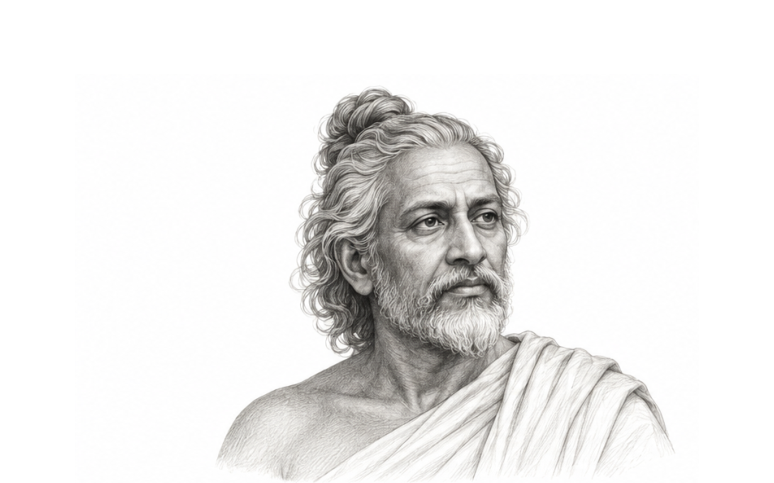
The Charaka Samhita is a major Ayurvedic compendium associated with internal medicine, health principles, examination and medical reasoning.
Its received form reflects teaching, compilation, transmission and revision. The tradition includes an earlier teaching lineage and later completion associated with Dridhabala.
Avoid assigning every sentence to one person on one exact date.
Reasoning and Responsibility
| Dimension | Question |
|---|---|
| Person | What circumstances and variations matter? |
| Observation | What was noticed or reported? |
| Explanation | Which traditional categories are used? |
| Response | What action is proposed and why? |
| Review | What would count as improvement or concern? |
A symptom description is not yet an explanation of its cause. Traditional categories should first be understood within their own framework, rather than relabelled as modern biomarkers.
Careful listening, clear records and recognition of uncertainty are transferable professional habits. They can inform an engineer’s user interview without equating medical care with machine repair.
4.3 Sushruta and Surgical Knowledge
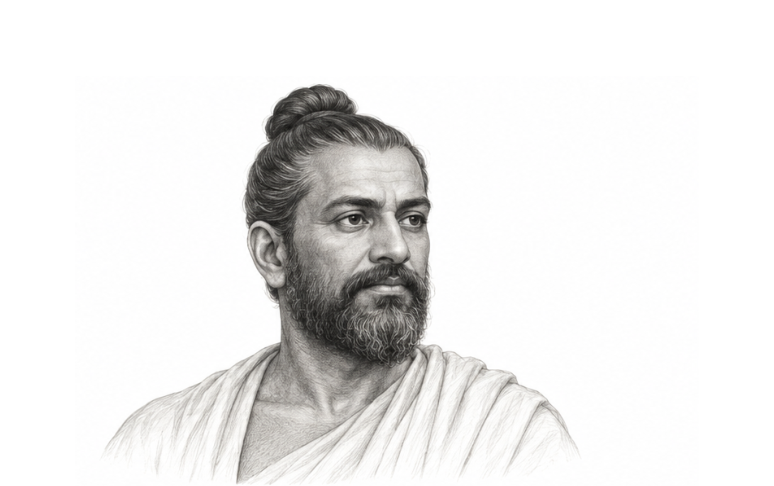
The Sushruta Samhita is especially associated with surgery, anatomy, instruments and training, while also containing broader medical material.
Its composition and redaction have a complex history. An interpretive portrait or honorific title cannot establish a precise biography.
Main Learning Themes
- Classifying instruments by form and task.
- Relating anatomical structures to an action.
- Developing manual precision through practice.
- Connecting preparation, procedure and aftercare.
Historical accounts of practice on substitute materials show concern for staged training. A written description alone does not establish practical competence.
Historical reconstructive procedures are significant, but they do not demonstrate that modern anaesthesia, infection control and clinical standards existed in identical form.
Charaka and Sushruta Compared
| Feature | Charaka emphasis | Sushruta emphasis |
|---|---|---|
| Principal text | Charaka Samhita | Sushruta Samhita |
| Familiar association | Internal medicine and reasoning | Surgery, anatomy and instruments |
| Learning lesson | Person, observations and context | Knowledge with supervised manual skill |
| Historical caution | Received text has layers | Received text has layers |
Both belong to a wider Ayurvedic intellectual tradition.
4.4 Tridosha: A Traditional Conceptual Framework
Tridosha refers to Vata, Pitta and Kapha as organising categories in Ayurvedic accounts of functioning and disturbance.
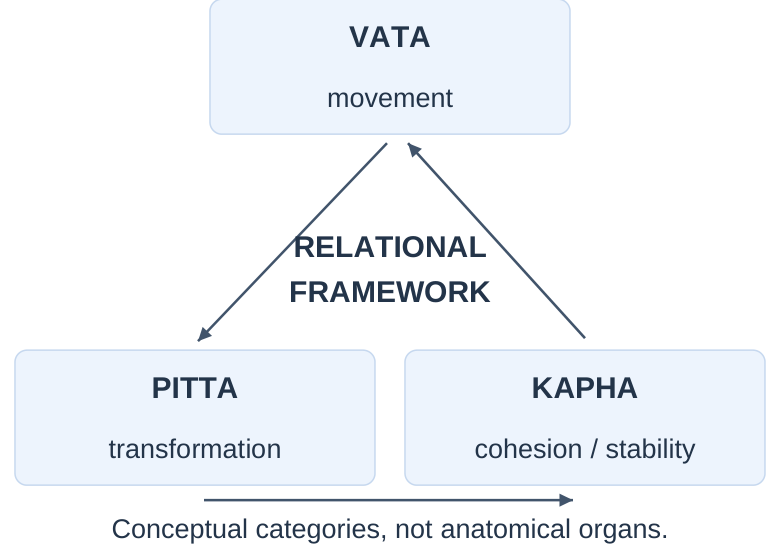
| Category | Broad teaching association | Avoid equating it with |
|---|---|---|
| Vata | Movement and communication | The nervous system alone |
| Pitta | Transformation and heat | One enzyme, acid or hormone |
| Kapha | Cohesion and stability | Body fat alone |
These short associations do not exhaust the terms’ meanings.
Balance, Prakriti and Vikriti
“Balance” does not mean three measurable laboratory values must be equal.
- Prakriti: Constitutional pattern within the traditional framework.
- Vikriti: Altered or disturbed condition within that framework.
A casual online checklist is not a substitute for professional assessment. Learning the concepts does not require assigning a constitution to oneself or classmates.
A modern organ can have several functions, while a traditional category can span several observations. A claimed correspondence requires clearly defined measures and reproducible assessment.
Careful wording: “The author interprets these observations through a Pitta-related category” describes an explanation. A claim that a blood test proves identity with a hormone requires separate evidence.
4.5 Daily Routine, Seasons and Surroundings
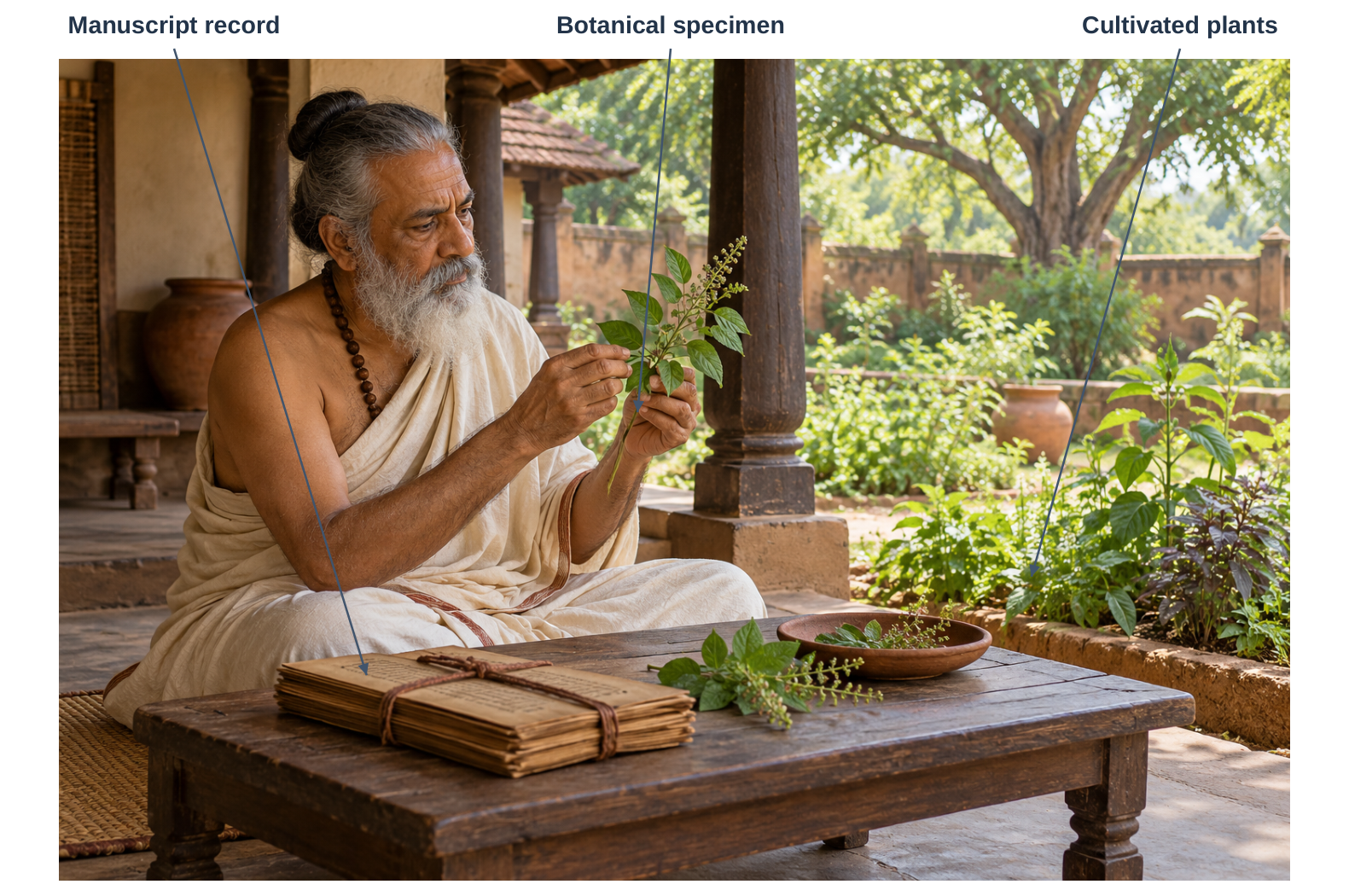
- Dinacharya: Daily routine.
- Ritucharya: Seasonal regimen.
These concepts recognise patterns over time within the traditional framework.
A routine can be unsuitable for another person because of health, work or access constraints. Academic study does not require prescribing diets, medicines or seasonal treatments.
Similar-looking plants can differ in identity and composition. A drawing cannot verify species, purity, dose or safety.
A campus team can study heat, water access and schedules, then assess shade or drinking-water improvements. This applies contextual thinking without establishing clinical validity for a historical category.
4.6 Traditional Knowledge and Evidence
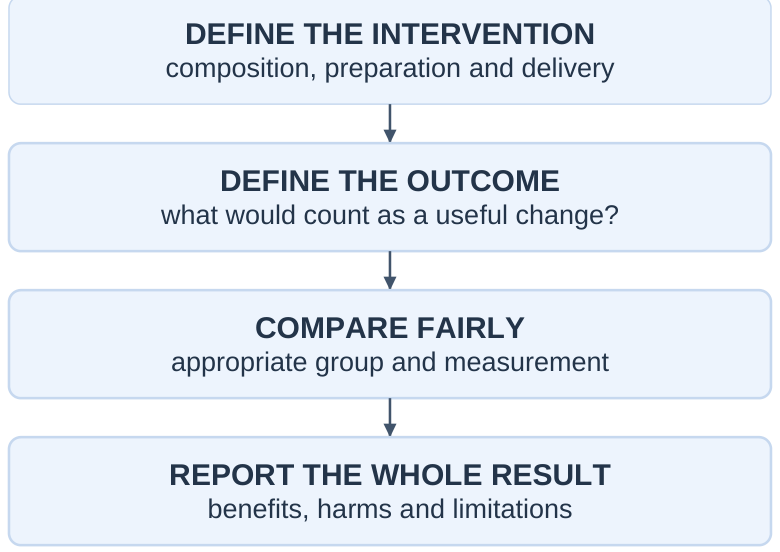
| Evidence | What it can establish |
|---|---|
| Manuscript | A statement was recorded |
| Transmitted practice | A practice continued within a tradition |
| Chemical analysis | Constituents of a tested sample |
| Clinical assessment | Outcomes of a defined intervention in people |
These forms of evidence are useful but not interchangeable.
Questions for a Health Claim
- Who was studied?
- What preparation or programme was actually used?
- Compared with what?
- What was measured?
- Were harms and missing results recorded?
- What limits the conclusion?
A result for one preparation does not automatically apply to every product sharing a name. Identity, processing, concentration and contamination can differ.
A testimonial that ten volunteers “felt better” does not isolate a programme’s effect. Ask how improvement was defined, whether measurement was consistent and what else changed.
Respectful historical study and critical evaluation can coexist. Traditional or natural labels alone do not establish safety, and a classroom summary should not replace established care.
4.7 Application: A Medicinal-Garden Catalogue
A student catalogue should document knowledge rather than offer treatment.
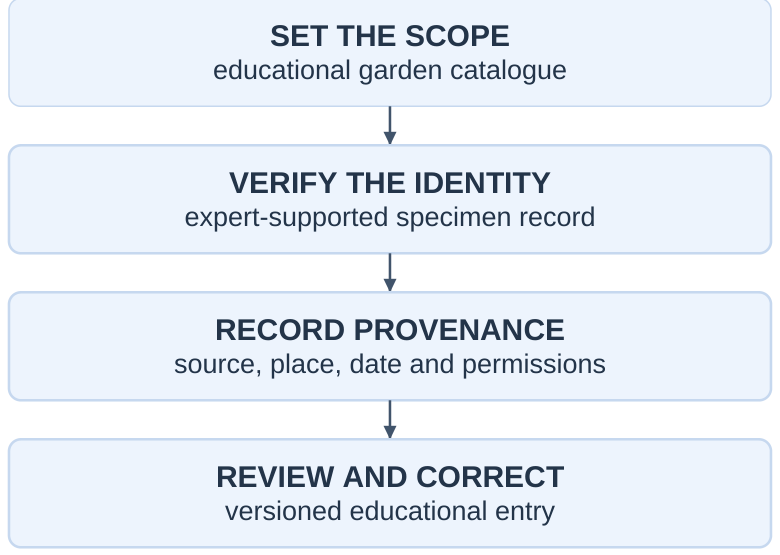
Useful fields include:
- Verified botanical name.
- Local name.
- Photograph and identifying features.
- Location and date.
- Informant or source.
- Permission status.
- Uncertain identification and reviewer notes.
A record can describe a reported traditional use without presenting it as a guaranteed effect.
Do not add unverified dosages, cures or medicine-preparation instructions. Keep uncertain records visibly marked and preserve attribution.
The activity also introduces metadata, intellectual property and responsible access: documentation creates responsibilities toward knowledge holders.
4.8 Patanjali and Ashtanga Yoga
Patanjali’s Yoga Sutras systematise a philosophical and practical discipline concerned with the mind and sustained practice.
Yoga has diverse traditions; one text does not establish that one person invented every form.
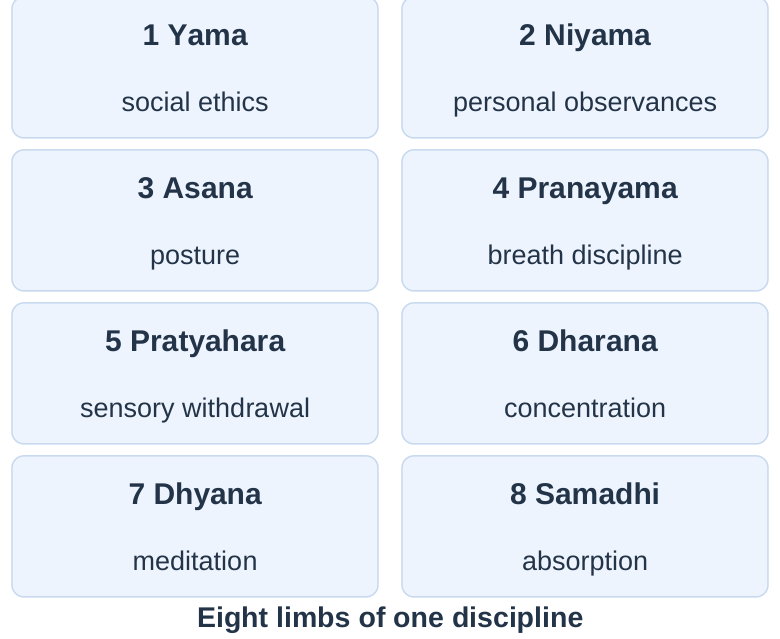
| Order | Limb | Introductory meaning |
|---|---|---|
| 1 | Yama | Ethical restraints |
| 2 | Niyama | Personal observances |
| 3 | Asana | Posture |
| 4 | Pranayama | Breath discipline |
| 5 | Pratyahara | Sensory withdrawal |
| 6 | Dharana | Concentration |
| 7 | Dhyana | Meditation |
| 8 | Samadhi | Absorption |
Ashtanga means eight-limbed, not eight postures.
The classical aim is broader than reducing examination stress. A contemporary wellness programme may adapt selected practices, but should identify and evaluate that adaptation.
4.9 Yama and Niyama
Five Yamas
| Yama | Introductory explanation |
|---|---|
| Ahimsa | Non-harming in action and intention |
| Satya | Truthfulness |
| Asteya | Non-stealing |
| Brahmacharya | Disciplined conduct; traditionally includes celibacy |
| Aparigraha | Non-grasping or non-possessiveness |
Truthful reporting and attribution provide modern analogies to satya and asteya. The terms have wider philosophical meanings.
Truthfulness does not require cruelty. Non-harming does not justify hiding a serious safety defect.
Five Niyamas
| Niyama | Introductory explanation |
|---|---|
| Shaucha | Cleanliness or purity |
| Santosha | Contentment |
| Tapas | Disciplined effort or austerity |
| Svadhyaya | Study of self and relevant teachings |
| Ishvara-pranidhana | Dedication or surrender to Ishvara |
Ishvara-pranidhana has a theological dimension and should not be silently redefined as time management. Academic explanation does not require compulsory devotional practice.
Tapas does not justify sleep deprivation or humiliation. Contentment does not excuse careless work.
Example: When a team misses a deadline, report completed work and gaps rather than inventing test results. Seek a realistic next step.
4.10 Asana and Pranayama
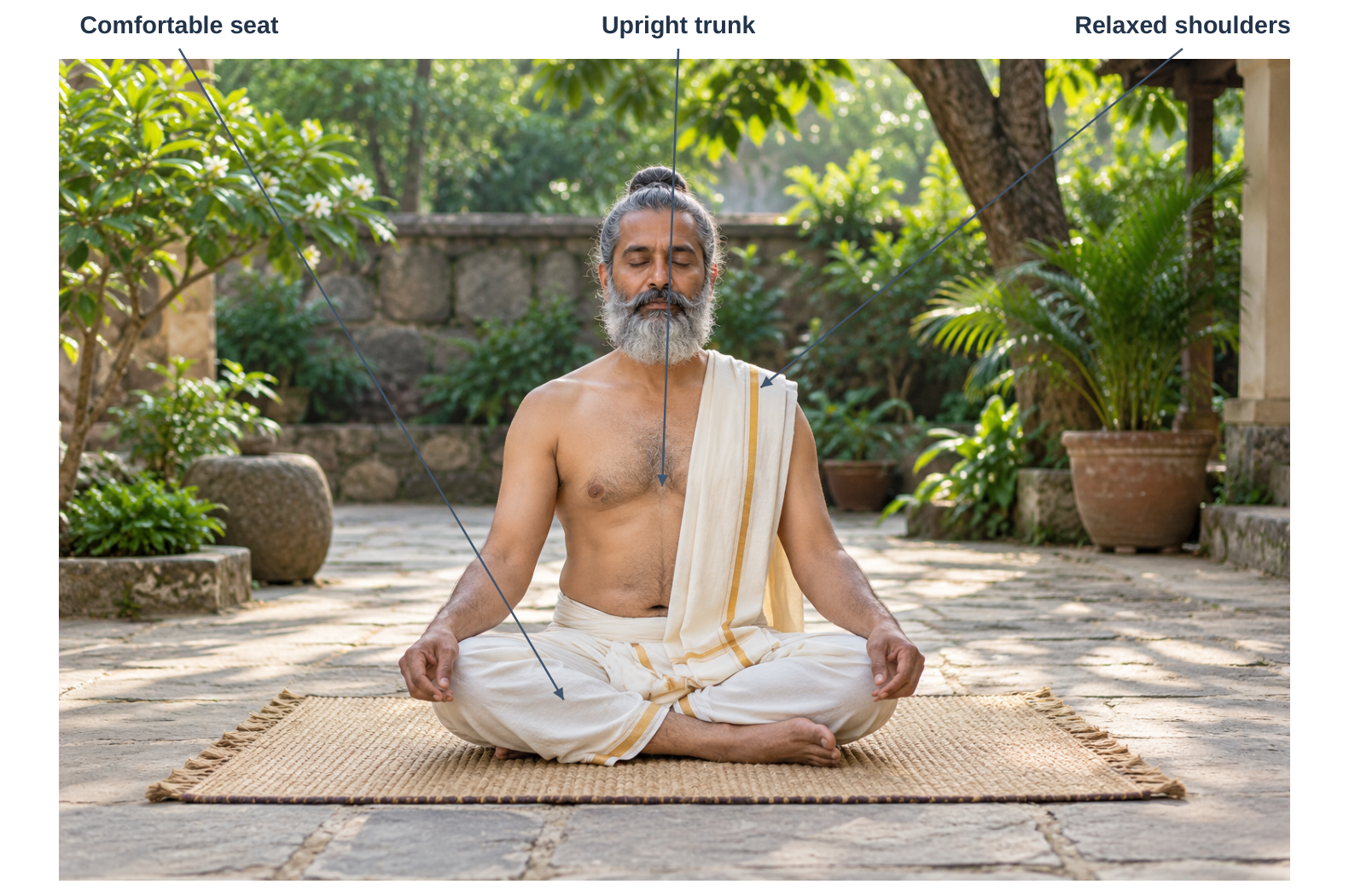
Asana concerns posture, with steadiness and ease important in the classical account. A difficult shape is not automatically better understanding.
Pranayama concerns breath regulation within the discipline. It should not be reduced to holding the breath as long as possible.
Accessible options, including a chair, can support participation. No student should be pressured to imitate a picture or continue through pain, dizziness or distress.
Learning terminology differs from receiving personalised instruction. Appropriate guidance and adaptation matter where limitations affect participation.
4.11 Pratyahara, Dharana, Dhyana and Samadhi
Pratyahara
Pratyahara concerns withdrawal of sensory engagement from objects. Reducing unnecessary notifications is a limited everyday analogy, not a complete classical definition.
Dharana
Dharana concerns establishing and holding concentration on a chosen focus.
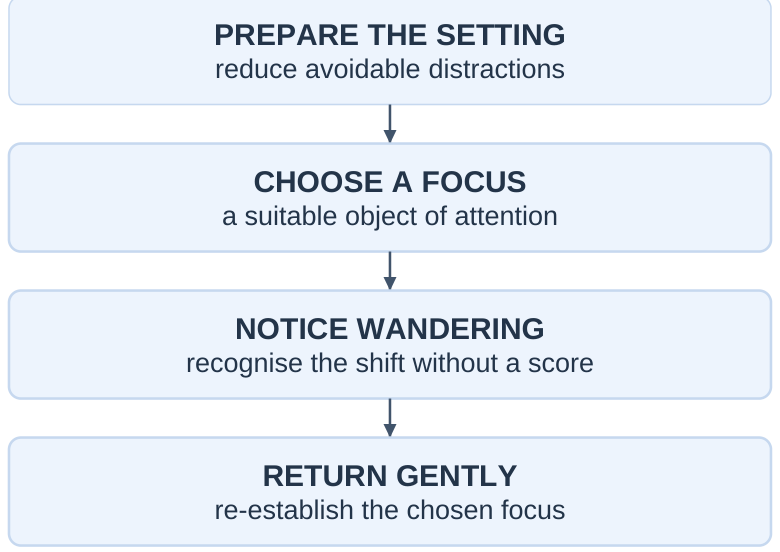
Dhyana
Dhyana concerns sustained meditative continuity. A useful introductory distinction is establishing focus versus a continuing flow of attention.
Samadhi
Samadhi is commonly introduced as absorption in the classical meditative path. It is not ordinary sleep, a short relaxation period or a laboratory score.
An app may record participation time; time spent alone cannot verify spiritual attainment.
A study-habit experiment can measure completed problems or interruptions. It should report those outcomes rather than claiming proof of samadhi.
4.12 Wellness as a Planned Programme
A college proposes a voluntary instructor-led programme to explore feasibility and reported well-being.
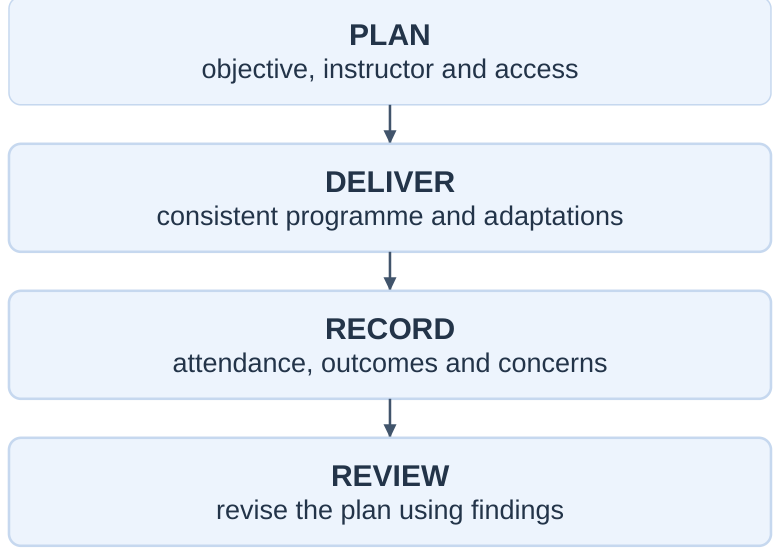
Define group, activities, duration and review method first.
| Component | Planning question |
|---|---|
| Setting | Is space, ventilation and access adequate? |
| Instruction | Who supervises and adapts activities? |
| Content | What is included and excluded? |
| Participation | Is consent informed and voluntary? |
| Review | Which outcomes and concerns are recorded? |
Attendance should not affect academic marks. Provide accessible options and respect non-participation.
Distinguish the Outcomes
- Feasibility: Can the programme be delivered and attended?
- Acceptability: How do participants experience it?
- Safety: What discomfort or other concerns arise?
- Effectiveness: Does it improve the defined outcome?
Record sessions offered, attendance, missed-session reasons, consistent outcome measurements and concerns. Collect only necessary personal information.
Missing responses must be reported. If more distressed participants leave, the remaining sample may appear improved for reasons unrelated to programme benefit.
Personal practices should accompany attention to workload, harassment, accommodation and support access.
4.13 Case Study: Yoga for Well-Being
Two groups of 20 student volunteers each complete a hypothetical stress scale before and after four weeks. Higher scores mean more reported stress.
These are constructed classroom figures.
| Group | Before mean | After mean |
|---|---|---|
| Y: supervised programme | 24 | 18 |
| C: usual-schedule comparison | 23 | 21 |
Calculate Both Changes
Group Y change = 18 − 24 = −6 points.
Group C change = 21 − 23 = −2 points.
Difference in changes = −6 − (−2) = −4 points.
The programme group shows a four-point greater reduction in the supplied means.
The follow-up difference, 18 − 21 = −3, is a different calculation because baseline means differed.
What the Arithmetic Does Not Prove
The means alone do not establish statistical significance, clinical importance or causation.
Consider:
- Self-selection and motivation.
- Expectations affecting self-report.
- Sleep and workload changes.
- Missing follow-up forms.
- Small groups and imprecise estimates.
Where appropriate, random assignment can reduce selection differences. Use consistent timing, suitable comparisons, adherence records and reporting of concerns.
Model conclusion: The supplied data show a larger average reduction in Group Y, with important design limitations. They do not establish a universal cure or identical benefit for all students.
Case-answer order: Objective → groups → outcome → changes → alternatives → qualified conclusion.
4.14 Environment in Indian Thought
Indian philosophical, religious and community traditions offer varied ideas about people and nature.
Restraint, non-harming, responsibility, interdependence and reverence can encourage environmental care. They do not amount to one identical policy across all traditions.
| Value | Practical question |
|---|---|
| Restraint | Can unnecessary consumption fall? |
| Non-harming | Who or what is affected? |
| Responsibility | Who maintains the shared resource? |
| Interdependence | Which upstream and downstream links matter? |
Reverence for a river can motivate care, but actual condition also depends on sewage, flow, land use and institutions.
Symbolic references to elements or landscapes should not be relabelled as exact chemical classifications.
Ecological Relationships
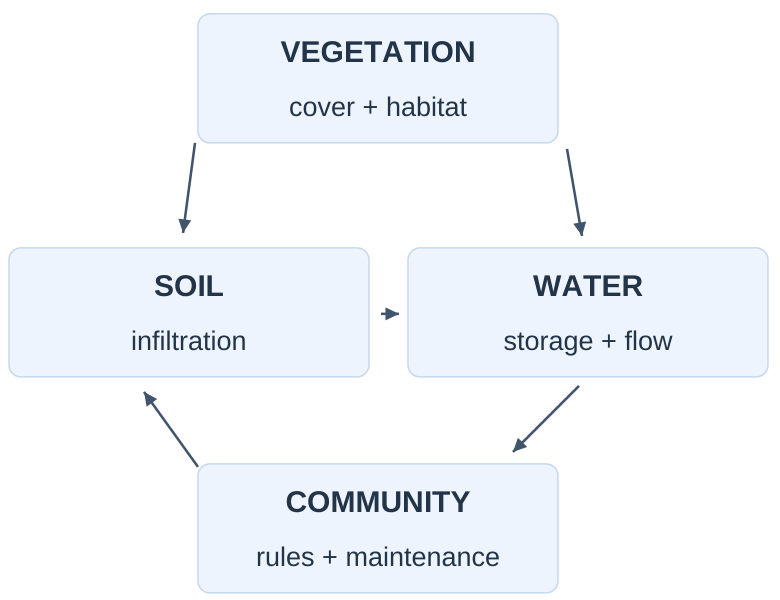
Vegetation influences surface protection and habitat. Soil affects infiltration and erosion. Community rules affect access and land use.
A drainage project must consider downstream users and contaminants, rather than hiding costs outside a convenient project boundary.
Answer pattern: Value → practice → ecological mechanism → condition for success.
4.15 Sacred Groves and Community Conservation
A sacred grove is a patch of vegetation protected through local cultural or religious commitments and rules.
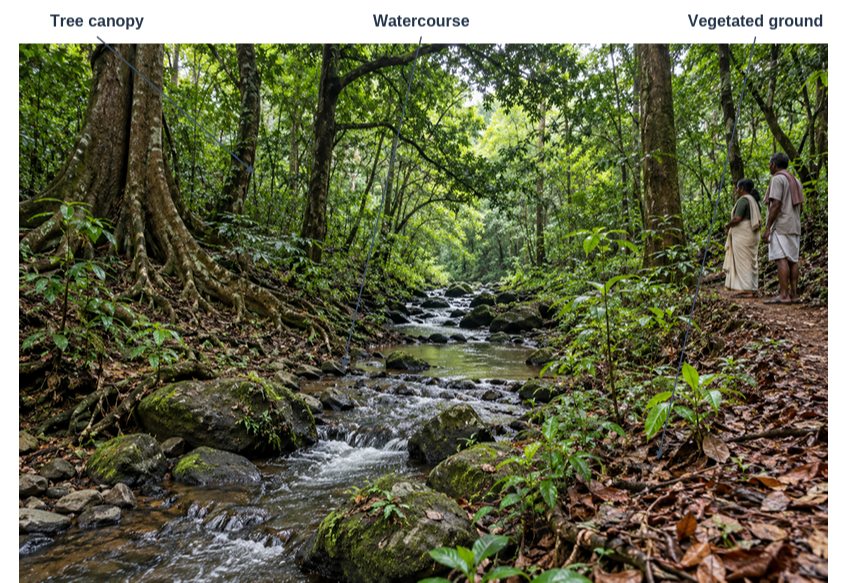
Ecological condition depends on area, species, disturbance, extraction pressure, surrounding land use and management.
Case-Study Questions
- What is protected?
- Who makes and maintains rules?
- What do observations show?
- Who benefits or bears costs?
- Which current pressures affect the practice?
Record boundaries, vegetation, water features, disturbance and management explanations. Seek permission for sensitive access or knowledge.
A grove cannot by itself offset regional pollution or habitat loss. Wider connections and ecological assessment remain necessary.
4.16 Sustainability as a System Question
Sustainability considers useful functions, environmental limits, social fairness and long-term consequences.
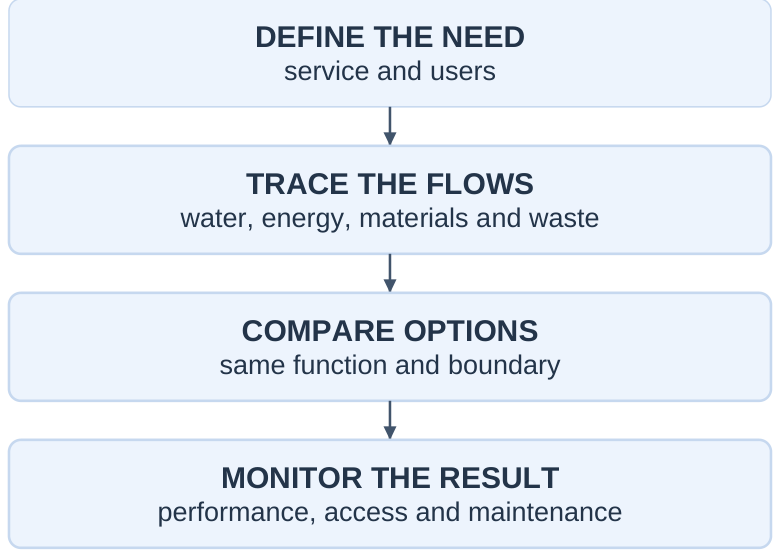
Specify resource, users, place, time and system boundary.
Conservation should preserve essential service. Lower water use caused by losing sanitation access is not successful efficiency.
| Dimension | Indicator |
|---|---|
| Water | Litres per person per day |
| Energy | Energy per unit of useful service |
| Materials | Repair frequency and replacement mass |
| Ecology | Habitat condition and disturbance |
| Social access | Reliable service access |
| Governance | Maintenance completed on time |
Normalise the Comparison
- 100 residents using 12,000 L/day = 120 L/person/day.
- 150 residents using 15,000 L/day = 100 L/person/day.
Total demand rises while demand per person falls. Report both.
Consider rebound, leakage, production, maintenance and disposal. A device’s efficiency rating is not automatically the system’s actual saving.
4.17 Case Study: Campus Water Stewardship
A hostel repairs leaks, improves reporting and assigns weekly inspections. Comparable demand falls from 12,000 to 9,000 L/day under stable occupancy and service.
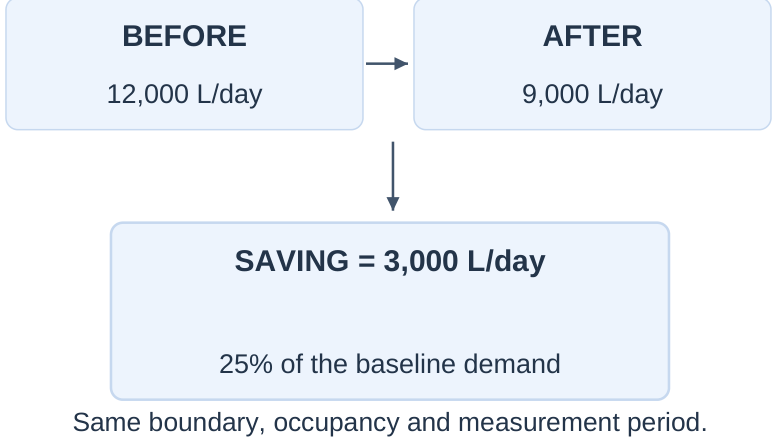
Daily saving = 12,000 − 9,000 = 3,000 L/day.
Percentage reduction = 3,000/12,000 × 100 = 25%.
For 30 comparable days:
Avoided use = 3,000 × 30 = 90,000 L = 90 m³.
This assumes a stable daily difference; actual totals should replace the estimate when available.
| Action | Responsible role | Evidence |
|---|---|---|
| Report | Resident or staff | Dated ticket |
| Inspect | Maintenance supervisor | Inspection record |
| Repair | Authorised worker | Completion and parts record |
| Verify | Facilities team | Comparable meter readings |
Check Other Explanations
Verify occupancy, holidays, meter changes, measurement periods and supply continuity. A lower reading can reflect reduced service.
Assign inspection intervals, reporting channels and follow-up responsibility. Review recurring failures and parts quality.
If occupancy becomes 120 and use is 10,800 L/day:
Use per person = 10,800/120 = 90 L/day.
Compare both total and per-person values with baseline.
4.18 Kautilya and the Arthashastra
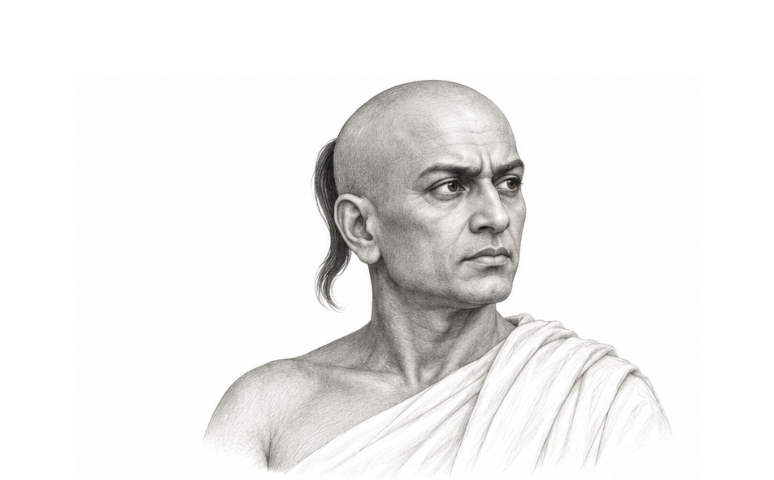
The Arthashastra is associated with Kautilya, traditionally also known as Chanakya or Vishnugupta.
It discusses statecraft, administration, economy, security and interstate relations. Its surviving form has a complex textual history.
The work belongs to a monarchical setting that includes coercion, hierarchy, surveillance and conflict. Modern applications require critical selection.
Organisational Learning
| Theme | Modern analytical question |
|---|---|
| Administration | Are roles and authority clear? |
| Resources | Can the plan be financed and supplied? |
| Information | Are records reliable? |
| Resilience | What happens when essential service fails? |
| External relations | Which dependencies require cooperation? |
A college is not a kingdom. The analogy should preserve accountable modern procedures, rights, fairness and consent.
Do not call a contemporary management formula an ancient textual rule without demonstrating the connection.
4.19 Saptanga: Seven Constituents of the State

| Constituent | Meaning |
|---|---|
| Svamin | Ruler and leadership capacity |
| Amatya | Ministers and administrative personnel |
| Janapada | Territory, people and productive base |
| Durga | Fortification and protected infrastructure |
| Kosha | Treasury and financial resources |
| Danda/bala | Enforcement and defence capacity |
| Mitra | Ally or external support |
Resources without capable administration can be wasted. Infrastructure needs funding, information and maintenance. External support can help while also creating dependencies.
Limited Campus Analogy
Consider leadership, staff, users, facilities, finance, operating procedures and partners. This does not justify importing coercive political authority into education.
If a laboratory has funds and equipment but no trained operator, additional equipment alone may not solve its capacity gap.
Memory cue: Leader → advisers → people/territory → protection → treasury → enforcement/defence → ally.
4.20 Planning, Records and Accountability
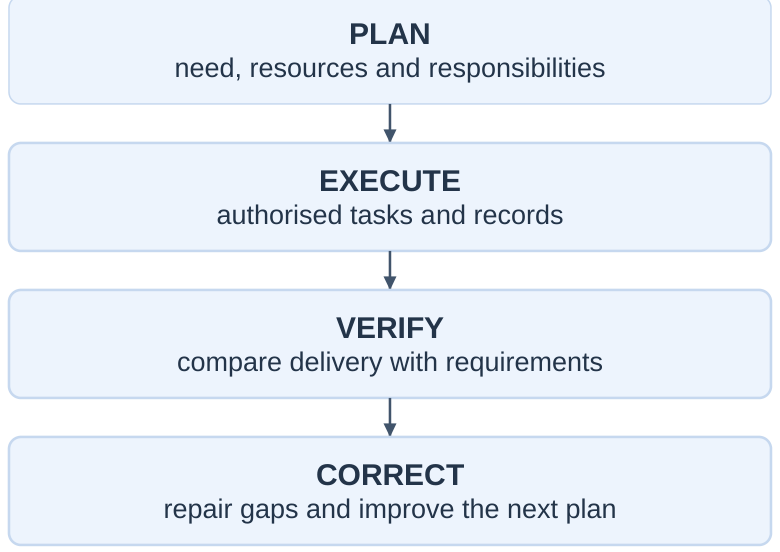
A useful plan states service, resources, owner, deadline and completion evidence.
Information and Delegation
Records need consistent units, identifiers, dates and responsibility. Competent delegation also defines authority and escalation routes.
Incentives Can Distort Results
Rewarding only closed maintenance tickets can encourage premature closure. Check verified completion, recurrence and user confirmation.
| Control | Purpose |
|---|---|
| Approved request | Establish need |
| Purchase and issue record | Trace resources |
| Receipt/completion check | Confirm delivery |
| Reconciliation | Compare records with reality |
| Independent review | Reduce unchecked conflicts |
Prepare for supplier delays, equipment failure and loss of records. Resilience concerns maintaining or restoring essential service.
A discrepancy requires investigation. Counting errors, timing differences and weak processes should be examined before accusations.
4.21 Case Study: Campus Resource Store
A store repeatedly runs out of an essential component despite a positive recorded balance.
The scenario applies organisational ideas through a modern classroom example.
Reconcile the Stock
| Quantity | Units |
|---|---|
| Opening stock | 100 |
| Receipts | +80 |
| Recorded issues | −135 |
| Expected closing stock | 45 |
| Physical count | 38 |
Expected stock = 100 + 80 − 135 = 45 units.
Discrepancy = 45 − 38 = 7 units.
Possible explanations include unrecorded issues, counting error, receipt error, damage or loss. The number is not proof of theft.
Improve the Process
- Clarify approval, issue and review roles.
- Provide a practical way to record urgent issues.
- Check dated transactions and item codes.
- Reconcile periodically.
Constructed Reorder Point
Average demand = 6 units/day; lead time = 5 days; selected safety stock = 12 units.
Reorder point = 6 × 5 + 12 = 42 units.
Physical stock of 38 is below this illustrative point. Replenishment and investigation of the discrepancy remain separate decisions.
The rule assumes reasonably stable demand and lead time. Real policies consider variability and service requirements.
Review stock-out days, urgent purchases, record accuracy and service delays. Excess inventory can tie up funds or expire.
4.22 Ethics from the Bhagavad Gita
The Bhagavad Gita presents Krishna’s dialogue with Arjuna within the Mahabharata. It explores difficult action, duty, knowledge, discipline and liberation.
Dharma
Dharma includes duty and right conduct within a broad, context-dependent meaning. Naming a role does not automatically resolve every conflict; examine facts, affected people and responsibilities.
Nishkama Karma
Nishkama karma is commonly explained as action without attachment to personal reward.
It encourages committed effort without allowing reward-seeking to distort judgement.
It does not mean refusing to plan, ignoring consequences or tolerating careless work.
Verse 2.47 as a Theme
A familiar teaching distinguishes action from attachment to its fruits and warns against attachment to inaction.
Its application is disciplined engagement, while acknowledging that interpretations differ across commentarial traditions.
Equanimity
Equanimity is steadiness amid success and failure. It supports reflection rather than panic or hostility.
It does not mean indifference to suffering or defective designs.
Lokasangraha
Lokasangraha introduces concern for sustaining the world or social order. A modern analogy considers wider effects on people and institutions.
Professional standards and concrete obligations remain necessary. A convenient philosophical interpretation cannot replace evidence or responsibility.
4.23 Case Study: Honesty Under Pressure
A team tests a water-level alarm. It sometimes fails when a sensor connector becomes wet. A teammate proposes hiding failed trials to win a prize.
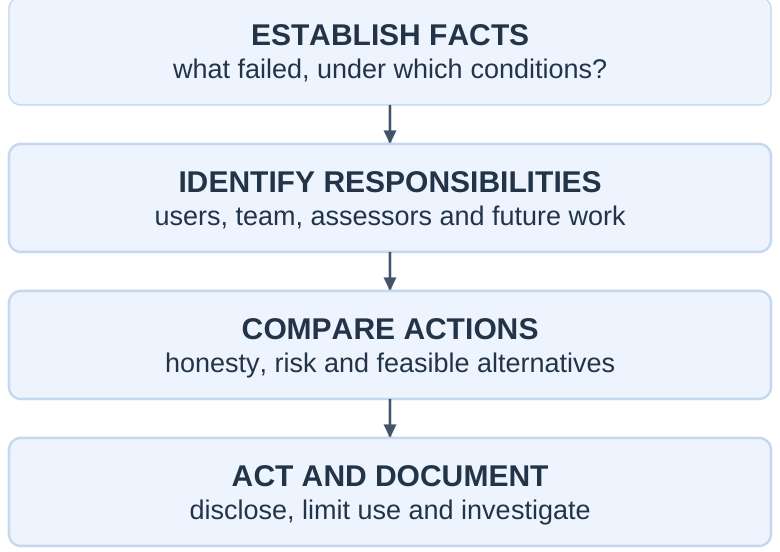
Stakeholders
- Assessors need truthful evidence.
- Team members need an accurate learning record.
- Future users could be misled by exaggerated reliability.
- The institution needs fair assessment and responsible project work.
Apply the Ethical Themes
| Theme | Responsible behaviour |
|---|---|
| Duty | Test and report honestly |
| Disciplined effort | Investigate the connector failure |
| Non-attachment | Do not let the prize determine which data appear |
| Equanimity | Respond steadily to disappointing results |
| Wider responsibility | Consider future users and assessors |
Defensible Decision
- Retain and report all trials.
- Identify failure conditions.
- Limit the demonstration to its justified scope.
- State that the prototype is not ready for safety-critical use.
- Preserve original records.
- Separate completed repairs from proposed changes.
- Agree on further tests before claiming reliability.
“Do your duty and ignore results” misses the responsibility to review consequences. Honest effort and corrective action belong together.
4.24 Solved Answers and Numerical Revision
Explain Tridosha with Its Limits
Tridosha comprises Vata, Pitta and Kapha, broadly associated with movement, transformation and cohesion/stability. They organise traditional explanations rather than naming three organs. Prakriti and vikriti distinguish constitutional pattern and altered condition within that framework.
Why Is Ashtanga More Than Exercise?
Its eight limbs include ethics, observances, posture, breath discipline, sensory withdrawal, concentration, meditation and absorption. Posture is one part of a wider philosophical path.
What Does a Grove Case Demonstrate?
Values and local rules can influence conservation. Outcomes still depend on vegetation, area, disturbance, surrounding land use and management.
Is Non-Attachment Neglect?
No. Planning, effort, honest reporting, attention to consequences and correction remain necessary. Reduced attachment to reward should strengthen responsible judgement.
Another Water Calculation
Comparable use falls from 8,000 to 6,800 L/day:
Saving = 1,200 L/day.
Reduction = 1,200/8,000 × 100 = 15%.
Check occupancy, service, meter condition and measurement period before attributing the entire change to an intervention.
Key Numerical Results
| Case | Result |
|---|---|
| Programme stress-score change | −6 points |
| Comparison change | −2 points |
| Difference in changes | −4 points |
| Campus water saving | 3,000 L/day; 25% |
| Assumed 30-day avoided use | 90,000 L |
| Stock discrepancy | 7 units |
| Illustrative reorder point | 42 units |
All figures belong to constructed examples and their stated assumptions.
4.25 Quick Revision and Examination Practice
| Theme | Recall | Application |
|---|---|---|
| Ayurveda | Charaka, Sushruta, Tridosha | Historical description versus clinical evidence |
| Yoga | Eight limbs and distinctions | Voluntary programme with fair comparison |
| Environment | Values, ecological links and institutions | Grove or campus water case |
| Governance | Arthashastra and Saptanga | Records, resources and oversight |
| Ethics | Duty, non-attachment and steadiness | Honest prototype reporting |
Short-Answer Questions
- Distinguish health, wellness and a clinical outcome.
- Name the compendia associated with Charaka and Sushruta.
- Explain prakriti and vikriti without diagnosing anyone.
- List the eight limbs in order.
- Distinguish dharana and dhyana.
- Name factors affecting a grove’s ecological condition.
- Name all seven Saptanga constituents.
- Why is a stock discrepancy not proof of theft?
- Distinguish equanimity and indifference.
- Why does non-attachment preserve responsibility?
Long-Answer Questions
- Explain Ayurvedic foundations, Charaka, Sushruta, Tridosha and evidence distinctions.
- Explain Patanjali’s eight limbs and design a responsible wellness case study.
- Connect an environmental value with a conservation practice and measurable indicators.
- Apply selected Arthashastra-related organisational ideas to a resource problem.
- Analyse an engineering dilemma using duty, effort, non-attachment and affected people.
Common Mistakes
- Treating Tridosha as directly measurable organs.
- Defining Ashtanga as eight postures.
- Equating classical samadhi with an app score.
- Claiming every traditional practice is automatically sustainable.
- Importing monarchical coercion into modern management.
- Treating a discrepancy as proof of misconduct.
- Interpreting non-attachment as ignoring consequences.
- Presenting classroom figures as real research findings.
Answer check: Definition → accurate terms → relationship or diagram → relevant example → limitation.
Frequently Asked Questions
What does Indian Knowledge System Unit 4 cover?
Ayurveda, Yoga, environmental responsibility, sustainability, Arthashastra, Saptanga and Gita-inspired ethical reasoning.
How do Charaka and Sushruta differ?
Charaka is commonly associated with internal medicine and reasoning; Sushruta with surgical subjects, anatomy, instruments and training.
Are Vata, Pitta and Kapha anatomical organs?
No. They are organising categories in a traditional conceptual framework.
What are the eight limbs of Yoga?
Yama, niyama, asana, pranayama, pratyahara, dharana, dhyana and samadhi.
Does the Yoga case prove causation?
No. The supplied means show a difference in change, while causation and significance require further design and analysis information.
What does Saptanga explain?
Seven interacting constituents of the state: svamin, amatya, janapada, durga, kosha, danda/bala and mitra.
Does Nishkama Karma mean ignoring outcomes?
No. Responsible effort, planning, consequence assessment and corrective action remain necessary.
What connects the unit’s different themes?
Attention to the person, community, environment and institutions, combined with evidence, responsibility and review.