Course Code: BP102T
Unit IV Overview
Unit IV: Monophasic and Biphasic Liquids. Liquid medicines may contain dissolved ingredients, suspended solid particles or dispersed liquid droplets. This unit connects their structure with formulation, preparation, quality and correct presentation.
Topics Covered – Syllabus Coverage
| Required topic | Coverage |
|---|---|
| Monophasic and biphasic foundations; excipients | Sections 4.1-4.2 |
| Aromatic waters: definition and preparation | Section 4.3 |
| Syrups, elixirs and linctus: definition and preparation | Sections 4.4-4.7 |
| Liniments, lotions and throat paints | Sections 4.8-4.10 |
| Gargles, mouthwashes and enemas | Sections 4.11-4.12 |
| Eye, ear and nasal drops | Sections 4.13-4.15 |
| Tinctures with examples | Section 4.16 |
| Study of official preparations | Section 4.17 |
| Suspensions: definition, types, advantages and disadvantages | Sections 4.18-4.20 |
| Suspension excipients and preparation | Sections 4.21-4.22 |
| Emulsions: definition and types | Section 4.23 |
| Emulsifying agents and formulation excipients | Section 4.24 |
| Tests for identification of emulsion type | Section 4.25 |
| Emulsion preparation methods | Section 4.26 |
| Quality, instability, revision and examination practice | Sections 4.27-4.29 |
Learning Outcomes
- Distinguish a solution, suspension and emulsion from the physical state of the dispersed ingredient.
- Explain the purpose and preparation of every liquid preparation listed in the syllabus.
- Choose excipient functions according to solubility, route, stability and product performance.
- Compare flocculated and deflocculated suspensions and explain redispersibility.
- Identify O/W and W/O emulsions using more than one suitable test.
- Describe dry-gum, wet-gum, bottle and mechanical emulsification methods in sequence.
Essential Vocabulary
| Term | Meaning |
|---|---|
| Vehicle | Liquid medium carrying ingredients |
| Solute | Dissolved substance |
| Dispersed phase | Particles or droplets distributed through a medium |
| Continuous phase | Surrounding liquid phase |
| q.s. | Sufficient quantity |
| q.s. to | Add enough to reach the final stated quantity |
The central formulation question: Is the ingredient dissolved, suspended as a solid, or dispersed as liquid droplets? This determines the relevant preparation method and stability checks. Labelled sketches show formulation principles and process stages.
4.1 Liquid Dosage Forms: Phases and Classification
A liquid dosage form presents a medicine in a suitable liquid vehicle. The vehicle may be aqueous, oily, alcoholic or a compatible combination. Route names and physical classifications answer different questions: an eye drop describes a site of administration, whereas a solution describes the physical system.
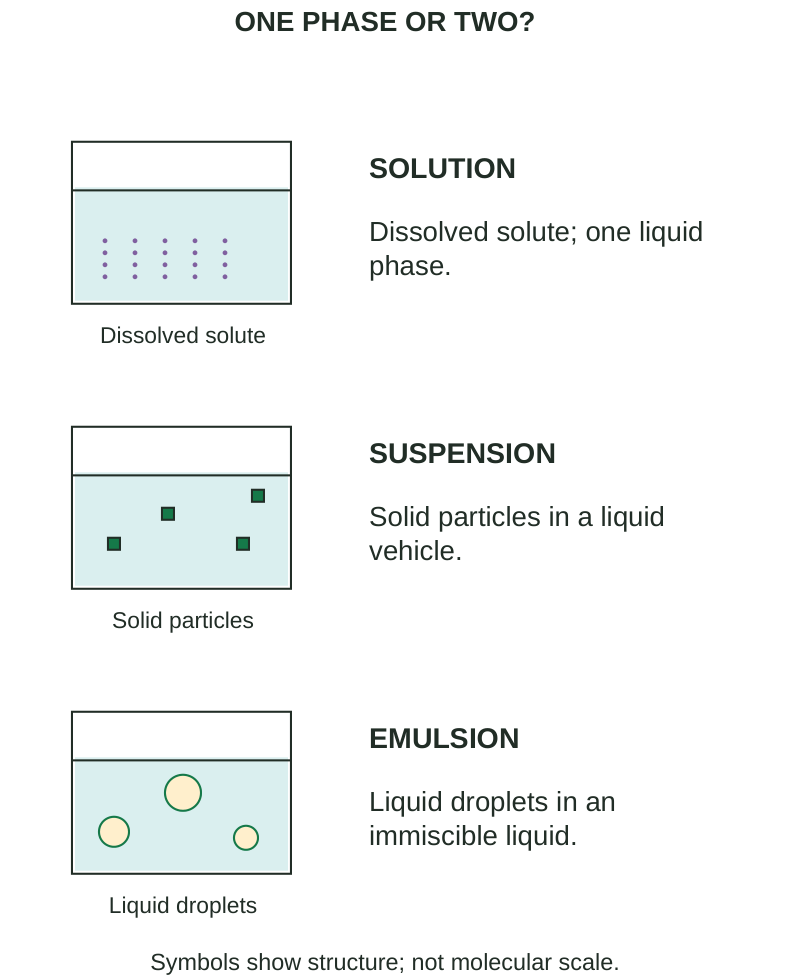
Diagram labels: Solution: dissolved solute; one liquid phase. Suspension: solid particles in a liquid vehicle. Emulsion: liquid droplets in an immiscible liquid. Symbols show structure, not molecular scale.
Explanation: Symbols represent dissolved solute, solid particles and liquid droplets. A uniform-looking dispersion still contains an internal phase; a solution has no separate dispersed solid or liquid phase.
| System | Physical organisation | Example |
|---|---|---|
| Solution: monophasic | Ingredients molecularly or ionically dispersed in one liquid phase | Sodium chloride solution |
| Suspension: biphasic | Undissolved solid distributed through a liquid | Calamine suspension lotion |
| Emulsion: biphasic | Immiscible liquid droplets distributed through another liquid | Liquid paraffin O/W emulsion |
- Monophasic means one physically homogeneous phase. A coloured solution can still be clear; clear does not mean colourless.
- Biphasic means two phases. A properly mixed suspension or emulsion may look uniform to the eye, but microscopy reveals particles or droplets.
- A preparation called a lotion or drop is not automatically monophasic. Its actual formulation may be a solution, suspension or emulsion.
Common examination error: Do not classify every lotion as a solution or every drop as an aqueous solution. Check the internal structure, not only the dosage-form name.
Routes Within the Unit
Internal oral preparations include aromatic vehicles, syrups, elixirs and linctuses. Skin preparations include liniments and lotions. Oromucosal preparations include throat paints, gargles and mouthwashes. Other sites include the rectum, eye, ear and nose. The vehicle, packaging and microbial requirements must suit the particular site.
4.2 General Formulation Principles and Solution Preparation
Advantages of Suitable Liquids
- Useful when a patient has difficulty swallowing solid units.
- Allow different measured dose volumes when the formulation and device support them.
- A dissolved medicine does not need a dosage unit to disintegrate first. This does not guarantee faster clinical action in every case.
- Can distribute a medicine over skin or a mucosal surface.
Limitations
- Bulkier and more liable to leakage than many solid preparations.
- Dose accuracy depends on the concentration, measuring device and user technique.
- Water can favour microbial growth or chemical degradation. Alcohol, sugar and other vehicles also have suitability limitations.
- Dispersions require physical-stability control; solutions can precipitate after dilution or storage.
| Excipient function | Typical examples | Selection principle |
|---|---|---|
| Vehicle / solvent | Purified water; suitable oil | Use the quality appropriate to the route |
| Co-solvent | Ethanol, glycerol, propylene glycol | Check patient, route and solvent compatibility |
| Sweetener / flavour | Sucrose; appropriate flavours | Use only where suitable; not routinely in eye/ear drops |
| Buffer / pH modifier | Compatible citrate or phosphate system | Balance stability, solubility and tolerability |
| Preservative | Suitable benzoate, paraben or other validated system | Effectiveness depends on formulation and packaging |
| Antioxidant / chelator | Suitable antioxidant; disodium edetate where appropriate | Control relevant oxidation pathways |
| Viscosity modifier | Cellulose derivatives or suitable gums | Balance retention, pouring and dose delivery |
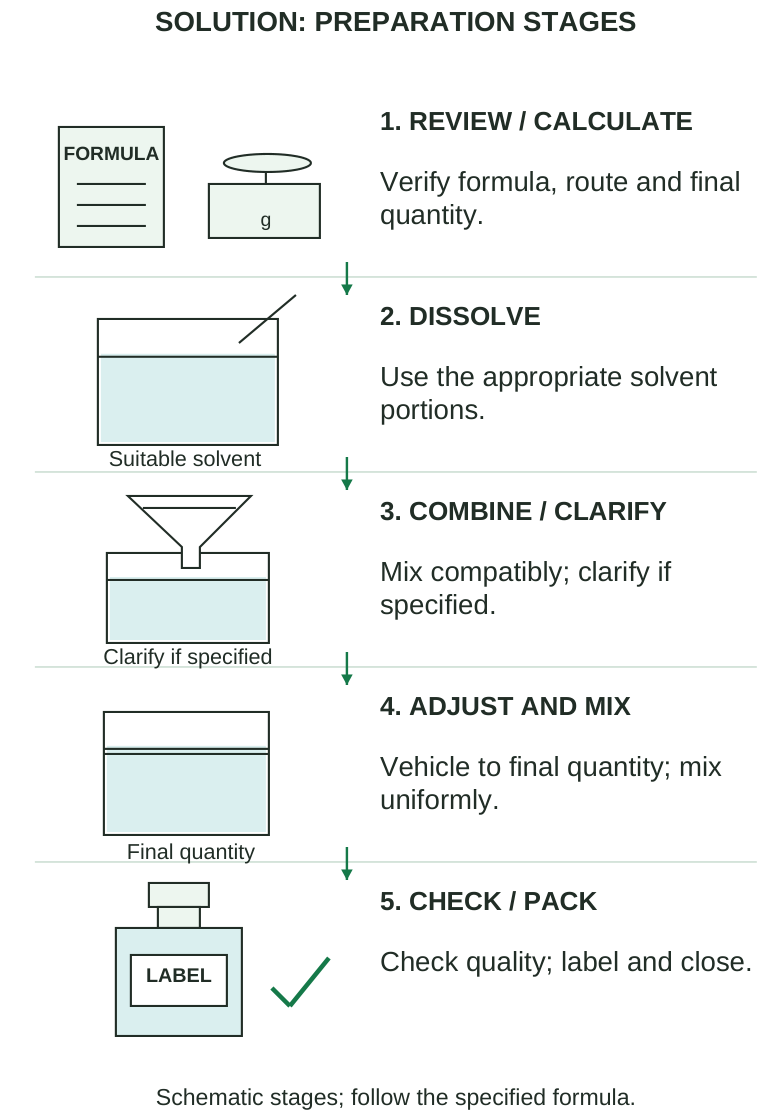
Diagram labels: Review/calculate: verify formula, route and final quantity. Dissolve: use the appropriate solvent portions. Combine/clarify: mix compatibly; clarify if specified. Adjust and mix: vehicle to final quantity; mix uniformly. Check/pack: check quality; label and close. Schematic stages; follow the specified formula.
Explanation: Dissolution and final-volume adjustment are separate operations. The illustration is a general sequence; specialised eye preparations require the sterile process described in Section 4.13.
- Step 1: Review and calculate. Verify identity, route, strength, final quantity and compatibility.
- Step 2: Dissolve separately. Use portions of the appropriate solvent for ingredients with different solubilities. Avoid unnecessary heat for volatile or heat-sensitive materials.
- Step 3: Combine. Add solutions in a suitable order while mixing. Observe for unexpected precipitation.
- Step 4: Clarify if applicable. Use a compatible clarification method when allowed. Filtration can remove material and cannot make an ordinary preparation sterile.
- Step 5: Adjust quantity and mix. Bring to the stated final volume or mass at the specified conditions; mix uniformly.
- Step 6: Check and pack. Verify appearance, strength-related controls, pH where relevant, quantity, container and label.
Final volume is not added water: To make 100 mL, add vehicle to a final volume of 100 mL. Do not add 100 mL of water to ingredients unless the formula explicitly says so.
Worked Example
An illustrative solution requires 2% w/v of a fictional soluble ingredient in 150 mL.
Required ingredient = 2 g per 100 mL × 150 mL = 3 g.
Dissolve in a portion of vehicle, then make the total volume 150 mL. This is a concentration exercise, not a treatment formula.
4.3 Aromatic Waters: Definition, Methods and Examples
Aromatic waters are clear aqueous preparations containing dissolved volatile aromatic substances, commonly obtained from volatile oils. Traditional simple aromatic waters are generally saturated solutions under the preparation conditions. They mainly provide flavour or an aromatic vehicle rather than a universal therapeutic action.
| Example | Aromatic ingredient | Teaching significance |
|---|---|---|
| Peppermint water | Peppermint oil constituents | Volatile flavouring system |
| Cinnamon water | Cinnamon oil constituents | Limited aqueous solubility |
| Rose water | Rose aromatic constituents | Distillation-based aromatic preparation |
Distillation Method
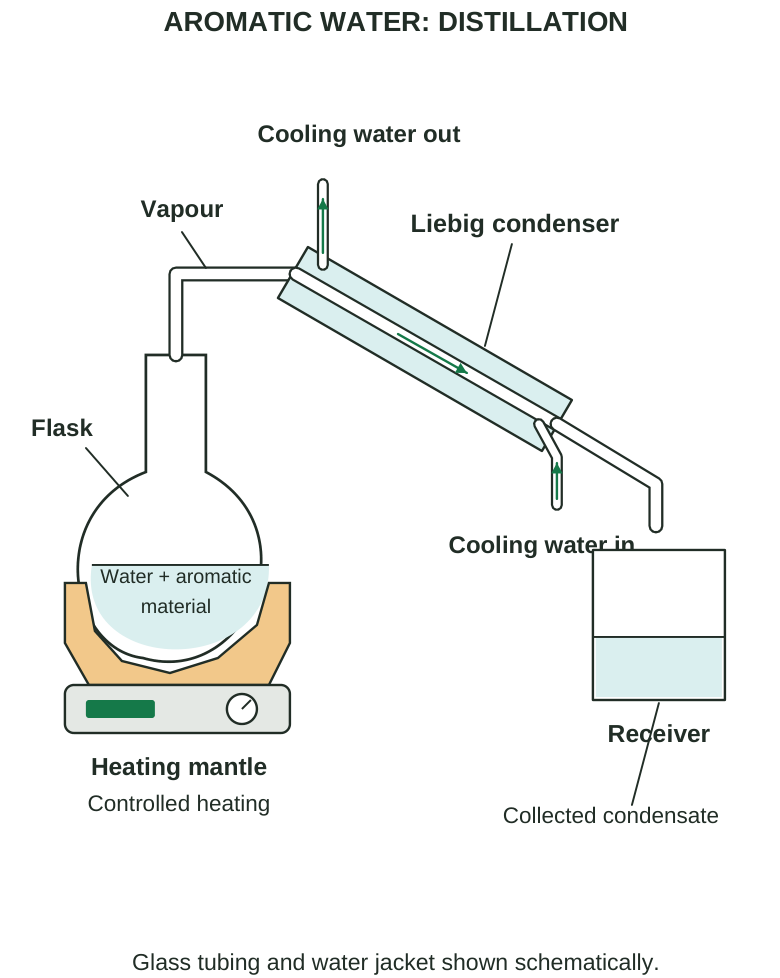
Diagram labels: Flask with water + aromatic material; heating mantle with controlled heating; vapour path; Liebig condenser; cooling-water outlet at upper end; cooling-water inlet at lower end; receiver with collected condensate. Glass tubing and water jacket shown schematically.
Explanation: Volatile material travels with water vapour into a cooled condenser. The receiver collects condensate. Cooling-water inlet is at the lower jacket end and outlet at the upper end; the diagram is a principle sketch rather than an apparatus specification.
- Step 1: Place the specified aromatic material or volatile oil with water in suitable equipment.
- Step 2: Apply controlled heating so volatile constituents pass with water vapour.
- Step 3: Cool the vapour in a condenser and collect the specified condensate.
- Step 4: Separate excess undissolved oil where required, then evaluate clarity and aromatic quality.
- Step 5: Package in a suitable well-closed container, with protection required for the formulation.
Solution / Dispersion Method
- Step 1: Measure the specified aromatic substance and water.
- Step 2: Disperse the oil thoroughly to increase contact with water; a specified distributing or filtering aid may be used.
- Step 3: Allow the prescribed contact, then remove excess undissolved material by the suitable clarification process.
- Step 4: Check clarity and quantity, and package.
Traditional procedures may use purified talc or another permitted aid to spread oil and assist clarification. The aid is not automatically part of the final dissolved product and is not a preservative. Its use and removal must follow the formula.
Concentrated Aromatic Preparations
Some concentrated aromatic waters contain a co-solvent and require a specified dilution before use as a vehicle. They are not interchangeable volume-for-volume with simple aromatic waters. Dilution can lower oil solubility and produce cloudiness; order of mixing and clarification matter.
Memory trick: Aroma travels; vapour cools; water collects. For the solution method, remember disperse → contact → clarify.
Volatile ingredients may be lost through unnecessary heating or an open container. A pleasant smell does not demonstrate freedom from microbial contamination.
4.4 Syrups: Composition, Preparation and Stability
Syrups are concentrated, sweet aqueous preparations, traditionally containing a high proportion of sucrose. A simple syrup is a sugar-water vehicle. A medicated syrup contains an active ingredient. Flavoured syrups improve palatability or act as vehicles.
Sugar-free oral liquids may use alternative sweetening systems but should not be assumed to have the same preservation or viscosity as sucrose syrup.
Composition and Concentration
A classic teaching formula for simple syrup uses 66.7% w/w sucrose: 66.7 g sucrose in 100 g of the final product. Other compendial traditions may express syrup strength on a different basis. A percentage by mass is not a percentage by final volume; use the stated formula and edition.
| Ingredient | Function |
|---|---|
| Sucrose | Sweetness and viscosity; lowers water activity at sufficiently high concentration |
| Water | Dissolution medium |
| API, if medicated | Therapeutic ingredient |
| Flavour / colour, if permitted | Acceptability and presentation |
| Preservative, if required | Validated microbial protection |
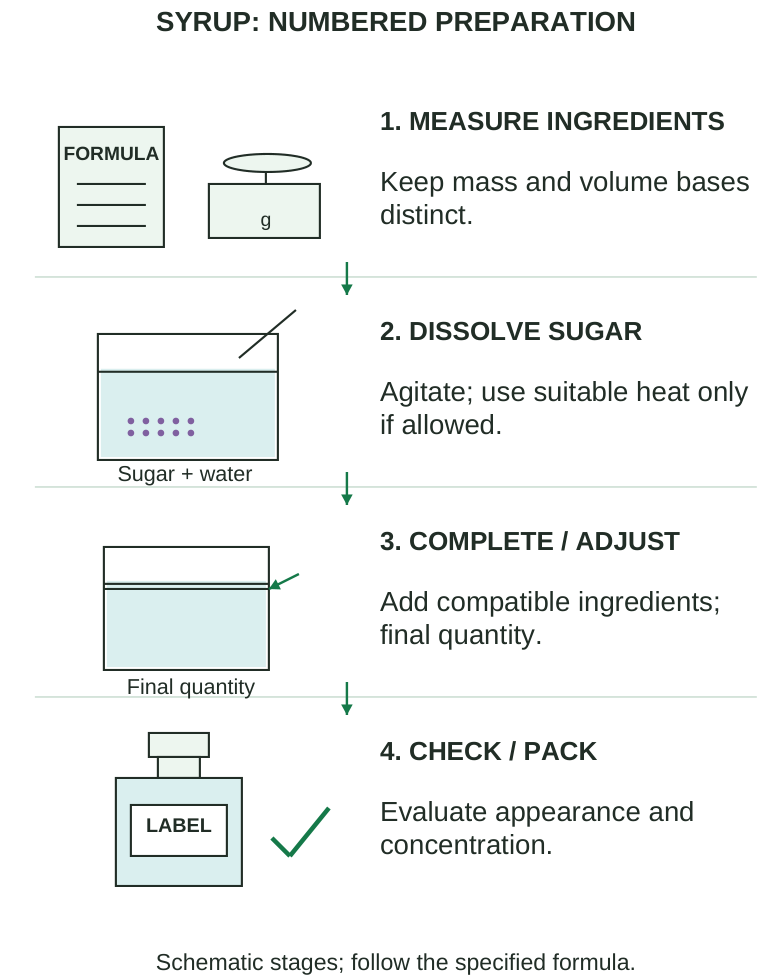
Diagram labels: Measure ingredients: keep mass and volume bases distinct. Dissolve sugar: agitate; use suitable heat only if allowed. Complete/adjust: add compatible ingredients; final quantity. Check/pack: evaluate appearance and concentration. Sugar + water; final quantity. Schematic stages; follow the specified formula.
Explanation: Controlled dissolution is followed by quantity adjustment and mixing. Heat may help dissolve sugar, but excessive heat can alter sugar or damage other ingredients.
Methods of Preparation
- With suitable heat: Dissolve sucrose in the specified portion of water using controlled heating, cool as required, incorporate compatible ingredients and adjust the final quantity.
- Without heat: Dissolve by agitation when heat-sensitive ingredients are present or heating is unnecessary.
- By adding sucrose to a medicated/flavoured liquid: Use only when the liquid and sugar are compatible and the required final concentration is maintained.
- By percolation: In suitable traditional procedures, water passes through sucrose or an appropriate material to obtain the intended solution. This is method-specific, not obligatory for every syrup.
Stepwise Cold Method
- Step 1: Calculate batch amounts on the formula’s mass or volume basis.
- Step 2: Dissolve sucrose in a suitable portion of water by agitation.
- Step 3: Incorporate separately prepared compatible API/excipient solutions.
- Step 4: Adjust to final stated quantity and mix. Check appearance and concentration-related controls.
- Step 5: Fill suitable containers and apply the product-specific label and storage conditions.
Common Problems
- Crystallisation: Sugar may crystallise after water loss, cooling or an unsuitable concentration.
- Fermentation / contamination: Dilution can reduce the protective effect of sugar. Concentrated syrup is not sterile.
- Inversion: Sucrose hydrolyses into glucose and fructose; acid and heat can promote it.
- Caramelisation / discolouration: Excessive heating may change colour and flavour.
Worked mass calculation: For 300 g of a 66.7% w/w teaching syrup:
Sucrose = 0.667 × 300 = 200.1 g.
Remaining mass = 99.9 g if water is the only other ingredient.
Do not interpret the remaining grams as a prescribed final volume in mL.
4.5 Elixirs: Hydroalcoholic Systems and Preparation
Elixirs are traditionally clear, sweetened, flavoured hydroalcoholic oral liquids. The water-alcohol combination helps dissolve ingredients that may not dissolve adequately in water alone. Glycerol or other permitted co-solvents can supplement the solvent system.
Ethanol content varies with the formulation; there is no single alcohol percentage valid for all elixirs.
- Non-medicated elixir: Used as a compatible vehicle.
- Medicated elixir: Contains an active ingredient in the solvent system.
Historical piperazine citrate and paracetamol elixirs illustrate the class; their names do not establish current suitability for every patient.
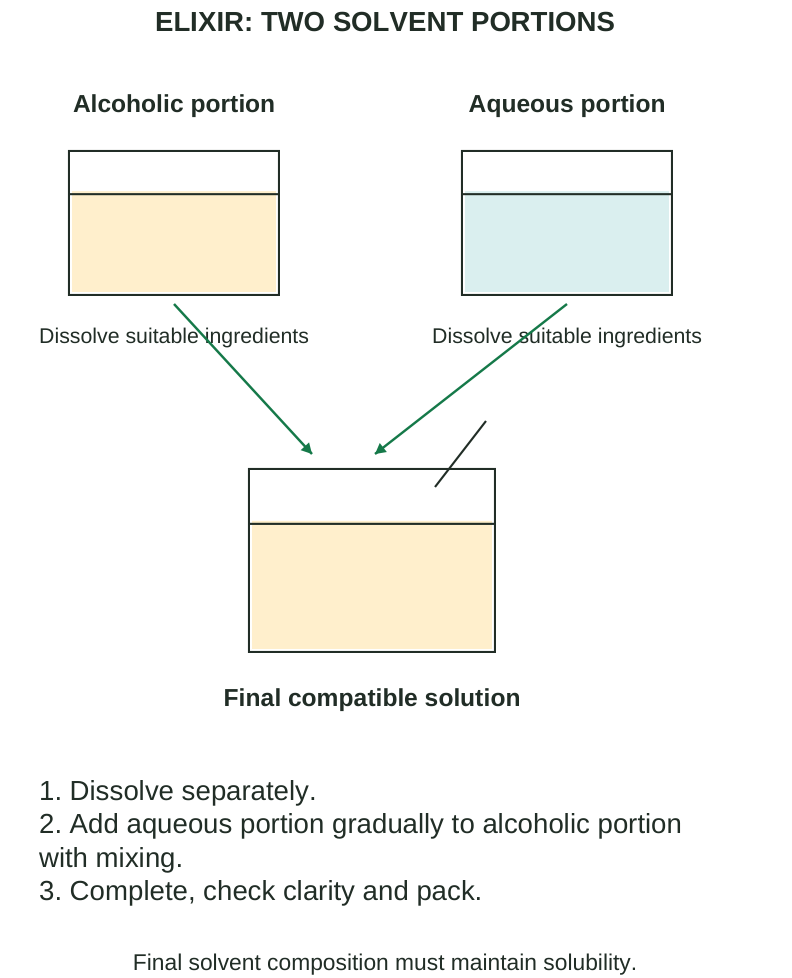
Diagram labels: Alcoholic portion and aqueous portion: dissolve suitable ingredients separately. Add aqueous portion gradually to alcoholic portion with mixing. Complete, check clarity and pack. Final compatible solution. Final solvent composition must maintain solubility.
Explanation: Ingredients are dissolved in the phase appropriate to their solubility. Adding the aqueous portion gradually to the alcoholic portion limits abrupt loss of solvent power; the final composition must still maintain solubility.
Preparation: Solution Method
- Step 1: Verify ingredients, required final solvent composition and intended patient/route suitability.
- Step 2: Dissolve alcohol-soluble ingredients in the alcoholic portion and water-soluble ingredients in the aqueous portion.
- Step 3: Add the aqueous portion gradually to the alcoholic portion with continuous mixing.
- Step 4: Add compatible sweeteners, co-solvents and remaining ingredients in the prescribed order.
- Step 5: Allow equilibration or clarify when specified; adjust final quantity without destroying solvent compatibility.
- Step 6: Check clarity and pack in a well-closed suitable container.
Advantages and Limitations
- Can dissolve certain poorly water-soluble substances and is often less viscous than a concentrated sucrose syrup.
- Alcohol and co-solvents can improve physical solubility but do not guarantee chemical stability.
- Ethanol suitability depends on the patient population and use; an alcoholic vehicle should not be chosen automatically.
- Dilution with water can precipitate an ingredient by reducing alcohol concentration.
Memory trick: Alcoholic phase + aqueous phase, added gradually. Elixir clarity depends on the final solvent composition, not merely on each ingredient dissolving separately.
An elixir that was clear before dilution and later develops cloudiness requires evaluation. Shaking cannot convert precipitated drug into a validated dissolved product.
4.6 Linctuses: Purpose and Preparation
A linctus is a viscous oral liquid traditionally used for cough relief. Its syrupy or polyhydric-alcohol-rich vehicle gives prolonged contact with the throat. It is generally intended to be sipped and swallowed slowly, commonly without dilution, according to its product directions.
| Component | Formulation purpose |
|---|---|
| Active ingredient, when present | Selected cough-related action |
| Viscous sweet vehicle | Palatability and prolonged local contact |
| Glycerol or suitable polyol | Vehicle, sweetness or viscosity contribution |
| Flavour / buffer / preservative | Use-specific acceptability and stability |
Examples include simple linctus as a traditional soothing preparation and codeine linctus as a historical medicated example. An example name is not a recommendation to use an opioid, especially in children. Choice of a cough medicine depends on the current product indication and patient circumstances.
Stepwise Preparation
- Step 1: Verify the formula, final quantity and required consistency.
- Step 2: Dissolve soluble ingredients in a suitable portion of the vehicle; prepare other compatible solutions separately.
- Step 3: Incorporate the solutions into the viscous base gradually with mixing.
- Step 4: Add permitted flavours and remaining excipients while minimising air incorporation.
- Step 5: Adjust final quantity, mix uniformly and evaluate appearance and viscosity.
- Step 6: Package with accurate measurement and product-specific directions.
Important Distinctions
- A linctus is defined by intended use and consistency, not by the presence of alcohol.
- It is not simply a gargle: the preparation is intended to be swallowed as directed.
- Sugar-free versions require suitable substitute vehicle and preservation systems.
Memory trick: Linctus lingers. Its viscosity helps it remain in contact with the throat longer than a thin liquid, but the actual medicinal effect depends on the ingredients.
4.7 Internal Liquid Preparations: Comparison and Calculations
| Feature | Aromatic water | Syrup | Elixir | Linctus |
|---|---|---|---|---|
| Main identity | Aromatic aqueous vehicle | Sweet concentrated aqueous preparation | Sweet hydroalcoholic oral liquid | Viscous cough preparation |
| Typical role | Flavour / vehicle | Vehicle or medicated product | Solubilisation / oral delivery | Throat contact / cough-related use |
| Key control | Volatility and clarity | Sugar concentration and stability | Final solvent composition | Viscosity and uniformity |
| Typical error | Excess oil left undissolved | Confusing w/w with w/v | Adding water causes precipitation | Confusing it with a gargle |
Dose-Volume Concentration
For a uniform liquid:
Amount delivered = concentration × measured volume
If an illustrative label states 100 mg in 5 mL, concentration = 20 mg/mL. A measured 2 mL contains 40 mg. This arithmetic does not determine whether 2 mL is a clinically appropriate dose.
Dilution Example
Suppose 20 mL of a compatible 10% w/v stock is diluted to 100 mL total.
Using C1V1 = C2V2:
Final concentration = 10 × 20 / 100 = 2% w/v.
The vehicle is added to 100 mL, not as an extra 100 mL.
- The dilution equation assumes the same concentration basis and no loss or reaction of the ingredient.
- Check solubility after dilution. A correct numerical dilution can still produce a physically unsuitable formulation.
- A household spoon does not establish a reliable measured volume. Use an appropriate calibrated device.
Memory sequence: Aroma – sugar – solvent – viscosity: aromatic water, syrup, elixir and linctus each highlight a different formulation feature.
4.8 Liniments: Definition, Examples and Preparation
Liniments are liquid or semi-liquid preparations intended for application to the skin, traditionally with rubbing where the product directions permit. Their vehicles may be alcoholic, oily or emulsified. Depending on ingredients, they may provide a counterirritant, analgesic or protective action.
| Type | Example | Important feature |
|---|---|---|
| Oily solution | Camphor in a suitable oil: camphor liniment | Oil-soluble ingredient |
| Alcoholic preparation | Soap liniment: traditional example | Alcoholic solvent system |
| Emulsified liniment | Turpentine liniment: traditional example | Requires emulsion stability control |
General Preparation
Step 1: Identify whether the formula is a solution or emulsion and calculate quantities.
Step 2: Dissolve soluble ingredients in the appropriate oil/alcohol portion, avoiding loss of volatile constituents.
Step 3: For an emulsion, prepare and combine the phases using the specified emulsification method.
Step 4: Incorporate other compatible ingredients, adjust quantity and mix.
Step 5: Evaluate appearance, uniformity and separation, then package with the appropriate external-use label.
A dispersive liniment may need shaking; a true solution does not require shaking for dose uniformity.
Do not infer that every liniment is suitable for damaged skin or vigorous massage. Irritant ingredients and use sites govern suitability.
Alcoholic or volatile formulations require suitable closed containers and any relevant flammability information.
Liniment versus lotion: Liniment: rubbing may be intended. Lotion: usually spread or applied without vigorous rubbing. The actual product directions take priority over the traditional general description.
4.9 Lotions: Solutions, Suspensions and Emulsions
Lotions are fluid preparations applied to the skin. They may be solutions, suspensions or emulsions. A lotion can distribute a cooling, protective, soothing or medicinal ingredient over a relatively large area.
Calamine lotion is a familiar suspension example containing dispersed insoluble material. An aqueous solution lotion contains dissolved substances; an emulsion lotion contains droplets of an immiscible liquid. The word lotion alone does not determine its phase classification.
Suspension Lotion: Preparation Principles
- Step 1: Verify the formula, ingredient quantities and required particle quality.
- Step 2: Reduce aggregates and levigate the insoluble ingredients with a small amount of suitable wetting liquid.
- Step 3: Incorporate the suspending vehicle gradually with thorough mixing.
- Step 4: Add separately prepared compatible soluble ingredients.
- Step 5: Bring to final quantity, mix, and evaluate redispersibility and uniform distribution.
- Step 6: Fill a suitable container with a closure and enough practical mixing space where required; label For external use and Shake well before use when applicable.
Desired Properties
- Spreadable without excessive grittiness or irritation.
- Suitable viscosity: enough residence on skin, yet easy to pour or spread.
- A suspension sediment should redisperse readily; an emulsion should not crack.
- Microbial quality and packaging must suit the intended site and period of use.
Clinical presentation: A settled suspension lotion is not automatically spoiled. Persistent hard sediment, unexpected odour or failure to redisperse requires evaluation; merely adding water is not a valid repair.
4.10 Throat Paints: Concentrated Local Preparations
Throat paints are liquid preparations applied locally to the throat or related oromucosal surfaces using a suitable applicator. A viscous vehicle helps the preparation remain at the application site. They differ from gargles because they are painted onto a selected area rather than used as a rinse.
Compound iodine paint is a traditional compendial teaching example. In iodine-containing systems, iodide can help aqueous solubilisation through formation of soluble polyiodide species, while glycerol can contribute viscosity and contact. The precise composition, concentration and indications belong to the particular formula.
Stepwise Solution Preparation
Step 1: Verify identity, compatibility, concentration and intended local use.
Step 2: Dissolve solubilising ingredients in the specified solvent portion.
Step 3: Incorporate the active ingredient using the prescribed dissolution order.
Step 4: Mix with the viscous vehicle and remaining compatible ingredients.
Step 5: Adjust quantity and check clarity, homogeneity and viscosity.
Step 6: Package with a suitable closure and applicator instructions.
Strong colour does not demonstrate correct concentration or stability.
The applicator and container should minimise contamination of the bulk product.
The preparation is not interchangeable with an iodine gargle, tincture or eye drop.
Memory trick: Paint = place and retain. The important feature is controlled local application with suitable contact, not simply a high concentration.
4.11 Gargles and Mouthwashes: Distinction and Preparation
Gargles are liquids brought into contact with the throat/oropharyngeal region by gargling. Mouthwashes are liquids used to rinse the oral cavity. Both are oromucosal preparations rather than ordinary swallowed oral solutions.
| Feature | Gargle | Mouthwash |
|---|---|---|
| Main contact site | Throat / oropharynx | Oral cavity |
| Use pattern | Gargle as directed, then expel | Rinse as directed, then expel |
| Example | Povidone-iodine gargle, where labelled | Chlorhexidine gluconate oral rinse |
| Dilution | Only if product specifies it | Only if product specifies it |
General Method
- Step 1: Verify the intended strength and whether the product is ready to use or a concentrate.
- Step 2: Dissolve water-soluble components in a portion of aqueous vehicle.
- Step 3: Prepare any permitted flavour/solubiliser portion separately and combine compatibly.
- Step 4: Incorporate the active ingredient and other excipients in the required order.
- Step 5: Adjust quantity, check clarity and relevant pH, then package.
- Step 6: State the correct local-use directions, any required dilution and Do not swallow where applicable.
Formulation Points
- Taste, pH and tolerability matter because the liquid contacts mucosa.
- Alcohol may be present in selected formulations but is not essential to every gargle or mouthwash.
- Surface-active agents, ionic antiseptics and other ingredients can interact; compatibility must be verified.
- A concentrate is not a ready-to-use rinse. The exact dilution belongs on the specific product label.
Memory trick: Mouthwash: mouth. Gargle: throat. Neither should be described as a syrup to be swallowed.
4.12 Enemas: Rectal Liquids and Formulation
An enema is a liquid preparation introduced into the rectum. Depending on the purpose, it may be used for evacuation, retention of a medicine for local action or another specified clinical function. It may be a solution, suspension or emulsion.
| Type / purpose | Example | Formulation implication |
|---|---|---|
| Evacuant | Glycerol-containing rectal preparation | Vehicle and osmotic/local effects matter |
| Medicated retention | Mesalazine rectal suspension: example | Uniform suspended drug and appropriate applicator |
| Oily preparation | Selected oil-based enema | Oil compatibility and retention properties |
General Preparation of a Solution Enema
- Step 1: Verify the intended rectal route, concentration, volume and formula.
- Step 2: Dissolve or mix components using the suitable vehicle and compatible containers.
- Step 3: Add remaining ingredients and adjust to final quantity.
- Step 4: Evaluate appearance, homogeneity, relevant pH and microbial quality.
- Step 5: Fill the specified rectal delivery container and label the route clearly.
For a suspended rectal medicine, use particle-size, wetting and redispersibility controls. A rectal product is not a parenteral injection; equipment, route marking and administration volume must be appropriate to the intended product.
- Retention and evacuant preparations should not be assumed interchangeable.
- Tonicity, irritation potential and volume can affect tolerance and intended effect.
- Clinical suitability is product- and patient-specific; an academic preparation outline does not establish an administration regimen.
Memory trick: Enema enters the rectum. Classification by purpose and by physical system are separate: a retention preparation can also be a suspension.
4.13 Eye Drops: Sterile Formulation and Process Control
Eye drops are sterile liquid preparations intended for instillation into the conjunctival sac. They may be aqueous or oily solutions, suspensions or emulsions. Sterility is essential; clarity alone cannot demonstrate it.
| Requirement | Why it matters |
|---|---|
| Sterility and protective closure | Reduce infection risk at a sensitive site |
| Appropriate pH and buffer capacity | Balance stability with ocular tolerability |
| Suitable tonicity | Limit osmotic discomfort where formulation permits |
| Particle / droplet control | Maintain comfort, uniformity and product performance |
| Compatible viscosity | Support retention without unsuitable delivery |
| Preservative strategy, if applicable | Suit multidose packaging; validate effectiveness |
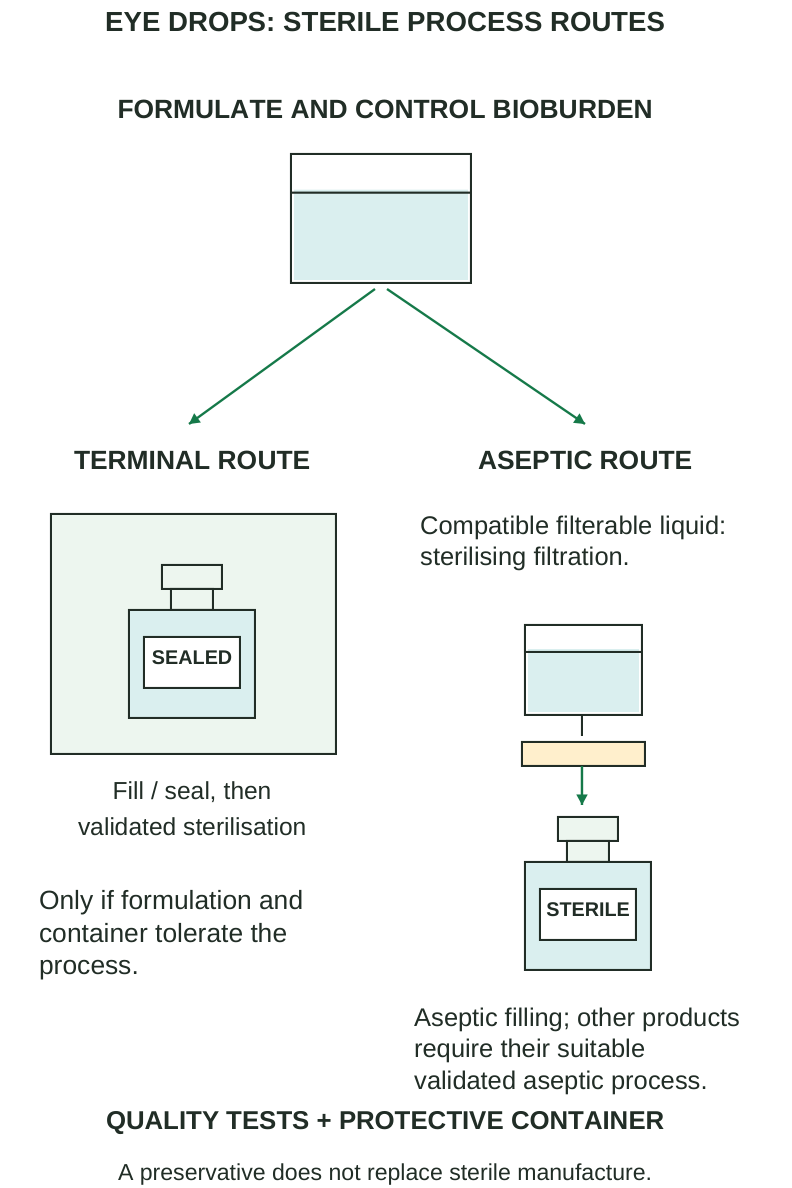
Diagram labels: Formulate and control bioburden. Terminal route: fill and seal, then validated sterilisation; only if formulation and container tolerate the process. Aseptic route: compatible filterable liquid undergoes sterilising filtration, followed by aseptic filling; other products require their suitable validated aseptic process. Quality tests + protective container. A preservative does not replace sterile manufacture.
Explanation: Terminal sterilisation is used when the formulation and container tolerate it. Otherwise a validated aseptic process is required. Sterilising filtration applies only to compatible filterable liquids and is followed by aseptic filling.
Stepwise Formulation and Manufacture
- Step 1: Verify the sterile-product formula, ingredient quality and container-closure system.
- Step 2: Prepare the solution or dispersion using the required pharmaceutical water/vehicle quality and controlled conditions.
- Step 3: Adjust appropriate pH, tonicity and viscosity, checking compatibility and solubility.
- Step 4: Use the validated terminal-sterilisation or aseptic-manufacture route. Do not pass a suspension through a filter that removes its intended solid drug.
- Step 5: Fill and seal with the specified process controls, then perform required quality tests.
- Step 6: Label storage, route, strength and the product-specific period after opening.
Examples and Interpretation
Artificial-tear solutions and suitable sodium chloride ophthalmic solutions illustrate dissolved systems. Prednisolone acetate ophthalmic suspension illustrates a dispersed solid system. These dosage forms must not be interchanged simply because both use a dropper.
- Solutions should have appropriate clarity; intended suspension particles require controlled size and redispersion rather than disappearance.
- A preservative is not a substitute for sterile manufacture.
- Isotonicity and pH are different properties. Sodium chloride adjusts osmotic effects; it does not necessarily set the pH.
- A common isotonic reference is 0.9% w/v sodium chloride. It is not a universal complete eye-drop formula.
Important distinction: Ordinary filtration ≠ sterilising filtration ≠ sterility assurance. Sterility depends on the complete validated process and protected container, not a final visual check.
4.14 Ear Drops: Vehicles, Examples and Preparation
Ear drops, or otic drops, are liquids introduced into the external auditory canal according to product directions. They may contain dissolved or dispersed ingredients in aqueous, glycerol-rich, glycol or oily vehicles.
Examples include suitable carbamide peroxide cerumenolytic ear drops and medicated otic solutions or suspensions. Cerumenolytic means helping soften or remove ear wax. The exact formulation and use depend on the product; a named ingredient alone does not establish a safe otic formula.
Preparation Outline
- Step 1: Verify the otic route, formula, ingredient solubility and container requirements.
- Step 2: Dissolve or disperse the ingredient in the specified compatible vehicle.
- Step 3: Incorporate remaining excipients and adjust quantity.
- Step 4: Check homogeneity, relevant pH, physical stability and required microbial quality.
- Step 5: Fill suitable dropper containers and label For use in the ear with specific directions.
Key Formulation Considerations
- Viscosity affects retention and drop delivery. Very viscous liquid may not release drops conveniently.
- Vehicle and ingredients must suit the ear; an eye, nasal or oral product is not automatically suitable.
- Microbial/sterility requirements follow the intended product and use. Sterile preparations are particularly important when the use requires them.
- A perforated tympanic membrane or other ear condition changes suitability; formulation cannot be selected from the word ear drop alone.
Memory trick: Otic = ear; ophthalmic = eye. Route names must be visible on the label. A dropper shape does not establish interchangeability.
4.15 Nasal Drops: Local Delivery and Preparation
Nasal drops are liquid preparations intended for instillation into the nasal cavity. Their vehicle and excipients must suit the nasal mucosa. A solution contains dissolved ingredients; a suspension contains dispersed solids and requires appropriate particle and dose-uniformity control.
Sodium chloride nasal solution is an example of an aqueous nasal preparation. Historical ephedrine nasal drops illustrate a medicated compendial class; current product choice and duration of use cannot be inferred from a historical formula.
Preparation of an Aqueous Solution
Step 1: Verify formula, route, concentration and required microbial quality.
Step 2: Dissolve ingredients in the specified quality of water.
Step 3: Adjust permitted tonicity, pH and viscosity components while maintaining compatibility.
Step 4: Bring to final quantity and evaluate clarity or, for a suspension, particle uniformity and redispersibility.
Step 5: Fill suitable nasal containers with a delivery device that gives the intended drops.
Step 6: Label route, product-specific directions and storage.
pH, osmotic properties and excipients can affect mucosal comfort and normal clearance mechanisms.
A nasal spray and a nasal drop are different delivery systems; dose delivery must be assessed with the actual device.
Preservatives, when used, need compatibility and effectiveness checks. Preservative-free products require a suitable protective packaging/process strategy.
| Drop preparation | Main site | Essential distinction |
|---|---|---|
| Eye / ophthalmic | Conjunctival sac | Sterile preparation |
| Ear / otic | External auditory canal | Otic suitability and product-specific quality |
| Nasal | Nasal cavity | Mucosal compatibility and nasal delivery |
One word, different products: Drop describes a small delivered volume. It does not define a universal concentration, drop size, vehicle or sterility category.
4.16 Tinctures: Definition, Extraction and Examples
Tinctures are alcoholic or hydroalcoholic preparations traditionally obtained from plant materials or prepared by dissolving suitable chemical substances. The term does not mean that every tincture is for external use: the route belongs to the particular preparation.
| Method | Principle | Suitable context |
|---|---|---|
| Maceration | Soak material in a specified menstruum, then separate extract | Extraction when prolonged contact is suitable |
| Percolation | Pass menstruum through a suitably packed, prepared material | Controlled continuous extraction |
| Direct solution | Dissolve specified soluble substances in alcohol/water | Chemical tinctures or soluble components |
Menstruum means the extraction solvent. Its ethanol-water composition controls extraction selectivity and solubility. More alcohol does not necessarily extract every desirable constituent better.
Maceration: Stepwise
- Step 1: Verify identity, quality and required particle preparation of the material.
- Step 2: Add the prescribed menstruum and maintain the specified closed contact conditions.
- Step 3: Agitate as required and separate the extract by the prescribed expression/filtration method.
- Step 4: Combine appropriate extract portions and adjust to the specified final quantity/strength.
- Step 5: Evaluate clarity, identity/strength and solvent-related controls; package well closed.
Percolation: Stepwise
- Step 1: Moisten the suitable material with menstruum and allow the prescribed equilibration.
- Step 2: Pack the percolator uniformly without inappropriate channels or excessive compaction.
- Step 3: Pass menstruum at the controlled rate and collect the required percolate.
- Step 4: Complete any specified concentration or strength adjustment and evaluate the product.
Compound benzoin tincture and iodine tincture are external-use examples in relevant formulations. Compound benzoin tincture contains resinous constituents in an alcoholic system; water addition can cause precipitation. Alcohol-containing tinctures require appropriate closure and any applicable flammability information.
Memory trick: Maceration = soak; percolation = pass; solution = dissolve. The named method follows the material and formula, not a universal rule for all tinctures.
4.17 Study of Official Preparations: Formula and Excipient Roles
An official preparation is a preparation described in the applicable pharmacopoeia or formulary. Its authoritative identity, composition, preparation, tests and storage belong to the specified edition. A familiar teaching formula is not proof that an identical monograph exists in every current compendium.
How to Study an Official Preparation
- Step 1: Identify the exact official title and edition.
- Step 2: Identify route, dosage form, strength basis and final quantity.
- Step 3: Assign a function to each ingredient: active, vehicle, solubiliser, emulsifier, suspending agent, preservative or other role.
- Step 4: Explain each preparation operation and why its order matters.
- Step 5: Connect quality checks, container and label to the formulation.
| Traditional compendial teaching example | Ingredient roles / principle | Study focus |
|---|---|---|
| Simple syrup | Sucrose + water; sweet viscous vehicle | Mass versus volume strength |
| Camphor liniment | Camphor dissolved in suitable oil | Oil-soluble substance |
| Calamine lotion | Insoluble material + wetting/suspending vehicle | Particle wetting and redispersion |
| Compound iodine paint | Iodine system + solubilising ingredients + viscous vehicle | Solubility and contact |
| Compound benzoin tincture | Resinous substances + alcoholic menstruum | Extraction / solubility and volatility |
| Liquid paraffin emulsion | Oil + water + emulsifying system | Continuous phase and emulsification |
Other examples include suitable aromatic waters, simple linctus and medicated elixirs. Exact quantities should be taken from the specified formula rather than mixed across editions. A formula stated per 100 g cannot be directly treated as per 100 mL.
Scaling a Formula
If a formula is stated for 100 mL and the required final volume is 250 mL:
Scale factor = 250 / 100 = 2.5.
Multiply specified ingredient quantities by 2.5; bring vehicle to the final quantity. Process times, equipment settings and sterilisation conditions are not automatically multiplied by the batch factor.
Examination answer pattern: Name → class → ingredient functions → numbered preparation → quality → container/label. This structure explains an official preparation rather than merely listing its ingredients.
4.18 Suspensions: Definition, Classification and Usefulness
A pharmaceutical suspension is a dispersion of finely divided, substantially insoluble solid particles in a liquid vehicle. Some drug may dissolve in the vehicle, but an intended solid phase remains. Particle properties, wetting, interactions and the vehicle determine physical performance.
| Classification basis | Types / examples |
|---|---|
| Route | Oral suspension; external lotion; specialised sterile suspension |
| Supply form | Ready-to-use liquid; powder/granules for reconstitution |
| Particle association | Flocculated; deflocculated |
| Concentration | Dilute or more concentrated dispersed-solid systems |
Advantages
- Permits liquid delivery of ingredients that cannot be dissolved at the required concentration in a suitable vehicle.
- Can be easier to swallow than solid units for suitable patients.
- Some ingredients are more chemically stable predominantly in solid form than completely dissolved; this is formulation-dependent.
- Can reduce the dissolved fraction responsible for unpleasant taste in selected systems.
- Supports external application of protective insoluble substances such as calamine.
Disadvantages
- Particles settle or aggregate; inconsistent mixing can cause non-uniform doses.
- Hard caking may prevent redispersion.
- Grittiness or a bulky sediment may impair acceptability.
- More formulation controls are needed than for a simple compatible solution.
- Microbial quality, chemical stability and dose-delivery device remain important.
Desired suspension behaviour: The goal is readily redispersible particles and reproducible dose delivery, not simply a bottle that never shows sediment. Fast-settling loose flocs may be preferable to a slowly forming hard cake.
Examples include oral antacid suspensions, calamine suspension lotion and appropriately formulated ophthalmic suspensions. The same active ingredient in different routes requires a different validated formulation.
4.19 Flocculated and Deflocculated Suspensions
Flocculation is the formation of loose associations of particles, called flocs. Under controlled conditions, these associations can break apart on shaking. Deflocculated systems contain particles that remain relatively separate rather than forming loose flocs.
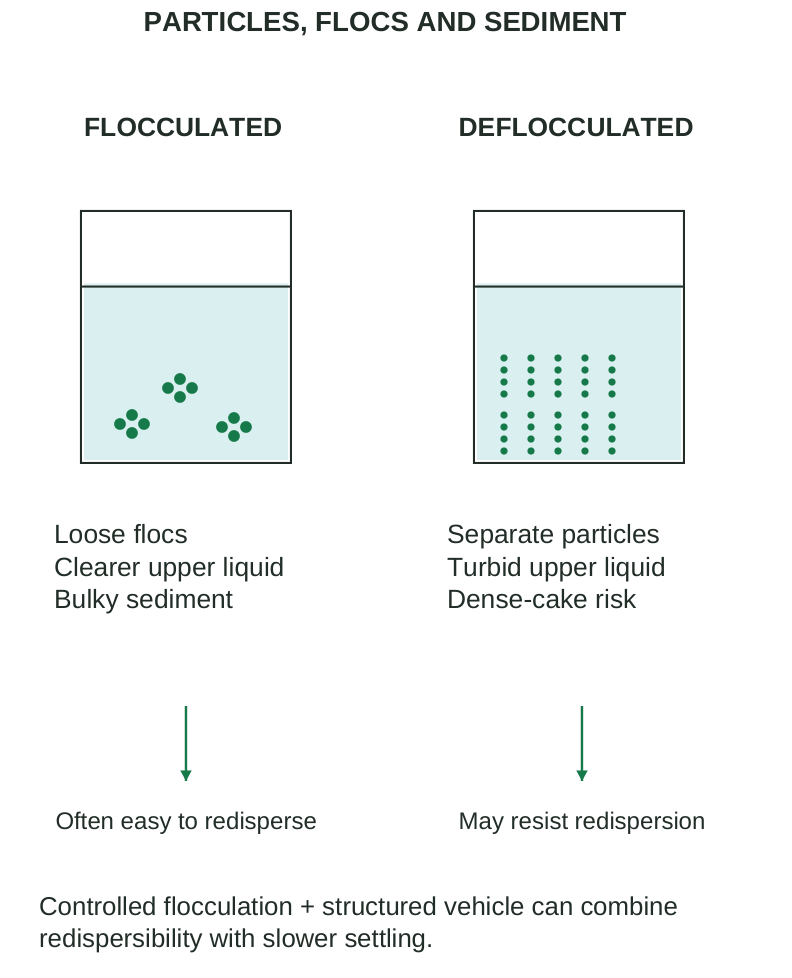
Diagram labels: Flocculated: loose flocs, clearer upper liquid, bulky sediment, often easy to redisperse. Deflocculated: separate particles, turbid upper liquid, dense-cake risk, may resist redispersion. Controlled flocculation + structured vehicle can combine redispersibility with slower settling.
Explanation: Loose flocs can settle into a bulky sediment that redistributes. Separate particles may settle more slowly and pack densely. The diagram illustrates typical tendencies rather than unavoidable outcomes in every formulation.
| Feature | Flocculated | Deflocculated |
|---|---|---|
| Particle association | Loose flocs | More separate particles |
| Typical settling | Often relatively faster | Often slower initially |
| Supernatant | Often clears sooner | Often stays turbid longer |
| Sediment | Bulky, relatively loose | Can become closely packed |
| Redispersion | Usually easier when properly controlled | Caking risk can make it difficult |
| Main concern | Settling before a dose is withdrawn | Dense sediment / cake formation |
Why Faster Settling Can Still Be Acceptable
A floc behaves as a larger moving unit and may settle more rapidly. Its loose structure retains liquid and resists close packing. The formulation can combine controlled flocculation with a structured vehicle to reduce settling while maintaining redispersibility.
- Flocculation is not the same as irreversible aggregation or crystal growth.
- Electrolytes, polymers or suitable surfactant systems may alter particle interactions. Their effects depend on concentration and surface chemistry.
- Too little or too much flocculating material can give an unsuitable product; more is not automatically better.
Memory trick: Flocs: fast but fluffy. Deflocculated particles: delayed settling, dense-cake risk. These are useful tendencies, not rigid guarantees.
4.20 Sedimentation, Caking and Physical Stability
Sedimentation is gravitational settling of dispersed solid particles when their density exceeds that of the vehicle. Some particles can rise instead when less dense. Caking is formation of a compact sediment that does not readily redisperse.
Stokes’ Relationship: Teaching Approximation
For isolated spherical particles in a dilute Newtonian liquid under the relevant laminar-settling conditions:
v = d²(rho-p – rho-v)g / (18 eta)
| Symbol | Meaning |
|---|---|
| v | Settling velocity |
| d | Particle diameter |
| rho-p; rho-v | Particle and vehicle density |
| g | Gravitational acceleration |
| eta | Dynamic viscosity of vehicle |
- For otherwise identical conditions, doubling diameter gives four times the predicted settling velocity.
- Increasing viscosity lowers the predicted settling velocity.
- Reducing the density difference lowers the predicted settling velocity.
- Real concentrated suspensions, irregular particles, flocs and non-Newtonian vehicles may not follow the simple model quantitatively.
Sedimentation Volume
F = Vu / V0
Vu is the ultimate sediment volume and V0 is the original suspension volume.
For 20 mL sediment in an original 100 mL suspension:
F = 20 / 100 = 0.20.
F has no unit. It describes volume organisation, not the percentage of drug remaining active.
Rheology and Particle Changes
- Pseudoplastic behaviour: Apparent viscosity falls as shear increases; the product can be thicker at rest and easier to pour during handling.
- Thixotropy: A time-dependent decrease in structure/viscosity under shear followed by recovery at rest. It is distinct from shear thinning alone.
- Crystal growth: Dissolution and recrystallisation can enlarge particles, affecting texture, settling and dose performance.
- Smaller particles can improve texture and reduce ideal settling, but excessive size reduction can change interactions, dissolution or stability.
Stability is multidimensional: A suspension must be physically redispersible, chemically acceptable and microbiologically suitable. A high sedimentation volume alone proves none of these completely.
4.21 Suspension Excipients and Their Functions
| Function | Examples | Why used |
|---|---|---|
| Wetting agent | Suitable polysorbate; glycerol where appropriate | Displaces air and assists liquid contact with solid |
| Suspending / viscosity agent | Sodium carboxymethylcellulose, xanthan gum, suitable bentonite | Slows movement; supports a structured vehicle |
| Flocculation modifier | Selected electrolytes or polymers | Controls reversible particle association |
| Vehicle | Suitable pharmaceutical water / compatible medium | Continuous liquid phase |
| Buffer | Compatible pH-control system | Balances stability, solubility and tolerance |
| Preservative | Suitable validated antimicrobial system | Controls microbial growth where required |
| Sweetener / flavour | Sucrose or suitable alternatives | Acceptability for oral use |
| Other stabilisers | Compatible antioxidant / chelator | Protect against relevant chemical changes |
Wetting Versus Suspending
A wetting agent helps the vehicle contact the particle surface. A suspending agent changes the flow or structure of the vehicle. They solve different problems. A powder floating on the surface may need better wetting even if the liquid is already thick.
Hydration of Polymers
Gums and cellulose derivatives require the specified dispersion and hydration procedure. Adding powder too quickly can create lumps with a hydrated outer layer and a dry centre. Pre-wetting in a compatible liquid or gradual addition under mixing may help when the formula allows it.
Compatibility
- Ionic charge, pH and electrolyte concentration can change polymer viscosity or particle association.
- Preservatives may bind to particles or polymers, reducing available antimicrobial activity.
- A sweetened oral suspending vehicle is not automatically suitable for an ophthalmic suspension.
- Ingredient quality and microbiological controls cannot be replaced by adding a preservative.
Memory trick: Wet the solid; structure the liquid; control association. These three tasks correspond to wetting, suspending and flocculation functions.
4.22 Suspension Preparation: Dispersion, Precipitation and Reconstitution
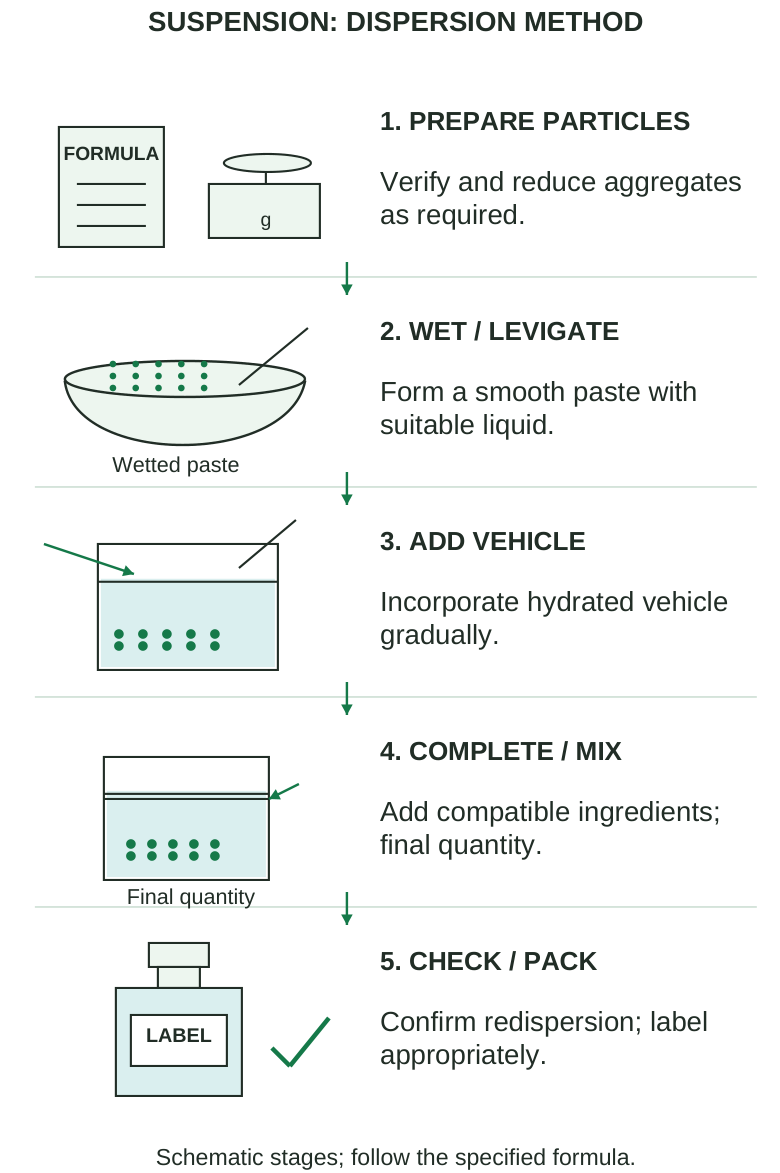
Diagram labels: Prepare particles: verify and reduce aggregates as required. Wet/levigate: form a smooth paste with suitable liquid. Add vehicle: incorporate hydrated vehicle gradually. Complete/mix: add compatible ingredients; final quantity. Check/pack: confirm redispersion; label appropriately. Schematic stages; follow the specified formula.
Explanation: The powder is wetted and levigated before the vehicle is incorporated gradually. Final mixing and redispersibility checks support uniform withdrawal of doses.
Dispersion Method
- Step 1: Verify the formula, required final quantity and particle specifications.
- Step 2: Reduce aggregates or suitably size the particles where required.
- Step 3: Wet/levigate the solid with a small amount of compatible liquid to form a smooth paste.
- Step 4: Prepare the suspending vehicle using the required hydration procedure.
- Step 5: Gradually incorporate vehicle into the paste, mixing thoroughly and rinsing equipment appropriately.
- Step 6: Add soluble ingredients and controlled flocculation modifiers as specified; adjust final quantity.
- Step 7: Mix, check physical/chemical/microbial requirements, and package with relevant shake-before-use directions.
Precipitation Method
A solid may be generated by a controlled chemical reaction, solvent change or other suitable process. For example, changing the solvent can reduce solubility and produce particles. Particle size, residual reagents/solvents and crystal form must be controlled. Accidental precipitation in an elixir is not equivalent to a properly developed suspension.
Powder for Reconstitution
- Step 1: Verify the product’s own diluent, quantity and reconstitution directions.
- Step 2: Loosen the dry material if the directions require it.
- Step 3: Add the specified liquid in the stated sequence; shake or mix as directed.
- Step 4: Allow foam to settle or complete final adjustment only where instructed.
- Step 5: Label the reconstituted strength, storage and product-specific usable period.
The water to add is not necessarily the final suspension volume because the powder occupies volume. Refrigeration and the period after reconstitution are product-specific, not universal for every antibiotic suspension.
Batch Arithmetic
For an illustrative 120 mL suspension containing 250 mg per 5 mL:
Concentration = 50 mg/mL.
Total API = 120 × 50 = 6000 mg = 6 g.
Vehicle and excipients are then incorporated to the stated final quantity under the formula. A uniform blend and accurate filling remain necessary.
Labelling: A suspension generally needs Shake well before use, route, strength, a suitable measuring device and specified storage. Shaking instructions do not make a non-redispersible cake acceptable.
4.23 Emulsions: Definition, Types and Advantages
An emulsion is a dispersion of one immiscible liquid as droplets within another liquid. The droplets form the internal/dispersed phase; the surrounding liquid forms the external/continuous phase. An emulsifying system limits droplet merging, but ordinary emulsions remain thermodynamically unstable.
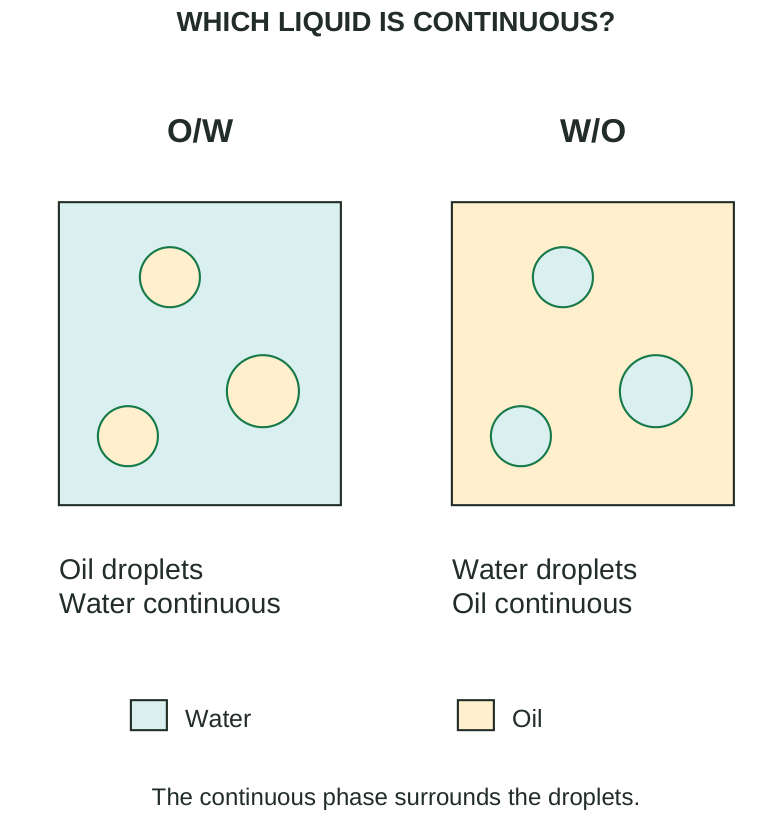
Diagram labels: O/W: oil droplets; water continuous. W/O: water droplets; oil continuous. The continuous phase surrounds the droplets.
Explanation: In O/W, oil is inside droplets and water surrounds them. In W/O, water is inside droplets and oil surrounds them. Phase names follow the actual continuous phase, not whichever ingredient has the greater volume.
| Feature | Oil-in-water: O/W | Water-in-oil: W/O |
|---|---|---|
| Dispersed phase | Oil | Water |
| Continuous phase | Water | Oil |
| Compatible dilution | Usually water | Usually oil |
| Typical feel / removal | Often less greasy; water-washable | Often more oily / occlusive |
| Examples | Suitable oral oil emulsion; many lotion emulsions | Selected external emulsions / cream bases |
Multiple emulsions, such as W/O/W, contain droplets within droplets. They are more complex systems and do not change the basic requirement to identify each internal and external phase.
Advantages
- Allows immiscible liquids to be distributed through one dosage form.
- Can improve presentation or mask an unpleasant oily taste in selected formulations.
- Can carry oil-soluble ingredients in the dispersed oil phase of an O/W product.
- Can modify skin feel, spreading and occlusion through continuous-phase selection.
Disadvantages
- Creaming, flocculation, coalescence and phase inversion can occur.
- Requires suitable emulsifier, mixing conditions and droplet-size control.
- Aqueous regions can support microbial growth unless properly protected.
- Sensitive to temperature, electrolytes, incompatibility and changes in phase proportions.
Memory trick: Read the slash as “in”: O/W = oil in water. The letter after the slash names the surrounding continuous phase.
4.24 Emulsifying Agents and Formulation Excipients
Emulsifying agents help create and stabilise the oil-water interface. Depending on their nature, they reduce interfacial tension, form protective films, alter droplet charge or support a barrier against coalescence. Viscosity-building ingredients can assist stability without being adequate primary emulsifiers on their own.
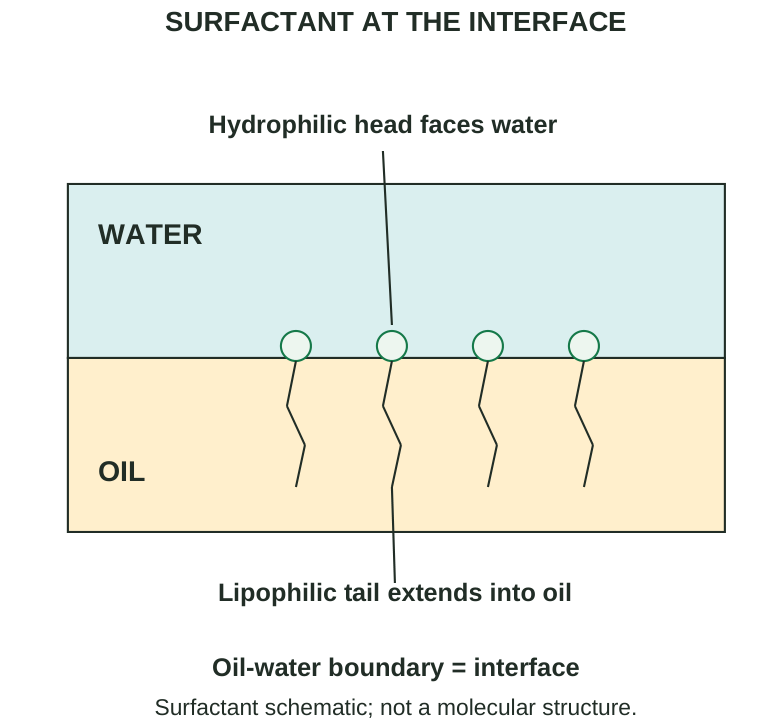
Diagram labels: Water; oil; hydrophilic head faces water; lipophilic tail extends into oil. Oil-water boundary = interface. Surfactant schematic, not a molecular structure.
Explanation: The hydrophilic head faces water and the lipophilic portion extends into oil. This orientation illustrates an amphiphilic surfactant; gums and solid-particle emulsifiers stabilise by other interfacial structures.
| Class | Examples | Main teaching point |
|---|---|---|
| Natural / hydrocolloid | Acacia, tragacanth; selected proteins | Hydrated interfacial films; microbial protection may be needed |
| Nonionic surfactant | Polysorbates; sorbitan esters | Hydrophilic/lipophilic balance guides selection |
| Ionic surfactant | Suitable soaps or other ionic surfactants | Charge and incompatibilities matter |
| Finely divided solid | Suitable bentonite or other particles | Particles can form an interfacial barrier |
| Auxiliary stabiliser | Cetyl alcohol; suitable viscosity modifiers | Supports structure with an appropriate primary system |
Desirable Properties
- Compatible with the API, phases and other excipients.
- Effective at the intended concentration and processing conditions.
- Suitable for the route, tolerability and patient population.
- Stable during storage, without unacceptable taste or odour where relevant.
HLB: Hydrophilic-Lipophilic Balance
For suitable surfactant systems, a higher HLB generally indicates greater affinity for water and often supports O/W emulsions; a lower HLB generally favours W/O systems. The required HLB of an oil phase and experimental stability guide the choice. HLB is not a universal proof of emulsion type for every emulsifier.
For a compatible two-surfactant blend:
HLB mix = (fraction A × HLB A) + (fraction B × HLB B)
The mass fractions sum to 1.
If A has HLB 4 and B has HLB 16, a 25:75 mass blend gives:
0.25 × 4 + 0.75 × 16 = 13.
These are illustrative values.
Other Emulsion Excipients
Oil and water are the major phases. Buffers, preservatives, antioxidants, flavours for suitable oral use, and viscosity modifiers may be incorporated where needed. A preservative can partition into the oil or interact with surfactant structures, so its effectiveness must be evaluated in the complete product.
Memory trick: Interface first; structure supports. Increasing viscosity alone does not guarantee that droplets cannot merge.
4.25 Identification Tests for Emulsion Type
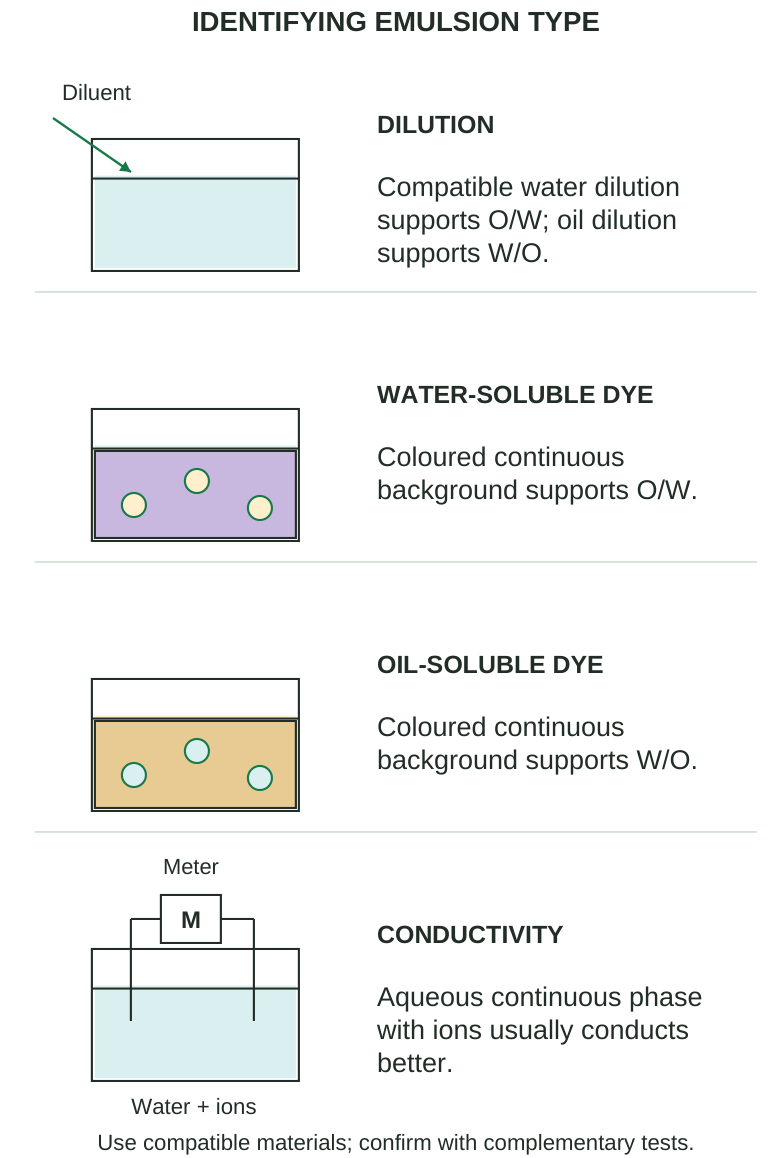
Diagram labels: Dilution: compatible water dilution supports O/W; oil dilution supports W/O. Water-soluble dye: coloured continuous background supports O/W. Oil-soluble dye: coloured continuous background supports W/O. Conductivity: aqueous continuous phase with ions usually conducts better. Meter; water + ions. Use compatible materials and confirm with complementary tests.
Explanation: Dilution, dye distribution and conductivity are complementary observations. They require compatible test materials and interpretation; a single inconclusive result should not establish the emulsion type.
| Test | O/W tendency | W/O tendency | Limitation |
|---|---|---|---|
| Dilution | Mixes more readily with water | Mixes more readily with oil | Wrong diluent may destabilise the test sample |
| Water-soluble dye | Continuous phase becomes coloured | Dye chiefly marks aqueous droplets | Dye must be suitable and observed correctly |
| Oil-soluble dye | Oil droplets become coloured | Continuous oil becomes coloured | Partitioning / solubility can confuse results |
| Conductivity | Conducts when water phase contains mobile ions | Usually much lower conduction | Ion content and instrument sensitivity matter |
Dilution Test: Steps
- Step 1: Place small separate samples in suitable vessels.
- Step 2: Add compatible water to one and suitable oil to the other.
- Step 3: Mix gently and compare uniform dilution with visible disruption.
- Step 4: Confirm the interpretation with another suitable test.
Dye / Microscopic Observation
Add a small suitable dye sample according to the test method. Under observation, determine whether the continuous background or separate droplets carry the colour. Water-soluble dye in a coloured continuous background supports O/W; separate dyed water droplets in an oily background support W/O.
Conductivity Test
Use electrodes and an appropriate meter with the test sample. A connected aqueous phase containing ions permits current flow more readily than an oil-continuous phase. Low conductivity does not prove W/O when the aqueous phase contains very few ions or the instrument cannot detect the current.
- Additional traditional tests include wetting of filter paper and fluorescence with an appropriate oil phase. Results depend on formulation; they are supporting tests rather than universal shortcuts.
- Do not identify the continuous phase solely by total oil/water percentages or visual whiteness.
Memory trick: Dilute – dye – conduct. Identify the surrounding phase by its compatibility, where the dye goes and whether ions have a connected path.
4.26 Emulsion Preparation: Dry Gum, Wet Gum and Other Methods
Emulsification requires appropriate ingredients and energy to disperse droplets. The correct emulsifier, order of addition, phase conditions and mixing intensity are formulation-specific. A primary emulsion is the initial concentrated emulsion formed before final dilution and incorporation of remaining ingredients.
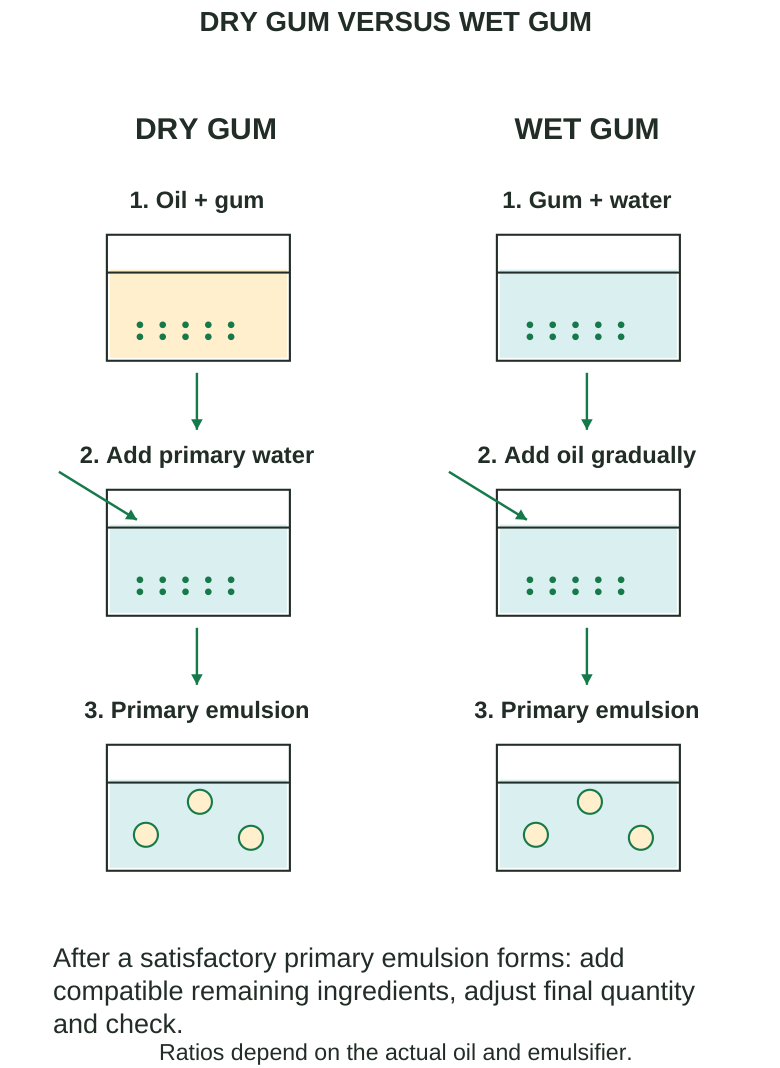
Diagram labels: Dry gum: oil + gum → add primary water → primary emulsion. Wet gum: gum + water → add oil gradually → primary emulsion. After a satisfactory primary emulsion forms, add compatible remaining ingredients, adjust final quantity and check. Ratios depend on the actual oil and emulsifier.
Explanation: Dry gum begins with oil and dry gum before the primary water is added. Wet gum begins with gum hydrated in water before oil is added gradually. Both must form a satisfactory primary emulsion before further dilution.
Traditional Acacia Ratio
For many fixed-oil acacia teaching formulations, the primary ratio is:
Oil : water : gum = 4 : 2 : 1
Conventionally, mL is used for oil and water and g for gum.
The ratio is not universal for volatile oils, mineral oils or different emulsifiers. Use the appropriate formula for the actual oil/emulsifier system.
Dry-Gum / Continental Method
- Step 1: Use the specified clean, dry equipment and verify primary-emulsion quantities.
- Step 2: Mix the gum with the oil to wet and distribute the gum.
- Step 3: Add the specified primary water and triturate promptly and vigorously until the primary emulsion forms.
- Step 4: Incorporate compatible dissolved ingredients and additional vehicle gradually.
- Step 5: Transfer, adjust final quantity, mix and evaluate stability and quality.
Wet-Gum / English Method
- Step 1: Triturate gum with the primary water to form a suitable mucilage.
- Step 2: Add oil gradually in portions while triturating.
- Step 3: Continue until a satisfactory primary emulsion forms.
- Step 4: Add remaining compatible ingredients and vehicle, adjust final quantity and evaluate.
| Feature | Dry gum | Wet gum |
|---|---|---|
| First contact | Gum + oil | Gum + water |
| Next major addition | Primary water | Oil in portions |
| Memory order | O-G then W | G-W then O |
Bottle / Forbes Method
A suitable bottle method uses shaking to disperse a sufficiently mobile oil system. The emulsifier and oil are combined in the prescribed order, the specified water is incorporated, and a primary emulsion is formed by shaking before completion.
It is unsuitable for a very viscous system that cannot be adequately mixed. Oil-dependent primary ratios must be respected.
Mechanical / Beaker Methods
- Step 1: Dissolve oil-soluble ingredients in the oil phase and water-soluble ingredients in the aqueous phase.
- Step 2: Bring phases to suitable compatible processing conditions. Heat is used only when needed and tolerated.
- Step 3: Combine in the required order under controlled mixing.
- Step 4: Homogenise or use a colloid mill when appropriate to refine droplet distribution.
- Step 5: Cool/condition as specified, complete the formula and evaluate before filling.
In-Situ Emulsifier Formation
Some systems generate a soap emulsifier by interaction of a suitable fatty acid/oil constituent with an alkaline component. The soap’s nature can favour a particular continuous phase. This is a formula-specific chemical process, not simply a replacement for any commercial emulsifier.
Ratio exercise: If a suitable teaching formula uses 20 mL fixed oil at 4:2:1:
Primary water = 10 mL.
Gum = 5 g.
This is the primary emulsion, not necessarily the final product quantity.
4.27 Emulsion Instability, Quality and Packaging
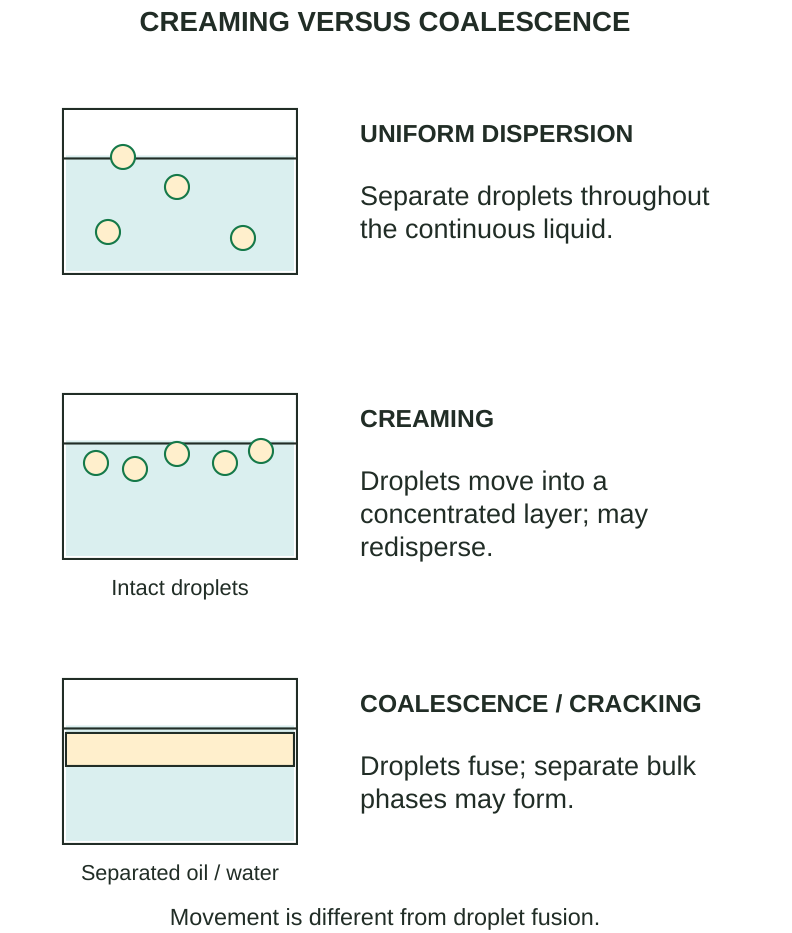
Diagram labels: Uniform dispersion: separate droplets throughout the continuous liquid. Creaming: droplets move into a concentrated layer; may redisperse; droplets remain intact. Coalescence/cracking: droplets fuse; separate bulk phases may form, producing separated oil/water. Movement is different from droplet fusion.
Explanation: Creaming concentrates droplets in one region without requiring them to fuse; it may redisperse. Coalescence merges droplets and can lead to separate bulk liquid layers. Shaking a cracked product is not a validated restoration.
| Change | Meaning | Practical distinction |
|---|---|---|
| Creaming | Droplets collect towards top or bottom under gravity | Can be reversible if droplets remain intact |
| Flocculation | Droplets form loose associations | Different from droplet fusion |
| Coalescence | Droplets merge into larger droplets | Interfacial protection has failed |
| Cracking / breaking | Extensive coalescence produces separated bulk phases | Generally irreversible by ordinary shaking |
| Phase inversion | Continuous and dispersed phases exchange roles | May change dilution behaviour and performance |
| Microbial / chemical change | Growth, degradation or oxidation | May occur even without obvious separation |
Factors to Control
- Appropriate emulsifier identity and concentration.
- Compatible pH, electrolytes and additives.
- Controlled droplet distribution and appropriate processing.
- Suitable viscosity and storage conditions without damaging freeze/thaw or heat exposure.
- Effective microbial protection and compatible container closure.
Quality Checks for Liquids
| Solution | Suspension | Emulsion |
|---|---|---|
| Clarity; no unintended precipitate | Particle distribution; redispersibility | Droplet distribution; no cracking |
| Identity/assay; pH where relevant | Identity/assay; uniform dose withdrawal | Identity/assay; uniformity |
| Quantity and device performance | Sediment/caking; viscosity; device | Creaming behaviour; viscosity; device |
| Required microbial quality | Required microbial quality | Required microbial quality |
Sterile-site preparations require their sterile-product specifications in addition to suitable physical performance. Appearance is an important screen but does not replace chemical, microbial or dose-delivery tests.
Packaging and Labelling
- Use a compatible container: sorption, leaching, evaporation or oxidation must not compromise quality.
- State identity, strength, route and usable/storage information appropriate to the preparation.
- Include shake-before-use directions when the product requires redispersion.
- Provide a suitable measuring/delivery device and clear local-use or do-not-swallow wording where applicable.
Case example: An O/W product forms a cream layer that mixes uniformly again: investigate creaming. A product develops persistent oil/water layers after ordinary shaking: investigate cracking. These observations guide evaluation, not automatic release of the batch.
4.28 Quick Revision and Memory Aids
One-Line Revision
- Solution: One homogeneous liquid phase with dissolved ingredients.
- Suspension: Solid particles in a liquid; redispersibility governs useful uniformity.
- Emulsion: Liquid droplets in an immiscible liquid; identify the continuous phase.
- Aromatic water: Dissolved volatile aromatic material in water.
- Syrup: Concentrated sweet aqueous preparation; check the concentration basis.
- Elixir: Traditional sweetened hydroalcoholic oral liquid; avoid precipitation on dilution.
- Linctus: Viscous cough-related oral liquid intended for slow swallowing as directed.
- Liniment: Skin preparation traditionally applied with rubbing when suitable.
- Lotion: Fluid skin preparation; can be solution, suspension or emulsion.
- Throat paint: Local painted preparation with suitable contact.
- Gargle / mouthwash: Throat / mouth contact; local-use liquid.
- Enema: Rectal liquid preparation.
- Eye / ear / nasal drops: Site-specific liquid delivery; eye products are sterile.
- Tincture: Alcoholic/hydroalcoholic extract or solution; route depends on the product.
Core Comparisons
| Concept pair | Difference to remember |
|---|---|
| Wetting / suspending | Particle contact / vehicle structure |
| Flocculated / deflocculated | Loose associations / more separate particles |
| Creaming / coalescence | Droplet movement / droplet fusion |
| O/W / W/O | Water continuous / oil continuous |
| Dry gum / wet gum | Oil-gum first / gum-water first |
| Isotonicity / pH | Osmotic effect / acidity-alkalinity |
| q.s. / q.s. to | Sufficient amount / reach final amount |
Memory ladder: Identify phase → choose vehicle/excipients → prepare in order → check quality → package for the route. This works across the unit.
Common Errors to Avoid
- Calling every external liquid monophasic.
- Assuming a high-sugar syrup is sterile or universally self-preserving.
- Using the same dropper or vehicle rules for eye, ear and nose.
- Equating a fast-settling suspension with unavoidable poor quality.
- Confusing a suspension’s hard cake with an emulsion’s cracked layers.
- Using 4:2:1 for every oil and emulsifier.
- Treating every filter as a sterilising process.
- Adding the stated final volume as extra vehicle.
4.29 Possible Examination Questions and Application Practice
These practice questions follow the supplied syllabus. Numerical quantities illustrate formulation arithmetic and do not establish patient dosing or a universal official formula.
Very-Short-Answer Questions
- Define monophasic and biphasic liquid preparations.
- Define aromatic water, syrup, elixir and linctus.
- Differentiate a gargle from a mouthwash.
- What is a menstruum? Name two tincture preparation methods.
- State the essential microbial requirement for eye drops.
- Define flocculation, caking, internal phase and continuous phase.
- Write the meaning of O/W and W/O.
- Name two emulsion identification tests and two emulsifying-agent classes.
Short-Answer Questions
- Explain aromatic-water preparation by distillation and the solution method with a labelled sketch.
- Describe syrup preparation methods and common stability problems.
- Explain the order of combining aqueous and alcoholic portions in an elixir.
- Compare liniments, lotions and throat paints with examples.
- Describe preparation principles of gargles, enemas and route-specific drops.
- Explain how to study an official liquid preparation and assign excipient functions.
- Compare flocculated and deflocculated suspensions.
- Explain sedimentation volume and the limits of Stokes’ relationship.
- Differentiate wetting, suspending and flocculating functions.
- Explain emulsion identification by dilution, dye and conductivity tests.
- Describe the functions and classes of emulsifying agents.
- Differentiate dry-gum, wet-gum and bottle methods.
Long-Answer Questions
- Classify liquid dosage forms and discuss the internal monophasic preparations with definitions, methods and examples.
- Discuss the listed external/body-cavity preparations, their excipients, preparation and quality requirements.
- Define suspensions and describe types, advantages, disadvantages, formulation and methods of preparation.
- Define emulsions and discuss types, emulsifiers, identification tests and preparation methods with labelled figures.
- Discuss physical instability and quality control of liquid dispersions.
Application and Calculation Practice
| Question | Answer / key idea |
|---|---|
| 1. 2% w/v solution, final volume 150 mL: ingredient mass? | 3 g; vehicle to 150 mL |
| 2. 300 g syrup at 66.7% w/w: sucrose mass? | 200.1 g |
| 3. 100 mg in 5 mL: amount in 2 mL? | 40 mg; not a dose recommendation |
| 4. 20 mL of 10% w/v stock to 100 mL total: strength? | 2% w/v, if compatible |
| 5. 20 mL sediment from 100 mL suspension: F? | 0.20, no unit |
| 6. Diameter doubles under Stokes assumptions: change in v? | Fourfold increase |
| 7. 20 mL fixed oil at a suitable 4:2:1 primary ratio? | Water 10 mL; gum 5 g |
| 8. HLB values 4 and 16 blended 25:75 by mass? | HLB 13 |
| 9. Water-soluble dye colours the continuous phase? | Supports O/W; confirm suitably |
| 10. Persistent fused oil/water layers after shaking? | Cracking / breaking; investigate |
| 11. Elixir precipitates after adding water. Why? | Reduced solvent power / incompatibility |
| 12. Clear eye drops passed through an ordinary filter. Sterile? | No; validated sterile process is required |
Answer Structure
Begin with the definition and classification. Explain ingredient functions, draw a clearly labelled relevant sketch, describe preparation as Step 1, Step 2…, then discuss quality, packaging and route-specific labelling. For a numerical answer, show units, concentration basis, calculation and final quantity.