Course Code: BP102T
Unit I Overview
Unit I: Introduction to the Profession of Pharmacy. The unit covers professional history and scope, medicine-quality standards and prescription handling.
Topics Covered – Syllabus Coverage
| Required topic | Coverage |
|---|---|
| History: education, industry, organisations and milestones | Sections 1.2-1.5 |
| Scope: retail/community, hospital and clinical pharmacy | Sections 1.6-1.8 |
| Industrial pharmacy, including R&D | Section 1.9 |
| IP, BP, USP, BPC, International Pharmacopoeia and other pharmacopoeias | Sections 1.10-1.13 |
| National Formulary of India | Section 1.14 |
| IP structure and content | Section 1.15 |
| Study of one model IP monograph | Sections 1.16-1.17 |
| Prescription: structure and parts | Section 1.18 |
| Handling prescriptions | Sections 1.19-1.20 |
| Latin terminology related to prescriptions | Section 1.21 |
Revision and examination practice
Sections 1.22-1.24 contain applied examples, quick revision, possible examination questions and answer guides.
Learning outcomes
- Explain milestones in Indian pharmacy education, industry and organisations.
- Compare community, hospital, clinical and industrial responsibilities.
- Distinguish pharmacopoeias from formularies; interpret IP structure and a model monograph.
- Identify prescription parts, describe safe handling and translate prescription Latin.
Important abbreviations
| Term | Expansion |
|---|---|
| PCI | Pharmacy Council of India |
| IPC | Indian Pharmacopoeia Commission |
| IPA | Indian Pharmaceutical Association |
| IP | Indian Pharmacopoeia |
| NFI | National Formulary of India |
| API | Active pharmaceutical ingredient |
| QA / QC | Quality assurance / quality control |
| GMP | Good manufacturing practices |
| R&D | Research and development |
The central principle: Acceptable medicine quality, supply to the correct patient and clear instructions work together.
Editions covered
The overview includes IP 2026, 10th edition, and NFI 2026, 7th edition. The monograph study uses an identified historical IPC format example.
1.1 Pharmacy: meaning and professional foundations
Pharmacy is the science and professional practice concerned with the development, preparation, quality, supply and appropriate use of medicines.
It combines knowledge of drugs with the practical responsibility of helping people use them correctly.
Essential terms
- Drug substance / API: the active material responsible for the intended pharmacological action of a medicine.
- Drug product: the finished medicine, such as a tablet or oral liquid, containing the API and usually suitable excipients.
- Dispensing: interpreting an authorised medicine order, preparing or selecting the medicine, labelling it, checking it, providing instructions and recording the supply.
- Compounding: preparing a medicine for a specific need by combining or modifying ingredients under appropriate professional and legal conditions.
- Pharmaceutical care: patient-focused work that identifies and helps resolve medicine-related problems through cooperation with the patient and healthcare team.
Example: Paracetamol powder used in manufacture is a drug substance; a correctly formulated paracetamol tablet is a drug product. Supplying that tablet with verified directions and counselling is part of professional pharmacy practice.
Knowledge areas working together
| Area | Main question |
|---|---|
| Pharmaceutics | How can the drug be made into a suitable medicine? |
| Pharmaceutical chemistry and analysis | What is it, how is it made and how is quality tested? |
| Pharmacology | What effects does it have in the body? |
| Pharmacognosy | What medicinal materials come from natural sources? |
| Pharmacy practice | How can medicines be used safely and effectively? |
| Pharmaceutical jurisprudence | What legal and ethical duties govern the work? |
Professional principle: A pharmacist combines scientific competence, accurate communication, ethical conduct and accountability. Dispensing involves judgement and verification, not simply handing over a pack.
1.2 Evolution of pharmacy in India
From traditional medicines to an organised profession
India has a long history of preparing and using medicines through systems such as Ayurveda, Siddha and Unani.
This historical use of medicinal materials should be distinguished from the later development of organised university pharmacy education and the modern regulated pharmacist profession.
- Early practice: medicinal plants, minerals and preparations were selected and prepared within established traditions.
- Growth of modern medicine: hospitals, dispensaries and commercial manufacture increased the need for trained personnel and reproducible preparations.
- Professional organisation: education, associations, legal registration and official quality standards developed alongside the pharmaceutical industry.
- Modern practice: pharmacists contribute to product development, quality systems, medicine supply, patient counselling and safety monitoring.
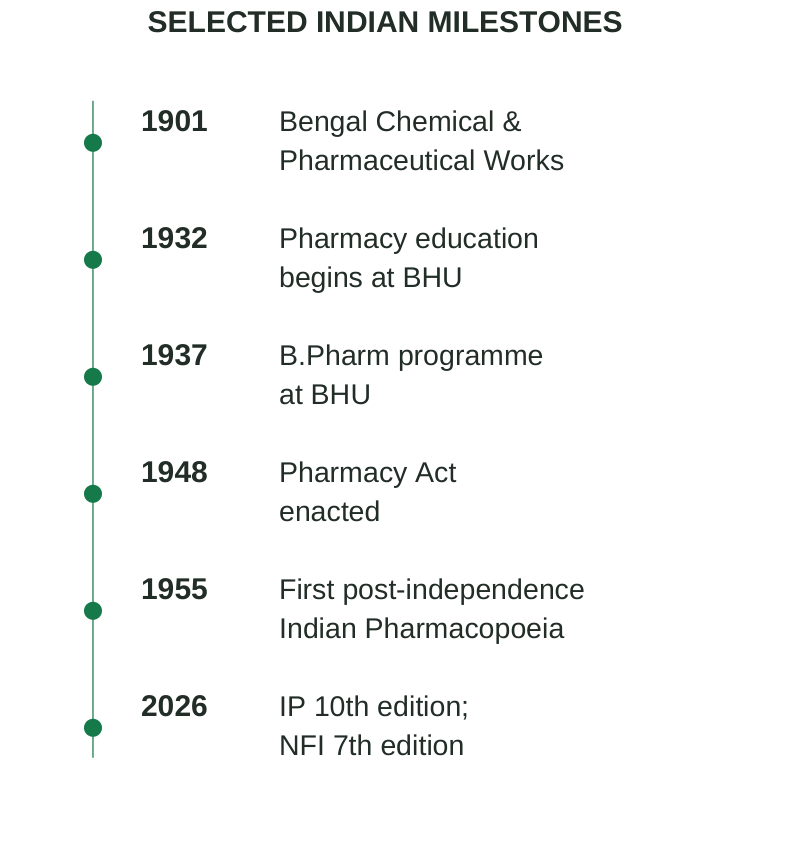
Diagram labels: 1901: Bengal Chemical & Pharmaceutical Works; 1932: pharmacy education begins at BHU; 1937: B.Pharm programme at BHU; 1948: Pharmacy Act enacted; 1955: first post-independence Indian Pharmacopoeia; 2026: IP 10th edition and NFI 7th edition.
Explanation: The timeline selects milestones from education, industry, legislation and compendia. It is not an exhaustive list, and the events do not imply that every branch developed at the same rate.
Why the profession changed
As the range of medicines expanded, reliable identification, uniform preparation and consistent quality became increasingly important.
More complex treatment also created a need for medicine-information services and collaboration between pharmacists, prescribers and nurses.
Memory sequence: Prepare → Educate → Organise → Regulate → Standardise → Care.
Use this sequence to organise an essay on professional evolution; attach verified historical dates to the relevant stages.
1.3 Pharmacy education: development and milestones
Professor Mahadev Lal Schroff is widely recognised as the father of pharmacy education in India.
With the support of Pandit Madan Mohan Malaviya, pharmacy education developed at Banaras Hindu University.
The department traces its establishment to 1932; the B.Pharm programme began in 1937.
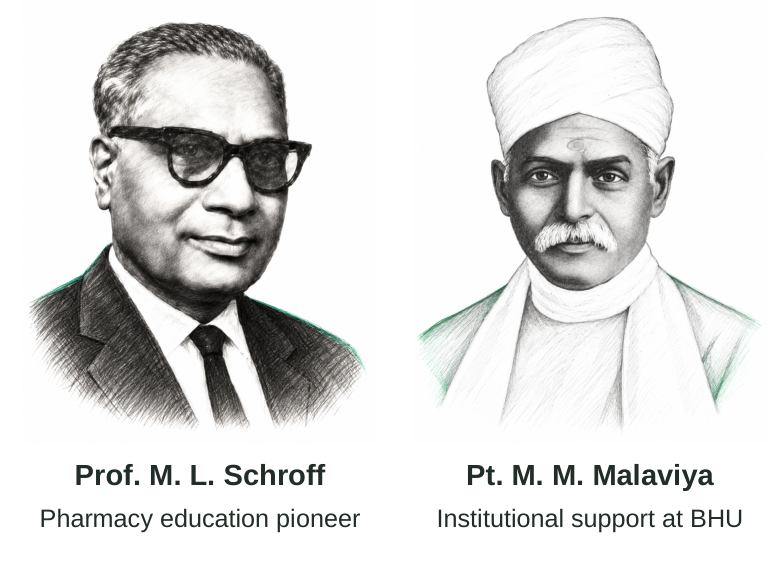
Diagram labels: Prof. M. L. Schroff: pharmacy education pioneer. Pt. M. M. Malaviya: institutional support at BHU.
Explanation: Schroff led the development of pharmacy education, supported by Malaviya’s institutional vision. The portraits are artistic illustrations based on historical reference photographs.
Major educational developments
| Year | Milestone |
|---|---|
| 1932 | Pharmaceutical education established at BHU under M. L. Schroff |
| 1937 | B.Pharm programme at BHU |
| 1941 | M.Pharm programme at BHU |
| 1945 | Ph.D. programme at BHU |
| 1948 | Pharmacy Act established the statutory basis for regulation |
| 1949 | Pharmacy Council of India established |
| 2008 | Pharm.D Regulations introduced a practice-oriented doctoral programme |
Educational pathways
- D.Pharm: diploma education supporting entry into pharmacist practice, subject to the approved course and registration requirements.
- B.Pharm: undergraduate education in pharmaceutical sciences, manufacture, analysis and pharmacy practice.
- M.Pharm: postgraduate specialisation in a selected area of pharmaceutical science or practice.
- Pharm.D: education with a substantial clinical and hospital-practice component; it is distinct from a research Ph.D.
- Ph.D.: advanced research training culminating in an original research contribution.
Education and registration are different
The PCI regulates educational standards and approves relevant courses and examinations under the Pharmacy Act framework.
State Pharmacy Councils maintain pharmacist registers.
Completing a qualification and obtaining professional registration are related but separate processes.
Common examination error: Do not write that the Pharmacy Act was passed in 1949. The Act is dated 1948; the PCI was established in 1949.
Also distinguish the early BHU development in 1932 from the B.Pharm programme in 1937.
Educational significance: Formal training replaced reliance on informal experience alone with systematic study of medicine preparation, testing and responsible supply.
Continuing professional development remains necessary as medicines and standards change.
1.4 Pharmaceutical industry: evolution and development
The Indian pharmaceutical industry developed from early domestic chemical and medicine enterprises into a sector covering APIs, formulations, vaccines, biological products, research and international supply.
Its development is best understood through capability changes, rather than only a list of company names.

Diagram labels: Acharya P. C. Ray; chemist and educator; pioneer of indigenous pharmaceutical enterprise.
Explanation: Ray’s work connects chemical science, education and the development of domestic pharmaceutical manufacture. Bengal Chemical and Pharmaceutical Works became a limited company in 1901.
Selected industrial milestones
| Milestone | Importance |
|---|---|
| Bengal Chemical and Pharmaceutical Works, 1901; P. C. Ray | Pioneering indigenous chemical and pharmaceutical enterprise |
| Cipla incorporated in 1935 | An example of the expansion of Indian-owned pharmaceutical manufacture |
| Drugs and Cosmetics Act, 1940 | Legal framework for control of drug quality and relevant activities |
| Indian Drugs and Pharmaceuticals Limited, 1961 | Public-sector initiative for self-reliance in essential medicines |
| Department of Pharmaceuticals, 2008 | Dedicated government focus on development of the pharmaceutical sector |
Stages of capability development
- Domestic production: increasing capacity to prepare medicines and chemicals locally.
- API and formulation capability: producing active materials and converting them into reproducible dosage forms.
- Quality-based manufacture: greater emphasis on GMP, documented operations, validated processes and quality testing.
- Research expansion: formulation improvement, analytical methods, new delivery systems, clinical research and biotechnology.
- Patient and global-market needs: medicine availability, product reliability and compliance with the standards required by the intended market.
API manufacture versus formulation manufacture
| API manufacture | Formulation manufacture |
|---|---|
| Produces the active drug material | Produces the finished dosage form |
| May involve synthesis, extraction, fermentation or biotechnology | May involve mixing, granulation, filling, tableting or sterile processing |
| Controls identity, purity and material consistency | Controls dose delivery, content, stability and product performance |
Example: Manufacture of an antibiotic API and manufacture of capsules containing that API require different processes. Both need quality controls.
A high-quality API alone does not guarantee that the finished capsule has acceptable dissolution or uniformity.
Quality throughout the lifecycle
A product must be designed, manufactured, stored and supplied appropriately.
End-product testing cannot compensate for an uncontrolled manufacturing process.
1.5 Organisations supporting the profession
Pharmacy organisations have different purposes.
A statutory council, a drug regulator, a standards body and a professional association should not be treated as interchangeable.
| Organisation | Core role |
|---|---|
| Pharmacy Council of India (PCI) | Educational standards and related statutory functions under the Pharmacy Act |
| State Pharmacy Councils | Registration of pharmacists and relevant state-level professional functions |
| Central Drugs Standard Control Organization (CDSCO) | Central drug-regulatory responsibilities; works with state authorities |
| Indian Pharmacopoeia Commission (IPC) | Indian Pharmacopoeia, NFI and associated reference-standard functions |
| Indian Pharmaceutical Association (IPA) | Professional development, advocacy and exchange of knowledge |
| Association of Pharmaceutical Teachers of India (APTI) | Support for pharmacy teaching and academic development |
| Indian Drug Manufacturers’ Association (IDMA) | Industry representation and technical/professional engagement |
| International Pharmaceutical Federation (FIP) | International federation representing pharmacy and pharmaceutical sciences |
IPA: historical development
M. L. Schroff established the United Provinces Pharmaceutical Association in 1935 at BHU.
It was renamed the Indian Pharmaceutical Association in 1939.
Professional publications and congresses supported the exchange of pharmaceutical knowledge.
Avoid confusing IPC names
Indian Pharmacopoeia Commission is a standards organisation.
Indian Pharmaceutical Congress is a professional congress.
Both can be abbreviated IPC in different contexts, so write the full name when the meaning could be unclear.
Memory trick: C-R-S-A
- Council: education/registration.
- Regulator: regulatory oversight.
- Standards body: specifications.
- Association: professional support.
Ask which function is needed before naming the organisation.
Example: A graduate applies to the relevant State Pharmacy Council for registration; a laboratory consults IPC publications for IP standards.
Joining a professional association does not itself confer statutory registration.
1.6 Scope: retail and community pharmacy
Community pharmacy provides pharmacy services to people living in the community.
Retail pharmacy emphasises the setting in which medicines and related products are supplied.
The same establishment commonly performs both functions.
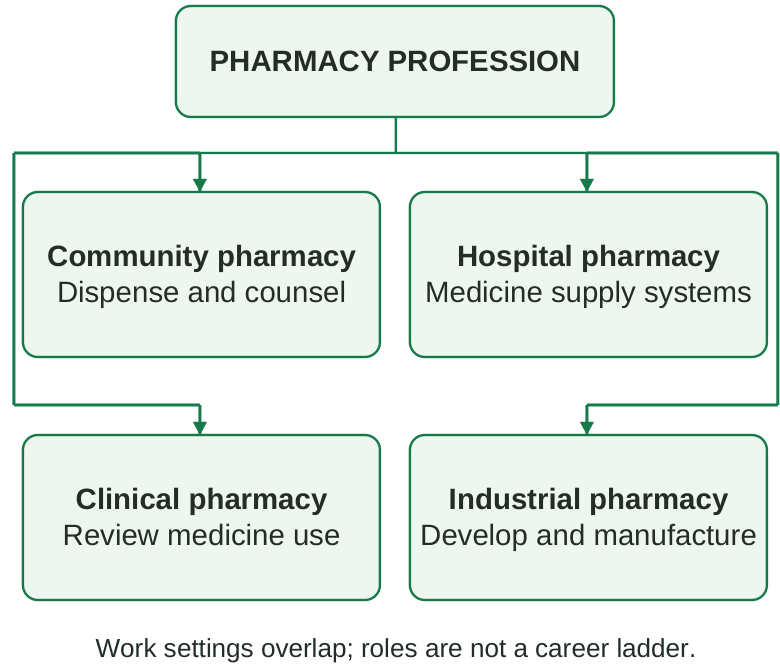
Diagram labels: Community pharmacy: dispense and counsel. Hospital pharmacy: medicine supply systems. Clinical pharmacy: review medicine use. Industrial pharmacy: develop and manufacture. Work settings overlap; roles are not a career ladder.
Explanation: The four settings share knowledge of medicines but have different immediate responsibilities. Hospital describes an institutional setting, while clinical describes a patient-focused activity that can occur in several settings.
Main responsibilities
- Prescription assessment: check completeness, medicine details and relevant patient factors; clarify concerns before supply.
- Accurate dispensing: select the correct medicine, strength and dosage form; label and perform the final check.
- Counselling: explain how to use the medicine, relevant precautions, storage and what to do if a problem occurs.
- Stock management: purchase through authorised channels, maintain appropriate storage and monitor expiry and recalls.
- Health support: give appropriate advice within professional competence and refer patients when assessment by another professional is needed.
- Safety and ethics: protect confidentiality, maintain required records and help identify suspected adverse reactions or misuse.
A practical example
A patient requests the same tablet colour as a previous medicine but cannot identify its name.
The pharmacist should establish the actual medicine from reliable records or an appropriate prescription.
Colour alone is not a safe identifier.
Dispensing versus counselling: Dispensing provides the correct labelled medicine. Counselling helps the patient understand its use.
Good community pharmacy practice needs both.
Use first-expiry, first-out (FEFO) for suitable stock rotation.
Medicines with damaged packaging, expired stock or a relevant recall should be separated from usable stock according to the applicable procedure.
1.7 Scope: hospital pharmacy
Hospital pharmacy manages the acquisition, storage, preparation and distribution of medicines within a hospital.
It supports inpatient wards, outpatient services, specialised units and the healthcare team.
Important functions
- Procurement and selection: obtain suitable medicines and contribute to formulary and purchasing decisions.
- Storage and inventory: maintain environmental conditions, secure storage where required, expiry control and emergency availability.
- Distribution: support individual-patient supply, ward stock or unit-dose systems according to hospital policy.
- Preparation: undertake authorised compounding or specialised preparation using appropriate facilities, trained staff and documented procedures.
- Medicine information: answer queries about formulations, compatibility, storage and use with reliable references.
- Safety systems: assist medication-error reporting, adverse-reaction monitoring, recalls and safe-use policies.
Distribution systems
| System | Basic idea |
|---|---|
| Ward stock | Selected medicines are held in the ward under controlled procedures |
| Individual prescription supply | Medicines are dispensed for a named patient on an authorised order |
| Unit-dose supply | Individually packaged doses are supplied through a patient-specific system |
Example: The pharmacy identifies that a refrigerated product was stored outside its specified conditions.
It segregates the stock, documents the excursion and obtains an evidence-based assessment before deciding whether the product can be used.
Pharmacy and Therapeutics Committee
A multidisciplinary Pharmacy and Therapeutics Committee, where established, reviews medicine selection and use within the institution.
Pharmacists contribute information on quality, formulations, safety, supply and cost.
Hospital pharmacy is a system: Its work extends beyond the dispensing counter.
Reliable procurement, storage, preparation, supply and records protect many patients at the same time.
1.8 Scope: clinical pharmacy
Clinical pharmacy applies pharmaceutical knowledge directly to patient care to improve medicine use.
Its central concern is whether treatment is appropriate, effective, safe and practical for a particular patient.
Typical activities
- Medication history: collect information on prescribed medicines, non-prescription products, supplements, allergies and previous reactions.
- Medication reconciliation: compare medicine lists during admission, transfer or discharge and help resolve unintended differences.
- Prescription review: assess dose, route, duration, duplication, interactions and relevant clinical factors.
- Therapy monitoring: help evaluate benefit and adverse effects; contribute to therapeutic drug monitoring where appropriate.
- Patient education: support understanding, adherence and correct use of devices or formulations.
- Team communication: discuss medicine-related concerns and recommendations with the responsible clinician.
Hospital and clinical pharmacy compared
| Hospital pharmacy | Clinical pharmacy |
|---|---|
| Defined mainly by the hospital setting | Defined mainly by patient-focused medication work |
| Strong emphasis on supply systems and preparation | Strong emphasis on assessment and monitoring of therapy |
| Serves departments and individual patients | Examines the needs of individual patients |
| May include clinical services | May operate in hospitals or community settings |
Example: A discharge list contains two medicines with the same active ingredient under different brand names.
A clinical pharmacist identifies possible duplication and asks the prescriber to confirm the intended treatment.
Professional boundaries
Pharmacists make evidence-based recommendations and work within applicable law, institutional policy and their competence.
A medicine review does not automatically authorise independent diagnosis or changes to a prescription.
Memory trick: H-R-M-C
History → Review → Monitor → Counsel
These four actions summarise the patient-focused contribution of clinical pharmacy.
1.9 Scope: industrial pharmacy and R&D
Industrial pharmacy concerns the development and reproducible large-scale manufacture of medicines.
Pharmacists contribute to formulation, production, analysis, quality systems, regulatory work and product safety.
Major departments and responsibilities
| Department | Typical work |
|---|---|
| Formulation R&D | Select a dosage form, suitable excipients and processing conditions |
| Analytical R&D | Develop and evaluate methods for identification, impurities and assay |
| Production | Manufacture according to approved instructions and controlled processes |
| Quality control (QC) | Sample and test materials and products against specifications |
| Quality assurance (QA) | Maintain systems that prevent and manage quality failures |
| Regulatory affairs | Prepare submissions and maintain compliance-related product information |
| Pharmacovigilance | Collect and assess medicine-safety information |
| Packaging and stability | Select suitable packs and evaluate quality over storage |
A simplified development pathway
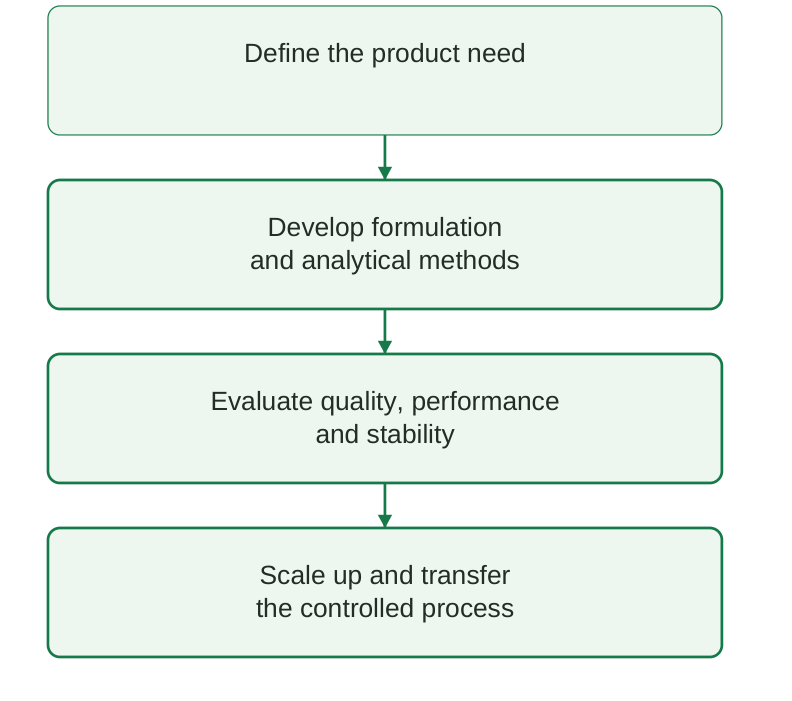
Diagram labels: Define the product need; develop formulation and analytical methods; evaluate quality, performance and stability; scale up and transfer the controlled process.
Explanation: This is a formulation-development outline. It does not replace the nonclinical, clinical or regulatory steps that may be required for a new product.
QA and QC: a useful distinction
QA asks whether the overall system is designed and operated to produce acceptable quality consistently.
QC asks whether a tested material or product meets its specified requirements.
QC is part of the wider quality system.
- QA example: approving procedures, reviewing deviations and organising change control.
- QC example: testing an incoming API for identity or testing tablets for assay and dissolution.
R&D examples
A formulation scientist investigates why a tablet releases drug slowly.
An analytical scientist develops a method that distinguishes the drug from its degradation products.
A process scientist evaluates whether the improved method remains reproducible at a larger scale.
Research requires evidence
A promising formulation is not automatically a marketable medicine.
Quality, stability, relevant safety and efficacy evidence, and applicable permissions must support its intended use.
1.10 Pharmacopoeias: meaning and purpose
A pharmacopoeia is a recognised compendium of standards for medicines, drug substances and related materials.
It describes quality requirements and methods used to determine whether an article complies.
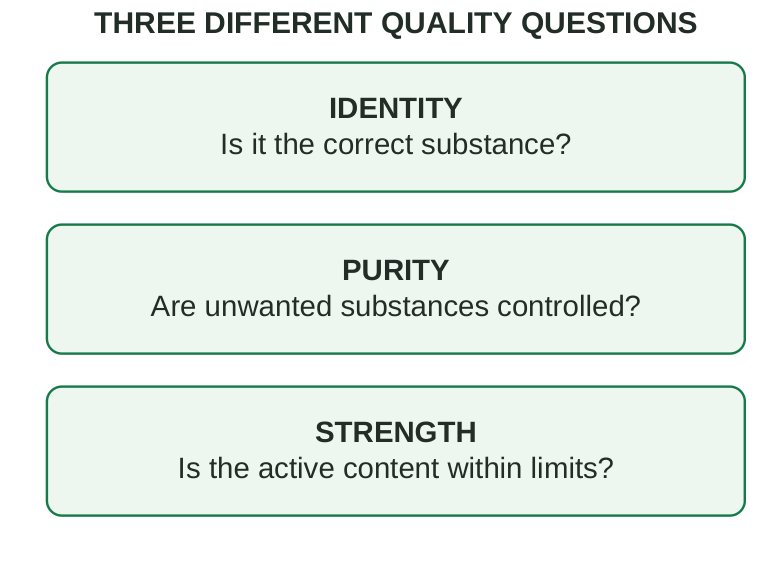
Diagram labels: Identity: is it the correct substance? Purity: are unwanted substances controlled? Strength: is the active content within limits?
Explanation: An article must satisfy all applicable requirements. A correct identity result does not demonstrate acceptable purity, and an acceptable assay does not automatically establish freedom from impurities.
What pharmacopoeias commonly contain
- General notices: rules for understanding and applying the compendium.
- General chapters: analytical procedures, apparatus descriptions and other relevant methods.
- General monographs: requirements for groups or classes, such as a type of dosage form.
- Individual monographs: requirements for a named drug substance, dosage form or other article.
Why standards are needed
Without common requirements, different manufacturers or laboratories might use incompatible meanings of acceptable quality.
A pharmacopoeia provides a shared basis for testing and comparison, while legal recognition determines how its standards apply in a particular jurisdiction.
Important distinctions
- Monograph: the specification and test information for an article.
- Specification: the required tests, procedures and acceptance criteria.
- Reference substance: an appropriately characterised material used for comparison or measurement in a defined test.
- Certificate of analysis: a document reporting results for a particular sample or batch; it is not the monograph itself.
Memory trick: I-P-S
- Identity: correct substance.
- Purity: controlled unwanted substances.
- Strength: acceptable amount or potency.
Dosage forms may also need tests of performance and uniformity.
1.11 Indian Pharmacopoeia: introduction and history
The Indian Pharmacopoeia (IP) is India’s official compendium of drug-quality standards.
It is published by the Indian Pharmacopoeia Commission, under the Ministry of Health and Family Welfare.
Its standards have legal significance under the Drugs and Cosmetics framework.
Historical development
A colonial-era Pharmacopoeia of India appeared in 1868.
The first post-independence edition of the modern IP was published in 1955.
These are different milestones; 1868 should not be substituted for 1955 when an examination asks for the first modern IP edition.
| Edition | Year |
|---|---|
| 1st | 1955 |
| 2nd | 1966 |
| 3rd | 1985 |
| 4th | 1996 |
| 5th | 2007 |
| 6th | 2010 |
| 7th | 2014 |
| 8th | 2018 |
| 9th | 2022 |
| 10th | 2026 |
Practical importance
- Provides requirements used by manufacturers, quality-control laboratories and regulatory authorities.
- Supports consistent identification, purity, content and product-performance assessment.
- Uses individual monographs with applicable general requirements and referenced methods.
The IP 2026 introduction describes the tenth edition and a four-volume arrangement.
It also explains that an immediately preceding-edition monograph omitted from the new edition can continue to have official status under the statutory framework.
Meaning of IP on a medicine label
The designation IP indicates a claim of compliance with the applicable IP standard.
It is not a brand name, a treatment recommendation or proof that a particular medicine is suitable for every patient.
Using editions correctly: Publication year, effective status, addenda and amendments matter.
The current applicable requirements must be checked together; never combine test conditions from different editions without justification.
1.12 British Pharmacopoeia and USP-NF
British Pharmacopoeia (BP)
The British Pharmacopoeia, first published in 1864, is the official collection of pharmaceutical quality standards used in the UK.
It is published annually and includes the texts of the European Pharmacopoeia alongside British national standards.
- Contains standards for drug substances, preparations and other relevant pharmaceutical materials.
- Uses monographs, general notices, appendices and reference standards to support testing.
- The British Pharmacopoeia (Veterinary) contains relevant veterinary standards.
United States Pharmacopeia-National Formulary
The United States Pharmacopeia (USP) began in 1820.
Its standards are published with the National Formulary (NF) as USP-NF by the United States Pharmacopeial Convention, a non-governmental standards organisation.
- USP-NF includes standards for drug substances, drug products and excipients, with general chapters and other relevant material.
- USP reference standards support specified compendial tests and assays.
- Official dates and revisions determine which text applies.
Publishing a USP monograph is not the same as granting regulatory marketing approval.
| Feature | BP | USP-NF |
|---|---|---|
| Origin | United Kingdom | United States |
| Early publication | 1864 | 1820 for USP |
| Publisher / standards system | British Pharmacopoeia system, MHRA | United States Pharmacopeial Convention |
| Main focus | Pharmaceutical quality standards | Pharmaceutical quality standards |
| Related compendium | Includes Ph. Eur. texts | USP and NF published together |
Important distinction: The NF within USP-NF is not the National Formulary of India.
Similar names do not imply the same publisher, purpose or content.
Example: A laboratory testing a product against a BP claim uses the applicable BP requirements.
It should not choose a more convenient USP method and assume that the acceptance decision is automatically equivalent.
1.13 BPC, International Pharmacopoeia and other compendia
British Pharmaceutical Codex (BPC)
The British Pharmaceutical Codex was first published in 1907 under the Pharmaceutical Society.
Early editions supplemented the BP with information on drug actions, uses, preparation formulae and materials not included in the BP.
Following the 1972 recommendation for one UK medicine-standards compendium, the BPC’s provision of standards was discontinued.
It subsequently developed as The Pharmaceutical Codex, with emphasis on pharmaceutics.
It is a historical reference in this syllabus, not a substitute for the current BP.
Two meanings of BPC: Here BPC = British Pharmaceutical Codex.
In current British regulatory writing, BPC can also mean British Pharmacopoeia Commission.
Write the full term to prevent confusion.
The International Pharmacopoeia
The International Pharmacopoeia (Ph. Int.) is published by the World Health Organization.
It provides recommended quality specifications, particularly for medicines relevant to public-health needs.
Countries may adopt its requirements; it does not automatically create one legally binding pharmacopoeia for the entire world.
Other important pharmacopoeias
| Compendium | Organisation / context |
|---|---|
| European Pharmacopoeia (Ph. Eur.) | European Pharmacopoeia Commission and EDQM, Council of Europe; common medicine-quality standards |
| Japanese Pharmacopoeia (JP) | Established by Japan’s Ministry of Health, Labour and Welfare |
| Chinese Pharmacopoeia (ChP) | National pharmacopoeial standards of China |
| Ayurvedic, Siddha and Unani pharmacopoeias of India | Standards for the corresponding traditional medicine systems; distinct from IP |
| Homoeopathic Pharmacopoeia of India | Standards for homoeopathic materials and preparations; distinct from IP |
Pharmacopoeial harmonisation
Harmonisation aims to reduce unnecessary differences in selected quality requirements and methods.
It does not mean that every monograph in every pharmacopoeia is identical.
Confirm the specific harmonised text and the requirements of the intended market.
Choose the correct reference: First identify the article, quality claim, jurisdiction and applicable edition.
Then select the compendium.
A familiar abbreviation alone is not enough.
1.14 National Formulary of India
The National Formulary of India (NFI) is an authoritative medicine-information reference intended to promote rational use of medicines.
It is published by the IPC and supports prescribing, dispensing and administration decisions.
Chronology
The first NFI appeared in 1960.
The sixth edition was released in 2021.
The seventh edition, NFI 2026, was released on 21 September 2026 in print and digital versions.
Typical information needed for rational use
- Therapeutic uses and the place of a medicine in treatment.
- Dosage forms, usual strengths and relevant administration information.
- Contraindications, precautions, interactions and clinically important adverse effects.
- Guidance that helps healthcare professionals compare and use medicines appropriately.
| Pharmacopoeia | Formulary |
|---|---|
| Focuses on medicine quality | Focuses mainly on appropriate medicine use |
| Includes specifications and analytical procedures | Includes therapeutic and practical information |
| Asks whether the article meets its standard | Helps assess selection and use in treatment |
| Example: IP, BP, USP-NF quality texts | Example: National Formulary of India |
How to consult a formulary
- Step 1: identify the medicine using its correct name and formulation.
- Step 2: read the full entry and relevant general information.
- Step 3: consider the patient’s age, other medicines, allergies and clinical circumstances.
- Step 4: check whether updated guidance or product-specific information changes the decision.
- Step 5: clarify unresolved questions with the responsible clinician and document significant interventions.
Example: An analyst uses a pharmacopoeia to investigate tablet assay.
A pharmacist seeking information about an important interaction uses an appropriate medicine-information source such as a formulary.
Memory trick: Pharmacopoeia: product quality. Formulary: thoughtful medicine use.
A monograph in a formulary and a monograph in a pharmacopoeia can therefore have very different contents.
1.15 Structure and contents of Indian Pharmacopoeia
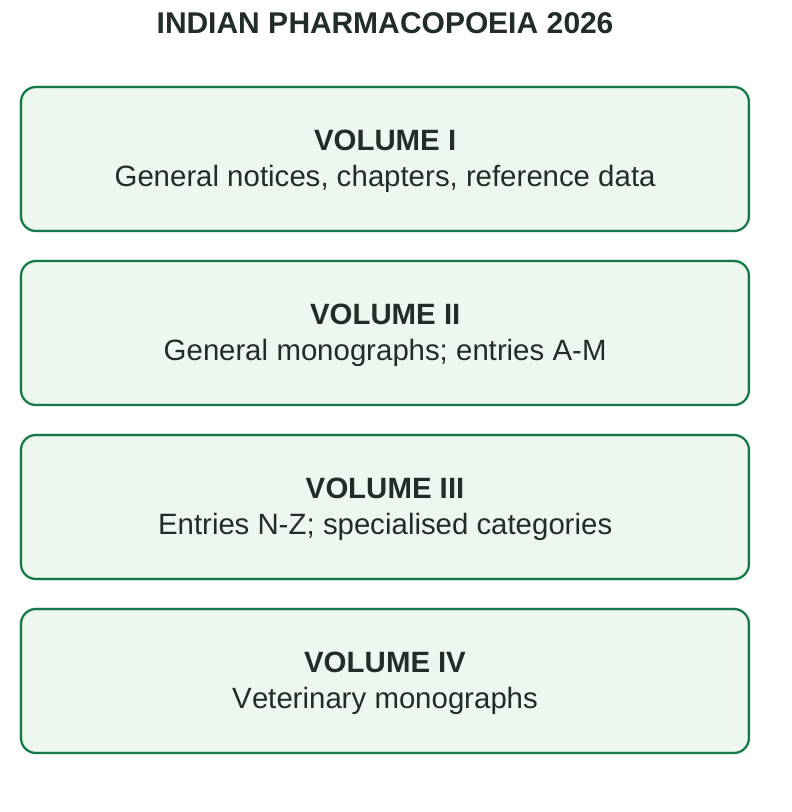
Diagram labels: Volume I: general notices, chapters and reference data. Volume II: general monographs and entries A-M. Volume III: entries N-Z and specialised categories. Volume IV: veterinary monographs.
Explanation: Volume III also includes specialised groups such as biological, herbal and radiopharmaceutical entries.
The index and the actual title of an entry should guide location; a product cannot always be found simply by guessing a volume.
IP 2026 volume map
| Volume | Main contents |
|---|---|
| I | Introductory material; general notices; general chapters; reference data; index |
| II | General notices; general monographs; drug substances, dosage forms and pharmaceutical aids A-M |
| III | General notices; entries N-Z; vitamins/minerals and related groups; phytopharmaceuticals, herbs, biologicals and radiopharmaceuticals |
| IV | General notices; notices; veterinary monographs; index |
What each component does
- Introduction: explains the edition and important changes.
- General notices: explain interpretation, terminology and application of requirements.
- General chapters: provide common methods, for example spectroscopic, chromatographic or pharmaceutical tests.
- General monographs: establish relevant requirements for a class of materials or dosage forms.
- Individual monographs: specify the quality of a particular article.
- Reference data and index: assist interpretation and location of material.
Stepwise use of IP
- Step 1: confirm the applicable edition and updates.
- Step 2: locate the exact article in the index; distinguish the API from its finished dosage form.
- Step 3: read the general notices and relevant general monograph.
- Step 4: read the entire individual monograph and referenced chapters.
- Step 5: note required tests, sample preparation, criteria, reference materials, storage and any special instructions.
Read a complete standard: Do not treat an isolated assay line as the whole IP requirement.
Identity, impurities, performance, uniformity and other applicable requirements must also be considered.
1.16 How to read a pharmacopoeial monograph
A monograph links a named article to a set of tests and acceptance criteria.
The headings vary with the article.
An API, a tablet and an injectable preparation do not necessarily have the same tests.
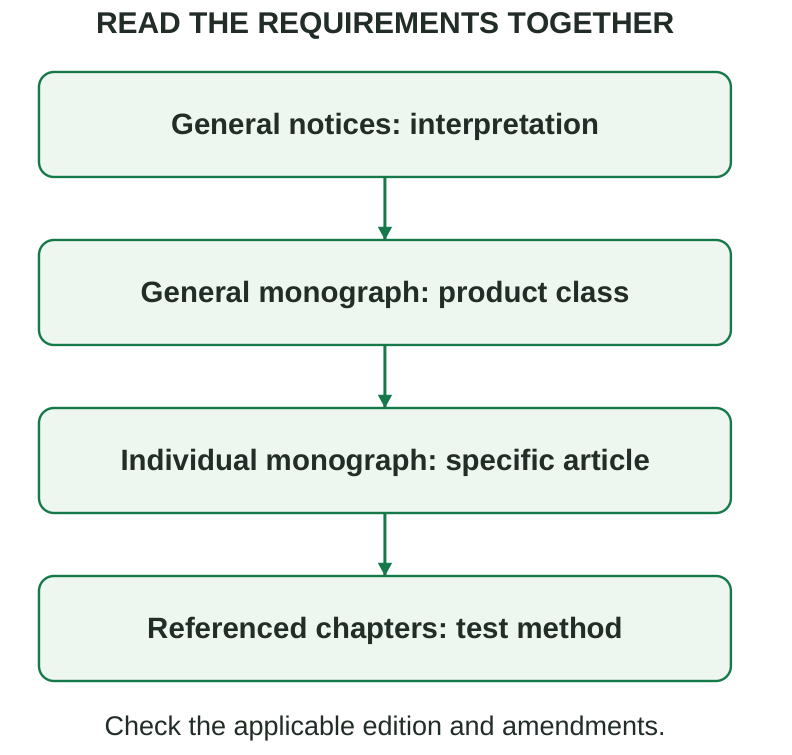
Diagram labels: General notices: interpretation; general monograph: product class; individual monograph: specific article; referenced chapters: test method. Check the applicable edition and amendments.
Explanation: The diagram is a reading order, not a hierarchy allowing one layer to be ignored.
Relevant general notices, general monographs, individual requirements and referenced methods are applied together.
| Heading | Meaning |
|---|---|
| Title and definition | Identifies the article and states its required composition or content |
| Description / solubility, where provided | Describes relevant physical characteristics |
| Identification | Demonstrates that the correct substance is present |
| Tests / related substances | Controls impurities and other specified quality attributes |
| Performance tests, where applicable | Assesses properties such as dissolution or uniformity |
| Assay | Determines active content or potency |
| Storage / labelling | States applicable handling or label requirements |
Difficult concepts made simple
Identification versus assay: Identification asks “Is this the correct drug?”
Assay asks “How much active drug is present?”
A sample may pass one test and fail the other.
Interpreting limits
- NLT: not less than; the result must meet the stated lower limit.
- NMT: not more than; the result must not exceed the stated upper limit.
- Stated amount: the declared drug content, not the total mass of the tablet.
- Dried / anhydrous basis: a defined calculation basis accounting for specified moisture-related factors.
Analytical result versus dose: A percentage in a monograph is an analytical specification.
It is not a percentage dose adjustment to be made for a patient.
1.17 Model IP monograph study: Betamethasone Tablets
Model context: The IPC’s Indian Pharmacopoeia 6: Guide to Formats includes a worked Betamethasone Tablets example on its printed pages 36-38.
The following is a paraphrased study of that historical teaching model, not a reproduction of the current IP 2026 monograph or a laboratory procedure.
Key features of the published model
| Feature | What the model illustrates |
|---|---|
| Article | Betamethasone Tablets; finished dosage form |
| Formula of active drug | C22H29FO5 |
| Content statement | 90.0%-110.0% of the stated betamethasone amount |
| Identity checks | Infrared comparison and other identity procedures, including TLC |
| Related substances | TLC-based impurity assessment |
| Dissolution | Basket apparatus; 50 rpm; 45 minutes; chromatographic measurement |
| Uniformity of content | Individual-unit content evaluated by liquid chromatography |
| Assay | Liquid chromatography for betamethasone content |
| Storage | Protection from light |
Model status matters: The values above belong to the identified IPC format example.
For actual testing, use the complete currently applicable official monograph, its general requirements and amendments.
The model does not prescribe treatment.
What the student should understand
The title identifies a tablet monograph.
The molecular formula identifies the active chemical entity; it is not the formula of the whole tablet because excipients also contribute to tablet mass.
The content range is relative to the declared active amount.
As a purely arithmetic illustration, if the stated amount were 1.00 mg, 90.0%-110.0% would correspond to 0.90-1.10 mg.
This calculation explains percentage of claim; it does not specify a marketed strength or patient dose.
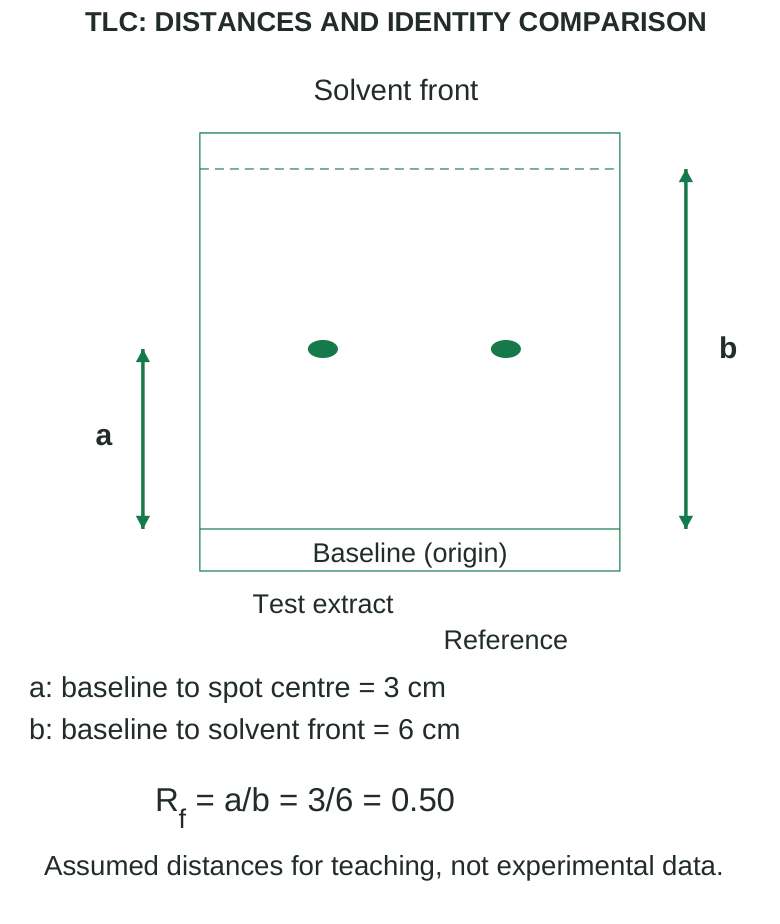
Diagram labels: Solvent front; baseline/origin; test extract; reference; a = baseline to spot centre, 3 cm; b = baseline to solvent front, 6 cm; Rf = a/b = 3/6 = 0.50. Assumed distances for teaching, not experimental data.
Explanation: The baseline is where samples are applied.
During development, the solvent moves upward.
Measure a from the baseline to the centre of the spot and b from the same baseline to the solvent front.
The assumed distances of 3 cm and 6 cm give Rf = 0.50.
The test and reference spots are at corresponding positions under the same conditions; this supports identity comparison but does not establish all quality requirements.
Reading the TLC figure step by step
- Step 1: locate the baseline, test-extract lane and reference lane.
- Step 2: locate the solvent front and the centre of each principal spot.
- Step 3: measure both distances from the baseline; do not measure from the plate edge.
- Step 4: calculate Rf = spot distance / solvent-front distance. The units cancel, so Rf has no unit.
- Step 5: compare test and reference positions and the prescribed spot characteristics under the same chromatographic conditions.
Conditions needed for an actual TLC test
The specified stationary phase, mobile-phase composition, sample and reference preparation, application volume, development distance and detection method must be followed.
These determine how the spots develop and are visualised.
The relevant monograph also states the required comparisons and method-validity checks.
Teaching example versus laboratory result: The 3 cm and 6 cm distances are assumed values chosen to explain the calculation.
They are not measured results or an acceptance criterion for betamethasone.
Rf = 0.50 is not a universal identity requirement.
Why there are several tests
- Identity: establishes whether the intended active material is present.
- Related substances: examines unwanted components rather than measuring only the main drug.
- Dissolution: evaluates drug release under defined conditions.
- Uniformity: assesses consistency among individual tablets.
- Assay: estimates the drug content in the prepared sample.
- Storage: helps maintain quality during the product’s life.
Stepwise examination answer
- Step 1: state the model title and source context.
- Step 2: explain the definition and content statement.
- Step 3: describe identity and purity assessment in simple terms.
- Step 4: explain dosage-form tests and assay.
- Step 5: mention storage and the need to consult applicable general requirements.
Do not generalise the model: The 90%-110% range is not a universal acceptance range for all medicines.
Different articles and editions have their own limits and test conditions.
1.18 Prescription: definition, structure and parts
A prescription is an authorised order from a suitably qualified prescriber for the preparation or supply of a medicine to an identified patient, together with directions for its use.
It provides both professional communication and a record of intended treatment.
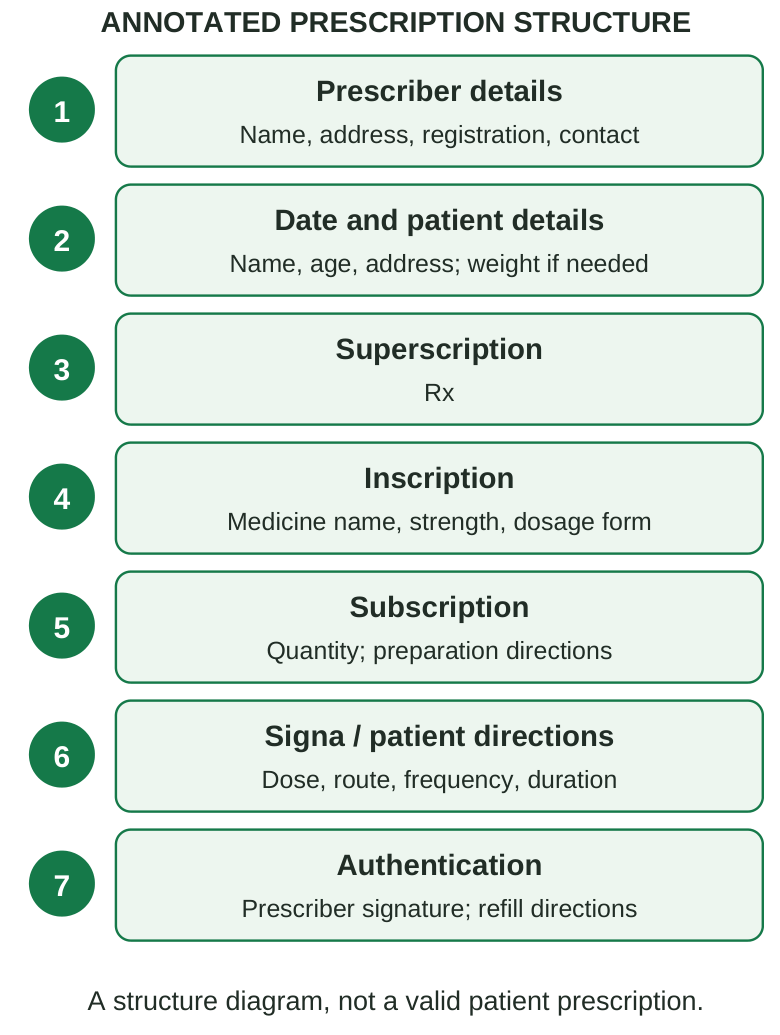
Diagram labels: Prescriber details; date and patient details; superscription Rx; inscription with medicine name, strength and dosage form; subscription with quantity and preparation directions; signa/patient directions; authentication with prescriber signature and refill directions. This is a structure diagram, not a valid patient prescription.
Explanation: Traditional names identify the medicine order and its directions.
Modern printed and electronic prescriptions may arrange the fields differently, but the information must remain clear and attributable to the patient and prescriber.
Parts explained
- Prescriber details: identify the authorised professional and enable verification or clarification.
- Date: records when the order was issued and helps assess the relevant prescription and refill conditions.
- Patient details: identify the intended patient; include relevant information such as age and weight where necessary.
- Superscription: the symbol Rx, traditionally associated with the Latin recipe, meaning “take”.
- Inscription: medicine name, strength, dosage form and, for compounded preparations, ingredients and amounts.
- Subscription: directions to the pharmacist, such as quantity to supply or preparation instructions.
- Signa / signature directions: instructions intended for the patient, including dose, route, frequency and duration.
- Prescriber authentication: the signature or appropriate electronic authentication, with other required identification.
- Refill information: repeat-supply directions where applicable; absence of clear permission should not be treated as unlimited authority.
Two uses of the word signature: Traditional signatura / signa refers to patient directions.
The prescriber’s signature authenticates the order.
These are not the same part.
Simple and compounded prescriptions
| Simple / ready-made medicine order | Compounded medicine order |
|---|---|
| Names an existing medicine and its formulation | May list ingredients and amounts for preparation |
| Usually specifies strength, directions and quantity | Also needs clear preparation and final-quantity instructions |
| Requires product selection and verification | Requires formula, compatibility and preparation checks |
An electronic prescription improves legibility but may still contain the wrong patient, strength or formulation.
Clear printing does not remove the need for professional assessment.
1.19 Handling prescriptions: stepwise dispensing process
Prescription handling is a sequence of verification, supply and communication.
Any uncertainty affecting safety must be resolved before the medicine is dispensed.
Step 1: receive and identify
- Confirm the patient using appropriate identifiers and establish who is collecting the medicine.
- Read the date and prescriber information. Protect the patient’s confidential information.
Step 2: assess completeness and authenticity
- Check the medicine name, strength, dosage form, quantity and complete directions.
- Check authentication and applicable legal requirements. Do not infer a missing signature or refill authorisation.
Step 3: perform the pharmaceutical and patient check
- Review relevant age, weight, allergies, other medicines and available clinical information.
- Check dose, route, frequency, duration, duplication, interactions and potential contraindications using suitable references.
- Assess formulation suitability and any compounding compatibility concern.
Step 4: clarify unresolved concerns
- Contact the responsible prescriber through an appropriate channel when the order is incomplete, ambiguous or potentially unsafe.
- Document the concern, authorised clarification and resulting decision. Do not guess from handwriting or change therapy independently.
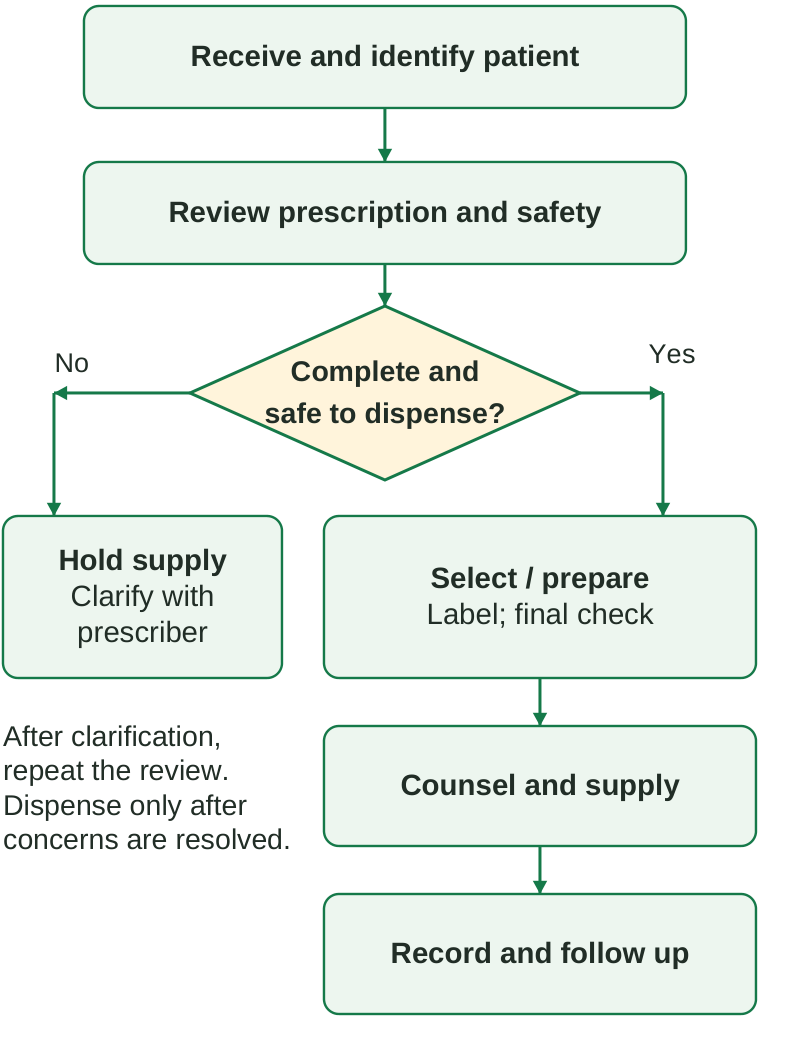
Diagram labels: Receive and identify patient; review prescription and safety; assess completeness and safety. No: hold supply and clarify with prescriber, then repeat review. Yes: select or prepare, label and final-check; counsel and supply; record and follow up.
Explanation: The “No” branch holds supply for clarification.
After a concern is resolved, the order is reviewed again before entering the verified supply pathway.
The chart simplifies, rather than replaces, the detailed steps.
Step 5: select or prepare
- Select the correct medicine, strength and dosage form; check expiry, pack integrity and relevant storage history.
- If authorised compounding is needed, follow the validated or suitable formula and documented procedure with appropriate calculations and checks.
Step 6: label clearly
- Include required patient and medicine identification and directions in understandable language.
- Add relevant warning, storage and administration information. Do not rely on Latin abbreviations on the patient’s label.
Step 7: final accuracy check
- Compare the original or clarified order with the selected product, label and quantity.
- Check calculations and critical details; follow the organisation’s independent-check policy where applicable.
Step 8: counsel and supply
- Explain use, relevant precautions and storage. Invite questions and ask the patient to explain the instructions back.
- Discuss medicine-specific action for problems such as a missed dose using an appropriate reference; no single instruction is suitable for all medicines.
Step 9: record and arrange follow-up
- Maintain the required dispensing and intervention records, including authorised clarification and repeat-supply information.
- Arrange appropriate monitoring, referral or follow-up where needed.
Memory trick: receive to record
Receive → Review → Resolve → Prepare → Label → Check → Counsel → Record
“Resolve” comes before supply whenever a concern remains.
1.20 Labelling, counselling and error prevention
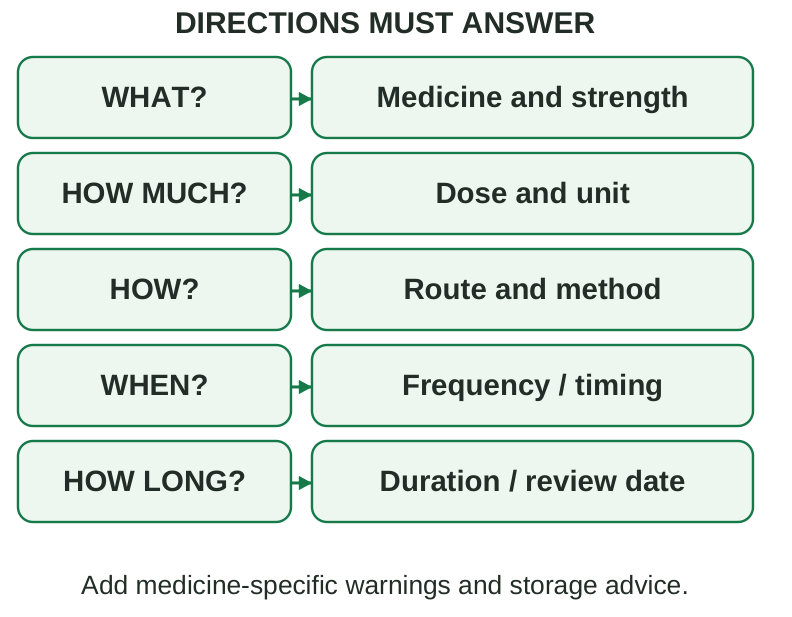
Diagram labels: What: medicine and strength. How much: dose and unit. How: route and method. When: frequency/timing. How long: duration/review date. Add medicine-specific warnings and storage advice.
Explanation: Complete directions identify the medicine, dose, method, timing and treatment period or review plan.
Appropriate warnings and storage information depend on the particular product.
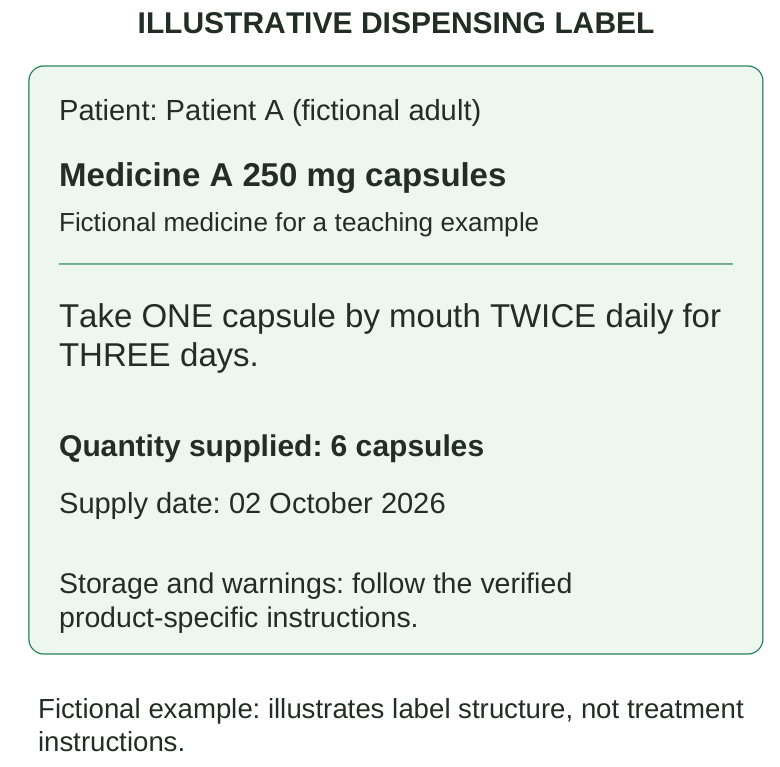
Diagram labels: Patient A, fictional adult; Medicine A 250 mg capsules, a fictional teaching medicine; take one capsule by mouth twice daily for three days; quantity supplied: six capsules; supply date: 02 October 2026; storage and warnings follow verified product-specific instructions. Fictional label example, not treatment instructions.
Explanation: The strength is 250 mg per capsule; the dose in this example is one capsule.
By mouth specifies the route, twice daily specifies frequency and three days specifies duration.
One capsule multiplied by two doses per day multiplied by three days gives six capsules.
The medicine and patient are fictional.
Understanding the sample label
- Strength versus dose: strength describes the active amount in each unit; dose describes the amount administered on an occasion.
- Quantity versus duration: the supply quantity should agree with the intended dose, frequency and treatment period.
- Patient identification: helps ensure that the labelled supply reaches the intended patient.
- Product-specific advice: storage, warnings and administration details must come from verified information for the actual medicine.
Clear labelling
A patient label should explain the intended use in familiar language.
“Use as directed” alone may be inadequate when the actual directions are not available or understood.
Quantity supplied and dose taken are separate pieces of information.
Common errors and corrective actions
| Problem | Appropriate response |
|---|---|
| Illegible name | Clarify with the prescriber; do not guess |
| Missing strength | Confirm the intended strength before selecting stock |
| Dose unit absent | Confirm the dose and unit |
| Two brands, same active drug | Assess duplication and clarify the treatment plan |
| Child order without relevant information | Obtain the information needed for dose/suitability assessment |
| Quantity conflicts with duration | Confirm intended directions or quantity |
| Wrong formulation selected | Recheck dosage form and release characteristics |
Decimal and unit safety
- Use a leading zero for a decimal below one: write 0.5 mg, not .5 mg.
- Avoid an unnecessary trailing zero: write 5 mg, not 5.0 mg in medication orders.
- Write unit or units clearly rather than U; write unambiguous dose units.
- Separate the number from the unit and avoid handwriting that confuses mg, microgram or mL.
Counselling with teach-back
After explaining an instruction, ask the patient to describe how they will use the medicine.
This checks the clarity of the explanation.
It should be supportive and should not be presented as a test of the patient.
Example: Instead of asking only “Understood?”, ask “Please tell me how you will measure and take this medicine at home.”
Correct misunderstanding, demonstrate the appropriate measuring device where relevant and repeat the explanation.
Patient-specific decisions: Dose suitability depends on the medicine and patient.
These notes describe verification principles; they do not provide a universal dispensing dose or authorise prescription changes.
1.21 Latin terminology used in prescriptions
Latin terms explain traditional prescription writing and help interpret older orders.
Recognising an abbreviation does not make it safe to use.
In patient instructions, use clear English or a language the patient understands.
Traditional terms and meanings
| Term | Latin / origin | Meaning |
|---|---|---|
| Rx | Recipe | Take |
| Sig. | Signa | Write the patient directions |
| M. | Misce | Mix |
| Mitte | Mitte | Send / supply |
| Fiat / fiant | Fiat / fiant | Let it / them be made |
| ad | Ad | Up to a stated quantity |
| q.s. | Quantum sufficiat | A sufficient quantity |
| a.c. | Ante cibum | Before food |
| p.c. | Post cibum | After food |
| p.o. | Per os | By mouth |
| b.i.d. | Bis in die | Twice daily |
| t.i.d. | Ter in die | Three times daily |
| q.i.d. | Quater in die | Four times daily |
| p.r.n. | Pro re nata | When required |
| s.o.s. | Si opus sit | If necessary |
| stat | Statim | Immediately |
| h.s. | Hora somni | At bedtime; may be ambiguous |
Interpreting frequency carefully
Twice daily describes a frequency.
It does not automatically mean an exact 12-hour interval unless that interval is intended and clearly stated.
Similarly, “when required” must be accompanied by medicine-specific information on the reason, interval and maximum permitted use when needed.
Terms that need special caution
| Unsafe / ambiguous form | Why it can cause error | Clearer wording |
|---|---|---|
| o.d. / OD | Can mean daily or be read as right eye | Daily, or right eye as intended |
| q.d. / QD | Can be confused with four-times-daily notation | Daily |
| q.o.d. / QOD | Can be confused with daily | Every other day |
| h.s. / HS | Bedtime and half-strength can be confused | At bedtime / half-strength |
| U / IU | Can resemble numbers or IV | Write unit / units clearly |
Short translation examples
- a.c.: before food; the exact timing depends on medicine-specific advice.
- stat: immediately; it is not a recurring frequency.
- q.s. ad 100 mL: use sufficient quantity to bring the final preparation to 100 mL, rather than adding an extra 100 mL.
- Misce: an instruction to mix during preparation, not a direction for the patient to take the medicine.
Memory trick: before and after
Ante = ahead / before.
Post = past / after.
Learn the meaning for examinations, but write complete, unambiguous directions in practice.
1.22 Applied examples and common conceptual errors
Case 1: education or registration?
A student completes an approved pharmacy qualification and joins a professional association.
Does association membership make the student a registered pharmacist?
No. Professional registration is handled through the relevant statutory process, including the State Pharmacy Council; association membership serves a different purpose.
Case 2: satisfactory assay, failed dissolution
A tablet has acceptable average active content but fails its applicable dissolution test.
Can it be accepted solely because the assay passes?
No. Content and drug release are different attributes. All applicable requirements must be satisfied.
Case 3: a conflicting quantity
A fictional order for Medicine A says “one tablet twice daily for three days” but asks for four tablets.
The arithmetic indicates six tablets for the stated course.
Action: Clarify the inconsistency before dispensing; the pharmacist should not decide without confirmation which part was intended.
Case 4: formulary or pharmacopoeia?
A student needs an interaction warning for counselling and an assay method for testing.
Answer: An appropriate therapeutic reference supports the interaction question; the applicable pharmacopoeia provides the quality-testing requirements.
Case 5: ambiguous abbreviation
An order uses OD without sufficient context.
Action: Clarify the intended meaning.
Knowledge that it can be used for daily does not exclude the possibility that it refers to the right eye.
| Incorrect statement | Correct understanding |
|---|---|
| Hospital pharmacy and clinical pharmacy are identical | Setting and patient-focused activity overlap but differ |
| IPC registers individual pharmacists | State Pharmacy Councils maintain registers |
| The IP is mainly a prescribing handbook | IP primarily sets quality standards |
| BPC is another current name for BP | The Codex and Pharmacopoeia have different histories |
| Every pharmacopoeia has identical limits | Requirements can differ by article and edition |
| Assay proves every tablet is uniform | Average content and unit-to-unit consistency differ |
| Subscription gives the patient’s signature | Subscription directs the pharmacist |
| An electronic order cannot contain errors | Electronic orders still require assessment |
A useful answer structure
For an application question:
Identify the issue → name the relevant principle → apply it to the facts → state the professional action.
Avoid inventing patient details or assuming that a quality test answers a therapeutic question.
1.23 Quick revision notes
History and organisations
- 1932: early pharmacy education at BHU. 1937: B.Pharm programme. M. L. Schroff: major pioneer of Indian pharmacy education.
- 1948: Pharmacy Act. 1949: PCI establishment. 1955: first modern post-independence IP.
- IPA: UPPA origin in 1935; renamed in 1939.
- PCI: educational regulation. State Pharmacy Councils: registration. IPC: IP and NFI. CDSCO: central drug-regulatory responsibilities.
Practice settings
- Community: prescription supply, counselling, stock and health support.
- Hospital: institutional medicine supply, storage, preparation and systems.
- Clinical: patient-specific assessment, monitoring and education.
- Industrial: development, manufacture, quality and regulatory functions.
- QA: systematic prevention and quality management. QC: sampling and testing against specifications.
Compendia
- IP: Indian quality standards; 10th edition, 2026.
- BP: British quality standards; first published in 1864.
- USP: United States standards; first published in 1820; published with NF.
- BPC: British Pharmaceutical Codex; first published in 1907; historical supplementary reference.
- International Pharmacopoeia: WHO-recommended quality specifications.
- NFI: rational-use information; first edition 1960; seventh edition 2026.
Monographs
- Identity: correct drug. Purity: controlled impurities. Assay: active amount. Dissolution: drug release. Uniformity: consistency among units.
- General notices + general monograph + individual monograph + referenced chapters are read together.
- The Betamethasone Tablets model is an identified IPC format example; its historical limits are not universal current specifications.
Prescriptions
- Superscription: Rx. Inscription: medicine details. Subscription: pharmacist directions. Signa: patient directions.
- Verify patient, prescriber, medicine, dose, formulation, quantity and complete directions.
- Clarify uncertainty before supply. Label, check, counsel and record.
- Use leading zeros; avoid unnecessary trailing zeros and ambiguous abbreviations.
One-minute recall
Name four practice settings; distinguish IP from NFI; list four traditional prescription parts; explain identity versus assay; describe what to do when a prescription is unclear.
1.24 Possible examination questions and answer guides
Very short-answer questions
- Define pharmacy, dispensing, pharmacopoeia and monograph.
- Expand PCI, IPC, IPA, IP, BP, USP, BPC and NFI.
- Name the pioneer of pharmacy education in India and the BHU milestones of 1932 and 1937.
- State the years of the Pharmacy Act and the first modern IP.
- What is the difference between inscription and subscription?
- Explain Rx, q.s., a.c., p.c., p.r.n. and stat.
- State two advantages of clear patient directions.
Short-answer questions
- Describe the contributions of PCI, IPC and IPA.
- Explain the roles of a community pharmacist.
- Differentiate hospital and clinical pharmacy.
- Differentiate QA and QC with examples.
- Compare a pharmacopoeia and a formulary.
- Write notes on BP, USP-NF and the historical BPC.
- Describe the purpose of the International Pharmacopoeia.
- Explain the structure of IP 2026.
- Distinguish identity, assay, dissolution and content uniformity.
- Explain five prescription abbreviations and why modern instructions should use clear language.
Long-answer questions
- Trace the evolution of pharmacy in India with educational, industrial and organisational milestones.
- Discuss the scope of pharmacy in community, hospital, clinical and industrial settings, including R&D.
- Describe IP and other important pharmacopoeias. Explain NFI and distinguish it from a pharmacopoeia.
- Explain the structure of a pharmacopoeial monograph using the identified Betamethasone Tablets teaching model.
- Draw and label the parts of a prescription, and explain each part.
- Describe the stepwise handling of a prescription, including assessment, clarification, labelling, counselling and records.
Application questions
- Why can an acceptable assay coexist with a failed dissolution result?
- A medicine name is clear but its strength is missing. What should the pharmacist do?
- Explain why 5.0 mg and .5 mg can be unsafe ways of writing medication doses.
- Why does a professional association membership card not replace pharmacist registration?
- A prescription quantity is inconsistent with the stated duration. Describe the response.
Answer guide: history essay
Begin with early medicine preparation, then explain formal education, industry development, professional organisations, regulation and standards.
Include a chronological table.
Conclude with the modern patient-care and research roles.
Answer guide: prescription essay
Define prescription.
Draw the structure with correct labels.
Explain each part.
Describe Step 1 through Step 9 of handling.
Add an example of clarification and finish with counselling and documentation.
Answer guide: monograph essay
Identify the article and source context.
Explain definition, identity, tests, dosage-form performance, uniformity, assay and storage.
State why general requirements and the current applicable text must also be consulted.
Examination practice: These are possible questions derived from the supplied syllabus, not claims about an actual university paper or guaranteed examination questions.