
Course Code: BP103T
Programme: B.Pharm, Semester I
Unit: Introduction to Psychology in Healthcare
Healthcare Psychology and Communication Skills Unit 1 Notes explain how behaviour and mental processes shape health experiences, patient education and participation in care. The discussion links the scientific study of psychology with accessible communication, learning, memory, ethical reinforcement, emotion and motivation.
Unit I Introduction
Introduction to Psychology in Healthcare explains how people sense, interpret, learn, remember, feel and act in health-related situations. For a pharmacy student, these ideas help explain why receiving advice does not always lead to understanding or sustained behaviour change. The unit connects psychological concepts to clinical assessment, patient education and supportive care.
Topics Covered – Complete Syllabus Map
| Required topic | Sections |
|---|---|
| Definition, scope and relevance of psychology in health sciences | 1.1-1.3 |
| Clinical, health, behavioural and developmental branches | 1.4-1.5 |
| Sensation and perception in clinical assessment | 1.6-1.8 |
| Attention in clinical assessment | 1.9-1.10 |
| Learning and memory | 1.11-1.16 |
| Reinforcement in health behaviour change | 1.13, 1.17-1.18 |
| Emotion: theories and health implications | 1.19-1.21 |
| Motivation: theories and health implications | 1.22-1.24 |
| Applied cases and quick revision | 1.25-1.26 |
Learning Outcomes
Define psychology and explain its relevance to pharmacy and healthcare.
Distinguish the four prescribed branches and their overlapping roles.
Separate sensation, perception and attention using clinical examples.
Explain classical, operant and observational learning.
Compare encoding, storage and retrieval and major memory types.
Distinguish reinforcement from punishment and design ethical reinforcement.
Compare major emotion theories without treating one as a complete explanation.
Apply motivation theories while recognizing patient needs and practical barriers.
Essential Vocabulary
| Term | Meaning |
|---|---|
| Behaviour | Observable action or response |
| Mental process | Thinking, feeling, remembering or interpreting |
| Adherence | Following an agreed treatment plan |
| Reinforcement | Consequence that increases a behaviour |
| Encoding | Converting information into a usable memory representation |
| Appraisal | Interpretation of the meaning/significance of a situation |
| Self-efficacy | Belief in one’s capacity to perform a task |
Central question:
How can a healthcare professional make information understandable, rememberable and useful while respecting the patient’s feelings, choices and circumstances?
1.1 Meaning and goals of psychology
Psychology is the scientific study of behaviour and mental processes. Behaviour includes observable actions such as asking a question, taking a medicine or avoiding an appointment. Mental processes include attention, perception, memory, emotion, reasoning and motivation. They are studied through appropriate evidence rather than assumed from appearance alone.
Psychology is scientific
Psychological explanations use systematic observations, testable questions and suitable methods. An anecdote can suggest a question but cannot prove that all patients behave similarly. Findings are interpreted with attention to measurement, context and alternative explanations.
Four practical goals
| Goal | Healthcare example |
|---|---|
| Describe | Record when and how often doses are missed |
| Explain | Explore forgetfulness, adverse effects, cost or beliefs |
| Predict | Identify conditions in which difficulty is more likely |
| Support change | Agree on a feasible reminder or learning strategy |
Behaviour versus mental process
A patient looking away is an observation. Assuming that the patient is uninterested is an interpretation. They may be anxious, distracted, in pain or unable to hear. Ask respectfully and gather information before drawing a conclusion.
Psychology and related professions
Psychology contributes knowledge about behaviour and mental processes. Psychiatry is a medical specialty concerned with mental disorders and their management. Counselling provides supportive professional interaction; its scope depends on training and role. These fields can collaborate, but their responsibilities are not interchangeable.
Key exam sentence
Psychology helps explain behaviour; it does not justify judging a patient’s character from a single action.
1.2 Scope in health sciences
Psychological processes influence illness experience, help-seeking, prevention, learning, coping and treatment behaviour. They interact with biological disease, family circumstances, culture and access to resources.
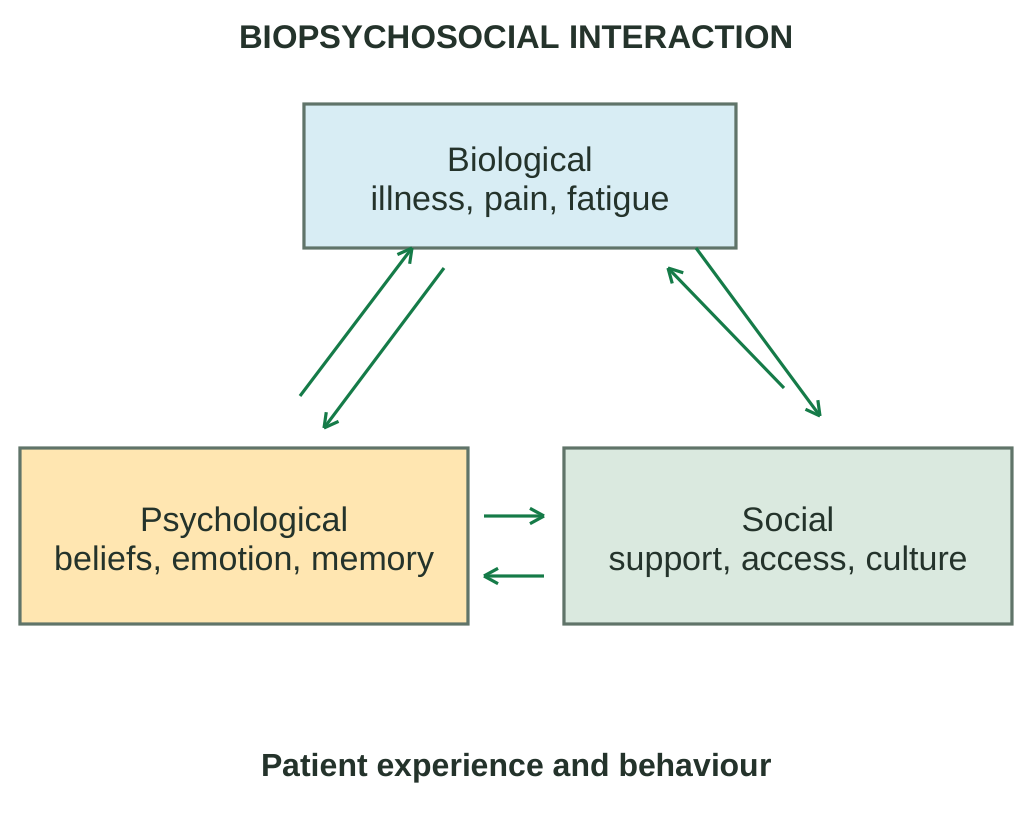
Diagram labels: BIOPSYCHOSOCIAL INTERACTION; Biological; illness, pain, fatigue; Psychological; beliefs, emotion, memory; Social; support, access, culture; Patient experience and behaviour
Major areas of application
| Area | Contribution |
|---|---|
| Prevention | Understanding habits, risk perception and readiness |
| Clinical encounter | Interpreting communication and supporting assessment |
| Patient education | Improving attention, comprehension and memory |
| Treatment | Supporting agreed plans and reducing avoidable barriers |
| Rehabilitation | Encouraging practice, adjustment and confidence |
| Professional work | Team behaviour, stress and reliable routines |
Biopsychosocial perspective
Biological factors include illness, pain, fatigue and treatment effects. Psychological factors include beliefs, emotion, learning and memory. Social factors include support, income, culture, work and access. They interact; one category rarely explains an entire health problem.
Example
A patient may miss a medicine because fatigue disrupts routines, fear of adverse effects reduces willingness and shift work makes timing difficult. Education alone may address only one part of the problem. Explore the complete situation and support an agreed practical plan within the professional role.
1.3 Relevance to pharmacy and patient care
Knowledge of psychology helps pharmacists understand how information is received and used. It supports a respectful clinical relationship, careful education and recognition of situations needing further assessment.
Relevance by activity
| Pharmacy activity | Psychological contribution |
|---|---|
| Medication history | Ask without blame; separate recall from actual use |
| Counselling | Match explanation to attention, language and understanding |
| Device demonstration | Use modelling, guided practice and feedback |
| Adherence support | Explore beliefs, habits, memory and practical barriers |
| Follow-up | Review outcomes and adapt agreed strategies |
| Referral/teamwork | Share factual observations and recognize role limits |
Person-centred reasoning
Start with the patient’s experience and goals. Ask what they understand, what worries them and what makes the plan difficult. Do not assume that a difficulty is deliberate noncooperation. Distinguish inability, misunderstanding, competing demands and informed choice.
Teaching implications
Receiving instructions, understanding them, remembering them and performing the action are separate achievements. Demonstration and practice can identify gaps that a yes/no question misses. Written support should be clear and matched to the patient’s needs.
Professional boundaries
Use psychological knowledge to improve care, not to diagnose a mental disorder from a brief interaction. Concerns about cognition, severe distress or safety require the appropriate clinical pathway and qualified assessment. Record specific observations and statements rather than stigmatizing labels.
Basic methods used in psychology
| Method | What it can contribute |
|---|---|
| Observation | Behaviour in a defined setting |
| Interview | Experiences, beliefs and difficulties |
| Questionnaire | Structured information about selected constructs |
| Experiment | Effects of a controlled manipulation where appropriate |
| Correlational study | Association between measured variables |
| Case study | Detailed examination of an individual situation |
Association is not causation
If stress and missed doses occur together, stress may contribute, missed doses may increase worry, or another factor may influence both. An association does not settle the direction or mechanism. A measured score also needs context; it is not automatically a diagnosis.
Ethics
Respect dignity, confidentiality, consent and cultural differences. Use accessible explanations and appropriate assistance. Do not manipulate, shame or withhold essential care to obtain compliance. Behaviour-change support should work toward goals agreed with the patient.
Common misconceptions
Psychology is not merely common sense or mind-reading.
A person’s behaviour is not determined only by personality.
Psychological influences do not make physical symptoms unreal.
More information is not always better when attention is overloaded.
A successful example does not guarantee the same outcome for everyone.
1.4 Branches with healthcare relevance
Clinical psychology
Clinical psychology addresses assessment, formulation and psychological intervention for mental, emotional and behavioural difficulties. It can contribute to understanding distress, coping and functioning in healthcare. Formal assessment/intervention requires the appropriate professional competence.
Health psychology
Health psychology examines how psychological, behavioural and social processes relate to health, illness and healthcare. Topics include prevention, adjustment to chronic illness, symptom interpretation, treatment adherence and health-related habits.
Behavioural psychology
Behavioural psychology focuses on learning and relationships between environment, actions and consequences. It supports analysis of habits, cues, practice and reinforcement. Behavioural explanations are useful but should not ignore thoughts, feelings or real-world constraints.
Developmental psychology
Developmental psychology studies change and continuity across the lifespan, including cognitive, social, emotional and physical development. Healthcare relevance includes age-appropriate teaching, family involvement and adaptation to changing capabilities and needs.
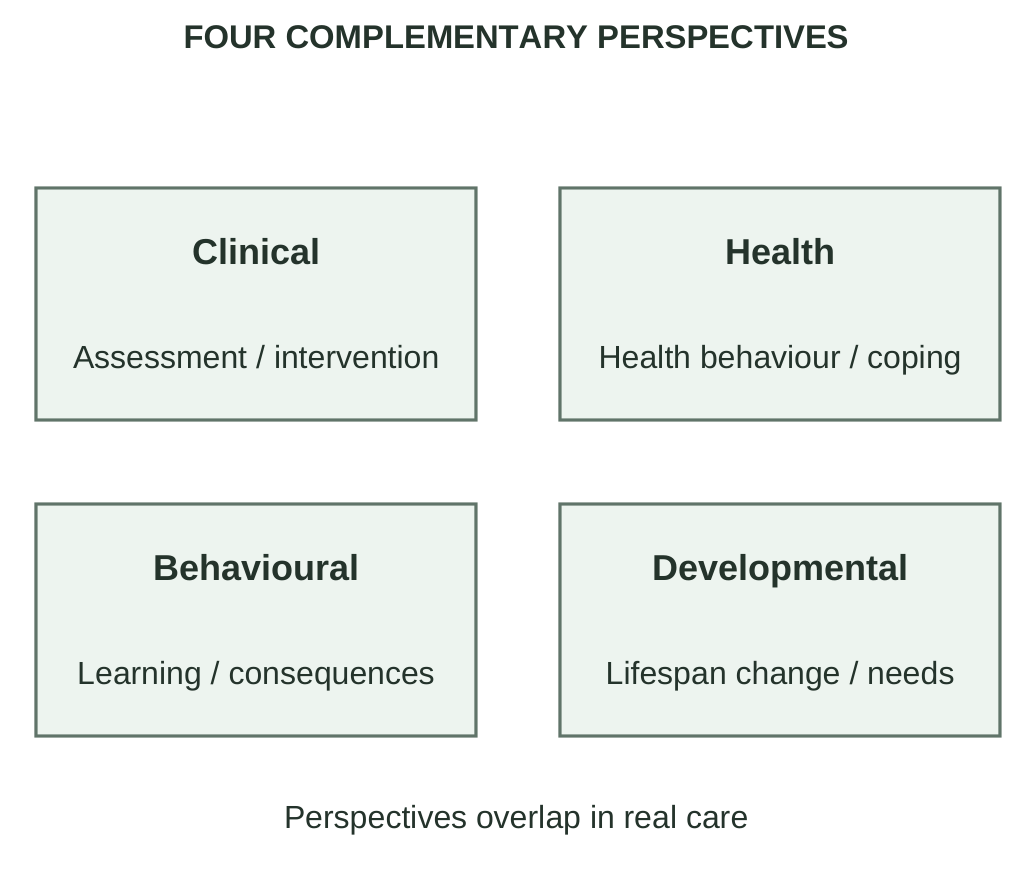
Diagram labels: FOUR COMPLEMENTARY PERSPECTIVES; Clinical; Assessment / intervention; Health; Health behaviour / coping; Behavioural; Learning / consequences; Developmental; Lifespan change / needs; Perspectives overlap in real care
1.5 Comparing the branches
| Branch | Main question | Example |
|---|---|---|
| Clinical | What psychological difficulty affects functioning? | Assessment of distress affecting daily life |
| Health | How do beliefs and behaviour relate to health? | Reasons for avoiding a preventive service |
| Behavioural | Which cues/consequences maintain an action? | Building a reminder and practice routine |
| Developmental | How do needs/capabilities change over time? | Adapting an explanation for a child or older adult |
Areas overlap
An older adult learning a device may need developmental adaptation, memory support, behavioural practice and help with illness-related anxiety. The branches offer complementary perspectives rather than four completely separate patient categories.
Applied example
A child worries about an unfamiliar procedure. Developmental understanding helps select a suitable explanation; learning principles support preparation and demonstration; health psychology considers expectations and coping; a clinical psychologist may contribute when distress is persistent or complex.
Match the response to the situation
Give a concrete demonstration when the difficulty is skill learning. Explore beliefs when the patient doubts the treatment’s value. Improve accessibility when hearing or vision is a barrier. Arrange appropriate assessment when the problem exceeds routine education.
Branch recall
Clinical: difficulty and intervention. Health: health-related experience and behaviour. Behavioural: learning and consequences. Developmental: change across the lifespan.
1.6 Sensation and sensory processing
Sensation is detection of stimulation by sensory systems. Transduction converts stimulus energy into signals usable by the nervous system. Sensory information contributes to perception, but detection and interpretation are not identical.
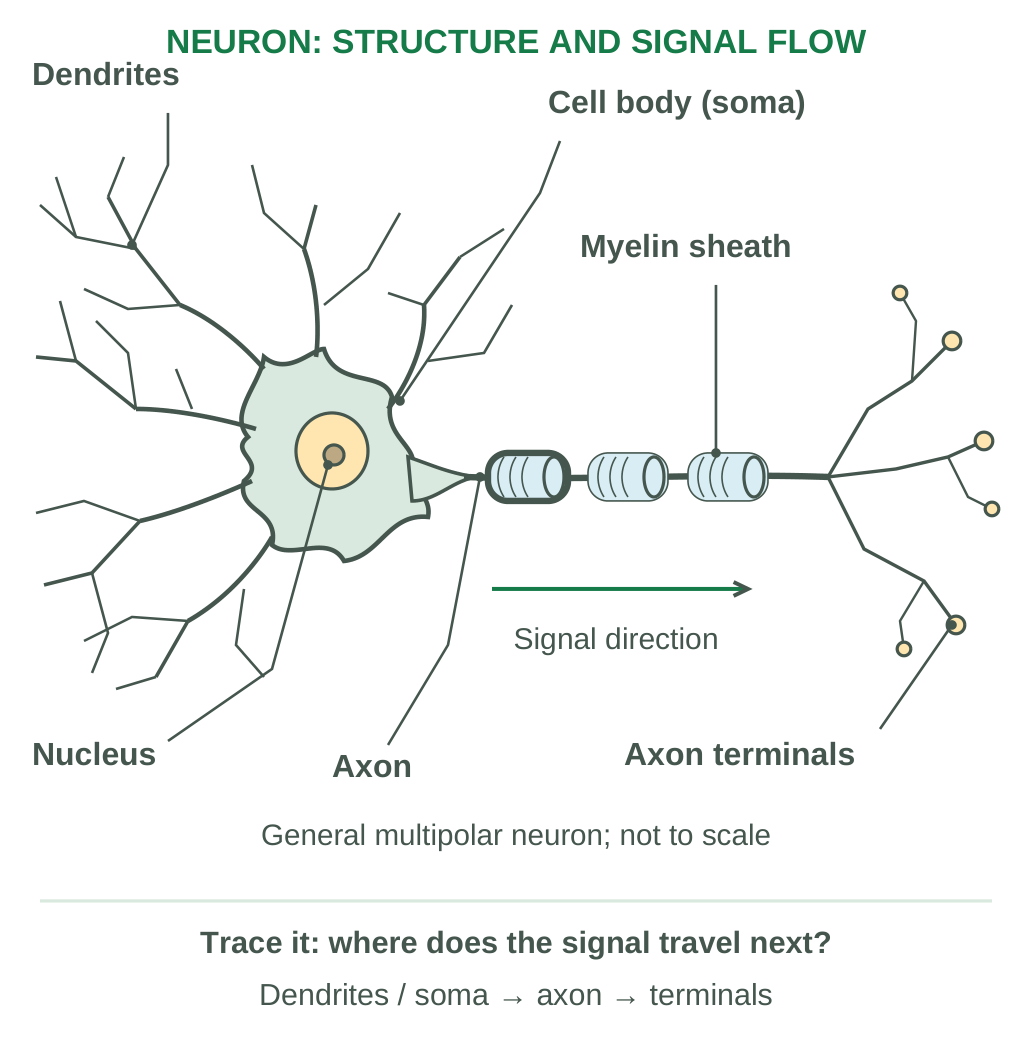
Diagram labels: NEURON: STRUCTURE AND SIGNAL FLOW; Dendrites; Cell body (soma); Myelin sheath; Nucleus; Axon; Axon terminals; Signal direction; General multipolar neuron; not to scale; Trace it: where does the signal travel next?; Dendrites / soma → axon → terminals
Main sensory systems
| System | Relevant information |
|---|---|
| Vision | Light, shape, colour and movement |
| Hearing | Sound and speech cues |
| Touch/somatosensation | Contact, pressure and related bodily information |
| Temperature and pain | Thermal/nociceptive stimulation |
| Smell and taste | Chemical information |
| Proprioception | Body position and movement |
| Vestibular sense | Balance and head movement |
Sensory threshold
An absolute threshold is commonly described as the stimulus level detected on 50% of trials under specified conditions. A difference threshold is the smallest detectable difference between stimuli under the method used. These are experimental concepts, not universal clinical cutoffs.
Sensory adaptation
Responsiveness or awareness may decrease during sustained, relatively constant stimulation. Habituation involves reduced responding after repeated exposure and is a learning-related concept. The mechanisms can differ; do not treat every reduction in response as damage to a sense organ.
1.7 Sensation in clinical assessment
A patient cannot accurately process a message that they do not adequately detect. Sensory difficulties can be mistaken for poor attention, memory or unwillingness. Establish accessibility before judging understanding.
Practical observation
| Difficulty | Educational response |
|---|---|
| Cannot hear the explanation clearly | Reduce noise; face the patient; arrange suitable communication support |
| Cannot read a label | Improve size/contrast and use appropriate accessible support |
| Difficulty manipulating a device | Demonstrate; assess handling; involve suitable assistance |
| Pain/fatigue disrupts listening | Address timing and comfort with the team |
Assessment sequence
Step 1: check whether the person can access the spoken/written message.
Step 2: ask about relevant hearing, vision, language and practical needs.
Step 3: adapt the environment and explanation appropriately.
Step 4: check understanding through explanation or demonstration.
Step 5: document concerns and seek qualified assessment when needed.
Interpretation limits
Not responding to a quiet question does not by itself establish hearing loss. Several causes are possible, including noise, attention, unfamiliar language or distress. Use observation and respectful questions; do not infer a diagnosis from a single behaviour.
Pain as experience
Nociception concerns processing potentially harmful stimulation; pain is a personal experience influenced by sensory, emotional and contextual factors. A psychological influence does not mean pain is imagined. Listen to the person’s report and follow the appropriate assessment process.
1.8 Perception and interpretation
Perception is organization and interpretation of sensory information into meaningful experience. It draws on incoming signals and prior knowledge, expectations, emotional state and context.
Sensation versus perception
| Sensation | Perception |
|---|---|
| Detecting a sound | Recognizing it as an instruction or alarm |
| Detecting printed shapes | Reading them as a medicine name |
| Detecting pressure/contact | Interpreting the experience in its context |
Bottom-up and top-down processing
Bottom-up processing builds an interpretation from incoming features. Top-down processing uses experience and expectations to interpret those features. Both can operate together. Prior knowledge helps recognition but can also bias an interpretation.
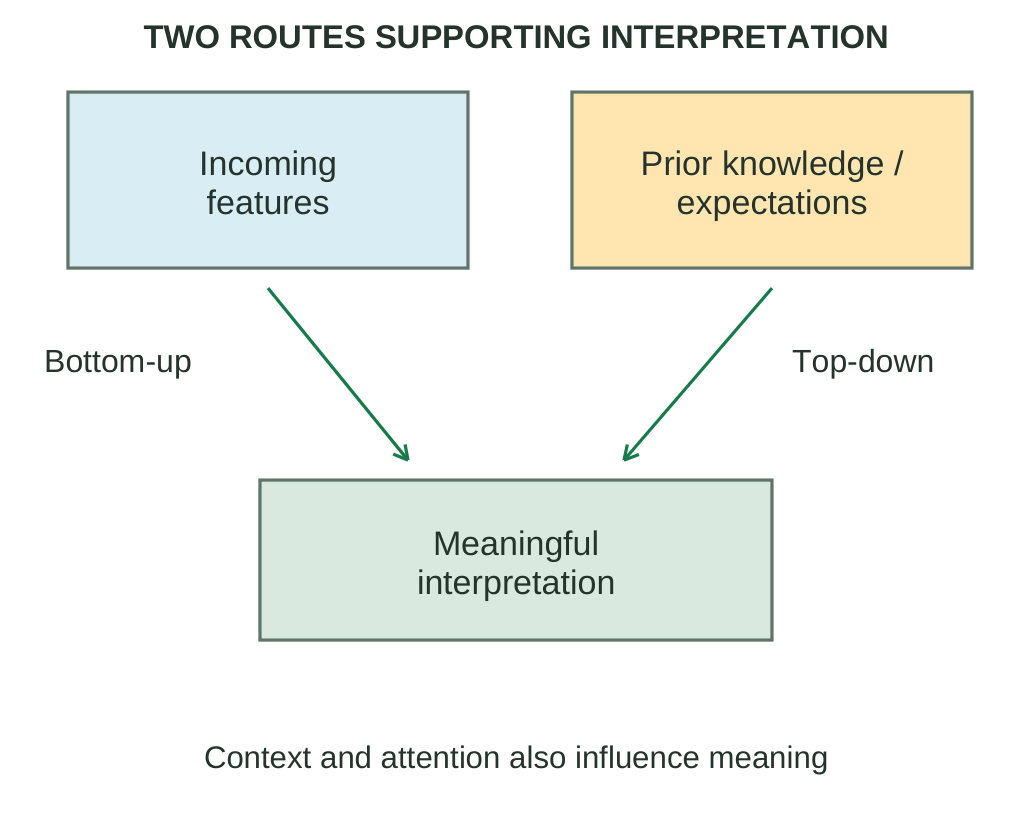
Diagram labels: TWO ROUTES SUPPORTING INTERPRETATION; Incoming; features; Prior knowledge /; expectations; Meaningful; interpretation; Bottom-up; Top-down; Context and attention also influence meaning
Healthcare example
Two patients hear the same explanation about a test. One expects reassurance; the other expects bad news. Their interpretation and emotional response can differ. Ask what the message means to the patient instead of assuming that identical words produce identical understanding.
Perceptual organization
Grouping by proximity, similarity and continuity can make visual information easier to read. A clearly separated dose instruction is easier to identify than several competing lines. Keep labels, units and instructions visually distinct and confirm interpretation.
Factors affecting perception
| Factor | Potential influence |
|---|---|
| Past experience | A prior difficult encounter affects expectations |
| Attention | Selected details receive more processing |
| Emotion | Threat-related interpretations may become prominent |
| Motivation | Personally important cues stand out |
| Culture/language | Meanings and expectations differ |
| Context | Surrounding information changes interpretation |
Illusion versus hallucination
An illusion is an incorrect interpretation of a real stimulus. A hallucination is a perception-like experience without the corresponding external stimulus. These terms describe different phenomena; a brief misunderstanding of a label should not be equated with a psychiatric symptom.
Bias in assessment
A professional expecting non-adherence may notice missed appointments but overlook transport barriers. An unfamiliar accent may be mistaken for lack of knowledge. Separate observation from interpretation and verify the patient’s meaning.
Improve interpretation
Use clear language, concrete examples and consistent labels. Explain purpose before giving complex instructions. Invite questions and ask the patient to describe the plan in their own words. Check whether terms such as ‘regularly’ or ‘as needed’ have been interpreted correctly in the particular treatment plan.
Clinical link
A sensory message can be detected yet misunderstood. Improving volume alone does not correct an unclear meaning.
1.9 Attention: selection and capacity
Attention directs limited processing resources toward selected information or activities. It influences what is noticed, understood and encoded into memory. Attention is active selection, not a container into which every message automatically enters.
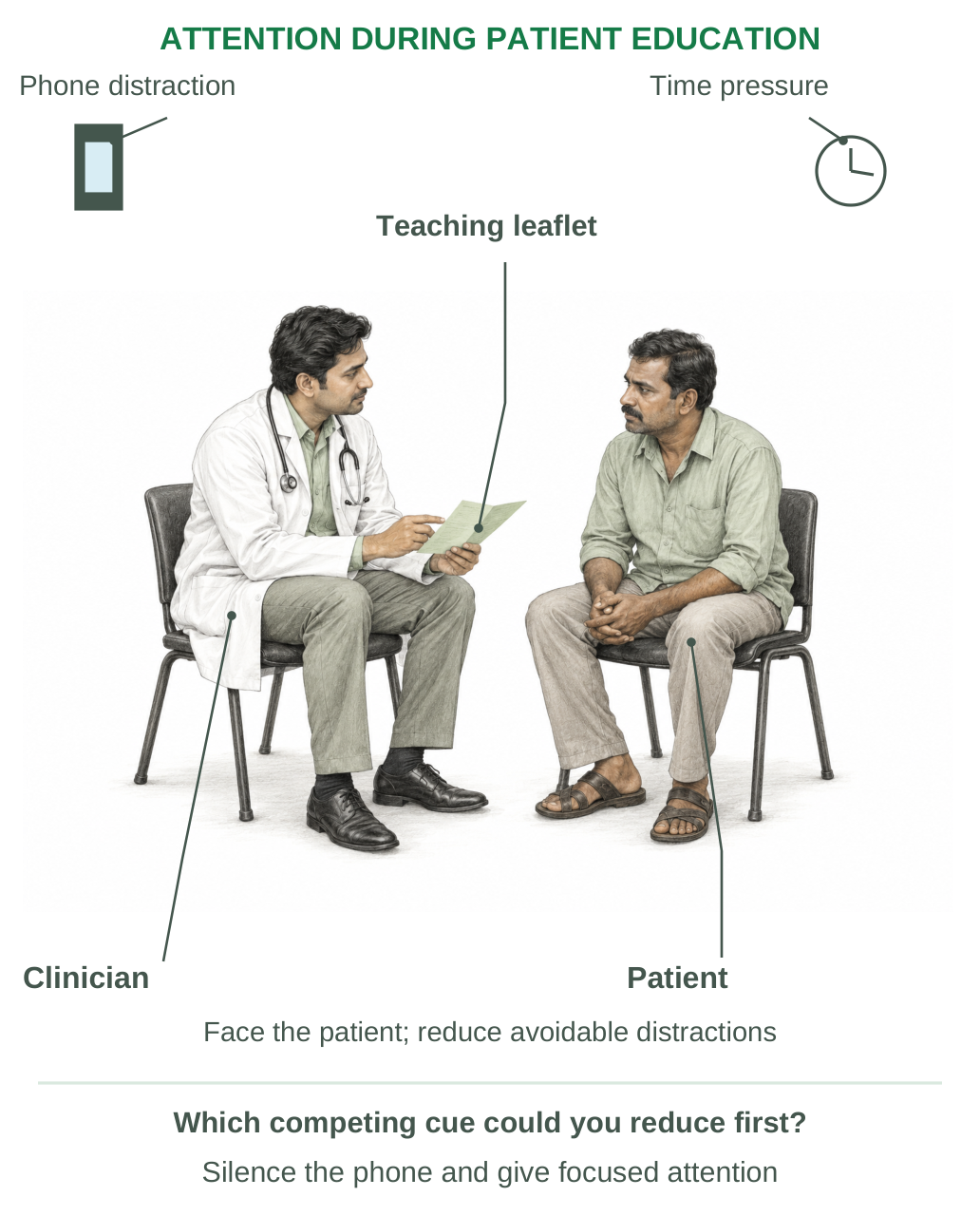
Diagram labels: ATTENTION DURING PATIENT EDUCATION; Clinician; Patient; Teaching leaflet; Phone distraction; Time pressure; Face the patient; reduce avoidable distractions; Which competing cue could you reduce first?; Silence the phone and give focused attention
Types of attention
| Type | Meaning | Example |
|---|---|---|
| Selective | Focus on one source while filtering others | Listening amid background conversation |
| Sustained | Maintain focus over time | Following a longer explanation |
| Divided | Allocate resources to multiple tasks | Listening while completing another task |
| Alternating | Shift between tasks or sources | Moving between a label and a device demonstration |
Factors affecting attention
External factors include noise, interruptions, novelty, movement and message organization. Internal factors include interest, goals, fatigue, pain, anxiety and competing thoughts. Capacity also depends on task complexity and familiarity.
Divided attention
Performing two demanding tasks can reduce accuracy. A person may look at a leaflet while listening yet fail to process either deeply. In education, finish one meaningful task before starting another when possible.
1.10 Attention in clinical assessment
Attention affects the reliability of a history and the success of counselling. A distraction during encoding may later appear to be a memory failure. Check the circumstances before interpreting the outcome.
Practical assessment and support
Step 1: establish a calm, accessible setting.
Step 2: assess readiness: fatigue, distress, discomfort and competing demands.
Step 3: explain one short point at a time and identify the key action.
Step 4: pause for questions and give appropriate demonstrations.
Step 5: check understanding and arrange reinforcement/follow-up.
Clinical observations
Notice whether the person follows the conversation, repeatedly loses the thread, responds to irrelevant distractions or needs repeated redirection. Record concrete observations. These signs can have many causes and require context; they do not independently establish a cognitive disorder.
Acute change
A new marked change in attention or confusion in a clinical setting should be communicated promptly to the responsible team. Do not automatically dismiss it as anxiety or ordinary forgetfulness.
Teaching design
Use clear headings, uncluttered figures and short instructions. Allow time for response. Avoid unnecessary multitasking. A patient’s ability to repeat one sentence does not establish that they can perform a complex skill while distracted at home.
Sensation-perception-attention check
Can the person access the message? What meaning do they give it? Can they focus on it long enough to learn?
1.11 Learning: meaning and forms
Learning is a relatively enduring change in knowledge or behaviour resulting from experience. Temporary changes caused only by fatigue, illness or maturation are not the same as learning. Performance at one moment can differ from what has been learned.
Major forms
| Form | Core relationship |
|---|---|
| Classical conditioning | Association between stimuli |
| Operant conditioning | Association between action and consequence |
| Observational learning | Learning through watching others |
| Cognitive learning | Understanding, organization and problem solving |
| Habituation | Reduced response to repeated stimulation |
Healthcare relevance
A patient may learn a device skill through demonstration and practice, acquire worry through repeated unpleasant encounters or develop a routine through cues and consequences. Understanding the mechanism helps select the support rather than simply repeating instructions.
1.12 Classical conditioning
Classical conditioning occurs when a previously neutral stimulus acquires the ability to elicit a learned response after association with a stimulus that already elicits a response.
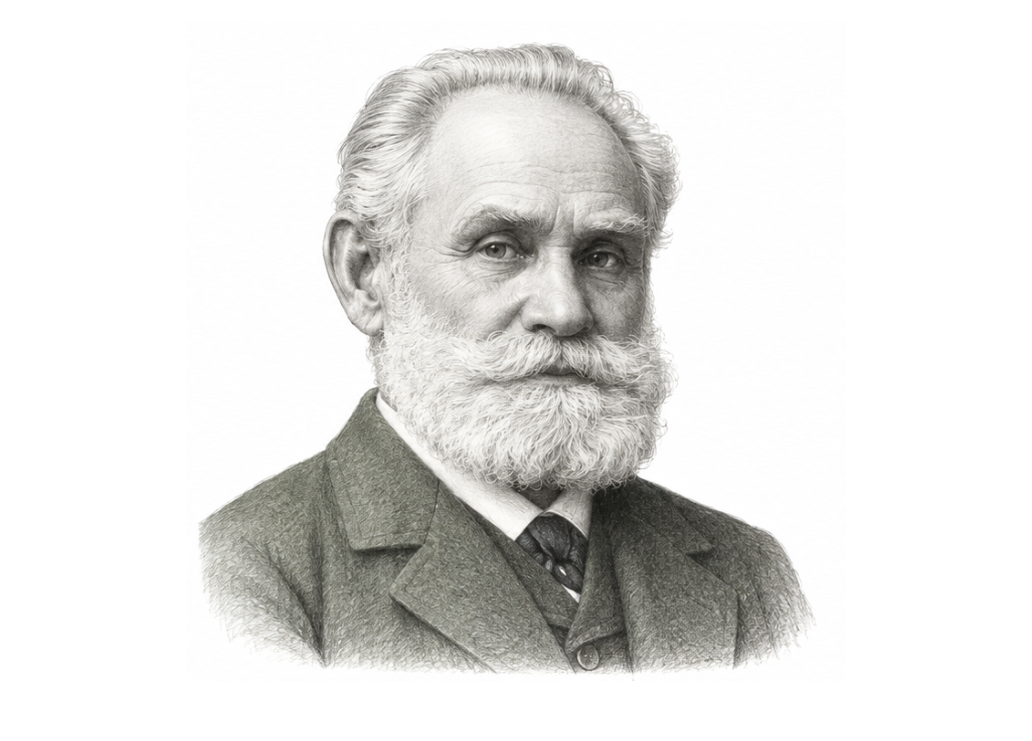
Diagram labels: Portrait: Ivan Petrovich Pavlov (1849-1936).
Ivan Petrovich Pavlov (1849-1936) investigated conditioned reflexes. His work provides a foundation for understanding learned stimulus-response associations. His Nobel Prize was awarded for work on digestion, not specifically for a bell experiment.
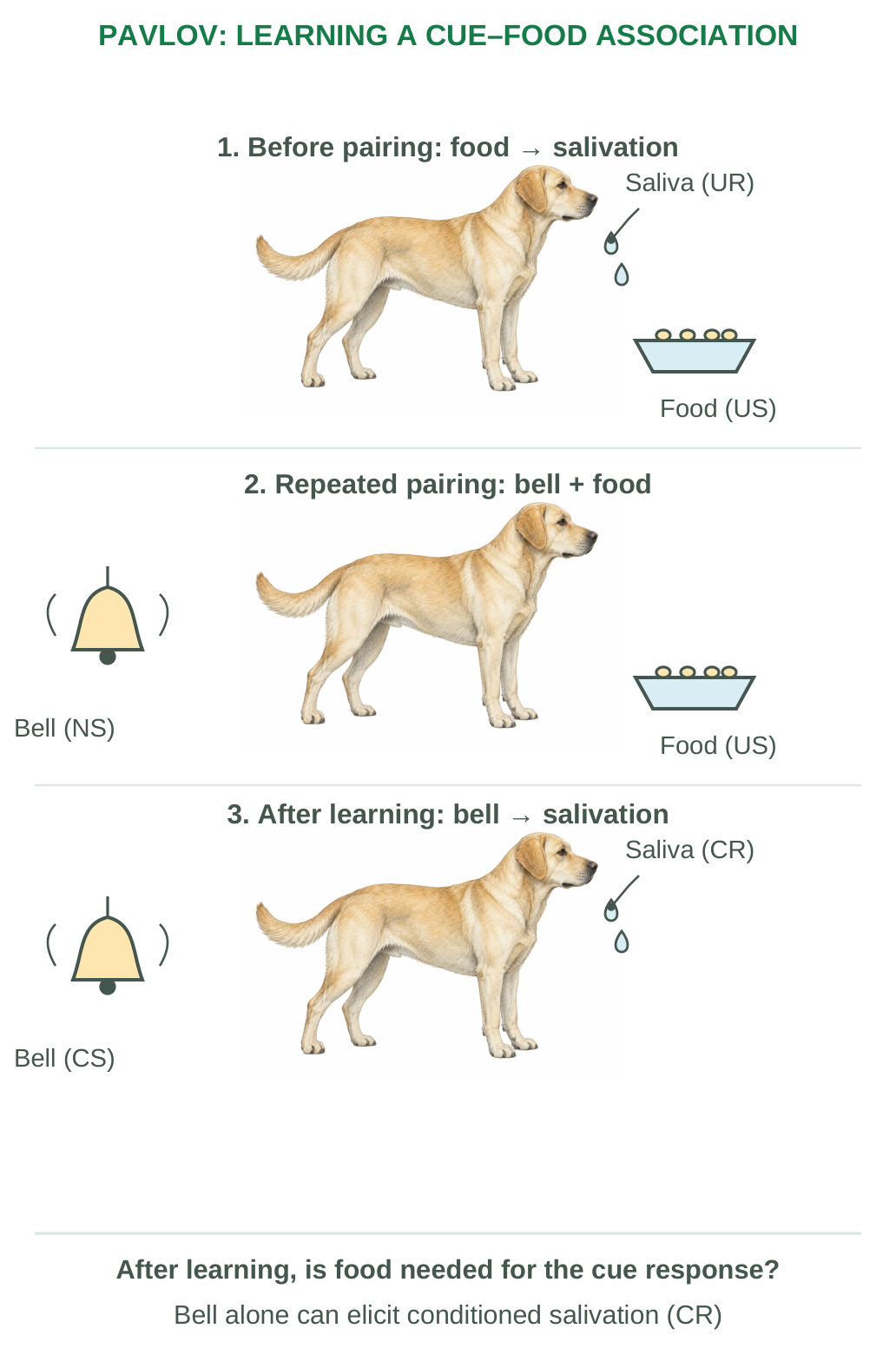
Diagram labels: PAVLOV: LEARNING A CUE–FOOD ASSOCIATION; 1. Before pairing: food → salivation; Food (US); Saliva (UR); 2. Repeated pairing: bell + food; Food (US); Bell (NS); 3. After learning: bell → salivation; Bell (CS); Saliva (CR); After learning, is food needed for the cue response?; Bell alone can elicit conditioned salivation (CR)
Essential terms
| Term | Meaning |
|---|---|
| Unconditioned stimulus (US) | Stimulus eliciting a response without the relevant prior conditioning |
| Unconditioned response (UR) | Initial response to the US |
| Neutral stimulus (NS) | Initially does not elicit the target response |
| Conditioned stimulus (CS) | Previously neutral stimulus after learning |
| Conditioned response (CR) | Learned response to the CS |
Healthcare illustration
An unpleasant procedure may elicit distress. Repeatedly associated sights or smells can later evoke anticipatory distress before the procedure starts. This example illustrates a possible learned association, not the only explanation of procedural anxiety.
Processes
Acquisition: the association develops. Extinction: repeated CS presentations without the relevant US reduce the learned response. Spontaneous recovery: a reduced response can briefly reappear after a pause. Generalization: similar cues evoke responses. Discrimination: responses differ between cues.
Care implications
Predictability, respectful preparation and supportive experiences may help change expectations. Avoid deliberately creating frightening associations or implying that a patient’s learned fear is irrational or voluntary. Formal treatment of significant fears belongs within qualified care.
1.13 Operant conditioning
In operant conditioning, consequences influence the future probability of an action. A consequence is classified by its actual effect on behaviour, not only by what the professional intended.
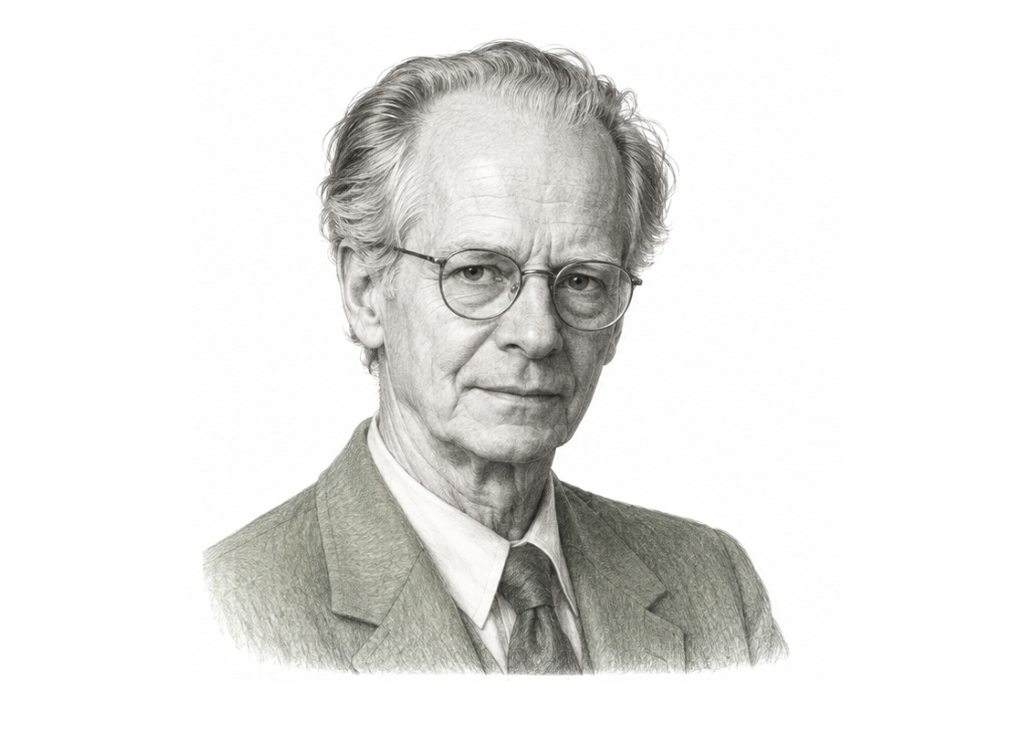
Diagram labels: Portrait: Burrhus Frederic Skinner (1904-1990).
Burrhus Frederic Skinner (1904-1990) developed experimental work on operant behaviour and consequences. These principles help analyse practice, habits and feedback, while healthcare use must respect autonomy and context.
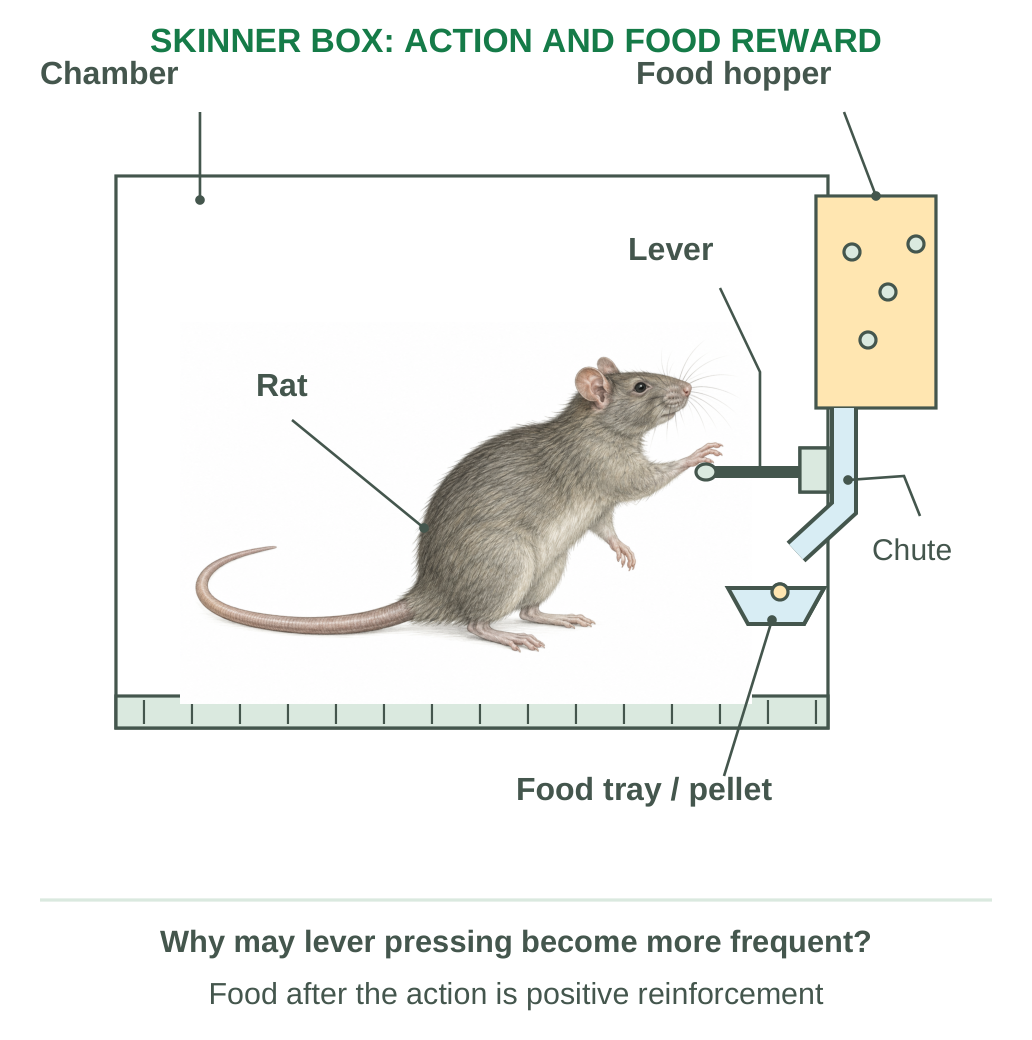
Diagram labels: SKINNER BOX: ACTION AND FOOD REWARD; Chamber; Food hopper; Lever; Rat; Food tray / pellet; Chute; Why may lever pressing become more frequent?; Food after the action is positive reinforcement
Basic distinction
Reinforcement increases a behaviour. Punishment decreases a behaviour. Positive means something is added; negative means something is removed. Positive does not mean morally good, and negative does not mean bad.
Behaviour-specific example
If timely, meaningful praise after a successful practice attempt leads to more practice, it functions as positive reinforcement. If praise does not increase practice, its reinforcing effect has not been established.
Four consequence types
| Type | Consequence | Future target behaviour |
|---|---|---|
| Positive reinforcement | Add a valued stimulus | Increases |
| Negative reinforcement | Remove an aversive stimulus | Increases |
| Positive punishment | Add an aversive consequence | Decreases |
| Negative punishment | Remove a valued stimulus | Decreases |
Illustrations, not care recommendations
Removing an unpleasant reminder when a person completes a chosen routine may reinforce that routine if it becomes more frequent. Adding an unpleasant consequence or removing a privilege can reduce a behaviour, but punitive approaches can harm trust.
Essential care must not be withheld as a behavioural penalty.
1.14 Observational and cognitive learning
Observational learning includes attending to a model, remembering the action, having the capacity to reproduce it and sufficient motivation to perform it. Watching does not guarantee correct execution; guided practice and feedback are needed.
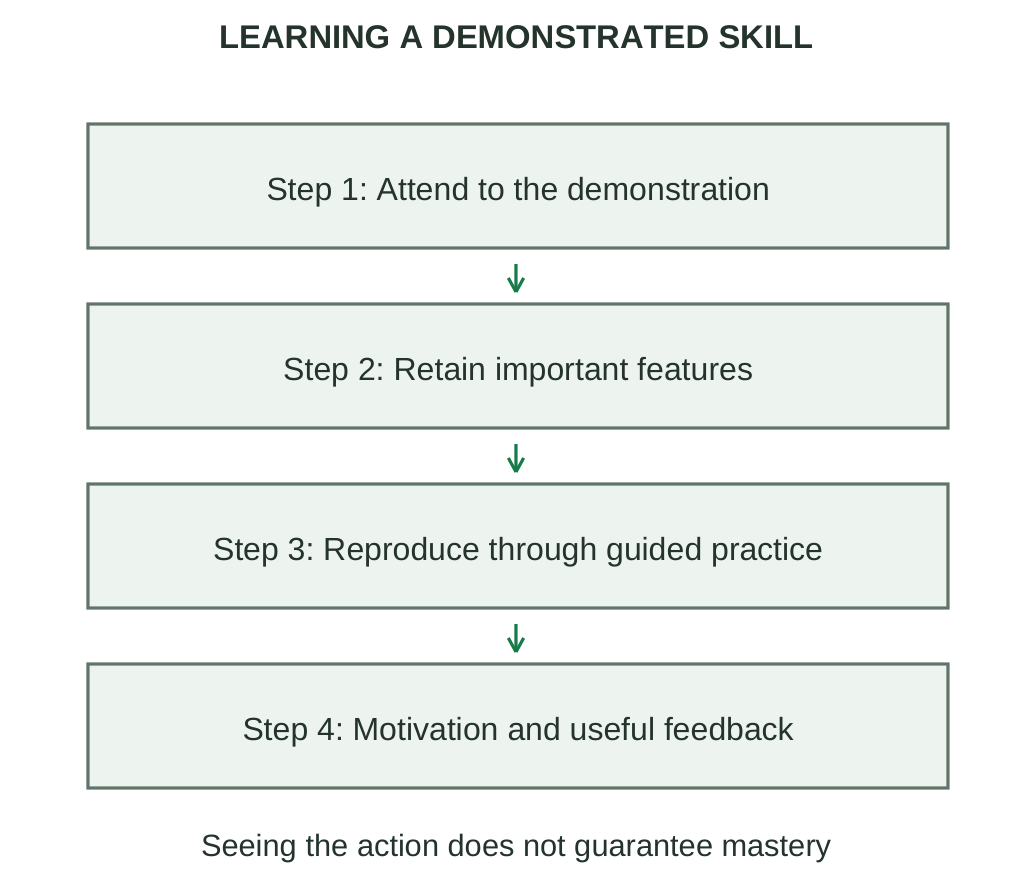
Diagram labels: LEARNING A DEMONSTRATED SKILL; Step 1: Attend to the demonstration; Step 2: Retain important features; Step 3: Reproduce through guided practice; Step 4: Motivation and useful feedback; Seeing the action does not guarantee mastery
Demonstration sequence
Step 1: explain the purpose and show the action clearly.
Step 2: ask the learner to describe important features.
Step 3: invite a safe practice attempt under appropriate supervision.
Step 4: give specific feedback and repeat as needed.
Step 5: check the skill in the intended setting and arrange follow-up.
Cognitive learning
Meaningful explanation, examples, organization and links to prior knowledge support understanding. A person who understands why an action matters may adapt it more appropriately than one who has memorized words without meaning.
1.15 Memory: processes and systems
Memory allows information to be encoded, retained and retrieved. It supports medication history, learning, decision making and daily routines. A memory difficulty can arise at different stages, so repetition alone may not address its cause.
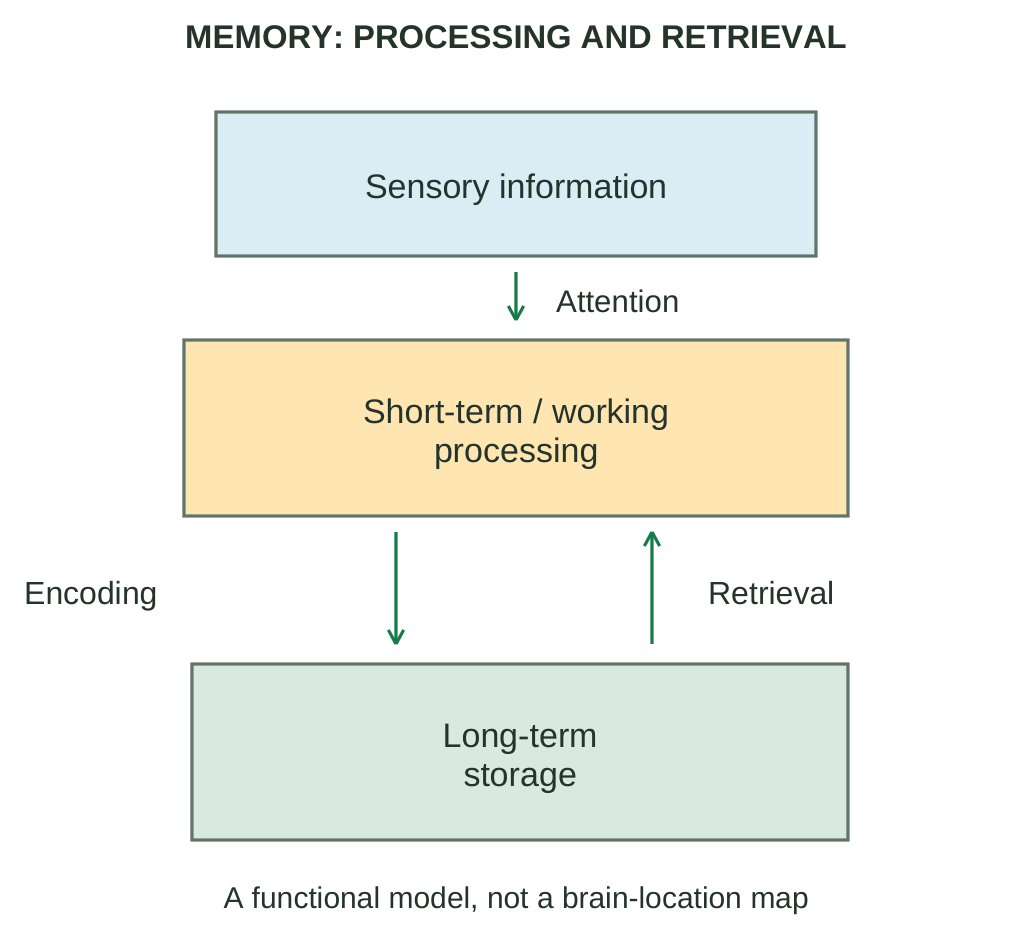
Diagram labels: MEMORY: PROCESSING AND RETRIEVAL; Sensory information; Short-term / working; processing; Long-term; storage; Attention; Encoding; Retrieval; A functional model, not a brain-location map
Three core processes
| Process | Meaning | Example |
|---|---|---|
| Encoding | Form a usable representation | Understand and organize an instruction |
| Storage | Retain information over time | Keep the learned plan available |
| Retrieval | Access retained information | Recall the plan when needed |
Memory systems
Sensory memory briefly retains aspects of incoming stimulation. Short-term memory holds limited information over a short interval. Working memory maintains and manipulates information during a task. Long-term memory supports more durable knowledge, experiences and skills.
Long-term memory types
Explicit/declarative memory includes facts and events that can be consciously described. Semantic memory concerns knowledge; episodic memory concerns personal events. Implicit/nondeclarative memory includes skills and other influences expressed through performance without necessarily conscious recollection.
Prospective memory
Remembering to perform a future action is prospective memory. A person may know a regimen well yet forget to act at the relevant time. Suitable cues and routines can support this different problem.
1.16 Forgetting and memory support
Forgetting may reflect weak initial encoding, difficulty accessing a stored representation, interference, insufficient cues or other factors. Normal everyday forgetting and a clinically significant change must not be treated as identical.
Common mechanisms
| Mechanism | Example |
|---|---|
| Poor encoding | Instructions heard during a distracting event |
| Retrieval failure | Knows the information but cannot access it in the situation |
| Proactive interference | Earlier instructions interfere with a new plan |
| Retroactive interference | New learning disrupts recall of an earlier plan |
| Lack of useful cues | No reminder when a future action becomes due |
Retention over time
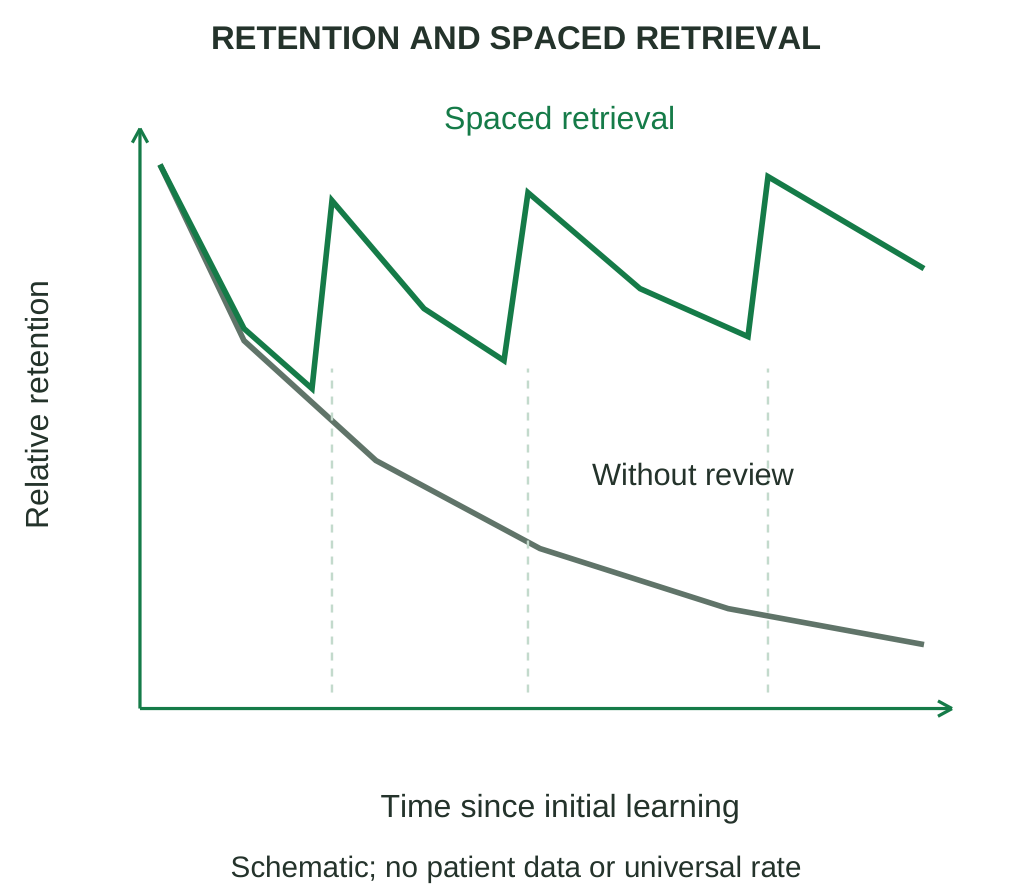
Diagram labels: RETENTION AND SPACED RETRIEVAL; Relative retention; Time since initial learning; Spaced retrieval; Without review; Schematic; no patient data or universal rate
The graph is a conceptual teaching model. Retention may fall after learning; spaced retrieval can support later access. Its shape is not a universal patient curve and the percentages are not clinical predictions.
Support strategies
Use meaningful organization and small chunks. Connect new information to an existing routine where appropriate. Ask the patient to explain or demonstrate the plan; use clear written support and suitable reminders. Revisit information at spaced intervals rather than relying on one long session.
Teach-back
Frame teach-back as a check of the explanation: ‘To check that I explained this clearly, how will you use it at home?’ Clarify misunderstandings and check again. It is not a test of intelligence and should not shame the learner.
1.17 Reinforcement and behaviour change
Reinforcement can strengthen a specific, observable and agreed behaviour. It should support capability and confidence, not pressure a person to accept a plan they do not understand or choose.
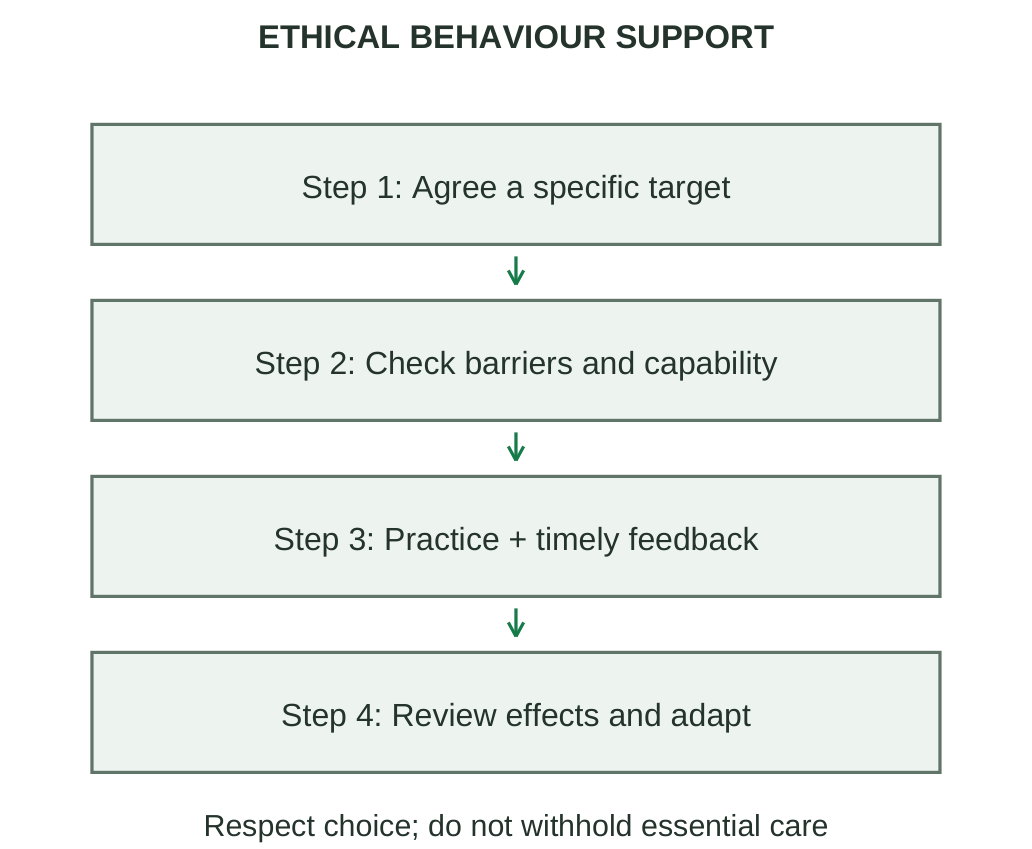
Diagram labels: ETHICAL BEHAVIOUR SUPPORT; Step 1: Agree a specific target; Step 2: Check barriers and capability; Step 3: Practice + timely feedback; Step 4: Review effects and adapt; Respect choice; do not withhold essential care
Designing a supportive plan
Step 1: define the target. Specify an observable action, such as completing a supervised practice sequence accurately.
Step 2: understand barriers. Check ability, understanding, access and personal concerns.
Step 3: agree a small achievable goal. Avoid goals that require resources the person lacks.
Step 4: provide timely, meaningful feedback. Link recognition to the actual action and effort.
Step 5: review behaviour. Determine whether the target action becomes more likely and whether the plan remains acceptable.
Step 6: support maintenance. Gradually strengthen practical routines and self-management rather than creating dependence on external rewards.
Shaping
Shaping reinforces successive approximations toward a more complex behaviour. For example, acknowledge accurate preparation, then the complete demonstration and later independent performance. Do not reward an unsafe partial action as if the entire task has been mastered.
1.18 Reinforcement schedules and ethics
Schedules
| Schedule | Reinforcement after… | Main distinction |
|---|---|---|
| Continuous | Every suitable target response | Clear relationship during initial learning |
| Fixed ratio | A specified number of responses | Based on response count |
| Variable ratio | A varying response count around an average | Count varies |
| Fixed interval | First suitable response after a fixed interval | Based on elapsed time |
| Variable interval | First suitable response after varying intervals | Time varies |
Interpret schedules accurately
An interval schedule does not reinforce every action during the interval. A ratio schedule concerns response count, not elapsed time. These are learning models; healthcare follow-up visits do not automatically represent one of these schedules.
Effective feedback
Be specific: identify what was done correctly and what needs adjustment. Timely, respectful feedback can support learning. A consequence intended as a reward may be irrelevant, embarrassing or coercive to the recipient.
Ethical limits
Do not shame, threaten, make unrealistic promises or withhold essential treatment. Avoid incentives that undermine meaningful choice or disadvantage people with disability or limited resources. A patient’s goals, preferences and welfare remain central.
Measuring change
Use relevant observations over time.
Completion percentage = completed agreed opportunities ÷ total agreed opportunities × 100. This teaching measure must be defined carefully; it does not prove correct technique, therapeutic benefit or informed agreement.
1.19 Emotion: components and relevance
Emotion involves subjective feeling, physiological changes, appraisal and behavioural/expression tendencies. Fear, anger, sadness and relief can influence attention, interpretation, decision making and interaction with care.
Components
| Component | Example during an unfamiliar test |
|---|---|
| Subjective experience | Feeling worried |
| Physiological response | Faster heartbeat or sweating |
| Appraisal | Interpreting the situation as threatening |
| Expression/action tendency | Tense posture or urge to avoid |
Emotion versus mood
An emotion is often related to a particular event and may be relatively brief. Mood is generally more diffuse and longer-lasting. This is a useful distinction, not a precise time cutoff for every experience.
Health implications
Worry can direct attention toward danger while reducing attention to other information. Relief can improve engagement; anger may signal a perceived threat, loss of control or an unmet need. Do not assume a single meaning from an expression.
Respectful response
Acknowledge the person’s experience, invite an explanation and provide clear information. Allow an appropriate pause and check understanding. An emotional response does not make a patient incapable of participating in decisions; capacity is assessed according to the actual situation and relevant process.
1.20 Major theories of emotion
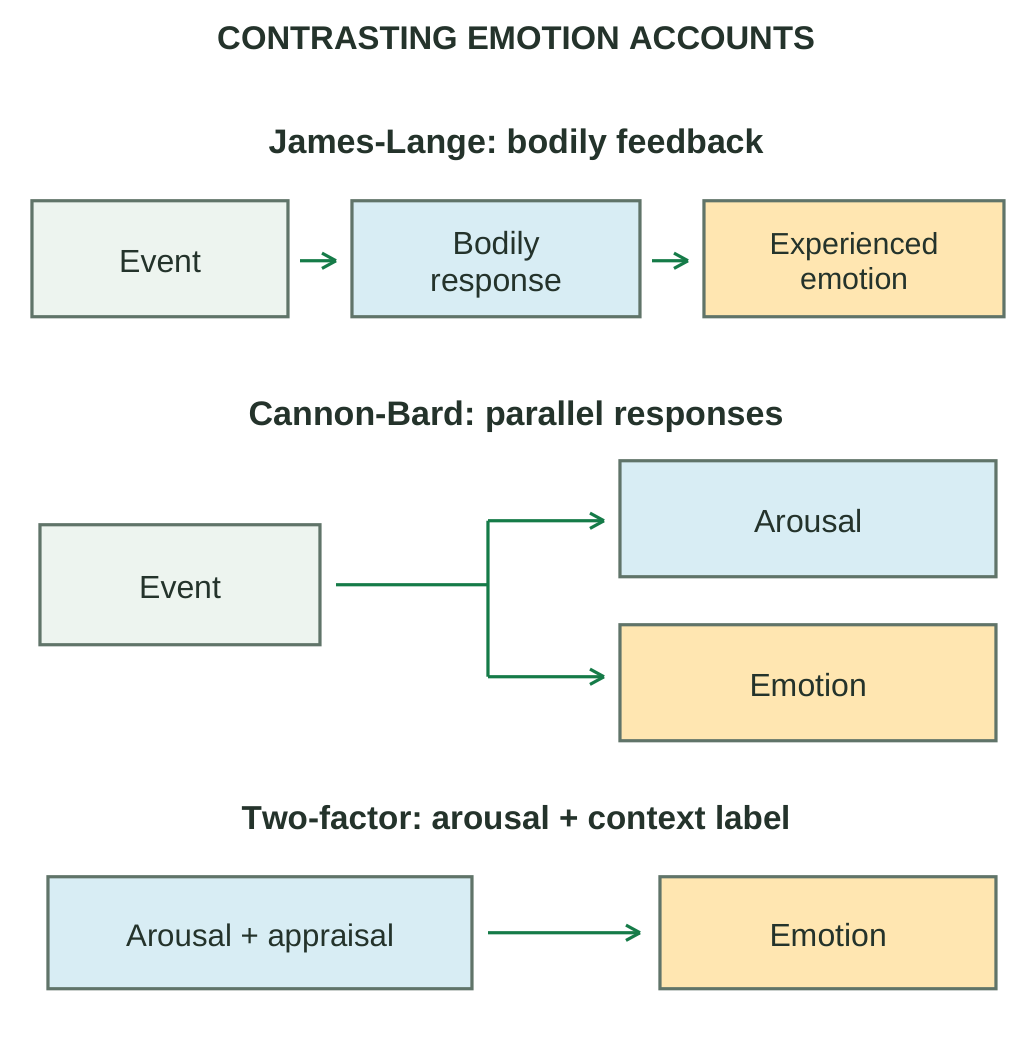
Diagram labels: CONTRASTING EMOTION ACCOUNTS; James-Lange: bodily feedback; Event; Bodily; response; Experienced; emotion; Cannon-Bard: parallel responses; Event; Arousal; Emotion; Two-factor: arousal + context label; Arousal + appraisal; Emotion
Bodily-feedback account: James-Lange
The sequence emphasizes bodily change followed by the experience of emotion through perception of that change: stimulus → bodily response → experienced emotion. It helps highlight feedback from the body but does not fully explain every emotion or context.
Simultaneous-response account: Cannon-Bard
The event is proposed to produce physiological arousal and conscious emotion in parallel. The main distinction is that the felt emotion is not simply the result of noticing bodily arousal first.
Two-factor account: Schachter-Singer
Emotion involves physiological arousal plus a cognitive label based on context. Similar arousal can be interpreted differently depending on the situation. Context matters; a bodily signal alone does not uniquely identify one emotion.
Cognitive-appraisal accounts
The person’s evaluation of the event’s meaning influences emotional experience. A situation can be interpreted as threat, challenge, loss or reassurance. Appraisal and bodily processes can interact; the account should not be simplified to ‘all emotion is a deliberate thought’.
Comparison
| Account | Emphasized relationship |
|---|---|
| James-Lange | Bodily response contributes to the feeling |
| Cannon-Bard | Arousal and feeling occur in parallel |
| Two-factor | Arousal is interpreted using context |
| Appraisal | Meaning/significance influences emotion |
Model limitation
These are explanatory accounts, not diagnostic tests. The simplified arrows compare key ideas; real emotional processes are interactive.
1.21 Applying emotion concepts in healthcare
Example: anticipatory anxiety
A patient sees an unfamiliar device and becomes tense. The professional should not guess that one theory uniquely explains the response. Ask what the patient expects, explain the purpose, address practical concerns and offer a clear demonstration when appropriate.
Emotion and clinical assessment
Arousal can reflect emotion, pain, illness, environment or treatment effects. Faster heartbeat is not sufficient evidence of fear. Consider the clinical context and relevant assessment rather than assigning a psychological explanation to every physical sign.
Emotional regulation
People may regulate emotion by changing a situation, redirecting attention, reappraising meaning or managing expression. Supportive explanation and a sense of involvement can help; telling someone simply to ‘stop worrying’ is usually uninformative.
Communication implications
Use a calm, respectful tone. Acknowledge distress without pretending to know exactly how the person feels. Ask what information or support is needed. Avoid blame and false reassurance. Seek appropriate team support when distress exceeds the scope of routine education.
Example distinction
‘You look tense; what is worrying you?’ invites clarification. ‘You are frightened because you do not understand’ makes two unverified assumptions. The first response better separates observation from interpretation.
1.22 Motivation: meaning and forms
Motivation concerns processes that initiate, direct and sustain goal-related behaviour. It influences effort and persistence, but behaviour also depends on ability, opportunity, resources and competing demands.
Intrinsic and extrinsic motivation
Intrinsic motivation concerns interest or satisfaction in an activity itself. Extrinsic motivation concerns an outcome outside the activity, such as recognition or another valued consequence. Real actions can have mixed motives.
Health-related examples
A patient may practice a skill because mastering it feels worthwhile, because it supports independence or because family encouragement makes the effort meaningful. A person may also agree with a health goal yet struggle because the action is difficult or unaffordable.
Motivation is not a fixed label
Avoid describing a person as simply ‘motivated’ or ‘unmotivated’. Ask what goal matters, what effort seems possible, what outcome is expected and what barriers exist. Readiness can vary across actions and over time.
Readiness and confidence
Wanting an outcome and believing one can perform the required action are different. A patient may value improved health but lack confidence in a device skill. Demonstration, manageable practice and specific feedback can address capability and confidence more effectively than repeated persuasion.
1.23 Theories of motivation
Drive-reduction theory
A physiological need can create a drive, and action can reduce it toward regulation/homeostasis. Thirst encouraging drinking is a simple illustration. Not every health behaviour reduces a biological drive; curiosity, goals and social meanings also matter.
Incentive theory
Behaviour can be drawn toward expected desirable outcomes or away from unwanted ones. Outcomes differ in value between people. Merely offering an incentive does not guarantee change and may introduce ethical concerns.
Arousal theory
People may seek or regulate a suitable level of stimulation. Too little stimulation can reduce engagement; excessive stress can overwhelm performance. The ideal level depends on the person and task, so there is no universal best arousal level.
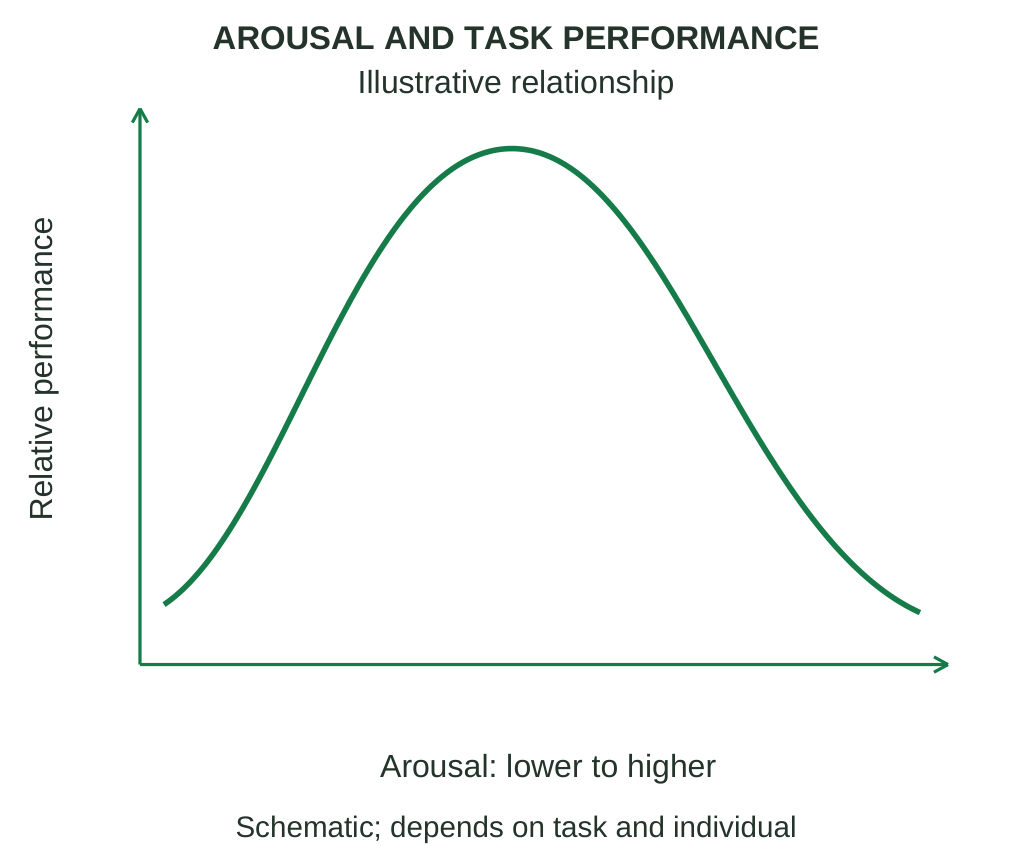
Diagram labels: AROUSAL AND TASK PERFORMANCE; Relative performance; Arousal: lower to higher; Illustrative relationship; Schematic; depends on task and individual
Humanistic needs perspective
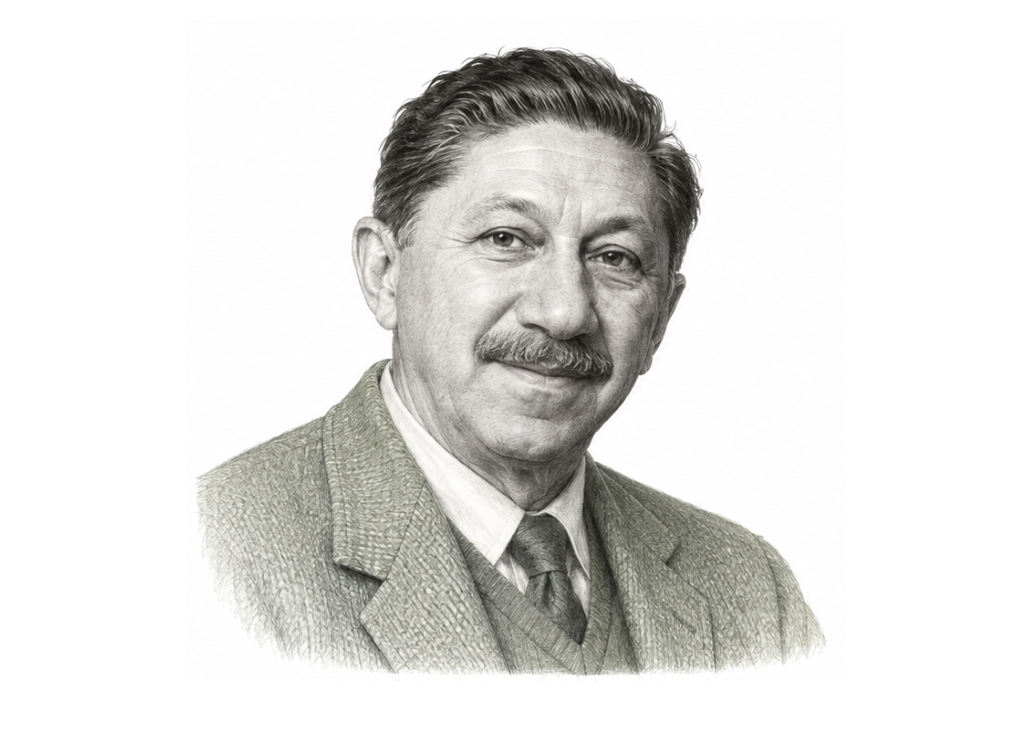
Diagram labels: Portrait: Abraham Harold Maslow (1908-1970).
Abraham Harold Maslow (1908-1970) proposed a hierarchy of human needs, commonly described from physiological and safety needs toward belonging, esteem and self-actualization. It is a useful framework for asking about needs, not a rigid rule that everyone advances in the same order.
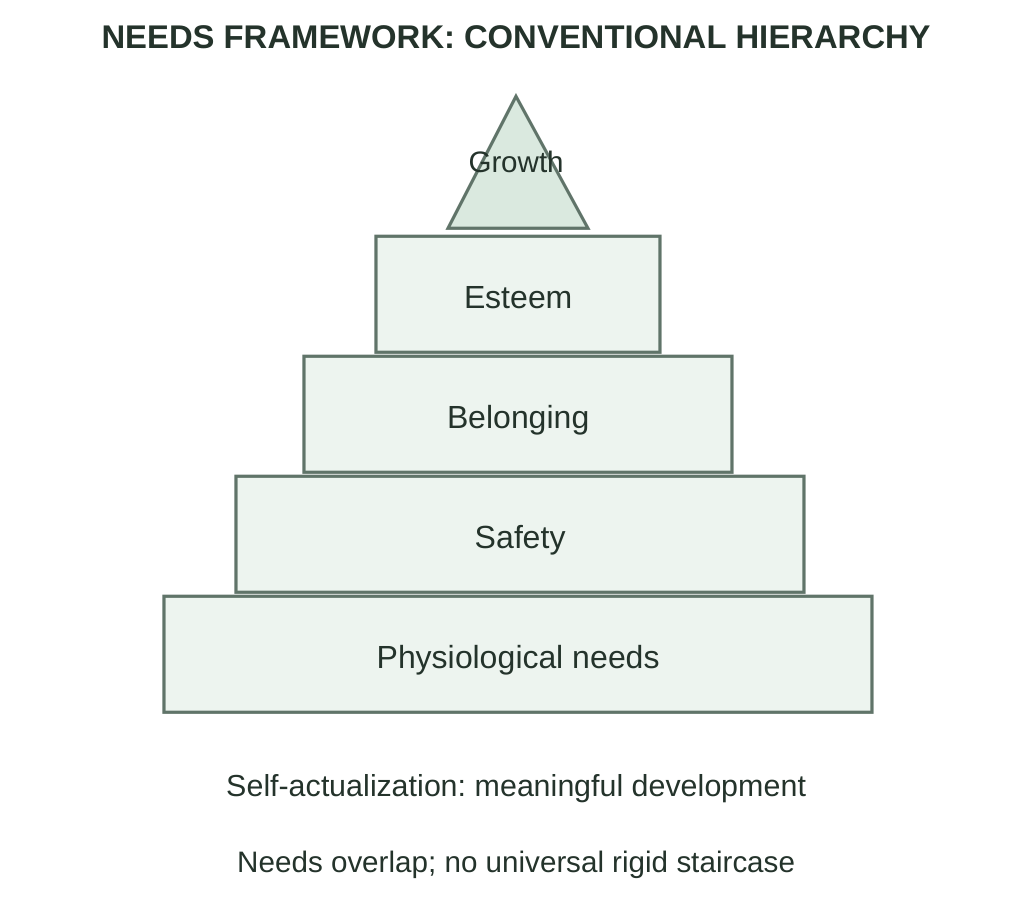
Diagram labels: NEEDS FRAMEWORK: CONVENTIONAL HIERARCHY; Physiological needs; Safety; Belonging; Esteem; Growth; Self-actualization: meaningful development; Needs overlap; no universal rigid staircase
Applying the needs framework | Physiological | Comfort, food, rest and other basic needs | | Safety | Predictability, security and understandable care | | Belonging | Support and respectful inclusion | | Esteem | Dignity, competence and recognition | | Self-actualization | Personally meaningful growth/goals |
Expectancy and value
Effort can depend on whether a person expects the action to be feasible and useful, and how much the outcome matters. A valued goal can be abandoned if the person believes the action cannot work or cannot be performed.
Self-determination perspective
Motivation can be supported by autonomy (meaningful choice), competence (feeling able) and relatedness (supportive connection). These concepts do not mean leaving the patient without guidance; they encourage collaborative explanation and practical support.
Theory limitations
Needs overlap and are influenced by culture and situation. Incentives can change short-term behaviour without maintaining it. Arousal curves are conceptual, not individual clinical predictions. Use theories to ask better questions rather than forcing every patient into one model.
1.24 Motivation and health behaviour
A useful approach connects an action to a meaningful goal while addressing capability and practical barriers. Motivation cannot compensate for an unavailable medicine, inaccessible device or confusing instructions.
Collaborative support sequence
Step 1: ask what the person hopes to achieve and what concerns them.
Step 2: explore understanding, expected benefits and difficulties.
Step 3: identify one feasible action with the patient.
Step 4: explain or demonstrate the action and check understanding.
Step 5: agree on suitable cues, practice and support.
Step 6: review progress, acknowledge effective effort and adapt the plan.
Examples of appropriate support | Does not see purpose | Explain relevance to the person’s goal | | Low confidence | Demonstration and manageable practice | | Forgets at the intended time | Appropriate cue/routine and written support | | Feels excluded | Invite questions and respect preferences | | Cost/access problem | Discuss with the relevant service/team |
Avoid oversimplification
Non-adherence is not always a failure of motivation or memory. Adverse effects, beliefs, access, misunderstanding and informed choice can contribute. Explore causes and coordinate care rather than using psychological terms as labels.
1.25 Solved application cases
Case A: repeated instructions, poor recall
A patient is counselled beside a noisy counter while attending to a phone. Later they cannot explain the plan. Interpretation: poor attention during encoding is possible; a memory disorder is not established. Support: reduce distraction, explain a few points clearly, check comprehension and use appropriate written support. Review whether the problem persists in a better setting.
Case B: learns by watching, cannot perform
A learner watches a device demonstration and says it is clear but makes errors during practice. Interpretation: observation has not ensured reproduction of the skill. Support: break the action into stages, invite supervised practice, give specific corrective feedback and check the complete sequence. Do not assume agreement equals competence.
Case C: correct knowledge, missed future action
A person accurately explains a plan but forgets at the relevant time. Interpretation: prospective memory, routines or practical opportunity may be involved. Support: identify the actual circumstances and agree on a suitable cue or routine without changing the prescribed plan independently.
Case D: fearful interpretation
A patient interprets an unfamiliar procedure as a sign of serious deterioration. Interpretation: appraisal and expectations may influence emotion; the clinical meaning still needs explanation by the appropriate professional. Support: ask about the concern, clarify the purpose, acknowledge distress and check understanding. Avoid unsupported reassurance.
1.26 Quick revision and exam distinctions
Use these distinctions to revise Healthcare Psychology and Communication Skills Unit 1 Notes and identify the mechanism, example and limitation in each answer.
| Pair | Important difference |
|---|---|
| Behaviour/mental process | Observable action/internal processing |
| Sensation/perception | Detection/interpretation |
| Perception/attention | Giving meaning/selecting processing resources |
| Encoding/retrieval | Forming a representation/accessing it |
| Classical/operant | Stimulus association/action-consequence relationship |
| Reinforcement/punishment | Increase/decrease in target behaviour |
| Positive/negative | Addition/removal of a stimulus |
| Short-term/working memory | Brief holding/holding plus manipulation |
| Retrospective/prospective memory | Past information/future intended action |
| Intrinsic/extrinsic motivation | Activity itself/external outcome |
Memory aids
S-P-A: Sense the message → Perceive its meaning → Attend to it. This is a recall aid, not a claim that all processing occurs in a strictly linear order. E-S-R: Encode → Store → Retrieve. A-R-P-M: Attend → Retain → Perform → Motivate for observational skill learning. R up; P down: Reinforcement increases; punishment decreases.
Cause-and-effect map
| Problem | Question before intervention |
|---|---|
| Cannot hear/read message | Is sensory access adequate? |
| Misinterprets message | What meaning and expectations are involved? |
| Loses focus | Are distraction, fatigue or distress present? |
| Cannot recall explanation | Was it encoded clearly and meaningfully? |
| Knows but forgets to act | Are cues and opportunity available? |
| Avoids action | What belief, emotion or barrier contributes? |
| Cannot perform skill | Was there practice and usable feedback? |
Common answer errors
Calling negative reinforcement punishment.
Assuming every reward actually reinforces behaviour.
Treating visual attention as proof of understanding.
Claiming that a person has a fixed ‘learning style’ that determines all teaching.
Calling a conceptual graph measured patient evidence.
Treating needs hierarchies as a universal strict staircase.
Inferring a diagnosis or motive from a single behaviour.
Blaming a patient before exploring context and barriers.
1.27 Possible examination questions
Long-Answer Questions
Define psychology and discuss scope, goals and relevance to health sciences and pharmacy.
Compare clinical, health, behavioural and developmental psychology with healthcare examples.
Explain sensation, perception and attention and their importance in clinical assessment.
Describe classical conditioning with a labelled sequence and relevant healthcare example.
Explain operant conditioning and distinguish the four consequence types.
Discuss observational learning, memory processes and strategies for patient education.
Explain reinforcement schedules and an ethical health-behaviour support plan.
Compare major emotion theories and their healthcare implications.
Explain motivation theories and apply them to a patient’s practical barriers.
Short-Answer Questions
Behaviour versus mental process.
Biopsychosocial perspective.
Transduction and sensory thresholds.
Bottom-up and top-down perception.
Selective, sustained and divided attention.
Acquisition, extinction and generalization.
Negative reinforcement versus punishment.
Encoding, storage and retrieval.
Working and prospective memory.
Shaping and reinforcement schedules.
Emotion versus mood; cognitive appraisal.
Intrinsic and extrinsic motivation.
Needs, autonomy, competence and relatedness.
Worked Questions and Calculations
Completion percentage: A learner completes 9 of 12 agreed practice opportunities. Percentage = 9/12 × 100 = 75%. Define an opportunity and separately verify safe technique; this is illustrative educational data.
Change in correct steps: A demonstration improves from 5 to 8 correct steps out of 10. Scores are 50% and 80%; the increase is 30 percentage points, or 60% relative to the initial count. State which measure is intended.
Classify the consequence: Specific praise follows practice and future practice increases. Positive reinforcement: valued feedback is added and the target action increases.
Negative reinforcement: An aversive reminder is removed after a chosen action; that action increases later. This is negative reinforcement, not punishment. Classification follows observed effects.
Attention or memory? A distracted patient cannot recall a message. Improve access/attention and check learning before attributing the problem to storage impairment.
Same arousal, different emotion: Context changes the interpretation of bodily arousal. This illustrates the two-factor account, without proving it explains every case.
Answer-writing checklist
Define the concept and distinguish related terms.
Explain its principle, then use a suitable healthcare example.
Label diagrams and clearly name relationships.
State theory limitations and avoid causal overclaims.
Include respectful, practical care implications.
Show units, assumptions and denominators in calculations.
Final examination tip
A strong answer links definition → mechanism → example → healthcare application → limitation.
Final recall
Understand the person → make information accessible → explain meaning → support attention and learning → check understanding/skill → review practical use.
1.28 Detailed Examination Answers and Concept Development
Healthcare Psychology and Communication Skills Unit 1 Notes become easier to apply when each definition is connected to an observable situation. The following explanations develop the unit’s concepts through educational examples. They are additional study applications of the principles already introduced, rather than additional patient data or a replacement for the prescribed clinical plan.
1.28.1 Psychology as a Scientific Discipline
The scientific character of psychology depends on how a question is investigated. A professional may notice that several learners remember a demonstration better after practice. This observation is a useful starting point, but the explanation still requires careful examination. Perhaps the learners who practised were also less tired, had more previous experience or received longer explanations. A scientific account asks how learning was measured and whether competing explanations were considered. It does not turn a memorable experience into a rule for every patient.
A useful first distinction is between a description and an explanation. The statement that a learner completed six steps correctly describes performance under particular conditions. The statement that anxiety caused the remaining errors proposes an explanation. To evaluate that explanation, one would need information about the learner’s experience, the instructions, sensory access, task difficulty and other relevant circumstances. The explanation may be plausible without being established.
Prediction is also different from certainty. Recognizing that interruptions can make a demanding explanation harder to follow helps plan a quieter encounter. It does not mean that every interrupted learner will forget everything. Psychological predictions concern patterns and conditions, while individual outcomes can vary. The same caution applies when moving from a classroom example to a real clinical interaction.
Supporting change brings these ideas together. Begin with a clearly described difficulty, explore possible explanations, choose a feasible response and check what happens. If a new arrangement improves practice, record that result while remaining open to other influences. If it does not help, reconsider the explanation instead of blaming the learner. This sequence makes psychological reasoning practical, respectful and capable of correction.
Exam application: Define psychology, explain behaviour and mental processes, describe the four goals, give one connected healthcare example and finish by explaining why evidence and context matter.
1.28.2 Observation, Interpretation and Attribution
An observation is a record of what was seen, heard or otherwise established in the encounter. An interpretation assigns meaning to that observation. For example, a patient asks the same question three times. Possible interpretations include uncertainty, difficulty hearing, incomplete understanding, worry or difficulty retaining the explanation. The observation alone does not select among them. Careful communication keeps the factual description separate from the proposed explanation.
Attribution concerns how a cause is assigned to behaviour. It is easy to attribute a missed appointment to the person’s attitude while overlooking transport, work or access. It is equally possible to assume that every difficulty is external and miss an important concern expressed by the patient. Good reasoning avoids choosing an explanation before hearing the person’s account. The purpose is to understand the circumstances well enough to respond appropriately.
Consider a learner who looks away during a demonstration. The professional might write, ‘Learner looked toward the doorway during two stages and asked for the final stage to be repeated.’ This wording records relevant behaviour without deciding that the learner was disrespectful or uninterested. A follow-up question can explore whether noise, discomfort or another concern interrupted attention. The answer then guides the response.
This distinction improves teamwork because another professional can evaluate a concrete observation. A label such as ‘difficult patient’ provides little information about what occurred or what assistance is required. A factual note describing the question asked, support offered and remaining difficulty gives the next professional something useful to act upon. It also allows changes over time to be recognized more accurately.
Study exercise: For any clinical example, write one sentence containing only observation, one containing a possible interpretation and one question that could help distinguish alternatives. If the interpretation contains a diagnosis or motive that the evidence does not establish, revise it.
1.28.3 The Biopsychosocial Perspective in Detail
The biopsychosocial perspective organizes questions about health experience into interacting biological, psychological and social influences. Biological influences can include illness, fatigue, discomfort and treatment effects. Psychological influences include expectations, emotion, attention, memory and learning. Social influences include family support, language, work, income and access. The categories help identify relevant information; they do not divide a person into three independent parts.
A learner who struggles with a new routine may be tired, worried about making a mistake and working at changing times. Fatigue can make sustained attention harder, worry can occupy processing resources and irregular work can make a familiar cue unreliable. These influences can combine. Simply giving the same leaflet again may leave the main difficulty unresolved because the problem is not just a shortage of written information.
The model also changes how questions are asked. A biological question might concern whether discomfort interrupted the explanation. A psychological question might explore what the person thinks the instruction means. A social question might ask whether the planned routine is feasible in the person’s living or working circumstances. The answers may reveal that more than one adjustment is needed within the agreed care plan.
Interaction does not mean that every arrow in a teaching diagram represents a proven causal pathway. The figure invites a broad assessment of possibilities. It does not show how large an influence is, whether it applies to a particular person or which direction a relationship takes. The professional still needs evidence from the encounter and appropriate assessment.
Extended example: A patient understands a plan but cannot obtain the required item. The immediate barrier concerns access. Confidence or memory support may be useful later, but motivational encouragement does not make an unavailable resource available. A biopsychosocial answer identifies the practical barrier and explains how the relevant service or team could be involved.
1.28.4 Using Psychological Knowledge in Pharmacy
Pharmacy involves repeated opportunities to connect information with action. Taking a medication history requires attention to what the patient remembers and how questions are framed. Explaining a plan requires understandable language and an accessible setting. Teaching a device requires observation of performance. Following up requires checking what happened in the patient’s actual circumstances. Psychological knowledge helps distinguish these tasks instead of treating them all as information delivery.
During a history, a question that sounds accusatory can make disclosure harder. A neutral invitation to explain the usual routine may reveal uncertainty or difficulty that a yes-or-no question misses. The professional should distinguish the patient’s recollection from independently verified information and remain careful about what the available account can establish. Respectful questioning supports accuracy without guaranteeing a perfect memory report.
During counselling, ask what the person already understands. This identifies useful prior knowledge and possible misconceptions. Explain a manageable amount, pause and check meaning. If the task involves a skill, invite an appropriate demonstration rather than relying only on verbal agreement. Understanding the purpose and performing the sequence are related achievements, but one does not prove the other.
During follow-up, compare the planned action with the experience reported. A reminder that seemed suitable in the consultation may fail during a changing work schedule. A written instruction may be clear to one person and inaccessible to another. Revising support is part of good teaching, rather than evidence that the first explanation was useless or that the patient was unwilling.
Professional boundaries remain important throughout. The pharmacist can recognize relevant observations, improve communication and coordinate appropriate support. Introductory psychological knowledge does not establish competence to diagnose complex cognitive or emotional difficulties. A strong examination answer connects psychological principles with pharmacy activities while explaining when additional assessment belongs to qualified professionals.
1.28.5 Comparing the Four Branches Through One Case
Imagine an adult who has difficulty learning a new device and becomes distressed during practice. Clinical psychology may contribute to understanding significant distress and its effects on functioning. Health psychology considers beliefs about illness, expectations of treatment and adjustment to care. Behavioural psychology examines the demonstration, practice opportunities, cues and consequences. Developmental psychology considers changing capabilities, experience and needs across the lifespan.
The same situation can therefore be understood through several questions. Is distress preventing participation? Does the person believe the device is necessary? Which step is difficult? Is the demonstration accessible? What practice and feedback have been provided? Are assumptions being made about age or ability? Each question highlights a different aspect without making the other perspectives irrelevant.
A common examination error is to assign the whole person to one branch. A child does not belong only to developmental psychology, and an anxious adult does not belong only to clinical psychology. The branches identify areas of study and professional contribution. Real healthcare situations often involve overlapping processes and coordinated roles.
Another error is to confuse a branch with a method. Observation can be used within several branches. A questionnaire is not itself health psychology, and an interview is not automatically clinical assessment. The purpose, training, context and interpretation determine what the activity can contribute. Similarly, an introductory learning model does not replace a complete professional assessment.
Answer structure: Define each branch in a separate sentence, identify its main question and give a relevant example. Then use one combined case to demonstrate overlap. Conclude with the principle that the response should match the actual difficulty and the professional’s competence. This produces a more complete comparison than four isolated definitions because it shows how the perspectives are useful in practice.
1.28.6 Sensation, Transduction and Neural Communication
Sensation begins with the detection of stimulation through sensory systems. Transduction refers to conversion of stimulus energy into signals usable by the nervous system. These concepts explain why information must first be accessible before it can be understood. Printed instructions require adequate access to the visual message; spoken explanations require adequate access to the sound or an appropriate alternative communication route.
The general neuron diagram supports this discussion by identifying dendrites, cell body, nucleus, axon, myelin sheath and terminals. The illustrated direction of signalling helps students follow a basic communication pathway. It is a schematic representation of a general neuron, not a full map of sensory processing or a claim that every neuron has exactly the same shape and function.
Sensory systems provide different kinds of information. Vision contributes features such as shape and movement. Hearing contributes sound and speech cues. Somatosensory systems contribute contact and bodily information. Proprioception concerns position and movement, while vestibular information supports balance and head movement. These distinctions help explain why successful instruction can involve more than simply hearing words.
For example, a learner may understand a spoken explanation yet have difficulty handling a device. It would be inaccurate to call this a failure of hearing or memory without examining the task. The difficulty may concern handling, visual access, unfamiliarity or another factor. A suitable demonstration and observation of performance can identify the stage where support is needed.
Examination extension: Explain the route from stimulation to a usable sensory signal, then distinguish this from interpretation. Identify the labelled neuron structures without claiming that the figure locates attention or memory in one part. Finally, use an accessibility example to connect sensory processing with patient education.
1.28.7 Thresholds, Adaptation and Habituation
A sensory threshold is defined within a method and set of conditions. The absolute threshold is commonly described using detection on half of the trials. This wording acknowledges variability: detection is not always an all-or-nothing event at one fixed intensity. A difference threshold concerns discrimination between stimuli. Neither concept should be copied directly into an individual diagnosis without the relevant assessment method.
Threshold examples are useful for understanding why environmental conditions matter. Background noise changes the conditions under which speech is detected. Contrast affects the visibility of print. Attention and task demands can also affect what a person reports. The teaching point is to examine access and context rather than to assume that the same message is equally detectable in every setting.
Sensory adaptation and habituation both involve reduced responding or awareness, but the concepts emphasize different processes. Adaptation concerns changes during relatively sustained stimulation. Habituation describes a learned reduction in response with repeated exposure. A repeated harmless sound may attract less attention over time, but that observation alone does not establish a change in the physical ability to hear it.
This distinction helps avoid a practical mistake: treating reduced response as proof of sensory damage. A person might no longer react to a familiar background noise because attention has shifted or responding has changed. Alternatively, an important change in sensory access may require assessment. The professional should record the observation and investigate appropriately rather than selecting a mechanism from appearance alone.
Worked interpretation: A learner stops noticing an unchanging background sensation. State that adaptation may be relevant. If the learner reacts less after repeated presentations of a sound, habituation may be considered. Explain that the exact process depends on the evidence and method. The strongest answer states both the conceptual distinction and the limit of what the example establishes.
1.28.8 Perception, Context and Expectations
Perception gives organization and meaning to sensory information. Recognizing printed marks as a familiar word involves more than detecting light and shape. The learner brings language, prior knowledge and expectations to the task. This is why a message can be visible yet misunderstood. Increasing size may improve access, while clarifying meaning addresses a different part of the difficulty.
Bottom-up processing emphasizes incoming features. A learner examines the letters, sequence and layout before identifying the instruction. Top-down processing emphasizes the contribution of prior knowledge and expectations. A familiar-looking package may be interpreted according to previous experience before all details are examined. Both routes can contribute during the same act of recognition.
Prior knowledge is helpful because it allows efficient interpretation. It can also create errors when the current situation differs from what is expected. A learner who previously followed one routine may read a changed instruction as if it were unchanged. The appropriate educational response is to identify the difference clearly and check the person’s interpretation, while preserving the clinician’s agreed plan.
Context also affects emotional meaning. A routine test may be understood as reassurance by one person and as evidence of worsening illness by another. The professional cannot settle that difference by repeating the test name more loudly. Asking what the person thinks the test means reveals the interpretation that needs discussion by the appropriate team member.
Revision point: Sensation asks whether the message was detected. Perception asks what meaning was assigned. Attention asks which information received processing resources. These questions overlap in a real encounter, but separating them helps select useful support. The mnemonic is a memory aid rather than proof that the brain always works in a simple three-step sequence.
1.28.9 Perceptual Organization and Bias
Visual organization can make a message easier or harder to interpret. Items placed close together may be seen as belonging together. Similar formatting can suggest a shared category. A clear sequence can help the reader follow a process. These principles explain why labels, units and instructions should be arranged consistently and why competing visual elements can create confusion.
For a student designing a teaching aid, the goal is to make the important relationship clear. Separate the name of an item from the action to be performed if combining them creates ambiguity. Keep related steps together and show the intended order. Use a simple structure, then check whether the learner reads it as intended. Attractive design alone does not establish correct interpretation.
Bias also affects the professional’s perception. Expecting a patient to be careless may draw attention toward errors while successful actions or practical barriers are overlooked. Assuming that an unfamiliar accent indicates poor understanding can distort the encounter. These are reasons to verify meaning and performance instead of treating a first impression as a complete assessment.
The distinction between illusion and hallucination should be expressed carefully. An illusion involves misinterpretation of a real stimulus. A hallucination is a perception-like experience without the corresponding external stimulus. A reader misidentifying an unclear label does not by itself establish a psychiatric symptom. Introductory terminology should improve precision rather than encourage inappropriate labels.
Applied examination paragraph: Clear visual organization supports interpretation, but people still bring expectations and experience to the message. The professional should therefore combine accessible design with questions that check meaning. Where the observation raises a concern beyond routine education, document what occurred and use the appropriate assessment pathway. This links perceptual principles with both practical action and interpretive caution.
1.28.10 Attention and Limited Processing Capacity
Attention concerns selection and allocation of processing resources. In an educational encounter, many sources compete: the explanation, the leaflet, nearby conversations, a phone and the person’s own thoughts. The fact that information was spoken does not show that it received enough attention to be understood and encoded. The professional needs to consider the conditions under which the message was presented.
Selective attention supports focus on one source while filtering others. Sustained attention supports continued engagement. Divided attention concerns allocating resources across tasks. Alternating attention concerns shifting between them. These distinctions are useful when teaching a task that requires looking between a label and an object, listening to instructions and then performing a sequence.
A demanding task can become harder when performed alongside another demanding task. The teaching implication is to reduce avoidable competition and sequence activities sensibly. Explain a short stage, demonstrate it clearly and then allow practice. This does not mean that every person must learn in exactly the same arrangement. The appropriate design depends on the task and the learner’s circumstances.
Internal demands also matter. Pain, fatigue, worry and competing concerns can occupy attention even in a quiet room. Asking whether the person is ready to continue may reveal a barrier that cannot be seen. The response may involve changing timing or involving the responsible team, rather than simply asking for greater effort.
Examination example: A distracted patient cannot later explain an instruction. One possible explanation is incomplete encoding because attention was divided. Improve access and attention, clarify the message and check learning again. Do not infer a memory disorder from this single result. The reasoning should connect the observed difficulty, plausible mechanism, supportive action and limits of interpretation.
1.28.11 Learning Versus Immediate Performance
Learning is a relatively enduring change arising from experience. Performance is what the person does at a particular time. A person may perform poorly because they are tired or distracted even though learning has occurred. Another person may repeat a sentence immediately without being able to recall or use it later. These possibilities show why one observation should be interpreted in context.
Patient education often requires several kinds of learning. Classical conditioning can explain learned responses to associated cues. Operant conditioning concerns consequences of actions. Observational learning concerns learning from a model. Cognitive learning emphasizes understanding, organization and problem solving. A complete teaching encounter may use more than one process, even when one is the main focus of an examination question.
Suppose a learner watches a skill demonstration, explains the purpose and completes the steps with feedback. Observation provides a model, cognitive understanding provides meaning and consequences influence future practice. Later performance still needs review in the setting where the skill will be used. Success under supervision may not transfer automatically to a distracting or unfamiliar environment.
The distinction between temporary change and learning also prevents exaggerated conclusions. A learner becoming less responsive because of fatigue is not necessarily acquiring a new behaviour. A sudden improvement after an unusually strong prompt may not represent independent mastery. Define what counts as successful learning and use an observation suited to that definition.
Answer development: Begin with the definition, distinguish performance, name the main forms and give a healthcare example for each. Then explain why demonstration, practice, feedback and later review are useful. Avoid claiming that a person has one fixed learning style that determines all effective teaching. Match the method to the actual task and accessibility needs.
1.28.12 Classical Conditioning Step by Step
Classical conditioning concerns an association between stimuli. In the familiar teaching example, food elicits salivation without the relevant prior conditioning. Food is therefore the unconditioned stimulus, and salivation to food is the unconditioned response. A bell initially does not elicit the target salivary response in the same way and is described as a neutral stimulus in this example.
During learning, the cue is associated with food. After an effective association develops, the bell can elicit a conditioned response. The bell is now the conditioned stimulus, and salivation to it is the conditioned response. The important examination task is to label the role of each element before and after learning. The cue’s role changes through the association; food does not become the conditioned stimulus simply because it appears in the experiment.
The conditioned response does not require food to be presented on that particular cue-only trial. This explains the distinction between a learned response to the cue and the original response to food. However, repeated cue presentations without the relevant unconditioned stimulus can reduce the conditioned response through extinction. A reduced response can later briefly reappear, illustrating spontaneous recovery.
Generalization occurs when similar cues elicit related responses. Discrimination involves responding differently to distinguishable cues. In healthcare illustrations, a person may develop anticipatory distress around features associated with an unpleasant experience. The example identifies a possible learning process, not a complete explanation for every patient’s concern.
Diagram answer: Draw or place the three stages, label US, UR, NS, CS and CR, then explain acquisition and extinction. Add a respectful healthcare illustration and state that significant fears require appropriate professional care. Avoid suggesting that learned fear is chosen or that an introductory conditioning exercise is a treatment plan.
1.28.13 Operant Conditioning and Functional Consequences
Operant conditioning concerns how consequences influence future action. The key unit of analysis is a defined behaviour and what follows it. In the chamber illustration, lever pressing is the action and food delivery is a possible reinforcing consequence. The classification depends on whether lever pressing becomes more likely under the relevant conditions. Intending to reward the action is not enough to establish the effect.
Two independent distinctions are needed. Reinforcement increases the target behaviour, while punishment decreases it. Positive means addition of a stimulus, while negative means removal. Combining these distinctions produces four categories. Students often make errors because they use positive and negative as moral judgments instead of descriptions of what changed in the situation.
For positive reinforcement, a valued consequence is added and the future target action increases. For negative reinforcement, an aversive condition is removed and the future target action increases. For positive punishment, an aversive consequence is added and the target action decreases. For negative punishment, a valued consequence is removed and the target action decreases. The action being measured must stay clear throughout the answer.
In an educational example, specific recognition following practice may function as reinforcement if practice becomes more frequent. If the learner finds public praise embarrassing and practises less, calling that consequence reinforcement would be inaccurate. The recipient’s response and the observed pattern matter more than the professional’s original intention.
Classification method: Identify the target behaviour, state what was added or removed and determine whether the future behaviour increased or decreased. Then choose the corresponding category. Keep this analytical exercise separate from recommendations about patient care. Understanding punishment does not justify humiliation, coercion or withholding essential treatment. Ethical support should preserve the person’s dignity and meaningful choice.
1.28.14 Observational Learning and Skill Teaching
Observational learning requires more than exposure to a model. The learner must attend to relevant features, retain them, have the capacity to reproduce the action and have sufficient motivation to perform it. A demonstration that is obscured, rushed or inaccessible may fail at the attention stage. A clear demonstration can still fail to produce independent performance if practice is missing.
A useful teaching sequence begins by explaining the purpose and showing the action clearly. The learner can then describe important features in their own words. This identifies what has been retained before a performance attempt. Appropriate supervised practice reveals whether the person can reproduce the movement or sequence. Specific feedback can then address the stage that needs adjustment.
The model should demonstrate the intended action consistently. If the spoken explanation describes one sequence while the hands perform another, the learner receives competing information. Similarly, unnecessary details can draw attention away from the key feature. Clear organization helps the learner distinguish essential steps from background activity.
Motivation contributes to whether an available skill is used, but a performance error should not automatically be treated as unwillingness. The learner may want to succeed yet lack the physical ability, resources or confidence required. A useful response examines these conditions rather than repeating encouragement alone. The same principle applies when transferring performance from the teaching setting to everyday use.
Extended examination answer: Define observational learning, explain the four requirements and connect each requirement with one teaching action. Use a device demonstration as an illustration without inventing device-specific instructions. Conclude that watching, agreeing and performing are different observations. The completed skill should be checked in a relevant setting, with suitable follow-up and support within the agreed care plan.
1.28.15 Memory Processes and Memory Systems
Memory processes describe what happens to information: encoding, storage and retrieval. Memory systems describe different forms or functions of retention. These two classifications answer different questions. Encoding concerns forming a usable representation. Storage concerns retaining information over time. Retrieval concerns accessing retained information when it is needed. A difficulty at any stage can affect later performance.
Sensory memory briefly retains aspects of incoming information. Short-term memory supports brief holding, while working memory includes maintaining and manipulating information during a task. Long-term memory supports more enduring knowledge, events and skills. The diagram is a functional teaching model rather than a claim that each system occupies a separate box-shaped location in the brain.
Within long-term memory, explicit or declarative memory includes information that can be consciously described. Semantic memory concerns knowledge, and episodic memory concerns personal experiences. Implicit or nondeclarative memory includes influences expressed through performance without necessarily conscious recollection. A person describing a rule and a person performing a familiar sequence therefore provide different kinds of evidence.
Prospective memory concerns remembering to perform a future intention. A learner may know exactly what an agreed action is and still fail to remember it at the relevant time. Repeating the factual explanation may not directly address that problem. A suitable cue or routine can support the future intention when it fits the person’s circumstances and care plan.
Examination application: Explain the three processes first, then the main systems and long-term distinctions. Add an example contrasting knowing an instruction with remembering to act later. This demonstrates why a single statement such as ‘the patient has poor memory’ is incomplete. The professional needs to consider access, encoding, retrieval, future cues and the wider context before interpreting the difficulty.
1.28.16 Forgetting, Interference and Retrieval Support
Forgetting can arise because information was not encoded clearly, because it cannot be accessed in the current situation or because competing information interferes. These possibilities suggest different educational responses. A person who did not understand the original explanation needs clarification. A person who understands but cannot recall at the right time may need a useful cue. More repetition without identifying the stage may be inefficient.
Proactive interference occurs when earlier learning interferes with newer information. Retroactive interference occurs when newer learning disrupts access to earlier information. A student can remember the direction by asking which information is producing the interference and which information is harder to retrieve. Both terms describe relationships between learning episodes, not a diagnosis.
In healthcare education, a changed plan may be confused with a familiar earlier plan. The appropriate response is to identify the current agreed instruction clearly and check the person’s understanding of what changed. Do not independently alter the prescription to simplify an examination example. The learning issue is how old and new information are distinguished and remembered.
Meaningful organization, small chunks and links to existing knowledge can support encoding. Retrieval practice asks the learner to bring information back rather than merely reread it. Spaced opportunities allow review across time. The retention figure illustrates these principles conceptually; its curves do not predict a universal percentage for a particular learner or patient.
Teach-back connection: Ask the person to explain how they will use the plan, framing the question as a check of the explanation. Correct misunderstandings and check again. For a skill, an appropriate demonstration gives information beyond verbal recall. Neither activity should be used to shame the learner. The purpose is to reveal what support is needed and improve the educational encounter.
1.29 Reinforcement, Emotion and Motivation: Extended Answers
1.29.1 Designing an Ethical Reinforcement Plan
An ethical reinforcement plan starts with an agreed action that can be observed. ‘Be responsible’ is too vague to measure. ‘Complete the agreed supervised practice sequence’ is more specific. The person should understand the action, its purpose and how progress will be reviewed. Agreement matters because increasing a behaviour is not the only goal; the process must also respect the person’s welfare and choices.
Next, examine whether the person can carry out the action. A plan that rewards completion while ignoring inaccessible instructions or unavailable resources can unfairly disadvantage the learner. Capability, understanding and opportunity should be considered before interpreting noncompletion. The professional may need to change the teaching arrangement or coordinate practical support rather than increase the promised consequence.
Feedback should identify what was done and why it matters. Saying that the learner correctly completed an important stage gives more useful information than a general label such as ‘good patient’. Feedback can recognize effort while still distinguishing an incomplete sequence from safe mastery. Encouragement should not conceal an error that needs correction.
Review the effect over time. If the action becomes more frequent, consider whether the feedback contributed and whether the support remains acceptable. If it does not, ask whether the action was feasible, the consequence was meaningful and the opportunity was defined fairly. A plan should be revised in response to evidence rather than defended because it sounded reasonable initially.
Maintenance involves supporting routines and growing independence. The objective is not permanent dependence on approval from a professional. The person may need suitable cues, written information and opportunities to practise in everyday circumstances. An examination answer should therefore include target definition, barrier assessment, agreement, feedback, review and maintenance, together with the explicit principle that essential care must not be withheld as a behavioural penalty.
1.29.2 Shaping Without Confusing Progress and Mastery
Shaping reinforces successive approximations toward a more complex target behaviour. A beginner may first learn to identify the relevant parts, then prepare the task correctly and later perform the complete sequence. Recognizing progress at each stage can help sustain effort while the demands increase gradually. The final target should remain clear so that partial success is not mistaken for complete competence.
A shaping plan needs an observable criterion for each stage. If feedback is based only on a general impression, the learner may not know what to repeat. Specific recognition links the consequence to the action. For example, acknowledging correct preparation identifies a successful component while leaving room to explain the next stage. This is more informative than announcing that the entire skill has been mastered.
The distinction is particularly important when a task contains essential safety features. An unsafe partial action must not be treated as if it meets the complete standard. Supervision and corrective teaching remain necessary where appropriate. Shaping concerns how progress is supported; it does not remove the need for a valid final performance check.
Successive approximations also need to fit the learner. A step that is manageable for one person may be too large for another. If errors persist, examine whether the stage combines too many demands or whether an accessibility barrier remains. The response can involve revising the teaching step rather than concluding that the learner lacks motivation.
Worked educational sequence: Agree on the final demonstration, identify the initial component, show that component clearly, allow an appropriate attempt and give specific feedback. Once it is established, add the next component and later check the whole sequence. Record both progress and remaining needs. In an examination, this sequence shows how shaping differs from simply repeating praise after any action or lowering the final standard without explanation.
1.29.3 Reinforcement Schedules: Count Versus Time
Reinforcement schedules describe the relationship between a response and the availability of a reinforcing consequence. Continuous reinforcement follows every suitable target response. Intermittent schedules provide reinforcement according to another rule. The most important first distinction is whether the rule depends on the number of responses or on elapsed time.
A ratio schedule is based on response count. A fixed-ratio schedule uses a specified count, while a variable-ratio schedule varies the count around an average. An interval schedule is based on time. Under a fixed-interval schedule, the first suitable response after a set interval is reinforced. Under a variable-interval schedule, the interval varies. Time passing alone is not the same as a suitable response receiving reinforcement.
Students often misclassify a schedule because they notice a number without asking what it measures. A number of completed actions suggests a ratio rule. A period before a response becomes eligible suggests an interval rule. The word ‘variable’ indicates that the relevant count or interval changes; it does not mean that the consequence is completely unrelated to behaviour.
Healthcare appointments do not automatically constitute a reinforcement schedule. A follow-up visit after a certain period may simply be a review arranged for clinical or educational reasons. To classify a learning schedule, specify the target response and the consequence, then explain the rule connecting them. Without those details, the label may be unjustified.
Examination method: Underline the response, circle the consequence and identify whether count or time controls availability. Then identify whether that quantity is fixed or varies. State the classification in one sentence. If the example does not establish that the consequence increases future behaviour, explain that its reinforcing function remains uncertain. This keeps schedule terminology connected to the functional definition of reinforcement.
1.29.4 Measuring Behavioural Change Carefully
A measurement is meaningful only when its numerator, denominator and observation conditions are clear. Completion percentage divides completed agreed opportunities by all agreed opportunities and multiplies by one hundred. If an opportunity was not genuinely available, counting it as a failure can distort the result. The definition should therefore be agreed before interpreting the percentage.
Suppose a learner completes nine of twelve practice opportunities. The completion percentage is seventy-five percent. This describes participation according to the defined opportunities. It does not show whether each practice attempt was technically correct, whether the learner understood the purpose or whether a health outcome improved. Those are separate questions requiring appropriate information.
A correct-step score measures something different. If a sequence contains ten defined steps and eight are completed correctly, the score is eighty percent. The educational significance depends on which steps were correct and what errors remained. A percentage can summarize performance while concealing an important pattern. A high total does not automatically establish safe independent practice.
Comparisons also require compatible denominators. Eight correct steps out of ten and eight correct steps out of twelve represent different percentages. A change between two scores may reflect a different task, amount of assistance or setting. Record those conditions before attributing the change to reinforcement or a teaching method.
Interpretation principle: State exactly what improved, under what conditions and over which observations. Describe whether assistance was provided and whether the target was unchanged. Then distinguish participation, correct technique, retention and clinical benefit. These distinctions prevent an educational calculation from being presented as a complete assessment. They also make examination answers clearer because the numerical result is followed by its actual meaning and an explicit limit on the conclusion.
1.29.5 Components of Emotion in a Healthcare Encounter
Emotion can be examined through subjective feeling, physiological response, appraisal and expression or action tendency. These components describe different aspects of the experience. A person may report worry, notice bodily arousal, interpret an event as threatening and feel an urge to avoid it. The components can influence one another, but they should not be treated as interchangeable measurements.
Subjective experience is what the person feels and reports. Physiological change concerns bodily responses. Appraisal concerns the meaning assigned to the situation. Expression and action tendencies include visible behaviour and inclinations to act. A tense posture may be relevant, but it does not reveal every component or establish a single emotion without further information.
The distinction helps explain why observation should be followed by respectful inquiry. A person who appears tense might be worried, uncomfortable, concentrating or reacting to something unrelated to the explanation. Asking what is concerning them allows their account to guide the interaction. Assuming that the expression proves fear can lead the professional away from the actual difficulty.
Emotion can affect attention and interpretation. A threatening meaning may draw attention toward particular details while other instructions receive less processing. Supportive explanation can clarify uncertainty, but it should not become unsupported reassurance. The professional needs to acknowledge the experience and explain what can appropriately be explained within their role.
Exam paragraph: Define emotion, describe the four components and connect each to one example from an unfamiliar procedure. Then distinguish emotion from mood, noting that mood is generally more diffuse and longer-lasting without imposing a universal time boundary. End by explaining that emotional expression does not by itself establish diagnosis, capacity or a person’s willingness to participate in care. The actual situation requires context and appropriate assessment.
1.29.6 Comparing Emotion Theories Through a Common Event
Consider a person approaching an unfamiliar demonstration. The James-Lange account emphasizes bodily response and the experience of emotion through perception of that change. The Cannon-Bard account emphasizes physiological arousal and conscious emotion arising in parallel. The two-factor account emphasizes arousal combined with a contextual interpretation. Appraisal accounts emphasize evaluation of the event’s meaning or significance.
Using the same event makes the comparison clearer because the theories differ in their proposed relationships rather than in the example chosen. Under one account the explanatory focus is bodily feedback. Under another it is parallel responding. Under another it is how arousal receives a contextual label. Under appraisal approaches it is the significance of the event for the person.
These simplified accounts should not be treated as four diagnostic categories. A clinician cannot identify one theory as the complete explanation of a person’s response by seeing a faster heartbeat or a worried expression. Bodily signals can have several causes, and emotional processes are interactive. The theories help organize ideas and questions; they do not replace clinical assessment.
A useful practical question is what the person expects the event to mean. If an unfamiliar device is interpreted as evidence of serious deterioration, that meaning requires clarification by the appropriate professional. If the concern is uncertainty about the action, a clear explanation or demonstration may be helpful. These responses use the importance of context without claiming to prove one theory.
Examination comparison: State the emphasized sequence or relationship for each theory, use consistent terminology and include one shared example. Add a limitation explaining that real emotions involve interacting bodily, cognitive and contextual processes. Avoid writing that all emotion is deliberate thought or that every bodily change proves a psychological cause. Precision in the limitation strengthens the explanation rather than weakening it.
1.29.7 Emotional Regulation and Respectful Communication
Emotional regulation concerns processes that influence an emotional experience or its expression. The unit identifies changing a situation, redirecting attention, reappraising meaning and managing expression. These are broad ways of understanding regulation. Their relevance depends on the person and circumstances, and introductory knowledge does not qualify a student to provide formal psychological treatment.
In routine education, a more predictable explanation can reduce uncertainty about what will happen. Offering an appropriate pause may help someone attend to the next part. Clarifying a mistaken interpretation can change the meaning assigned to an event. These actions should respond to the concern expressed rather than assume that every emotional response needs to be eliminated.
Respectful communication acknowledges the experience without pretending to know it completely. ‘You seem uncomfortable; what would help us understand the difficulty?’ leaves room for correction. A statement that declares the cause of the person’s emotion without asking can be inaccurate. The person’s own explanation is an important source of information.
False reassurance is another risk. A professional may want to reduce distress and say something that exceeds what is known. A more reliable response explains the available information, identifies uncertainty and involves the relevant team member where necessary. Support does not require promising an outcome that cannot be established.
Educational application: A learner becomes tense during practice. Pause, ask about the concern and check whether the explanation, setting or task needs adjustment. If the issue lies beyond routine education, use the appropriate professional pathway. Record the concern and support offered in factual language. An examination answer should connect emotional regulation with clear communication, participation and boundaries, while avoiding the claim that a calm tone alone resolves every source of distress.
1.29.8 Motivation, Capability and Opportunity
Motivation concerns initiating, directing and sustaining goal-related behaviour. It helps explain why a person begins an action and continues despite difficulty. However, a desired action also requires capability and opportunity. A person can value the goal and still lack accessible instructions, practical resources or the ability to carry out the task under current conditions.
This distinction prevents the label ‘unmotivated’ from becoming a substitute for investigation. Ask what outcome matters, what the person believes the action will achieve and what seems difficult. A learner may be willing to practise but embarrassed to admit uncertainty. Another may understand the task but be unable to obtain the required item. These situations need different support.
Readiness and confidence also differ. Readiness concerns willingness to engage in the action, while confidence concerns belief in the ability to perform it. A person may be ready yet uncertain about a complex skill. Demonstration and manageable practice can address that uncertainty more directly than repeating why the outcome is important.
Opportunity includes the circumstances in which the action must occur. A cue that fits a stable routine may be unsuitable during changing work patterns. A plan that depends on assistance may fail if the assistance is unavailable. These observations should guide a collaborative revision within the care plan rather than a judgment about character.
Exam application: Define motivation, explain intrinsic and extrinsic forms, then distinguish motivation from capability and opportunity. Use one example in which the goal is valued but practical access is missing. Conclude with the principle that support should match the actual barrier. A persuasive explanation cannot by itself provide a resource, teach an unpractised skill or resolve every competing demand.
1.29.9 Intrinsic and Extrinsic Motivation
Intrinsic motivation concerns interest or satisfaction in the activity itself. Extrinsic motivation concerns an outcome beyond the activity. A student may enjoy understanding a psychological concept and also want a good examination result. A learner may find mastering a skill satisfying while also valuing encouragement from family. Real actions can therefore have several motives at the same time.
The distinction describes the source of value, not whether the motive is morally good. An external outcome can be meaningful, and an enjoyable activity can still be difficult. It is inaccurate to assume that every external consequence weakens interest or that internal interest guarantees persistence. The actual effect depends on context and the person’s interpretation.
In healthcare education, meaningful personal goals can connect practice with the person’s priorities. Someone may value independence, understanding or participation in daily activities. Asking about these goals can help explain why an action matters. However, the professional should not impose a goal simply because it seems desirable from their own perspective.
Recognition can support effort when it is specific and acceptable. It can also be irrelevant or uncomfortable. This is why the intention to encourage does not prove a reinforcing effect. Motivation and reinforcement are related concepts, but a motive is not identical to an observed consequence increasing a defined action.
Examination distinction: Explain each form with an activity-based example, acknowledge mixed motives and avoid judging the person from a single action. Then connect motivation with capability, opportunity and meaningful choice. A complete answer shows that understanding why someone values an action is useful, while also recognizing that valuing the outcome does not automatically make the action feasible or establish that a proposed incentive will help.
1.29.10 Motivation Theories as Different Questions
Drive-reduction theory asks how a need can create a drive and how action can reduce it. Incentive theory asks how anticipated outcomes attract or discourage behaviour. Arousal theory asks how a person regulates stimulation in relation to activity. The humanistic needs perspective asks which needs and opportunities for growth are important. These are different explanatory emphases rather than mutually exclusive descriptions of every action.
A simple physiological example can illustrate drive reduction, but not all learning is an attempt to reduce a biological drive. Curiosity and meaningful goals can sustain activity without fitting that simple pattern. Incentives can explain the appeal of an anticipated outcome, but their value differs between people. The same offered consequence may encourage one person and have little effect on another.
Arousal theory highlights that engagement and performance can be affected by stimulation and stress. The unit’s curve is schematic. It does not identify a universal optimum or allow the student’s performance to be predicted from a single arousal score. The task, familiarity and individual circumstances influence the relationship.
Needs frameworks broaden the questions beyond immediate performance. Comfort, security, belonging, esteem and meaningful development can all matter during education. These concerns can overlap. A person may seek connection and growth while experiencing unmet basic needs, so a rigid staircase should not be imposed on the example.
Exam comparison: Name each theory, identify the question it emphasizes and give a brief illustration. Then add a shared limitation: behaviour also depends on experience, context, resources and choice. Use the theories to generate useful questions rather than forcing every patient into one model. This approach preserves the conceptual value of the theories while avoiding exaggerated claims about individual behaviour.
1.29.11 Maslow’s Needs Framework in Patient Education
The conventional needs diagram moves from physiological needs and safety toward belonging, esteem and self-actualization. It provides a memorable way to ask about priorities. Physiological considerations include comfort and rest. Safety includes predictability and understandable care. Belonging includes support and inclusion. Esteem includes dignity and competence. Self-actualization concerns meaningful development and personal goals.
A learner who is uncomfortable may find it difficult to focus, but this does not mean that higher concerns disappear. They may also care deeply about independence or family participation. Similarly, someone seeking information about personal growth may still face insecurity or limited resources. The framework helps broaden awareness rather than dictate a universal sequence.
Applying the framework means asking appropriate questions instead of assigning a level to the person. Does the setting support comfort? Is the purpose clear? Does the person feel included? Are opportunities for successful practice available? How does the task connect with a meaningful goal? The answers can reveal support needs across several categories.
The professional should avoid treating an appealing diagram as proof of a fixed law. The source explicitly notes that needs overlap and do not form a universal rigid staircase. Cultural and situational differences also influence priorities. An examination answer should include this limitation rather than present the diagram as an exact prediction of behaviour.
Worked application: A learner is worried about making mistakes in front of others. Predictable explanation may support safety, private practice may protect dignity and manageable success may support competence. A personally meaningful goal can connect these supports with motivation. Describe these relationships as possible educational considerations, then check the learner’s own preferences instead of assuming that the framework has already explained the complete situation.
1.29.12 Expectancy, Value and Self-Determination
Expectancy concerns whether an action seems feasible and likely to produce the relevant outcome. Value concerns how much the outcome matters to the person. A valued goal may not lead to action if the person expects failure. Conversely, an easy action may attract little effort if its purpose seems irrelevant. Asking about both beliefs helps identify which explanation or support is needed.
A learner who says, ‘I want to do this, but I cannot manage the sequence,’ expresses a possible confidence or capability concern. Repeating the importance of the goal may not address it. Demonstration, a manageable starting point and specific feedback can make the action clearer. The professional should still check whether a practical or accessibility barrier remains.
Self-determination perspectives emphasize autonomy, competence and relatedness. Autonomy concerns meaningful participation and choice. Competence concerns feeling able to act effectively. Relatedness concerns a supportive connection. These ideas can guide an educational encounter without replacing professional guidance or leaving the person to manage an unclear task alone.
Autonomy can be supported by inviting questions and explaining reasons. Competence can be supported through appropriately structured practice. Relatedness can be supported through respectful interaction and agreed involvement of suitable support people. The precise arrangement should fit the person’s preferences and circumstances rather than follow a fixed script.
Examination synthesis: Explain expectancy and value, then define the three self-determination concepts. Apply them to one learner with low confidence and an important personal goal. State that support should address actual feasibility as well as beliefs. Avoid assuming that confidence alone proves competence or that a supportive relationship makes practical resources unnecessary. The concepts are most useful when they sharpen the questions asked and the assistance offered.
1.30 Integrated Solved Cases
1.30.1 Case: Accessible Message, Unclear Meaning
Situation: A learner can read a written instruction aloud but describes its meaning differently from the intended explanation. The print is visible and the words can be spoken, yet the planned action remains unclear. The person also connects one phrase with an earlier experience that does not apply to the present instruction.
Reasoning: Reading aloud provides evidence that aspects of the visual message were accessed. It does not establish complete comprehension. Perception, language and prior knowledge may be contributing to interpretation. Top-down expectations may be influencing the meaning assigned to the text. The example therefore should not be reduced to a sensory problem alone.
Educational response: Ask the learner to explain what they think the instruction means and which part is uncertain. Clarify the purpose and distinguish the current agreed plan from the earlier experience. Use concrete wording, then ask the learner to describe the action again. If a skill is involved, use an appropriate demonstration to check performance as well as verbal meaning.
Review: Record what was misunderstood and how understanding changed after clarification. If the difficulty remains, investigate relevant accessibility, language or other needs and involve appropriate support. Do not make a diagnosis from the initial misunderstanding or assume that repeating the same sentence is sufficient.
Examination lesson: Separate detection, verbal reproduction, comprehension and action. The strongest answer identifies the stage supported by each observation and the stage that still needs checking. It also recognizes that prior knowledge can assist interpretation in one situation and mislead it in another. The final conclusion should describe what the new observation establishes, rather than claim that one corrected explanation proves reliable performance in every future setting.
1.30.2 Case: Good Immediate Recall, Forgotten Future Action
Situation: A person accurately explains an agreed plan at the end of education. Later, they report that the action did not occur at the intended time. They still remember the explanation when asked and express that the goal matters to them. Their daily routine changes frequently.
Reasoning: Immediate explanation suggests that some understanding and retrieval were available in the teaching setting. It does not prove that the future intention will be retrieved at the appropriate moment. Prospective memory, cue availability and practical opportunity are relevant possibilities. Motivation should not be assumed absent simply because the action was missed.
Educational response: Explore what happened around the intended time. Ask whether a suitable cue existed, whether the action was feasible and whether another demand interrupted it. Agree on a practical support that fits the person’s circumstances and the existing care plan. Written information can preserve meaning, while a suitable cue can support remembering to act. These supports address different functions.
Review: Ask whether the revised support was available and useful. A cue that works on one type of day may be less reliable when work or family demands change. Adaptation should be based on the person’s experience rather than on the assumption that one reminder suits everyone.
Examination lesson: Knowing what to do, wanting to do it and remembering to act are separate observations. Describe each before choosing an explanation. Avoid changing the prescribed plan independently in order to make the case simpler. The psychological application is to understand the difficulty and coordinate suitable support, while acknowledging that the original account alone does not establish the complete cause.
1.30.3 Case: Praise Intended as Encouragement
Situation: A supervisor publicly praises a learner after practice. The supervisor expects more participation, but the learner subsequently avoids demonstrating in front of the group. In a private conversation, the learner says that public attention felt embarrassing. Their performance during an individual session is more engaged.
Reasoning: The supervisor’s intention was to reward participation. However, reinforcement is defined by an increase in the target behaviour, not by intention. The available observations do not support calling the public praise positive reinforcement of group participation. The effect and the learner’s interpretation need to be considered.
Educational response: Ask what kind of feedback the learner finds useful and acceptable. Give specific information about correct steps and remaining needs, using an arrangement that respects the learner’s preferences. Keep the performance standard clear while changing how feedback is delivered. The purpose is to support learning, not to insist that the learner appreciate a consequence that they experience differently.
Review: Observe the defined target action under the revised conditions. A later increase in participation may suggest that the new arrangement is more supportive, but other changes should also be considered. One private conversation does not establish a universal rule that public recognition is harmful for every learner.
Examination lesson: This case distinguishes intended rewards from functional reinforcers and connects consequences with perception and emotion. Identify the behaviour, consequence and observed direction of change before assigning terminology. Ethical teaching also requires attention to dignity and choice. A consequence can be analytically classified without becoming an appropriate recommendation for every person or situation.
1.30.4 Case: Demonstration Without Independent Mastery
Situation: A learner watches a clear demonstration and says that it makes sense. During an appropriate supervised attempt, they omit one stage and reverse two others. They can explain the purpose but cannot yet perform the complete sequence without prompts. The learner asks to try again.
Reasoning: The learner has attended to at least some information and can express understanding of purpose. Reproduction of the skill remains incomplete. Observational learning requires retention and the ability to perform, not just exposure to a model. Asking for another attempt also provides a reason to avoid assuming that the error reflects unwillingness.
Educational response: Identify the stage at which the sequence becomes uncertain. Demonstrate the relevant part consistently, allow manageable practice and provide specific corrective feedback. Link each component with the larger task so that the person does not learn disconnected movements without understanding their relationship. Maintain appropriate supervision and the final performance standard.
Review: Check the whole sequence again and record the amount of assistance required. Correct performance after a prompt is useful progress, but it differs from independent performance. Later review in the relevant setting can assess whether the learning remains accessible and usable under ordinary conditions.
Examination lesson: Distinguish verbal agreement, conceptual understanding, guided performance and independent mastery. Each gives different information. Shaping may support progress through successive approximations, while observational learning explains the role of the model. Cognitive organization helps the sequence make sense. The case illustrates overlap among learning processes without requiring the student to choose one theory as the exclusive explanation.
1.30.5 Case: Interpreting a Teaching Graph
Situation: A student sees the retention figure and concludes that every patient will remember the same percentage after a particular interval. Another student interprets the arousal figure as a precise method for predicting an individual’s performance. Both conclusions go beyond the information shown.
Reasoning: The figures are schematic teaching models. Their purpose is to illustrate relationships and prompt discussion. They do not contain measured patient observations, universal rates or individual prediction rules. A smooth curve can look precise while representing only a conceptual pattern. The labels describing its limitations are therefore part of the meaning of the figure.
Correct interpretation: The retention diagram illustrates that access can decline without review and that spaced retrieval opportunities may support later recall. The arousal diagram illustrates that insufficient or excessive stimulation may hinder performance depending on the task and person. Neither figure establishes a fixed percentage or a universal optimum.
Educational response: Describe the axes, explain the conceptual relationship and state what evidence would be needed for a numerical claim. Avoid adding invented values to make the graph appear more scientific. When using the figure in an examination answer, include the word ‘schematic’ or ‘illustrative’ and connect it with the relevant principle.
Examination lesson: A diagram communicates through its labels, scale and stated purpose. Reading the shape alone can lead to overclaiming. Good answers distinguish a model from data and a general teaching relationship from an individual prognosis. This same caution applies to the biopsychosocial arrows, memory boxes and needs hierarchy: each organizes ideas without proving that real processes follow a single rigid diagram.
1.31 Worked Numerical Practice and Interpretation
1.31.1 Completion Percentage: Original Unit Example
Question: A learner completes nine out of twelve agreed practice opportunities. Calculate the completion percentage and explain the result.
Formula: Completion percentage = completed agreed opportunities ÷ total agreed opportunities × 100.
Substitution: Completion percentage = 9 ÷ 12 × 100 = 75%.
Interpretation: Three quarters of the defined opportunities were completed. The result concerns completion. It does not independently show correct technique, understanding or therapeutic benefit. The opportunities should have been defined consistently and genuinely available. If the learner completed an attempt incorrectly, that may still count as an attempt under one definition, but it should not be counted as successful technique without a separate criterion.
1.31.2 Percentage Points and Relative Improvement: Original Unit Example
Question: Correct steps increase from five to eight in a ten-step demonstration. Calculate the two percentages, the percentage-point change and the relative increase in correct steps.
Initial score: 5 ÷ 10 × 100 = 50%.
Later score: 8 ÷ 10 × 100 = 80%.
Percentage-point increase: 80% − 50% = 30 percentage points.
Relative increase in correct-step count: (8 − 5) ÷ 5 × 100 = 60%.
Interpretation: The result can correctly be described as an increase of three correct steps, thirty percentage points or sixty percent relative to the initial count. These statements answer different questions. Writing only ‘improved by thirty percent’ is ambiguous and does not match the relative calculation. State the intended measure and keep the denominator visible.
1.31.3 Additional Educational Example: Comparing Unequal Totals
Question: Learner A completes six of eight agreed opportunities. Learner B completes nine of twelve. Compare completion percentages.
Learner A: 6 ÷ 8 × 100 = 75%.
Learner B: 9 ÷ 12 × 100 = 75%.
Interpretation: The counts differ, but the percentages are equal. This does not establish equal effort, opportunity difficulty, correct technique or learning. A fair comparison requires compatible definitions and attention to circumstances. The example illustrates why raw totals and proportions should not be confused. It is invented study data, not evidence about real learners or a recommended performance threshold.
1.31.4 Additional Educational Example: Direction of Change
Question: A learner correctly performs seven of ten steps at one observation and nine of ten at another. Find the percentage-point increase and relative increase in correct-step count.
Initial percentage: 7 ÷ 10 × 100 = 70%.
Later percentage: 9 ÷ 10 × 100 = 90%.
Percentage-point increase: 90 − 70 = 20 percentage points.
Relative increase: (9 − 7) ÷ 7 × 100 ≈ 28.57%.
Interpretation: The different answers arise from different denominators. Percentage-point change compares the two percentages directly. Relative change uses the initial count as the reference. Neither calculation alone establishes independent competence. Record the task, assistance and observation conditions, and examine which steps remain incorrect. A numerical summary should support interpretation rather than replace it.
1.32 Active Recall Questions With Explanatory Answers
1.32.1 Does Looking at a Leaflet Prove Understanding?
No. Looking is an observation of orientation toward a source. It does not establish that the text was accessible, interpreted correctly, attended to throughout or retained. Ask the learner to explain the relevant meaning and, where appropriate, demonstrate the action. This provides evidence closer to the educational goal. A learner may appear attentive while worrying about another issue, or may understand a message without maintaining constant eye contact. Avoid using one visible behaviour as a complete assessment.
1.32.2 Is Negative Reinforcement the Same as Punishment?
No. Negative reinforcement increases the future target behaviour through removal of an aversive stimulus. Punishment decreases the future target behaviour. The words positive and negative refer to addition and removal, while reinforcement and punishment refer to direction of behavioural change. Identify both dimensions before classifying an example. The terminology describes a functional relationship; it does not itself establish that a consequence is ethical or appropriate in healthcare.
1.32.3 Does Repetition Always Solve Forgetting?
No. Repetition may be poorly targeted if sensory access or meaning remains unclear. A future intention may need a suitable cue rather than another explanation of facts. Interference may require clarification of the current plan and how it differs from earlier learning. First ask whether the difficulty concerns encoding, access, competing information or the future opportunity to act. Then select support that fits the actual problem and review whether it helps.
1.32.4 Does an Emotional Response Establish Incapacity?
No. The existence of worry, anger or sadness does not by itself establish inability to participate in decisions. The actual situation and relevant assessment process matter. Introductory psychology should encourage respectful inquiry and accessible explanation, rather than broad conclusions from emotional expression. Support participation, clarify concerns and involve the appropriate qualified professional when assessment is required. Do not replace a specific evaluation with a label based on appearance.
1.32.5 Is a Needs Hierarchy a Universal Staircase?
No. The conventional diagram is a framework for considering needs and priorities. Needs can overlap, and their importance depends on the person and circumstances. A person may value connection, dignity and meaningful growth while basic difficulties remain. Use the categories to ask broader questions about support. Avoid concluding that someone cannot care about one goal until every need in another category has been completely satisfied.
1.32.6 Can One Observation Prove That Feedback Caused Improvement?
No. Improvement following feedback is compatible with a contribution from feedback, but other factors may also have changed. Additional practice, task familiarity, assistance or a quieter setting can influence performance. Describe the sequence accurately and avoid overstating causation. A useful review records the target action, conditions, feedback and subsequent observations. The purpose is to improve the educational plan while keeping conclusions proportional to the evidence.
1.32.7 Why Include Limitations in an Examination Answer?
Limitations show that the student understands what a concept can and cannot explain. They prevent a schematic figure from becoming invented patient data, a learning principle from becoming a coercive recommendation or an observation from becoming a diagnosis. A useful limitation is specific: identify the inference that is unsupported and explain what further information is needed. This is stronger than a vague statement that every theory has disadvantages.
Healthcare Psychology and Communication Skills Unit 1 Notes connect scientific reasoning with practical education: observe carefully, check access and meaning, support learning, respect choices and review the actual result. These connections make definitions useful in pharmacy encounters while preserving the distinction between introductory concepts and qualified clinical assessment.