EE and EEE Notes are useful for AKTU B.Tech 7th Semester Electrical Engineering and Electrical & Electronics Engineering students who want subject-wise study material for semester preparation, internal assessments, university examinations, and quick revision.
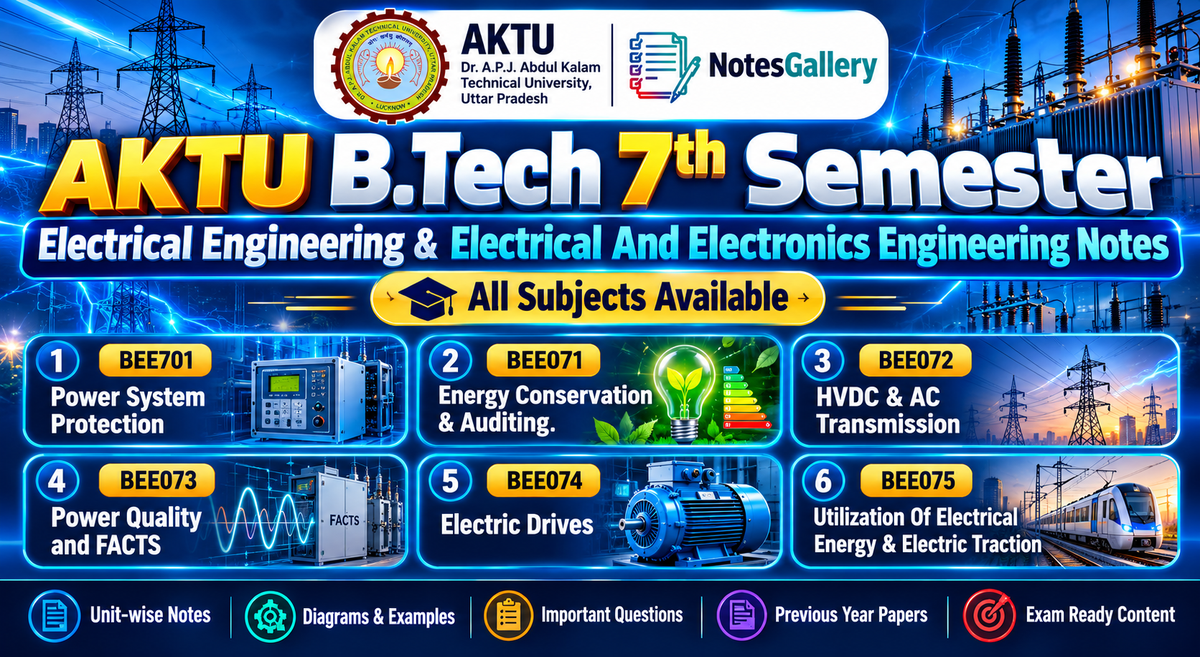
Based on the provided subject list, the 7th semester includes Power System Protection (BEE701) along with Departmental Elective-IV options covering energy conservation, HVDC and AC transmission, power quality, FACTS, electric drives, and electrical-energy utilisation.
Students looking for AKTU B.Tech 7th Semester EE and EEE Notes can use this page as a subject-wise study guide and combine these notes with the prescribed syllabus and previous-year question papers for better preparation.
Students can also explore AKTU notes, PYQs, syllabus resources, and other academic materials through NotesGallery. For official university notices, examination updates, circulars, and authoritative academic information, students should refer to the AKTU Official Website.
Download Electrical Engineering & Electrical and Electronics Engineering All Subjects Notes
Note:
PDF 1 ≠ Unit 1. Each collection may contain complete,
unit-wise, part-wise, or mixed notes.
Energy Conservation & Auditing
| Multiple Notes Resources | Download Links |
|---|---|
| Collection 1 |
HVDC & AC Transmission
| Multiple Notes Resources | Download Links |
|---|---|
| Collection 1 |
Power Quality and FACTS
| Multiple Notes Resources | Download Links |
|---|---|
| Collection 1: Quantum |
Electric Drives
| Multiple Notes Resources | Download Links |
|---|---|
| Collection 1: Quantum | |
| Collection 2 | |
| Collection 3 | |
| Collection 4 | |
| Collection 5 | |
| Collection 6 | |
| Collection 7: Handwritten |
Utilization Of Electrical Energy & Electric Traction
Power System Protection
AKTU B.Tech 7th Semester EE and EEE Subjects
Based on the provided subject list, the subjects are:
| Subject Code | Subject Name | Category |
|---|---|---|
| BEE701 | Power System Protection | Main Subject |
| BEE071 | Energy Conservation & Auditing | Departmental Elective-IV |
| BEE072 | HVDC & AC Transmission | Departmental Elective-IV |
| BEE073 | Power Quality and FACTS | Departmental Elective-IV |
| BEE074 | Electric Drives | Departmental Elective-IV |
| BEE075 | Utilization Of Electrical Energy & Electric Traction | Departmental Elective-IV |
Students should study the Departmental Elective-IV subject allotted or selected according to their college and applicable curriculum.
BEE701 Power System Protection Notes
Power System Protection is an important subject that deals with detecting abnormal conditions in electrical power systems and isolating faulty sections so that the remaining system can continue operating safely.
Power systems include:
- generators
- transformers
- transmission lines
- distribution systems
- motors
- substations
Protection is required because faults can damage expensive equipment and interrupt electricity supply.
Meaning of Power System Protection
Power System Protection refers to the use of protective devices and schemes to detect electrical faults and disconnect the affected part of the system as quickly and selectively as possible.
A simple protection sequence is:
Fault Occurs → Relay Detects Fault → Circuit Breaker Operates → Faulty Section Isolated
Objectives of Power System Protection
Important objectives include:
- protecting equipment
- protecting personnel
- reducing fault damage
- maintaining system stability
- isolating only the faulty section
- improving reliability
- reducing interruption time
Characteristics of a Good Protection System
A good protection system should generally provide:
- reliability
- selectivity
- sensitivity
- speed
- stability
- simplicity
Reliability
Reliability means the protection system should operate correctly when required.
Selectivity
Selectivity means only the faulted section should be disconnected while healthy sections remain in service.
Sensitivity
Sensitivity refers to the ability of the protective system to detect faults of sufficiently low magnitude within its intended protection zone.
Speed
Faults should be cleared rapidly to minimise:
- equipment damage
- system disturbance
- safety risk
Electrical Faults
A fault is an abnormal electrical condition that may cause excessive current or abnormal voltage.
Broad fault categories may include:
- symmetrical faults
- unsymmetrical faults
Symmetrical Fault
A symmetrical fault affects all three phases in a balanced manner.
Although less common, it can produce very high fault currents.
Unsymmetrical Fault
Unsymmetrical faults may involve:
- single line-to-ground fault
- line-to-line fault
- double line-to-ground fault
These faults are common in practical systems.
Protective Relay
A Protective Relay monitors electrical quantities and sends a trip signal when it detects an abnormal condition.
Relays may respond to quantities such as:
- current
- voltage
- impedance
- frequency
Circuit Breaker
A Circuit Breaker is a switching device capable of interrupting fault current.
A protection arrangement commonly works as:
Instrument Transformer → Relay → Trip Circuit → Circuit Breaker
Overcurrent Protection
Overcurrent protection operates when current exceeds a predefined level.
It is commonly used in:
- distribution systems
- feeders
- backup protection
Differential Protection
Differential Protection compares electrical quantities entering and leaving a protected zone.
Under normal operation, the difference should be small.
A significant difference may indicate an internal fault.
Applications may include:
- transformers
- generators
- busbars
Distance Protection
Distance Protection estimates the electrical impedance between the relay location and the fault.
Since impedance depends on line length, this method is commonly used for transmission-line protection.
Transformer Protection
Transformers may require protection against:
- internal faults
- external faults
- overheating
- abnormal operating conditions
Protection methods may include differential and overcurrent schemes depending on the application.
Generator Protection
Generators are valuable power-system components.
They may require protection against:
- stator faults
- rotor faults
- overload
- abnormal voltage
- frequency-related conditions
Transmission Line Protection
Transmission lines may be protected using:
- overcurrent schemes
- distance protection
- differential schemes
depending on voltage level and system requirements.
Busbar Protection
Busbars connect multiple circuits in substations.
Busbar faults can affect large parts of the power system, so high-speed protection is important.
Primary and Backup Protection
Primary Protection is the main protection designed for a particular equipment or zone.
Backup Protection operates if the primary protection or associated equipment fails.
Importance of Power System Protection
Power System Protection is essential for:
- system safety
- continuity of supply
- equipment protection
- reliable grid operation
- minimising fault consequences
BEE071 Energy Conservation & Auditing Notes
Energy Conservation & Auditing focuses on efficient utilisation of energy and systematic evaluation of energy consumption in industries, buildings, and electrical systems.
The subject helps students understand how energy losses can be identified and reduced.
Meaning of Energy Conservation
Energy Conservation means reducing unnecessary energy consumption while maintaining required performance.
It may involve:
- efficient equipment
- improved operating practices
- better maintenance
- reduction of losses
- energy management
Need for Energy Conservation
Energy conservation can help:
- reduce operating cost
- reduce energy demand
- improve efficiency
- reduce environmental impact
- conserve energy resources
Energy Efficiency
Energy efficiency means obtaining the required output while using less energy.
For example, a more efficient motor may provide the same mechanical output with lower electrical losses.
Energy Management
Energy Management is the systematic planning, monitoring, and control of energy consumption.
It may involve:
- measurement
- target setting
- performance monitoring
- conservation measures
Energy Audit
An Energy Audit is a systematic examination of energy use in a facility or system.
Its purpose is to identify:
- where energy is consumed
- where energy is wasted
- possible energy-saving opportunities
Objectives of Energy Audit
Important objectives include:
- analysing energy consumption
- identifying losses
- estimating saving potential
- recommending improvements
- reducing energy cost
Energy Audit Process
A general process may include:
- Collect energy data
- Inspect the facility
- Identify major energy-consuming systems
- Measure performance
- Identify losses
- Recommend conservation measures
- Evaluate savings
Preliminary Energy Audit
A preliminary audit provides an initial overview of energy consumption and major opportunities.
It is usually less detailed.
Detailed Energy Audit
A detailed audit involves:
- extensive measurements
- detailed analysis
- technical evaluation
- economic evaluation
Energy Accounting
Energy accounting tracks how much energy is used by different:
- departments
- equipment
- processes
It helps identify inefficient areas.
Energy Conservation in Electrical Systems
Energy savings may be achieved through improvements in:
- motors
- transformers
- lighting
- power factor
- electrical distribution
Power Factor Improvement
Poor power factor can increase current and electrical losses.
Power-factor correction can help improve system efficiency.
Efficient Motors
Energy-efficient motors may help reduce electrical losses in industrial applications.
Motor selection should consider:
- load
- efficiency
- operating duration
Energy-Efficient Lighting
Lighting-energy consumption can be reduced through:
- efficient lamps
- proper lighting design
- automatic controls
- natural-light utilisation
Economic Evaluation of Energy Conservation
Energy-saving projects may be evaluated using concepts such as:
- investment cost
- annual savings
- payback period
A simple relationship is:
Payback Period = Initial Investment / Annual Savings
Importance of Energy Auditing
Energy audits help industries and organisations:
- reduce cost
- improve efficiency
- identify waste
- support sustainability
- improve energy management
BEE072 HVDC & AC Transmission Notes
HVDC & AC Transmission focuses on high-voltage electrical power transmission using both alternating-current and direct-current systems.
Power transmission is necessary because generating stations and major load centres are often separated by large distances.
Meaning of AC Transmission
AC Transmission transmits electrical power using alternating current.
It is widely used because voltage levels can be conveniently transformed using transformers.
Meaning of HVDC Transmission
HVDC stands for High Voltage Direct Current.
HVDC transmission transfers large amounts of electrical power using high-voltage direct current.
A basic HVDC system may be represented as:
AC System → Converter → DC Transmission Line → Converter → AC System
Need for High-Voltage Transmission
For a given transmitted power, using a higher voltage allows lower current.
Lower current helps reduce:
- conductor losses
- voltage drop
Components of HVDC System
Major components may include:
- converter station
- converter transformer
- valves
- smoothing reactor
- DC transmission line
- filters
- control system
Converter Station
Converter stations perform conversion between:
- AC and DC
at the two ends of an HVDC link.
Rectifier Operation
At the sending end, AC power may be converted into DC.
AC → DC
Inverter Operation
At the receiving end, DC power is converted back into AC.
DC → AC
Advantages of HVDC Transmission
Potential advantages include:
- suitable for long-distance bulk power transfer
- useful for long submarine or underground cables
- controllable power flow
- ability to interconnect asynchronous AC systems
Limitations of HVDC
Possible limitations include:
- expensive converter stations
- complex controls
- filtering requirements
- converter-related losses
AC vs HVDC Transmission
| AC Transmission | HVDC Transmission |
|---|---|
| Uses alternating current | Uses direct current |
| Transformers enable easy voltage conversion | Requires converter stations |
| Widely used in interconnected networks | Attractive for selected long-distance links |
| Reactive-power effects are important | No AC line reactive-power flow on DC link |
| Lower converter complexity | Higher terminal complexity |
HVAC Transmission
High Voltage AC transmission remains widely used for bulk electrical-power transfer.
Important issues may include:
- line parameters
- voltage regulation
- reactive power
- stability
Transmission Line Parameters
Important parameters include:
- resistance
- inductance
- capacitance
- conductance
These influence transmission-line performance.
Corona
At very high voltages, ionisation of air around conductors may result in Corona.
Corona may cause:
- power loss
- noise
- interference
Reactive Power
Reactive power plays an important role in AC transmission.
It influences:
- voltage
- line loading
- system performance
Transmission Efficiency
Transmission efficiency relates the receiving-end power to sending-end power.
Higher efficiency means lower transmission losses.
Applications of HVDC
HVDC may be used for:
- long-distance transmission
- underwater cable links
- interconnection of asynchronous systems
- transfer of large blocks of power
BEE073 Power Quality and FACTS Notes
Power Quality and FACTS focuses on maintaining acceptable electrical voltage and current characteristics and using modern power-electronic controllers to improve transmission-system performance.
FACTS stands for:
Flexible AC Transmission Systems
Meaning of Power Quality
Power Quality refers to the characteristics of electrical supply that allow equipment to operate correctly and reliably.
Power-quality problems may involve:
- voltage variation
- harmonics
- interruptions
- flicker
- transients
Voltage Sag
A Voltage Sag is a temporary reduction in RMS voltage.
It may occur due to:
- faults
- motor starting
- heavy loads
Voltage Swell
A Voltage Swell is a temporary increase in RMS voltage.
Voltage Interruption
An interruption occurs when supply voltage is lost or becomes very low for a period.
Harmonics
Harmonics are voltage or current components at integer multiples of the fundamental frequency.
They may be produced by nonlinear loads.
Examples of nonlinear loads include:
- power-electronic converters
- variable-speed drives
- electronic equipment
Effects of Harmonics
Harmonics may cause:
- heating
- equipment malfunction
- power loss
- waveform distortion
Power Quality Improvement
Power-quality improvement may involve:
- filters
- compensation devices
- proper grounding
- improved equipment design
Meaning of FACTS
Flexible AC Transmission Systems (FACTS) use power-electronic controllers to improve control and performance of AC transmission systems.
FACTS can help control:
- voltage
- impedance
- power flow
- reactive power
Need for FACTS
FACTS devices may help:
- improve transmission capability
- improve voltage profile
- control power flow
- enhance system stability
- provide reactive-power support
Types of FACTS Controllers
Depending on the syllabus, students may study controllers such as:
- SVC
- STATCOM
- TCSC
- UPFC
Static VAR Compensator
SVC provides controllable reactive-power compensation.
It can help improve voltage regulation.
STATCOM
STATCOM is a power-electronic compensator used for reactive-power and voltage support.
TCSC
Thyristor Controlled Series Compensation modifies effective transmission-line series reactance.
This can help control power flow.
UPFC
Unified Power Flow Controller can provide flexible control of important transmission-system variables.
FACTS Applications
FACTS technology may be used for:
- voltage regulation
- reactive-power control
- power-flow control
- system-stability improvement
Power Quality vs FACTS
| Power Quality | FACTS |
|---|---|
| Focuses on quality of voltage and current | Focuses on controllability of AC transmission |
| Includes harmonics, sag, swell, interruption | Uses power-electronic transmission controllers |
| Important for equipment operation | Important for system performance and power flow |
BEE074 Electric Drives Notes
Electric Drives focuses on systems used to control the motion of electrically powered machines.
An electric drive generally combines:
- electric motor
- power converter
- controller
- mechanical load
Meaning of Electric Drive
An Electric Drive is a system that uses an electric motor and associated control equipment to provide controlled mechanical motion.
A basic arrangement is:
Electrical Supply → Power Converter → Motor → Mechanical Load
Components of Electric Drive
Major components include:
- power source
- power modulator or converter
- motor
- controller
- sensing system
- mechanical load
Advantages of Electric Drives
Potential advantages include:
- accurate control
- high efficiency
- clean operation
- easy automation
- flexible speed control
- regenerative operation in suitable systems
Types of Electric Drives
Electric drives may be classified based on:
- type of motor
- number of motors
- control method
Broad motor categories include:
- DC drives
- induction-motor drives
- synchronous-motor drives
DC Motor Drives
DC motors traditionally provide convenient speed control.
Speed can be influenced through control of:
- armature voltage
- field flux
depending on motor type and operating region.
Induction Motor Drives
Induction motors are widely used because they are:
- robust
- reliable
- relatively simple
Modern power electronics allow efficient speed control.
Synchronous Motor Drives
Synchronous motors may be used in applications requiring:
- controlled speed
- high efficiency
- specific performance characteristics
Speed Control
Drive systems regulate motor speed according to application requirements.
Speed control can improve:
- productivity
- energy efficiency
- process control
Braking of Electric Motors
Electric drives may use braking methods such as:
- regenerative braking
- dynamic braking
- plugging
Regenerative Braking
In regenerative braking, the motor operates as a generator under suitable conditions and returns energy to the source or storage system.
Dynamic Braking
Dynamic braking dissipates generated electrical energy in a resistor or other load.
Plugging
Plugging creates braking torque by changing electrical connections or phase relationships according to the motor type.
Four-Quadrant Operation
Drive systems may operate in combinations of:
- forward motoring
- forward braking
- reverse motoring
- reverse braking
This is referred to as four-quadrant operation.
Selection of Electric Motor
Motor selection may depend on:
- load characteristics
- speed range
- starting torque
- braking requirement
- environment
- efficiency
Applications of Electric Drives
Electric drives are used in:
- pumps
- fans
- cranes
- elevators
- conveyors
- rolling mills
- electric vehicles
- machine tools
BEE075 Utilization Of Electrical Energy & Electric Traction Notes
Utilization Of Electrical Energy & Electric Traction focuses on practical applications of electrical energy and the use of electrical systems for transportation.
Electrical energy can be used for:
- heating
- lighting
- welding
- industrial processes
- traction
Meaning of Electrical Energy Utilization
Electrical energy utilisation deals with the efficient use of electricity for useful applications.
The subject may include areas such as:
- electric heating
- electric welding
- illumination
- electric traction
Electric Heating
Electric heating converts electrical energy into heat.
Applications may include:
- industrial furnaces
- domestic heating
- material processing
Advantages of Electric Heating
Potential advantages include:
- clean operation
- accurate temperature control
- high efficiency at point of use
- easy automation
Resistance Heating
Resistance heating is based on heat generated when electric current flows through resistance.
A basic relationship is:
Heat Energy ∝ I²R × Time
Induction Heating
Induction heating uses electromagnetic induction to generate heat in conductive materials.
It is useful in:
- metal heating
- heat treatment
- industrial processes
Dielectric Heating
Dielectric heating uses alternating electric fields to heat insulating materials under suitable conditions.
Electric Welding
Electric welding uses electrical energy to create the heat required to join materials.
Broad methods may include:
- resistance welding
- arc welding
Arc Welding
Arc welding uses an electric arc to produce intense heat for joining metals.
Resistance Welding
Resistance welding produces heat because of electrical resistance at the contact region.
Illumination Engineering
Illumination Engineering deals with producing and using light efficiently.
Important concepts may include:
- luminous flux
- illumination
- luminous intensity
- lighting efficiency
Good Lighting System
A good lighting system should provide:
- adequate illumination
- low glare
- suitable uniformity
- efficient energy use
- visual comfort
Electric Traction
Electric Traction refers to the use of electrical power for transportation.
Applications include:
- electric trains
- metro systems
- trams
- electric locomotives
Advantages of Electric Traction
Potential advantages include:
- high starting torque
- rapid acceleration
- regenerative braking
- reduced local emissions
- suitable for frequent-stop services
Traction System
An electric-traction system may include:
- power supply
- traction motors
- control equipment
- current-collection system
- braking system
Traction Motors
Traction motors should generally provide characteristics suitable for:
- starting
- acceleration
- variable-speed operation
- frequent load changes
Speed-Time Curve
A speed-time curve represents how vehicle speed varies during a journey.
It may include stages such as:
- acceleration
- free running
- coasting
- braking
Electric Braking in Traction
Electric braking may help:
- reduce mechanical brake wear
- improve control
- recover energy through regenerative braking where applicable
Regenerative Braking in Electric Traction
During regenerative braking:
Vehicle Kinetic Energy → Traction Motor as Generator → Electrical Energy
The recovered energy may be returned to the electrical system where the traction network permits.
Applications of Electric Traction
Electric traction is widely used in:
- metros
- suburban railways
- high-capacity urban transport
- electric locomotives
Importance of EE and EEE Notes for AKTU Students
Well-organised EE and EEE Notes can help students:
- understand advanced electrical concepts
- prepare unit-wise topics
- revise important formulas
- practise technical diagrams
- prepare numerical questions
- improve conceptual understanding
- prepare for university examinations
The seventh semester includes subjects closely connected with modern electrical-power infrastructure, industrial energy systems, and transportation technology.
How to Prepare AKTU B.Tech 7th Semester EE and EEE Notes
Step 1: Start With the Prescribed Syllabus
Divide every subject into:
- units
- theoretical topics
- numerical topics
- diagrams
- applications
Step 2: Prepare Unit-Wise Notes
Complete one unit at a time and create concise notes containing:
- definitions
- formulas
- working principles
- advantages
- limitations
- applications
Step 3: Practise Important Diagrams
Important diagrams may include:
- relay protection schemes
- HVDC transmission system
- FACTS controllers
- electric-drive block diagrams
- traction systems
Step 4: Prepare Comparison Tables
Comparison-based revision can help with topics such as:
- AC vs HVDC transmission
- primary vs backup protection
- SVC vs STATCOM
- different motor drives
- different heating methods
Step 5: Practise Numerical Problems
Where applicable, practise questions involving:
- transmission performance
- energy conservation
- drives
- traction
- protection calculations
Step 6: Understand Practical Applications
Connect theoretical concepts with practical electrical systems.
For example:
- protection in substations
- HVDC in long-distance transmission
- FACTS in transmission control
- drives in industries
- traction in metro systems
Step 7: Solve Previous-Year Questions
PYQs can help students understand:
- question pattern
- important concepts
- answer depth
- numerical style
Students should still prepare the complete prescribed syllabus rather than depending only on previous-year questions.
Quick Revision Strategy for EE and EEE Notes
Power System Protection
Revise:
- faults
- relays
- circuit breakers
- overcurrent protection
- differential protection
- distance protection
- equipment protection
Energy Conservation & Auditing
Revise:
- energy conservation
- energy efficiency
- energy audit
- energy management
- electrical-system savings
- economic evaluation
HVDC & AC Transmission
Revise:
- AC transmission
- HVDC system
- converters
- transmission-line parameters
- advantages of HVDC
- AC vs HVDC
Power Quality and FACTS
Revise:
- voltage sag
- swell
- harmonics
- power quality
- FACTS
- SVC
- STATCOM
- TCSC
- UPFC
Electric Drives
Revise:
- drive components
- motor selection
- DC drives
- induction-motor drives
- braking
- four-quadrant operation
Utilization Of Electrical Energy & Electric Traction
Revise:
- electric heating
- electric welding
- illumination
- traction motors
- speed-time curve
- electric braking
- regenerative braking
Why Use NotesGallery for EE and EEE Notes?
Students looking for AKTU B.Tech 7th Semester EE and EEE Notes can explore academic resources on NotesGallery.
NotesGallery can help students find:
- AKTU B.Tech Notes
- semester-wise study material
- subject-wise notes
- previous-year question papers
- syllabus resources
- exam-preparation content
Using organised subject-wise resources can make semester preparation more efficient.
Useful Resources for AKTU B.Tech EE and EEE Students
Students can explore AKTU B.Tech 7th Semester EE and EEE Notes and other academic materials through NotesGallery.
For official university notices, examination announcements, academic circulars, and authoritative information, students should refer to the AKTU Official Website.
NotesGallery is an independent educational resource platform and should not be considered the official website of Dr. A.P.J. Abdul Kalam Technical University.
For official examination notices and syllabus updates, visit the AKTU official website.
Frequently Asked Questions
What are AKTU B.Tech 7th Semester EE and EEE Notes?
These are subject-wise study materials for Electrical Engineering and related EEE students that can help with conceptual learning, revision, internal assessments, and AKTU semester examinations.
Which subjects are shown for AKTU B.Tech 7th Semester EE and EEE?
Based on the provided subject list, the subjects are Power System Protection (BEE701) along with the Departmental Elective-IV options Energy Conservation & Auditing (BEE071), HVDC & AC Transmission (BEE072), Power Quality and FACTS (BEE073), Electric Drives (BEE074), and Utilization Of Electrical Energy & Electric Traction (BEE075).
What is the subject code of Power System Protection?
The provided subject code for Power System Protection is BEE701.
What is the subject code of Energy Conservation & Auditing?
The provided subject code for Energy Conservation & Auditing is BEE071.
What is the subject code of HVDC & AC Transmission?
The provided subject code for HVDC & AC Transmission is BEE072.
What is the subject code of Power Quality and FACTS?
The provided subject code for Power Quality and FACTS is BEE073.
What is the subject code of Electric Drives?
The provided subject code for Electric Drives is BEE074.
What is the subject code of Utilization Of Electrical Energy & Electric Traction?
The provided subject code for Utilization Of Electrical Energy & Electric Traction is BEE075.
Where can I find AKTU B.Tech 7th Semester EE and EEE Notes?
Students can explore subject-wise AKTU notes and related academic resources through NotesGallery.
How should I prepare EE and EEE subjects for the AKTU 7th Semester examination?
Start with the prescribed syllabus, study each subject unit-wise, prepare short revision notes, practise important diagrams and numerical problems, understand practical applications, and solve previous-year questions after completing each major topic.