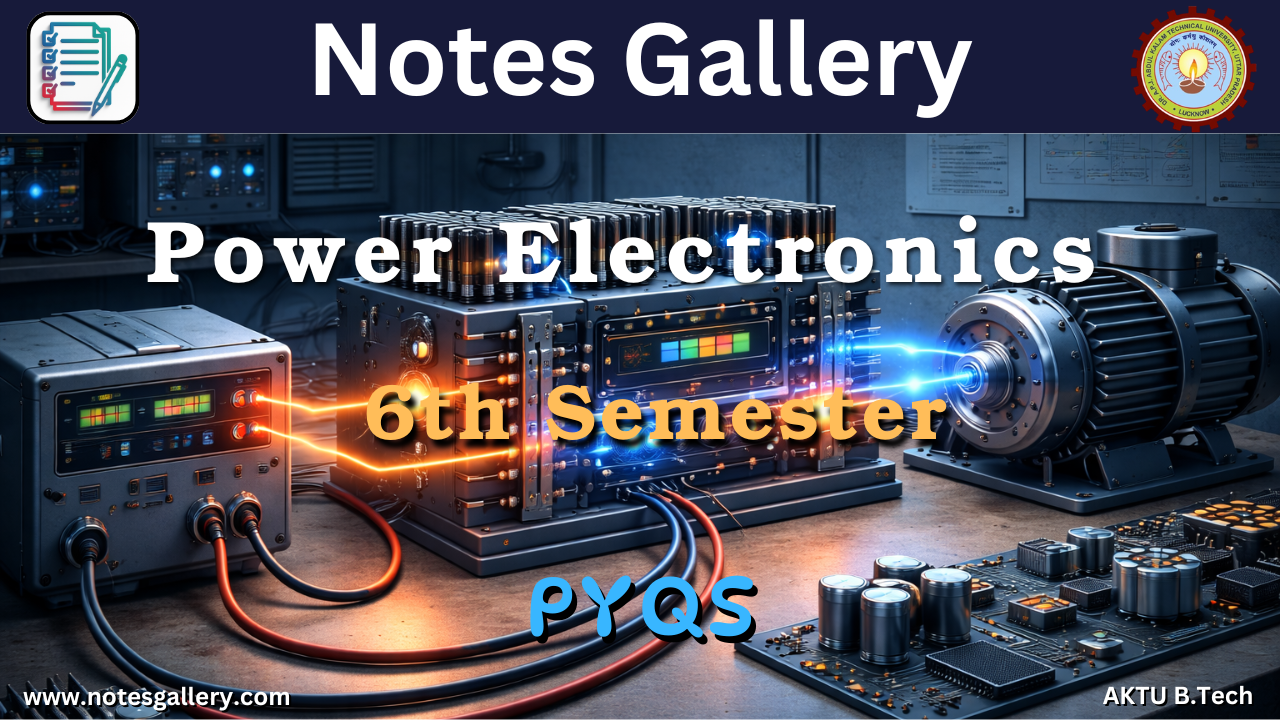
If you are preparing for AKTU semester exams and searching for EEE/EE 3rd Year PYQs (Power Electronics), then you are already following the right strategy. Power Electronics is one of the most important core subjects in EEE/EE 3rd year, and it carries significant weightage in the final examination. Every year, several questions are repeated either directly or conceptually. That is why practicing EEE/EE 3rd Year PYQs (Power Electronics) can dramatically improve your exam performance and confidence level.
At www.notesgallery.com, we provide organized, year-wise PYQs along with Notes, Quantum PDFs, Important Questions, and syllabus-based study materials for AKTU students. Our aim is to make exam preparation simple, focused, and result-oriented.
Download EEE/EE 3rd Year PYQs (Power Electronics)
| Year | Download Links |
|---|---|
| 2016-17 | DOWNLOAD |
| 2017-18 | NA |
| 2018-19 | NA |
| 2019-20 | NA |
| 2020-21 | NA |
| 2021-22 | NA |
| 2022-23 | DOWNLOAD |
| 2023-24 | NA |
| 2024-25 | DOWNLOAD |
| 2025-26 | coming soon… |
RELATED PYQs + Open Elective PYQs
Why EEE/EE 3rd Year PYQs (Power Electronics) Are Essential for High Scores
Power Electronics is a numerical and theory-based subject that focuses on semiconductor devices and power conversion techniques. By practicing EEE/EE 3rd Year PYQs (Power Electronics), students can:
- Identify repeated numerical problems
- Understand common derivations
- Focus on high-weightage units
- Improve speed in solving circuit-based questions
- Learn presentation format for long answers
In the AKTU marking scheme (30 internal + 70 external), the external paper includes long numerical problems and theoretical explanations from standard topics. Students who consistently solve EEE/EE 3rd Year PYQs (Power Electronics) often find 40–50% similarity in final exam questions.
Syllabus Overview of Power Electronics
Understanding the syllabus is the first step toward scoring well. The subject generally includes:
1. Power Semiconductor Devices
- SCR (Silicon Controlled Rectifier)
- TRIAC and DIAC
- UJT
- MOSFET and IGBT
- Switching Characteristics
Questions related to SCR operation and characteristics are frequently asked in EEE/EE 3rd Year PYQs (Power Electronics).
2. Phase-Controlled Rectifiers
- Single Phase Half Wave and Full Wave Rectifiers
- Three Phase Rectifiers
- Performance Parameters
- Effect of Source Inductance
Numerical problems from rectifiers are very common and carry high marks.
3. DC-DC Converters (Choppers)
- Step-up and Step-down Choppers
- Control Techniques
- Applications
Chopper circuit diagrams and output voltage calculations are repeated topics.
4. DC-AC Converters (Inverters)
- Single Phase Inverter
- Three Phase Inverter
- PWM Techniques
Inverter waveform analysis and working principle questions are frequently asked.
5. AC Voltage Controllers and Cycloconverters
- Operation and Applications
- Performance Analysis
Smart Strategy to Use EEE/EE 3rd Year PYQs (Power Electronics)
Downloading question papers is just the first step. To maximize benefits, follow this approach:
Step 1: Analyze 5–7 Years of Papers
Go through multiple years of EEE/EE 3rd Year PYQs (Power Electronics) and mark frequently asked questions.
Step 2: Focus on Numericals
Practice rectifier, chopper, and inverter numericals daily to improve speed and accuracy.
Step 3: Memorize Important Derivations
Derivations related to average output voltage and RMS values are often repeated.
Step 4: Practice Waveform Diagrams
Draw waveforms clearly and neatly. Proper labeling can fetch full marks.
Step 5: Attempt Full-Length Mock Papers
Solve at least two complete previous year papers within 3 hours before the exam.
Students who follow this structured method while practicing EEE/EE 3rd Year PYQs (Power Electronics) usually perform much better in exams.
Internal and External Exam Preparation Tips
Internal Exam (30 Marks)
- Prepare short notes on semiconductor devices
- Revise device characteristics
- Practice viva questions related to SCR and MOSFET
External Exam (70 Marks)
- Attempt numerical questions carefully
- Show all calculation steps
- Draw neat circuit diagrams
- Write proper assumptions and formulas
Good presentation plays a major role in scoring higher marks in Power Electronics.
Frequently Repeated Topics in Power Electronics
Based on trend analysis of previous papers, the following topics are repeatedly asked:
- SCR Construction and Working
- Two-Transistor Model of SCR
- Single Phase Fully Controlled Rectifier
- Step-Up and Step-Down Chopper
- Single Phase Bridge Inverter
- PWM Techniques
- Comparison of MOSFET and IGBT
Solving EEE/EE 3rd Year PYQs (Power Electronics) makes these patterns clear and predictable.
Why Choose www.notesgallery.com for EEE 3rd Year Resources?
At www.notesgallery.com, we focus on helping AKTU students score better by providing:
- Organized Year-wise PYQs
- Updated Quantum PDFs
- Handwritten and Typed Notes
- Important Question Banks
- Semester-wise Study Resources
Instead of searching across multiple websites, students can access everything in one place. Our content is structured to reduce preparation time and increase efficiency.
Conclusion
Power Electronics may seem challenging initially, but with consistent practice and the right resources, it becomes highly scoring. By solving EEE/EE 3rd Year PYQs (Power Electronics), students can understand exam trends, improve numerical accuracy, and build conceptual clarity. Start practicing early, revise important topics regularly, and use reliable resources like www.notesgallery.com to maximize your performance in AKTU exams.