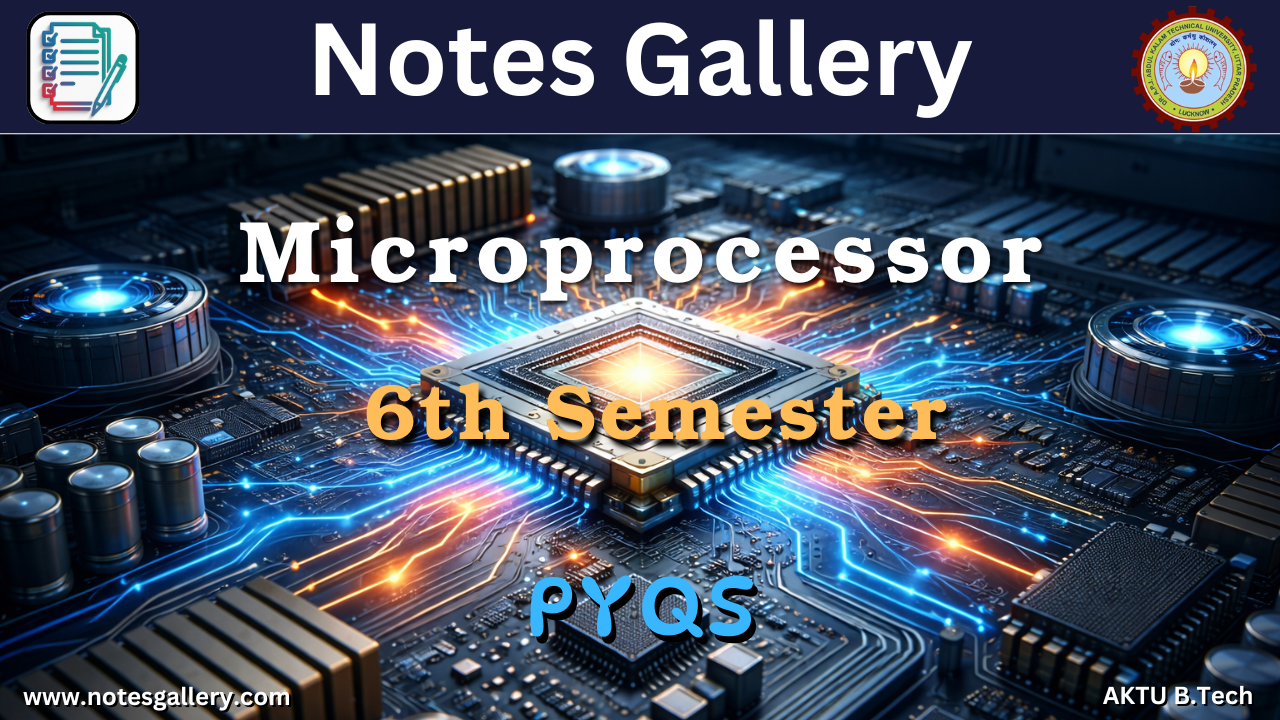
If you are looking for EEE/EE 3rd Year PYQs (Microprocessor), then you are preparing in the smartest way possible. Microprocessor is one of the most important and conceptual subjects in the EEE/EE 3rd year curriculum of AKTU. Every year, a significant number of questions are repeated either directly or with slight modifications. That is why practicing EEE/EE 3rd Year PYQs (Microprocessor) gives students a strong advantage in scoring high marks in the semester examination.
At www.notesgallery.com, we provide structured, year-wise Previous Year Question Papers along with Notes, Quantum PDFs, Important Questions, and updated syllabus resources. Our goal is to help EEE students prepare efficiently without wasting time searching across multiple platforms.
Download EEE/EE 3rd Year PYQs (Microprocessor)
RELATED PYQs + Open Elective PYQs



Why EEE/EE 3rd Year PYQs (Microprocessor) Are Extremely Important
Microprocessor is a subject that combines theory with practical understanding of architecture, instruction sets, and interfacing techniques. By practicing EEE/EE 3rd Year PYQs (Microprocessor), students can:
- Identify repeated architecture-based questions
- Understand important instruction set programs
- Focus on frequently asked numerical problems
- Analyze long-answer theoretical patterns
- Improve programming logic for assembly language
In AKTU’s 30-70 marking scheme, the external paper carries 70 marks, and most long questions are framed from core and repetitive topics. Students who thoroughly solve EEE/EE 3rd Year PYQs (Microprocessor) often find similar question structures in their final exams.
Syllabus Overview of Microprocessor
To score well, you must first understand the subject structure. Microprocessor (commonly based on 8085/8086 architecture in AKTU syllabus) includes the following major units:
1. Introduction to Microprocessor
- Evolution of Microprocessors
- Architecture of 8085
- Functional Block Diagram
- Registers and Flags
Questions from architecture and block diagram explanation are frequently asked in EEE/EE 3rd Year PYQs (Microprocessor).
2. Instruction Set and Programming
- Data Transfer Instructions
- Arithmetic and Logical Instructions
- Branching Instructions
- Assembly Language Programming
Short programs such as addition, subtraction, sorting, and BCD conversion are highly repeated.
3. Interfacing Techniques
- Memory Interfacing
- I/O Interfacing
- Programmable Peripheral Devices
Interfacing numericals and diagrams are commonly asked in long-answer questions.
4. Interrupts and Timing Diagrams
- Types of Interrupts
- Maskable and Non-Maskable Interrupts
- Timing Diagram Analysis
Timing diagrams are very important for scoring full marks in diagram-based questions.
5. Advanced Concepts
- Microcontrollers overview
- Comparison between 8085 and 8086
- Applications in Embedded Systems
Smart Preparation Strategy Using EEE/EE 3rd Year PYQs (Microprocessor)
Simply downloading papers is not enough. You must follow a structured strategy.
Step 1: Unit-Wise Question Analysis
Go through at least 5–6 years of EEE/EE 3rd Year PYQs (Microprocessor) and categorize questions according to units.
Step 2: Mark Repeated Programs
Programs like addition of two numbers, finding largest number, and block transfer are frequently repeated.
Step 3: Practice Diagrams
Block diagrams and timing diagrams should be practiced multiple times for perfect presentation.
Step 4: Time-Based Practice
Solve one full paper in 3 hours under exam conditions. This improves speed and accuracy.
Step 5: Revise Important Theory
Topics like interrupts, instruction cycles, and memory mapping are common 10–14 mark questions.
Students who consistently practice EEE/EE 3rd Year PYQs (Microprocessor) gain confidence in writing structured and logical answers.
Internal and External Exam Strategy
For Internal Exams (30 Marks)
- Focus on short programs
- Revise architecture-based questions
- Prepare viva questions related to registers and flags
For External Exams (70 Marks)
- Attempt programming questions carefully
- Draw neat block diagrams
- Use proper labels in timing diagrams
- Write algorithm before writing assembly program
Many students lose marks due to poor presentation. Writing step-wise explanations and maintaining clarity can increase scores significantly.
Commonly Repeated Topics in Microprocessor
Based on analysis of previous papers, these topics are frequently asked:
- 8085 Architecture Explanation
- Flag Register Details
- Instruction Cycle and Machine Cycle
- Interrupt Structure
- Memory Interfacing Diagram
- Assembly Language Programs
- Timing Diagrams of MOV and MVI Instructions
Solving EEE/EE 3rd Year PYQs (Microprocessor) helps you recognize these patterns easily.
Why Choose www.notesgallery.com for EEE Resources?
At www.notesgallery.com, we are dedicated to helping AKTU students with:
- Year-wise Previous Year Question Papers
- Updated Quantum PDFs
- Handwritten and Typed Notes
- Important Question Banks
- Organized Semester Resources
All materials are structured to reduce your preparation time and increase efficiency. Instead of searching randomly, you can access everything at one place.
Conclusion
Microprocessor is not a difficult subject if prepared with the right approach. By solving EEE/EE 3rd Year PYQs (Microprocessor) regularly, you can understand the exam trend, improve programming skills, and gain confidence before the final examination. Start your preparation early, practice consistently, and use structured resources available at www.notesgallery.com to maximize your score.